



Abstract
Integrating the perspective of smart grid users is the next challenge to be tackled in order to deploy fully the broad technical development of this new generation of electrical grids and improve the efficacy thereof. This is the conclusion reached by the social research developed within the framework of the European UPGRID project. This paper presents the main findings of the Spanish demonstration, working with domestic electricity consumers. The results indicate that these consumers know little about their contract and consumption of electricity, with regard to smart grids. In spite of this, there is some evidence that there is willingness among these consumers to make a change in their energy use towards more environmentally responsible behaviours, a tendency that needs to be developed so that consumers play an active role, which is essential in order to deliver optimal energy supply through smart grids. However, the results must be taken with a degree of caution, since, in spite of the major drive for recruitment, the sample was small and the experimental mortality between phases was high, so the research presented is exploratory in nature.
With smart grids (hereinafter SG), the traditional perspective regarding the distribution of electrical energy — integrated vertically and characterized by one-way energy and communication flow from generators to consumers — is being replaced by a new paradigm of active distribution that could radically change the role of the consumer, who can become at one and the same time producer (‘prosumer’), which could also contribute to a more efficient and environmentally responsible use of energy 1 .
The incorporation of Information and Communication Technologies (ICTs) in SG allows for two-way communication and exchange of information (e.g., real-time consumption) and the remote operation of network equipment, as well as interaction between different stakeholders (grid users and operators, energy suppliers, energy service providers, etc.) enabling consumer-producers to become active agents in the functioning of the grid and in the management of the energy distributed. But for grid users to truly play an active role, as well as providing two-way information in real time (e.g., consumption), users must also be involved from the initial stages of the roll-out of SG so that they can contribute, firstly, to defining this new role and, subsequently, they can take on their role as active participants in the electrical energy system, also contributing to the definition and smooth operation of new energy services (Gangale, Mengolini, & Onyeji, 2013). For this to occur, part of the attention focused up until now on technological issues and economic incentives, aimed mainly at electricity grid operators, must be transferred to users in general and small consumers in particular (Honebein, Cammarano, & Boice, 2011; Verbong, Beemsterboer, & Sengers, 2013).
The first step in integrating consumers would be to ascertain their knowledge and perceptions with regard to these new electricity grids. Studies that examine this issue are only very recent (Devine-Wright & Devine-Wright, 2009; Ngar-yin Mah, Van der Vleuten, Chi-man Ip, & Ronald Hills, 2012; Krishnamurti et al., 2012; among others). They recognize a positive attitude among consumers towards SG technologies. However, they also note the need to tackle enduring erroneous beliefs and concepts with regard to these new technologies (e.g., increase in energy bills, privacy of information, technological complexity, etc.), as well as struggling to achieve trust, transparency and feedback to ensure consumer participation and acceptance.
In this regard, the European Commission, in a communiqué to the European Economic and Social Committee and the Committee of the Regions about SG, recognizes the importance of raising consumer awareness when establishing an energy system that generates lower carbon dioxide emissions in order to contribute effectively to the Europe Strategy 2020 in favour of intelligent, sustainable and integrating growth (European Commission, 2011). However, to do this, SG must allow consumers to control and manage their individual energy usage, so they ‘must have real-time access to their exact energy consumption’. Furthermore, the Council of European Energy Regulators (CEER) and the European Consumer Organisation (BEUC), in their working document ‘Vision 2020 for the energy consumers of Europe’ (CEER, 2012), state that smaller consumers should be considered first and foremost, recognizing the lack of attention received by consumers in the current European energy market. This is in spite of the fact that, for example, in Spain, 20% of electrical energy is consumed by homes (IDEA, 2016).
Integrating consumers into SG involves considering and adapting along these lines the developments made in human and social sciences in relation to understanding human behaviour and motivations. The active participation of consumers in technology is influenced by attitude, social norms, perceived behavioural control and personal norms (Huijts, Molin, & Steg, 2012; Venhoeven, Bolderdijk, & Steg, 2013). Attitude in particular can be influenced by important factors such as trust and distributional equity (Steg, 2008). These results recall the psychological models and theories that provide general explanations of human behaviour. These include Azjen’s Planned Action Theory (1991), Schwartz’s Norm Activation Model (1977) and the Value-Belief-Norm Theory of Stern, Dietz, Abel, Guagnano, & Kalof (1999). With regard to the specific behaviour of electricity consumption or related to smart energy grids, no similar models have been found, but of particular note is the social research developed by Pedroso-Lima et al. from the ISCTE Research and Social Intervention Centre (Instituto Universitario de Lisboa) within the framework of the Evora InovCity project (Pedroso de Lima, Batel, Moreira, & Fonseca, 2011).
The previous models involve accepting the difficulty of changing behaviours and assimilating the understanding and protection of the consumer as future challenges (Giordano et al., 2013). In this respect, the most effective and successful strategies to inform and involve consumers in energy conservation include social marketing approaches. They are personalized and provide information that adapts to the needs and desires of specific consumer profiles, to which end sociological segmentation is useful (Salas-Prat, Carrasco, Zelco, Solé, & Segura, 2014), as are strategies that provide information about the behaviour of others (Steg, 2008), generating value for the consumer, developing new business opportunities or making energy savings through a change in behaviour.
In order to further our understanding of the active role played by consumers in smart energy grids in Spain, a social research project was conducted as part of the European project UPGRID (‘Real proven solutions to enable active demand and distributed generation flexible integration, through a fully controllable LOW Voltage and medium voltage distribution grid’) 2 . UPGRID is a European H2020 project about SG launched in early 2015 and which concluded in December 2017. It was headed up by Iberdrola Distribución Eléctrica, and it was developed through the experience of a consortium made up of 19 partners from seven European countries (Spain, Portugal, Sweden, Poland, the UK, France and Norway). UPGRID aims to promote the development and implementation of real proven solutions to enable the flexible integration of active demand and distributed generation through fully controllable low-voltage and medium-voltage distribution grids (González Bordagaray & Bachiller Prieto, 2017). It is characterized by a highly practical component, working through four major demonstrations in Bilbao (Spain), Lisbon (Portugal), Åmål (Sweden) and Gdynia (Poland).
This paper presents some of the main findings of this social research project (Gonçalves, Patricio, Herranz, & Díez Garpón, 2017; Herranz-Pascual, Díez, & García, 2017), which aimed to ascertain the social impact of deploying smart networks, carried out in the Spanish demonstration of the UPGRID project.
Method
To verify the social impact of deploying SG as part of UPGRID, a longitudinal design was devised based on compiling information from domestic consumers at three points in time: initial contact, and before and after the Spanish demonstration.
Participants
Sociodemographic characterization of the total sample and of the employees and residents (in percentages).
Note: ***p < .001
Of these 146 people, 62% of the sample (NI = 90) were employees of the partners involved in the UPGRID project, together with their relatives and friends living in Bilbao (hereinafter ‘employees’) and 38% (NII = 56) were residents of Bilbao who had attended the meetings organized by associations of residents in Bilbao (hereinafter ‘residents’). The majority of these residents were members of the governing bodies of 10 of the 24 neighbourhood associations present in Bilbao that participate in the umbrella federation. The main differences between these two groups were that the residents were older (χ2 = 36.005; df = 4; p < .001), whereas the employees generally had a higher level of employment (88.9%) (χ2 = 54.736; df = 9; p < .001), and most of them had university and post-graduate studies: 85.5% compared to 45.4% of residents (χ2 = 31.331; df = 4; p < .001). Table 1 sets out the main characteristics of the sample and of these two groups.
In spite of the existence of these two groups and their demographic differences, in this article they are viewed as a single sample because these discrepancies did not turn out to be as relevant as expected 3 , and furthermore, in the longitudinal social research, experimental mortality was very significant (see the Procedure section).
Procedure
As commented previously, to evaluate the social impact of UPGRID, a longitudinal design was applied based on gathering information from domestic consumers at three different moments in time: (1) contact with consumers (phase 1) in the area of the demonstration in order to characterize homes and consumption; (2) establishment of the baseline (PRE phase); and (3) establishment of the situation after the demonstration (POST phase). The social impact of the Spanish demonstration is deduced from the difference between the responses of the participants between the PRE and POST phases.
This next paragraph provides, firstly, a brief description of the Spanish demonstration, before and after the questionnaires were administered. We then focus on the participant recruitment procedures, before finally presenting the moments at which the measurements were taken, and the samples obtained in each of the study phases.
The Spanish demonstration was conducted in the area of Bilbao, in the north of Spain, in the energy grid operated by Iberdrola Distribución. The demonstration area is characterized by 1,075 secondary substations (SS), which supply more than 190,000 consumers. The smart grid and meters had been rolled out previously in this area. The Spanish demonstration of UPGRID was focused mainly on analysing the problems found in the grid and how to solve them. The demonstration reinforced the operation and maintenance of Low Voltage (LV) grids with a view to anticipating technical issues associated with the large-scale integration of distributed generation, including the development of the new LV control system, which enabled substantial improvements to be made in terms of service quality, with a positive impact on the end consumer, and reinforcing the decision to extend its implementation to the entire grid. These improvements are not usually perceived directly by consumers. The only thing they might notice is that there were fewer power cuts, although these were already infrequent in this area. The Spanish demonstration also sought to empower consumers with information, knowledge skills and tools, and so they attended, among other activities, workshops held within the framework of the social research part of the project (see ‘Participant recruitment strategies’). To carry out the social study, domestic consumers were chosen to take part in the Spanish demonstration.
Participant recruitment strategies: to engage the participation of domestic consumers, a wide variety of strategies were used. The main one was to use Bilbao Neighbourhood Associations Federation (FAAVV) as a mediator. This Federation encompasses 24 participant associations and nine observer associations, which represent practically all the residents of this municipality of Bilbao. The process was long and arduous: (1) over the course of 2016 and 2017, various interviews and meetings were held with the president and secretary of the Bilbao FAAVV; (2) this groundwork gave rise to a publication in the newsletter of the Federation, Hiritarrok issue no. 24 (April 2016), presenting the UPGRID project and its social research to the citizens of Bilbao; (3) the technical team from the UPGRID project were invited to attend the Meeting of the Federation Board in September of 2017, to present the work, and the members of the Board took part by completing the questionnaire from contact phase 1; (4). they were also involved in creating information about SG aimed at domestic consumers, to spread knowledge about the subject; (5) consumers were engaged through six workshops each lasting over four hours, which were held between October and November of 2017. In these workshops, as well as presenting the project and compiling information from consumers through questionnaires, information and practical demonstrations were provided about the web services where consumers could obtain information about their electricity usage (webpage of Iberdrola Distribución) and energy behaviour (webpage ‘MiEnergía’ of the Ente Vasco de Energía (EVE)); (6) to boost motivation, another memorandum was drafted for the FAAVV newsletter, announcing that participants in the workshops would receive a weather station, paid for by the Federation.
Because the process to recruit domestic consumers through the Bilbao FAAVV was taking a long time, we decided to open up another channel for participation, engaging residents of Bilbao who worked in the companies taking part in the project (Iberdrola Distribución-Bilbao, ZIV, EVE and TECNALIA), encouraging them to invite their friends and relatives also living in Bilbao to take part.
These strategies also included short informative releases about the social research project, published on the project webpage (upgrid.eu) and on the webpage of EVE (www.eve.eus).
The recruitment strategy in the POST phase was personalized. Hence, the people who had participated in the two previous stages and who had expressed their desire to continue collaborating with the research were invited to complete the questionnaire for this stage by means of a personalized email, which included a direct link to the questionnaire.
Information gathering periods in each of the study phases and level of participation achieved.
As this table shows, in the social research project, experimental mortality was significant. Hence, at the moment of initial contact (phase 1), a total of 146 valid questionnaires were collected. In the PRE phase, 77 participated (53%), and just 36 participated in the POST phase (25%). In other words, the samples obtained in the PRE and POST phases were small, and so the results must be interpreted with caution, on account of their low level of representativeness. Furthermore, many of the participants did not provide us with their email address, which was their ID, and so it was not possible to carry out adequate statistical comparisons to compare the social impact of the demonstration, since we were unable to identify which questionnaires were completed by each participant in the different phases.
Instruments
The main tool used to compile information from consumers (perception, attitudes, behaviours) was the questionnaire developed based on the general psychosocial explanatory models of behaviour cited in the introduction and on the research of Lima et al. (Pedroso de Lima et al., 2011) conducted in Évora about SG. The information was collected directly in the three phases of the study. For each of these phases, a specific questionnaire was designed, which was presented on paper and online.
The PRE and POST questionnaires revolved around the classic elements of general psychosocial explanatory models of behaviour: attitudes and beliefs, expectations, subjective norms and procedural justice, improvements, behavioural intentions and conduct (consumption) in relation to SG.
This article focuses specifically on: Variables that characterize electricity consumption behaviour, such as type of contract, time specific tariffs, contractual power supplied, checking usage levels. Consumer’s degree of knowledge about SG and related issues (six items). The measurement scale contained six points (from 1, ‘none’, to 6, ‘very high’). Consumers’ perspective: the main psychosocial elements of behaviour were included, such as attitude, subjective norm, perceived usefulness and behavioural intention (five items). Furthermore, a 13-item scale was included to measure perceptions of SG, which set out the main advantages of SG. Both scales were measured using a Likert five-point format (1 ‘totally disagree’, vs. 5 ‘totally agree’). Changes in consumer behaviour: consumers were asked to indicate whether in the time that had passed between filling in the PRE and POST questionnaires there had been any changes in the characteristics of their electricity contract, usage consultations or in their own consumer behaviour by means of a dichotomic scale. If there had been any changes, they were asked about the direction of the change (increasing or decreasing).
The questions indicated in the first point were compiled during phase 1. The questions from points 2 and 3 were collected in the PRE and POST phase. And the questions in point 4 were only included in the POST phase, since they were considered to be interesting and they had not been included in the previous phases.
Results
As indicated previously, the high level of experimental mortality between the different phases of the study, together with the impossibility of identifying the majority of participants in the POST phase, prevented us from carrying out adequate statistical comparisons in order to analyse statistically the social impact of the demonstration. Hence, the results presented in this section should be taken with a certain degree of caution.
In the Initial contact phase (phase 1), the participants were found to have little knowledge of issues related to their electricity contract (more than 40% of the participants did not know which tariff they were using), or with the information services available about their consumption and how to improve energy efficiency in the home (75% were unaware of the consumption information system offered by Iberdrola Distribución, and 80% did not know that there was an advice service about energy efficiency offered by EVE’s ‘MiEnergía’ website), or even SGs in themselves, in relation to which only 30% of participants considered they had any information.
This next section compares the results from the PRE and POST phases by means of analysis of variance (ANOVA), estimating the size effect using Cohen’s d. The descriptive results of these analyses, as well as the F values, degrees of freedom, probability and size effects, are given in the Appendix document to this paper.
During the demonstration (between the PRE and POST phases), the information and knowledge held by consumers about SG and related issues improved considerably (Figure 1). The change was in excess of one point on a six-point scale, moving from a low to a medium level of knowledge. The improvement observed in consumers’ knowledge was greater in relation to active demand management (from 2.28 to 3.60; F(1, 100) = 20.61; p < .001), pro-sumers (from 1.75 to 2.93; F(1, 98) = 13.91; p < .001) and distributed generation (from 2.31 to 3.52; F(1, 103) = 15.31; p < .001), issues that are important in the active role required of SG consumers. The effect sizes were strong (Cohen’s d = 0.70 in the case of energy efficiency) or high (> .80 in the others). After the demonstration, 45% of participants had registered with Iberdrola Distribución’s information service about their own consumption, although the use they made of this service was occasional.
Average scores regarding the level of information possessed about different issues related to smart grids (six-point scale).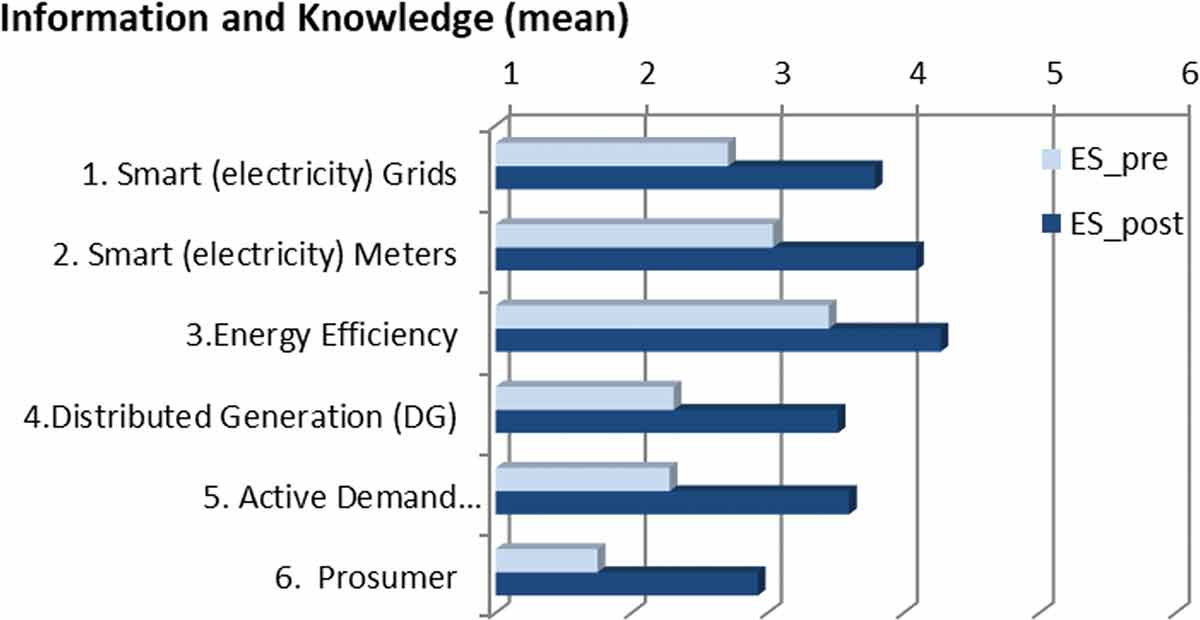
Over the course of the demonstration, the perspective of the consumers changed (Figure 2), and by the end of the project they exhibited a more favourable attitude with regard to smart meters (F(1, 98) = 5.78; p = .018) and SG (F(1, 98) = 59.88; p < .001), with a moderate size effect in the first case (Cohen’s d = 0.55) and very high size effect in the case of smart grids (1.82).
Mean scores for the level of agreement (five-point scale) with the different elements pertaining to consumer perspectives on smart grids.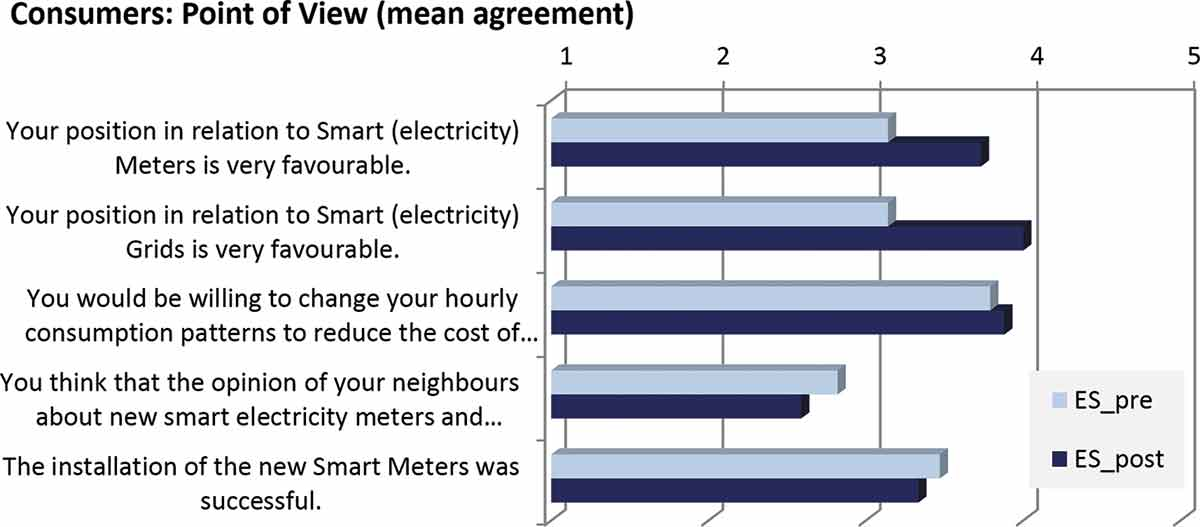
After the demonstration, consumers also expressed a greater awareness of some of the benefits of SG (Figure 3). The greatest increases in perceived benefits were registered in the reduction of SG vulnerability to climate disaster and security attacks (the average increased from 2.9 to 3.5; F(1, 89) = 4.52; p = .036) and the control they exercised over consumption through information about their own energy usage (from 3.5 to 4.0; F(1, 89) = 4.17; p = .044), with moderate to high effect sizes (Cohen’s d = 0.51 and 0.49 respectively).
Mean scores on the level of agreement (five-point scale) regarding the characteristics of smart grids.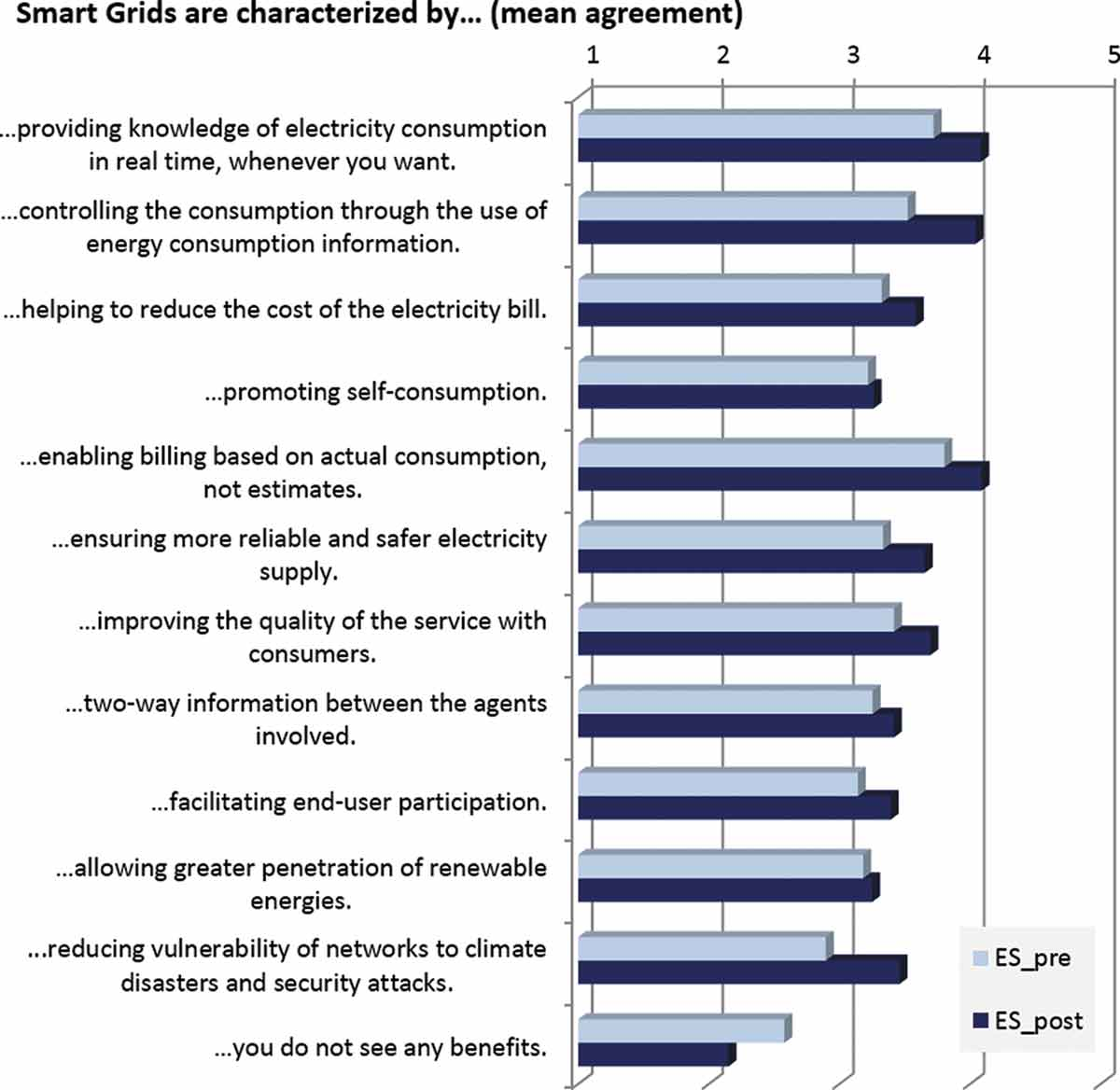
With regard to consumption behaviour, after the demonstration, the consumers stated that they had made positive changes, mainly with regard to how often (38%), how (29%) and who (29%) checks their energy usage levels. These changes indicate that by the end of the demonstration, it was the consumers themselves who checked their consumption (28%), consultations increased (19%), and that they were more aware and more interested in their energy behaviour (31%). Their consumption had also reduced (11%), and their habits had changed (22%), because the participants felt more capable of managing their electricity consumption (67%).
Conclusions and discussion
This section sets out the main conclusions drawn from the social research conducted as part of the Spanish demonstration of the UPGRID project. A series of considerations for future improvements are also offered in the form of lessons learned.
Before presenting the substantive conclusions relative to the social impact of smart energy grids, it should be noted that the authors recognize the limits of this work, derived from the high level of experimental mortality between phases and the impossibility of identifying many of the participants in the POST phase of the study.
Hence, the conclusions set out below must be approached with caution, although the participation of members of the governing boards of 10 of Bilbao’s 24 neighbourhood associations in this work might bestow greater relevance on the results found to move forwards in the active role required of domestic consumers in smart energy grids.
The main substantive conclusion derived from the findings is the lack of knowledge among domestic consumers regarding electrical energy. This lack of knowledge is particularly relevant in terms of the characteristics of their electricity contract, the online information services available from their energy provider and the potential benefits of SG. To improve the information provided to real users in general, and to domestic consumers in particular, and to develop informational, communication and collaborative tools, one suggestion is that information should be provided in such a way that it is easily accessible, clear, straightforward and user-friendly, so that it reaches everyone, paying particularly close attention to generational equity on account of the different levels of experience possessed by different age groups with regard to new technologies. Furthermore, not only should information and communication tools be developed; also, consumers should be informed and educated in order to enable them to take on a more active role as required in order to change the paradigm of energy consumption regarding SG. In accordance with the benefits of these SG, the participants involved need to have the mutual benefits clearly explained and demonstrated (‘win-win’, ‘give to receive’, etc.).
However, even though consumers possess little knowledge, the social research conducted indicated that there could be, or indeed already are, changes taking place in terms of their attitudes and behaviour (positive beliefs in relation to SG and behavioural intentions aimed at achieving energy savings and efficiency), which might enable consumers to transition towards an active role and participation in SG, which is a very important point for the active involvement of consumers in energy efficiency and savings.
Furthermore, in spite of the participants’ difficulty perceiving the changes or benefits of the results of the UPGRID project, positive changes were observed in their knowledge and in the different psychosocial elements of energy consumption behaviour. After the demonstration, there were positive changes, principally in the frequency, the way and the person who checked energy usage levels. In addition, participants felt more aware and capable of managing their own energy usage.
Another relevant conclusion of this paper is the difficulty engaging consumers, requiring major staffing and time investments. Their engagement and participation is key to the success of the complete deployment of SG capacities, and to ensure that consumers can take up the active role they need to perform with these new technologies. Therefore, further work is required to integrate and engage final consumers with energy systems. In this respect, UPGRID has focused on specific strategies closer to the different stakeholders, with the collaboration of their representatives from the associations of which they are members.
Integrating the perspective of SG users complements the broad technical development of this new generation of energy grids, which will make them more effective and efficient.
To increase public collaboration, consumer motivation needs to be boosted through the development of new strategies, and closer links need to be formed with different stakeholder groups, by liaising with their representatives. A good example of this kind of action would be the practical sessions developed with consumers (demonstration and participatory workshops), which were particularly appreciated by the participants in the UPGRID workshops. The workshops could be aimed at increasing understanding of recent technological developments that make the grid smarter, improving the quality of service offered to consumers (improved energy reconnection times following an incident, up-to-date and immediate information, etc.), thus facilitating their active participation in the electricity market. Furthermore, they could also be used to provide training about, for example, electricity tariffs, billing, possible options and activities to save energy in the home, the possibilities of the services offered by energy providers through their websites, etc.
Finally, it is interesting to note that the transition towards users playing an active role is a highly complex process, as indeed is any change, and entails an initial reaction of resistance. Furthermore, in order to effect a change in behaviour, and above all in habits, firstly they must have a favourable attitude towards the object of this change, perceiving the utility and benefits it entails, questions that are not that evident or visible for SG users. In the work presented here, as mentioned previously, there are indications that among domestic consumers this change in attitudes and behaviours might be occurring already, which would enable these stakeholders to make the transition towards an active role and to engage actively in the adequate provision of SG services. To this end, we must know, understand and involve these stakeholders in order to improve the SG of the future.
Footnotes
1.
Acknowledgements
We would like to thank the European Union for the funding it granted the UPGRID project ‘Real proven solutions to enable active demand and distributed generation flexible integration, through a fully controllable LOW Voltage and medium voltage distribution grid’ (H2020 Research and Innovation Programme, subsidy agreement number 646.531), the framework research project for this paper. We would also like to thank the different people and associations who collaborated with and participated in the social research conducted, without whom its development would not have been possible, and especially Iberdrola Distribución and EVE for providing us with the information required to conduct this research, and the Bilbao Federation of Neighbourhood Associations for their support and participation.
Disclosure statement
No potential conflict of interest was reported by the authors.
Supplemental data
The Spanish version of this article is available only as online supplemental material here. ( ). / La versión en castellano de este artículo está disponible únicamente como material suplementario online
aquí
(https://www.tandfonline.com/doi/full/10.1080/21711976.2019.1643661).
). / La versión en castellano de este artículo está disponible únicamente como material suplementario online
aquí
(https://www.tandfonline.com/doi/full/10.1080/21711976.2019.1643661).