




Abstract
Creosote is commonly used as a wood preservative for highway timber bridges in Norway. However, excessive creosote bleeding at various highway timber bridge sites lead to complaints, and a potentially bad reputation for wooden timber bridges. Macro-and micro-anatomical factors such as the amount of heartwood, annual ring width, annual ring orientation, ray-height and composition and resin canal area were investigated in order to classify seven timber bridges in Norway into bleeding- and non-bleeding bridges. A classification into bleeding and non-bleeding was possible for discriminant categories based on three anatomical factors analysed on wood core samples. The amount of heartwood content dominated the influencing factors, even obscuring the significance of other factors. Classification with a low amount of variables was done preferably on sample level instead of bridge level, due to the restricted number of 17 core samples per bridge.
Introduction
Creosote bleeding from timber bridges can have a negative influence on the use of creosote as a wood preservative and on the use of wood in construction more generally. Creosote has been commonly used to protect wood in highway timber bridges in Norway. The first modern timber bridges in the country were built in the mid-1990s. Since then, more than one hundred road and pedestrian bridges have been built (Burkart 2016). In addition to bridges, creosote is also used as a preservative in wooden railroad ties, poles and posts. Although its future use is questionable due to forthcoming European commission restrictions, there are currently no viable alternative protection systems available (Hundhausen et al. 2014). One problem associated with the use of creosote in timber bridges is the tendency of the material to exude or bleed preservative chemical. Polycyclic aromatic hydrocarbons and nitrogen heterocycles from creosote treated wood were shown to leach, though in small amounts, using different solvents for the leaching process (Becker et al. 2001). Evidence was found that creosote treated bridges were bleeding when exposed to hot weather over a longer period of time (Brooks 2000). Another study reports that bleeding is caused by entrapped air following empty cell treatment (Barnes & Ingram 1995). Kelso and Parikh (1976) suggest the treatment of green wood or a post-treatment which includes seasoning must incorporate a period of heating to avoid bleeding.
Recently, the Norwegian Public Roads Administration (NPRA) received several complaints and claims for damage on car finish caused by excessive creosote bleeding at various highway timber bridge sites, where creosote dripped from the bridges onto the road beneath. Additionally, excessive creosote bleeding and accumulation in the surrounding area is environmentally harmful. Other creosote treated timber bridges, however, did not bleed to this extent. The question was therefore why some bridges bled creosote and some showed no sign of excessive bleeding. NPRA has the specification requirement of wood material for timber bridges originating from Northern European countries. However, no requirements exist for anatomical properties such as annual ring width or the exposure direction of heartwood in the timber bridge construction.
The aim of this study was to analyse macro- and micro-anatomical factors such as amount of heartwood, annual ring width, annual ring orientation, ray-height and composition and resin canal area in order to classify timber bridges into bleeding- and non-bleeding bridges. Other factors such as creosote composition and retention, climate conditions at bridge site and origin of wood material were not taken into account.
Material and methods
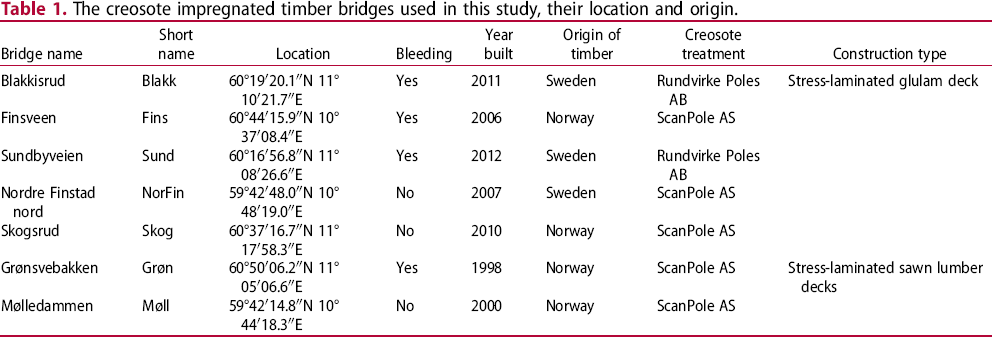
The creosote impregnated timber bridges used in this study, their location and origin.
Wood core samples (20 × 19 mm) were collected from the bridges using a hollow-core drill, stored at 4°C to avoid migration and redistribution of creosote and were classified according to their surface as bleeding ‘yes’ or ‘no’. Wood core samples which were not fully penetrated with creosote were excluded from macro- and micro-anatomical analysis (Figure 1). Creosote treated dowel plugs were hammered into the sample holes after sampling. In total seven bridges and 17 core samples from each bridge were analysed.
Wood core samples from different bridges with different degree of penetration, annual ring orientation and heartwood content. Only wood core samples with full creosote penetration were used for the analysis (c and e).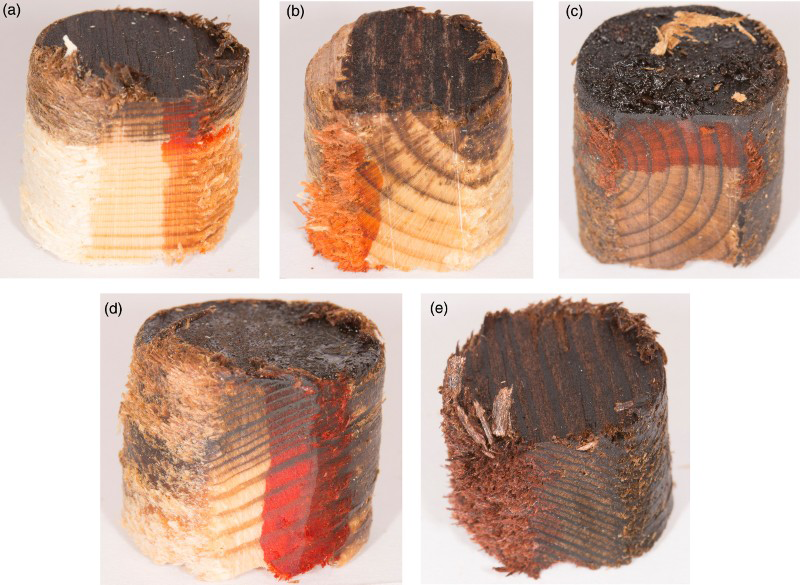
Sample preparation for macro-anatomical analysis
The transverse surfaces of the wood cores were planed with a microtome and annual ring width and orientation were measured. Heartwood reagent was used on the smoothed surfaces to distinguish between sapwood and heartwood. The reagent consists of equal amount of 10% sodium nitrite solution in water and a solution of o-anisidin (1%, C7H9NO) and hydrochloric acid (2%, HCl) in water.
Sample preparation for micro-anatomical analysis
Wood core samples for microscopic analysis were softened in purified water for 24 h before transverse and tangential sections were prepared at a thickness of 16 µm using a Reichert sliding microtome. The sections were stained for 2 min each in 1% safranin and 1% astra blue, dehydrated in a succession of 50, 75 and 96% ethanol for 30 s each, dried on a heating plate at 40°C and finally mounted in DPX New on a microscope slide. Microscopic images were recorded using a Leica DMR light microscope with a Leica DFC 425 camera. The number of rays per mm2 was counted on three tangential areas of 1.547 mm2 (5× magnification) for each sample. Images of tangential sections (20× magnification) were used in order to analyse structure and composition of rays (ray parenchyma and ray tracheids) of at least 30 rays per sample.
Statistics
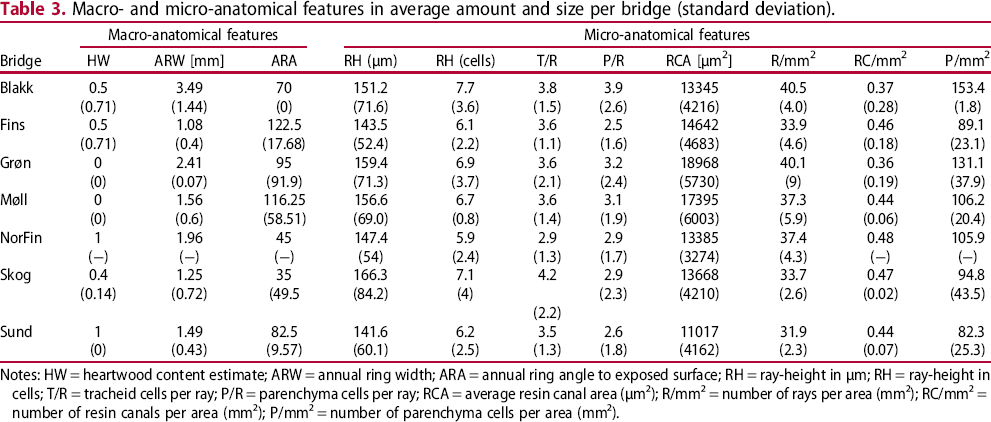
Discriminant analysis in JMP 10 was used to classify measured macro- and micro-anatomical observations in two groups according to the respective group means and to which the observations were closest. The one-way linear classification was performed on the category ‘wet sample surface’ (yes or no), taking into account the surface evaluation of single plugs (N = 17). A first classification by discriminant analysis on bridge level and related to the visual inspection of the entire bridge was also performed. The 10 variables used in this study are described in Table 3.
Origin of the wood material, impregnation process and creosote mixture could have an influence on the bleeding behaviour of the respective core samples. Since our mission was solely related to the wood anatomy of the respective bleeding parts of the bridges data on the aforementioned variables were not included in the statistical analysis. The wood core samples are treated therefore as independent variables.
Results and discussion
Classification approach based on bridge level
Seven bridges, which were pre-classified as bleeding (yes) and non-bleeding (no) were included in this study (Table 1). The classification by the category ‘bleeding bridges’ based on visual observations is a subjective overall impression of the bridge's condition. Incidents of bleeding from timber bridges, e.g. onto cars underneath, could be isolated cases and the overall impression may be influenced by these incidents and by scattered bleeding problems. Migration or redistribution of creosote from a few areas of a bridge can distort the impression of bleeding. Therefore, regular inspections are necessary to confirm or disprove these impressions. The studied timber bridges have been inspected several times prior to this study. Thus, we have to assume a pre-classification based on thorough visual inspections.
When using discriminant analysis for the classification of the category ‘bleeding bridges’, the three macro-anatomical variables, heartwood content, annual ring width and annual ring angle, were sufficient to correctly classify 86% of the observations on their bleeding performance. Including resin canal per area as a variable, altogether four variables, led to 100% correct classification. Heartwood content dominated the classification and had a great influence as a variable. A degree of 71.5% correct classification was obtained by using only ray-height and annual ring width as variables while excluding heartwood content. However, two misclassifications resulted in this approach, meaning two out of seven bridges, could not be classified correctly. However, the same classification including heartwood as a variable resulted in 1 misclassification. The classification on bridge level is therefore not preferable, when only a few variables are used for classification. Increasing the amount of variables and the number of samples taken from each bridge would help to more accurately classify on bridge level. However, from the 10 variables used in this study (Table 3), only three variables are based on macro-anatomical features, which are easier to examine compared with micro-anatomical features.
Classification approach based on sample level
Owing to the classification results on bridge level, it was decided to include the level of single wood core samples in this study. The wood core samples were classified as wet surface samples (‘yes’), if an oily or tar-covered surface was present. Smearing and creeping of creosote from surrounding areas on wood core samples leading to incorrect visual impression was not observed. However, temperature during sample preparation is reported as an influencing factor (Chin et al. 1983).
Summary of linear discriminant method of classification.

Notes: Number misclassified = Provides the number of observations in the specified set that are incorrectly classified; percent misclassified = Provides the percent of observations in the specified set that are incorrectly classified; entropy RSquare = A measure of fit. Larger values indicate better fit; −2Log-Likelihood = Twice the negative log-likelihood of the observations in the training set, based on the model. Larger values indicate better fit.
Heartwood content seemed to be an important variable. Wood core samples with 100% heartwood content were all classified as ‘wet surface samples’ (Figure 2). Although heartwood is described as refractory to the penetration of fluids (Wang & De Groot 1996), the wood samples in this study showed uptake even in the heartwood area. The treatability of heartwood is much lower compared to that of sapwood (Wang & De Groot 1996), but a study by Behr et al. (2011) showed treatability variation in Scots pine heartwood. The same patterns as for penetration of wood preservatives were found for leaching of wood preservatives from two softwood species (Venkatasamy 2007). Besides heartwood and sapwood, the orientation and the width of annual rings influenced the bleeding (Table 2). Annual ring width is a result of growth conditions and will therefore relate to the origin of the timber. This is supported by the large annual ring width of the core samples from Blakkisrud bridge with an average of 3.5 mm and a timber origin of southern Sweden with good growing conditions. However, timber origin did not form part of this study. Further research should also include timber origin since the results show that annual ring width has an impact on the bleeding.
Heartwood content of wood samples with dry- and wet surface. Data expressed by circles refer to wood samples which originate from non-bleeding bridges.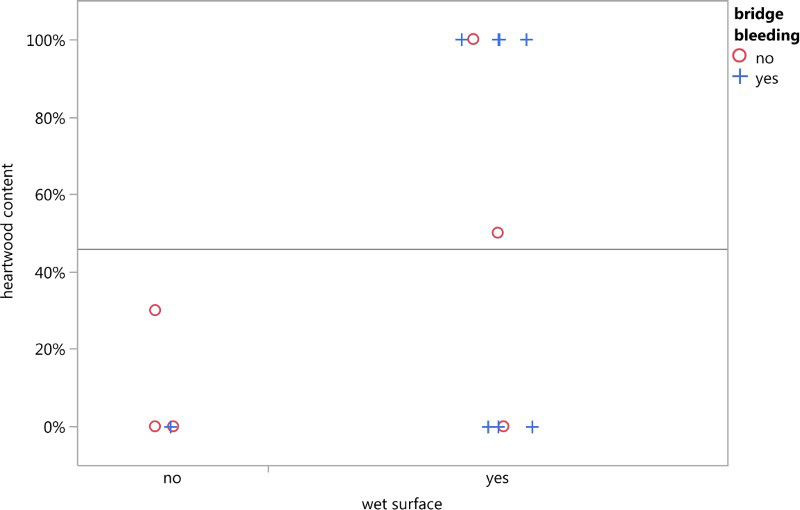
Migration of creosote from other areas of a bridge to the area from where the wood core sample was taken could have influenced the results. In addition, a classification approach which is based solely on individual samples does not take into account the timber bridge site. Variables connected to the timber bridge sight, such as climate and construction, can therefore not be correlated to the bleeding of a bridge.
Anatomical analysis on sapwood samples
Since heartwood content was a dominating factor for both the classification approach based on bridge–and wood sample level, pure sapwood samples from the wood core samples were investigated more closely. Sapwood samples (N = 8), free of any heartwood portion, and showing a wet surface had significantly wider annual rings widths (2.9 ± 1.07 mm) compared to core plugs which were not bleeding creosote (1.2 ± 0.43 mm, Figure 3, left). Specifications on maximum annual ring width should therefore be included in the specifications of the NPRA and this could reduce the risk of bleeding. Non-bleeding sapwood core plugs had an average of 2.64 ± 0.37 parenchyma cells per ray (Figure 3, right), while creosote bleeding core plugs had an average of 3.77 ± 1.15 parenchyma cells per ray. For samples that included heartwood, wood anatomical features were statistically not significant. Wood anatomical features (Table 3), such as ray-height, the number of parenchyma cells in the ray and annual ring width better represent growth conditions than the aforementioned variables. Ray-height in wood can positively influence the penetration of impregnation agents (Zimmer et al. 2014). At the same time, bleeding could be increased either due to higher uptake, very high local uptakes and poor distribution of the creosote or increased mobilisation of creosote, for example due to high temperatures (Brooks 2000). Annual ring width influences the uptake positively. With a higher amount of latewood in large annual rings, unaspirated pits in the latewood fraction will positively influence treatability (Sedighi-Gilani et al. 2012).
Annual ring width (left, in mm) and number of parenchymatous cells per ray (right) of pure sapwood samples. Macro- and micro-anatomical features in average amount and size per bridge (standard deviation). Notes: HW = heartwood content estimate; ARW = annual ring width; ARA = annual ring angle to exposed surface; RH = ray-height in µm; RH = ray-height in cells; T/R = tracheid cells per ray; P/R = parenchyma cells per ray; RCA = average resin canal area (µm²); R/mm² = number of rays per area (mm²); RC/mm² = number of resin canals per area (mm²); P/mm² = number of parenchyma cells per area (mm²).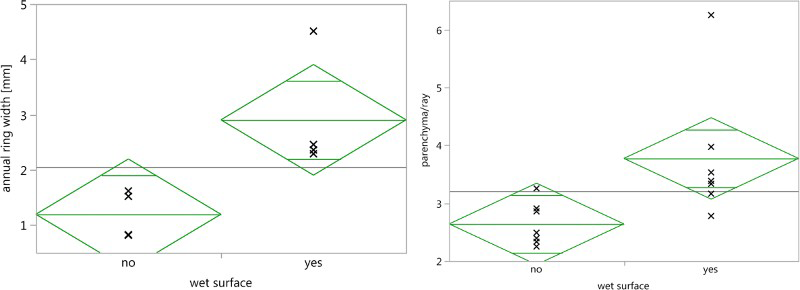
Limitations of this study
A great deal of explanation is expected from the data on creosote retention levels and chemical composition (Wacker 2003). However, creosote retention can only partly explain bleeding in this study, because the creosote losses from a bridge are unknown due to potential bleeding in service from the time of installation to the time of sampling. Furthermore, retention data do not describe distribution of creosote within the wood matrix and wood anatomical features are often ignored.
The origin of the wood material was not part of this study; neither was the composition and viscosity of creosote. This study dealt only with wood anatomical features in order to classify bleeding bridges and bleeding (wet) samples. Other factors were not analysed due to missing data and low budget within the contract work. The results gave tendencies but no significance, because the number of samples was too small. Future research should also include growth conditions or origin of the timber, since some of the wood samples in our study showed large annual ring widths.
Conclusion
It is possible to categorise bleeding ‘wet sample surface’ correctly by 88% when macro-anatomical factors, such as heartwood content, annual ring width and annual ring angle are used in the analysis. Categorisation on bridge level is concluded to lead to great misclassification when few variables are used and the number of wood core samples per bridge is low. Heartwood content is the most important factor in the classification. Creosote bleeding core plugs can be associated with a high amount of heartwood content on the exposed surface. Differences in wood anatomy such as annual ring width and the number of parenchyma cells per ray can be observed for bleeding and non-bleeding core plugs, when heartwood is excluded and only sapwood samples are analysed. Otherwise, heartwood content obscures the influence of other variables. For pure sapwood core samples narrow annual rings and few parenchyma cells per ray is shown to be advantageous and the bleeding of creosote is lower. Timber sourcing becomes therefore vital and should be specified even further, with a requirement for narrow annual rings in particular. The lowest bleeding is expected for wood samples with a high amount of sapwood and a bleeding direction towards the bark. A construction of glulam beams with the sapwood facing outwards and the heartwood inwards in the outermost lamella could be an approach to reduce the bleeding. It is therefore advisable that the national authorities require the exposure of sapwood in the outer lamella in their building specifications for timber bridges.
It was not possible within this study to analyse the influence of the various non-wood anatomical factors affecting the bleeding in more detail. Nevertheless, the described method helps to determine which wood anatomical variables are most relevant and should be further investigated.
Based on this wood anatomical study, specifications for the wood material of timber bridges should include more requirements based on wood anatomical features in the future in order to reduce bleeding of creosote.
Footnotes
Acknowledgements
The author would like to thank the Norwegian Public Roads administration for their financial support. The authors express their grateful appreciation to Otto Kleppe for providing data on the origin of the timber and treatment details for the wood material.
Disclosure statement
No potential conflict of interest was reported by the authors.
Notes on contributors
