



Abstract
Desire conflicts arise in several real-world contexts. In this paper, we propose a mixed deliberation dialogue for reconciliation. A mixed deliberation dialogue is defined as a combination of forward and backward deliberation dialogues with respective goals which are subordinate and superordinate desires of a given desire. This research and the introduction of mixed deliberation dialogue have been motivated by Kowalski and Toni's reconciliatory scenario. We show that an instantiation of a mixed deliberation dialogue implements key parts of Kowalski and Toni's reconciliatory solution. We also prove the correctness of mixed deliberation dialogues.
Introduction
Dialogue theory encompasses various types of descriptive and formal studies, aimed at various purposes, on the structure of dialogues (van Eemeren, Grootendorst, and Henkemans, 1996). Hintikka's game-theoretic semantics (1968) and Lorenzen's dialogue logic (1961) explore semantics of language. Hamblin's formal dialectics (1970) explores descriptive or formal dialogue systems. Because formal dialogue systems can give agents rational interaction and computation mechanisms under uncertain, incomplete, inconsistent, subjective, and distributed information, they have received attention from researchers working on formal argumentation (Fan and Toni, 2012; Kok, Meyer, Prakken, and Vreeswijk, 2010; Prakken, 2006, 2005; Wells and Reed, 2006).
However, little work has been done for dialogue systems for reconciling conflict not only by searching for means of satisfying either all or part of given desires, but also by searching for means for satisfying their underlying desires behind the given ones. Kowalski and Toni (1994) first presented arguments for the necessity of reconciliation in the context of argumentation.
What is interesting about their scenario is that neither the generalised goal nor reconciliatory solution is obtainable merely by just choosing one of the given alternatives based on utilities or preferences, that is, quantitative measures, but their scenario requires some sort of qualitative measure to shift to an underlying desire. Based on the scenario, they outlined what a generalised goal and a reconciliatory solution are. However, an open question is how one should have a dialogue to reach the generalised goal and the reconciliatory solution. These observations motivate us to formalise reconciliatory dialogues as consisting of forward and backward deliberation dialogues.
This paper contributes to the state of the art of studies of formal dialogue and argumentation by handling the processes leading from conflict detection to justification of reconciliation in terms of a series of dialogues. Particularly, this paper gives underlying dialogue and inference principles behind reconciliation. Furthermore, we address Kowalski and Toni's academically acknowledged scenario that cannot be solved simply by taking advantage of utilities or preferences assumed in many formal dialogue-based and argumentation-based approaches.
This paper is organised as follows. Section 2 motivates the research referring to Kowalski and Toni's scenario: a running example is used throughout the paper to describe our proposal. Section 3 presents some preliminary notions that are used widely to define dialogue goals in Section 4 and dialogue protocols in Section 5. In Section 6, we proved the correctness of the dialogues with respect to their goals. Section 7 discusses related work, and Section 8 concludes the paper. Proofs of results are given in Appendix.
Motivation
We consider the following realistic reconciliatory scenario demonstrating the importance of goal generalisation.
Kowalski and Toni, 1994
In a recent head-of-sections committee meeting in our Department, we discussed the composition of a new resources committee. Two conflicting arguments were put forward. The Director of Administration argued that, in the interests of efficiency, the members of the new committee should consist of himself and the other principal administrative officers of the Department. The Director of Research argued, in opposition to him, that, in the interests of democracy, the committee should also contain members elected by the Department.
During the course of the discussion, it became clear that the two sides were focusing on different assumptions about the purpose of the new committee: the Director of Administration on its purely administrative function, and the Director of Research on its presumed policy-making nature. These two assumptions could be viewed as conflicting solutions to the more general goals of deciding, on the one hand, which group should administer resources, and on the other hand, which group should make policy about resources.
By focusing on the more general goals, it was possible to identify a new solution which was acceptable to both parties: the resources committee will administer resources, whereas the head-of-sections committee will make policy about resources. In the interests of efficiency, the members of the resources committee will consist of administrative officers only. In the interests of democracy, the head-of-sections committee will represent the views and interests of the various Department sections on matters concerning policy about the allocation of resources.
In this scenario, neither a generalised goal nor a reconciliatory solution is obtainable merely by just choosing a given alternative based on utility or preference. An open question is how one should have a dialogue to reach the generalised goal and the reconciliatory solution.
Therefore, we formalise reconciliatory dialogues as consisting of forward
and backward deliberation dialogues. We show how shifting between
forward and backward deliberation dialogue highlights
the linkage with more general goals. On the one hand, the Director of Administration desires
In Figure 1, we show rough causal relations behind
their scenario with some additional information where nodes, respectively, represent
statements and arrows, from node x to node y, attached
with + (resp. −) represent x promotes (resp. demotes) y.
For the discussion, we expand Kowalski and Toni's scenario. Rough causal relations behind
Kowalski and Toni's reconciliatory scenario.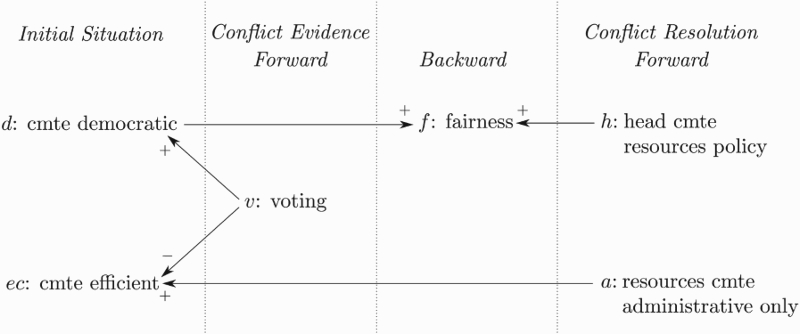
According to Figure 1: d represents ‘the resources committee is
democratic’; ec represents ‘the
resources committee is efficient’; v
represents ‘the resources committee is elected by
vote’; f represents ‘the policy is
fair’; h represents ‘the head
committee makes policy about
resources’; a represents ‘the
resources committee is composed by administrative officers
only’.
Preliminaries
We use Dung's theory of acceptability semantics (1995) that reformulates consequence notions of nonmonotonic logics. The semantics
is defined on a pair
Dung, 1995
Let S is conflict-free iff no
a
is acceptable with respect to S iff, for all
The characteristic
function, S
is the grounded extension iff it is the least fixed point of
Given an argumentation framework
In the following, we consider argumentation frameworks instantiated from
continued
To illustrate our proposal, we consider the following additional propositions: e represents ‘the policy is
effective’; m represents ‘the
resources committee makes policy about
resources’; r represents ‘the
head-of-sections committee represents various views of
interests’.
Moreover, let us consider the following rules, which provide the casual relations
depicted in Figure 1:
Any rule of inference that is not valid with respect to modal logic KD is called a
defeasible inference rule, represented by ↝. More precisely, a rule of inference is not
valid if it can derive a formula that is not a theorem in KD. Intuitively, an inference is
not valid if it is not deductive in terms of KD. We use letters
Bench-Capon and Prakken, 2006
Positive forward practical syllogism, denoted by PFPS, and negative forward practical syllogism, denoted by NFPS, are defined as follows, respectively1
The authors originally call them positive and negative practical
syllogisms, respectively, and the conclusion part of the negative one is
The positive one states intuitively that if one believes that α is
desirable (e.g. ‘democratic cmte’ d), γ is the case and if
β (e.g. ‘voting’ v) is realised under γ
is the case then α is satisfied, then one defeasibly concludes that
β is desirable (
Let
The first condition states that an argument is a derivation from Σ using strict and
defeasible inference rules. The second assures that an argument consists of a minimal number
of formulae. As described herein
Superordinate and subordinate desires
This section provides formal definitions of dialogue goals. Given a desirable outcome or desire, we use the term superordinate desire to refer to a desire such that, once it is assumed, it can be a rationale for desiring a given desire, but it cannot be a rationale for not desiring a given desire. Based on the recognition that the practical syllogisms give fundamental inference mechanisms for practical reasoning, we give a formal definition of superordinate desires as follows.
Let
Definition 4 states that a superordinate desire Dh derives
Dg by application of only forward practical syllogisms
Df is a superordinate desire of Dd in
Rough causal
relations behind the superordinate desire in Example 1.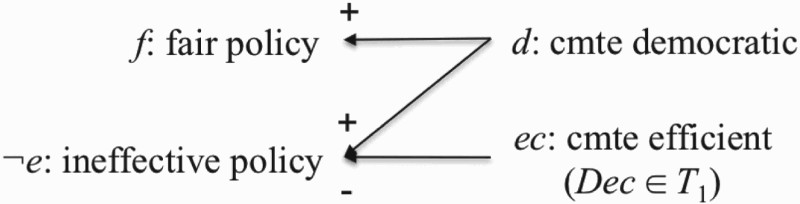
We introduce a notion of subordinate desires. Given a desire, we use the termsubordinate desire to refer to a desire such that if once it is realised then it satisfies at least one of the given desires, but it frustrates no desire in them. Namely, a subordinate desire of a desire is desirable as a means of satisfying the desire, but not as a means of frustrating any other desire.
Let
Definition 5 states that the subordinate desire Dg is derived by
application only of forward practical syllogisms, but no desire in
Da is a subordinate desire of Dec in
Rough causal relations behind the subordinate desire in
Example 1.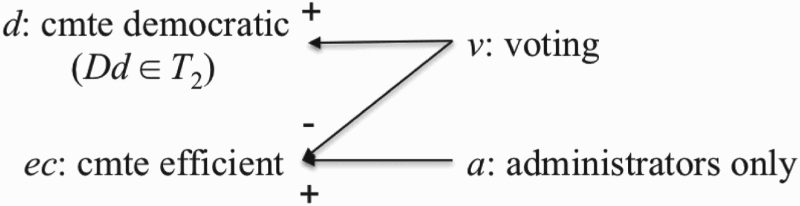
Finally, we introduce the notion of reconciliatory desires defined by combining superordinate desires and subordinate desires.
Let
Definition 6 states that g is desirable because it does not frustrate
any desire in
Backward practical syllogisms
We introduce a backward version of the practical syllogism. This
inference pattern, differently from the traditional forward practical syllogism,
represents the result of a critical thinking approach. Indeed, presuming that
α is a desirable outcome (
Positive backward practical syllogism, denoted by PBPS, and negative
backward practical syllogism, denoted by NBPS, are defined as follows:
The positive backward practical syllogism intuitively states that if one believes that
α is desirable (e.g. ‘cmte democratic’ d),
γ is the case (e.g. ‘the resources committee makes policy about
resources’ m) and if α is realised under
γ is the case then β is realised (e.g. ‘fairness’
f). Then one defeasibly concludes that β might be
desirable (
An application of BPS sometimes derives a false conclusion. The following example shows that how such false conclusions can be withdrawn by an interaction of BPS.
The following is an application of a backward practical syllogism:
This is intuitively a false conclusion. As we will see in Section 5, the conclusion is
withdrawn by agent's belief De or the following another application of
a backward practical syllogism:
Finally, in this section, we show the fact that backward practical syllogisms redefine superordinate desires originally defined by forward practical syllogisms.
Let
General elements of dialogues
This section aims to formalise three types of dialogues: a backward deliberation dialogue, a forward deliberation dialogue, and a mixed deliberation dialogue. Particularly, this section gives a formal definition of the intersection of backward and forward deliberation dialogues, as general as possible. In general, there are various ingredients associated with formal dialogues, Foe example, locution, reply, commitment, turntaking, termination, and outcomes. In this paper, we only consider locutions, reply, and outcomes because we think that they are necessary and sufficient factors to cover a key part of reconciliation typified by Kowalski and Toni's reconciliatory story. A general framework of reconciliatory dialogues equipped with all of the ingredients is beyond the scope of this paper although it is true that they make reconciliatory dialogues more realistic and sound. In our dialogue setting, unspecified number of players exchange moves during dialogues in which they always have their turn to put forward moves, they are not distinguished from a proponent and opponent, and their locutions are not subject to consistency check with their commitments.
Each move in dialogues consists of a speech act – the content of the move – and atype of dialogue – the context in which moves are put forward.
Let
Let us define the set of allowed replies to a move.
In the following, if
A dialogue as a network of moves is defined using a dialogue framework. It is an abstract argumentation framework whose arguments and attacks are instantiated, respectively, by moves and attacks on the set of moves.
A dialogue framework is a pair
Note that dialogue frameworks do not preserve the order in which agents put forward locutions, but preserve only the replying relation between moves. Agents dynamically construct a network of moves, that is, a dialogue framework, by replying to a preceding move in it.
Dung's acceptability semantics evaluates acceptability of moves in dialogue frameworks. This is because it is rational to think that moves successfully replying to critical questions are worthy of acceptance. In general, dialogue frameworks are constructed by multiple agents who freely participate and make moves from their private knowledge bases. This knowledge is invisible to others. They can only see what they said during a dialogue.
Let DF be a dialogue framework. A collaborative
theory built from DF, denoted by
A forward deliberation protocol is defined using forward practical syllogisms.
Let M be a set of moves and
Moreover, if the speech act of m is
A dialogue framework DF is a forward deliberation dialogue iff DF is constructed by the forward deliberation protocol. The first move of DF is called the subject of the dialogue.
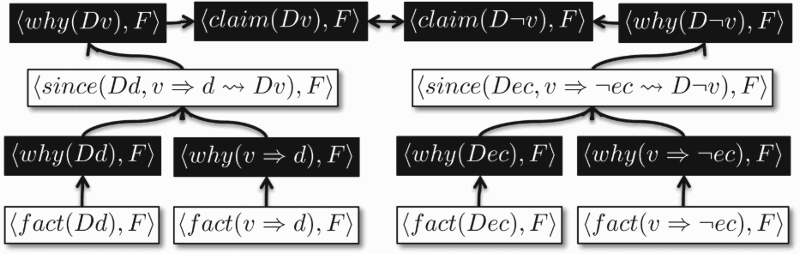
Figure 4 presents an example of a forward
deliberation dialogue with overruled subject Forward deliberation dialogue with the overruled subject
A backward deliberation protocol is defined similarly.
Let M be a set of moves,
Moreover, if the speech act of m is
Definition 13 says that the backward deliberation protocol restricts a type of dialogue to a backward deliberation and an inference to backward practical syllogisms. We say that a dialogue framework DF is a backward deliberation dialogue iff DF is constructed by the backward deliberation protocol.
Figure 5 presents an example of a backward
deliberation dialogue in which subject Backward
deliberation dialogue with the justified subject 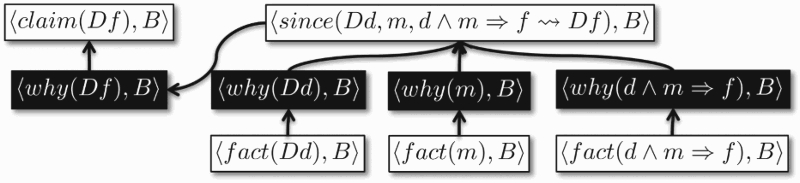
We now define mixed deliberation dialogues by which agents search for and justify
reconciliatory desires. We extend the forward and backward protocols so that claim moves
in forward deliberation dialogues serve as a trigger to shift from backward to forward
deliberation dialogues. Formally, a mixed deliberation protocol allows
agents to put forward
Let N be a set of moves and
A dialogue framework DF is a mixed deliberation dialogue iff DF is constructed using the mixed deliberation protocol. Note that forward and backward deliberation dialogues are both special cases of mixed deliberation dialogues.
Figure 6 presents an example of a mixed
deliberation dialogue DF in which the subject Mixed deliberation dialogue
with the justified subject 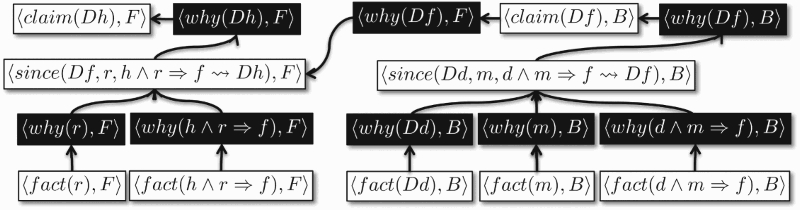
Forward deliberation dialogues for justifying subordinate desires
This section shows the relations between acceptability status of dialogue subjects and desires of three kinds (subordinate, superordinate, and reconciliatory desires) defined on collaborative theories. It gives dialogue agents rationale for accepting and agreeing to dialogue subjects.
We say a dialogue framework is finite if the number of moves in it is finite. We imposeclosedness on dialogue frameworks to associate status of subjects and subordinate, superordinate, and reconciliatory desires. A dialogue framework is closed if it is finite and the corresponding dialogue protocol does not permit to put why and since moves forward.
Let DF be a finite dialogue framework and P be a
protocol. DF is closed iff there is no
We show that subjects of forward deliberation dialogues interpret their dialogue goals, that is, subordinate desires, defined on collaborative theories built through the dialogues. The following two lemmas guarantee that forward deliberation dialogues are sound in the sense that justified subjects are necessarily subordinate desires in the collaborative theory, and complete in the sense that subordinate desires in the collaborative theory are necessarily justified subjects.
Let DF be a closed forward deliberation dialogue for which the subject
is
The following lemma assures that forward deliberation dialogues arecomplete in the sense that subordinate desires in the collaborative theory are necessarily justified subjects.
Let DF be a closed forward deliberation dialogue for which the subject
is
Lemmas 1 and 2 imply Theorem 1.
Let DF be a closed forward deliberation dialogue whose subject is
Subject status of backward deliberation dialogues interpret their dialogue goals, that is, superordinate desires, defined on collaborative theories built through the dialogues. The following theorem can be shown similarly to Theorem 1.
Let DF be a closed backward deliberation dialogue for which the
subject is
Subject status of mixed deliberation dialogues interpret their dialogue goals, that is, reconciliatory desires, defined on collaborative theories built through the dialogues. The following lemma guarantees that mixed deliberation dialogues are sound in the sense that justified subjects are necessarily reconciliatory desires in collaborative theories.
Let
Let
Lemmas 3 and 4 imply Theorem 3.
Let
This section gives an illustrative example to show how mixed deliberation dialogues
unfold by agents. In Figure 7, we show information
flows of our dialogue systems where moves from agents constitute a dialogue framework, and
facts from the framework constitute a collaborative theory. Reconciliatory (resp.
subordinate, superordinate) desires defined in the collaborative theory give a
justification to mixed (resp. forward, backward) deliberation dialogues, and justified
claims in the dialogue give a justification to multiagent decision-making. System overview of mixed deliberation
dialogue.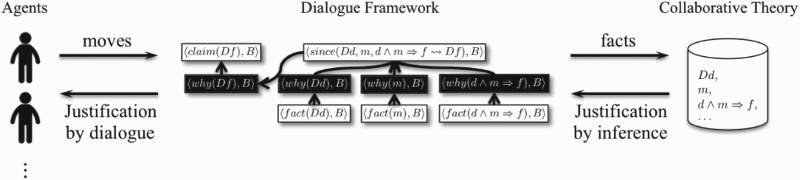
So far, however, we paid no attention to agent models (the leftmost component in Figure 7) such as agent's knowledge base nor agent's dialogue strategy. This is because we focus on dialogue protocols that should be distinguished from them. A dialogue protocol deals with moves agents are allowed to put forward in dialogues. On the other hand, a dialogue strategy deals with moves agents actually put forward in dialogues. Agent's knowledge base defines moves she can make from her knowledge base, and this information affects her strategy of what to say in dialogues. However, it does not affect dialogue protocols of what moves she is allowed to put forward.
However, we think that agents' knowledge and strategies are necessary to show how a
dialogue unfold by them. In this section, we assume two agents
Moreover, we assume the simple strategy that each agent willingly and honestly participates in dialogues with no particular order. By permission of a given dialogue protocol, each agent puts forward fact and since moves she can make from her knowledge base. She also puts forward why moves in any time and claim moves in the beginning of dialogues.
The above table shows a sequence of moves and their utterers, targets, and status in the
forward (and therefore mixed) deliberation dialogue where the subject
The above table shows a sequence of moves and their utterers, targets, and status in the
mixed deliberation dialogue where the subject
We can also see that the subject
Focusing on superordinate or underlying desires furthers reconciliation. Fisher, Ury, and Patton (1992) argue that paying attention to stakeholders' interests helps to find reconciliation in negotiation. Brett (2014) says that negotiation theory distinguishes a position and an interest where a proposition is what negotiators say they want and an interest is the needs of concerns that underlie positions.
In argument-based negotiation and deliberation, the research studies (Amgoud, Devred, and Lagasquie-Schiex, 2009; Hulstijn and van der Torre, 2004; Modgil and Luck, 2009) use practical reasoning to deal with desire derivation and generation mechanisms for knowledge-dependent and context-dependent desires. They, however, do not address the situations in which there is no means to achieve original nor derivative desires. Rahwan, Pasquier, Sonenberg, and Dignum (2007) argue that underlying goals improve negotiation processes and consider desires hierarchised in advance. In contrast to their approach, we assume the situation where desires are structurised as a result of inference by forward and backward practical syllogisms. Our approach is necessary when agents have incomplete desires, as well as incomplete knowledge. Hitchcock, McBurney, and Parsons (2001) and McBurney, Hitchcock, and Parsons (2007) propose deliberation dialogue frameworks, for example, DDF (McBurney et al., 2007), equipped with fundamental elements for deliberation dialogues such as locutions, commitments, and termination. Kok et al. (2010) give an argumentation framework for deliberation dialogue taking into account agent's preference. However, these frameworks do not address evaluation of their correctness. In this paper, we gave proof-based evaluation for correctness of our dialogues in terms of dialogue goals. Fan and Toni (2012) use an assumption-based argumentation framework to relate successful dialogues with admissible arguments in the framework. Wells and Reed (2006) handle a shift from persuasion to negotiation, and demonstrate its effectiveness using an example. Although we also use argumentation frameworks and dialectical shifts to define our dialogues, the type of dialogue and the goal of dialogue, we focus on, are uniquely deliberation and reconciliatory, respectively.
Kido and Ohsawa (2013) propose a reconciliatory argumentation system instantiating Dung's argumentation framework with modal propositional language and rules of practical inference. Our dialogue-based reconciliation has an advantage over argumentation-based in the sense that it handles circumstances under which individual agents cannot make a reconciliatory argument by themselves because of lack of knowledge, but can make such an argument for mutual coverage. Moreover, dialogue-based approaches succeed in capturing dynamic aspects of interaction where individual agents build a theory collaboratively during a dialogue. On the other hand, this paper has the limitation that dialogue protocols allow agents to use only practical syllogisms and allow them to attack only moves except facts. We think that our work can be extended to a general reconciliatory dialogue by utilising the persuasion dialogues mentioned above and inquiry dialogues (Black and Hunter, 2009) allowing agents to share knowledge to jointly construct arguments or dialectical trees.
Much work for formal deliberation dialogues has been inspired by studies of formal
persuasion dialogues. Prakken (2005) provides a
formal dialogue system and shows that, under some conditions, a proponent wins in a dialogue
iff a topic of the dialogue is defeasibly derived from agreed information. We also adopt a
similar manner in giving the correctness of our dialogue protocols because we agree with
Carlson's idea (1983), summarized by
Prakken (2005, 2006), that whereas logic
defines the conditions under which a proposition is true, dialogue systems define the
conditions under which an utterance is appropriate, and this is the case if the
utterance furthers the goal of the dialogue in which it is
made.
Conclusions and future work
We proposed a mixed deliberation dialogue for reconciliatory desires. A mixed deliberation dialogue is defined as a combination of forward and backward deliberation dialogues for which the goals are subordinate and superordinate desires, respectively. We showed the correctness of dialogues based on the fact that the subject of closed mixed deliberation dialogue is justified iff the subject is a reconciliatory desire of a desire in the collaborative theory, that is, iff the dialogue satisfies its goal. Weaknesses of our formalisation are, first, that it restricts inference mechanisms to only forward and backward practical syllogisms, and second, that it does not allow agents to challenge or rebut facts put forward in dialogues. We will utilise existing persuasion and inquiry dialogues to address these issues.
Footnotes
No potential conflict of interest was reported by the authors.
Funding
This research was partially supported by the Telecommunication Advancement Foundation, Japan.