






Abstract
The use of ambiguous expressions in argumentative dialogues can lead to misunderstanding and equivocation. Such ambiguities are here called active ambiguities. However, even a normative model of persuasion dialogue ought not to ban active ambiguities altogether, one reason being that it is not always possible to determine beforehand which expressions will prove to be actively ambiguous. Thus, it is proposed that argumentative norms should enable each participant to put forward ambiguity criticisms as well as self-critical ambiguity corrections, inducing them to improve their language if necessary. In order to discourage them from nitpicking and from arriving at excessively high levels of precision, the parties are also provided with devices with which to examine whether the ambiguity corrections or ambiguity criticisms have been appropriate. A formal dialectical system is proposed, in the Hamblin style, that satisfies these and some other philosophical desiderata.
Keywords
Introduction
Argumentative types of dialogue can be hampered by expressions that are ambiguous or equivocal. A participant can show dissatisfaction with such ambiguities by disambiguating the formulations he has used or by inciting the other side to improve upon their formulations. A typical example can be found in the case where W.B. had been arrested both for drink and driving and for driving under suspension. In an attempt to move his car to a car park without breaking the law, ‘W.B. pushed the car, walking next to it, while he operated the steering wheel through the open window of the left car door’ (Dutch jurisdiction: HR, 12 June 1990, NJ 1991, 29). W.B., however, disagreed with the police officer that his behaviour constituted driving (in Dutch: besturen, a word derived from the Dutch word for steering). In the officer's understanding of the term, W.B. had driven a car, while in the way W.B. himself understood it, he had not. Expressions that are ambiguous in ways that hinder argumentative discussion by inciting misunderstanding (Naess 1953, 1966; van Eemeren and Grootendorst 1992, 2004) or by masking argumentative weaknesses (cf., on equivocation, Mackenzie 1988, 1990; Walton 1996) will be referred to in this paper as actively ambiguous. Two issues will be examined. What notion of active ambiguity is appropriate for a normative model of argument? and In what ways should discussants themselves deal with issues of active ambiguity?
To answer these questions, I will develop a normative model of persuasion dialogue (cf. Walton and Krabbe 1995) or critical discussion (van Eemeren and Grootendorst 2004), extended by devices with which to solve ambiguity problems. In a persuasion dialogue, two parties start from a difference of opinion and attempt to resolve this difference on, what they perceive to be the merits of the case, partly by trying to persuade each other and thereby presenting the pros and cons of the issue.
Walton and Krabbe (1995) distinguish six main types of dialogue: persuasion dialogue, negotiation dialogue, deliberation dialogue, inquiry dialogue, eristic dialogue and information seeking dialogue. This typology has been widely applied in artificial intelligence (Parsons, Wooldridge, and Amgoud 2003; McBurney and Parsons 2002; Prakken 2005; Wells and Reed 2005). For each type of dialogue, a distinction can be made between a descriptive and a normative approach (Krabbe and van Laar 2007). Given a main goal that in part characterises a type of dialogue, norms can be stated that, in a theorist's eyes, are to be followed in order for the participants to achieve this main goal. Alternatively, a theorist can use empirical means in order to arrive at an adequate description of a dialogue type, now considered as a cultural artefact referred to by van Eemeren and Houtlosser (2005) as argumentative activity type (p. 76), including a description of the conventions and rules that the participants in that dialogue type happen to impose upon each other. The question arises: if an argument is put forward in a dialogue of type D, should we then evaluate this argument with the norms that further the main goal of that type of dialogue? In contrast to Walton (1998), who answers affirmatively (p. 30), I start from the assumption that if one is interested in the argumentative merits of an argument, it can be evaluated with the appropriate norms of persuasion dialogue, regardless of the type of dialogue in which an argument is situated. The reason is that the norms of persuasion dialogue, unlike those of the other dialogue types, explicate the pretences with which argumentative moves are brought forward (in Section 2, I will elaborate on these pretences).1
The approach that I adopt coheres with that of pragma-dialectics, as defended by van Eemeren and Grootendorst (1992, 2004).
The result is a formal dialectical dialogue system with which the moves available to an agent at each stage can be univocally determined. Specific to the model developed in this paper is that the agents are enabled to raise the issue of active ambiguity in various ways depending on the circumstances, and deal with such procedural moves in a critical manner. In this way, the paper develops Hamblin's (1970) programme for a theory of charges or procedural objections (chap. 8) that is immanently dialectical (Krabbe 1997) in providing the agents with the dialogical means to address the argumentative problems and fallacies they encounter. The resulting system, ambiguity dialectic, constitutes a proposal for dealing with active ambiguities in argumentatively reasonable ways. First, the model can be used for the analysis and evaluation of actively ambiguous arguments and concessions as well as the moves with which participants themselves attempt to solve ambiguity problems. Second, the model can be used to enrich argumentative interaction protocols by enabling the agents to address active ambiguities.
In Ambiguity Dialectic (specified in Section 5), four distinct components for dealing with active ambiguity are integrated into a model of persuasion dialogue: (1) a component that enables a protagonist (or proponent) of a thesis or standpoint to offer a self-critical ambiguity correction, (2) a component that enables the protagonist to raise an ambiguity criticism against his antagonist (or opponent), (3) a component that enables the antagonist to offer a self-critical ambiguity correction and (4) a component with which the antagonist can offer an ambiguity criticism against the protagonist.2
The fourth component is part of the incomplete sketch of ambiguity dialogues in van Laar (2001).
Section 2 will first introduce the dialogical approach to argument and criticism. Section 3 will provide an explication of the term active ambiguity. Section 4 will introduce a number of philosophical desiderata of a dialogue system that can accommodate active ambiguities, while Section 5 will outline a dialogue system along these lines and a number of examples that illustrate the system.
The dialogue system ambiguity dialectic is a close relative of the model of critical discussion developed by van Eemeren and Grootendorst (2004), and the family of models of persuasion dialogue developed by Walton and Krabbe (1995) and adapted for the purposes of artificial intelligence by, for example, Prakken (2005), McBurney and Parsons (2002), Parsons et al. (2003) and Wells and Reed (2005). In line with these dialectical approaches, the notions of ‘argument’ and ‘criticism’ are here understood from the perspective of a critical exchange between a protagonist and an antagonist. The protagonist defends a standpoint against the criticisms of an antagonist using propositions that the antagonist has committed to at the start of the exchange.
An ambiguity dialogue, that is, a dialogue according to the rules of ambiguity dialectic, starts with a situation in which the protagonist and the antagonist are assumed to have a difference of opinion that they intend to resolve on what they perceive to be the merits of the case. It suffices to say that the parties are assumed to disagree, for it is not to be excluded that the parties come to decide at a later stage that the assumed difference of opinion was merely verbal rather than substantial.
At a preliminary stage, the antagonist has committed to a possibly empty set of formulated propositions called her initial concessions (cf. Barth and Krabbe 1982). The protagonist's first move in the dialogue expresses a standpoint. The individual aim of the protagonist is to demonstrate to the antagonist that the initial concessions that the latter has made also commit her to the acceptability of the former's intended standpoint.3
If a protagonist defends a standpoint as true, rather than as merely acceptable to the antagonist, this may be considered as a special case when the thesis is defended ex concessis and when the concessions used are presented as true rather than merely accepted by the antagonist.
I follow Walton and Krabbe (1995) in characterising dialogue types by referring to the initial situation, the individual aims of the participants and the common goal of the dialogue. Ambiguity dialectic is a subtype of what Walton and Krabbe call permissive persuasion dialogue. If a dialogue participant abandons the aim of persuading an interlocutor, or resolving the difference of opinion, he or she is no longer involved in the kind of dialogue that fits the description of persuasion dialogue. However, in such a situation, we may nevertheless apply the norms of a persuasion dialogue in order to reconstruct and evaluate a contribution from an argumentative stance.
What resolution amounts to is specified by the rules that constitute an ambiguity dialogue. The general idea is that the participants have resolved their difference of opinion if either the protagonist has given up defending the standpoint or if the antagonist has given up challenging the protagonist's defence after having had all the opportunities they themselves considered necessary to achieve their individual persuasion aims. The discussion rules provide an explication of what it means to work towards a resolution of a difference of opinion. Given that we consider some differences of opinion unresolvable – for example, because we lack the information with which to decide the issue or because the disagreement is overly intractable, and given that in a reasonable persuasion dialogue the participants cannot be forced to prematurely terminate their persuasion dialogue, the model should enable the participants to converse without ever making a decision to terminate the conversation. For practical purposes, additional rules can be adopted that do guarantee a determinate outcome in favour of one of the participants.
In an ambiguity dialogue, participants converse at two levels (cf. Krabbe (2003) on meta-level dialogue; cf. McBurney and Parsons (2002) on the control layer of a dialogue, pp. 323–325). At a ground level, the parties exchange arguments and criticisms. The antagonist is allowed to pose critical questions, which must be understood as requests for argument. These critical questions enable the antagonist to force the protagonist to accomplish the burden of proof, without having to take on a burden of proof herself, as in the case of attempts at defeating the protagonist's reasoning using a rebutting argument, an undercutting argument or a premise attack (cf. Pollock 1995, pp. 40–41; cf. Prakken 2005, p. 1013). In response to a challenge ‘why ϕ?’, the protagonist has a prima facie obligation to offer an argument ‘ψ so ϕ ’, such that ψ is the argument's reason and
In the context of an ambiguity dialogue, the term ‘argument’ refers to pieces of reasoning, used for persuasive purposes,5
Krabbe and van Laar (2007) propose a typology of functions of reasoning.
These latter two pretences closely correspond to the objective of dialectical reasonableness and the objective of rhetorical effectiveness that constitute strategic manoeuvring, as examined by van Eemeren and Houtlosser (1999, 2002, 2005).
At each stage, a participant has a commitment store that contains the propositions that he or she is committed to at that stage of the dialogue (Hamblin 1970; Walton and Krabbe 1995). In ambiguity dialectic, the protagonist's commitment store remains a singleton that contains the global argument at that stage. This commitment of the protagonist, however, can become increasingly complex due to the addition of arguments and subsequent disambiguations. The antagonist's commitment store contains the concessions which can change through subsequent disambiguations and the number of concessions can increase through the antagonist accepting various readings of one and the same concession.
What is the pejorative sense of ambiguity as this term is used in an argumentative context? When discussing a definition, I will prepare for an appropriate division of labour between the protagonist and the antagonist by pointing out who is likely to profit from and who is likely to pay for the ambiguity left unnoticed and unresolved. The latter party will be given the meta-linguistic devices with which to bring the discussion back on track.
The following argument can be used as part of a case in favour of the contention that the English term ‘ambiguous’ can be used ambiguously, in its pejorative sense, on some occasions. One might, on a superficial reading of it, consider the argument as having two acceptable reasons and an acceptable connection premise that is left implicit, but a clearly unacceptable standpoint:
(1) Almost all English expressions are ambiguous. (2) If a speaker uses an expression that is ambiguous, then we can object to the use of that expression. Therefore, (3) we can object to the use of almost all English expressions.
I am interested here in the sense of the term ‘ambiguous’ that makes reason (2) acceptable while making reason (1) quite implausible. ‘Ambiguity’ in this pejorative sense and when applying to argumentative contexts will be called ‘active ambiguity’. The definition has three clauses and is restricted to the propositional content of speech acts. Thus, I will refrain from dealing with ambiguities in illocutionary force and with ambiguities in the super-sententional structures of a textual contribution, such as with respect to whether something is an argument or an explanation, or to whether reasons are to be seen as linked (or compound) or convergent (or multiple), and so forth.
First, for an expression to be actively ambiguous in a particular dialogue, it must allow of various readings in that dialogue, even after having taken the contextual clues into account. For example, particular uses of the word ‘bank’ can be contextually ambiguous: ‘I've seen John walking to the bank therefore his leg must have healed.’ Also, expressions that are vague, in the sense of admitting of borderline cases, having fuzzy edges and enabling the construction of sorites arguments (Keefe 2000, pp. 6–7), typically allow various readings within specific circumstances and are consequently candidates for active ambiguities. Contextual ambiguity has been studied extensively in ‘word sense disambiguation’ in computational linguistics (see for overviews, Ide and Veronis 1998; Navigli 2009). Active ambiguity applies to expressions that are used in a particular situation and that in this situation allow various readings even when having taken the contextual clues into account.
Second, the ambiguity is not overt. It is not made clear to the addressee that the expression admits of more than one reading, for example by conveying the message that the expression is to be understood in terms of both readings. Active ambiguity is not a figure of style. In his introduction to Thoreau's his pamphlet ‘On the duty of civil disobedience’ Sharp explains that Thoreau used the term ‘civil’ in ‘civil disobedience’, overtly in two distinct senses, referring to politeness and humaneness as well as to what befits us as members of a community of citizens (Thoreau 1963/1849, p. 3). The above bank example can easily be imagined to contain a covertly ambiguous occurrence of ‘bank’.
Third, among the covert and contextual ambiguities, a further distinction can be made. Some can be expected to allow interpretational options, such that choosing one over the other has consequences for whether or not the standpoint, reason or connection premise is acceptable to the antagonist. Other interpretational divergences, however, are so overly subtle, fine-grained, far-fetched or irrelevant to the topic at hand that choosing one reading over the other would be inconsequential to the course of the dialogue. The first is what constitutes an active ambiguity.
If the parties are only interested in John's physical well-being, the sentence can be covertly ambiguous without leading to any interactional problems. Of course, the interlocutor may desire to know what the speaker has in mind when using the term ‘bank’, but for the argumentative purpose of this dialogue, a request for disambiguation would probably initiate an irrelevant detour. Similarly, a request for more precision seems inappropriate when a protagonist states that Mozart was a musical child, for it is clear that he was musical in all relevant senses (cf. Pinkal (1995) for a supervaluationist theory of reasoning that elaborates this idea). Again, the interlocutor can be interested in what the speaker more specifically has in mind, but this interest extends beyond the aim of resolving disputes. Active ambiguity is not merely a communicative but also an interactional phenomenon.
Nevertheless, some covertly ambiguous expressions are plausible candidates for creating a confusion that can influence the course of the verbal interaction and are consequently actively ambiguous. Think of the term ‘unbearable suffering’, which constitutes a ground for exemption from liability under Dutch euthanasia law. In a much discussed case, a family doctor had provided the former Dutch senator Brongersma with a lethal potion. Brongersma had been weary of life (in Dutch: levensmoe) and according to the doctor's defence, Brongersma had complied with the criterion of unbearable suffering. Thus, in this context, the vague expression unbearable suffering triggers two kinds of readings – does it include mental disorders such as extreme depression or does it not? – and becomes actively ambiguous (van Laar 2003, chap. 8).
Or take the driving example from the introduction. Suppose the police officer stated to W.B.: Officer: You're driving a car while your license is suspended therefore a fine is in order.
Then, W.B., were he sufficiently reflective, would note two senses in which to drive can be taken in this dialogue situation. Either the term is taken in a stricter sense, excluding W.B.’s actions, or in a broader sense, including them. If W.B. detected these interpretational options, he would subsequently notice that accepting the officer's reason in the broader sense need not harm his position, for in that reading the connection premise is plausibly false, while accepting it in the stricter sense would amount to losing the discussion. W.B. now has two options that might turn out opportune for him.
First, he might raise the issue of ambiguity, pointing out the two meanings that to drive admits of in this situation and the fact that he is willing to concede the officer's reason in the broader reading of the term but not in the stricter. He might want to add that his acceptance of the reason in its broader reading does not provide the officer, in his capacity as the protagonist, with a winning argumentative strategy, the reason being that W.B. does not accept the connecting premise according to which driving in this broad sense would amount to a transgression of the law.
If one party introduces an expression and the other party thinks it opportune to point out its active ambiguity, we can best refer to the raising of this issue as an ambiguity criticism. The reason is that the party who introduces an expression remains at least partly responsible for the problems to which the expression gives rise.7
This is unproblematic if it is the protagonist who introduces the expression. In cases where the antagonist has used an expression in her initial concessions which, when used by the protagonist, turns out to be actively ambiguous, the antagonist remains partly responsible for any resulting problems, even though the protagonist is probably also in part to blame. In order to obtain a clear division of tasks ambiguity dialectic assigns in those cases the burden of solving these problems to the antagonist alone. See, for example, the fourth set of examples in Section 5.7.
Second, W.B. might choose not to raise the issue of ambiguity and simply challenge the officer's reason that he had been driving a car: W.B.: Why would you say I was driving the car?
Be that as it may, now it is the officer's turn, and the officer might note the two interpretational options. The officer might raise the ambiguity issue, pointing out that W.B. was probably challenging his reason while taking ‘driving’ in its strict sense, whereas it was meant in its broader sense, which the officer surmises as acceptable to W.B. The officer might add that if, as expected, W.B. accepts the broader sense of the statement, a strong persuasive strategy is available, as the officer also expects that it will be possible to convince W.B. of the proposition that ‘driving’ in the broader sense constitutes a violation of the law. (The disagreement appears to be substantial with respect to the connection premise, but not with respect to the reason.)
If one party first introduces an expression and this same party thinks it opportune to point out that this expression is actively ambiguous, this raising of the issue of ambiguity can best be seen as a self-critical move called an ambiguity correction. Note that an ambiguity correction can be legitimate even when one has willingly introduced an actively ambiguous expression. Raising an ambiguity correction amounts to admitting that an argumentative move has transgressed a norm that harmed one's own position. An ambiguity correction can best be seen as acknowledging a strategically weak move, or even a blunder, that is subsequently repaired and corrected. In the current scenario of the example, the protagonist (the police officer) can be understood as offering such an ambiguity correction.
In the first scenario, where the antagonist (W.B.) raises an ambiguity criticism, the antagonist appeals to the possibility of having accepted a reason, while the protagonist intended to express a different reading, and as a matter of fact a reading that is not acceptable to her. Hence, the antagonist appeals to the possibility of a particular kind of misunderstanding, which Naess (1966) has called pseudo-agreement. More precisely, the antagonist appeals to the feasibility of performing a speech act, that is, verbally accepting a reason, which could better have been avoided. Clearly, such a pseudo-agreement, if materialised in the speech acts of the parties, is detrimental to the antagonist's chances of winning the discussion. Pseudo-agreement is always prima facie disadvantageous to the antagonist and advantageous to the protagonist.
The protagonist's (the officer's) ambiguity correction, in the second scenario, appeals to the possibility that the antagonist challenges a reason that the protagonist intended in a different sense, and as a matter of fact in a sense that is acceptable to the antagonist. Hence, the protagonist appeals to the possibility of a different kind of misunderstanding, which Naess called pseudo-disagreement. More precisely, the protagonist appeals to the feasibility of the antagonist's performing a speech act, that is challenging the reason, that is not really appropriate and in fact undesirable from the perspective of the protagonist's individual aim. Clearly, a pseudo-disagreement, if materialised in the speech acts of the parties, is always prima facie disadvantageous to the protagonist and advantageous to the antagonist.
The kind of reasoning that is normally discussed under the heading of ‘equivocation’ (Mackenzie 1988; Walton 1996) must, within this argumentative setting, be seen as a special case of trading on an actively ambiguous expression that leads to or might lead to pseudo-agreements. An equivocation is an argument that contains a covertly and contextually ambiguous expression that admits of more than one reading, such that: (1) there is a reading that makes all reasons acceptable to the addressee, and (2) there is a reading that makes the connection premise acceptable, but (3) there is no reading that makes all reasons and the connection premise acceptable. These readings, for example of the connection premise, can be mixed disambiguations (Lewis 1982) where the expression at hand obtains distinct disambiguations at distinct occurrences within a sentence. This analysis of equivocation applies to the argument that trades on the term ‘ambiguous’ discussed at the start of this section, and also to the police officer's argument as expressed vis-à-vis W.B. An equivocation can be understood as involving more than one pseudo-agreement. Failing to notice the ambiguity and naively accepting the reasons and connection premise (due to their having an air of acceptability), leads to a complex kind of pseudo-agreement: for at least one reason as well as for the connection premise it holds that there is a reading that makes it acceptable as well as a reading that makes it unacceptable to the addressee.8
Elsewhere (van Laar 2003) I have defended the notion that whether or not an argument constitutes a fallacy of equivocation is in part dependent upon what the addressee is willing to accept.
An expression, as used in a particular argumentative discussion, is only to be called an active ambiguity if its use is likely to have one of these interactional consequences rather than merely communicative effects. The ambiguity is actively problematic rather than latently so, as in the case of merely contextual ambiguities. Thus, if an expression motivates one of the participants to ponder the intended meanings, without its being the case that one interpretational option would make the assertion acceptable while the other would make it questionable, then the expression, in this context, is not actively ambiguous. However, if it can be shown that it is plausible that a pseudo-disagreement, pseudo-agreement or an equivocation is at play, then it is actively ambiguous. The proper definition of ‘active ambiguity’, that is, of ‘ambiguity’ in its pejorative sense as used in argumentative situations, is that of a covert, contextual ambiguity that is of interactional consequence. Given that the interactional consequences are always detrimental to one of the participants, active ambiguity is also of strategic significance.
In this section, three distinctions have been drawn that will be used in the specification of ambiguity dialectic. (1) Some covert contextual ambiguities are not interactionally relevant in a discussion while others are. (2) Active ambiguities are either connected to pseudo-agreement, including the ambiguities in equivocal reasoning, or to pseudo-disagreement. In the first case, it is up to the antagonist to solve the ambiguity problem, in the second case, it is up to the protagonist. (3) Either the protagonist first introduces the expression that turns out to be actively ambiguous, or the antagonist does so. In the first case, raising the issue of ambiguity amounts to an ambiguity correction if this is done by the protagonist and to an ambiguity criticism if done by the antagonist. In the second case, raising the issue of ambiguity counts as an ambiguity criticism if this is done by the protagonist and as an ambiguity correction if done by the antagonist.
In Section 5, a dialectical system will be developed that satisfies the following requirements: the system should be immanently dialectical, it should strike a balance between normative bite and a tolerance of imperfections, it should implement the correct norms regarding the use of actively ambiguous expressions, it should be organised in accordance with a dialectical division of labour, it should strike a balance between enabling meta-remarks and addressing the topic at hand, and it should make use of a clear conception of disambiguation. I will discuss these six desiderata in turn.
(1) A theory of argumentation is meant to assist agents who are dealing with a contentious issue. The disagreement can easily extend to the criteria with which to decide whether expressions are actively ambiguous. Therefore, the theory should accommodate situations where the participants disagree about whether an expression is actively ambiguous. In Krabbe's words, the theory is to be ‘immanently dialectical’, in the sense of providing the participants with the means to solve their own problems,9
The immanent dialogical nature of the theory is in line with Hamblin's (1970) proposal to study ambiguity within the setting of a theory of charges. His idea is that given that we lack objective criteria for determining expressions that give rise to equivocation, we should study charges of equivocation.
In the driving example, I assumed the parties to be engaged in a persuasion dialogue, thus not appealing to a judge with the power to decide who is right or wrong. (As a matter of fact, the judge did, in the end, settle the dispute by choosing the broader meaning of ‘to drive’ as the proper legal meaning.)
The theories of Mackenzie (1988, 1990), Walton (1996) and van Eemeren and Grootendorst (2004) do not provide participants with fully explicit linguistic devices for testing the correctness of ambiguity charges or the appropriateness of ambiguity corrections.
(2) The theory is to provide norms at two distinct levels. First, the theory must make it clear what a commitment to the clear use of language amounts to, as far as the avoidance of ambiguities is concerned. The ideal is simply to steer clear of active ambiguities. However, there are a number of reasons not to adopt this norm as constitutive of reasonable persuasion dialogue.12
Different from, for example, Frege, Russell and Wittgenstein, who were striving after a logically ideal language, implying among other things an isomophism between syntactic expressions and semantic meanings, in this paper I picture dialogue participants who are trying to improve their language, if they think that is needed, without such high aspirations (cf. Soames 2003; Sullivan 2003).
There is a regulative rule that prohibits active ambiguities and this regulative rule is implemented by constitutive rules that enable the participants to deal with violations of this ideal in the best possible manner. In this way, a stricter model of persuasion dialogue, which precludes the parties from employing actively ambiguous expressions, is embedded in a looser model of persuasion dialogue that does not make it impossible for the parties to use such expressions (intentionally or by accident) but instead, enables them to raise the issue of ambiguity and to improve upon their language if they consider it necessary (cf. Mackenzie (1988, 1990) for a similar solution to the problem of modelling rule violations.) Consequently, by adopting a model that strikes a balance between normative bite and tolerance of imperfections, it is possible to commit oneself to the ideal of a language that is free of active ambiguities, while adopting an appropriate measure of realism, leniency and flexibility.
(3) In addition, the model must implement the correct norm. First, given the explication of the pejorative kind of ambiguity as active ambiguity, provided in Section 3, any multiplicity in meaning that is either not contextual, not covert or not interactionally relevant should not be banned as actively ambiguous from argumentative discussion. Thus, parties should not be discouraged from using expressions that are merely contextually ambiguous. In order to keep things simple, it will be assumed that all interactionally relevant ambiguities are covert ambiguities. In other words, we will not be dealing with literary uses of contextual ambiguity. Second, the consequences of having used an actively ambiguous expression should not be overly severe. For example, if the antagonist successfully points out an active ambiguity and forces the protagonist to disambiguate the argument, it remains entirely up to the protagonist to make the disambiguation choices that he considers appropriate and opportune.13
This is not the case in Mackenzie (1988, 1990), where the critic who charges the arguer with equivocation chooses the disambiguation of the arguer's commitments.
Ambiguity dialectic specifies a procedure that enables the participants to, what Cohen (1966) phrased as, adapting meanings to truth-values. Cohen considers meanings as changeable. In case we are confronted with vague expressions, we are not forced to consider some of the sentences that contain them as either both true and false or neither true nor false. Instead, we may choose to adapt their meaning by ‘precisification’, in order to make the statement simply true or false. ‘A special logic of vagueness may well be interesting, but it is not indispensible’ (p. 293).
Because a participant in an ambiguity dialogue is allowed to request further disambiguations, again and again, there is no guarantee that the initial difference of opinion will be resolved by the parties. This consequence is shared by other models of reasonable discussion (Walton and Krabbe 1995; van Eemeren and Grootendorst 2004).
Ambiguity dialectic does not accommodate the option to retrace one's steps (Barth and Krabbe 1982, p. 76; cf. backtracking in Prakken 2005, p. 1016), by introducing an alternative response to a previous move from the interlocutor. As far as disambiguation is concerned, it would be interesting to extend the system so that a participant is enabled to retrace his steps and to try an alternative disambiguation.
(4) A related issue is the requirement to strike a balance between enabling the parties involved to raise the meta-issue of ambiguity by correcting themselves or by criticising the other and remaining focused on their attempts to resolve the ground level dispute which started the discussion. The proper solution is that a meta-dialogue is instrumental to and embedded in the ground level discussion. Thus, the rules will enable meta-dialogues concerning alleged active ambiguities, but also incite the parties to return to the ground level topic as soon as possible. In ambiguity dialectic, the rules are such that a participant has one shot at an alleged ambiguity, while the other side has at most two shots at criticising the ambiguity correction or ambiguity criticism, and the meta-dialogue terminates with a retraction of the ambiguity correction or ambiguity criticism or with a so-called forced disambiguation (to be explained below). After the retraction of an ambiguity correction or ambiguity criticism and after a forced disambiguation, the participants resume the ground level dialogue.
(5) A further requirement is that ambiguity dialogues are based upon a distribution of rights and obligations that fits the asymmetrical, dialectical division of labour (Rescher 1977, p. xiii). As we have seen, each participant can continue to work towards his individual aim, also while dealing with ambiguity problems. As explained in the last section, if participant A is responsible for introducing an expression α, then participant A can do something about α ’s active ambiguity with an ambiguity correction if it harms himself and participant B can do something about it with an ambiguity criticism if it harms participant B, such that the antagonist attempts to solve or avoid pseudo-agreements, including equivocal reasoning, and the protagonist attempts to solve or avoid pseudo-disagreements. This implementation of a division of labour goes beyond Walton's (1996) theory, according to which the proper use of language is a shared responsibility (pp. 34–35). However, Walton does not provide procedural details.17
Elsewhere, Walton proposes a dialogue system that starts from a clear division of labour (Walton 2007). However, this system is designed to clarify unclear expressions and is not specifically tailored to ambiguity problems.
(6) Finally, the model must make use of a clear concept of disambiguation. Disambiguation can, in the kind of context we are examining, apply to the global argument at some stage (which may, initially, happen to be just the standpoint or a single argument) or to the set of initial concessions at some stage. Suppose a global argument G
i
(or a set of concessions C
i
) has a number of occurrences of the expression α. Then a disambiguation of G
i
(or of C
i
), based on α and a set of disambiguating reformulations
Disambiguation is related to retraction (cf. Walton and Krabbe 1995), but differs in the important respect that the person who disambiguates remains committed to a proposition expressed by the sentence replaced, even though at certain stages in the discussion what proposition that is can still be undetermined. Consequently, if statement
Presenting a disambiguation is related to presenting a definition in the following way. If a participant disambiguates his or her position with respect to expression α, he or she provides a kind of stipulative definition of α in that it is made clear how in this context this expression is to be understood. Moreover, it is also made clear for at least one other definition of α that this is not to be understood as providing α ’s meaning. No method of stipulative definition need be excluded for the purpose of definition (Robinson 1972/1954). Disambiguation implies a definition, but not vice versa, for the reason that definitions can also be used to clarify the meaning of an expression which is not considered ambiguous. Presenting a disambiguation is less closely connected to dissociation, for a participant who disambiguates his or her position can, but need not claim that the disambiguation choice corresponds to the ‘real meaning’ of the ambiguous term (Perelman and Olbrechts-Tyteca 1969).
In accordance with the requirement of immanent dialectics, there is no supposition as to whether, ‘as a matter of fact’, a real disagreement has threatened the discussion or occurred at some point in the dialogue. Instead, the parties can never be sure what the other side has in mind, or even precisely what they have in mind themselves. What the rules implement, however, is a commitment to some proposition or propositions when making a concession or when presenting an argument. The model, however, does assume that the parties can, at least sometimes, come to agree on disambiguation relations between sentences, so that they agree on the one sentence
Fulfilling these six requirements will lead to a dialogical or dialectical theory that has both normative bite and at the same time is suitable for real and imperfect reasoners in an argumentative discussion.
Definitions and conventions
In the following, the letters
Ambiguity dialectic will be characterised by four kinds of rules: locution rules, commitment rules (cf. update rules in Parsons et al. 2003), dialogue rules (cf. rationality and dialogue rules in ibid; cf. combination rules in McBurney and Parsons 2002; cf. structural rules in Walton and Krabbe 2005) and win-and-loss rules (cf. termination rules in McBurney and Parsons 2002).
Locution rules
There are six types of speech act or locution that can only be used by the protagonist:
L1: Initial standpoint: STϕ.
L2: Local arguments: ψ SOϕ.
L3: Spontaneous disambiguations of arguments: SDf(G
i
;α; The protagonist can present a spontaneous disambiguation of his global argument at stage i, that is, an ambiguity correction, using
L4: Forced disambiguations of arguments: FDf(G
i
; α; The protagonist can present a forced disambiguation of the global argument at stage i, using
L5: Disambiguation withdrawals: WIG
i
; α.
The protagonist can return to the global argument at i, thereby withdrawing a disambiguation f(G
j
; α;
L6: Global arguments: G
i
The protagonist can present his global argument at that stage.
There are five types of locution that can only be used by the antagonist:
L7: Challenges: WHϕ
The antagonist can challenge a standpoint, reason or connection premise.
L8: Spontaneous disambiguation of concessions: SDf(C
i
;α; The antagonist can present a spontaneous disambiguation of the set of concessions at stage i, that is, an ambiguity correction, with
L9: Forced disambiguation of concessions: FDf(C
i
;α; The antagonist can present a forced disambiguation of the set of initial concessions at stage i, using
L10: Disambiguation withdrawals: WIC
i
; α.
The antagonist can return to the set of concessions at stage i, thereby withdrawing a disambiguation f(C
j
; α;
L11: Pseudo-agreement analyses: CO The antagonist can present an analysis of a pseudo-agreement by stating that she would have been willing to concede a sentence in one reading without accepting it in another reading.
There are five types of locution that can be used by the protagonist and antagonist:
L12: Ambiguity criticisms: α AAα1,…, α
n
A participant can raise an ambiguity criticism, such that α is characterised as actively ambiguous between
L13: Relevance criticisms: RE?
A participant can challenge the relevance of an ambiguity criticism or a spontaneous disambiguation.
L14: Linguistic criticisms: LI?
A participant can challenge the linguistic admissibility of an ambiguity criticism or a spontaneous disambiguation.
L15: Ambiguity criticism withdrawals: WIα
A participant can withdraw the criticism that α is actively ambiguous.
L16: Surrenders: GIVE UP
A participant can give up.
The commitment rules
The commitment store of the antagonist at stage i, C
i
, contains the concessions the antagonist has made, vis-à-vis the protagonist, at a preliminary stage of the discussion. The number of initial concessions remains the same or increases in cases where the antagonist chooses to accept various readings of one and the same concession.
If the antagonist disambiguates her initial concessions by presenting SDf(C
i
; α;
The commitment store of the protagonist at stage one is empty. Given that the first stage of a dialogue contains the utterance of STϕ by the protagonist, G2 only contains ϕ. The commitment store of the protagonist remains a singleton, but its element can become both increasingly disambiguated, if the protagonist chooses to disambiguate in the course of the dialogue, as well as increasingly complex, if the protagonist chooses to offer reasons for his standpoint or for premises that support his standpoint. As every argument put forward by the protagonist is an argument in favour of an element that is already part of his global argument at that stage, the protagonist is building a single, ever more complex defence of his position. This makes it convenient to determine that the content of G
i
is the tree-shaped structure of standpoint, reasons, connection premises and their relations, which represents the protagonist's defence at stage i. Thus, a first local argument, SsoT, would lead to the following element in the protagonist's commitment store: If the protagonist utters STϕ at stage 1, then G2 only contains ϕ. If the protagonist utters ψSOϕ at stage i, then If the protagonist at stage i utters SDf(G
i
;α; If the protagonist at stage i utters WIG
j
; α, j<i, then If the antagonist at stage i utters WIC
j
; α, j<i, then 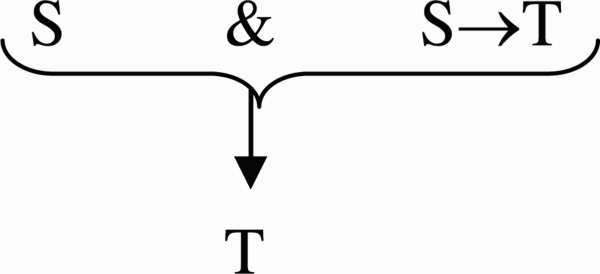
Part of each local argument in the global argument at some stage is a connection premise. The argument's connection premise is a conditional sentence having the argument's conclusion as its consequent and the conjunction of all reasons of that argument as its antecedent. Thus, if the protagonist has put forward the argument 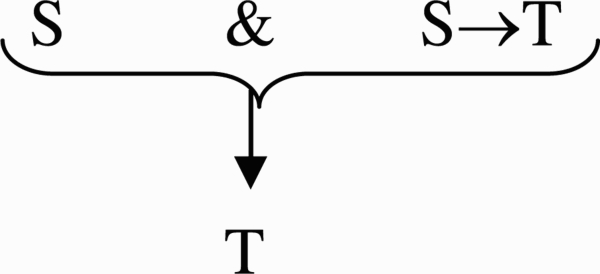
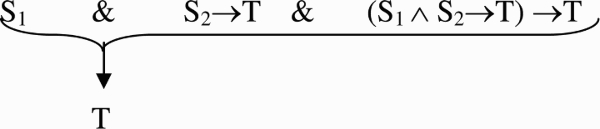
The regulative dialogue rules
There is one regulative rule.
Do not use expressions that are actively ambiguous within the context of the discussion.
This rule can be violated in a dialogue in which none of the constitutive dialogue rules of ambiguity dialectic have been violated. Nevertheless, the constitutive dialogue rules incite the parties to obey the regulative rule or attempt to obey it as much as possible.
The constitutive dialogue rules
If an ambiguity correction or ambiguity criticism focusing on an expression α is not appropriate, for the reason that α is not really actively ambiguous, the disambiguation must be seen as unnecessarily nitpicking and opportunistic or as an attempt at filibustering. Therefore, when participant P1 is confronted with an ambiguity correction or an ambiguity criticism focused on α and mentioning
The dialogue model has the option to follow a procedure which determines whether the parties share linguistic norms that exclude one or more of the proposed disambiguating reformulations
For most rules, it is stated in parentheses regarding what rule to apply if certain options are chosen.
The protagonist starts the dialogue at stage 1 by uttering STϕ (D3). The parties move alternately. If stage i contains the protagonist's standpoint STϕ, then stage i+1 contains the antagonist's:
WHϕ (D4), or SDf(C
i
; α; GIVE UP. If stage i contains ϕ as a standpoint, a reason or a connection premise and if stage i+1 contains the antagonist's challenge WHϕ, then stage i+2 contains the protagonist's:
ψ SOϕ (D5), or SDf(G
i
; α; α AA GIVE UP. If stage i contains WHχ
j
for some χ
j
(D4 or D10), or SDf(C
i
; α; α AA GIVE UP. If stage i contains the antagonist's spontaneous disambiguation SDf(C
i
; α; linguistic criticism LI? (D11 or D12), or relevance criticism RE? (D13), or disambiguation FDg(G
i
; α; If stage i contains the antagonist's WH linguistic criticism LI? (D16), or WH WHψ such that ψ is a (yet) unchallenged reason or connection premise in f(Gi+1; α; If stage i contains the protagonist's ambiguity criticism α AA linguistic criticism LI? (D17), or relevance criticism RE? (D19), or disambiguation FDg(C
i
; α; If stage i only contains the antagonist's forced disambiguation FDg(C
i
; α; If stage i contains the antagonist's WHϕ, stage i+1 the protagonist's ambiguity criticism α AA If stage i contains the antagonist's SDf(C
i
; α; If stage i contains the antagonist's α AA If stage i contains the antagonist's SDf(C
i
; α; CO WIC
i
; α, when stage i contains SDf(C
i
; α; If stage i contains the antagonist's relevance defence CO FDf(G
i
; α; GIVE UP. If stage i contains the antagonist's ambiguity withdrawal WIα or WIC
i
; α, then stage i+1 contains the protagonist's G
i
(D5). If stage i contains the protagonist's SDf(G
i
; α; If stage i contains the protagonist's αAA If stage i contains the antagonist's WHϕ, stage i+1 the protagonist's SDf(Gi+1; α; If stage i contains the protagonist's ambiguity criticism α AA The antagonist is not allowed to challenge ϕ (standpoint, reason or connection premise) at stage i if ϕ is an element of C
i
. At stage k the use of expression α is not permittted if at an earlier stage i there is an occurrence of α AA It is not permitted to raise exactly the same ambiguity criticism, linguistic criticism or relevance criticism.
Win-and-loss rules
There is one win-and-loss rule:
The participant who utters GIVE UP loses the discussion and the other participant wins it.
Sample ambiguity dialogues
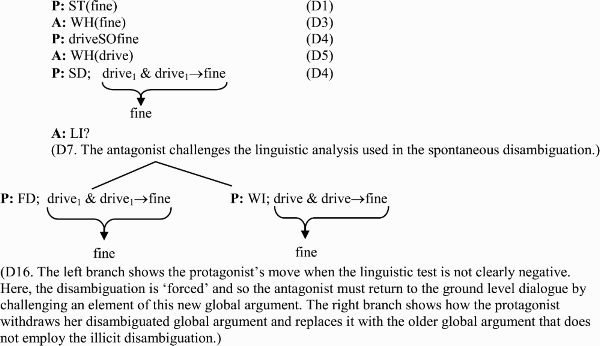
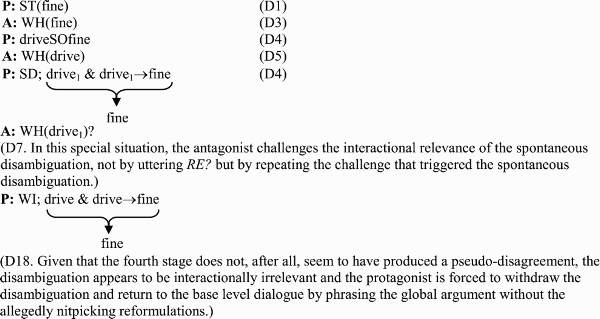
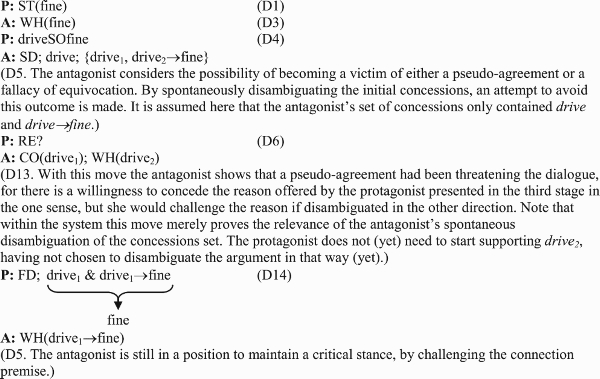
In this section, I will illustrate the dialogue system using some examples. A branching of the sequence of moves stands for alternative courses of the ambiguity dialogue. P is short for Protagonist, A for Antagonist. The code refers to a rule that enables the move. The term ‘fine’ is short for ‘W.B. must be fined’; ‘drive’ for ‘W.B. is driving a car’; ‘drive1’ for ‘W.B. is driving a car, in the broad sense of “driving”’; ‘drive2’ for ‘W.B. is driving a car, in the strict sense of “driving”’.
(1) In the first set of examples, the antagonist raises an ambiguity criticism and the protagonist acknowledges it by disambiguating the global argument in somewhat different ways in the two dialogues.
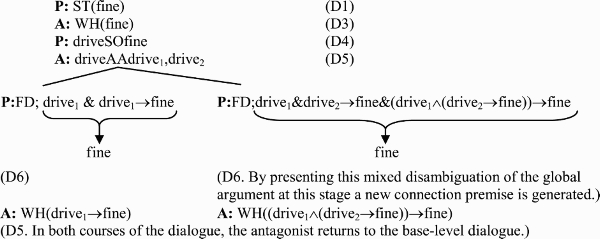
(2) In the second set of examples, the protagonist, out of fear of a pseudo-disagreement, spontaneously disambiguates his global argument and the antagonist responds critically by challenging the linguistic admissibility. In the branch on the left, the linguistic test does not prove negative, in the branch on the right, it does.
(3) In the third set of examples, the antagonist challenges the relevance of a spontaneous disambiguation offered by the protagonist.
(4) In the fourth set of examples, the antagonist is herself partly responsible for the existence of the expression ‘fine’. Consequently, the antagonist spontaneously disambiguates her set of initial concessions.
Conclusion
In this paper, an explication of the pejorative sense of ‘ambiguous’, called ‘actively ambiguous’, has been presented. It has been argued that even a normative model of reasonable and critical discussion ought not to ban active ambiguities altogether. Instead, it was proposed that the norms of persuasion dialogue must first enable each participant to put forward ambiguity criticisms as well as self-critical ambiguity corrections to induce them to improve their language, and second enable them to determine whether the ambiguity corrections or ambiguity criticisms are appropriate, thereby preventing nitpicking and filibustering.
A dialogue system, ambiguity dialectic, has been specified that satisfies six philosophical requirements on normative models of argumentative discussion that accommodate active ambiguities. Ambiguity dialectic is immanently dialectical, it strikes a balance between normative bite and a tolerance of imperfections, it implements the correct norms regarding the use of actively ambiguous expressions, it is organised in accordance with a dialectical division of labour, it strikes a balance between enabling meta-remarks and keeping to the topic at hand, and it starts from a clear conception of disambiguation. The model can be used to analyse and evaluate ways in which discussants deal with ambiguities, as well as for the further development of interaction protocols for agents attempting to achieve their argumentative aims in a reasonable way while using an imperfect language.
Footnotes
Acknowledgements
An earlier version of this paper was presented at the ‘Dimensions of Ambiguity’ conference at the Eberhard Karls University Tübingen, Tübingen, November 2009. I am very grateful for the comments made by the anonymous reviewers of this journal.