



Abstract
Readers’ eyes often skip over words as they read. Skipping rates are largely determined by word length; short words are skipped more than long words. However, the predictability of a word in context also impacts skipping rates. Rayner, Slattery, Drieghe and Liversedge reported an effect of predictability on word skipping for even long words (10-13 characters) that extend beyond the word identification span. Recent research suggests that better readers and spellers have an enhanced perceptual span. We explored that whether reading and spelling skill interact with word length and predictability to impact word skipping rates in a large sample (N = 92) of average and poor adult readers. Participants read the items from Rayner et al., while their eye movements were recorded. Spelling skill (zSpell) was assessed using the dictation and recognition tasks developed by Sally Andrews and colleagues. Reading skill (zRead) was assessed from reading speed (words per minute) and comprehension accuracy of three 120 word passages each with 10 comprehension questions. We fit linear mixed models to the target gaze duration data and generalized linear mixed models to the target word skipping data. Target word gaze durations were significantly predicted by zRead, while the skipping likelihoods were significantly predicted by zSpell. Additionally, for gaze durations, zRead significantly interacted with word predictability as better readers relied less on context to support word processing. These effects are discussed in relation to the lexical quality hypothesis and eye movement models of reading.
Introduction
Reading requires the coordinated movement of the eyes across lines of text so that high acuity foveal vision can be used to encode each word. These eye movements are comprised of short pauses (fixations) and fast jumps (saccades) from one location to the next. To read efficiently, the eyes must remain fixated on words just long enough for identification. However, words differ in how easy they are to process and, therefore, how long they need to be fixated during reading (see Rayner, 1998, 2009 for reviews).
Ending a fixation requires programming a saccade to a new location which takes approximately 125-150 ms (Becker & Jürgens, 1979; Rayner, Slowiaczek, Clifton, & Bertera, 1983). Therefore, efficient reading requires that readers learn to program eye movements to new locations in advance of the completion of ongoing word processing. Failing to do this would result in the eyes remaining in locations longer than is optimal. Using only a handful of assumptions about the visual system and language processing, Reichle and Laurent (2006) demonstrated how an intelligent agent can “learn” to coordinate simulated eye movements qualitatively similar to humans. Including saccadic error in the simulation resulted in optimal patterns that included refixating certain words and skipping others. 1 Word skipping is of interest because the decision to program these saccades is based on coarse parafoveal information about upcoming words (Brysbaert & Vitu, 1998), rather than the detailed information required for efficient word identification. Both the E-Z Reader (Reichle, Pollatsek, Fisher, & Rayner, 1998; Reichle & Sheridan, 2015) and saccade-generation with inhibition by foveal targets (SWIFT (Engbert, Nuthmann, Richter, & Reinhold, 2005; Richter, Engbert, & Kliegl, 2006)) models of eye movements during reading predict that word skipping can occur based on incomplete lexical processing of the upcoming word, albeit for different reasons. Within E-Z Reader, intended skips of an upcoming word (n + 1) will be triggered when the initial stage of lexical processing (L1) of word n + 1 completes before the initial stage of oculomotor processing (M1) from word n completes. However, with SWIFT, intended skips occur when the lexical activation of word n + 2 (or beyond) is greater than the lexical activation of word n + 1. So, with E-Z Reader, the important thing is how much lexical processing of the upcoming word has occurred, but with SWIFT, the important thing is the relative amount of lexical processing for the upcoming words.
Word skipping during reading
Adult readers skip approximately one third of the words in a text as they read (Rayner, 1998, 2009). Word length is the largest factor influencing whether that word is skipped or not (Drieghe, Desmet, & Brysbaert, 2007). Shorter words are more likely to be skipped than longer words (Brysbaert & Vitu, 1998; Rayner, 1979; Rayner & McConkie, 1976; Vitu, O’Regan, Inhoff, & Topolski, 1995). However, word length is not the only factor influencing word skipping. Words matched on length are more likely to be skipped if they are predictable from context (Altarriba, Kroll, Sholl, & Rayner, 1996; Balota, Pollatsek, & Rayner, 1985; Drieghe, Rayner, & Pollatsek, 2005; Ehrlich & Rayner, 1981; Gollan et al., 2011; Rayner, & Well, 1996) and if they are high rather than low frequency (Angele, Laishley, Rayner, & Liversedge, 2014; Rayner, & Fischer, 1996; Rayner, Sereno, & Raney, 1996). These effects of predictability and word frequency indicate that word skipping is at least partially the result of higher level cognitive processes. 2
The decision to skip the upcoming word is necessarily based on visual information obtained from parafoveal vision (for a review, see Schotter, Angele, & Rayner, 2012) and predictions derived from context. When these two sources of information have been pitted against each other, visual word length information from the parafovea has outweighed contextual predictability (Brysbaert & Vitu, 1998). For instance, Angele and Rayner (2013) found that readers will skip an invalid preview of the article “the” even when it is contextually inappropriate. They argue that detection of short high frequency words may automatically initiate a word skipping saccade.
Drieghe, Brysbaert, Desmet, and De Baecke (2004) were the first to examine word length and predictability in the same experiment. They embedded target words with either two or four letters within sentence frames that were highly constraining for a particular word. Readers read these words in one of three conditions: the target was the word which was predictable from context, the same length as the predictable word or a different length than the predictable word. Thus, they were able to examine the effect of having parafoveal word length information that either matched or did not match the length of the expected word. They found that unpredicted target words were skipped with similar likelihoods regardless of whether they had the same number of letters as the predicted word or not. Additionally, skipping was greater for the predicted than the unpredicted words. So, word length and predictability had independent effects on skipping with word length being more important.
Drieghe et al. (2004) had two important limitations. First, using very short words may have resulted in ceiling effects for skipping. This may have obscured potential length and predictability interactions. Second, with such high skipping rates, the sparse fixation duration data make it difficult to interpret how length and predictability influence word processing when these words are not skipped. Rayner, Slattery, Drieghe, and Liversedge (2011) addressed these limitations by manipulating the predictability of target words that varied from 4 to 12 letters in length. Readers were more likely to skip shorter words than longer ones and more likely to skip words that were predictable from prior context. Main effects of word length and predictability were also found in target gaze durations. However, they found no evidence of an interaction between length and predictability in either skipping rates or fixation time measures. They concluded that skilled adult readers use word length and predictability information independently to inform oculomotor programming.
Lexical quality, reading and eye movements
Not everyone develops the same level of reading expertise. According to the lexical quality hypothesis (LQH), what differentiates good from poor readers is the precision of their lexical representations (Perfetti, 2007; Perfetti & Hart, 2002). One consequence of having low-quality lexical representations is greater reliance on context to support word processing. Indeed, such interactions between reading ability and contextual constraint have been reported for college aged readers (Ashby, Rayner, & Clifton, 2005).
Andrews and Hersch (2010) explored the LQH using masked priming in the lexical decision task (LDT). They argued that the quality of a person’s lexical representations should be directly related to their spelling ability. Therefore, they measured the spelling ability of their participants along with other measures of reading ability. They found that neighborhood priming was inhibitory for good spellers but facilitatory for poor spellers. These effects highlight how differences in specific reading related abilities can alter the reading process. Moreover, these effects of reading ability were found even with a relatively homogeneous college student population, making them all the more striking (see also Andrews & Lo, 2012, 2013).
Kuperman and Van Dyke (2011) demonstrated that reading skill differences account for more variance in readers’ eye movement behaviors than word-level variables, such as frequency and length. Their work is especially important because they sampled from a population of non-college-bound adults which allowed them to examine reading abilities in a less homogeneous group. Consistent with the LQH, they found that measures of word identification ability were consistently predictive of reading eye movements. On average, readers with better word identification abilities had shorter gaze durations and longer saccades during reading. Poor word identification abilities were also associated with larger gaze duration effects of word length.
More recently, Eskenazi and Folk (2015) explored the effect of reading skill on word skipping by varying the length of target words (three or five letters) and foveal load. They found that for less skilled readers, the skipping of three-letter target words was influenced by foveal load, being greater following high than low frequency n – 1 words. However, neither reading ability nor foveal load influenced the skipping of five-letter target words. While Eskenazi and Folk (2015) measured reading skill with the vocabulary and comprehension sections of the Nelson–Denny Reading Test, they did not include any measures of spelling ability in their study.
Veldre and Andrews (2016) investigated reading and spelling skill in semantic parafoveal preview benefit with a boundary change study. They reported that for four- to six-letter target words embedded in unpredictable contexts, target skipping increased with spelling ability. However, reading ability as assessed by the Nelson–Denny Reading Test did not significantly predict target word skipping rates. So, word skipping appears to be more related to spelling ability than to reading comprehension skill.
Spelling and reading abilities have also been shown to modulate the amount of information that readers obtain from the right of fixation during reading. Veldre and Andrews (2014) used the moving window paradigm (McConkie & Rayner, 1975) and demonstrated that better spellers and readers had larger rightward perceptual spans than poor spellers and readers. Using the boundary paradigm (Rayner, 1975), Veldre and Andrews (2015a) reported that readers who were highly proficient at written language comprehension (i.e., high reading and spelling ability) extracted more lexical information from upcoming words than less proficient readers. These results agree with earlier reports that beginning readers have a smaller span than skilled readers (Rayner, 1986), and slower readers have a smaller span than faster readers (Rayner, Slattery, & Bélanger, 2010).
Highly skilled readers and spellers may also benefit more from parafoveal word length cues. Veldre and Andrews (2015b) explored the hypothesis that parafoveal word length information can be used to constrain lexical processing (Clark & O’Regan, 1999; Inhoff, Eiter, Radach, & Juhasz, 2003; Juhasz, White, Liversedge, & Rayner, 2008; White, Rayner, & Liversedge, 2005). They used the boundary paradigm to provide readers with accurate or inaccurate previews of orthography and word length. They found that preview benefits associated with having access to the accurate letters in the parafovea were larger when accurate word length information was also available. Furthermore, this effect interacted with reading and spelling ability as it was driven primarily by highly skilled readers and spellers.
Experiment
Differences in spelling and reading abilities are associated with differences in how readers use context, process orthographic information and benefit from parafoveal information. Word skipping during reading is also directly tied to these three processes. Therefore, we examined the effect that reading and spelling ability had on word skipping rates in a large-scale replication of Rayner et al. (2011) and included measures of participants’ reading and spelling abilities.
We were particularly interested in three questions. First, would the increased perceptual span of highly skilled readers and spellers (Veldre & Andrews, 2014) provide them information useful for influencing word skipping? While Eskenazi and Folk (2015) found that reading ability influenced the skipping of short (three letter) words, it only did so under conditions of high foveal load. Additionally, they did not include a measure of orthographic decoding (i.e., spelling) ability which has been shown to influence word skipping (Veldre & Andrews, 2016). However, no study of reading and spelling ability has yet to manipulate both the length and predictability of target words. The current study included target words that varied from 3 to 12 letters in length embedded in predictable and unpredictable contexts allowing for a broader exploration of word skipping behavior.
Second, would better spellers have reduced word length effects compared to poor spellers? Better spellers have, by definition, more orthographic knowledge of words than poor spellers. Since long words contain more orthographic information than short words, it follows that differences in word processing based on spelling ability would be more apparent with longer words, similar to the effect reported by Kuperman and Van Dyke (2011).
Third, would readers with high-quality lexical representations, as indexed by spelling ability, utilize word length and predictability information jointly to influence word processing? While Rayner et al. (2011) reported additive effects of these variables, they did not measure their participants reading and spelling ability which may have obscured a potential interaction. For instance, if readers only obtain predictability benefits for words when their lexical representation for them is of sufficiently high quality, then poor spellers would be expected to benefit less from predictability when the target word is long compared to good spellers. Additionally, Veldre and Andrews (2015b) reported that individuals with high reading and spelling ability were able to use word length cues to aid word processing in parafoveal vision. Therefore, good readers, who are also good spellers, may be capable of using word length and predictability information jointly to constrain lexical processing.
Methods
Participants
In total, 106 students of the University of South Alabama participated in this study. All participants had normal or corrected to normal vision, were naïve as to the purpose of the experiment, self-identified as native speakers of American English and indicated that they did not have a diagnosis of dyslexia. However, we acknowledge the possibility that some of our participants may have been undiagnosed dyslexic. To reduce the likelihood that such undiagnosed dyslexic readers were included in the analyzed sample, we excluded data from 14 participants who failed to achieve at least 70% accuracy on the reading comprehension test of individual differences. 3
Individual difference tests
We collected two measures of spelling ability reported in Andrews and Hersch (2010). The first test required participants to spell 20 words after hearing them read aloud, alone and in a sentence. Their score on this test was the number of words correctly spelled. The second test presented participants with 88 words, half of which were spelled incorrectly. Participants were required to indicate which words were spelled incorrectly. The participants’ score on this second test was 88 – (unidentified misspelled words + misidentified correctly spelled words).
We estimated effective reading rate by having participants read three 120-word passages with an average word length of 5.07 characters and a Flesch–Kincaid grade level of nine indicating that they were appropriate for readers with at least a ninth-grade education. The Flesch–Kincaid grade level is a metric for estimating the ease with which a passage can be read 4 (Kincaid, Fishburne, Rodgers, & Chisholm, 1975) and is easily obtained using Microsoft Word by selecting the “show readability statistics” option within the spelling and grammar tool. After reading each passage, participants answered 10 factual true or false question about the passage. The participants’ effective reading rate was calculated as their words per minute (WPM) reading rate multiplied by the proportion of comprehension question they answered correctly (Jackson, & McClelland, 1975, 1979; Rayner, Abbott, & Plummer, 2015).
Apparatus
An SR Research Eyelink 1000 eye-tracker sampled gaze position every millisecond. Reading was binocular, though eye movement data were only collected from the right eye. Stimuli were presented on a 24 inch BenQ gaming LCD monitor. Participants were seated 60 cm from the monitor. Responses were collected with a VPixx five-button response box.
Materials
The stimuli were taken from Rayner et al. (2011). Each of the 54 experimental items consisted of two sentences with a target word in the second sentence which was either high or low cloze probability. The first sentence of the pair established the predictability manipulation. The target words varied in length ranging from 4 to 12 letters (M = 7.74). In Rayner et al. (2011), the target words were broken into three-word length categories: short, medium and long. The average log HAL frequency (Burgess, 1998; Burgess & Livesay, 1998) for the target words was 9.01 (range = 7.19-11.59) and did not differ across the word length categories, F < 1. Sentences were presented in black letters on a white background using a 14-point Consolas font (3.2 letters subtended 1° of visual angle).
Procedure
Upon arrival, participants were informed of procedures, familiarized with equipment and asked to read and sign an informed consent document. Then they were seated comfortably in front of the eye tracker. Head movements were minimized with a chin rest. The tracker was calibrated using a full-screen calibration procedure. Validation errors greater than 0.4° of visual angle resulted in a new calibration. The 54 experimental stimuli and 88 filler stimuli were presented in a random order. Participants read them silently at their own pace for comprehension. At the start of each trial, a 50 × 50 pixel black square appeared, coinciding with the location of the beginning of the passage. Upon detecting a stable fixation on this square, it was replaced by the passage. Participants pressed a button on the response box to indicate that they finished reading. To check for comprehension, “yes/no” questions were presented after one third of the stimuli. Participants answered these questions by pressing one of two buttons on the response box.
Following the experiment, participants were given a 5-min break before completing the individual difference tests in the following order: reading comprehension, spelling dictation and misspelled word recognition. The procedure took 1 hr 30 min to complete including breaks. Participants received course credit for their participation.
Results
Individual difference measures
The means and standard deviations of the individual difference tests appear in Table 1. The spelling data are noteworthy in that the standard deviations for these measures are on par with Andrews and Hersch (2010), but the means are a standard deviation below theirs. The effective reading rate scores in our sample ranged from very low (75 WPM) to average (246 WPM). While we did not explicitly recruit struggling readers, our sample nonetheless included students with poor reading skills. This aspect of our data makes it well suited for the study of individual differences in reading.
Descriptive statistics for the individual difference variables.
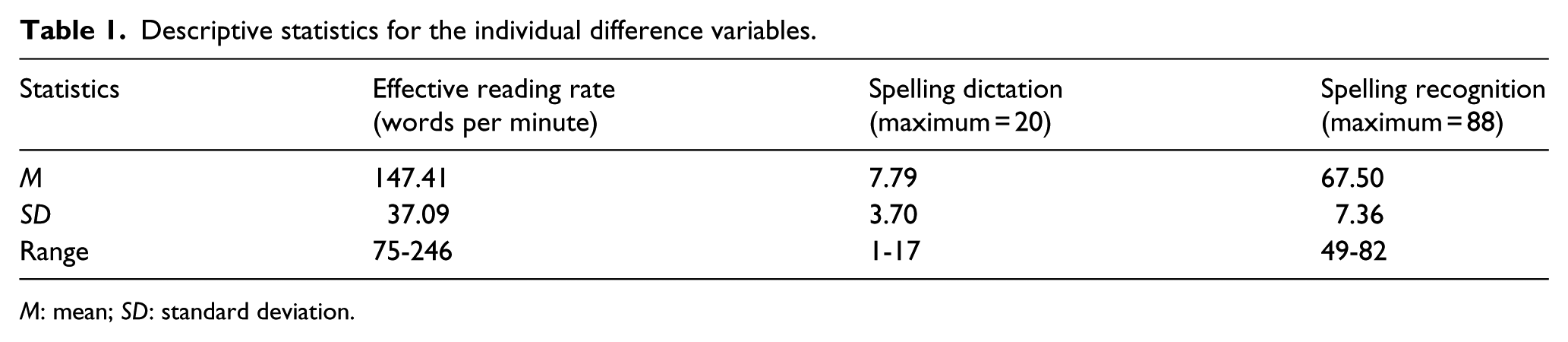
M: mean; SD: standard deviation.
Following Andrews and Hersch (2010), the two spelling measures were standardized then averaged together to create the variable zSpell. The effective reading rate measure was also standardized to create the variable zRead. These variables were positively correlated, r = 0.305, p < 0.01. This correlation was only slightly smaller than the one reported by Andrews and Hersch (2010) despite using a different reading comprehension test.
Reading eye movement measures
The average comprehension question accuracy was 84% (range = 73%-97%). Trials with a blink or track loss on the target word or an immediately adjacent fixation were excluded from analysis (4.96% of trials). Gaze durations were calculated as the sum of first-pass fixations on the target word contingent on it being fixated during first-pass reading (Rayner, 1998). Target word skipping rate was calculated as the percentage of trials in which the target word was not fixated during first-pass reading. We also calculated the length of the first-pass reading saccade that either landed on or beyond the target word. Target word gaze durations and skipping rates appear in Table 2, split by word length category for comparison with Rayner et al. (2011).
Reading eye movement variables.
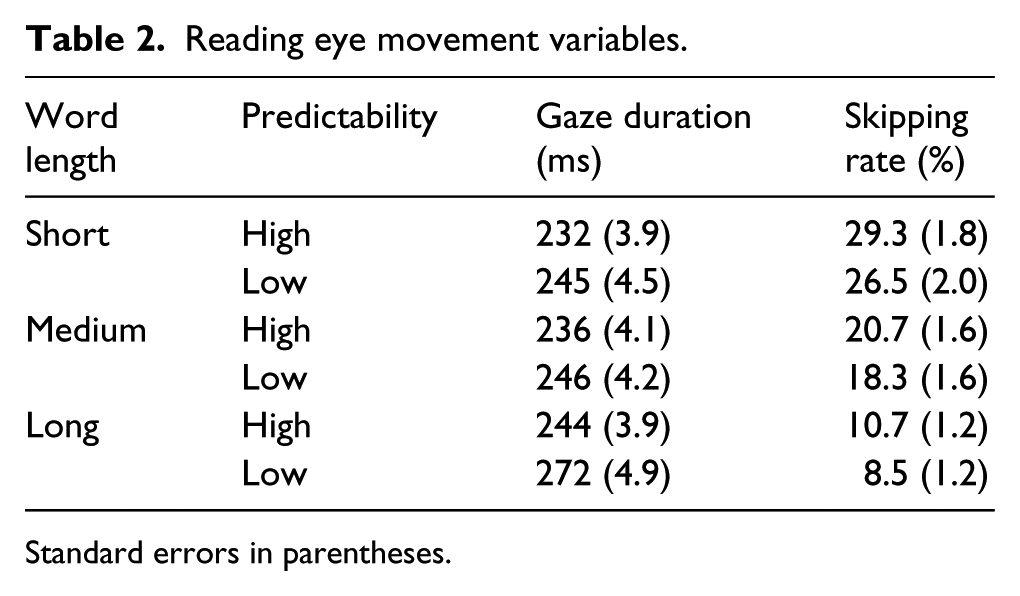
Standard errors in parentheses.
We used the lmer function from the lme4 package (Bates, Maechler, Bolker, Walker, 2015) within the R Environment for Statistical Computing (R Development Core Team, 2015) to fit linear mixed models (LMMs) of gaze duration and saccade length data and generalized linear mixed models (GLMMs) for the word skipping data. For all statistical models, we present effect coefficients (b), standard errors (SEs), and t values (t) or z values (z) within the relevant tables.
Gaze duration
We conducted two LMMs for log-transformed gaze duration data. The first LMM included fixed effects for only the experimentally manipulated variables: word length, predictability and their interaction. Crossed random intercepts were included for participants and items as well as random participant slopes for word length and predictability. Word length (number of characters) and predictability (cloze probability) were used as centered numerical predictors.
Gaze durations significantly increased with word length and significantly decreased with increasing cloze probability (see Table 3). However, the word length and predictability interaction was not significant. These effects replicate those from Rayner et al. (2011).
Results of first LMM for log gaze duration on the target word.
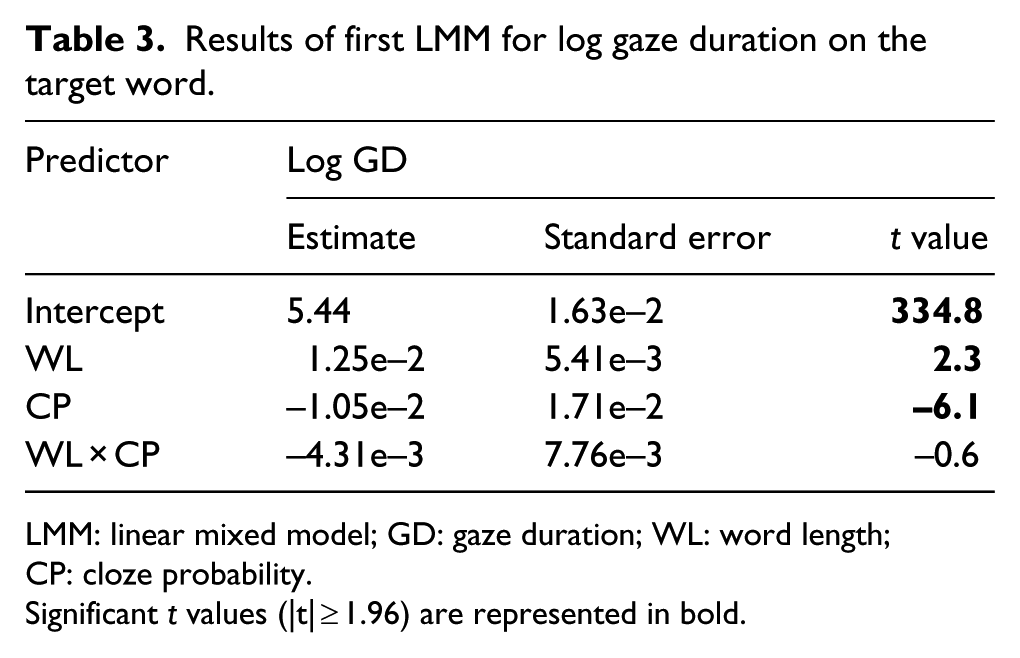
LMM: linear mixed model; GD: gaze duration; WL: word length; CP: cloze probability.
Significant t values (|t| ≥ 1.96) are represented in bold.
The second LMM for gaze (see Table 4) included the same fixed and random effects of the first model, but we now added the individual difference variables of zRead and zSpell as centered numerical fixed effects predictors along with all possible interactions. Slopes for the main effects of these predictors were also added to the random effects for items.
Results of second LMM for log gaze duration on the target word.
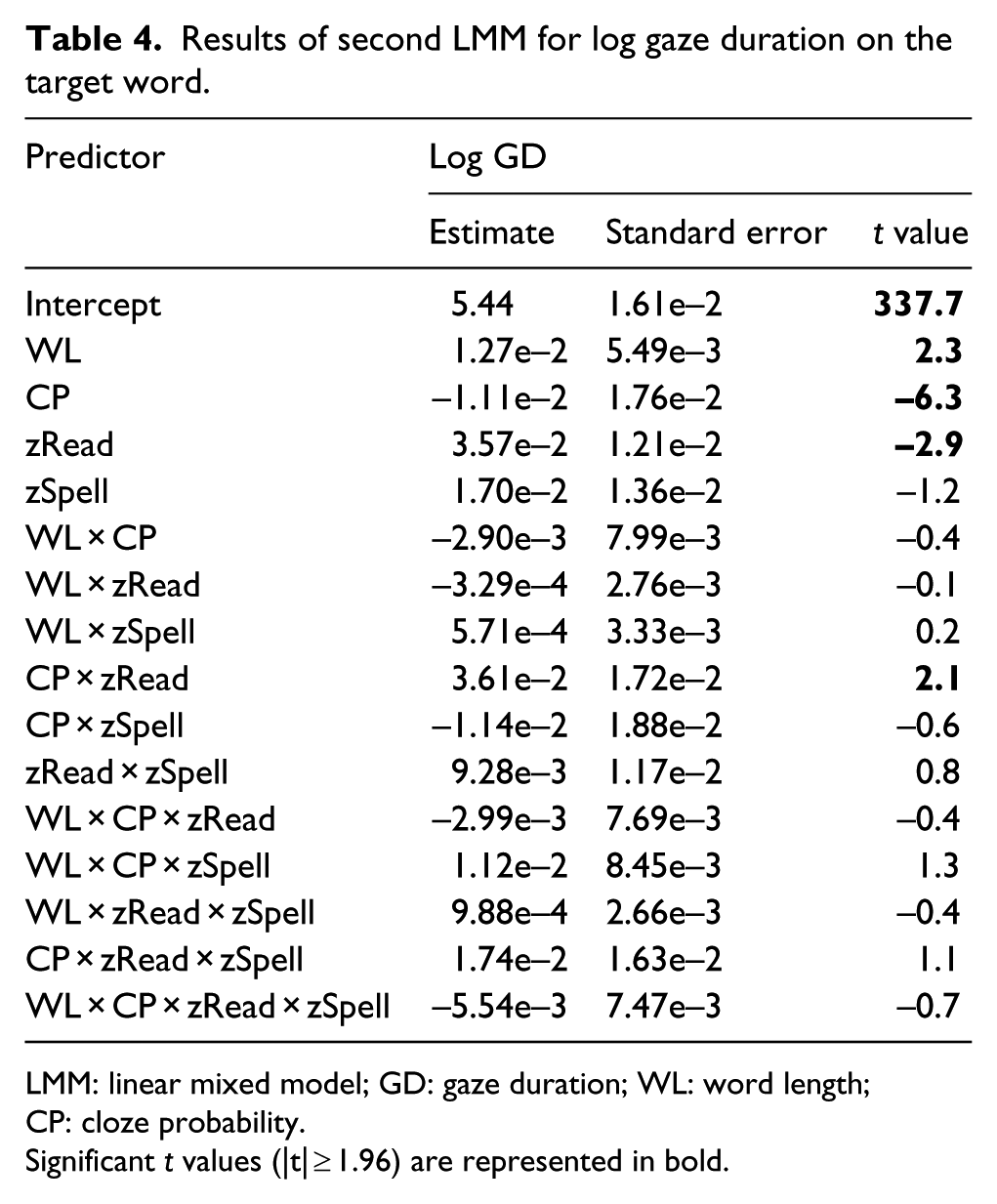
LMM: linear mixed model; GD: gaze duration; WL: word length; CP: cloze probability.
Significant t values (|t| ≥ 1.96) are represented in bold.
The main effects of length and predictability were nearly identical to those in the first LMM. Log gaze durations decreased as zRead increased. However, zSpell had no significant impact on gaze durations. When predictability increased, the gaze durations of lower ability readers decreased more than those of higher ability readers, which resulted in a significant interaction between zRead and cloze probability (see Figure 1).
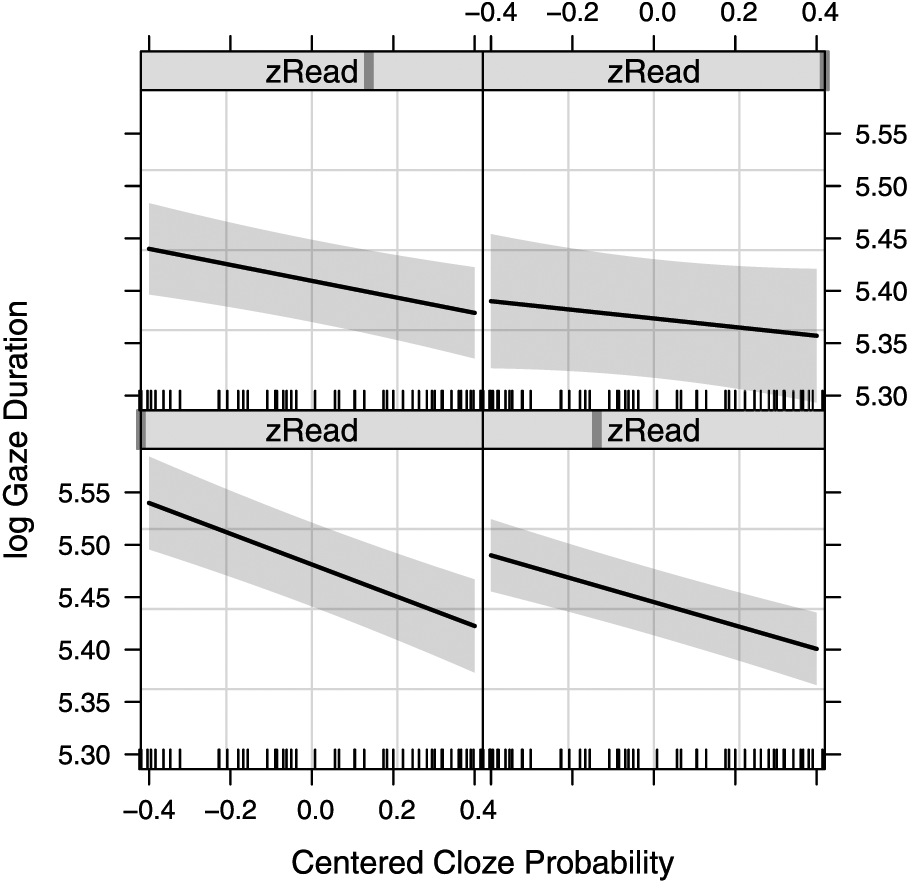
Gaze duration zRead by predictability interaction. The different panels split the zRead variable into four equal groups with the vertical line indicating the mean zRead for that panel. Therefore, the bottom left panel corresponds to the slowest 25% of readers and the upper right hand panel corresponds to the fastest 25%. The 95% confidence interval is indicated by the shaded bands around the best fitting lines.
Target word skipping
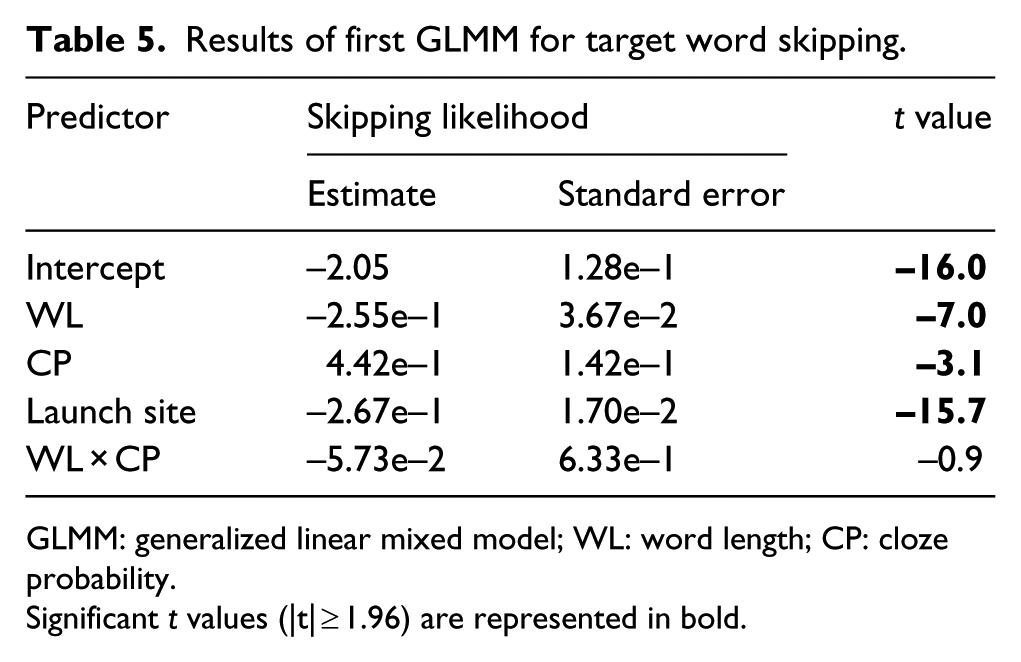
We fit two models to the skipping data. The first GLMM predicted word skipping using the same fixed effects structure as the first gaze duration model (main effects for length and predictability and their interaction) plus a main effect of launch site as a centered numerical predictor. Launch site has been shown to have a large impact on the likelihood of word skipping with skips being more likely for close launch sites (Rayner et al., 1996; Slattery, Staub, & Rayner, 2012; Vitu et al., 1995). We included crossed random effects for items and participants as with the gaze duration model. However, we did not include random participant slopes for length and predictability as these models failed to converge.
There was a significant effect of word length as the likelihood of skipping the target word decreased as its length increased (see Table 5). There was also a significant effect of predictability as the likelihood of target word skipping increased with increasing cloze probability. Additionally, the likelihood of skipping the target word increased as launch site decreased. The interaction between length and predictability was not significant. These effects again replicate those from Rayner et al. (2011).
Results of first GLMM for target word skipping.
GLMM: generalized linear mixed model; WL: word length; CP: cloze probability.
Significant t values (|t| ≥ 1.96) are represented in bold.
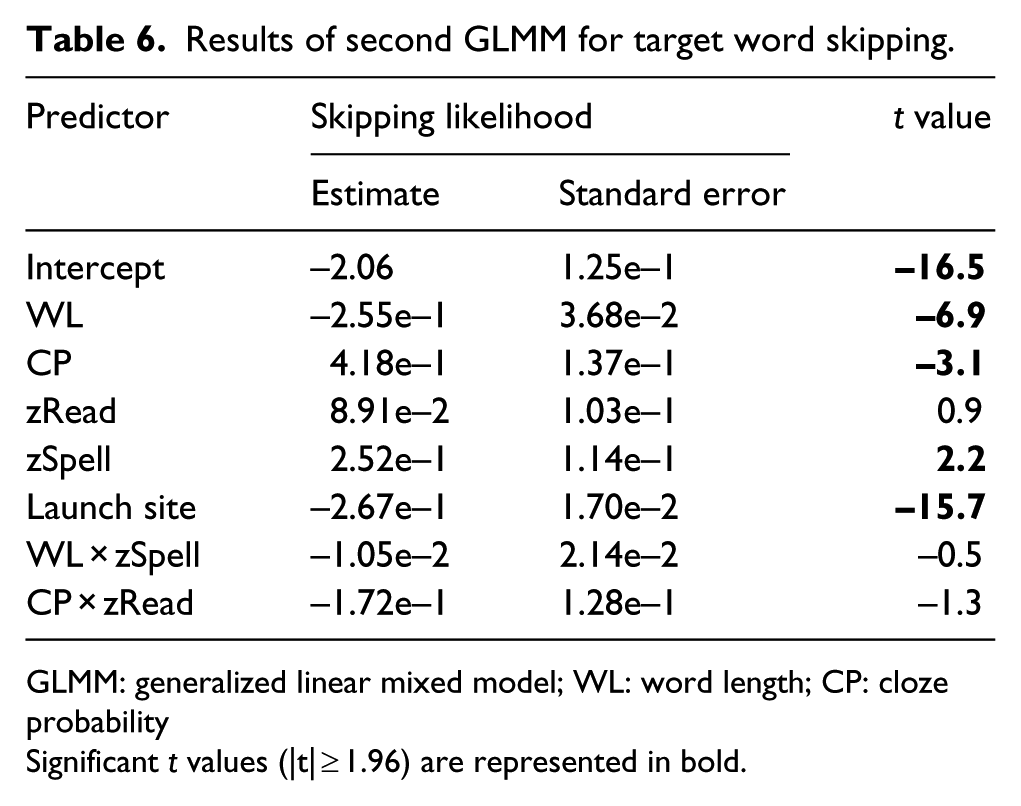
Next, we fit a second GLMM including the individual difference variables. However, GLMMs with the full fixed effects structure failed to converge, as did models with three-way interactions. Therefore, we reduced the fixed effects structure to include only a subset of the interactions that were of greatest a priori interest. These were the interaction between cloze probability and zRead and the interaction between word length and zSpell (see Table 6). As with the first GLMM, there were significant effects of word length and predictability. While there was no main effect of zRead on the likelihood of skipping the target word, there was a significant effect of zSpell, as better spellers were more likely to skip target words. However, neither interaction was significant.
Results of second GLMM for target word skipping.
GLMM: generalized linear mixed model; WL: word length; CP: cloze probability
Significant t values (|t| ≥ 1.96) are represented in bold.
Target word saccade length
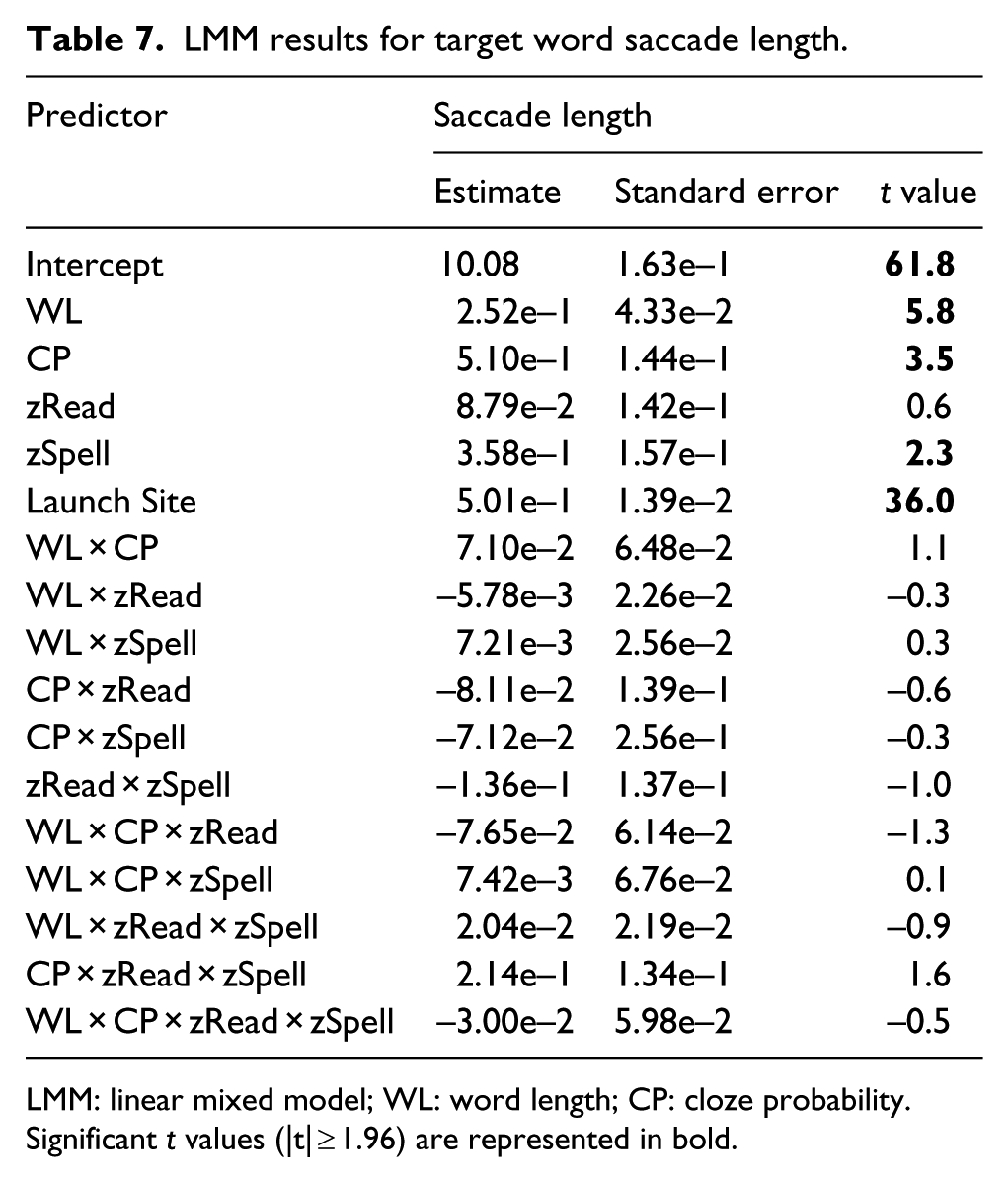
The GLMMs for word skipping failed to converge when higher order interactions were included. In order to rule out the possibility that reading and spelling ability influenced saccade planning and execution in more complex ways, we examined the length of the first-pass reading saccade that landed on or beyond the target word. In this way, we can examine the oculomotor programming related to the length and predictability of the target word as a continuous measure in an LMM (see Table 7) containing the full fixed effects structure used in the model for gaze duration with the addition of a main effect for saccade launch site.
LMM results for target word saccade length.
LMM: linear mixed model; WL: word length; CP: cloze probability.
Significant t values (|t| ≥ 1.96) are represented in bold.
The analysis of the saccade lengths yielded a similar result as the analysis of the skipping data. When controlling for launch site, there were significant positive effects of word length, cloze probability and zSpell. However, despite having the full fixed effects structure, with all interactions between the experimentally manipulated variables and individual difference variables, there was no evidence of higher order interactions.
Discussion
The current reading experiment manipulated the length and predictability of target words. We were able to successfully replicate numerous effects reported in the literature including all of the effects reported in Rayner et al. (2011). Gaze durations increased with word length and decreased with predictability. Skipping rates decreased with word length and increased with predictability. Additionally, the significant interaction between zRead and word predictability indicates that our better readers relied less on context to support their lexical processing. The LQH predicts just such an effect as context would only be required to aid word identification for words with low-quality lexical representations.
We were primarily interested in three questions. The first was whether better spellers and/or readers would be more likely to skip our target words. Prior research has demonstrated that perceptual span is larger for faster readers (Rayner et al., 2010) and readers who are better spellers (Veldre & Andrews, 2014). Additionally, readers with better word identification skills (i.e., pronunciations) make longer saccades (Kuperman & Van Dyke, 2011). While these effects suggest that increased reading/spelling abilities should result in greater skipping, they could also be the result of fewer refixations. In fact, Eskenazi and Folk (2015) reported that reading ability only influenced word skipping for short three-letter words and then only under conditions of high foveal load. In this study, we found that saccade lengths were significantly lengthened as spelling ability increased. Moreover, these longer saccades resulted in significantly higher target word skipping rates as spelling ability increased. The effect of spelling ability on skipping likelihood did not interact with word length which indicates that precise orthographic knowledge can aid in the skipping of more than just short words. However, effective reading rate did not significantly impact skipping rates. In light of this, it may be that the increased word skipping due to reading ability reported by Eskenazi and Folk (2015) resulted from a correlation between reading and spelling ability. If so, they may have underestimated the effect that individual differences in written language proficiency can have on word skipping behavior.
Our second question of interest was whether better spellers would have reduced word length effects compared to poor spellers. Kuperman and Van Dyke (2011) reported that compared to readers with poor word identification skills, the gaze durations of better word identifiers increased to a lesser degree as word length increased. Longer words contain more orthographic information, so readers with more orthographic knowledge should be less hindered by increases in word length. However, we found no evidence that word length effects were reduced for better spellers. This failure to replicate may be the result of differences between their measure of word identification skill, which used a pronunciation task, and our measure of spelling ability. However, it may also reflect the differences between corpus style studies which examine fixation times on every word in a passage and experimental studies which examine a single controlled target word embedded within a sentence (see Angele et al., 2015 for a discussion of such differences).
Our third primary question was whether better spellers would be able utilize word length and predictability information jointly to influence word processing. In Rayner et al. (2011), word length and predictability had additive effects on both gaze durations and skipping rates. However, it was possible that such interactions were masked by individual differences between readers. We found that while both reading and spelling ability significantly impacted eye movement measures in this study, there was still no indication of an interaction between word length and predictability.
Perhaps the most interesting result from this study is one that we were not anticipating. Reading but not spelling ability influenced gaze durations, and spelling but not reading ability influenced skipping rates. 5 Thus, it would appear that reading ability influenced primarily foveal processing while spelling ability influenced primarily parafoveal processing. However, within the E-Z Reader model, gaze durations and skipping rates are both related to the duration of the initial lexical processing stage (L1). Decreases in the duration of L1 have successfully modeled the eye movement differences between children and adults (Reichle et al., 2013) which are related to orthographic knowledge (Mancheva et al., 2015). As young adults, our poor spelling participants spent years “developing” reading skills without acquiring high-quality lexical representations. Perhaps their shorter saccades and reduced skipping behavior represent a beneficial compensation strategy. Still, it may prove challenging for the model to account for gaze and skipping rate effects that are generated from independent sources.
In SWIFT, lexical processing involves a word’s activation rising from zero to a maximum and then returning to zero. Since saccade targets are chosen based on their activation, SWIFT may be able to account for these effects by allowing the letter and word activation rates to be a function of spelling ability. Better spellers may be more likely to encounter states where the activation of word n + 1 is decreasing and word n + 2 is increasing at the point when the saccade target is selected.
In summary, word skipping during reading was influenced by word length, word predictability and readers’ spelling ability. Skipping likelihood was higher for short words, predictable words and good spellers. However, there were no interactions between these variables nor was there any influence of reading ability on skipping likelihood or saccade lengths, even when zSpell was removed from statistical models. Given that word skipping behavior is based on coarse parafoveal information, these results indicate that the lexical representations of good spellers allow them to do more than poor spellers can with this coarse information.
Recent research has consistently found that reading speed and spelling ability influence eye movement measures of reading in important ways. Future research and modeling efforts exploring how these variables shape the reading process may yield great advances for theory and application alike.
Footnotes
Acknowledgements
The authors thank Bernhard Angele for his helpful comments on an earlier draft and his assistance in graphing the effects from the statistical models with R.
Declaration of conflicting interests
The author(s) declared no potential conflicts of interest with respect to the research, authorship, and/or publication of this article.
Funding
The author(s) received no financial support for the research, authorship, and/or publication of this article.