




Abstract
Illusory control refers to an effect in games of chance where features associated with skilful situations increase expectancies of success. Past work has operationalized illusory control in terms of subjective ratings or behaviour, with limited consideration of the relationship between these definitions, or the broader construct of agency. This study used a novel card-guessing task in 78 participants to investigate the relationship between subjective and behavioural illusory control. We compared trials in which participants (a) had no opportunity to exercise illusory control, (b) could exercise illusory control for free, or (c) could pay to exercise illusory control. Contingency Judgment and Intentional Binding tasks assessed explicit and implicit sense of agency, respectively. On the card-guessing task, confidence was higher when participants exerted control than in the baseline condition. In a complementary model, participants were more likely to exercise control when their confidence was high, and this effect was accentuated in the pay condition relative to the free condition. Decisions to pay were positively correlated with control ratings on the Contingency Judgment task, but were not significantly related to Intentional Binding. These results establish an association between subjective and behavioural illusory control and locate the construct within the cognitive literature on agency.
Keywords
Under conditions of chance, including many forms of gambling, humans often overestimate their level of control or skill. In Langer's (1975) famous experiments introducing the “illusion of control”, participants who had the opportunity to choose a lottery ticket requested a higher price for selling back the ticket than participants who did not have this opportunity to choose (mean selling prices: $8.67 vs. $1.96, respectively). According to Langer (1975), this inappropriate expectation of success (termed illusory control) arises when games of chance employ features that are typically associated with skilful situations. As well as a choice (in the lottery experiments), the opportunity for instrumental action can be a potent means of eliciting illusory control. For example, in a field study of craps players, players were more likely to bet and placed higher bets when they were personally throwing (“shooting”) the dice than during other players’ throws (Davis, Sundahl, & Lesbo, 2000). Similarly, in a laboratory study of roulette, participants placed higher bets in a condition where they threw the roulette ball onto the wheel than when a croupier threw the ball (Ladouceur & Mayrand, 1987).
Despite some provocative demonstrations of illusory control, and a widespread recognition that the construct is relevant to gambling policy and the treatment of problem gambling (Fortune & Goodie, 2012; Griffiths, 1993; Ladouceur & Sevigny, 2005), there is still much that is unclear about the cognitive underpinnings of illusory control. The conventional definition by Langer (1975) refers to a judgment effect, that the perceived likelihood of winning (“the expectancy of a personal success probability”, p. 311) is altered by some kind of personal involvement. However, a host of complementary (but psychologically distinct) factors may also contribute to these effects. The reluctance to exchange lottery tickets may be linked to magical beliefs about “tempting fate” (Risen & Gilovich, 2007) or an increased “ownership effect” (i.e., enhanced value attached to personal possessions; Gawronski, Bodenhausen, & Becker, 2007; Pierce, Kostova, & Dirks, 2003). Participants may derive greater reward utility from outcomes that arise from their own behaviour than from non-contingent outcomes (e.g., Leotti & Delgado, 2011; Tricomi, Delgado, & Fiez, 2004). An overestimation effect under conditions of low control may also reflect a more general difficulty in discerning the level of control, such that participants similarly underestimate their degree of control when control is actually high (Gino, Sharek, & Moore, 2011; see also Thompson, Armstrong, & Thomas, 1998).
Arbitrating between these various mechanisms has been hampered in part by differences in how studies have operationalized illusory control. Although Langer's (1975) original studies measured pricing decisions, most subsequent studies have relied upon subjective ratings as the primary dependent variable, either of “confidence in winning” or of “perceived control” (see Presson & Benassi, 1996; Stefan & David, 2013). Ratings offer a quick means for quantifying illusory control perceptions, but these estimates tend to be taken after (rather than during) the task and can therefore be prone to demand characteristics and memory biases (Ejova, Navarro, & Delfabbro, 2013; Presson & Benassi, 1996). Moreover, reporting higher confidence in a given condition does not convincingly show that the participant is under an illusion. For a compelling demonstration of a psychological “illusion”, participants should be willing to actively disadvantage themselves (e.g., by paying a cost) in order to gain or exercise control in a chance situation.
Fewer studies on illusory control have employed behavioural measures (see Stefan & David, 2013). Of those that have, some have used relatively “soft” measures that suffer from similar limitations to subjective ratings. For example, one procedure involves a dice-throwing game where rolling a six wins a prize. Participants are given the choice between throwing the die themselves, or letting the experimenter throw the die. Unsurprisingly, the majority of participants (73%, in Fast, Gruenfeld, Sivanathan, & Galinsky, 2009) choose to roll the die themselves (see also Dunn & Wilson, 1990; Grou & Tabak, 2008; Koehler, Gibbs, & Hogarth, 1994). However, this bias could again reflect demand characteristics, or a simple wish to be entertained or more involved in the experiment, rather than a genuine belief that one's own dice roll is more likely to win (see Koehler et al., 1994).
Only a small number of studies have examined whether players will actively disadvantage themselves to gain illusory control, and the means of disadvantaging the participant has been enacted in a number of ways. In Langer's (1975) original report (Experiment 3), participants who chose their lottery ticket later rejected an opportunity to exchange the ticket for a ticket in a second lottery with a higher chance of winning. In a roulette study where participants could use a handbrake device to stop the wheel, participants persisted in using the device when losses were punished with electric shocks, and even when using the device reduced the objective probability of success (and thus increased their probability of receiving a shock; Friedland, Keinan, & Regev, 1992). In another study, participants were prepared to buy the right to choose bet locations on a roulette wheel, rather than betting on random locations (Dixon, Hayes, & Ebbs, 1998). Perhaps unsurprisingly, these effects are sensitive to the magnitude of the costs involved (Dunn & Wilson, 1990). Grou and Tabak (2008) found that most participants (67%) elected to personally roll a die when it was free to do so, but only 12% paid a premium for this opportunity. Therefore, the evidence for participants actively disadvantaging themselves to exert illusory control is mixed. As gambling necessarily involves a monetary wager on an uncertain outcome, it is important to understand participants’ willingness to pay money in order to exercise control under conditions of chance. Past work has also neglected the question of whether subjective and behavioural definitions of illusory control are related.
The present study sought to develop a novel experimental task to distinguish between a subjective operationalization of illusory control based upon confidence ratings and a behavioural definition based upon the participants’ willingness to pay money in order to exercise control in a chance situation. Our task presented 13 playing cards face down around the perimeter of a circular wheel (see Figure 1), on each trial. A win segment and a loss segment (both of variable size) overlaid the cards; participants were told that if the Ace was revealed in the win segment, they would win a £1 (approximately $1.50US) prize, and if the Ace was revealed in the loss segment, they would lose £1. In this way, participants were encouraged to guess the position of the Ace on each trial. In some trials, participants were able to enact their guesses by rotating the win and loss segments. This control either was free (the “free spin” condition), or required the participant to pay a small fee (the “pay to spin” condition). In a baseline condition, the position of the win and loss segments was fixed (the “no control” condition). Confidence ratings were taken on each trial before the cards were turned over (which was after subjects made any decision to spin), to index subjective illusory control. The behavioural measure of illusory control was defined as the number of “pay to spin” decisions, demonstrating participants’ willingness to actively disadvantage themselves. As the number of wins was pre-specified, each participant's financial bonus on the task dropped in direct proportion to their number of pay decisions. By presenting the three conditions in an inter-leaved, multi-shot game, illusory control measures could be calculated for each participant. As previous studies have relied upon either single-shot, between-groups designs (Friedland et al., 1992; Grou & Tabak, 2008; Langer, 1975) or small sample sizes (n = 5; Dixon et al., 1998), the systematic investigation of individual differences has not been possible.
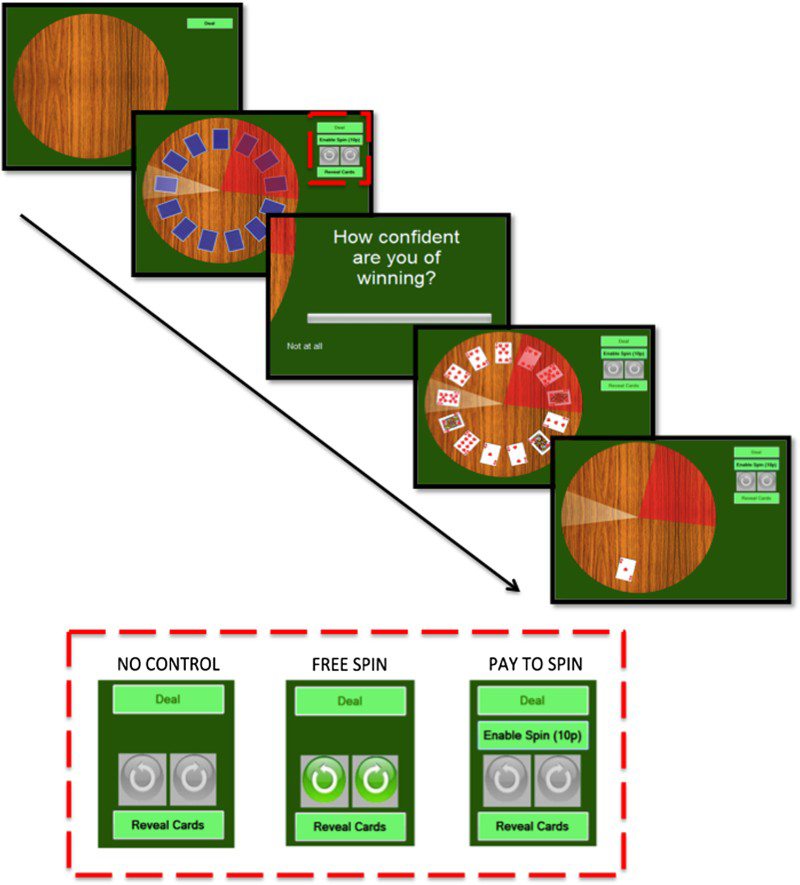
A full trial sequence for the gambling task; win probability is depicted in white, and loss probability is depicted in red. To view this figure in colour, please visit the online version of this Journal.
In light of these individual difference metrics, our second aim was to examine how illusory control is related to sense of agency. Sense of agency refers to our experience of control over our environment (Moore, Middleton, Haggard, & Fletcher, 2012). Recently, a distinction has been proposed between implicit and explicit aspects of the sense of agency (Dewey & Knoblich, 2014; Moore et al., 2012; Synofzik, Vosgerau, & Newen, 2008). Explicit agency refers to reflective, direct attributions of one's control over an event—for example, assessed by subjective ratings of control on a contingency judgment task (Alloy & Abramson, 1979). In contrast, implicit agency refers to a pre-reflective feeling of agency, typically measured by perceptual differences in reaction times between events that were self-generated versus externally generated. The “intentional binding” effect provides an established measure of implicit agency, referring to the subjective compression of time when a self-initiated action (e.g., a button press) gives rise to an outcome (e.g., a tone presented 250 ms later; Dewey & Knoblich, 2014; Haggard, Clark, & Kalogeras, 2002; Moore & Obhi, 2012). Changes in the magnitude of intentional binding are thought to indicate changes in the pre-reflective experience of control over actions and their outcomes (Moore et al., 2012).
How are individual differences in these implicit and explicit aspects of the sense of agency related to the illusion of control? Illusory control may be conceptualized as the faulty experience of agency in a non-contingent (i.e., chance) environment. This could arise either as a consequence of a reflective attributional process (explicit agency) and/or a distorted perceptual experience of one's control (implicit agency). Some work has suggested that there is a link between illusory control and reflective attributional processes. Pathological gamblers show elevated scores on questionnaire measures of illusory control (Raylu & Oei, 2004; Steenbergh, Meyers, May, & Whelan, 2002) and were recently found to make greater overestimations of control (relative to a healthy comparison group) on a contingency judgment task (Orgaz, Estévez, & Matute, 2013). In the classic version of this paradigm, the participant must decide on each trial whether or not to press a button (the action) in order to illuminate a lightbulb (the outcome; Alloy & Abramson, 1979). After a block of trials, participants rate their degree of control over the lightbulb illuminating. Under conditions of zero contingency, healthy participants typically overestimate their level of control, and particularly when the positive outcomes are frequent and are rewarded (e.g., by winning money). The observation that this bias was exaggerated in pathological gamblers was interpreted by Orgaz et al. (2013) as evidence that the illusion of control is a distributed, domain-general trait that conveys risk of gambling problems, although their study did not employ any direct measures of illusory control in a gambling context.
Other work indicates a link with measures of implicit agency. The intentional binding procedure is sensitive to disordered experiences of control in some clinical groups. For example, schizophrenia is associated with an abnormal sense of agency (e.g., passivity experiences) and exaggerated intentional binding (Haggard, Martin, Taylor-Clarke, Jeannerod, & Franck, 2003; Voss et al., 2010). In patients with Parkinson's disease, intentional binding was also sensitive to dopamine manipulation (via medication withdrawal; Moore et al., 2010). Dopamine is intimately linked to addictive disorders including pathological gambling (Boileau et al., 2014). Moore et al. (2010) hypothesized that an increased implicit sense of agency is a risk factor for impulse control disorders including pathological gambling, which are often seen as a side effect of dopaminergic medication in Parkinson's disease.
To formally characterize these relationships between the illusion of control and the explicit and implicit aspects of sense of agency, we administered a Contingency Judgment task (Alloy & Abramson, 1979) and the Intentional Binding task (Haggard et al., 2002), alongside our novel card-guessing task of illusory control. We also included a Locus of Control questionnaire (Levenson, 1973) to assess dispositional beliefs in the ability to influence one's environment (Rotter, 1966). Our hypotheses were as follows. First, at a descriptive level, we expected participants to make pay to spin decisions on the card-guessing task, consistent with a definition of illusory control that requires participants to disadvantage themselves. Second, we predicted that confidence ratings on the card-guessing task would be higher on trials where participants chose to spin the wheel than in the no control baseline condition. Third, we predicted that the cost involved (free spin, pay to spin), the probabilities of winning and losing (which were orthogonalized), and the participants’ confidence on each trial would influence participants’ choice to spin (see Footnote 2). Finally, we hypothesized that pay to spin decisions and confidence ratings on the card-guessing task would be correlated with internal locus of control (i.e., the belief that life events are determined by ones behaviour, rather than a result of external factors), overestimations of control on the Contingency Judgment task, and the magnitude of the intentional binding effect.
Experimental study
Method
Participants
Undergraduate student participants from the University of Cambridge (n = 78, 52.6% male, age range: 18–23 years) were recruited via poster and email advertisements. Approximately a quarter (26.9%, n = 21) of participants reported that they had gambled at least once within the past 12 months. The Problem Gambling Severity Index (Ferris & Wynne, 2001) indicated that our participants were predominantly non-problem gamblers (score = 0, n = 52, 66.7%) or “low-risk” gamblers (score = 1–2, n = 20, 25.6%), with a small number of “moderate-risk” gamblers (score = 3–7, n = 6, 7.7%). No participants were classified as “probable problem gamblers” (score > 7). Self-reported games of choice in the subgroup who gambled were mostly poker and sports betting. The study was approved by the University of Cambridge Psychology Research Ethics Committee.
Participants completed the card-guessing task, the Contingency Judgment task, and the Intentional Binding task on a 15″ Acer laptop, in a counterbalanced order. Testing sessions lasted approximately 1 hour. Participants received £5 for their participation, in addition to a financial bonus based on their performance on the card-guessing task. The raw data are available on Dspace, the University of Cambridge archiving repository (http://dx.doi.org/10.17863/CAM.516).
Materials
Card-guessing task
The task was programmed using Visual Basic Software (see Figure 1, and for participant instructions, see Appendix). On each trial, a circular table with wood grain finish was displayed on a green background. A “deal” button was displayed to the right of the table. Upon clicking “deal” on each trial, 13 cards (the full suit of hearts) were dealt face down around the perimeter of the table. Two transparent coloured segments overlaid the cards: a white “win” segment and a red “loss” segment. The size of the two segments varied (independently of one another) between trials, with each covering 1, 3, or 5 cards. 1 Each of the nine possible combinations of win and loss probability segment sizes was presented within each condition. The win and loss areas did not overlap and were separated by at least one card. Participants were instructed that the aim of the game was to find the Ace on each trial. If the Ace fell within the win segment, they would win £1, if the Ace lay within the loss segment they would lose £1, and if the Ace was revealed outside the two coloured zones, there was no financial outcome.
Three types of trials were presented in a randomized order. In the baseline no control condition, the position of the win and loss segments were fixed, and participants could only select the “Reveal Cards” button. On free spin trials, participants could rotate the win and loss segments, using two buttons labelled with clockwise- and anticlockwise- pointing arrows. When either button was clicked, both segments rotated, one card at a time. The participant clicked a third button, “Reveal Cards”, when the desired configuration was reached. On pay to spin trials, participants first selected between two options, “Reveal Cards” or “Enable Spin (10 pence)”. If the participant selected “Reveal Cards”, the trial proceeded as for the no control condition, whereas if the participant selected “Enable Spin”, 10 pence was deducted from the participant's balance, and the two arrows were enabled as in the free spin condition. On every trial, participants gave an on-screen confidence rating [“How confident are you of winning?” from “Not at all” (0) to “Extremely” (100)] after selecting “Reveal Cards”. When the participant submitted his or her confidence rating, the 13 cards were turned over, revealing the Ace location, and any feedback was presented centrally (“Win £1” or “Lose £1” for 2 s, with no financial feedback presented if the Ace was outside the two coloured zones). There was a 0.5-s inter-trial interval before the next trial.
Participants played 54 trials (18 trials per condition) in a single block that took approximately 20 minutes to complete. Participants were provided with a £3 endowment at the start of the task. Given that the wins and losses were pre-specified, their financial bonus on completion varied from £1.40 to £3, as a direct function of the number of trials in which they paid to spin.
A debrief questionnaire was administered after the card-guessing task to assess several factors linked to illusory control: (a) “How much skill do you think was involved in winning the task?” (1 = “No skill” to 5 = “A lot of skill”); (b) “How much additional control do you think moving the win section gave you?” (1 = “No more control” to 5 = “A lot more control”); (c) “Did you use the previous locations of the ace to help you choose whether to move the win section?” (1 = “Not at all” to 5 = “Always”); (d) “Did your previous wins or losses affect your confidence on the next trial?” (1 = “Not at all” to 5 = “Always”); (e) “Did moving the win segment affect your confidence of winning?” (1 = “Not at all” to 5 = “Always”).
Contingency Judgment task
We used a computerized version of the classic Alloy and Abramson (1979) task. Participants were instructed that their goal was to illuminate a light bulb as often as possible (see Gillan et al., 2014), using the space bar. On each trial, the participant was presented with an unlit light bulb, and they had 1.5 s to decide whether or not to make the action. The light bulb would then either illuminate or fail to illuminate, with auditory feedback. At the end of each block of 40 trials, participants rated their degree of control over the lightbulb, on a scale from 0 (no control) to 100 (complete control). The true contingency between pressing the spacebar and the illumination of the light bulb was fixed at zero, such that control ratings above 0 represent an overestimation of control.
Participants took 15 min to complete four blocks of the task, in a 2 × 2 design with counter-balanced order. The frequency with which the lightbulb illuminated was set at either 25% (low reinforcement) or 75% (high reinforcement). Reinforcement valence was also manipulated between a win condition (where each illumination won 5 pence) and a loss condition (where failures to illuminate were penalized with a 5-pence loss). Thus, the four conditions were: 75% win, 75% loss, 25% win, and 25% loss. Based on prior work, we expected overestimations of control to be greatest in the win condition with the high reinforcement rate (Alloy & Abramson, 1979; Gillan et al., 2014). We also measured the number of space bar presses, as participants who respond more often tend to provide greater overestimations of control (Hannah & Beneteau, 2009; Matute, 1996).
Intentional Binding task (Haggard et al., 2002)
This task involved four conditions (20 trials per condition, counterbalanced) where the participant judged the timing of either an action (key press) or a tone. For each trial, a “Libet clock” (see Libet, Gleason, Wright, & Pearl, 1983) was presented to the participant on screen, with a clock hand rotating at one revolution every 2560 ms. In two operant conditions, the participant was required to make a key press at the time of their own choosing, and the key press produced a tone after a 250-ms delay. After the tone, the clock hand continued to rotate for a random period of time (between 1500 and 2500 ms). When the hand stopped rotating, the participant was prompted to estimate either the time of their key press (in the operant action condition) or the time of the tone (in the operant tone condition). In two baseline conditions, the participant estimated the time of their key press (in absence of a tone; the baseline action condition) or the time of a computer-generated tone (in absence of a key press; the baseline tone condition). The participants submitted their timing judgments via an on-screen text box. The task took 15 min to complete.
We calculated participants’ timing judgment errors as the difference between their perceived time of an event (i.e., key press or tone) and the actual time of the event. In each case, a positive value indicates that the event was perceived as occurring later than it actually occurred, and a negative value indicates that the event was perceived as occurring earlier in time than the actual event. Intentional binding occurs when the perceived onset of an operant action is shifted forward in time, and the perceived onset of the resultant tone is shifted backwards in time compared to baseline judgments of the action and tone occurrences, respectively (Haggard et al., 2002). This score was calculated by subtracting the perceptual shift for action judgments (judgment error in operant action minus the judgment error in baseline action) from the perceptual shift for tone judgments (judgment error in operant tone minus the judgment error in baseline tone).
Levenson's Locus of Control Scale (Levenson, 1973)
This 24-item questionnaire assesses participants’ perceived ability to control their environment. The scale comprises three subscales measuring internal locus of control (sample M = 33.6, SD = 5.60), external locus of control by powerful others (M = 19.2, SD = 6.85), and external locus of control by chance (M = 18.8, SD = 6.45).
Statistical analysis
Data were analysed using R (R Core Team, Vienna, Austria), Statistical Analysis Software (SAS) University Edition (SAS Institute Inc, Cary, NC) and SPSS Statistics (Version 22, IBM Corp, Armonk, NY). For the analysis of the card-guessing task, we used multi-level regression, where every trial from each subject is entered into a regression model. Using this approach, the correlation between trials within a subject is accounted for at one level of the model, and experimental effects of interest are investigated at the second level of the model. Three regression models were carried out on these trial-by-trial data, using the GENMOD procedure in SAS. The first model investigated predictors of confidence; the second model sought to predict the likelihood of spinning, 2 only considering the free and pay to spin conditions, and the third model obtained a subjective illusory control measure for each participant. For the first two models, we further subdivided pay to spin and free spin trials based on whether or not they chose to spin (free/spin, free/no spin, pay/spin, pay/no spin). Inspection of the data for the task revealed that seven participants never spun in any condition, and these participants were excluded from the regression models.
Model 1: Confidence
To investigate predictors of confidence across all task conditions, we used a fixed-effect approach to model the within-subject correlations. Within a fixed-effects model each participant acts as their own control, thereby circumventing any bias that could result from a participant's spin decision dictating the proportion of their trials that contribute to each condition. To achieve this, subject was entered into the model as a categorical predictor. Win and loss probability were entered as linear predictors in the model. The five levels of spin conditions (no control, free/spin, free/no spin, pay/spin, pay/no spin) were entered as a single categorical predictor, with no control as the reference condition. Predicted values were calculated for each spin condition for every participant (with win and loss probability held constant), and these values were averaged for graphing the model's predicted data, independent of whether or not participants experienced each trial type. To plot the observed data, a mean confidence score was also calculated for every trial type that a participant experienced and was averaged across participants. These observed averages were collapsed across all win and loss probabilities, to include as much raw data as possible. Standard errors were calculated for the observed data using a method that removes between-subject variance in within-subject designs (Cousineau & O'Brien, 2014). To plot the effects of win and loss probabilities, the predicted values and observed values were calculated the same way, this time holding spin condition constant at the level of no control.
Model 2: Spin probability
On free spin and pay to spin trials, we investigated predictors of spin decisions. We used a generalized estimating equation (GEE) to model the within-subject correlations, using a logit link function given that the outcome variable (spin or no spin) was binary. GEE is a powerful way of analysing such data in balanced designs (i.e., where all participants contribute equally to all conditions); this is appropriate for this model (but not Models 1 and 3) as spin decision is the outcome variable rather than a predictor. The predictor variables that were considered for inclusion in the model were spin condition (free spin or pay to spin), confidence, 3 win probability, and loss probability, and the interactions between these predictors. Confidence was mean-centred for each subject to achieve parity with the fixed-effects model. Confidence and win probability were initially entered into the same model, but neither variable was significant. Win probability was the least significant predictor (win probability, z = 0.56 versus confidence, z = 1.38), and the quasi-likelihood information criterion was lower when confidence was included in the model than when win probability was. Therefore, win probability was removed from the analysis, and confidence was selected for inclusion. For plotting we calculated the predicted spin probability at different levels of confidence and the upper and lower 95% confidence limits of these predictions.
Model 3: Subjective illusory control
To derive an individual difference measure of subjective illusory control, we looked at the effect of exercising illusory control on confidence ratings. First, we collapsed the free/spin and pay/spin trials. A binary predictor representing the collapsed spin trials versus no control trials was entered into a fixed-effects model as an interaction with the categorical subject predictor. In addition to this interaction term, win and loss probability were entered as linear predictors. This model resulted in a beta value for each subject at the level of no control, and a beta value for each subject at the level of spin. The difference between these two beta values indicated the change in confidence when a participant spun versus baseline, providing a measure of subjective illusory control adjusting for the different distributions of win and loss probabilities amongst these conditions.
For each of the models on the card-guessing task, leverage and standardized residuals were calculated for each data point to identify cases that had undue influence on each model or where the model fit was poor. Unless stated otherwise, the assumptions of each model was met, and the model was reliable and was not unduly influenced by any cases. Similarly, unless otherwise stated, assumptions of the subsequent repeated measures analyses of variance (ANOVAs) and correlation analyses were also met (i.e., normality and sphericity).
Results
Card-guessing task
In the “pay to spin” condition, participants paid to rotate the wheel on 19.4% (SD = 22.8) of trials on average (see Table 1). More than half of our participants (50 of 78, 64.1%) paid to rotate the wheel on at least one pay to spin trial, and 28 participants (35.9%) paid on five or more trials. In the free spin condition, a large majority of participants (69 of 78, 88.5%) rotated the wheel at least once, and 76.9% did so on five or more trials. This proportion was significantly greater on free spin trials than on pay to spin trials, t(77) = 12.3, p < .001, dav = 1.46. On trials where participants elected to rotate the wheel, there was no difference in the mean number of movements (i.e., button clicks) between the free spin (M = 4.21, SD = 1.53) and pay to spin (M = 4.25, SD = 1.98) trials, t(45) = −0.12, p = .902.
Means and standard deviations for the primary variables on the card-guessing task.
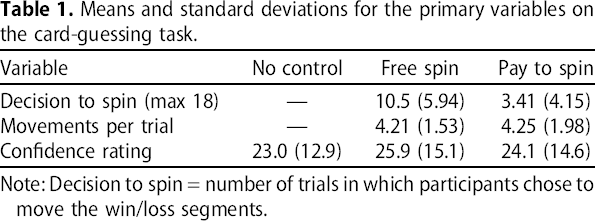
Note: Decision to spin = number of trials in which participants chose to move the win/loss segments.
The analysis of confidence ratings (Model 1) revealed expected effects of win and loss probability. As the win probability increased, confidence ratings increased, and as the loss probability increased, confidence ratings decreased (see Table 2 and Figure 2). Compared to the no control condition, confidence ratings were higher in the free/spin, free/no spin, and pay/spin conditions, but not in the pay/no spin condition (see Table 2 and Figure 3). Pairwise contrasts revealed that the difference in confidence between the free/spin and free/no spin conditions was only marginal, χ2(1) = 2.88, p = .090; that is to say, the actual decision to rotate the segments did not significantly affect confidence in the free condition. However, confidence was significantly higher in the pay/spin condition than in the pay/no spin condition, χ2(1) = 9.88, p = .002, supporting the notion that illusory control is better captured by spin decisions made under conditions of financial cost than tasks where control can be exerted at no cost.
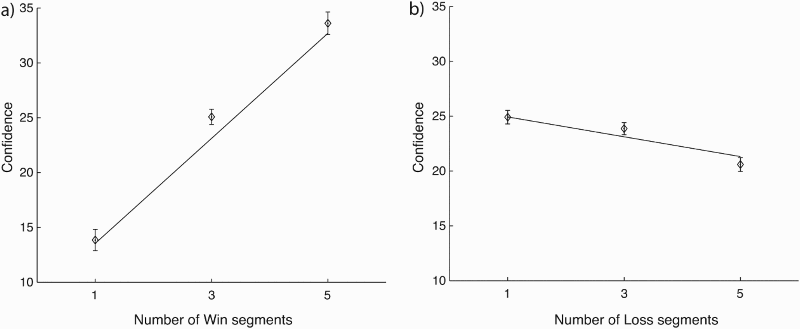
Modulation of confidence ratings as a function of (a) win probability and (b) loss probability within no control trials. Diamond markers indicate the mean and standard error of the observed data; lines indicate the values of confidence predicted by the model.
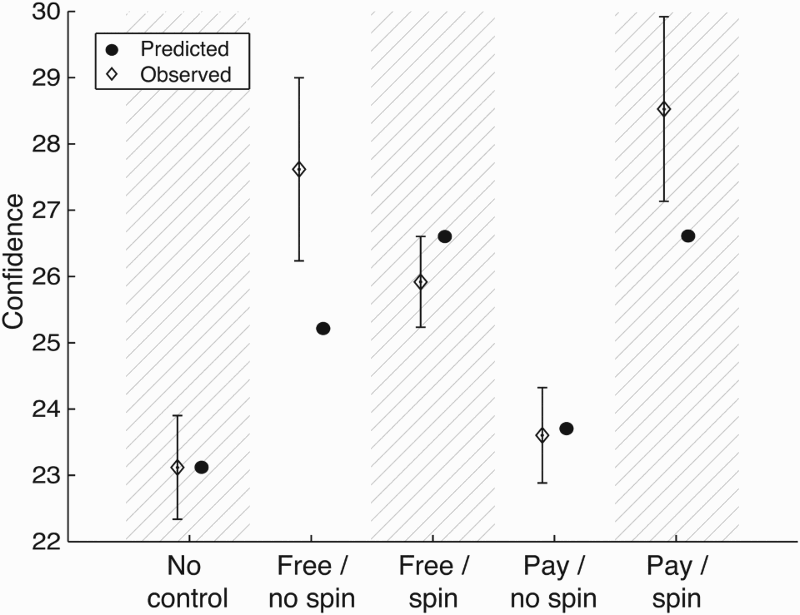
Observed and predicted confidence across the different card-guessing task conditions. Diamond markers indicate the mean and standard error of the observed data; black circles indicate the predicted values of confidence. Predictions are calculated with win and loss probability held constant covering three cards. The observed discrepancy between the predicted and observed values is probably due to the bias introduced in the observed data due the systematic differences in win and loss probabilities between spin and no spin trials in the task.
Predictors of confidence ratings in the card-guessing task.
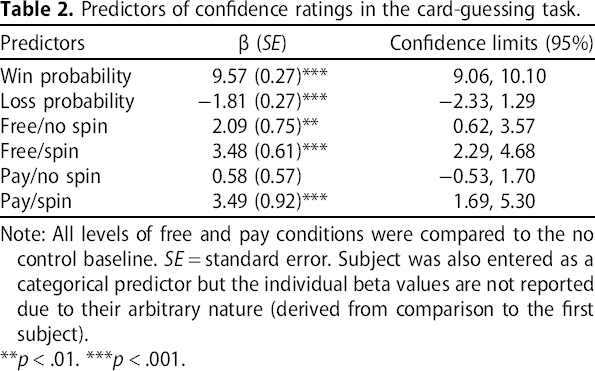
Note: All levels of free and pay conditions were compared to the no control baseline. SE = standard error. Subject was also entered as a categorical predictor but the individual beta values are not reported due to their arbitrary nature (derived from comparison to the first subject).
**p < .01. ***p < .001.
For the analysis of spin probability in Model 2 (see Figure 4), we observed a significant effect of spin condition (free spin or pay to spin) when confidence was held constant at each participant's mean: β (SE) = 1.87 (0.16), p < .0001, 95% confidence interval, CI [1.55, 2.18]. At this average level of confidence, the probability of spinning was higher in the free spin condition than in the pay to spin condition. In the pay to spin condition, as confidence increased, the probability of spinning increased: β (SE) = 0.012 (0.006), p < .05, 95% CI [0.001, 0.023]. However, in the free spin condition, probability of spinning was not modulated by confidence: β (SE) = −0.002 (0.004), p = .07, 95% CI [−0.007, 0.21]. This effect of confidence on spinning differed significantly between the pay to spin and free spin trials: Spin Condition × Confidence interaction, β (SE) = −0.014 (0.007), p < .05, 95% CI [−0.027, −0.001]. In Model 2, increasing loss probability also predicted increased likelihood of spinning: β (SE) = 0.08 (0.04), p < .05, 95% CI [0.004, 0.16].
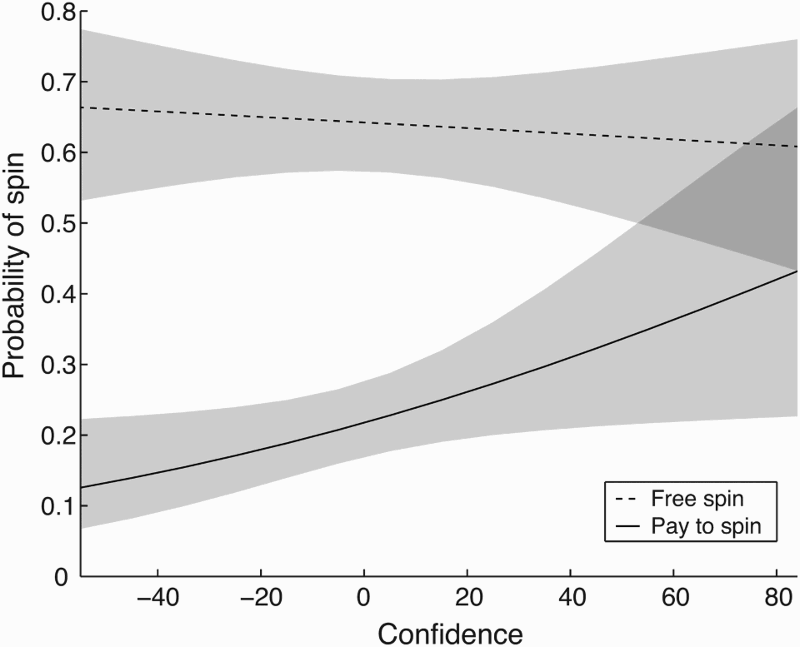
Effect of confidence and spin condition (free spin, pay to spin) on the probability of spinning. Shaded area indicates 95% confidence limits.
From Model 3 we derived a measure of subjective illusory control for each participant, controlling for win and loss probability, for use in the individual differences analyses. For this model, win probability and loss probability continued to predict confidence: win, β (SE) = 9.39 (0.34), p < .0001, 95% CI [8.72, 10.06]; loss, β (SE) = −1.76 (0.34), p < .0001, 95% CI [−2.42, −1.10].
Contingency Judgment task
The mean control ratings across the four conditions indicated clear overestimations of control [25% loss, M = 8.92 (SD = 16.0); 25% win, M = 15.1 (SD = 18.2); 75% loss, M = 34.6 (SD = 33.4); 75% win, M = 43.1 (SD = 34.1)]. A 2 × 2 repeated measures ANOVA tested the effects of valence (win, loss) and reinforcement rate (25%, 75%). Participants rated their control significantly higher in the 75% rate than in the 25% rate [main effect, F(1, 77) = 68.3, p < .001,
The percentage of trials on which participants pressed the space bar ranged from 51.6% to 55.6% (SD = 16.0–22.8%) and did not differ significantly across conditions. For the subsequent individual difference analyses, the control ratings across the four task conditions were averaged to create the overestimation score (see Table 3). This variable was positively correlated with the rate of responding on the task, r = .228, p = .045, consistent with previous studies (Hannah & Beneteau, 2009; Matute, 1996).
Correlations between the card-guessing task and the sense of agency tasks.
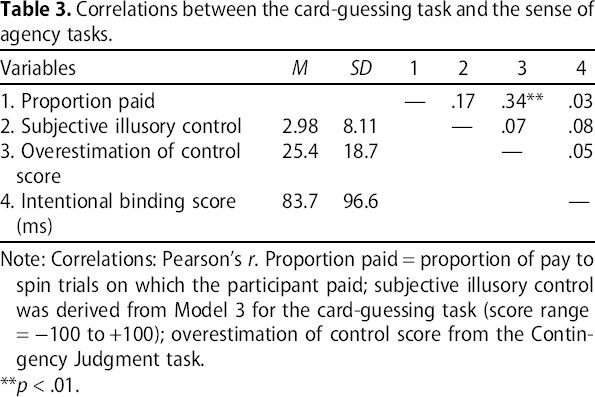
Note: Correlations: Pearson's r. Proportion paid = proportion of pay to spin trials on which the participant paid; subjective illusory control was derived from Model 3 for the card-guessing task (score range = −100 to +100); overestimation of control score from the Contingency Judgment task.
**p < .01.
Intentional Binding task
We observed a robust perceptual shift in the timing estimates consistent with the established intentional binding effect (Haggard et al., 2002). A 2 × 2 repeated measures ANOVA confirmed a highly significant Condition (baseline, operant) × Perceptual Judgment (action, outcome) interaction, F (1, 77) = 58.6, p < .001,
Correlations between illusory control and agency
To explore the relationships between the three tasks, four composite scores were derived. A behavioural measure of illusory control was defined as the proportion of pay to spin trials on which the participant paid (this variable showed positive skew, but parametric and non-parametric tests yielded similar results). Subjective illusory control on the card-guessing task was quantified as the change in confidence when exercising illusory control (derived from Model 3 for the card-guessing task). The overestimation score from the contingency judgment task was used as a measure of explicit sense of agency, and the overall intentional binding score was used as a measure of implicit sense of agency. The correlations and mean scores are provided in Table 3.
A significant positive correlation was found between proportion paid on the card-guessing task and the overestimation score on the Contingency Judgment task, r(78) = .34, p < .010, accounting for 11.7% of the variance (see Figure 5a). The subjective illusory control score from the card-guessing task was not significantly associated with the overestimation score. Although a robust intentional binding effect was observed in the overall sample, intentional binding scores did not correlate significantly with proportion paid (see Figure 5b) or subjective illusory control from the card-guessing task, nor with the overestimation score on the Contingency Judgment task. Using Steiger's calculation, the correlation between proportion paid and the overestimation score was significantly greater than the correlation between proportion paid and intentional binding, ZH= 2.03, p = .04.
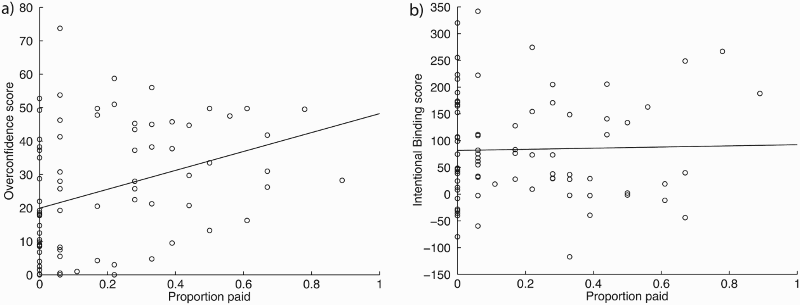
The correlation between proportion paid and (a) the Contingency Judgment task and (b) the Intentional Binding task.
On the Locus of Control scale, there was no significant relationships between the three subscales and the four behavioural variables (internal, r = −.04–.10, p > .393; powerful others, r = −.16–.07, p > .176; chance, r = −.08–.07, p > .471), except for the Locus of Control Chance subscale and subjective illusory control, r(71) = .25, p = .034.
Card-guessing task debrief questionnaire
The mean scores on the five debrief questions on perceived control were each fairly low. On average, participants perceived that little skill was involved in winning the task (Question 1: M = 1.83, SD = 1.0), they perceived little additional control from rotating the segments (Question 2: M = 1.94, SD = 1.07), and they reported little effect of moving the segments on their confidence (Question 5: M = 2.08, SD = 1.03). Participants did not reliably endorse using the previous Ace locations to influence their decisions to pay (Question 3: M = 2.22, SD = 1.35) or that previous wins or losses affected their confidence (Question 4: M = 2.22, SD = 1.30). However, despite these low ratings on average, each of these debrief questions was significantly correlated with both the proportion paid variable, r(78) = .45–.57, p < .01, and the subjective illusory control score, r(71) = .22–.50, p < .05.
Discussion
This study developed a novel experimental task to distinguish between two operational definitions of illusory control: a subjective component based upon confidence ratings, and a behavioural measure based upon the participants’ willingness to pay money in order to exercise control in a chance situation. The majority of our participants evidenced at least some degree of illusory control on the behavioural measure: Two thirds of our sample was prepared to pay a fee to rotate the win and loss segments on at least one trial. But importantly, this was a distributed trait: One third of participants paid to spin regularly, on at least five occasions, but equally, another third refused to pay at all and were effectively immune to the bias (see also Burger, 1986; Koehler et al., 1994). Subjective illusory control was also clearly evident, in the elevated confidence scores when participants accepted the opportunity to rotate the segments, compared to the no control baseline. Confidence ratings were also sensitive to the size of the win and loss segments, as expected. The subjective and behavioural variables were inter-related: In the GEE analysis, participants were more likely to rotate the wheel when their confidence was high, and this effect was significantly stronger in the pay to spin condition than in the free spin condition. Participants who reported higher confidence and pay to spin decisions also reported more overt beliefs about the level of skill and control in the card-guessing task on a retrospective debrief questionnaire. These results help to consolidate a disparate literature on illusory control that has used either subjective or behavioural measures, showing considerable overlap between the two conceptualizations.
By employing a multi-shot task to derive measures of the strength of illusory control in each participant, we also explored individual differences in relation to two domain-general, cognitive measures of agency. The Contingency Judgment task and Intentional Binding task were both successful in robustly inducing their respective cognitive biases. On the Contingency Judgment task, participants overestimated their degree of control over the lightbulb illuminations, and this was strongest in the condition with frequent outcomes that were positively valenced. This has been labelled the “outcome density effect” (Alloy & Abramson, 1979; Gillan et al., 2014). Participants with higher response rates also reported stronger overestimations of control, as observed previously (Hannah & Beneteau, 2009; Matute, 1996). On the Intentional Binding task, we observed a substantial compression in the subjective passage of time, whereby self-initiated actions were perceived later, and their operant outcomes were perceived earlier, than baseline judgments of actions and tones occurring alone. This created a mean Intentional Binding score of 84 ms that is much in keeping with earlier papers using this procedure (e.g., Haggard et al., 2002). Notably, these two domain-general agency measures were not significantly inter-correlated (r = .05), consistent with a proposed dichotomy between explicit and implicit aspects of the sense of agency (Dewey & Knoblich, 2014; Moore et al., 2012). Neither of the agency tests was related to trait scores on the Locus of Control scale, consistent with the study by Dewey and Knoblich (2014). The only significant relationship for Locus of Control was for the external chance subscale against the subjective illusory control parameter. This subscale has been highlighted in a previous study in problem gamblers (de Stadelhofen, Aufrère, Besson, & Rossier, 2009) and may reflect unusual beliefs in the nature of fate and chance that have clear relevance to the illusion of control. We note that the coefficient observed does not survive correction for the three subscales of the Levenson questionnaire, and that alternative self-report scales may better capture aspects of self-efficacy associated with gambling illusory control (e.g., Paulhus, 1983).
The proportion of pay to spin decisions on the card-guessing task was correlated significantly with control overestimations on the Contingency Judgment task. In a formal test, this relationship was significantly stronger than the coefficient for the same illusory control measure against the intentional binding effect. This relationship links domain-specific illusory control in a gambling context to the broader cognitive literature on the “sense of agency”. More specifically, the willingness to pay in order to exert control in a gambling game predicts the tendency to explicitly overestimate causal associations between random, non-contingent events. The Contingency Judgment task was also abstract and did not present gambling stimuli, involving only button presses and lightbulb illumination. Our results help substantiate a conjecture by Orgaz et al. (2013) that the heightened overestimations of control they observed in pathological gamblers performing the Contingency Judgment task reflected a dispositional trait of enhanced illusory control. Deficits in explicit agency have further been associated with delusions (Balzan, Delfabbro, Galletly, & Woodward, 2013), reduced self-efficacy (Taylor & Brown, 1988), and superstitious beliefs (Rudski, 2001).
As illusory control mapped onto explicit judgments of agency, as opposed to feelings of agency, our results imply that gambling-related illusory control arises from a reflective attributional process, rather than from a distorted perceptual experience of action–outcome relationships. Decisions to pay on the card-guessing task are deliberate, goal-directed actions that are likely to be moderated by both predictive and inferential beliefs, as well as social and contextual cues. These decisions, and confidence ratings, were both sensitive to the outcome probabilities in the card-guessing task, although the probability of winning and losing did not interact with condition. It is also conceivable that alternative measures of illusory control could detect associations with implicit agency. Karsh and Eitam (2015) recently found that both implicit and explicit judgments of agency play distinct roles in action selection: Implicit agency was reflected in the speed of responding, whereas explicit agency predicted which action was selected. As the card-guessing task emphasized action selection and not response speed, other operationalizations could detect links with intentional binding.
On the card-guessing task, our participants were significantly more likely to rotate the wheel in the free spin condition than in the pay to spin condition. This observation—that some individuals will exercise control when there is no cost, but are not willing to disadvantage themselves to gain such control—echoes the findings from Grou and Tabak (2008) who used a single-shot, between-subjects design. Naturally, these effects would be expected to vary further with the premium size (Dunn & Wilson, 1990), but it was beyond the aims of the current study to explore those effects. At the same time, the Condition × Confidence interaction in the GEE model indicates that confidence was actually a stronger predictor of when participants would exercise control in the pay to spin condition, compared to the free spin condition. Similarly, in the fixed-effects regression, the mere opportunity for control, if declined, was not sufficient to reliably increase confidence in the pay to spin condition. In the free spin condition, confidence was boosted by the opportunity to spin, regardless of whether participants actually moved the wheel. Overall, two effects are apparent here: (a) Confidence and decision making were more closely aligned when the decision was costly than when it was free, and (b) even within a fairly uniform, highly educated sample, illusory control is a distributed, quantitative effect.
Some limitations should be noted. First, the design of the card-guessing task allowed participants to exercise control as often, or as little, as they wished. This was effective in detecting individual differences, but complicated task analysis, precluding a straightforward analysis of variance approach. It was necessary to distinguish five conditions from the three trial types (e.g., the pay to spin condition was further separated into trials where the opportunity to spin was accepted versus declined). Seven participants rejected all opportunities to rotate the wheel across both free spin and pay to spin conditions; we could not calculate a subjective illusory control score for these participants, who were therefore removed from the models for the card-guessing task and the correlations for the subjective illusory control parameter. Second, by presenting the three trial types within a multi-shot task, it is possible that the presence of the free spin condition may have affected participants’ willingness to pay to spin on other trials. That said, any such influence would be expected to reduce the sensitivity of the pay to spin condition and increase Type 2 error rather than false positives. Third, our analyses cannot adjudicate on the causal directionality between confidence and illusory control decisions: It is possible that decisions to exercise control enhanced confidence, or that high confidence (e.g., from a prior success) prompted subjects to exercise control. Fourth, within a single experiment we were not able to characterize a number of possible moderators, including gender, the nature of the pay-off structure, or the precise wording of the task instructions (Dunn & Wilson, 1990; Presson & Benassi, 1996). The instructions for the card-guessing task sought to create an ambiguous environment in order to maximize individual differences, rather than emphasizing either chance or skill as the key determinant of success. Finally, our findings from a well-educated undergraduate sample may not generalize to illusory control in either regular or problem gamblers, and both groups represent fruitful targets for further investigation.
We believe that our results have a number of theoretical and practical implications. The distributed nature of illusory control in a healthy, well-educated sample highlights how this long-standing psychological bias is certainly not restricted to individuals with gambling problems, but equally, it does not appear to reflect a human universal; roughly one third of our participants fully refused to pay to exercise irrelevant control. Investigating the psychological characteristics of these “resilient” individuals may shed light on ways of attenuating illusory control in the larger demographic who are susceptible to the bias. From a methodological perspective, the dissociations apparent in our data between confidence ratings and payment behaviour are problematic for the proposal that “post-decision wagering” can serve as a proxy for decision confidence (Persaud, McLeod, & Cowey, 2007). From the perspective of gambling policy, illusory control can be elicited within gambling games in a myriad of different ways: For example, lottery players like to choose their favourite numbers (Hardoon, Baboushkin, Derevensky, & Gupta, 2001), and modern slot machines often include a stopping device to brake the spinning reels (Ladouceur & Sevigny, 2005). Our data support the inclusion of an “illusory control” variable in systems currently in development for gauging the likely public harms of any specific (e.g., new) form of gambling (e.g., Meyer, Fiebig, Häfeli, & Mörsen, 2011). Finally, our observed association between gambling-related illusory control and the Contingency Judgment task may be useful for gambling researchers, as a means of assessing control perceptions with a task that does not involve direct gambling cues, which can induce cravings and relapse in treatment-seeking individuals (Hanss, Mentzoni, Griffiths, & Pallesen, 2015).
Disclosure statement
The Centre for Gambling Research at the University of British Columbia (UBC) is supported by funding from the British Columbia Lottery Corporation and the Province of British Columbia government.
ORCiD
Juliette Tobias-Webb http://orcid.org/0000-0002-8491-9668
Footnotes
1.
The primary reason for varying the segment sizes was to encourage participants to vary their confidence ratings on a trial-to-trial basis, which we reasoned might enhance any differences between the 3 control conditions. It is an empirical question to what extent the illusion of control varies across different probabilities of winning or losing (cf. Gino et al., 2011) but we did not have an a priori prediction about the nature or direction of any such effect.
2.
We note that Models 1 and 2 are not independent, and actually address related questions: Model 1 examines spin condition as a predictor of confidence, and Model 2 includes confidence as a predictor of likelihood of spinning. Critically, Model 1 benefits from the No Control baseline condition; as this condition involves no actual decision, those data were excluded in Model 2. Conversely, only Model 2 directly tests spin “cost” (free or pay) as a factor influencing whether or not participants exercised control.
3.
We note that the confidence rating was taken after the spin decision. By including confidence as a predictor of the likelihood of spinning, we do not make any assumptions about the temporal order of these cognitions; we are testing the simple prediction that decisions to exercise control will be associated with higher levels of confidence.