




Abstract
Plasma treatment is the most popular surface modification process of polymers. A small cold plasma zone treatment is an important modification technique in modern industry. In this study, the effect of gas flow direction on plasma treatment was investigated. In order to decrease the plasma zone area, we added a separate cylinder to surround the upper electrode. The separate cylinder is effective in limiting the plasma discharge area, and we could find a light and dark area in the vacuum chamber. After O2 plasma treatment, the result shows that only PP nonwoven in the discharge area became hydrophilic, but the other position away from the plasma zone was not affected. The water adsorption of PP nonwoven increased from 34.8% to 537.4%. When the sample is further from the plasma zone, near the up stream of gas flow, the surface property is less hydrophilic. The water contact angle analysis of PS and glass shows the same results as those of PP nonwoven. But PET in plasma zone or dark zone (plasma zone: 75° to 31°, dark zone: 75° to 52°) both show hydrophilic property. The wettability effect in the dark zone may be due to the UV-light irradiation in the process of plasma excitation.
Keywords
Introduction
In order to enhance the other applications of material and without deteriorating the properties of the bulk, surface modification plays a very important role involving various fields [1–4]. Plasma treatment is the most popular surface modification process of polymer. Plasma modification is clear, quickly reacted, produces low pollution, coating, etc. During the process of plasma excitation, there are atoms, ions, radicals, and UV-light produced in the plasma treatment chamber [7]. Plasma can improve the properties like wettability, permeability, conductivity, printability, adhesion, or biocompatibility of the polymer surface [8]. Small cold plasma zone treatment is an important modification technique in modern industry. The effect around the small zone cold plasma and the effect of plasma gas flow direction on the wettability of the surface were discussed in this study.
The area of plasma glow discharge in a chamber was reduced. The effect of gas flow direction on plasma treatment was also investigated. The metallic organic polymer plasma treatment is also a popular plasma modification method [9], and therefore in this study, we also cogitated an experiment about it.
Experimental
A classical low temperature plasma reactor was shown in Fig. 1. The upper and lower electrodes are the same size of area and form of disk away from in the reactor. A sample between these two electrodes acquired a big area for plasma treatment. In order to limit the plasma discharge area and the treated area of the sample, we design a different kind of upper electrode in our plasma reactor. We added a separate cylinder (diameter: 65 mm) to surround the upper electrode, and expect to limit the glow discharge. We put a separate cylinder in upper of gas flow or lower of gas flow (shown in Fig. 2).

Schematic diagram of plasma treatment reactor system.

Schematic diagram of upper electrode in small zone cold plasma treatment reactor system: (I) upper of gas flow (II) lower of gas flow.
We prepared several different materials as substrates—PP non-woven, PET, glass, and PS, and the sample size is 2 cm × 1.5 cm × 1 cm. The sample was washed by a neutral detersive, dry in the air, and put into the plasma reactor. Oxygen plasma gas was used for surface modification in the small zone cold plasma treatment of polymer with the following plasma treatment parameter—12 W, 200 mtorr, 1 min. We put five samples on the lower electrode. One was under the upper electrode and the separate cylinder, another one was centered in the lower electrode. The last three samples were put on the rim of the lower electrode, and the distance of the sample under the separate cylinder is 10 cm and 15 cm (see Fig. 2).
In addition, we used different kinds of plasma treatment to discuss the surface hydrophobic and hydrophilic properties on the material. We used three plasma monomers and gas for hydrophobic plasma surface modification. Hexamethyldisilazane (HMDSZ): (CH3)3Si-NH-Si-(CH3)3, Perfluoromethylcyclohexane (PFMCH): C7F14 and CF4 are metallic organic compounds for this purpose [4].
Water Contact Angle of Glass by Small Zone Cold Plasma Treatment
When the separate cylinder was in the upper gas flow and after O2 plasma hydrophilic treatment, the result of the water contact angle for PET surface in a different place was shown in Fig. 3. The untreated water contact angle of PET was 75°. On the glow discharge area, the water contact angle of PET is 31°. On the other area, the water contact angle of the glass distance from the glow area (glow discharge area) 7.5 cm, 10 cm, 10 cm, and 15 cm are 52°, 59°, 55°, and 57°, respectively. It explains that when a sample is further from the glow area, near the gas flow, the surface property is less modified. After plasma treatment, the sample in the glow area shows hydrophilic property but in the dark area it does not.

Water contact angle analysis of PET distance from light area (glow discharge area) (a) untreated; (b) glow discharge; (c) 7.5 cm; (d) 10 cm; (e) 10 cm; (f) 15 cm. O2 plasma treatment.
Table 1 showed the water contact angle decay of the sample treated by the small zone cold plasma under upper or lower gas flow. After three days the water contact angle of the sample treated by small zone cold plasma at upper gas flow or lower gas flow raised to the angle of the untreated sample. But the water contact angle of the sample treated by small cold zone plasma at lower gas flow decayed less than at the upper gas flow.
Decay of Water Contact Angle (°) after Small Zone Cold Plasma Treatment.
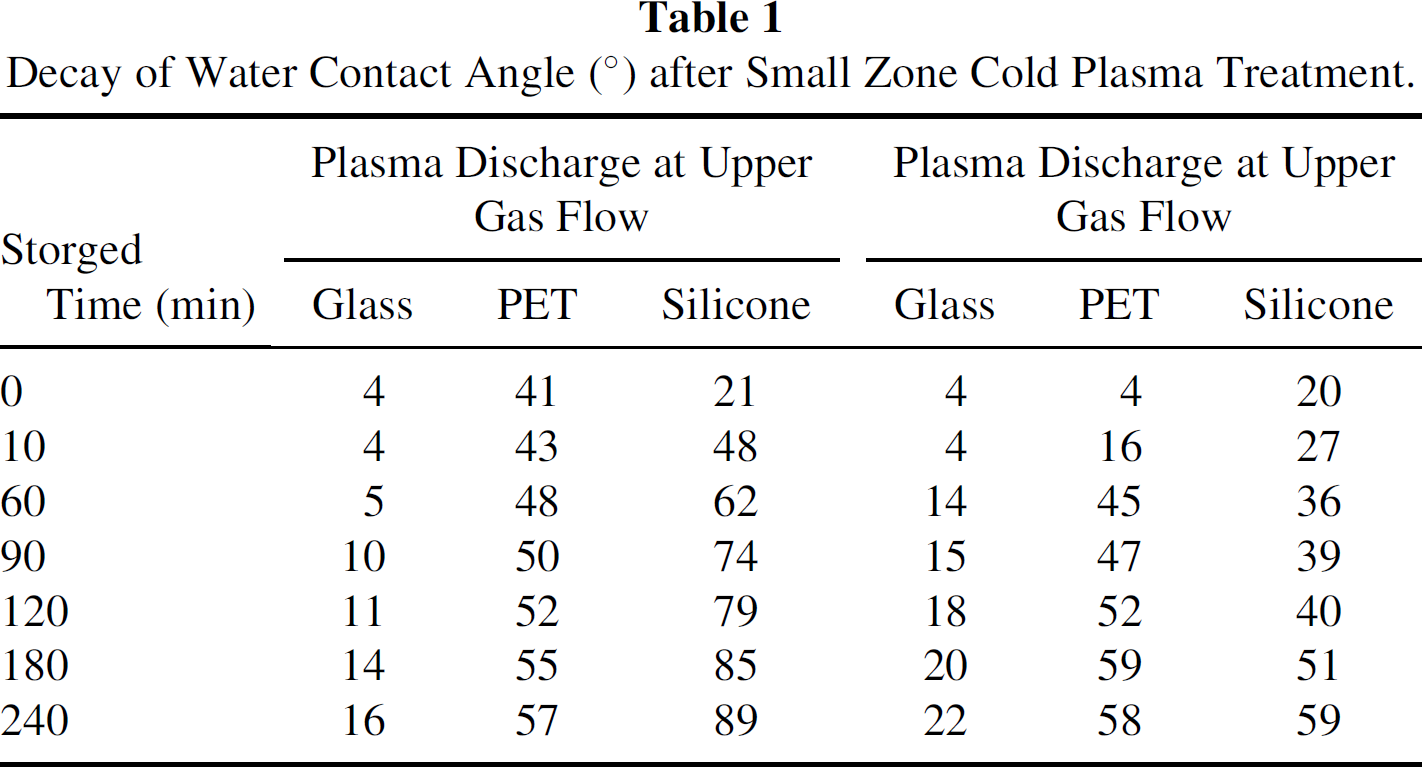
Table 2 listed the results for the PP nonwoven wetting test after plasma treatment. The PP nonwoven is the hydrophobic polymer. Put the untreated PP nonwoven into the deionized water for 1 h, its water absorption is only about 89.7%. Put the PP nonwoven on the glow discharge area at upper gas flow, its water absorption increases up to 537.4%, and the velocity of the absorbed water is very fast, just 1 s. It is thus clear that the PP nonwoven modification was obviously shown on the glow discharge area after O2 plasma treatment. Sample on the other area, water absorption of PP nonwoven with distance from glow area (glow discharge area) 7.5 cm, 10 cm, 10 cm, and 15 cm are 138.9%, 187.5%,98.0%, and 50.6%, respectively. Contrast the result at lower gas flow, the sample treated at glow discharge area also has good water absorption, and PP nonwoven which is furthest from the glow discharge has the least water absorption. Even the glow discharge area at upper or lower gas flow, sample far from the glow discharge area has the least water absorption, almost like untreated PP nonwoven.
Wetting Test of Plasma Treatment PP Nonwoven. (Plasma: O2 50W, 200 mtorr, 1 min)

Wetting Test of Plasma Treatment PP Nonwoven. (Plasma: O2 50W, 200 mtorr, 1 min)
plasma discharge area in upper gas flow
plasma discharge area in lower gas flow
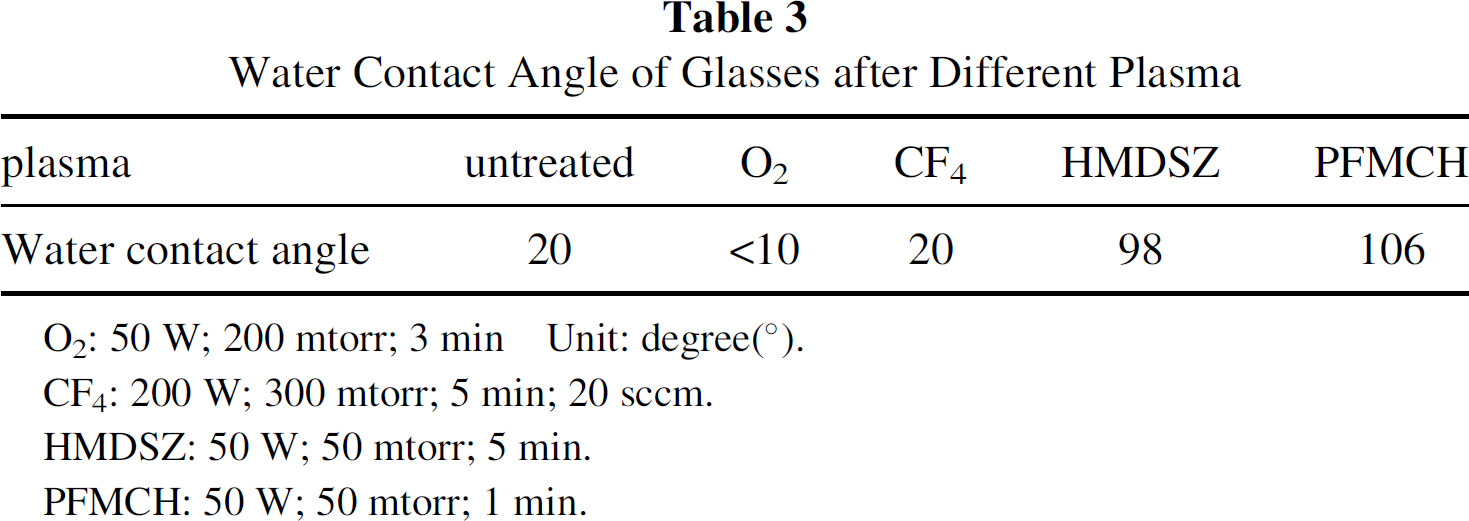
The water contact angle of HMDSZ plasma treated glass is 98°. Plasma deposited HMDSZ polymer is hydrophobic because the existence of methyl groups on the surface. On the HMDSZ plasma deposited surface showed the hydrophobic surface with 98°, but subsequently treated with O2 plasma treated area of slide glass decreased to 8°, part of the surface mask with slide glass for protection from irradiation of glow discharge also decreased to 70°, respectively. From Table 3 PFMCH plasma treatment also could raise the hydrophobic property of glass, but CF4 plasma could not. Because CF4 plasma has an etch glasses surface, that could increase the hydrophilic property of the glass surface. When the polymer was surface modified by CF4 plasma, which would increase the hydrophobic property of the polymer surface not hydrophilic. During CF4 plasma treatment, F ions would be given into the polymer surface, and bonding the C-F or the F functional group on it. The C-F boundary is stable and when there is lots of C-F boundary on the polymer surface, it would make low surface energy, high water contact angle, and good hydrophobic property to modify the polymer surface.
Water Contact Angle of Glasses after Different Plasma
Water Contact Angle of Glasses after Different Plasma
O2: 50 W; 200 mtorr; 3 min Unit: degree(°).
CF4: 200 W; 300 mtorr; 5 min; 20 sccm.
HMDSZ: 50 W; 50 mtorr; 5 min.
PFMCH: 50 W; 50 mtorr; 1 min.
The Micro-IR spectrum of glass after PFMCH plasma treatment was shown in Fig. 4. The presence of PTFE can be verified from the characteristic absorption peak at 740 cm-1, 1140–1188 cm-1 were CF2 characteristic absorption peaks. The Micro-IR spectrum of glass after CF4 plasma treatment has the same characteristic absorption peak as PFMCH plasma treatment.

The Micro-IR spectra analysis of PFMCH or CF4 plasma treatment.
ESCA analysis can be used to confirm the reaction of the plasma treatment. Plasma exposure leads to changes in the elemental composition at the surface of the polymers. The elemental composition at the polymer surface was determined easily with ESCA spectra. Figure 5 shows that the ESCA spectra after PFMCF plasma treatment, it has apparently a strong peak around at 680 eV due to electrons originating from the Fls level on the substrate surface. Figure 6 showed that the Cls level spectra for PFMCF plasma treatment, it has apparent C-C, C-Fx, and C-F bondings.

Surface ESCA analysis after PFMCF plasma treatment.

The C1s spectra of PFMCF plasma treatment from ESCA analysis.
After O2 plasma treatment, the result shows that the PP nonwoven in the discharge area became hydrophilic. Water adsorption of nonwoven PP increased from 34.8% to 537.4%. When the sample is further away from the plasma zone, the surface property is in effect less hydrophilic. The water contact angle analysis of PS and glass show the same results as PP nonwoven. But PET in plasma zone or dark zone (plasma zone: 75° to 31°, dark zone: 75° to 52°) both shows hydrophilic property. The wettability effect in the dark zone may be due to the UV-light irradiation in the process of plasma excitation. It explains when a sample is further away from the glow area, the surface hydrophilic property is less modified. CF4, HMDSZ, or PFMCH plasma treatment can increase the hydrophobic properties of the substrate.