



Abstract
This paper explores the future potential of informal learning for leadership development in the nonprofit sector through the experience of the Centre for Voluntary Sector Leadership (CVSL) at the Open University, UK. From its inception in 2016, CVSL developed learning outside the mainstream curriculum, providing open access informal learning opportunities to increase access to leadership development for practitioners in smaller nonprofit organizations. Our experience of developing and delivering this learning has encountered challenges related to institutional, sector, and policy contexts. Despite these challenges, we argue that HE-provided informal leadership learning has the potential to address issues of accessibility, timeliness, and relevance for smaller nonprofit organizations. The paper reflects on the future role of informal learning as part of an “ecosystem” of nonprofit leadership development in a volatile and marketized environment.
From its inception in 2016, the Centre for Voluntary Sector Leadership (CVSL) at the Open University, UK developed a research-informed, open access, informal leadership learning offer to address challenges of access to leadership development for smaller nonprofits (Terry et al., 2018, 2020). Drawing on this experience, we argue that the future development and delivery of leadership development and support for the UK nonprofit sector continues to be subject to challenges of institutional, sector, socio-political, and policy context—in ways that resemble challenges identified in earlier studies (see for example, Macmillan, 2011; Palmer & Bogdanova, 2008; Paton et al., 2007, 2008). Despite this, we argue that there is a place for HE-provided informal learning within the “ecosystem” of leadership development and support for the sector. Further, we argue for research-informed learning that draws on contemporary conceptualizations of leadership to challenge practitioners and grow their understanding of leadership that “makes things happen” (Huxham & Vangen, 2000) in and through nonprofits in a complex and interconnected world. Although the paper reflects on leadership learning for nonprofits in the UK context, we hope to promote discussion regarding the role of HE-provided informal learning in other national contexts.
This paper reflects on CVSL’s experience of developing and delivering leadership learning for nonprofit sector practitioners (staff and volunteers) from an HE institution but outside the mainstream credit-bearing curriculum, to inform our discussion of opportunities and challenges for the future. We use the term “informal learning” to distinguish from the undergraduate and postgraduate curriculum, but do not suggest that courses are either unstructured or without specific learning outcomes. Rather, learning resources have been produced by academics to facilitate self-directed learning in practitioners’ contexts. These resources are hosted on an open access online platform that enables access at scale. In terms of conceptualizations from adult education, this learning is intentional rather than incidental. It takes place outside the classroom, with the pace determined by individual practitioners to meet their needs (Marsick & Watkins, 2001; Schugurensky, 2000).
In contrast to the growth in US nonprofit education over the last two decades (Mirabella et al., 2019), UK provision has waxed and waned, leading to the current situation of a limited number of HE nonprofit programmes, and limited research and teaching clusters. Cranfield Trust’s (2023) review of leadership and management training identified only four HE leadership development providers (Cranfield Trust, 2023), although a small number of additional undergraduate and postgraduate degrees were identified by searching online for community, charity, and philanthropy programmes. These programmes are costly for HE institutions to develop and deliver and costly for individual practitioners to access without institutional support from large employers or foundations, and repeated studies have identified the challenges smaller UK nonprofits face in accessing leadership learning (Clore Social Leadership, 2019; Cranfield Trust, 2023; Harries, 2016; Marsh, 2013). Rather than a lack of demand per se, this seems to reflect a diminution of resources allocated to practitioner learning and development into and within the sector. Affordability is particularly significant as small and medium-sized organizations, operating with budgets under £1 million, constitute much of the UK nonprofit sector (NCVO, 2023).
CVSL was founded in 2016 to respond to this challenge. Like other academic centers (Weber & Brunt, 2022), CVSL is influencing the future of nonprofit studies in the UK and also responding to the current socio-political and policy context—in terms of the relationship between state and sector and education policy, particularly the trend toward a marketized HE system (Tholen, 2022). For HE institutions, this poses challenges of viability, while for individuals and smaller nonprofit organizations there are challenges of access and affordability, relevance, and timeliness. Furthermore, these trends have encouraged the development of an “ecosystem” of sector support and capacity-building—a market-like arrangement of competing and collaborating providers in which HE plays only a limited role (Dayson et al., 2017). For instance, Clore Social, itself a nonprofit organization, offers programmes for emerging and established leaders who have access to funding or sponsorship. In light of this context, we pose the questions, What have we learnt about informal learning in the nonprofit sector through our experience? and What is the future role of HE-provided informal leadership learning in nonprofit education?
In what follows, we position CVSL’s learning offer within the UK context for nonprofit leadership learning before introducing theories from the adult learning “prism” (Merriam, 2001), including lifelong and informal learning, together with the concept of “openness.” We then outline the process of structured reflection adopted to develop this paper before introducing key findings and discussing the future of informal university-based learning for leadership development in the nonprofit sector.
Context
Nonprofit education in the UK’s higher education sector
Long-term trajectories in relationships between HE institutions, sector funders, nonprofit organizations, and crucially, flows of funding, structure the operating context for learning provision. Historically, and in contrast to the US (Mirabella et al., 2019; O’Neill, 2007), in the UK there have been only a small number of HE-provided nonprofit programmes typically concentrated in London universities (for instance Brunel, London School of Economics, Birkbeck College and Bayes Business School at City St. George’s, London University), often associated with academic centers of expertise or individual academics (Harris, 2016; Palmer & Bogdanova, 2008). The Labour government of 1997–2010 increased investment in a variety of sector-focused, collaborative, and adult learning programmes in universities, but many were time-limited, and momentum dissipated as a result of austerity policies imposed by succeeding governments since 2010. Combined, these programmes drove pedagogic innovation via the creation of informal and alternative models of provision, including for nonprofit sector practitioners. In the research field, public investment after 2008, via the UK’s main research council, into research centers such as the Third Sector Research Center, Wales Institute of Social and Economic Research and Data, and smaller grants to other HE research centers, boosted nonprofit research, though this has not fed directly into nonprofit teaching programmes.
In contrast to the US, where nonprofit education is well funded by a robust philanthropic community and delivered through many HE institutions, the UK context is relatively underdeveloped, affected by short-term public funding initiatives, an uncertain philanthropic commitment that looks to market rather than developmental solutions to socioeconomic issues (Maclean et al., 2021). Furthermore, the government’s withdrawal of long-term HE funding over the previous decade and short-term policies aimed at reducing the number of students from outside the UK, have undermined the ability of many universities to provide formal learning and activities that generate social and public value. In this context, Hadjievska et al. (2023) identified a small number of national learning providers from within the nonprofit sector alongside multiple short-term, non-accredited programmes. Universities appear to play a small role, with Bayes Business School at City St. George’s, London University the most prominent HE actor. It is unclear whether the relative absence of universities from nonprofit learning is due to a mismatch with learning needs, issues of access, or inability to compete with smaller training providers. Some funders have intervened to shape this “ecosystem” - one example is the Community Leadership Academy, funded and provided by Local Trust, endowed by the National Lottery Community Fund. The commissioning of such initiatives has tended to favor smaller, independent entities such as policy “think tanks,” independent (including nonprofit) consultancies, or freelance experts. The resulting “ecosystem” is marketized and fragmented, and programmes are costly, whether funded by learners or by external funders (Clore Social Leadership, 2019; Terry et al., 2018). The result is duplication, lack of institutional memory, and the absence of research-informed leadership development.
Larger nonprofit organizations have money to purchase postgraduate courses for senior staff or to recruit people from other sectors with leadership and management expertise, but smaller organizations are under-served with leadership learning and development that is appropriate and relevant to them—this is important because they are typically innovative and responsive to need, yet resource-poor and fragile (Dayson et al., 2022). There is no clear professional trajectory, and much sector commentary has resisted the application of professionalization (see also Rochester, 2013) to such organizations, where leadership is enacted by volunteers as well as staff, and models of leadership and of learning are not easily transferable from other sectors.
As Clore Social Leadership (2019, p. 14) points out, many smaller organizations are focused on “survival and meeting immediate needs [making] it difficult to pause, make space, and take a strategic approach to leadership development.” Similarly, Cranfield Trust (2023) notes that immediate pressures, including costs, mean that many organizations find it difficult to justify expending resources on leadership training.
In this complex context, one way to increase access to leadership learning is through Open Education.
Open education at the OU
In the context of marketization, both of HE and of the nonprofit education and training field, online “open” education achieves multiple objectives for individuals and institutions. It removes barriers to learning, widens access, and has the potential to deliver social justice objectives, whilst providing opportunities for educators to share knowledge widely and to innovate (see Tietjen & Tutaleni, 2021).
The OU prides itself as a world leader in the design, and delivery of research-led online Supported Open Learning (SOL) with a mission to be “Open to People, Places, Methods and Ideas.” It is committed to widening access to HE through accessible technology, innovative pedagogy, and tuition. This aim resonates with the values of many nonprofits and suggests that the OU and nonprofits would be natural collaborators. However, the production of Open Educational Resources (OERs) requires high up-front investment and operation at scale in terms of number of learners.
In 2006, the OU launched its own online channel. OpenLearn achieved over 13 million visitors in 2022/23, resulting in almost 900,000 free course enrollments. This huge range of curated study materials may be used for self-study or downloaded for use in a group setting. Through adapted teaching and learning materials from accredited courses, or content commissioned specifically for public use, it provides a platform for accessible leadership development opportunities. Courses and linked outreach activities provide an accessible alternative to the market. They are provided free to the user but are not free to produce, host, or maintain, and are frequently funded from external resources.
Adult learning theories
We draw on Merriam’s (2001) “prism” of adult learning theories to conceptualize CVSL’s learning offer and extract learning for the future, as no one theory sufficiently provides a framing for the open education approach to learning. Together they operate as conceptual lenses that help us to understand how learner motivations, institutional and sector context come together to both enable and constrain an informal learning programme for leadership development focused on smaller nonprofit organizations.
Work-based learning
Lester and Costley (2010) describe the growth of work-based learning in HE since the 1980s as both a response to a need for organizational workforce development and to the need for individuals to take increasing responsibility for their own professional development. Like other OU courses, CVSL’s courses are designed as “work-based” learning that involves reflection on work practices, action learning and dialogue with peers (Raelin, 2011a). Fundamentally, work-based learning eschews the conventional dichotomy between classroom theory and workplace practice (Raelin, 2011a). Raelin (2011a) argues that this is pertinent to developing contemporary leadership practice as it enables a learning process that reaches beyond individuals as learning plays back into the workplace to benefit the organization. Work-based learning is a useful lens for conceptualizing leadership learning that is designed for capacity-building smaller nonprofit organizations.
Informal and non-formal learning
As Schugurensky (2000) points out, informal and non-formal learning are frequently defined by what they are not. “Non-formal” learning is outside the mainstream curriculum (undergraduate and postgraduate qualifications), short-term, and delivered by an instructor. In contrast, “informal” learning is directed by the learner to meet their needs. Although informal learning may be incidental (generated through everyday experience), we use the term to describe intentional learning that involves seeking out and making use of (often multiple) learning resources (ibid). Marsick and Watkins (2001) draw on earlier learning theorists (including Kolb, Argyris and Schon, and Dewey) to conceptualize informal learning as a process of meaning-making that involves diagnosing or framing everyday experiences and examining alternatives. This diagnosis draws on prior experience and interpretation of context. Stimulating skills development, critical reflection, and creativity (ibid) can enhance the informal learning process. This conceptualization of informal learning is useful for understanding CVSL’s approach to developing research-informed learning resources that can be accessed and utilized by learners at the point at which they need them to make sense of their current context.
Lifelong learning
This term is used in two connected ways in the literature—first, to refer to the need for learning to continue throughout an individual’s lifetime for the individual to adapt and flourish in a changing world; second, to refer to a marketized system of education across traditional institutional boundaries and for adults at all stages (Jarvis, 2004). From its inception, the OU’s learning offer spanned a breadth of opportunities that addressed both these ideas. As others have shown (see Chitiba, 2012), digitalization has played a key role in enabling lifelong learning, extending the reach of the organization and increasing access, but has also contributed to increasing competition between institutions—at national and international levels.
CVSL’s Open Educational Resources are informed by these three concepts. They were designed to be delivered online for self-directed learning, with the educator’s role limited to knowledge curation. Practitioners access open education resources at a time and pace that work for them, from within their own context, and in response to current learning needs and changing circumstances, delivering both work and quality of life objectives. This reflects recommendations in learning design guidance that emphasize the optimization of “relevance,” “value,” and “authenticity” (CAST, 2018). Tietjen and Tutaleni’s (2021) review identifies key principles of open pedagogy that can be summarized as positioning learners and educators as collaborators, offering a participatory rather than instructional model of learning, and working under licenses that allow for the modification and re-use of learning. CVSL’s approach adopts aspects of “openness” in both its resources and practice with free course materials issued under a Creative Commons license that allows for copying, distribution, and “remixing” of resources (with attribution). Such “Open Educational Practice” enables educators to work collaboratively and empowers learners in their educational journey (Cronin, 2017). However, critics have argued that open education lacks consistency in underlying pedagogy (Knox, 2013; Tietjen & Tutaleni, 2021) and makes assumptions about unmet demand and the autonomy of learners. Furthermore, Knox (2013) asserts that much open education literature continues to use the language of “marketization,” with the learner positioned as “consumer.” As discussed below, these limitations are significant for how CVSL’s learning offer developed and specifically for our growing understanding of the potential and limitations of open education to meet unmet demand.
Methodological approach—witness seminars as narrative inquiry
CVSL’s educational offer focuses on an approach to leadership that embraces shared, collective, and practice-based concepts. It was important for us as nonprofit leadership educators to echo this approach as we reviewed CVSL’s offer. Ospina and Dodge (2005) suggest that narrative inquiry offers such an approach, capturing complex context and meaning-making, with an internally consistent research focus. It also leverages knowledge present within storytelling that is not accessible through other methods. They describe an approach that facilitates in-depth group conversations with relevant stakeholders to capture complex experiences and to privilege voice and point of view. This has the added advantage of foregrounding the role of practitioners (in this case, those who develop and deliver the nonprofit educational offer) as knowledge producers and creates a space for participant reflection, learning, and growth through the telling of individual, overlapping stories.
Storytelling has been suggested as “the fundamental unit [and] …elementary particle of knowledge and meaning” (Gabriel, 2019, p. 1). Shared stories can provide a more relevant and coherent approach to practice and understanding than formal reports (Gabriel, 2019). Our method of capturing CVSL’s story through narrative inquiry broadly followed the format of a “witness seminar” as described by Denegri et al. (2024), drawing on the work of the Wellcome Trust (Wellcome Collection, 2024). Witness seminars invite people associated with a particular initiative to join a facilitated discussion where memories and reflections are shared, discussed, and debated. Participants are free to agree or disagree about their individual narratives, and it is not expected that a consensus will necessarily be reached. However, there is potential to develop shared narratives, particularly if key themes are identified across and between individuals.
Witness seminars involve careful planning and development of an agenda agreed with invited participants. The seminar is a collaborative process that takes place with a set of ground rules that are designed to ensure respect, acceptance of different perspectives, and acknowledgment of different memories and experiences (Denegri et al., 2024). Agreeing ground rules is important to establish the role of facilitators and to mediate any potential ethical concerns around power inequalities, risks that certain voices may not be heard, confidences breached, and/or data shared inappropriately. As witness seminars aim to capture the story of a particular event or project, and stories themselves are often chronological (Gabriel, 2019) participants within the seminar are invited to speak in broadly chronological order. The outcomes of witness seminars are primarily the discussions themselves in the form of transcripts, and often a form of thematic analysis that can either emerge within the discussion; be carried out after the event as a sensemaking exercise; or a combination of the two.
The CVSL witness seminar
Data collation
We collated reports and evaluations, learner surveys, online engagement data, learner interviews, management reports, and bidding documents from CVSL’s eight years of existence. The data became a framing device for discussion and prompted reflection to jog the memory and spark debate as we co-constructed the narrative of CVSL’s development. Interpreting CVSL’s story, therefore, involved both the narrative represented in the data as texts and a focus on the stories that practitioners told each other about that data in relation to our own experience. The record of the “witness seminar” (transcription, summary, and photos) and findings of our inquiry, as reported below, are the interplay between the narratives of the texts and the individuals involved.
Participants
Eight participants (six in person and two online), comprising current and former CVSL members, gathered for a half-day witness seminar. Participants included the founding Director (professor), the current Director, a part-time PhD student previously employed to support the team, and other academic staff who combine teaching commitments with research and knowledge-exchange activities in the nonprofit field. Two of the latter are no longer employees of the university, one working for a different university and a second working independently. Five of the participants previously worked in the nonprofit sector as development workers, managers and consultants or as volunteer board members. An agenda, instructions, and ground rules of participation were circulated in advance to provide time to prepare and refresh memories of events, and participants were invited to review the collated reports and statistics described above. Outputs were captured in two ways: a transcript of the conversation was recorded, and prompts were written on color-coded cards (a color relating to each participant) and placed on a “timeline” in the room. The cards served as an abbreviated form, using short phrases, of each contributor’s narrative.
Figure 1 illustrates how the stories were interwoven. Once all the stories were told, the group considered any gaps and challenged and supported each other with recollections of dates, names of individuals, and the sequence of events. Extract of CVSL timeline.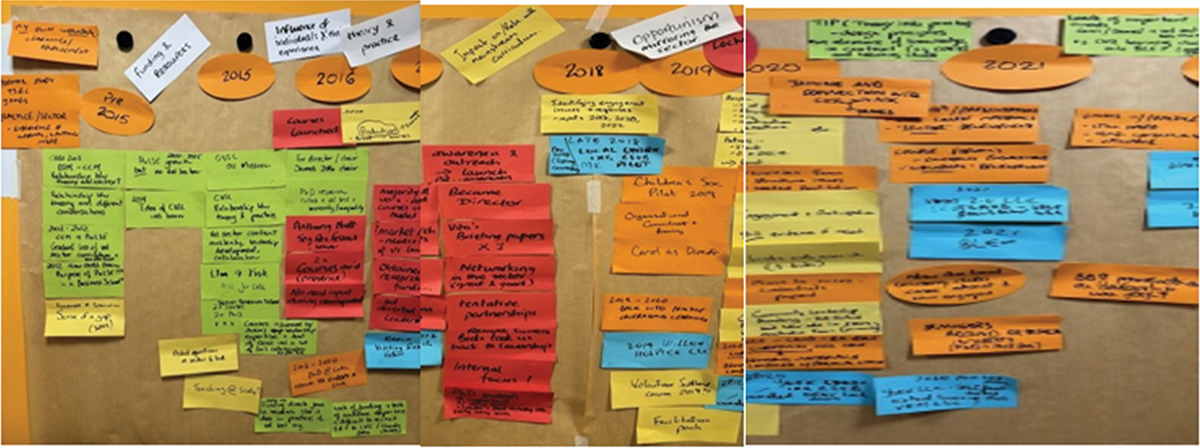
Analysis
Thematic analysis provided a flexible and accessible approach to data analysis, adapting the iterative approach outlined by Braun and Clarke (2006). Familiarization began prior to and continued through the seminar as individuals revisited the collated data that served to annotate the center’s history. This data effectively underpinned each narrative to the rest of the group, allowing them to re-familiarize themselves with key people, events, and decisions related to the teaching and learning delivered in their lifetime. The visual timeline (Figure 1) served as an initial framework for coding insights chronologically, capturing the evolution of our work, and the use of moveable cards on the timeline allowed for initial groupings of data. As we told, re-told, and wove together our stories, we identified recurring themes across stories and timelines. Following the seminar, the themes were reviewed and revised in repeated iterations between two of the authors, shared with the full team, and then finalized for producing this paper.
Findings: Looking back
This section first briefly tells CVSL’s founding story and then outlines key themes that characterized CVSL’s evolution. These themes have implications for understanding the contribution that informal HE-based learning can make to leadership development in the sector—and the limitations to that contribution.
CVSL: The founding story
Owing to the OU business model, the mainstream curriculum—including the continuation of a previous accredited nonprofit management programme—and the provision of an alternative new nonprofit graduate programme were both deemed financially unviable. With the aim to find a viable alternative consistent with the OU mission, CVSL was founded in 2016 to “strengthen” the voluntary sector through research, knowledge exchange, and leadership learning appropriate to the needs of smaller organizations. A philanthropic gift funded the appointment of a full-time senior research fellow with sector-specific expertise on a three-year contract, two full-time PhD studentships, and the development and delivery of two open education courses, under the leadership of a Professor of Collaborative Leadership in the OU Business School whose research context included nonprofit organizations. Ideally, CVSL could have been supported by the appointment of a professor with nonprofit leadership expertise, but the additional cost was prohibitive.
CVSL’s provision of research and learning was to yield a solid understanding of leadership that could affect change in a context that continues to be complex, ambiguous, and dynamic. As highlighted above, the identified needs focused on capacity-building, access, affordability, relevance, and timeliness. The previous section has outlined the use of OpenLearn to address access and affordability. For relevance and reliability, we drew on our expertise in developing practice-oriented theory from research-oriented action research (Eden & Huxham, 2006; Huxham & Vangen, 2003) and working with individuals in the sector using a practice-oriented ontology, which requires “tolerance for complexity and ambiguity” and engagement with organizational life through “observing and working with practitioners” (Feldman & Orlikovski, 2011, p. 1249). To address the ongoing need for capacity-building in the sector, we drew on the theory of collaborative advantage (Huxham & Vangen, 2005). Following Milbourne’s (2013) advice that the loss of collaborative leadership was having the greatest impact on organizations working at the community and grassroots level, we drew specifically on theory that sees collaborative leadership as the ability to “make things happen” (Huxham & Vangen, 2000; Vangen & Huxham, 2003). The first courses were written by academics with expertise in leadership and collaboration, one with work experience in the nonprofit sector, and further drawing on a “practice” conceptualization of leadership (Carroll et al., 2008; Raelin, 2011b, 2016a, 2016b, 2020) that reflects the broader “practice turn” in contemporary theory (Nicolini, 2012; Schatzki et al., 2001; Simpson, 2009). As a small center, CVSL has relied throughout its existence on the expertise and experience of academics recruited to work across the Business School.
Meeting needs
The first theme that emerged through the interwoven narratives was a continuing question as to whether CVSL’s open education offer is meeting the needs of the sector. Creating programmes that match learning needs is a key predictor of successful outcomes, and we are increasingly aware that our understanding of this need is growing but partial. OERs have huge potential in terms of reach and accessibility, but also limitations in meeting specific learner needs.
An initial review by CVSL academics (Terry et al., 2018) affirmed that sector actors and think tanks identified the need for increased, accessible leadership development opportunities (Bolton & Abdy, 2003; Clark, 2007; Grey-Thompson, 2013; Harries, 2016; Marsh, 2013). OpenLearn provided the platform to enable CVSL to engage at scale, and more than 20,000 people have accessed the webpages of CVSL’s initial two online courses since their production in 2016. Between March 1st, 2022, and December 31st, 2023 (some six years after production), there were over fifteen thousand visits by over nine thousand unique visitors. Although over 60% of visitors were from the UK, others were spread around the world. Repeat visits were higher than the OpenLearn average, with over 30% bookmarking the site to return multiple times. In 2024, individuals continue to engage with course online forums. These statistics, combined with learner feedback, 1 affirm that learners have found the courses useful (Box 1).
However, the format of “open” learning produces limited data about website visitors and their learning objectives. Activity data shows that many visitors do not complete a course in the linear way it is presented but rather engage with sections of content. It does not reveal why. In conversation with us, umbrella 2 organizations indicated that there is a need for more targeted offers rather than a generalized “open” offer. They requested learning based on alternative models to those included in the courses. As a result, CVSL incurred additional costs as academics offered facilitated sessions (face-to-face and online) in the form of “Learning Clubs” (a series of supported learning sessions) and workshops (one-off tailored events) to address specific needs. This has involved adaptation, curation, and re-use of the initial course material (see below) and the development of further learning resources, plus an investment in facilitation.
CVSL has engaged with learners in middle management roles, those who have just joined the voluntary sector, and volunteers interested in familiarizing themselves with the complexities of leadership in the sector, where leadership development often takes place at the top end of management and the board. As one online participant suggested, nonprofit organizations are reluctant to invest in middle management because they fear that other organizations will poach those they have invested in. Informal learning offered by institutions like CVSL bridges this gap and can help to level the playing field.
Adaptation, re-use and innovation
CVSL’s offer has evolved significantly over the center’s lifetime, broadly in line with the commitments to be open and adaptive. Regular maintenance and upgrade of informal learning are not resourced by the OU in the same way as mainstream curriculum, and maintaining currency can be a challenge, depending on funding from external partners or stretching internal resources. In both original design and development, we were limited by existing capacity, especially not having a dedicated nonprofit chair as mentioned above. Adaptation was, therefore, somewhat ad-hoc and opportunistic. Yet, all of the witness seminar participants identified innovations of the core CVSL materials in both an informal way through conferences, seminars, keynote speeches, presentations, webinars, etc., and in the development of additional formal learning. The stories of these innovations captured a variety of reasons for such evolution: responding to learner feedback, external pressures, and identification of gaps by learning and sector partners, such as the differing nature of Scottish and Welsh contexts compared to England, where the OU has its primary campus and where CVSL academics are based. The COVID-19 pandemic was a particular point of reflection during the witness seminar and marked a significant inflection point for CVSL as it was for many organizations in the UK voluntary sector (Rees et al., 2022). However, as the CVSL offer was (like the OU more generally) online first and emphasized self-directed learning, the impact of COVID-19 was not as marked as it might have been for other providers. It did, however, prompt adaptation and re-use of existing course materials for the purposes of a wholly online conference in 2020, whereas previously, these had been held face-to-face. We noted increased learner engagement with the online courses during the “lockdown” periods, but this was relatively short-lived.
Changes in CVSL’s offer have not always been directed proactively (or ideologically) toward greater “openness,” as illustrated by the example of the Black Leadership and Empowerment Programme (BLEP). BLEP combines free learning resources hosted on OpenLearn with a credit-bearing component, operating as a targeted programme at the intersection between open, informal learning and formalized education. It was developed following an approach by Black activists based in Liverpool, who produced the initial template for the programme. These activists, along with other stakeholders, played a key role in informing the production team, commenting on drafts, and contributing to audio-visual materials used in the production—moving toward a co-production model that was not present in CVSL’s original courses. In February 2024, the OU delivered BLEP in collaboration with community and corporate partners (Autotrader and Manchester Airport Group) and supported by a large national nonprofit organization (The King’s Trust) that took an active role in identifying and recruiting community learners, many of whom are active in the nonprofit sector. Following the success of the first BLEP Hub in Manchester, the OU is working with a nonprofit funder, the Henry Smith Charity, to deliver six BLEP hubs across the UK in February 2025. As the OU business model is geared toward large-scale delivery, producing bespoke learning such as BLEP is likely to continue to rely on collaboration with external partners.
Notably, through the original courses and through BLEP, CVSL developed a hybrid online/in-person offer, which required a fundamental shift away from the digital-first, self-directed approach of CVSL’s original resources. This related to particular relationships (see below) and preferences of both learners and educators, but also to the impact of new research, literature, and wider knowledge that fed into the CVSL offer. Such developments did not progress in a linear fashion. Furthermore, responding to emerging requirements led to less positive aspects, as seen in narratives of frustration as capacity was invested in unsuccessful funding bids or practice partnerships that stalled. However, reimagining and rephrasing the CVSL offer provided opportunities for development, even if specific short-term goals were not always met.
Relationships and collaboration
The witness process highlighted the centrality of relationship-building for CVSL’s development. Engaging with both academic and practice networks has enabled CVSL academics to begin to create a community of practice that has overtime become known for its expertise, attracting researchers, students, funders, and practice partners. Successful research partnerships, growing numbers of PhD students working with practice organizations, and ongoing dialogue with key umbrella organizations, locally and nationally, have all grown CVSL’s capacity. In one case, we co-created a new course with an umbrella organization (Volunteer Scotland); in others, we nurtured relationships with practice organizations that resulted in joint funding applications.
However, building and sustaining relationships takes time that is not fully accounted for in academic workloads. Developing these to a point where there is an effective partnership and mutually beneficial “co-produced” projects can be very slow to materialize, and potential partnerships are impacted by personnel turnover and changing priorities in both organizations. This is well illustrated by an ongoing dialogue with a nonprofit organization to co-create new learning that has lasted over six years at the time of writing. Furthermore, failure of funding bids (sometimes with multiple partners) in an increasingly competitive funding landscape has meant that objectives to create new learning in partnership with practice organizations remain only partially fulfilled. Relationship-building with practice keeps us engaged with and knowledgeable about the sector, but only a few of these relationships bear fruit in terms of extending the learning offer through co-produced resources.
Institutional and external context
Sharing our narratives in the witness seminar highlighted the enormous transformation in our institution, HE generally, and the broad socio-political context in the eight years since CVSL’s inception. The consequence of an increased squeeze on university funding and changing models (i.e., toward HE-based apprenticeships) has been higher viability hurdles for new projects and increasing internal competition for resources with a resultant tendency to seek scale, spread resources more widely, or reduce specialization. Externally, there are multiple training providers offering online learning opportunities post-Covid, though rarely at no cost and often with limited theoretical content. Our nonprofit partners are increasingly under pressure and time-poor, which limits their ability to engage with HE and frames their requests to academics. In the nonprofit sector and in education, there is decreasing reliance on public funding and a corresponding dependency on diversifying income streams, including from philanthropic donations and trusts. This dependency is still relatively new in the UK. An internal study commissioned by CVSL in 2022 reinforced the difficulty of competing for such funding (effectively against practice organizations) to extend CVSL’s learning resources in this environment. We also face the reality that CVSL’s offer does not sit within the leadership “mainstream:” attempting to swim against this tide—even with established academic theories as a basis—is difficult within such an external context.
Sustainability
Bringing together the above themes is the ongoing endeavor to sustain the center’s work in the light of both push and pull factors that shape the learning offer. As a small group of individual academics whose contractual commitments lie primarily in other elements of the role, we have made repeated pitches for resources. We have competed internally for resources, including marketing and communications expertise, to make practitioners more aware of our work, while simultaneously making repeated bids for external resources. We have grown CVSL’s resources through partnership and research, but at times, this has led to compromise. For example, participating in successful European partnership bids led to new “open” learning resources, but the associated requirements meant that these do not necessarily reflect our preferred pedagogical or theoretical approaches. At other times, we adapted our approach to meet perceived funders’ requirements but lost out to independent training organizations with lower overheads.
Despite challenges of demand, resources, and context, CVSL is sustained—firstly by the commitment of a small group of academics whose research interests involve engagement with (rather than simply the study of) the nonprofit sector, and secondly through alignment between CVSL’s objectives and the university’s social mission to offer accessible learning to all.
Discussion: Looking to the future
In this section, we address key issues emerging from our reflection that have implications for the development, design, and delivery of future HE-provided informal learning for UK nonprofits, recognizing that our proposals set up challenges for educators.
First, we argue that there is a continuing place for HE-provided informal learning to meet the needs of a diverse and complex sector where many, especially smaller, organizations encounter growing challenges of sustainability and capacity. As suggested by our “prism” of conceptual lenses, learning design for nonprofit leadership addresses both individual lifelong learning objectives and the capacity-building needs of the nonprofit sector as their workplace. Informal learning alone cannot meet all these needs but has a role to play, alongside mainstream curriculum and targeted or bespoke interventions. Open education addresses some of the challenges of accessibility, relevance, and timeliness faced by actors in the sector, particularly in smaller organizations. Moreover, HE-provided informal learning expands access to current research-informed insights and conceptualizations, in line with UK HE’s increasing focus on knowledge exchange and impact. It provides space for interaction between practitioners and academics, unconstrained by the boundaries of formal curriculum and accreditation requirements. Further, in spite of sustainability challenges, HE provides an element of continuity as nonprofit providers close due to financial pressures, as is happening at the time of writing (i.e., see reports from Charity Times on 9 October 2024 and 30 January 2025 at www.charitytimes.com).
As outlined above, a crucial motivation for developing and sustaining an informal learning offer was to address issues of access to leadership development for smaller nonprofits and for individuals working in these organizations. In line with Knox’s (2013) assertion, we recognize that going forward, we need more evidence about the size and nature of the demand. Moreover, a future learning offer depends on refreshed research-based insights into how leadership happens, how practitioners develop their leadership practice, and how meeting their learning needs, in turn, builds capacity for the sector.
Second, taking “open” principles seriously and further aligning leadership learning with a practice ontology highlights a need for deeper collaboration with practitioners to co-produce future informal learning adapted to their needs through ongoing dialogue between practice and theory. Collaborative design processes are resource-intensive, the outcomes are uncertain, and practice-academic partnerships are complex and challenging (Macintyre, 2022). Moreover, courses designed collaboratively do not necessarily fit with institutional parameters or prescribed learning design frameworks. Participation from practitioners can be tokenistic and/or relate to very specific work contexts that are not shared by others. The challenge is to design open access informal learning resources that can be adapted, built upon, and re-worked through collaborative dialogue between nonprofit practitioners and academics—rather than producing “courses” designed along institutional patterns. Additionally, there is more work to do to communicate what “open access” means and emphasize the permission that practitioners have to (re)use resources in different ways to truly achieve “work-based,” contextualized learning. Co-design applies not just to content, but additionally to how that content is delivered to and remixed by learners who are enabled to become co-educators through the principles of open education and the “co-development” of leadership practice.
Third, with regard to conceptual underpinning, we propose that there is a continuing need to offer nonprofit practitioners opportunities to widen their understanding and extend their practice of leadership by encouraging engagement with contemporary leadership concepts. As HE educators, rather than trainers, our aim is to stretch thinking and to share insights from research. We continue to assert that learning to lead with others and beyond authority and position is essential in today’s interconnected, interagency environment. CVSL’s learners have responded positively to this expansion of their conceptualization of leadership. However, in our conversations with nonprofit organizations, we are often asked for a more directive approach in which we share more traditional leadership models. In addition, our experience suggests that there is a demand for short one-off learning opportunities that are context-specific, rather than for courses that can be applied in different contexts, and for intensive facilitation, rather than (entirely) self-directed learning. One possible approach to resourcing this would be to sell bespoke leadership development opportunities to large nonprofit organizations to subsidize a similar offer to smaller organizations, or to identify sponsoring organizations. Such approaches set up a tension between principles of “openness” on the one hand and academic leadership of learning on the other—a tension likely to continue into the future.
Tensions also exist within the (often implicit) conceptual positions of the practitioners who constitute CVSL’s target audience. Cranfield Trust’s report (2023) identified that practitioners both saw leadership training as important and as a low priority. The report also identified that cost was a barrier to access to leadership training and that free training was not seen as high quality. Coupling these tensions with the recognition that CVSL intentionally swims against the mainstream tide—which often presents leadership as the responsibility of those in “powerful” hierarchical positions rather than those with less power and in smaller organisations—then the context remains challenging. Many potential learners and partners may see leadership as simply “someone else’s job.” Other, more formal, offers in the HE sector that target those in senior organizational positions may attract enthusiastic attendees who self-identify as “leaders” and who can justify the costs of personal development or access sponsorship, but they are not primarily the learners CVSL seeks to reach.
Fourth, a commitment to offering informal learning as part of a mix of HE provisions for the sector necessarily raises questions of resources. As indicated throughout this paper, this relates not only to institutional decisions but also to government education policy. Open access informal learning that is free to the learner has associated costs that must be covered by funders and comply with their conditions. In this way, the agenda is still often framed by HE and external agencies, rather than led by evidence of need. For the OU, the ongoing presence of a nonprofit academic center provides an anchor and a basis for recruiting academics with relevant expertise and specialist knowledge in the nonprofit sector. As has been the experience so far, shifting funding and personal research interests, reflecting broader changes in the nonprofit sector and in society, will continue to ensure the diversity and evolution of the Center’s profile and offer—for example, the increasing emphasis on equality, diversity, and inclusion.
UK education funding is undergoing further changes that may impact nonprofit practitioners. At the time of writing, the Labour government has signaled its intention to proceed with the Lifelong Learning Entitlement (LLE) announced by the previous government, providing individuals with loans to access learning over their lifetime. However, in spite of the “lifelong” framing, eligible courses are likely to be focused on a future industrial strategy and associated skills development (rather than individual development), and the offer is unlikely to extend to the leadership needs of nonprofit organizations. Whatever the details of such future schemes, working-age learners will remain time-poor, balancing all aspects of their lives to include study. They will require flexibility and be reticent about taking on debt for learning. They, like their employing (or volunteering) organizations are likely to be less concerned about academic credit and more concerned with the development of skills and knowledge for immediate application. Hence, there is a need for short bursts of learning or flexible provision that is work-based, makes an immediate impact on their organization, and causes minimal disruption to workload. From an HE perspective, the provision of such flexibility will require significant investment in new systems, with learners potentially mixing and trying to match up courses from multiple providers to meet their needs. This implies much more modular provision, significantly more administration, and, importantly for many learners, more support for learning than traditional students require. There is currently no scope to use LLEs for non-accredited learning. Therefore, the cost of producing, delivering, hosting, and supporting such programmes is still likely to mean accessing alternative funding via philanthropy, trusts, and/or co-production with partners. The (more unlikely) alternative is that some universities may see a niche and invest in formal learning, believing that a sufficient number of individuals working in the nonprofit sector will use their LLE to fund their professional development.
To an extent, the size of the opportunity is dictated by ideology. Both the trajectory of government investment in public services, education, and skills policies, and who should pay for these will shape future opportunities.
Conclusion
This paper has shown that there are formidable barriers to overcome to deliver a HE-provided open access informal leadership learning offer for the UK’s nonprofit sector. First, there is limited funding in HE for social justice-focused, research-informed learning outside the mainstream curriculum, and that which exists is highly competitive and often short term. Looking to the future, CVSL is aligning learning opportunities with HE’s increasing focus on impact, but this may mean moving away from “open” learning resources to a more targeted approach, as in BLEP. Second, initiatives to coordinate nonprofit leadership learning at a national level have not been sustained—in part because of the competitive nature of the nonprofit support “ecosystem.” In this context, understanding the learning needs of an incredibly diverse sector will continue to be partial. All of this suggests that close partnership between HE providers and sector support organizations will be needed to develop a future informal learning offer. As above, this may result in a more targeted rather than “open” offer. Third, although successive UK governments have indicated support for a more coordinated approach to leadership and learning in and of the sector, there is a lack of long-term policy and funding to address this. Some independent funders have made attempts to highlight leadership learning needs and innovate in this space, but these attempts have not been integrated with those of other funders and providers.
Our experience within CVSL and through partnerships with sector organizations affirms that there are continuing needs for leadership learning and development in smaller nonprofit organizations that are not being met. There is also a lack of intelligence, research, and analysis to underpin a forward strategy. This paper represents an attempt to articulate the challenge in the UK but also uncovers key issues for comparison with other national contexts.
In conclusion, we assert that HE-provided informal leadership learning continues to have an important supporting role in mainstream curriculum and targeted interventions for developing leadership in and through the nonprofit sector. Informal learning that is work-based and designed on open education principles provides vital access and impetus to organizations and individuals who otherwise may not be ready or able to engage in formal learning, or where formal learning does not meet their needs. Informal learning developed by academics provides a resource that can be the basis of self-directed or facilitated learning along with lifelong learning principles. However, existing tensions remain to be reconciled to enable such development and to make HE-provided informal learning available on a truly “open” basis. Realistically, this means reconciling institutional parameters, funding, and government policy with individual practitioners’ demands as adult learners, their organizations’ needs and academics’ ambitions. Learner Feedback. “emboldened to be a bit more critical of … superiors … and also, to be a bit more willing to try and influence matters within [organization] … to try to be a positive influence” (Online learner 21) “[One thinks] of leadership as those charismatic, lead from the top. And there is a role for people like that. But [CVSL courses confirmed they are] a leader of collaboration … confidence around that” (Learning Club Participant 13) Learned that “everyone can play a part in [leadership], regardless of their role” (Learning Club Participant 12) ‘Nobody is superhuman or expert in everything or has the skills in every area necessary … [leadership] is about recognizing your expertise and ensuring those around you can adequately fill gaps” (Online Learner 7).
