



Abstract
This study examines how mentorship opportunities contribute to the productivity and career growth of public affairs faculty, stratified by gender and race. The study uses primary data coming from an original survey administered at two different points in time (2017 and 2021) to faculty who are part of NASPAA member schools. Results indicate that women and faculty from racially under-represented groups are more likely to receive formal mentoring whereas men and white faculty are more likely to benefit from informal mentoring. Additionally, results show that the relationship between mentoring approaches and research effort differed by the faculty’s member gender and race with formal mentoring contributing to the research effort of men and white faculty across all academic ranks and university types, and informal mentoring contributing to the research effort of mid-career faculty of all genders and races. This study aims to inform individuals and universities about mentoring trends and contributions.
Mentorship in higher education has been defined as a collaborative learning process that relies on the knowledge and experience of mentors (e.g., senior faculty) to guide mentees (typically junior faculty or faculty transitioning into new roles) with career advancement and professional growth (Bean et al., 2014; Morrison et al., 2014). The relationship between the mentor and the mentee is different from that of a supervisor and an employee (Meschitti & Lawton Smith, 2017). In 1988 Kram identified two types of mentorship functions that are still relevant today. These are the career functions (which refer to mentoring activities that cover skill development, coaching and exposure to professional networks among other things) and the psychological functions (which refer to activities that focus on interpersonal relations, role modeling, counseling, and similar activities). Kram’s (1988) typology is important because mentoring can affect faculty differently. Existing studies acknowledge that men, women, and faculty from ethnically and racially under-represented groups tend to get involved in different mentoring relationships. Specifically, white men tend to get involved in mentoring activities that focus on career functions whereas women and faculty from ethnically and racially under-represented groups are more likely to get involved in mentoring activities that focus on psychological functions (O’Neill, 2002; Portillo, 2007).
Academia is considered a male-dominated industry with masculine organizational structures and policies that promote a gendered work environment (Rauhaus & Schuchs Carr, 2020). In the last three decades women representation in faculty positions of public affairs programs doubled from 17% in the 1990s (Slack et al., 1996) to 34% in the early 2010s (Network of Schools of Public Policy, Affairs and Administration [NASPAA], 2013), and 36% (Scutelnicu et al., 2018) in the late 2010s. Despite progress, women continue to be under-represented, especially in higher academic ranks and leadership roles (Knepper et al., 2020; Sabharwal, 2013) where they could serve as mentors. In the United States approximately 36% of full professors are women, and they occupy less than 40% of faculty tenured positions (Betancur & Livingstone, 2018). Faculty from ethnically and racially under-represented groups also improved their representation among NASPAA-accredited programs from 9% in 2000 to 23% in 2013 (NASPAA, 2013), but their presence in senior roles is even lower than that of women (Betancur & Livingstone, 2018). This under-representation of women and faculty from ethnically and racially under-represented groups in senior faculty ranks leads to their limitation and/or exclusion from professional networks that are beneficial for career advancement (van den Brink & Benschop, 2014). Mentoring is considered a useful tool in advancing the careers of women and minorities, in retaining them in the academy, and in questioning existing academic power structures (Meschitti & Lawton Smith, 2017).
The literature discusses both formal and informal mentorship opportunities in higher education and agrees that both forms are beneficial for faculty career advancement, with men being more likely to benefit from informal mentoring opportunities when compared to women (Garrett, 2006; Jäger, 2010). Formal mentorship is not as widely spread as informal mentorship, but the former has the potential to benefit women and faculty from ethnically and racially under-represented groups as these faculty groups don’t have well-established professional networks (Meschitti & Lawton Smith, 2017; Schwartz-Shea, 2020).
Seeking to explain the value of mentorship practices in public affairs, this study examines how formal and informal mentorship programs contribute to the productivity and career growth of faculty who are on the tenure stream (both pre and post tenure), stratified by gender and race. The study uses primary data coming from an original survey administered at two different points in time (2017 and 2021) to faculty who are part of NASPAA member schools. The survey data contains views of over 600 faculty who discussed their formal and informal mentoring experiences. As suggested by Scutelnicu and Knepper (2019) both formal and informal mentoring practices would be useful in increasing women’s presence and advancement in the academy. The need to assess the differences in mentoring experiences by faculty gender and their ethnic and racial backgrounds is important due to the different career foci (Quinlan, 1999) and roles these faculty groups play in academia (Portillo, 2007). Women and faculty from ethnically and racially under-represented groups dedicate more time to service and advising activities than white men (Lloyd-Jones, 2014; Rauhaus & Schuchs Carr, 2020). Through its findings, this study aims to inform individuals and institutions of higher learning in public affairs and other related social sciences about mentoring trends and needs of different faculty groups.
Literature review
There are several mentorship models that have been developed and successfully applied in academia. The most common model is the mentor-protégé model that describes a one-to-one relationship where a senior faculty is paired with a junior one (Wolfe Poel et al., 2006). The group mentoring model describes an arrangement where a mentor is assigned to several mentees (Darwin & Palmer, 2009) and it has been particularly helpful in instances when there are few women and faculty from ethnically and racially under-represented groups who could serve as mentors (Kwan et al., 2015). Peer mentoring describes an arrangement where peer colleagues mentor each other (Driscoll et al., 2009). This mentoring model has the potential to increase faculty professional networks (Van Emmerik, 2004). Finally, mentoring consortia is a model in which institutions of higher learning create a joint mentoring program (Füger et al., 2008).
The literature discusses more formal than informal mentorship opportunities. Most of the studies that assess the effectiveness of formal institutionalized mentorship programs are based on one of the mentoring models described above. Existing literature discusses the benefits of mentoring for both individuals (more for mentees than for mentors), and institutions. Mentoring assists mentees with career development and advancement (Bodkin & Fleming, 2021; Kram, 1988), as well as with research and teaching productivity (Falzarano & Zipp, 2012; Fountain & Newcomer, 2016). Mentoring also increases collegiality, it helps mentees build professional networks (Van Emmerik, 2004), and it encourages socialization (Bland et al., 2009; Borders et al., 2011). Moreover, mentoring helps faculty understand and navigate organizational processes and policies (Meschitti & Lawton Smith, 2017). The few studies that discuss benefits for mentors agree that social skills and previous mentoring training are important factors that ensure the success of mentors (Fountain & Newcomer, 2016; Lechuga, 2011).
Mentoring also benefits institutions as it serves as a support mechanism for faculty recruitment and retention (Falzarano & Zipp, 2012), especially for women (Füger et al., 2008; Gardiner et al., 2007) and minorities (Buzzanell et al., 2015; Curry, 2011). Additionally, mentoring has a positive effect on organizational commitment (Banerjee-Batist & Reio, 2016; Whitten, 2016) and job satisfaction (Gardiner et al., 2007). It ultimately, informs institutions of higher learning about policies that encourage gender and racial diversity and equity (de Vries et al., 2006; Raadschelders et al., 2019; Thomas et al., 2015).
Informal mentorship has become popular in the 1990s (Fountain & Newcomer, 2016). Studies that examine the implications of informal mentoring agree that men are more likely to benefit from informal mentoring opportunities when compared to women (Garrett, 2006; Jäger, 2010) mainly because of their professional networks (Meschitti & Lawton Smith, 2017).
The extant literature also discusses how mentorship models affect different faculty groups. For instance, group mentoring may be beneficial for institutions that have fewer women and faculty from ethnically and racially under-represented groups who can be mentors (Kwan et al., 2015) but it may pose challenges to mentees from these under-represented groups (Johnson-Bailey & Cervero, 2004). Additionally, peer mentoring can be beneficial for women and minorities because it encourages the psychological functions of mentoring (Portillo, 2007) and it helps expand professional networks (Van Emmerik, 2004).
This study extends previous research by providing a comprehensive view of the formal and informal mentorship opportunities that are available to faculty in public affairs programs (a need previously identified in the literature (see Meschitti & Lawton Smith, 2017) rather than focusing only on one specific mentoring model. The study also advances the literature by examining the extent to which different mentorship avenues contribute to faculty productivity defined by the faculty research effort. This study further contributes to the existing body of literature by discussing the role of mentoring practices in promoting diversity in academia at different career stages. Unlike existing studies that focus on early career faculty and students, this study examines the role of mentorship and faculty productivity for early and mid-career faculty, as well as for faculty occupying administrative roles.
Methods
Drawing on primary data coming from an original survey which was administered at two different points in time (2017 and 2021) to faculty who were part of NASPAA member schools, this study aims to answer the following two research questions:
What type of mentoring opportunities do public affairs faculty benefit from to advance their careers?
To what extent do formal and informal mentoring experiences influence the research effort of faculty in public affairs programs?
The 2017 survey was sent out to full-time, tenure-stream faculty who were part of NASPAA accredited programs whereas the 2021 survey was addressed to a similar group of full-time faculty members who were part of non-accredited programs at NASPAA member schools. The identification and selection of the survey participants involved two steps. First, full-time faculty were identified through a review of websites of NASPAA-member schools (both accredited and non-accredited). Then, full-time faculty holding the ranks of assistant, associate and full professors were included in the survey sampling frame. The 2017 survey had a sampling frame of 1,846 tenure-stream faculty while the 2021 survey had a sampling frame of 1,281, for a total sampling frame of 3,127 faculty. It should be noted that the data collection for all potential survey participants took place in 2017 but the survey was administered at two different times.
Both surveys were administered online, and data were collected in two waves with three to five follow-ups with individual faculty. The survey data contains views of approximately 624 faculty which represents an overall response rate of 20% for both surveys. The first survey had a higher response rate (24%) when compared to the second one (14%). It should be noted that the second survey was administered during the COVID-19 pandemic when faculty were less likely to complete voluntary surveys. Additionally, oversampling occurred in the process of identifying this study’s sampling frame because not all school websites clearly mentioned the programs their faculty were teaching in. Specifically, oversampling occurred in approximately half of the universities that had small non-accredited MPA/MPP programs (comprised of less than five full-time faculty) which were housed in political science and/or economics departments. This study’s limitation should minimally impact the generalizability of the findings considering the small number of faculty who were part of these public affairs programs as well as the disciplinary similarities of public affairs with political science and economics.
This study uses post-stratification weights (calibration) by gender to address survey nonresponse bias and to make the sample more representative of its population. The percentage of male participants was slightly higher (53%) than the female ones (47%) whereas the sampling frame was comprised of 64% male and 36% female faculty. Future studies could further address nonresponse bias through a selection of a stratified random sample based on key faculty demographics and through the use of sample weighting adjustments.
Descriptive statistics and the chi-square test of significance are used to describe the types of mentorship opportunities that are available to faculty and their variation by faculty individual characteristics. Additionally, the chi-square test is used to examine how faculty formal and informal mentoring experiences contribute to their research effort or workload.
Formal and informal mentorship are dichotomous variables and describe whether a faculty member received any formal or informal mentoring throughout their careers. Research effort or workload refers to the percentage of time faculty dedicate to research activities per year, and it is operationalized as low (when faculty spend 30% and less of their work time), medium (when faculty spend between 31% and 50% of their work time), and high (when faculty spend 51% and more of their time) on research activities.
The study examines the relationship between mentorship and the research effort of faculty members, overall and stratified by gender and race. This research approach is informed by existing studies that state that women and faculty from ethnically and racially under-represented groups would benefit from formal mentoring (Meschitti & Lawton Smith, 2017; Schwartz-Shea, 2020) whereas men and white faculty are more likely to benefit from informal mentoring when compared to their counterparts (Garrett, 2006; Jäger, 2010).
The following hypotheses are formulated to answer this study’s research questions:
H1: Men who benefit from informal mentoring tend to have a higher research effort when compared to women, overall and across academic ranks and tenure status. No differences are anticipated between men and women when formal mentoring is considered.
H2: White faculty who benefit from informal mentoring tend to have a higher research effort when compared to racially under-represented faculty, overall and across academic ranks and tenure status. No differences are anticipated between white faculty and faculty from racially under-represented groups when formal mentoring is considered.
The study uses two control variables: the Carnegie’s classification of the faculty institutional affiliation, and whether a faculty member works for a public or a private university. Existing research suggests that Ph.D. granting institutions and private universities are more likely to provide research support to their faculty than their counterparts (Fountain & Newcomer, 2016).
Results
Individual characteristics of survey participants.
*Sig. at .01 level; **Sig. at .05 level.
Overall, 23% of the survey respondents identified themselves as assistant professors, 36% of them as associate professors, and 41% as full professors. There are more participants at the assistant professor rank and fewer participants at the associate and full professor ranks in the first survey than in the second one. More than half of survey participants (59%) reported they did not occupy an administrative role while 41% of them reported they did. There is a higher percentage of survey participants who hold an administrative role in the second survey (53%) than in the first one (37%).
The majority of respondents identified themselves as men (53%) when compared to 47% who identified as women. There is a higher percentage of men participating in the second survey (64%) than in the first one (50%), and a lower percentage of women participating in the second survey (36%) than in the first one (50%). When survey participants were asked to indicate whether or not they had a LatinX descent, 95% of the faculty members identified themselves as non-Latin X whereas 5% identified as LatinX. In terms of racial composition most faculty identified themselves as white (83%), followed by 5.6% who identified as African American, 5.4% as Asian American, 3% as two or more races, and 3% as another race. The first survey has a higher percentage of white respondents (85% vs. 77%), and a smaller percentage of African Americans (5% v. 8%), Asian Americans (5% v. 6%), and participants of another race (2% v. 6%) when compared to the second survey.
Figure 1 describes the academic rank of respondents grouped by gender. Out of the total academic positions held by men, 20% are at the assistant professor level, 29% are at the associate professor level, and 51% are at the full professor level. Out of the total number of respondents who were women, 28% identified as assistant professors, 42% as associate professors, and 30% as full professors. These numbers show that women have a higher representation at the assistant and associate professor levels and a lower representation at the full professor level when compared to men. Academic rank by gender.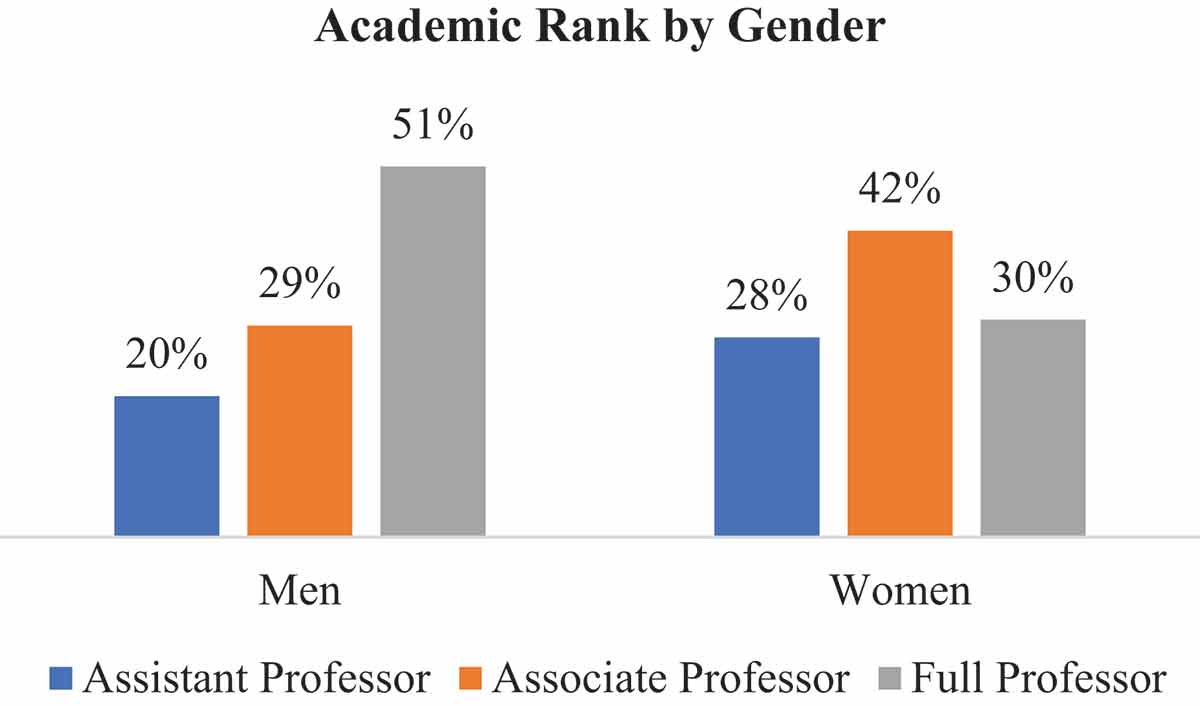
Figure 2 describes how faculty academic rank varies by race. Out of the total assistant professors, 81% of them identified themselves as white, 9% as African American, 6% as Asian American, 2% as two and more races, and another 2% as another race. Out of the total associate professors, 75% of them identified as white, followed by African Americans and Asian Americans at 9% each, two and more races (4%), and other race (3%). Finally, out of the total full professors, an overwhelming 92% of them identified themselves as white, followed by other race (3%), Asian Americans (2%), two and more races (2%) and African Americans (1%). Based on these statistics, white survey participants have an overwhelming representation across all faculty ranks, with associate professors having the most and full professors having the least racial diversity. Academic rank by race.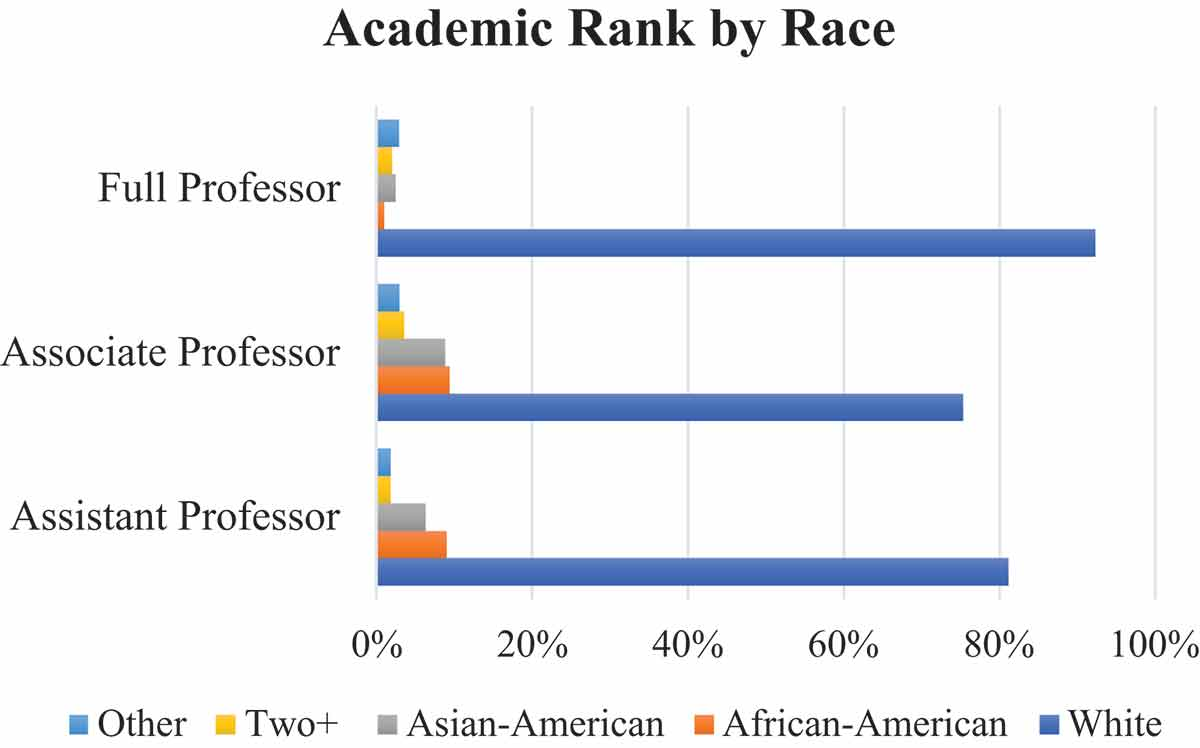
Mentorship opportunities
Most survey respondents (91%) indicated they had benefited from mentorship opportunities throughout their career compared to 9% who had not. In this study mentorship opportunities were classified in two main categories: formal and informal mentoring. Formal mentoring involves a planned and organized institutional program whereas informal mentoring happens without such an institutional organized effort. A third of the survey participants reported they benefited from a formal mentoring program compared to two-thirds of them who did not. An overwhelming majority of survey participants (95%) reported they benefited from informal mentoring opportunities.
Survey participants described several formal mentoring programs that helped them throughout their careers, as follows: faculty support centers which were typically led by faculty to assist other faculty with their teaching and career planning; mentoring programs for scholarly activities related to publishing, external grant application, funding for research travel and dissemination of research, and working with assigned mentors who helped junior faculty navigate the tenure and promotion process and provided research advice. Faculty who participated in the survey identified career and research guidance as the most common informal mentoring practices. Career guidance helps faculty understand and navigate internal organizational structures and the tenure and promotion processes. Research guidance helps faculty establish and maintain an engaged research agenda, and prepare their conference presentations and publications. Survey participants further discussed that informal mentoring relationships were both internal and external to their institutions. As a result of these informal mentoring relationships many faculty reported they developed life-long research collaborations with their Ph.D. advisors and external peers in the discipline. Faculty also mentioned they benefited from informal mentoring for teaching guidance, but no one discussed mentoring practices about service.
Similarities and differences between mentoring type and faculty characteristics.
*Sig. at .01 level; **Sig. at .05 level.
The cross-tabulations of informal mentoring and individual characteristics show statistically significant differences for three variables. First, the analysis shows that tenured faculty (97%) reported benefiting slightly more from informal mentoring than pre-tenured faculty (91%). Second, a higher percentage of associate (98%) and full (97%) professors reported benefiting from informal mentoring when compared to assistant professors (89%). Third, a slightly higher percentage of men (97%) than women (93%) reported benefiting from informal mentoring.
Survey participants shared specific examples about mentoring practices or programs that would have been beneficial to their career planning and advancement. Research support and advice was, by far, the most common area identified by survey respondents. Participants identified the following research support areas that would have benefited their careers: availability of clear research expectations, guidance about the peer-review and publication processes, support for conference travel, research funding, and grant writing, as well as opportunities for teaching release time. Survey participants identified career planning as the second most common area they would have liked to benefit from. Specific support practices for career planning included the organization of an orientation session for new faculty, guidance on navigating the academic culture and work environment, availability of approachable faculty than one could talk to, career development advice from peers, formal coaches, and senior colleagues who served on tenure and promotion committees, availability of a realistic work–life balance (especially for parents), and participation in external faculty success workshops. Faculty identified teaching support as the third most common area that they would have benefited them. Some of the teaching support practices included formal support and training through an internal institutional faculty center, guidance about teaching assignments and student advising expectations especially for women and faculty from racial under-represented groups. Finally, faculty also discussed that service support would have benefited their career, especially in terms of advice about service assignments. Some faculty believed they would have had more available time for research activities had they engaged in minimal service assignments. Overall, faculty agreed that a combination of formal and informal mentors coming from inside their institutions as well as from their discipline would have benefited their careers the most.
Mentorship and faculty research effort
Survey participants were asked to indicate their research workload or effort. The research effort of faculty is distributed almost evenly among the three categories where 32% of participants indicated they committed 30% or less of their work time to research, followed by 38% of faculty who reported spending between 31% and 50% of their work time to research, and 30% of faculty who reported committing more than half of their work time to research activities.
Similarities and differences of research effort and individual characteristics.
*Sig. at .05 level; **Sig. at .10 level.
Chi-square results of mentoring and research load by gender.
*Sig. at .05 level; **Sig. at .10 level.
Fifty-two percent of formally mentored, pre-tenure faculty members reported a high research effort when compared to those faculty who weren’t mentored (24%). Similar trends emerge for both men and women, with a higher percentage of formally mentored men (60%) and women (43%) reporting a high research effort when compared to 28% of the men and 20% of the women who weren’t mentored.
Results also show that a higher percentage (45%) of formally mentored men working at public universities reported a high research effort when compared to their counterparts (28%). Additionally, 77% of the formally mentored men who work at private universities reported a medium research effort when compared to 32% of those who were not mentored. No statistically significant differences are noted for women based on their formal mentoring.
When examining the relationship between informal mentoring and research effort, results indicate more significant associations for men than for women. Specifically, informally mentored men at the full professor rank are more likely (50%) to dedicate a medium effort to research activities than those who were not mentored (0%). Similarly, informally mentored, pre-tenure men (41%) reported a high research effort when compared to 0% of their unmentored peers. Also, informally mentored men working at private universities are more likely to have a high research effort than those who weren’t mentored. But both tenured men and women who are informally mentored show similar patterns in terms of research effort with a higher proportion of informally mentored men (45%) and women (40%) reporting a medium research effort when compared to those who weren’t mentored (0%).
Chi-square results of mentoring and research workload by race.
*Sig. at .05 level; **Sig. at .10 level.
Finally, the cross-tabulations of informal mentoring and research effort show significant associations for both white faculty and those coming from racially under-represented groups. A higher percentage of associate professors from racially under-represented groups who received informal mentoring (42%) reported a medium research effort when compared to those who weren’t mentored (0%). Also, 45% of the white full professors who were informally mentored reported a medium research effort when compared to 0% of those who were not mentored. It should be noted that all white associate professors and all assistant and full professors from racially under-represented groups received informal mentoring and therefore, no differences could be generated for these faculty groups. In terms of tenure status, 65% of informally mentored faculty coming from racially under-represented groups reported a high research effort when compared to 0% who were not mentored. Both tenured white faculty (43%) and tenured faculty from racially under-represented groups (43%) who were informally mentored reported a medium research effort when compared to 0% of their unmentored peers.
Discussion and conclusion
This study examined the state of mentorship among public affairs faculty as well as the relationship between formal and informal mentorship and faculty research effort. Overall, the study found gendered and racial patterns among faculty mentoring. Results suggested that specific faculty groups benefited from formal and informal mentoring opportunities differently. On one hand, early career faculty, women and faculty from racially underrepresented groups were more likely to benefit from formal mentoring than their counterparts. On the other hand, mid and late career faculty, men, and white faculty were more likely to benefit from informal mentoring. These findings are in line with existing studies in higher education that discuss the gendered and racial nature of mentoring where men have access to more mentoring opportunities when compared to women and minorities (Bodkin & Fleming, 2021; Portillo, 2007; Schwartz-Shea, 2020).
The study also found that the top mentoring areas identified by faculty refer to research support and career advancement in both formal and informal settings. Overall, survey participants indicated that faculty success would be ensured by access to both formal and informal mentors, preferably from inside and outside one’s organization. Findings showed that internal mentors could help mentees navigate internal organizational structures and processes whereas external mentors could help mentees with their research and professional networks.
Results reported herein indicated that early and late career faculty, as well as faculty working at Ph.D. granting institutions dedicated more than half of their work time to research activities. These findings are consistent with recent studies that discuss faculty research productivity in the public affairs discipline (Knepper et al., 2020; Sabharwal, 2013).
Additionally, this study found that formal and informal mentoring mattered in supporting faculty research differently. Overall, both formal and informal mentoring were more likely to benefit the research effort of men and white faculty than that of the other faculty groups. Specifically, men who received formal mentoring reported a higher research effort than their peers who weren’t mentored. This trend was present across academic ranks, tenure-track years, and university types. Similarly, findings showed that white faculty who were formally mentored were more likely to have a high research effort when compared to their counterparts.
Interestingly enough, the study found that women and faculty from racially under-represented groups who received formal mentoring did not differ in their research effort when compared to their unmentored peers. This finding suggests that even though women and faculty from racially under-represented groups were more likely to receive formal mentoring their workload did not translate into a higher research effort. This may be explained by the fact that women and minorities are more likely to engage in time-consuming invisible activities such as advising students and service assignments (Rauhaus & Schuchs Carr, 2020) even when formally mentored. As suggested by Fountain and Newcomer (2016) women value mentoring related to their career planning and minorities value mentoring related to their teaching. Hence, these faculty groups tend to dedicate more time to teaching and service rather as opposed to research.
Results also showed that informal mentoring contributed to the research effort of different faculty groups when compared to formal mentoring. Notably, informal mentoring benefited mid and late career faculty of all genders and races. Contrary to this study’s expectations, informal mentoring was associated with a high research effort for early and mid-career faculty from racially under-represented groups. Future studies should investigate in more depth the influence of informal mentoring on the academic career of women and faculty from racially under-represented groups.
In summary, this study found that the relationship between mentoring approaches and research effort differed by gender and race among faculty in public affairs programs. If formal mentoring was found to benefit the research effort of men and white faculty across all academic ranks and university types, informal mentoring was found to benefit the research effort of all faculty groups during their mid-career years.
This study’s findings warrant some recommendations that individuals and institutions of higher learning could implement. First, institutions that want to increase their faculty diversity should be more intentional about mentoring women and minorities as these groups do not have as many role models as men have (Portillo, 2007). Universities should institutionalize formal mentoring programs that could be tailored to different faculty groups based on their teaching, research, and service needs. As reported herein, early career faculty, women, and faculty from racially under-represented groups were more likely to receive formal mentoring when compared to their counterparts but their receivership of formal mentoring was not related to an increase in the amount of time they spent on research activities. Some examples of formal and semi-formal mentoring best practices could include large-scale institutional mentoring programs that are funded through the National Science Foundation ADVANCE initiative, and semi-formal mentorship practices offered by professional associations (see the mentoring program of American Society for Public Administration’s Section for Women in Public Administration, and the peer support group offered by the Academic Women in Public Administration). The mentoring of women and minorities should start as early as their undergraduate (Portillo, 2007) and graduate/doctoral studies (Bodkin & Fleming, 2021) when one’s research agenda and methodology approach is being shaped by their faculty advisors (Diaz-Kope et al., 2019).
Second, there should be a commitment to promote more women and faculty from racially under-represented groups into higher ranks to ensure an appropriate pool of mentors and to avoid high service assignments for these groups. Group and peer mentoring could be used to mentor these faculty groups because these approaches focus on the psychological dimensions of mentoring (O’Neill, 2002; Portillo, 2007; Wolfe Poel et al., 2006).
Third, institutions of higher learning should institute mentoring opportunities for faculty at different career stages: early career, mid-career and advancement into leadership roles. This approach could help women and faculty from racially under-represented groups advance in senior academic ranks faster. Most mentoring programs are currently geared toward students and early career faculty. Early career faculty could benefit from mentoring practices about the academic job search, the publication process, teaching, networking, career planning, and the academic culture. Mid-career faculty could benefit from mentoring opportunities related to balancing service with research and teaching responsibilities, acquiring national and international reputation into one’s area of research, and expanding existing professional roles and networks to obtain visibility in the profession. Mid and late career faculty could be mentored about avenues leading to leadership roles.
Fourth, as suggested by Schwartz-Shea (2020), institutions of higher learning should create and maintain an organizational culture that promotes mentorships. Public universities could learn more from private universities who seem to narrow the gender and racial mentoring gaps. As reported in this study private universities are more likely to institutionalize formal mentoring programs that provide extended opportunities for women and minorities to expand their professional networks. Institutions which invest in faculty mentoring programs are believed to be pursuing a pro-active approach in challenging existing organizational power structures that are not conductive to diversifying the academy (Meschitti & Lawton Smith, 2017) and the public affairs profession (Hatcher et al., 2022).
Ultimately, mentoring should occur both internally and externally in the profession. Ideally, mentoring related to organizational processes, teaching and university service could be provided by mentors internal to one’s university whereas research guidance and career planning could be provided by mentors outside one’s university. The latter has the advantage of helping early and mid-career faculty to get the appropriate advice in terms of research expectations and career planning. For mentorship to be successful, faculty should be pro-active in seeking out multiple mentors to assist them in different work areas and at different career stages (Peluchette & Jeanquart, 2000).
