



Abstract
The issue of faculty sexual misconduct is pervasive within academia, and more specifically, our public affairs graduate programs. At least 13% of women in academia experience sexual harassment by a faculty member. For too long, we have relied upon an underground network of individuals who work behind the scenes to protect our students. In this statement to the discipline of public affairs, we call out the institutional designs that permit complicity. An unbalanced student-professor power dynamic, exploited student vulnerabilities, and a lack of effective checks and balances nurture an environment that lets misconduct proliferate. Perpetrators are shielded by institutional protections and loopholes designed to protect universities from liability. In this call to action, we employ the social ecological framework to define achievable steps for confronting sexual misconduct at all levels of our academic system. Finally, we unequivocally demand action, now.
In the post #MeToo movement era, is the academy still locked away in its ivory tower? Did the waves of change, calling for accountability and the public denouncement of sexual misconduct, ever breach academia? In public affairs education programs, where much of the curriculum is differentiated based on the “publicness” (Bozeman, 1987; Perry & Rainey, 1988) of the sector, have we done any better than the status quo?
Public affairs education programs are still plagued with professors who abuse their positions of power to coerce students into sexual relationships and face little to no recourse. 1 Not only our programs, but our universities, scholarly associations, and higher education systems are all still institutionally designed to support a culture of complicity and complacency around sexual misconduct. Here in the ivory tower, it does not feel like there has been much progress. In this statement to the discipline of public affairs, we call out the institutions that permit complicity in this epidemic. We define achievable steps for confronting the sexual misconduct within. Then, we unapologetically demand action.
Faculty sexual misconduct: Our ignored epidemic
In 2019, the Association of American Universities surveyed 33 prominent research universities and found 13% of all students experienced a form of sexual assault and 41.8% experienced sexual harassment (Cantor et al., 2020). Only about 15% of student victims contact a program or resource. Thus, the numbers that are reported through the Clery Act and Title IX are likely far lower than what is actually occurring (Cantor et al., 2020). It is difficult to get exact data because no publicly available dataset exists for student reported sexual assault and harassment. 2
One of the few meta-analyses on sexual harassment across various work environments found that academia (58%) was second only to the military (69%) (Ilies et al., 2003, p. 622). Among graduate and professional students, 24% of the sexual harassment incidents experienced by women (18.2% for men) were perpetrated by a faculty member or instructor (Cantor et al., 2020). The problem is abounding and scarily applicable to public affairs education.
One might think that in public affairs education programs, the problem should be less pervasive because of the components of publicness that differentiate us as a field, such as accountability, due process, public values, and transparency. In fact, the American Society for Public Administration’s (ASPA) Practices to Promote the Code of Ethics (American Society for Public Administration, 2013) recognizes the additional morality components of public sector and requires members to “6. Demonstrate personal integrity. Adhere to the highest standards of conduct to inspire public confidence and trust in public service.” Further, it mandates “7. Promote ethical organizations: Strive to attain the highest standards of ethics, stewardship, and public service in organizations that serve the public.” A rational argument might be that those components of publicness translate into program cultures that are less tolerant of morally abhorrent behavior like the sexual exploitation of students.
Unfortunately, that may not be the case. The smallness and newness of the public affairs field may actually make it more susceptible to the systemic influences that perpetuate faculty sexual misconduct. The first public affairs education programs began in the 1920s (Frederickson, 2004) and the first public affairs Ph.D. program is thought to be in the 1930s by Princeton University. That is fairly new considering to the oldest doctorate program was started in 1150 by the University of Paris (Noble, 1994). To compare apples to apples, the first (non-medical) doctoral program in the United States began in 1861 at Yale University (Yale University, n.d.). As a result of the discipline’s newness, Public Affairs has comparatively fewer titans in the field (as compared to fields like management). As a result of the discipline’s smallness, we have a tight-knit academic community where everyone knows most of the major players. The shadows of the field’s titans loom large and close. The smallness and newness of the field may make it harder for students to combat retaliation, give fewer alternative options for students, and result in the faculty and associations less experienced and equipped to combat such problems.
The concern for faculty sexual misconduct occurring in public affairs programs may be confounded by the fact that public affairs education programs tend to be female-dominated; and the number of women in public affairs education programs is continually, and substantially, increasing (Yun et al., 2020). Currently, 63% of public affairs education graduate students are female (NASPAA, 2019). That is one of the highest numbers of female populated graduate education programs (NASPAA, 2019). While females are not the only victims of faculty sexual misconduct, they experience sexual assault and harassment at disproportionately higher rates than males (Cantor et al., 2020).
Public affairs education programs faced numerous sexual assault investigations within the last few years, with few perpetrators held accountable. In 2018 the editor of the American Journal of Political Science misused the journal’s webspace to deny sexual misconduct allegations against him. The professor later resigned from his position, citing “early retirement” as the reason. No findings were ever reported (Carlsen et al., 2018). More recently, a prominent professor in a large public administration program was defamed after e-mails outlining an affair with a student surfaced. After a Title IX investigation was initiated, other accounts of sexual misconduct that spanned decades came to light. Under the cover of the pandemic, the professor quietly disappeared from the university website with little fanfare around his early retirement.
According to Libarkin’s (2020) Academic Sexual Misconduct Database, 20 of the total 1,047 cases in the database (which includes cases filed from 2016 to 2020) include professors that researched or taught within the field of public affairs. Even though that is only about 2% of all disciplines, the number is still pretty shocking given the relative smallness, newness, and specific values of our academic field.
Why in 2020, three years after the #MeToo movement and half a century after the Rape Crisis movement, is this problem still so pervasive? There is a much deeper systemic problem within our field that we have yet to acknowledge. We need dialogue about these incidences in order to learn from them.
From a 10,000-foot view, why does it happen?
Higher education institutions are organizationally designed in ways that make them complicit when faculty sexual misconduct occurs. We, the authors of the manuscript, argue that public affairs programs suffer from the same culture of complicity and complacency instead of standing tall to our discipline’s ethos of accountability and transparency. Why?
At the individual level
Problem: The major professor–student relationship has an unbalanced power dynamic
The relationship between a major professor and student is extremely unique; it is likely the one time in a person’s life that their future career prospects will single-handedly be determined by one sole individual. The major professor is not only the student’s primary academic advisor and principal dissertation or thesis advisor, they are an academic mentor. This relationship is often-times a long-term commitment that creates an unequal dependency among two people. There is little equity in the relationship. The power dynamic between a professor and the student they supervise is intentionally asymmetrical and institutionalized within the academy.
The professor and student are members of specific groups that ultimately experience the academic environment differently as a result of their class. Systemic intersectionality (Prins, 2006) explains that one group will suffer from inequality because of their relational and reflective power to the other. Add in elements of race, nationality, and sexual orientation and the scale of equity tips further in favor of the white, straight, male mentor. The almost unchecked inequality that occurs between these two groups creates a form of administrative burden that must be accounted for (Moynihan et al., 2015).
Administrative burden is “composed of learning costs, psychological costs, and compliance costs that citizens face in their interactions with government” (Moynihan et al., 2015, p. 43). In the traditional sense of administrative burden, students are analogous to citizens; they seek access to services that are critical in their capacity as learners yet face costs that have substantial impact on their end goal. Their experience in higher education is shaped through the “burdens they encounter” (Moynihan et al., 2015, p. 43) interacting with their major professor.
Administrative burden is a venue for politics to play out (Moynihan et al., 2015). The imbalanced relationship between professor and student becomes the source of psychological costs. Citizens’ feelings about the nature of the burden influences how willing they are to engage in administrative structures for political gains (Moynihan et al., 2015). Translated to students oppressed by the burden induced by the imbalanced relationship, they become less willing to report a professor who abuses that relationship.
Problem: As a student, the risk of speaking up is high
Administrative burden can lead to “policymaking by other means” (Herd & Moynihan, 2018; Lineberry, 1977). “Policymakers will alter burdens as an alternative or complement to more overt forms of political activity” (Moynihan et al., 2015, p. 44). Professors can take advantage of the imbalance of power in the supervisory relationship to create additional administrative burdens in the form of retaliation. Threats of retaliation is an overt form of political activity. Retaliation is difficult to combat. Just the fear of retaliation makes it even less likely for the student to report.
As a field, public affair’s smallness and newness make the concern for retaliation very plausible. Similar to the role of guanxi in Chinese social networks, the influential relationships of these titans can help when students go on the job market (Ko & Liu, 2017). However, a professor may also utilize their guanxi to hinder a students’ careers too. For example, in 2015 philosophy doctoral student Monica Morrison was sexually assaulted by her major professor, renowned scholar Colin McGinn (Morrison v. University of Miami, 2016). Morrison reported the harassment to the university, but they initially failed to hold McGinn accountable. Morrison transferred to another institution to finish her degree. McGinn’s colleagues sent Morrison e-mails stating that “if she did not help protect McGinn’s job and reputation, she could expect to be damaged” (line 125). McGinn also sent letters to prominent colleagues across the United States defaming Morrison (Morrison v. University of Miami, 2016). In a field as small as public affairs such an influential scholar’s opinion would likely ruin the student’s academic career.
The power dynamic between professors and students is imbalanced, asymmetrical, and institutionalized. The imbalance builds burdens that keep students from feeling like they can speak up without personal and professional consequences. The burdens also incentivize students to stay quiet about faculty sexual misconduct and possibly punishes those who speak up. Yes, students want to do the right thing and hold the person accountable. But from the student’s perspective in that moment, it feels like a losing situation that could cost them everything they have worked for.
Problem: A graduate student’s journey is autonomous, yet interlinked
Many scholarly activities are autonomous by nature, but none more so than the dissertation process. 3 The dissertation tests the independent research skills of the student. Students, with guidance from their major professor, are required to produce novel research; thereby making the dissertating process, and the relationship between major professor and student, one that is often siloed. The autonomy of the work and the dynamics of the power relationship create an environment with few checks and balances (Strachan et al., 2004). There is little evidence that doctoral programs have meaningful practices in place to ensure that this autonomous relationship remains healthy (Liechty et al., 2009).
The relationship between major professor and student is largely autonomous, but it is not self-contained. Professors commonly advise more than one student at a time resulting in interlinked student relationships, which is the basis of academic genealogy (Damaceno et al., 2019). Ahmed offers a detailed description of what victim grooming looks like in an academic setting (Ahmad, 2020). Victim grooming extends beyond just the target victim. Academic lineages who have suffered from “environmental victim grooming” (Tanner & Brake, 2013) by someone who has so much power over them may be indoctrinated to view a threat to the head of the “family” as a risk (Martinez-Marcotte, 2018). Students end up finding themselves in impossible situations.
Problem: International graduate students are vulnerable to victimization
Public administration is a growing field that attracts many international students. The percentage of international students in graduate public affairs education programs in the United States hovers around 8% annually (NASPAA, 2017, 2018, 2019). Students that enter the United States on F1 visas must maintain the stringent requirements set forth by United States Citizenship and Immigration Services or else face deportation. These requirements include, but are not limited to: being enrolled in an academic program; maintaining full-time student status; maintaining sufficient funds available for self-support during the entire proposed course; maintaining a residence abroad with which they have no intention of giving up; and are not allowed to work off-campus during the first academic year and may only do so after the first year if the employment is related to the area of study. (U.S. Citizenship and Immigration Services, 2020)
These factors make international graduate students incredibly vulnerable to sexual exploitation. Professors that use grant funding to sponsor international graduate students have greater power imbalances over international students. Often times, professors serve as Principal Investigator (PI) on the grant and have almost complete autonomy over hiring and firing students funded by the grant. Professors can use the grant dollars to recruit and bring in students visiting on visas, which makes those students reliant on the employment status and financial support; thereby increasing the power asymmetry and burdens. The PIs are not often asked by the university or funding agency to justify why a student is terminated under a grant. These factors provide the professor with increased leverage to coerce international students into a sexual relationship. Saying “no” means the student might jeopardize their ability to stay in the United States and finish their graduate education, or possibly face deportation into unimaginable circumstances. When federal dollars are involved the resulting system can inadvertently create an informal type of human trafficking, paid for by U.S. tax dollars.
At the policy level
Problem: Weak protections for complainants translate to strong protection for perpetrator
While there are 23 federal whistleblower statutes, not a single one pertains to higher education (U.S. Department of Labor, 2020). Almost every state has some whistleblowing law, but how they address and protect students in higher education institutions varies widely. Universities also typically have some form of a whistleblower process and protections in place, but those also vary widely. Whistleblowing protections are not immediately triggered by a Title IX complaint because the two processes are handled by separate federal agencies and require separate filing processes. The victim and complainant typically have to file a separate whistleblower report. Title IX complainants and victims are not otherwise guaranteed whistleblower protections.
If a Title IX investigation has substantiated findings, the university decision-maker (often the Vice President of Student Affairs) must provide written determination that describes “responsibility with findings of fact, conclusions about whether the alleged conduct occurred, rational for the result as to each allegation, any disciplinary sanctions imposed on the respondent, and whether remedies will be provided to the complainant” (U.S. Department of Education, 2020, p. 8). While decision-makers determine sanctions and remedies, they do not make those decisions in a vacuum. Commonly, someone from the perpetrator’s academic unit, either the department head or college dean, is consulted on what remedies should be recommended.
For example, a university completes a Title IX investigation that resulted in substantiated findings against the public affairs department’s most prominent faculty member, who is also the graduate program director. The university’s Title IX investigator, the Vice President of Student Affairs, and the department head meet to discuss sanction recommendations that the Title IX investigator should include in the report. The Title IX investigator believes that the level of misconduct rises to the level of beginning the termination process. The department head’s conscience agrees, but is weighted against the department concern that the faculty member has millions of grant dollars funding multiple graduate students. If the faculty member is terminated, (or resigns in lieu of) the department will likely lose the grants and the graduate students will lose their funding. The Vice President wants the department head’s input on what sanctions should be imposed: Should the faculty member be fired? Or, should they be reprimanded and removed from their role as graduate program director? By involving from the department or college in deciding the reprimands, they are asking the unit to balance the remedies and sanctions against the needs of the department, creating a conflict of interest. As a result, bias is introduced into the remedies and sanctions (Cantalupo & Kidder, 2019).
Compounding the problem, Title IX investigations are administrative proceedings, there is no due process in place. The Supreme Court ruled that when a law, rule, or understanding creates an expectation of continued employment, such as found in tenure-line faculty positions, public employees have a constitutionally protected property interest that cannot be taken away without “due process” (Berman et al., 2019). Even for private institutions because of the role that faculty have in governance “professors are not treated like most other employees. Faculty tend not to be ‘employees at will’” (Euben, 2004, p. 1). In order to terminate a faculty member at a public institution the university must also be able to prove that that due process occurred. That translates into additional bureaucracy and even less incentive for universities to try and terminate the professor due to faculty misconduct.
Problem: Institutions are de-incentivized to hold predatory professors accountable
A university’s rankings are commonly based on complex algorithms that employ various schemes of weighted values across multiple indicators. However, most of the various university rankings place at least some level of importance on faculty research, academic reputation, and pecuniary resources (Morse et al., 2020). All of which would be detrimentally affected if the sexual exploitation became widely known. The more prominent the person involved, the less incentivized the school is to acknowledge that the sexual exploitation exists. Victim advocates report the implementation of sexual misconduct policy minimizes Title IX compliance and does not prioritize the welfare of the victim (Moylan, 2017). In increased regulatory environments compliance becomes a means to manage liability risks, which translates into institutions making decisions that make the process of seeking help more distressing for victims (Moylan, 2017).
Problem: University human resource policies are designed to protect the university, not the students
Case-level decisions are made by lawyers and administrators who have little contact with the victims or experience in navigating the complex service systems victims are forced to navigate. (Moylan, 2017). 4 Universities fear lawsuits, from both the victim and the alleged perpetrator. Given the potential embarrassment to the university, likelihood of retaliation lawsuits, lack of minimum sanctions, and faculty members’ due process protections under the new Title IX revisions (not to mention additional complications if the faculty member has tenure), the least messy solution for the university is for the problem to just go away. Universities not only permit faculty to resign or retire early as a way to keep the sexual exploitation quiet, they encourage it as a way to protect the university. The faculty member avoids facing sanctions, the university avoids facing potential lawsuits and public embarrassment, and the victim is revictimized by the lack of justice.
The implications are especially scary. As the findings become more egregious, the potential for scandal increases and with it the higher likelihood that the university will face public demand for actual sanctions and reparations. Resultingly, as the misconduct becomes more egregious the university is more motivated to keep the incident quiet and less motivated to impart sanctions. The recent sexual assault case at George Washington University’s Institute for International Economic Policy at the Elliott School of International Affairs is an example. Five students informed university supervisors that another senior institute employee sexually harassed and assaulted them; and then openly discussed a “sexual rating system of the women he raped” at their workplace (Doe 1 et al v. George Washington University et al., 2019). The students reported the behavior to the institute’s operations manager. The majority of the concerns were largely ignored; victims state they were even told “sometimes you need to work with people that you don’t necessarily get along with” (Larimer, 2018). The five students filed suit against George Washington University for mishandling the investigation. Courts substantiated George Washington University violated Title IX and allowed a sexually hostile work environment in several of the students’ cases (Doe 1 et al v. George Washington University et al., 2019). To date, the story has been kept relatively quiet with only a couple of news articles about it. The operation’s manager has faced seemingly few repercussions as he is, to date, still listed as a part of the institute’s leadership team.
Problem: Universities infringe on victims’ rights with nondisclosure agreements as a settlement term
There is a growing, and alarming use of nondisclosure agreements (NDA) put in place for individuals involved in more formal settlements (Macfarlane, 2020). Universities often require the victim to sign an NDA as a settlement term. Other complainants and witnesses employed by the university who are involved are also commonly required to sign these “gag orders” (Macfarlane, 2020, p. 364). This veil of secrecy is likely motivated by the university’s desire to avoid facing major public scandal (and the resulting public accountability), as well as based on a common fear by university administrators that the university may face countersuit from the aggrieved faculty member. For example, Sheila Liming, now an Associate Professor at Champlain College, was sexually assaulted by a faculty member when she was an undergraduate student (Liming, 2017). She reported the assault to another faculty member who forwarded to administration. Administration provided her with two options: “I could take my complaint to the police, thereby exposing myself to a public trial, newspaper reporters’ inquiries and the scrutiny of our entire college-town community. Or I could let the college handle the investigation, as long as I was willing to aid that investigation by keeping contractually quiet.” (Liming, 2017)
At 18 years old and more than 1,000 miles from home she signed the NDA before she received any impartial advice, spoke with a lawyer, or had the chance to tell her story to someone who could have offered her support (Liming, 2017). The problem with deploying NDAs this way is that they often preclude the victim from ever publicly speaking about the incident. The victim is “unable to shape the narrative that gets told and retold about them – instead, they are held hostage by the whims of gossip and hearsay” (Liming, 2017). Further, the comprehensive bans on speech preclude the victim from testifying in any future cases brought against their perpetrator. These legally binding agreements have significant penalties if violated.
The other major problem with using broad NDAs is the veil of secrecy it cloaks the perpetrator in, allowing them to move on with little to no consequences (Flaherty, 2016). There is often no criminal prosecution associated with faculty sexual misconduct complaints. The use of NDAs and the ability of the faculty member to walk away with little to no consequence, means that the faculty member can fairly easily transition to another university and begins the cycle of victimizing all over again (Amour, 2019; Flaherty, 2016).
NDA’s are widely used by public, for-profit, and nonprofit universities. Fundamentally, this goes against the ethos of transparency within public affairs. The case involving the e-mails that resulted in a professor from a large public administration program retiring early? That was at a public university. Gag orders were also issued in that case. How does the use of these NDA’s by public institutions not directly conflict with transparency laws?
A call to action
Unfortunately, some faculty are able to continuously perpetuate sexual misconduct because of influencing factors that shape their behavior. These influencing factors transcend multiple levels of influence; individual, departmental, university, field, and both state and federal policy. The behaviors that are shaped by the social environment will require solutions that reach all levels. There is no magic elixer.
As a field of management and policy scholars, we lean on policy solutions. No one single policy solution will be able to set up this systemic problem within public affairs education programs. Individual action and a culture shift will be necessary. We put forth a variety of solutions based on an informal ethnography from our shared experiences (Whyte & Whyte, 1984) that we assess from a macro perspective, which could ultimately change the academic milieu. The protective factors we propose are for the vulnerable and victimized, not the accused or the employer. Discussions of protection for the accused and employers are readily available elsewhere; nor do we offer suggestions for those preyed upon.
5
A checklist of strategies is offered in Figure 1. Social-Ecological Framework for Confronting Sexual Misconduct in the Discipline of Public Affairs: Checklist for Action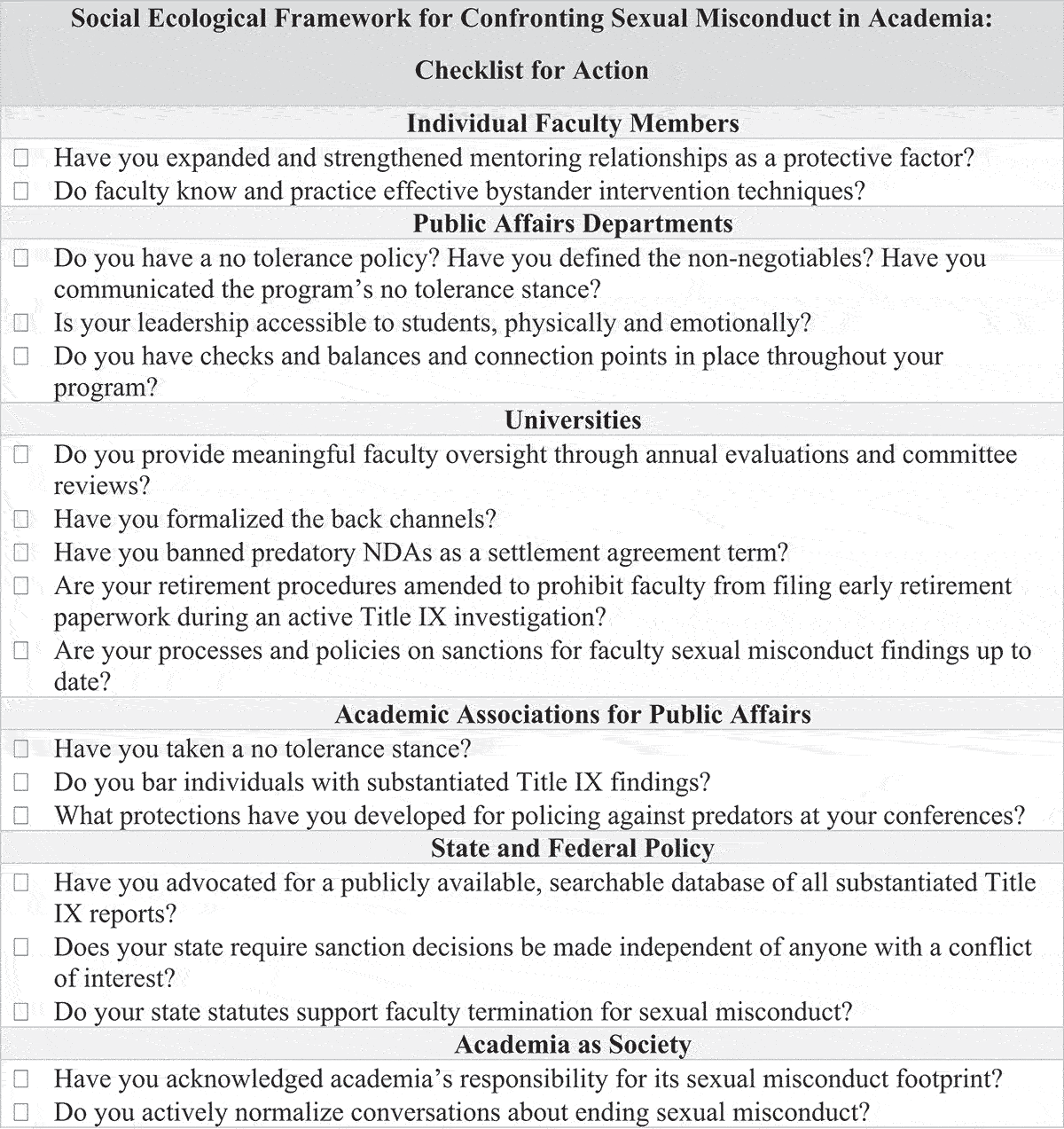
At the individual level
Solution: Build upon mentoring relationships as a protective factor
Perpetrators are always responsible for their behavior, there are effective strategies that advisors can employ to reduce students’ vulnerability. One such strategy is to build strong social support networks (Cheney et al., 2015). At the very least, the more individuals a student has in their proverbial corner the more likely they may be to report such abuse to someone (Golding et al., 1989). Solutions need to be centered around developing external support networks for students.
Solution: Teach and practice effective bystander intervention approaches
Many universities impose mandated reporter duties on faculty that require the faculty to report instances of sexual misconduct after they witness it or it is disclosed to them. However, few universities teach faculty or staff how to effective bystander interventions to intervene and stop sexual misconduct. Faculty and students can help intervene if they are prepared for scenarios where they might need to confront a potential predator when they observe these indicators. Programs can help facilitate effective bystander intervention by teaching provide effective bystander interventions to faculty, staff, and students; teaching them to recognize their own psychological barriers to intervention, and how to intervene safely. It is especially important for faculty to be prepared to implement bystander intervention, faculty are relatively more equal to their colleagues in power (as compared to a student), which reduces the psychological barrier of the fear of retaliation (Cialdini & Trost, 1998). For instance, one way faculty can intervene is by being taught and empowered to deploy intervention statements such as: “One of your students shared that you prefer to hold advising sessions away from campus in your home and at bars. I am concerned the students may not feel safe in those location and are uncomfortable asking you to meet them on campus instead. Our students from other countries may be particularly uncomfortable addressing this with you.” “The sexist joke you made during the dissertation defense today is not acceptable behavior in our department. Your statement implied women are inferior scholars. As a representative of our department and our field, I ask you to refrain from making sexist jokes.”
Students can also implement bystander interventions if they witness another student in a risky situation. One reason a student may be afraid to get involved is normative influence (Cialdini & Trost, 1998), they do not want to be viewed as going against the group, which creates that secondary barrier, fear of retaliation. We can teach students to overcome these barriers by employing the three D approach to bystander intervention:
Direct: create a direct interaction with either party. “I noticed you and Professor X talking, and you seemed slightly uncomfortable. Is everything ok?”
Distract: Think of a diversion to distract the professor or student. “Hey, you seem like you’re cold, would you like to go for a walk?
Delegate: Find another individual to help “Professor Y, I noticed Professor X seems like they might need some help leaving the bar. Would you be able to help get them back to their hotel room?” (Benner, 2013)
Universities require annual trainings on sexual harassment and sexual misconduct. The training is typically completed online independently and covers how to support victimized students. But to be comfortable having hard conversations with fellow faculty, we need to practice potential dialogs one-on-one on a regular basis (Ahrens et al., 2011). Universities around the U.S. already utilize the Green Dot Bystander Intervention training program, a multifaceted approach to violence prevention, and could make it more accessible for graduate students, faculty, and staff.
At the program or department level
Public affairs education programs can build protective factors to reduce the likelihood that students are subjected to faculty sexual misconduct. Confronting predatory sexual behavior on a case-by-case level cannot be the discipline’s response to sexual misconduct. A victim is more likely to be assaulted by a serial perpetrator (Cantalupo & Kidder, 2018). Protecting one’s students one-by-one will only mean that the predator will move on to a more vulnerable victim.
Solution: Create no tolerance policies and define the non-negotiables
Programs need no-tolerance policies for substantiated Title IX findings. “The most potent predictors of sexual harassment is organizational climate – the degree to which those in the organization perceive that sexual harassment is or is not tolerated” (National Academies of Sciences, Engineering and Medicine, 2018). Almost every applicable public service association have statements that reference an accountability measure in their codes of ethics. The discipline’s associations, for which we prepare graduate students to either join or strengthen through scholarship require accountability within their affiliated organizations.
Solution: Communicate and educate everyone on the program’s no tolerance stance
In order for an organization’s culture to shift, the desired change must be a priority for leadership and messaging must be repeated (Mills et al., 2005). The program must take responsibility to ensure their students, faculty, and staff are educated about what Title IX is and what violates it. The program needs to embody that annually required Title IX trainings are more than just institutionalized symbolic requirements of the university (Miller, 2017). One way to achieve this is through ensuring graduate student orientations include a component where faculty: earnestly discuss the importance of feeling safe and supported in the program; educate on Title IX and how to report anonymously; emphasize the importance of reporting any concerns related to misconduct; and provide handouts with the steps students should take to report misconduct, including specific contact information.
This knowledge is critical because there are informal and formal methods of filing complaints. Filing a Title IX complaint enacts a formal, federally mandated investigation process, whereas informal methods are often left up to the university. Informal methods do not provide protections to the student. Rather, informal methods commonly favor the faculty member because they do not require the student be given an opportunity to present witnesses or evidence.
The aforementioned case of Morrison v. University of Miami (2016) provides an example of why knowing the difference between formal and informal reporting is important. Ms. Morrison believed she was filing a formal report when she described the abuse to her university’s Associate Director of the Office of Equality Administration, Executive Director of the Equal Administration (and former Title IX coordinator), Department Chair, Director of Graduate Studies, and Vice Provost of Faculty Affairs. Ms. Morrison was never informed there were formal and informal methods of filing a sexual assault complaint. Her complaint was subjugated to the informal process without her knowledge or consent. The process moved to the faculty senate making a decision without hearing from Ms. Morrison and they determined the only infraction was Professor McGinn failed to report a consensual relationship.
Solution: Put checks and balances and connection points in place throughout the program
Graduate students should have multiple check-ins with multiple faculty members. A red flag for a potentially toxic, abusive relationship is a faculty member dominating a student’s time and research agenda, while ensuring they are isolated from other faculty. Programs can develop rotating faculty conversations on a semesterly basis that require graduate students to meet with faculty in the program beyond their major advisor. Students should be encouraged to work with multiple faculty members on a variety of projects that align with their area of interest.
Department chairs and graduate program directors should try to know most graduate students by name. Recognizing someone by name is a general sign of familiarity and respect (Russell, 2014). One way to achieve cultural shift through recognition is by implementing intentional visibility opportunities (Roberts et al., 2008). When possible, place program leadership in core courses that the majority of graduate students are required to take. Students become familiarized with the program’s leadership, making it more comfortable if they need to approach program leadership to report an issue in the future.
At the university level
Perhaps the greatest work yet to be done is what proactively needs to happen to prevent sexual misconduct at the university level. Universities must work to proactively shift their cultures toward a no tolerance stance.
Solution: Eliminate the need for whisper networks with better HR practices
In many past instances when the human resources department (HR) in the predator’s previous or new university failed to exercise due diligence, other women have quietly intervened. For example, women with knowledge of a predator’s misdeeds have called ahead to universities where known predators applied to discreetly alert hiring committee members (Brown, 2016). The whisper networks have worked tirelessly to intervene by quietly sending evidence of the misconduct or presence of an investigation. This labor belongs to HR.
The whisper networks’ work and impact is noble and appreciated, but the need for such could be eliminated through universities adopting better human resource policies and procedures. We recommend, where legally possible, every university have policies in place mandating that once a contingent offer of employment is accepted the HR department conducts a background investigation, which includes asking all of the candidate’s previous institutions if the candidate had any Title IX and sexual harassment reports during their employment. 6 The University of California, Davis has piloted a similar HR program where background checks include such personal conduct investigations (Amour, 2019). According to the U.S. Equal Employment Opportunity Commission “it’s not illegal for an employer to ask questions about an applicant’s or employee’s background, or to require a background check” (U.S. Equal Employment Opportunity Commission, 2014). 7 However, it is good practice to be respectful of the candidate’s privacy rights as well as have the candidate consent to such a background investigation first.
Many institutions may not want to offer that information out of fear of negligent reference or defamation suits. However, many courts cases and state statutes support a previous employer’s right to provide a negative opinion in good faith and accurate facts about the employee’s work performance, when asked within the context of an employment reference because they have qualified privileges 8 (White v. Nicholls, 1845; United Wild Rice, Inc. v. Nelson, 1982; LA Rev Stat § 6:4; Hunt v. University of Minnesota, 1991; Texas Labor Code § 103.003 (1999)). We recommend that HR departments provide as many facts about a previous employee as possible, while observing the requirements to maintain qualified privilege.
Another recommended tactic is for HR to ask the candidate whether they have had any Title IX substantiated findings or confirmed sexual harassment reports. While many candidates may not disclose such information, if they are hired and information comes to light proving they lied, HR has a well-precedented legal strategy to terminate them (Washington v. Lake County, Ill., 1992; Reed v. Amax Coal Co., 1992; Kristufek v. Hussmann Foodservice Co., 1993). At the very least, using either tactic of asking is a step in the right direction, and perhaps could help erase the need for whisper networks to exist.
Most universities require pre-employment criminal background checks (Owen, 2014) and even national sex offender searches (both of which the AAUP hotly contests because of privacy rights). A faculty member that preys on students may, very likely, not be a registered sex offender since many reports of faculty sexual abuse are unethical, but fail to rise to the level of criminal. There is a higher likelihood that civil litigation may have been filed, which creates another avenue to uncover information about faculty sexual misconduct. HR departments can search for publicly recorded civil litigation involving the candidate and try to determine if the candidate was ever involved in a sexual harassment suit. Publicly available civil court documents are privileged under the First Amendment (Florida Star v. B.J.F., 1989). Case law has found that judicial opinions belong to the public (PepsiCo, Inc. v. Redmond, 1995). The use of such information has been substantiated in case of precedent as an acceptable component of pre-employment screening (Jason L. Nieman v. Versuslaw, Incorporated, 2013).
There is little evidence that universities engage in any of the aforementioned strategies as part of their regular hiring practices of faculty, but shouldn’t they be? The American Association of University Professors’ (AAUP) own criteria for when background checks are necessary justifies that university HR departments should be when the faculty member interacts with students. The AAUP states: Because colleges or universities must repose a high degree of trust in their faculties, they are justified in attempting to ascertain whether candidates are worthy of that trust … The privacy of a candidate should be compromised only as necessary in order to secure information that may ensure that applicants are qualified to meet the particular obligations of specific positions. (Finkin et al., 2004)
A faculty member hired to work with students requires a high degree of trust. A future employer contacting a previous employer about behaviors that could jeopardize the safety and security of their students is performing due diligence to ensure that the person is qualified for the position. The AAUP (2004) offers the example that a faculty member appointed to a position that accesses federally classified data is justified in conducting a background check. By that logic, a university is justified to check leconduct a thorough background check on any person that supervises a student to ensure and make sure that the person they hire, who accesses and asserts control over students, will ensure their safety. While most states have state laws requiring K-12 schools conduct thorough background investigations to ensure anyone they hire hasn’t engaged in inappropriate behaviors with the student population they access through the school, few states and not even all universities have such requirements for institutions of higher education. All universities need policies that require thorough background investigations for anyone working with students. Those with a history of sexual misconduct against students should not be hired.
Solution: Amend retirement procedures to prohibit faculty from filing early retirement paperwork during an active Title IX investigation
Early retirement is often a loophole in university policy and Title IX procedures can allow faculty to avoid sanctions.
9
In many states, the employee is neither prohibited from returning to state employment after a short break nor barred from being employed by another state institution. The State of Florida, like many other state retirement systems, allows an employee to be reemployed after six months of being retired (State of Florida, 2020). Many states allow an individual who retires from one state system to become immediately employed in another. Perpetrators use these loopholes to avoid being held accountable to sanctions. A recent study by Espinoza and Hsiehchen (2020) identified 125 faculty accused by 1,668 different sexual assault targets between 1982 and 2019. Of accused faculty, 49.2% resigned or retired, 20.8% were terminated, and 8.8% were sanctioned by funding sources or boards governing clinical practice. (They) identified 50 accused faculty who remained in academia, of whom 40% held positions at different teaching institutions. Of the 50 faculty who remained in academia, 6 had been terminated by the first institution 15 had resigned or retired, and the remaining had faced sanctions or were disciplined. (p. 1503)
Universities allow it to happen because it creates an “out,” allowing the problem to go away quietly before there is negative press. However, since the majority of perpetrators are serial offenders and NDA’s are widely used in many cases, the loophole allows perpetrators to move from one hunting ground to another with no accountability for their actions (Cantalupo & Kidder, 2018). 10 Universities can negate this by facilitating better communication between the human resource department and the Title IX office; and enacting policy that prohibits faculty from filing retirement paperwork when a Title IX investigation is in progress.
Solution: Revamp processes and policies on sanctions for faculty sexual misconduct findings
The AAUP recognizes that “discipline of a faculty member appears to be rare. Regrettably, some faculty occasionally engage in misconduct, and their peers and administrators may face the need to respond to conduct that negatively affects faculty, students, or staff” (Euben et al., 2005). The AAUP also states “Sexual or racial harassment of students or staff, or criminal misconduct such as embezzlement or physical violence might lead the institution to commence de-tenuring proceedings” (Euben et al., 2005). The University of Texas at Austin recently implemented such policy recommendations after their recent case of sexual misconduct by a faculty member (Najmabadi, 2020), implementing a no-tolerance policy that terminates faculty and staff with substantiated findings of sexual misconduct or harassment. A faculty-student committee at Princeton University also recommended a similar minimum sanction type policy of a one-year suspension, which is under consideration (Women in Academia Report, 2018). However, a one-size fits-all approach may lead to nullification.
We encourage universities to implement processes to evaluate best practices associated with sanctions and match accountability measures appropriately, 11 similar to the approach that criminal justice scholars recently advocated for as a means to hold officers accountable when excessive force was used (Harmon, 2017). While state policies vary widely, public universities can terminate tenured faculty when a faculty member engages in activities that bring controversy to the university, involves matters of public concerns, and termination proceedings are conducted in ways that account for their due process rights 12 (Johnson v. Lincoln Univ. of Commonwealth Sys. of Higher Educ., 1985). Federal courts have upheld the termination of a state university faculty member who sexually harassed students, so long as their due process rights were observed (Levitt v. Monroe, 1984). The courts found that a termination held before a tribunal possessing expertise and impartiality toward the charged legally observes the faculty members due process rights (Levitt v. Monroe, 1984). We recommend that sanctions are “designed in a trauma-informed manner to serve clear long-term preventive purposes … .” (Cantalupo & Kidder, 2019, p. 2367).
At the association level
Solution: Incorporate sexual misconduct in codes of ethics and create policies to address
Associations need to clearly state in all codes of ethics that any findings of sexual misconduct will result in both membership refusal and cessation of publication privileges. Use clear language about sexual misconduct in the code of ethics rather than masking the true meaning behind words like appropriate. If an individual ethics inquiry is submitted about a member and there are no public findings to substantiate, then investigate. But if a Title IX report can be obtained, which had substantiated findings with serious sanction recommendations, then accept the report for the purpose of an association ethics complaint review. Currently, ASPA’s ethics complaint process requires them to only take on complaints they are capable of investigating and requires that they interview the victim; which can unnecessarily retraumatize the victim (K. Garrett, personal communication, September 11, 2020). Is this necessary if there is already an accessible Title IX report with substantiated findings?
Solution: Take a no tolerance stance and demand accountability
When physicians are found guilty of professional ethical violations their employers are required to report their violations to the authorizing entity, which is the state medical board. While public affairs education programs are not state-licensed, many are accredited through NASPAA. Higher education accrediting bodies like NASPAA must begin to require their accredited schools list on annual accreditation maintenance reports if faculty had Title IX reports with substantiated findings for that year.
Physicians’ found guilty of professional ethical violations are sanctioned not only by their employer, but also by their licensing entity. Our associations must also sanction faculty with substantiated findings. Publications and academic presentations are currency. Associations must not enable predators to move from one university to another by continuing to publish their work, allowing them to present at conferences, and honoring them with awards. Associations, especially those in accrediting roles, must lead by example and say no to perpetrators.
At the state and federal levels
Solution: Develop a publicly available, searchable database of all substantiated Title IX reports
Transparency is an ethos of the public sector, 13 yet there is very little transparency around Title IX findings. 14 The reports are required to be sent to the victim and accused, as well as available (redacted) by public records request if the Title IX investigation was completed at a public university. Yet, the reports are not readily accessible, which creates barriers in their usefulness as part of background checks. The lack of accessibility to Title IX reports facilitates perpetrators moving between institutions. To date, the only publicly accessible information pertaining to identities of faculty who have substantiated Title IX funding’s is through a grassroots effort by Julie Libarkin’s (2020) Academic Sexual Misconduct Database. Libarkin’s (2020) database only includes cases that were publicly covered in the media, which significantly limits what is included. Similar to how the U.S. Office of Child Support Enforcement created the Federal Case Registry (a national database of individuals delinquent on child support payments that states use to find the delinquent payor) the Department of Education could relatively easily create a database of Title IX reports that would be searchable by higher education institutions (Office of Child Support Enforcement, n.d.). Title IX coordinators could upload completed investigation reports, after redacting all identifying victim information. University HR departments can then make checking the database a required step of faculty pre-employment background checks.
Such a database would not meet the legal requirements for defamation or false light claims because the findings would have already been substantiated as true through the Title IX investigation (Ludlow v. Northwestern University, 2015; see also Ashcroft v. Javaid Iqbal et al., 2009). 15 Such a database would also not be a legal invasion of privacy because privacy torts must meet four qualifiers, the last of which is that the facts published must be “not newsworthy”; meaning that the public good of knowing the information outweighs the person’s right to keep the information private (Haynes v. Alfred A. Knopf, Inc., 1993; Doe v. Harpercollins Publishers LLC, and Laura Kipnis, 2018; Oppenheimer, 2018). Therefore, a database used by university human resource departments to background check candidates for substantiated findings of sexual assault against students would be “not newsworthy” since the public good of keeping sexual predators out of the student population would outweigh the person’s right to keep the information private.
Solution: Create legislation that support faculty being openly terminated for sexual misconduct
Terminating faculty can be exceedingly difficult. One way that public institutions can help to alleviate some of the bureaucracy surrounding termination is to include specific grounds for dismissal in their faculty handbooks. Especially at public institutions, faculty handbooks are often viewed as legally binding contracts (see American Association of University Professors v. Bloomfield College, 1974) and can explicitly outline grounds for dismissal and discipline. Faculty handbooks should explicitly state what types of faculty sexual misconduct constitute grounds for discipline and dismissal.
Another option for states is to adopt statutes defining when faculty can be dismissed and how due process will occur. Doing so will support termination procedures while still allowing for due process protections to occur, thereby alleviating much of the constitutional protections that currently make it difficult to terminate faculty in public institutions (Johnson v. Lincoln Univ. of Commonwealth Sys. of Higher Educ., 1985). For example, the state of New Jersey has a statute that states: No professor, associate professor, assistant professor, instructor, supervisor, registrar, teacher, or other persons employed in a teaching capacity in any state college, county college, or industrial school who is under tenure during good behavior and efficiency shall be dismissed or subject to reduction of salary, except for inefficiency, incapacity, conduct unbecoming a teacher or other just cause. (New Jersey Statute § 18A:6–18)
New Jersey also outlines procedures around termination that include “written charges, a hearing, the right to counsel, and the right to subpoena witnesses” (Cohen v. Board of Trustees of University of Medicine & Dentistry of New Jersey, 1999 as stated in Euben, 2004).
Lastly, states can adopt policies banning the use of NDA’s that place limits on victims’ First Amendment rights when claims involve sexual misconduct. Vermont, California, Illinois, New Mexico, New York, and several other states have all enacted such laws (National Women’s Law Center, 2020). Giving the victim’s their right to free speech back allows the victim to choose whether or not they want to speak up in the future; say for example, if the faculty member was about to be hired at another university.
At the societal level
Solution: Take responsibility for academia’s sexual misconduct footprint
Academia, as a society, must take responsibility for perpetuation of sexual misconduct by its members. The average reported sexual assault rate of females in college is approximately 21% (Krebs et al., 2016, p. 73). Resources toward confronting sexual misconduct in academia have focused on sexual assault committed by students. As a society, we must also confront misconduct perpetrated by faculty and challenge those who perpetuate a culture of complicity. The fact that sexual misconduct is rooted in all facets of college life is at the core of Title IX protections. It will come to no surprise that one of the most egregious sexual misconduct cases resides at a university that consistently ranks in Top 10 party schools lists and is home to the central case in the award-winning film on sexual assault on university campuses, The Hunting Ground (Dick, 2016). University scholars and individual disciplines cannot decouple themselves from this culture. They must take responsibility.
Solution: Normalize conversations about ending sexual misconduct
Faculty, administration, academic associations, and universities must work collectively. Normalize conversations about sexual misconduct perpetrated by faculty. Add “confronting sexual misconduct” to semester goals. Actively engage to improve the policies and practices. Read state statutes and contact your state representative about legislation to better ensure safety of our students. Learn your university’s policy on sexual misconduct of faculty and examine its record of holding preparators accountable. E-Mail your professional association’s board and ask what the association is doing to address sexual misconduct of its members. Talk about sexual misconduct at your faculty meetings. Do not wait for the chair to include it on the meeting agenda. Arrive prepared with actionable steps for your department. Coach your students on bystander intervention before sending them to a conference and provide a safe space for disclosure. Change the norms of complicity on college campuses by constantly confronting it.
Conclusion
We must pause to honor the women who have worked behind the scenes to protect our students through an underground network (Ahmad, 2020) within Public Affairs. These anonymous women deserve credit and respect from the discipline for carrying our collective burden. Now is the time to talk openly across universities, with assistance from our associations. Policy solutions have proven to work when perpetrators are caught, but are less effective as preventative measures. Tackling the sexism nested in university policy and management systems will take significant engagement and action. Like racism, sexism is embedded in the bones of our system.
As the authors, we reference our own lived case, yet it is one that we cannot name. Many, including the reviewers of this article called upon us to do so; stating that we “should name the accused professor and university (we) discuss in (this) article (and become a test case for defamation)” (JPAE, Personal Communication, 2020). While we prefer direct, transparent dialogue, doing so outright could cost us our current careers, upon which our children and families depend. Everyone from our mentors to our university counsels have advised us against naming the details of that case in fear of inciting legal action. Even successfully defending such a defamation case could put our families into financial ruin and force our universities to make politically driven resource decisions. 16 Perhaps one day we will be able to come forth with our stories, if and when the system is changed and solutions are implemented that would standardize such behavior being publicly denounced.
The perpetuated systemic breakdowns that resulted in these types of environmental constraints existing within a field predicated on academic freedom, confounded by our deep desire to call out social injustice, angers us to the core. That anger was what originally motivated us to write this article. Yet, in doing so we realized that there was a greater justice and purpose that we could serve. Our experience, along with the other instances of sexism, abuse, faculty sexual misconduct, and even assault that we have experienced, are personal to us but are also shared by so many. And to that we say enough.
Instead, we choose to view this manuscript as an opportunity to shed light on the greater problem and find solutions to the systemic breakdowns. Notice that we have not recommended more empirical work on how sexual misconduct manifests in public affairs. Scholars must look beyond their tried and true tools of scholarship. Yes, research is needed. But we need more than that now. We demand more than that now. We offer a social-ecological approach to root predators out of our discipline and bar them at all levels. We charge you, the institutional structures that make up public affairs, to take swift and collective action today.
Footnotes
1.
Recognizing the historical debate around the identity of public administration as a field, NASPAA’s description of undergraduate public affairs education provides the best definition for public affairs education that we can proffer: interdisciplinary education programs designed to bring students to a deeper understanding of their roles as public servants in the context of civic engagement (NASPAA,  ).
).
2.
Data reported under the Clery Act only includes crimes reported to police. Most student sexual assault or harassment, including those instances reported through the Title IX process, are not reported as criminal acts.
3.
This paper seeks to provide systemic solutions to faculty sexual misconduct, specifically victimizing graduate students. While this section primarily applies to doctoral student relationships, it has some broader implications that apply all graduate students.
4.
According to the National Labor Relations Board’s new rule that is supposed to take effect September of 2020, undergraduate and graduate students who perform a service for the university in connection to their studies, including teaching and researching duties, will no longer qualify as an “employee” under the National Labor Relations Act (Porzio & Dailey, ).
6.
Each state has its own constitutional and administrative laws pertaining to privacy and defamation. In most states, prospective employers can legally ask these types of questions within the context of an employment reference because it is considered to have qualified privilege.
7.
So long as the employer does not ask the candidate about medical or genetic information; or use any of the information obtained in a background check in a way that discriminates against any of the protected classes.
8.
“A qualifiedly privileged communication is one made in good faith on any subject matter in which the person communicating has an interest, or in reference to which he has a right or duty, if made to a person have a corresponding interest or duty on a privileged occasion and in a manner and under circumstances fairly warranted by the occasion and duty, right or interest. A qualified or conditional privilege does not change the actionable quality of the publication, but merely rebuts the inference of malice otherwise imputed in the absence of privilege. Generally, such a privilege attaches to publications made by an employer concerning a current or former employee” (Duffala, ; see also Am. Jur. 2d, Libel and Slander § 195.; Am. Jur. 2d, Libel and Slander § 271).
9.
For many public institutions, this would involve a state-level policy change. We include the recommendation within this section as the administrative body responsible varies widely, but applies most closely to the university level.
10.
Cantalupo and Kidder (2018) found in their study of 304 faculty members that engaged in sexual harassment behaviors, 53% engaged in patterns of serial sexual harassment. Espinoza and Hsiehchen () found 87.2% of the 125 faculty members in their study demonstrated recurring behaviors.
11.
State policies on sanctioning and termination vary widely. Additionally, faculty in public institutions are generally considered to have a property right interest to their employees that must be respected by following due process.
12.
Public university faculty that have a reasonable expectation of continued employment, such as tenured or tenure tracked employees, have constitutionally protected due process rights (42 U.S.C.A. § 1983).
13.
We intentionally do not include recommendations that specifically pertain to the Title IX changes that went into effect on August 14, 2020. Far better versed legal and victim rights scholars have already provided excellent recommendations. For more information please see the Brooking Institute’s report (Melnick, 2020) or Brown and Mangan .
14.
Finalized Title IX reports are redacted to protect the victim and the complainant, but still readily identify the perpetrator
15.
“A claim is found to have facial plausibility when the plaintiff pleads factual content that allows the court to draw the reasonable inference that the defendant is liable for the misconduct alleged” (Ashcroft v. Iqbal, 2009; see also Ludlow v. Northwestern University, ).
16.
Neither of the authors have been awarded tenure to date.
Acknowledgments
First and foremost, we acknowledge the victims who have pursued careers in academia despite the ever present perpetrators and we acknowledge those who have moved to safer spaces. We honor the whisper networks that work tirelessly to make academia a safer place. It is on the shoulders of these fierce women we stand. Lastly, we recognize and appreciate the “Librarian” and the “Lawyer” for their contributions to this paper.