



Abstract
We examined associations between group climate as perceived by 212 individuals with mild intellectual disability and work climate as experienced by 262 sociotherapists in a forensic setting. Results showed that if sociotherapists experienced more job satisfaction, they experienced less negative team functioning. Also, more positive team functioning was related to less repression. Workload and negative team functioning were related to less possibilities for growth by clients. No significant associations were found between other work climate and group climate dimensions. This study emphasized the importance of being aware of parallel processes between work climate and group climate in secure settings.
Sociotherapists 1 working with individuals with mild intellectual disability or borderline intellectual functioning (IQ 50–85) in a secure forensic treatment setting face an important task. Supporting individuals with intellectual disability or borderline intellectual functioning and creating a therapeutic group climate is of great importance for effective treatment (Robinson & Craig, 2019; Willets et al., 2014). Sociotherapists have to assess and manage risks while at the same time building and maintaining a therapeutic relationship and anticipating to the needs and requirements of clients in order to create a therapeutic group climate and to avert dangerous and harmful situations for themselves, their colleagues and clients living in the same group (i.e., therapy-security paradox; Inglis, 2010; Jacob, 2012). In secure forensic care for persons with intellectual disability or borderline intellectual functioning, these principles must be integrated with an approach, in which emotional, social, cognitive and adaptive functioning of clients are taken into account. This complicates the work of the sociotherapists in forensic care for people with intellectual disability or borderline intellectual functioning, that are working at the intersection of forensic care, psychiatry and care for individuals with intellectual disabilities.
Because daily interactions between clients and sociotherapists can be seen as transactional processes (Sameroff, 2009), it is assumed that sociotherapists and the way they function is influential in creating a therapeutic group climate (De Valk, 2019). There is preliminary evidence to suggest that a positive work climate, as perceived by sociotherapists, seems necessary in the degree to which sociotherapists can build an open and therapeutic group climate (Van der Helm & Stams, 2012). To enable sociotherapists to create a therapeutic group climate, it seems crucial to have a positive work climate. Work climate constitutes specific elements that influence (team) functioning and wellbeing of sociotherapists and can be defined as “the quality of the social and physical work environment in terms of the provision of sufficient and necessary conditions for occupational functioning, with respect for personnel’s human dignity and human rights and characterized by work demands (quality of work) and the employee’s decision latitude, aimed at the enabling of clients in recovery and successful participation in society” (De Valk, 2019, p.110; based on Heerkens et al., 2004).
To gain insight into the factors that influence group climate as perceived by individuals with intellectual disability or borderline intellectual functioning and work climate as reported by sociotherapists, it is helpful to view secure forensic treatment from a systemic perspective, such as Bronfenbrenner’s ecological model of development (Bronfenbrenner, 1979). The model emphasizes the context in which functioning and development of a person (this applies to clients, but also to sociotherapists) is the result of complex interactions between bio-psychological characteristics of a person (ontosystem) and environmental factors on four different levels (micro, meso, exo and macro system). At the microsystem level, factors that influence group climate and work climate are primarily related to client and professional characteristics and the client-professional interaction. In secure forensic care, clients interact with sociotherapists, but also take part in social processes with other clients and a team of professionals at the ward. These can be viewed as interacting microsystems, which is referred to as a meso-system. An example of the mesosystem is team functioning. Factors at the exosystem level refer to interactional and transactional processes in which clients do not participate directly but may influence their developmental and treatment outcomes. In the context of secure forensic care, these are factors such as organizational climate as well as interagency collaboration. The macrosystem refers to a context in which characteristics and conditions apply to an entire (social) group, such as cultural and political values, forensic care policy, and the body of available societal, clinical or scientific knowledge. These are beyond the scope of this paper and will therefore not be addressed. Factors in the meso- and exosystem together determine the quality of the work climate as perceived by sociotherapists.
If we want to understand and influence the quality of secure forensic treatment and professional functioning at the microsystem (group climate), it is therefore necessary that the surrounding systems (meso, exo and macro) are taken into account (Bronfenbrenner, 1979; Olivier-Pijpers, 2020; Van Miert & Dekker, 2020). Group climate in secure forensic care cannot be viewed independently from the complex dynamics between client, sociotherapist (or team of sociotherapist); group-dynamic processes between clients and sociotherapists as well as interactions among clients, and the social support system of clients outside of the facility; and the social climate at the facility, both at the ward and the organizational and work climate of the professional.
To maintain the balance between reducing risks on the one hand and sensitivity and responsivity toward the needs and characteristics of clients on the other hand, positive team functioning is considered important. Positive team functioning can be described as team members listening to each other, having a clear communication style, giving and receiving feedback, negotiating difficult choices, resolving conflicts and investing in adequate support, expertise and evaluation of and subsequently monitoring the results of the treatment programs (Knight & Eisenkraft, 2015; Knotter et al., 2018; Van der Helm, Boekee et al., 2011). Team functioning is influenced by the way sociotherapists perceive their own functioning, their wellbeing and job satisfaction (Van Gink et al., 2018). Team functioning in secure forensic settings often is unstable since it is constantly affected by contextual factors, including challenging behavior of clients or dynamics at the ward (clients with severe behavioral or mental health problems living together), dynamics of the team (for instance, feelings of unsafety among team members and low job satisfaction), absenteeism and turnover among staff (both team members and managers), and organizational factors such as vision, policy and housing (Knotter et al., 2018). For sociotherapists who are confronted daily with challenging behavior (which may evoke negative emotional reactions such as sadness, fear, anger and frustration), experiencing positive team functioning, together with inspiring, active and coaching leadership, is important for personal well-being and professional functioning (Deveau & McGill, 2016, De Valk, 2019; Lambert et al., 2015).
Another work climate factor that may influence group climate is workload. The higher the workload and the more demanding the target group, the greater the need for emotional support for sociotherapists (Buljac-Samardžić, 2012). The need for emotional support is not only about support among team members, but also about the perceived support from a team manager and the organization (Deveau & McGill, 2016, De Valk, 2019). Research suggests that transformational and empowerment leadership has a positive impact on team functioning (Bass & Bass, 2009; Stewart, 2006). If a team manager shows empathy, expresses confidence and offers help, stressors for a team can decrease, which can improve team functioning and team performance (Buljac-Samardžić, 2012; Nijman & Gelissen, 2011).
To improve group climate in residential settings, organizations often decide to invest in team functioning by means of coaching or training (Knotter et al., 2018). The rationale is that challenging behavior of clients does not occur in isolation but in a social context affected by behavior of staff (i.e., transactional processes). Similarly, staff members do not work in a vacuum (Hastings et al., 2013). In addition, scientific research is also increasingly paying attention to the work climate in relation to the quality of residential care (see e.g., Lambert et al., 2011, 2015; De Valk, 2019; Knotter, 2019; Olivier-Pijpers, 2020; Van Gink et al., 2018). However, studies on which aspects of work climate relate to group climate as perceived by clients with intellectual disability or borderline intellectual functioning have not yet been conducted.
The purpose of the study is to examine associations between group climate as perceived by individuals with intellectual disability or borderline intellectual functioning in a secure forensic setting and work climate as experienced by sociotherapists. This study adds to knowledge on group climate by being the first study to examine the association between work climate and group climate in a secure forensic treatment setting. The relationship between work climate, team functioning and outcomes (group climate) is still underresearched in forensic care. The model used in this research (Job Characteristic model from Hackman & Oldham, 1980) is already more than 30 years widely accepted in industrial and organizational psychology literature (Fried & Ferris, 1987). The relationship with team functioning in forensic teams (Haines et al., 2018) and subsequent outcomes, especially related to group climate and safety, is assumed in practice (Van Gink et al., 2018). Van Miert et al. (2022) argue for the unique Job Characteristics in secure forensic care in which staff has to combine therapeutic flexibility with control in order to ensure safety within the therapeutic climate. Structural equation modeling and multilevel analyses will be employed to analyze these relations. This is important as, from a social systems perspective, a ward is considered a unique social network where clients influence each other’s attitudes and behaviors. If clients are staying in the same ward, they share experiences and influence each other, which should be acknowledged in the analyses. Besides group level characteristics, the quality of group climate is affected by clients’ (individual) characteristics. Therefore, the present study distinguishes between characteristics of wards and characteristics of individual clients within wards.
It is hypothesized that if sociotherapists report low workload, a positive work environment, high job satisfaction, a shared vision, and transformational or transactional leadership, they experience a more positive team functioning, resulting in a therapeutic (i.e., positive) group climate in terms of more support, a more positive atmosphere and more possibilities for growth as perceived by clients. On the other hand, it is expected that high perceived workload, a negative work environment, a low job satisfaction, no shared vision, and laissez-faire leadership is related to negative team functioning, which is associated with a more repressive (i.e., negative) group climate.
Method
Participants and setting
The present study was conducted at Trajectum, a secure forensic treatment facility for adults with intellectual disability or borderline intellectual functioning and externalizing behavior problems (i.e., aggression or sexual offenses) and/or internalizing problems (e.g., self-injurious behavior and suicide attempts), located in the northern and eastern part of the Netherlands. Secure forensic treatment in this setting is organized with approximately 8 to 12 clients who live together in one ward, supported by trained sociotherapists. Clients are staying on these wards for a certain period of time and receive treatment and support 24 hours a day by a team of professionals. Sociotherapists support clients during daily routines, work and educational activities, individual and group therapy sessions and leisure activities in collaboration with psychologists, psychiatrists and psychotherapists, who supervise the sociotherapists and provide additional one-to-one or groupwise treatment. Depending on the clients’ risks and needs, in some units the clients have more autonomy, in other units clients receive one-to-one guidance throughout the day. Depending on the risk of (re)offending, legal status and treatment phase, clients move to wards with different levels of restrictions and security. The goal of treatment is to reduce risk factors for offending and symptoms of mental disorders, and to rehabilitate individuals and prepare them to return to society and to offer perspective. Rehabilitation can also mean that individuals are directed to assisted or semi-independent living environments.
The sample of participants consisted of 212 participants who had intellectual disability or borderline intellectual functioning (78% male, M age = 41 years, SD = 12.6). An IQ score was available for 183 participants: 47% of the participants had a mild intellectual disability (IQ 50-69) and 53% had borderline intellectual functioning (IQ 70-85). Mean total IQ was 69.7 (SD = 9.7). Besides intellectual disability or borderline intellectual functioning, participants had severe challenging behavior and/or a history of substance use. Most of the participants were admitted because of externalizing behavior problems (i.e. aggressive behavior or a sexual offense) and/or internalizing problems (e.g., self-injurious behavior or suicidal behavior). Participants were placed in the facility under criminal law (42%), civil law (24%) or were voluntarily admitted (34%).
The participants represented 58 wards. These wards consisted entirely of males (26%) or mixed gender (74%). Wards are characterized by different levels of restrictions and levels of security, therefore participants resided in wards with different security levels; 63% of the participants resided in a low security ward, 16% of the participants resided in a medium security ward and 21% of the participants resided in a high security ward. Wards also differ on care intensity; 6% of the participants resided on a high intensive care unit, 22% resided on a medium to high care unit, 24% on a medium care unit, 24% on a low to medium care unit and 24% on a low care intensity unit.
A total of 262 staff members (49% male) of the same 58 wards participated in the study. The age of the staff members was 37.2 years (SD = 11.34). The majority of the staff had worked longer than four years at the organization (38% between 4-10 years; 23% more than 10 years). One-third of the participants had worked less than two years at the organization (10% less than 1 year; 8% between 1-2 years; 13% between 2-4 years; 8% unknown).
Procedure
Data were collected between September 2017 and April 2018. Participation was on a voluntary basis. Participants were given oral and written information about the aim of the study and the process of data collection and storage. All participants and their legal guardians were informed that the data were confidential and anonymous, and that data were only reported on a ward-level. In addition, a multidisciplinary treatment team consisting of sociotherapist, psychologist, and psychiatrist determined whether a participant was able to give informed consent and to participate. Clients with severe and acute psychotic problems were excluded. All included participants, and if applicable their legal guardian, and a representative of the treatment team gave their oral and written consent. Ethics approval for this study was granted from the committee of ethics of the Radboud University (ECSW2017-3001-471).
The questionnaires were conducted by trained (assistant) researchers specialized in working with individuals with intellectual disability or borderline intellectual functioning. Most participants were assisted to complete the questionnaire by a (assistant) researcher who read the questions and answering categories out loud and explained the questions to the participant if necessary. Alternative scripted phrases to enable questions to be explained in a different way were part of the training they received. If used, this would provide an additional way of checking participants’ understanding whilst preventing the (assistant) researcher from projecting their interpretation of the questions onto participants. The completed questionnaires were returned to the researcher (first author). Characteristics on participant level (gender, age, total IQ, legal status) and group level (security level, care intensity, group composition, and ward size) were extracted from the records of the participants.
Measures
Group climate
Group climate was assessed with the Group Climate Instrument (Neimeijer et al., 2019; Van der Helm, Stams et al., 2011). This self-report measure consists of 29 items rated on a 5-point Likert type scale, ranging from 1 (Not applicable) to 5 (Entirely applicable). Each item belongs to one of the four scales of group climate: Support, Growth, Atmosphere, and Repression. The Support scale (11 items) assesses perceived support and responsiveness from group workers, such as listening to clients and taking their complaints seriously. An example item is: ‘Group workers treat me with respect’. The Growth scale (6 items) assesses clients’ perceptions on possibilities for learning and hope for the future during their stay in the center. An example item is: ‘I learn the right things here’. The Repression scale (7 items) assesses client’s perceptions of strictness and control, unfair and haphazard rules. An example item is: ‘You have to ask permission for everything here’. The Atmosphere scale (5 items) assesses the social interaction among clients in terms of mutual trust, their feelings of safety at the group, as well as how clients perceive the physical environment at the group, such as daylight and fresh air at the group. An example item is: ‘We trust each other here’. The internal consistency reliability was sufficient to good for the subscales Support (α = .88), Growth (α = .81), Atmosphere (α = .75), and repression (α = .70).
Work climate
The Living Group Work Climate Inventory (LGWCI; Dekker et al., 2019) was used to measure several aspects of the work climate as perceived by sociotherapists. The Living Group Work Climate Inventory comprises 21 scales that measure different aspects of work climate. In the present study, the following scales were used: Positive team functioning (8 items), Negative team functioning (10 items), Perceived workload (8 items), Leadership (16 items), Work environment (7 items), Job satisfaction (7 items) and Shared vision (5 items). Items were rated on a 5-point Likert type scale ranging from 1 (I do not agree) to 5 (I totally agree). The internal consistency reliability of the scales was sufficient to good for the scales Positive team functioning (α = .84), Negative Team Functioning (α = .76), Workload (α = .78), Leadership (α = .81), Work Environment (α = .67), Job Satisfaction (α = .75), and Shared vision (α = .61).
Statistical analyses
First, bivariate correlations (Pearson’s r) were examined between all study variables. Because work climate and group climate were measured from different perspectives (i.e., sociotherapists’ perception of work climate and clients’ perception of group climate), we used group mean scores in the analyses. Thus, correlations between work climate and group climate were analyzed at the group level. Subsequently, we tested the study hypotheses in a structural equation model (SEM). We hypothesized a direct effect of the work climate factors Perceived workload, Leadership, Work environment, Job satisfaction, and Shared Vision on Positive and Negative team functioning, respectively. Also a direct effect of team functioning was specified on Group climate (consisting of Support, Growth, Atmosphere, and Repression). The hypothesized model is depicted in Figure 1. In case of significant (bivariate) associations between work climate, team functioning, and group climate factors, mediation analyses were conducted to examine the potential mediating effect of team functioning on the association between work climate factors and group climate factors. Standardized coefficients of the direct and indirect effects can be interpreted as ‘small’ (.10 − .30), ‘medium’ (.30 − .50), or ‘large’ (> .50) effects (Cohen, 1992). Maximum likelihood with robust standard errors (MLR) was used to estimate the model. The ‘lavaan’ package in the R environment was used for the analyses.
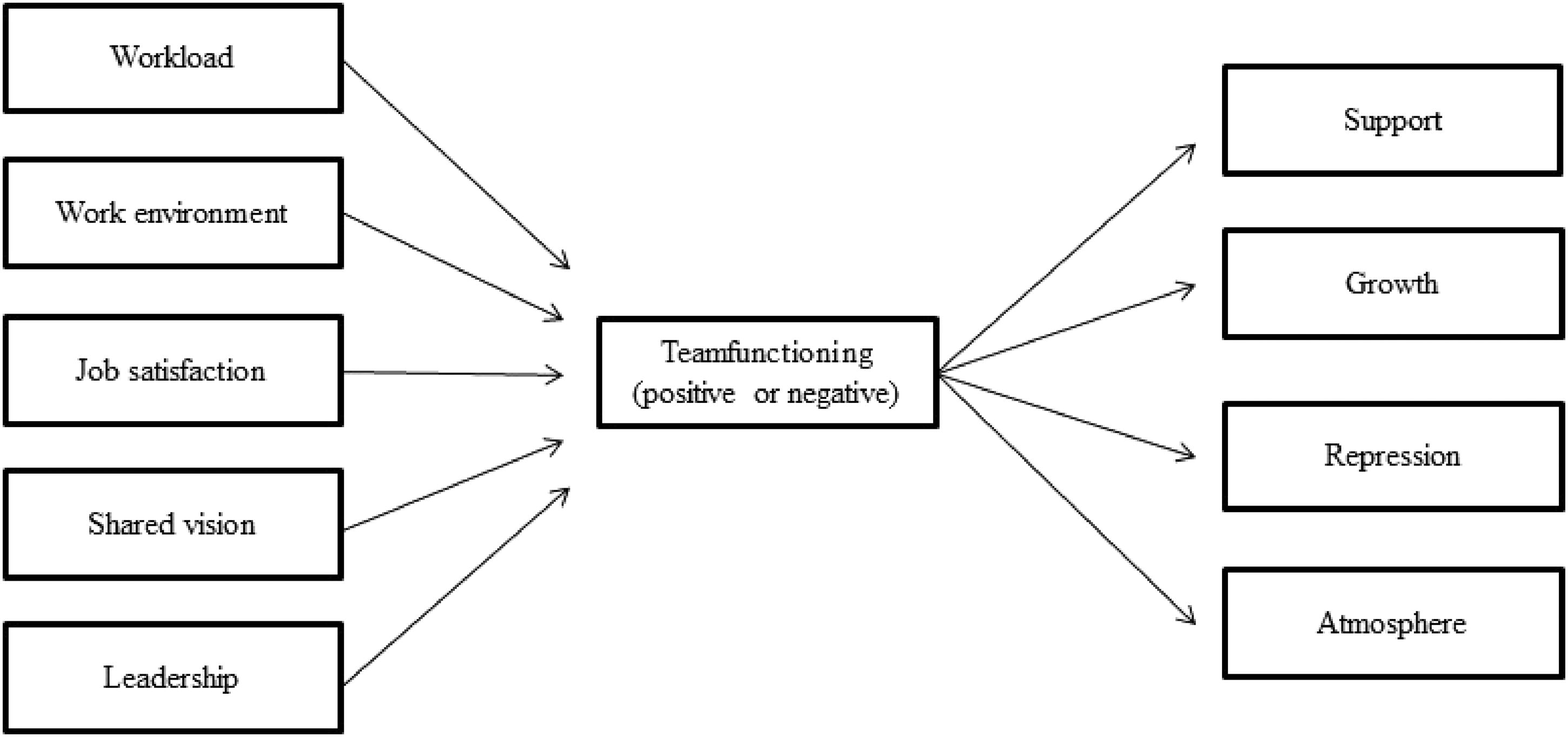
Hypothesized model of the relation between work climate and group climate.
Both the fit indices (comparative fit index [CFI], Tucker–Lewis index [TLI], and root mean square error of approximation [RMSEA]) and the model chi-square statistic were used to evaluate model fit (Kline, 2015). The following cutoff values are indicative of a close model fit: CFI > .90, TLI > .95, and RMSEA < .08, whereas a non-significant chi-square indicates exact model fit (Cheung & Rensvold, 2002).
Given the nested nature of the data (clients are nested in wards), a multilevel approach was also used to examine the relation between Group climate and Work climate. Instead of using group mean scores for both group climate and work climate, client ratings of group climate were used (level-1 variable) in relation to group mean scores of work climate as a characteristic of the ward in which clients resided (level-2 variable). Given that work climate scores of sociotherapists could not be used in the same dataset as the client ratings of group climate, we used the averaged staff ratings per unit for all work climate factors. Sociotherapists only reported on work climate on one unit (the unit at with they were working at the time of the study). The averaged sociotherapists ratings on their perception of work climate were used as level-2 variables in the dataset, as a characteristic of the unit with respect to perception of work climate of sociotherapists at the unit in which the client resided.
Hierarchical linear modeling (HLM) was used to account for violation of the independence assumption of regression. Hierarchical linear modeling allows for examination of how variation in the dependent variable is attributed to differences within-group (i.e., individual level, level-1) or between-group (i.e., ward-level, level-2; Raudenbush & Bryk, 2002). The analyses were conducted using the “lme4” package (Bates et al., 2015) in the R environment. The “lmerTest” package (Kuznetsova et al., 2015) was used for the calculation of p-values, which uses the Satterthwaite approximation procedure for calculating degrees of freedom.
Several models were fit for each dependent variable, i.e. Support, Growth, Repression, and Atmosphere. First, a random intercept only model (null model) was fitted without predictors to estimate the Level-2 variance and intraclass correlation coefficient (ICC) for the dependent variables. When significant Level-2 variance is demonstrated, multilevel analysis is warranted, and Level-2 predictors were examined in a multilevel model. If no significant Level-2 variance in the dependent variable (i.e., aspect of group climate) was found, it was concluded that work climate was not related to that aspect of group climate.
Subsequently, three multilevel models were fitted. The first model included only main effects of Level-1 predictors (gender, age, and placement status). A second model included Level-2 predictors (security level, ward size, and gender composition of the ward). The third model added the group mean work climate scores of staff (Team functioning, Workload, Work Environment, and Job Satisfaction) as Level-2 predictors. The variable security level consisted of three categories (low security, medium security, and high security) and was dummy-coded, using low security as the reference category. The fit of the models was compared using likelihood-ratio tests. Parameter estimates and statistical tests are reported for the initial and the final model.
Results
Preliminary analyses
First, descriptive statistics and correlations between Work climate subscales as well as between Group climate subscales were examined (Table 1). The correlations between Work climate and Group climate were in the expected direction, and most were small to moderate and non-significant. However, positive team functioning showed a significant and negative correlation with repression (r = −.31, p < .05), while Negative team functioning (r = −.37, p < .05) and Workload (r = −.29, p < .05) were significantly and negatively associated with Growth. No significant associations were found between the other Work climate and Group climate dimensions.
Means, standard deviations, and correlations between group climate scales reported by clients and work climate scales reported by staff.
N = 58. **p < .01 (two-tailed) *p < .05 (two-tailed).
Structural equation modeling
To examine the relations between the Work climate factors Perceived workload, Leadership, Work environment, Job satisfaction, and Shared Vision on Group climate (consisting of Support, Growth, Atmosphere, and Repression), potentially mediated by the Work climate factors Positive and Negative team functioning, a structural equation model was fitted to the data. The model with Negative team functioning (Figure 2) showed a good fit to the data: χ 2(8) = 7.11, p = .525, CFI = 1.000, TLI = 1.036, RMSEA = .000 (90% CI = .000-.156). The model with Positive team functioning (Figure 3) also showed a good fit to the data χ 2(8) = 9.10, p = .334, CFI = .967, TLI = .938, RMSEA = .052 (90% CI = .000-.179). Job satisfaction was negatively associated with Negative team functioning (ß = −.459, p = .006) and positively associated with Positive team functioning (ß = .493, p = .008). Negative team functioning was positively associated with Repression (ß = .270, p = .044) and negatively associated with Growth (ß = −.365, p = .003). Furthermore, Positive team functioning was negatively associated with Repression (ß = −.312, p = .013).
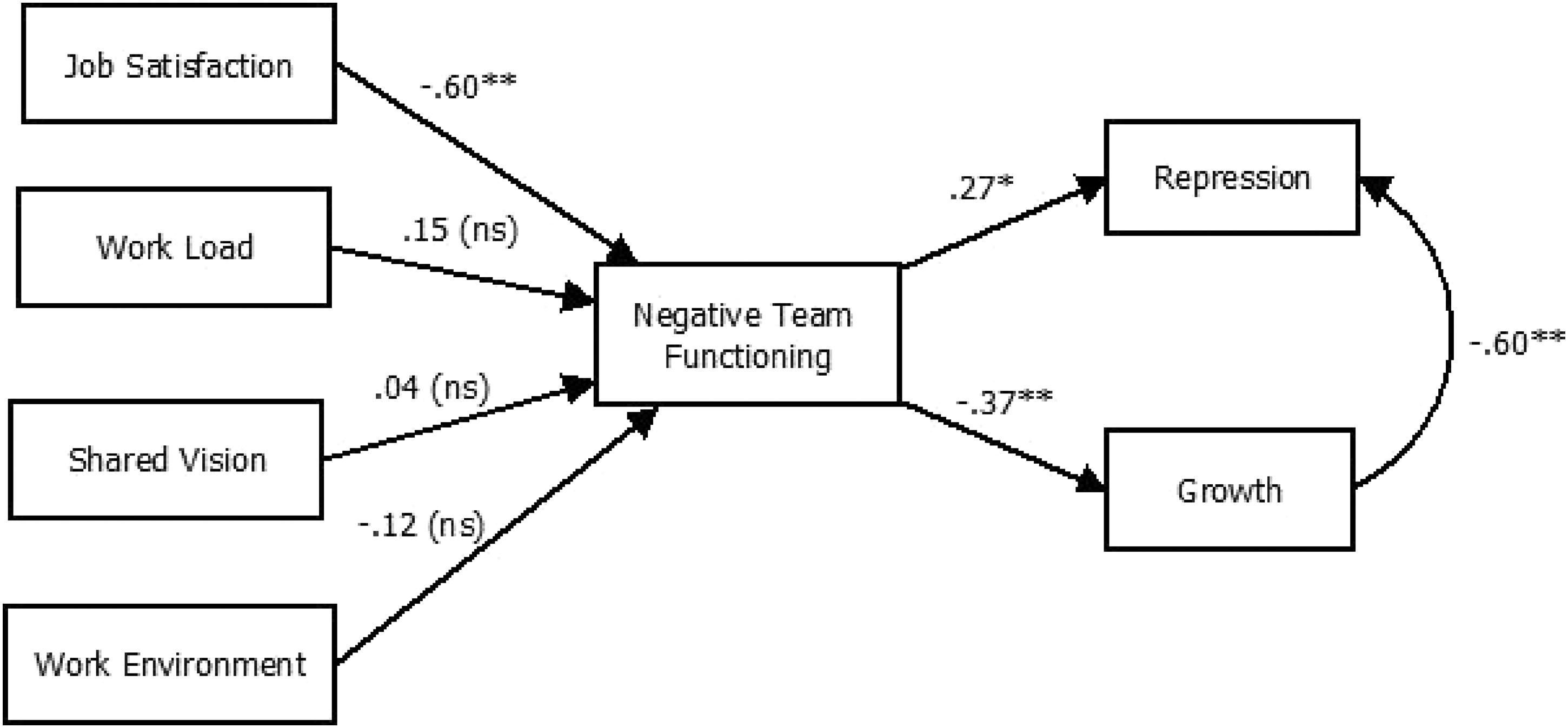
Structural equation model of the relation between work climate, negative team functioning, and group climate.
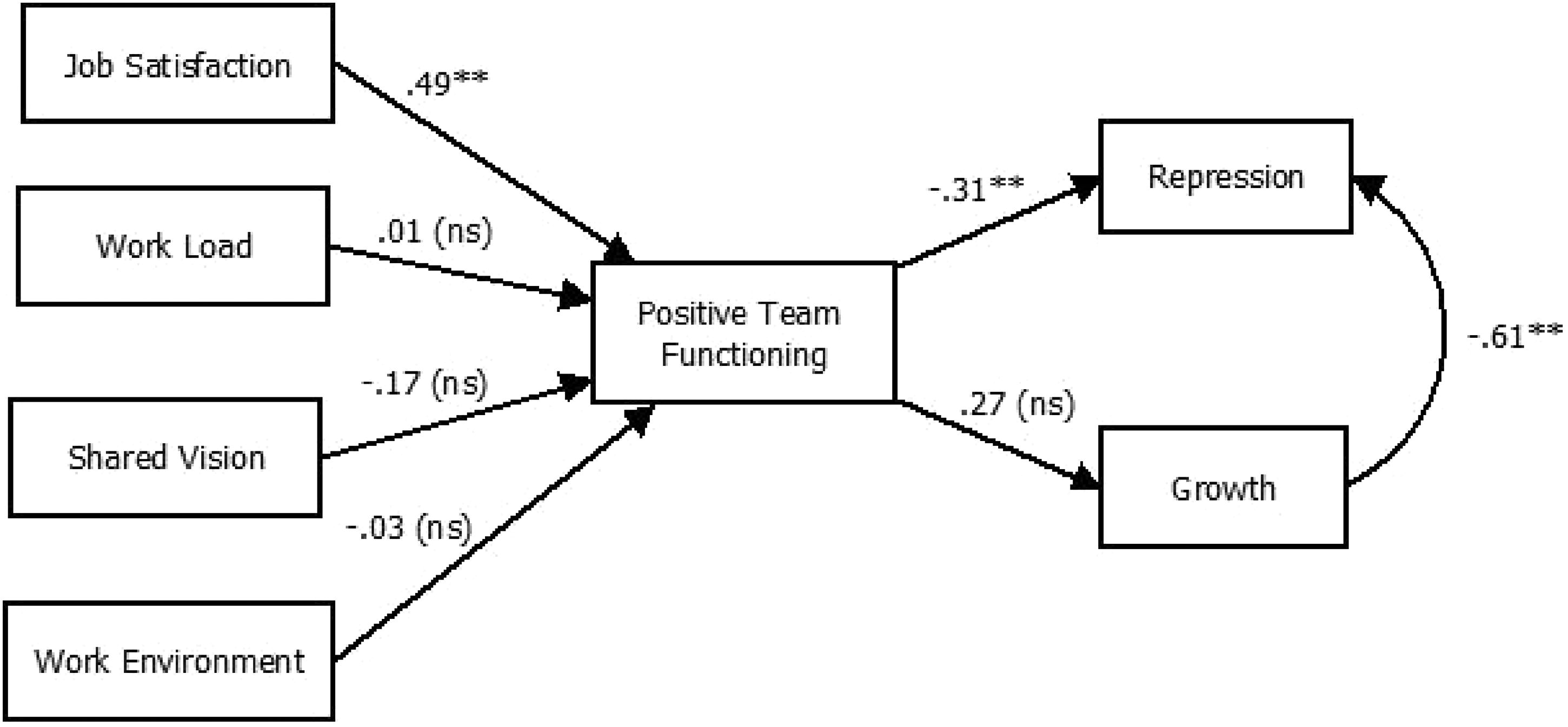
Structural equation model of the relation between work climate, positive team functioning and group climate.
However, no significant association between job satisfaction and group climate factors were found, therefore no analyses were conducted exploring the potentially mediating role of team functioning on group climate.
Multilevel analyses
Because Positive and Negative team functioning were strongly correlated (r = −.72), we combined these scores into a mean score of Team Functioning for use in further analyses. A series of hierarchical linear models was conducted to examine the relation between group climate (level 1 and 2) and work climate (level 2). First, four different random intercept-only models were examined to establish whether there was significant variance at Level-2 for the dependent variables Support, Growth, Repression, and Atmosphere. Results indicated that there was significant Level-2 variance for Atmosphere (ICC = .21, Wald z = 2.39, p = .017). No significant Level-2 variance was found for Support (ICC = .09, Wald z = 1.33, p = .185), Growth (ICC = .05, Wald z = 0.78, p = .434), and Repression (ICC = .07, Wald z = 1.06, p = .290). Subsequent analyses were thus only conducted for Atmosphere. However, none of the Level-1 nor Level-2 predictors were significantly related to Atmosphere, and these explanatory models did not significantly improve fit of the intercept-only model (see Table 2).
Likelihood ratio tests of multilevel models for atmosphere.
Discussion
The aim of the present study was to examine the associations between group climate as perceived by individuals with intellectual disability or borderline intellectual functioning in a secure forensic setting and work climate as experienced by their sociotherapists. It was hypothesized that if sociotherapists report a low workload, a positive work environment, high job satisfaction, shared vision, and transformational or transactional leadership they would experience more positive team functioning and clients would experience a more therapeutic group climate. On the other hand, it was expected that a high workload, a negative work environment, low job satisfaction, no shared vision, and laissez-faire leadership would be related to negative team functioning, and negative team functioning would lead to more experienced repression. The present study only confirmed some of the hypotheses. If sociotherapists experience more job satisfaction, they experience less negative team functioning. Also, if sociotherapists experience more positive team functioning, less repression was perceived by clients. Perceived workload and negative team functioning by sociotherapists are related to less experienced possibilities for growth by clients. No significant associations were found between the other work climate and group climate dimensions. The associations between team functioning, growth and repression are in line with the ecological theory of Bronfenbrenner (1979) in which the interactions between sociotherapists and clients and between clients themselves in the microsystem are being influenced by surrounding systems such as team functioning which is part of the mesosystem.
Considering the theoretical link between work climate and group climate and the assumption in daily practice that a positive work climate is necessary to create a therapeutic group climate, it is interesting to consider possible explanations for the unconfirmed hypotheses. First of all, it is important to keep in mind that work climate and group climate are complex and multifactorial constructs which are difficult to grasp in statistical models. Although self-report questionnaires such as the Group Climate Instrument and the Living Group Work Climate Instrument can measure group- and work climate in a reliable, valid and pragmatic manner in clinical practice, these instruments measure a simplified construct of work- and group climate. Therefore, some studies advocate for a more in-depth insight and operationalization of group climate, for example through individual interviews with sociotherapists and clients about their experiences of their shared living and work environment (Doyle et al., 2017). It would be premature to make strong claims about the relation between work- and group climate based on this study and a dataset limited to two sources (questionnaires among individuals with intellectual disability or borderline intellectual functioning and sociotherapists in one organization). Arguably, a more comprehensive measure of work- and group climate would also include data from other sources as part of routine monitoring. These data could be drawn from a range of sources, including incident reporting databases containing reports of aggressive incidents, self-harm, changes in sociotherapist and client composition, and changes to working practices at the ward. These are all factors that might affect work- and group climate within secure forensic settings and, therefore, are of importance to help clinicians and researchers better understand and interpret work- and group climate data regarding a certain ward.
It is also possible that group climate aspects such as support and atmosphere are less related to work climate and/or team functioning than assumed. This would mean that the experienced group climate is mainly influenced by individual characteristics of the participants, sociotherapists or other contextual factors. Indeed, when using Bronfenbrenner’s ecological theory, it should be noted that not all factors within the exosystem which comprises contextual, external factors that directly influence sociotherapists and indirectly clients, are taken into account in this study. An example is the prevailing organizational culture. After all, factors in the meso- and exosystem together determine the quality of the work climate as perceived by sociotherapists. However, considering studies on parallel processes between work- and group climate factors, it is more likely that characteristics of the present study (such as setting or client characteristics) caused the partly unexpected results. For example, Neimeijer (2013) found a significant relation between perceived workload and repression in forensic psychiatric institutions and residential youth care institutions. Also, Van der Helm et al. (2013) found mutual influence between certain aspects of work- and group climate in residential youth care for children with MID.
Another possible explanation for the partly unexpected results in this study may be caused by including participants from only one organization. Because of this, effects were only examined at two levels (individual and group level) instead of three levels (individual, group, and organization), reducing distributed variance at the group level. Variance between groups was only found for atmosphere, no significant variance in the perception of the other group climate dimensions within and between groups was found. This corresponds to the core idea in the group climate literature that there is some perceptual consensus among individuals on group climate, which means that individuals in the same unit and organization agree more on the perceptions of group climate than with individuals in other wards and organizations (Van Ginneken & Nieuwbeerta, 2020). However, shared variance could be considered relatively small, but these are still proportions of variance that cannot be ignored. Even the smallest proportion of variance at the group level can still have significant individual, practical implications for individuals with intellectual disability or borderline intellectual functioning and their sociotherapists and their perception of group- and work climate.
Overall, it can be concluded that there are some associations between work- and group climate, but that these should not be overstated. The purpose of this study was to give an indication whether there are associations—further research should explore the nature and mechanisms of these associations in greater detail. With the current cross-sectional study design, it was not possible to establish directions for the reported associations. Theoretically, it is plausible that each of these associations have bidirectional effects; for instance, team functioning as perceived by sociotherapists may affect group climate as experienced by individuals with intellectual disability or borderline intellectual functioning, but group climate may also affect team functioning. A longitudinal design would be required to determine the possible (causal) directions of associations between work- and group climate. This is also more in keeping with the idea that work- and group climate are dynamic concepts that change over time and require multiple measures for a more reliable picture.
Furthermore, our results are based on a sample of convenience. Not all sociotherapists and clients were willing to participate in the study. Consequently, the average scores on the work climate and group climate subscales were sometimes based on only a few team members or clients (three or more), leading to a possible selection bias and lack of generalizability. Some studies have attempted to provide guidance in this regard, but these guidelines are quite arbitrary and were not derived in any systematic, empirically based manner (Tonkin, 2015). Future research is needed to systematically investigate this issue, which will help researchers and clinicians who are seeking to measure work- and group climate in secure (forensic) settings.
Notwithstanding these limitations, this is the first study that investigated the relation between work climate as reported by sociotherapists and group climate as perceived by individuals with intellectual disability or borderline intellectual functioning in a secure forensic treatment setting. Although the results should be interpreted with caution, the associations found between positive team functioning and repression, between workload and growth, and between negative team functioning and growth should be considered as important findings. This stresses the importance of being aware of the parallel processes between work- and group climate.
Questionnaires that measure work- and group climate may provide relevant insights into what steps could be taken to improve group climate as perceived by individuals with intellectual disability or borderline intellectual functioning. Measuring group climate with the Group Climate Instrument and work climate with the Living Group Work Climate Instrument, and discussing the results with both clients and sociotherapists, appeared act as an ‘intervention’ in itself to create awareness and plans for improvement in daily practices. This process of measuring, providing feedback, analyzing and discussing the Group Climate Instrument outcomes and making improvement plans can be described as a Plan-Do-Check-Act (PDCA; Deming, 1986) cycle which encourages sociotherapists to reflect on their professional behavior and act accordingly. It was seen in clinical practice that sociotherapists reflected on how they function as a team, consider potential improvements, and develop plans about how new goals should be implemented at their ward. The Group Climate Instrument is important for monitoring the quality of group climate on a regular basis but can be also be used to evaluate the effectiveness of interventions (the A in PDCA) that aim to improve group climate for this target group and work conditions and training purposes for sociotherapists. To be able to understand how group climate can be improved for the benefit of both clients and sociotherapists, it is important to give clients a voice in this process.
Future research should investigate the determinants of work and group climate, and to what extent these can be explained by sample composition (considering the heterogeneous sample), ward characteristics (such as security level and care intensity) and organizational influences (management characteristics, organizational culture, and informal structures that surround the ward). This information is necessary in order to determine to what extent group climate can be influenced by policy and management decisions. If this type of research is replicated in other secure forensic settings, it would be possible to identify best practices (inter)nationally and even determine if national-level policies have an impact on work and group climate.
Organizations are faced with the challenge of enabling sociotherapists to perform their complex tasks as much as possible. This means that continuous attention must be paid to what teams as well as individual sociotherapists need to be able to do their important work. Creating and maintaining a supportive, open and positive working environment requires an active commitment from organizations.
Footnotes
Conflict of interest
We have no conflict of interest to disclose.
1
In this study, the term sociotherapist will be used for all work that takes place in the daily care of clients who stay at inpatient wards, by specially trained professionals. These are both nursing and agogically skilled professionals in secure forensic settings. In the international literature, the term forensic mental health nurses (FMHN) is often used, whereby the term forensic in most cases refers to the judicial system in which nursing takes place (Schaftenaar,  ).
).