



Abstract
This study adds to the understanding of why some adolescent boys react to unfair situations with anger and aggression, whereas others do not. We used an experimental design to test whether early maladaptive schemas influence the causal links between perceived injustice, negative affect, and aggression. Thirty-seven adolescent boys (13–18 years old; participation rate 67%) with severe behavior problems were randomly assigned to either the experimental condition, where a feeling of unfairness was induced, or to the control condition. Results showed that the effects of perceived injustice on aggression were mediated by angry feelings, and that this mechanism was conditional on levels of Abandonment and Entitlement schemas. These results suggest that even vulnerable schemas may underlie aggression, and that aggression treatment may benefit from a focus on underlying maladaptive schemas.
Berkowitz’ (1990, 2012) theory of anger and aggression has been widely adopted. It states that aversive situations produce negative affect (e.g., anger), increasing the likelihood of aggressive behavior. Also, it holds that certain attributions or beliefs about the aversive situation may influence the occurrence of anger and aggression. For example, the belief that an aversive situation is caused by another person with hostile intentions may intensify the anger experience and aggressive inclinations. With the present study, we aimed to test the causal links between aversive situations, anger or other negative affect, and aggression in a clinical youth population. Moreover, we investigated the influence of certain beliefs or schemas on these causal links.
Illegitimacy or unfairness is the most frequently reported trigger for anger (Shaver et al., 1987), and researchers have demonstrated the relationship between perceived injustice and anger or other negative affect (Pascoe & Richman, 2009; Schmitt, Branscombe, Postmes, & Garcia, 2014). Because negative affect, especially emotional vulnerability, may be underreported by patients with antisocial or disruptive behaviors, it is recommended to measure these feelings on both an implicit and an explicit level (Lobbestael & Arntz, 2010).
The appraisal of a situation as unfair and subsequent occurrence of anger or other negative affect may be influenced by the presence of deeply entrenched, dysfunctional beliefs or maladaptive schemas. Schemas are generalized knowledge representations of the self, others, and the world, and are used for screening, coding, and evaluating information (Beck, 1976; Young, 1994). They develop early in life, when the basic needs of a child are insufficiently addressed. For example, parenting style (e.g., parents’ nurturance and control) has recently been found to influence the development of maladaptive schemas (Pellerone et al., 2017). Maladaptive schemas may in turn influence how other, later interpersonal situations are being perceived, consistent with Bowlby’s (1969) Attachment Theory. They may therefore activate or intensify the pathways to negative affect and aggression. Indeed, several studies have demonstrated associations between schemas of Mistrust (i.e., the expectation that others will take advantage or will have bad intentions), Entitlement (i.e., the perception that one is superior to others or has special rights), and Insufficient Self-control (i.e., the inability to demonstrate adequate self-control or toleration of frustration) with both anger (Tremblay & Dozois, 2009) and aggression (Calvete et al., 2005; Tremblay & Dozois, 2009). Whereas the Mistrust schema may activate anger because of an anticipated threat, the schemas of Insufficient Self-control and Entitlement may provoke anger through feelings of frustration. The latter might be due to low frustration tolerance or the belief that one only has to do what one wants to do. Although it may seem paradoxical, anger and aggression might also be underlined by more vulnerable schemas. For example, the Abandonment schema (i.e., the belief that others will abandon you when you start to attach to them) may activate feelings of anger when abandonment is perceived as unfair or as betrayal. Indeed, one study showed that schemas of the disconnection and rejection domain, including the Abandonment schema, were associated with adolescents’ oppositional and aggressive behaviors (van Wijk-Herbrink, Roelofs, et al., 2018).
Evidence shows that anger and other negative affect are related to aggression (Caprara et al., 2001; Roberton et al., 2012), and that rumination is an important mediating variable between anger and aggression (Denson, et al., 2011). Specifically, Denson and colleagues (2011) showed that state rumination, but not anger per se, mediated the relationship between trait rumination and aggression. However, why certain individuals are more prone to ruminate when they become angry is a still unanswered question. One possibility is that early maladaptive schemas play a role in turning anger into rumination. Certain schemas may cause predisposed individuals to ruminate on perceived slights or feelings of unfairness, leading anger to increase, and undermining the cognitive resources needed for self-control (Baumeister et al., 2007).
Present study
The present study investigated whether specific schemas influence the occurrence of anger or vulnerable feelings (measured both explicitly and implicitly) in situations perceived as unfair, and whether such feelings subsequently lead to aggression. If this is the case, then this would imply that it is important to not only treat anger and aggression, but to also pay attention to underlying schemas and adverse child experiences that led to the development of such schemas. Most treatments for aggression so far, however, do not address these issues but focus only on the aggression itself and on dysfunctional cognitions sustaining aggression (Greenwald, 2002).
We used an experimental design with adolescent boys with externalizing behavior problems. Feelings of unfairness were induced through a vivid recollection of a recent situation of perceived injustice. In our measure of aggression, we dinstinguished between unprovoked aggression (i.e., aggression after induction of unfairness, no further provocation) and provoked aggression (i.e., further provocation through sound blasts). As provocation is known to trigger aggression (Barlett et al., 2016; Chermack et al., 1997), its application to all participants may weaken the effects of the unfairness induction.
Hypotheses
Moderation analyses
We hypothesized that our manipulation would increase anger, and that this effect would be moderated by schemas of Abandonment, Mistrust, Entitlement, and Insufficient Self-control. For example, the increase in anger would be larger for boys who have a basic expectation that others have bad intentions (schema Mistrust). We also hypothesized that our manipulation would increase (implicit and explicit) vulnerable feelings related to abandonment and abuse (e.g., feeling abandoned, maltreated, powerless, helpless, lonely, and humiliated), and that this effect would be moderated by schemas of Abandonment and Mistrust. For example, the increase in vulnerable feelings would be larger for boys who have a basic expectation that significant others will always abandon them (schema Abandonment).
Moderated mediation analyses
Next, we aimed to test several hypothetical models explaining the relationship between perceived injustice and aggression. The hypothetical models are based on Berkowitz' theory (1990, 2012), and are illustrated in Figure 1. If evidence would be found for an increase of particular emotions (anger and/or vulnerable feelings related to abandonment and abuse), we hypothesized that the effect of perceived injustice on aggression would go through such emotions (i.e., mediation). Thus, increase in anger and/or vulnerable feelings would explain the occurrence of aggression in situations perceived as unfair. Furthermore, we expected the mediation to be moderated by specific schemas (i.e., moderated mediation). In other words, maladaptive schemas would influence the strength of the effects of perceived injustice on aggression through state anger and vulnerable feelings. For example, situations of injustice may particularly lead to anger and subsequent aggression when the adolescent boy has a basic expectation that others have bad intentions (schema Mistrust).
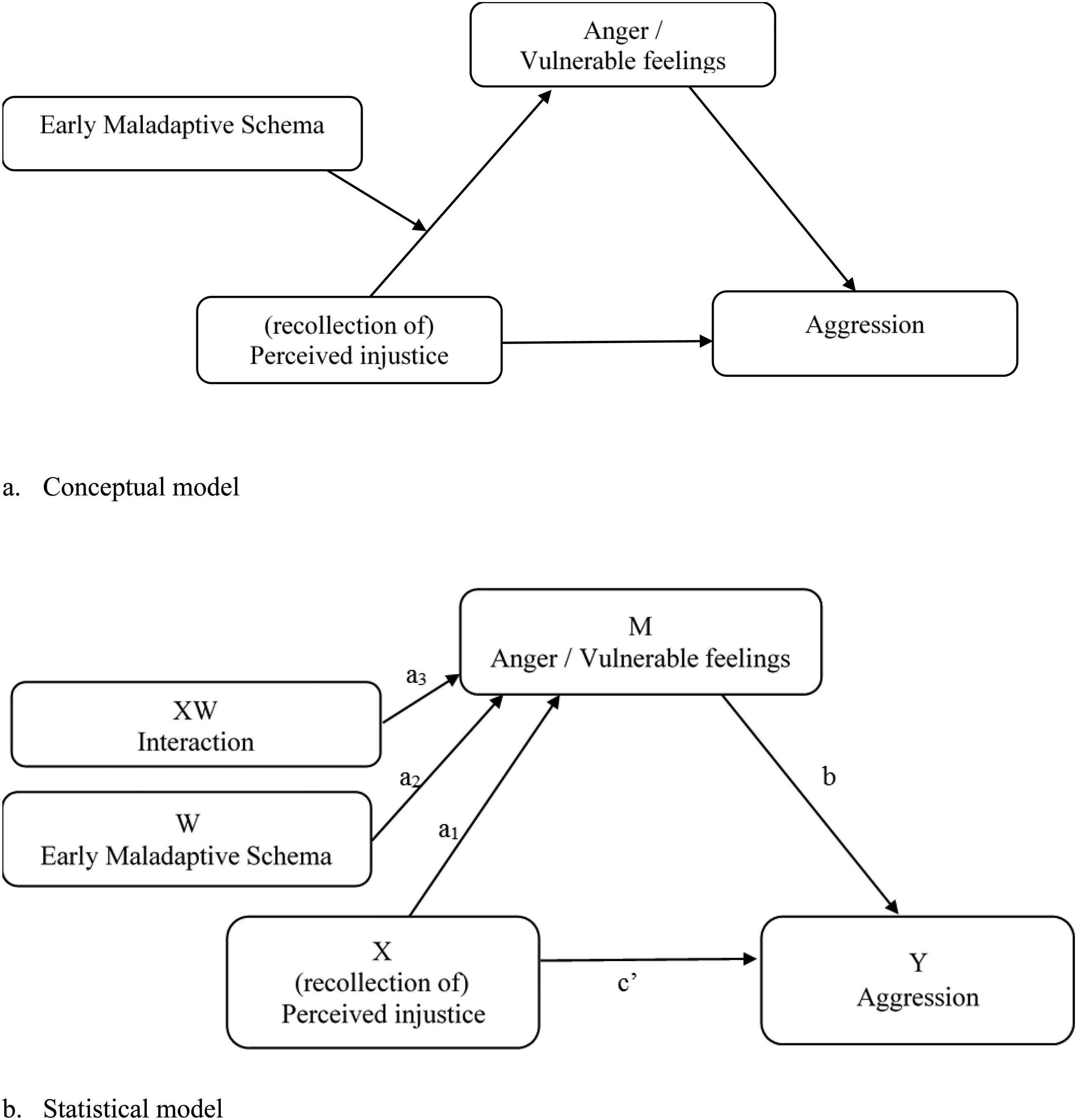
Conceptual and statistical model of moderation mediation. Direct effect = c’; Indirect effect = b(a1 + a3W); Moderated mediation index = a3b.
We hypothesized that the largest effects of our unfairness induction would be found on unprovoked aggression (i.e., effects would only be attributed to the induction of unfairness, and subsequent feelings of anger and abandonment/abuse, in the experimental condition), and not on provoked aggression (i.e., the provocation with sound blasts of all participants may weaken the effects of the unfairness induction).
Method
Participants
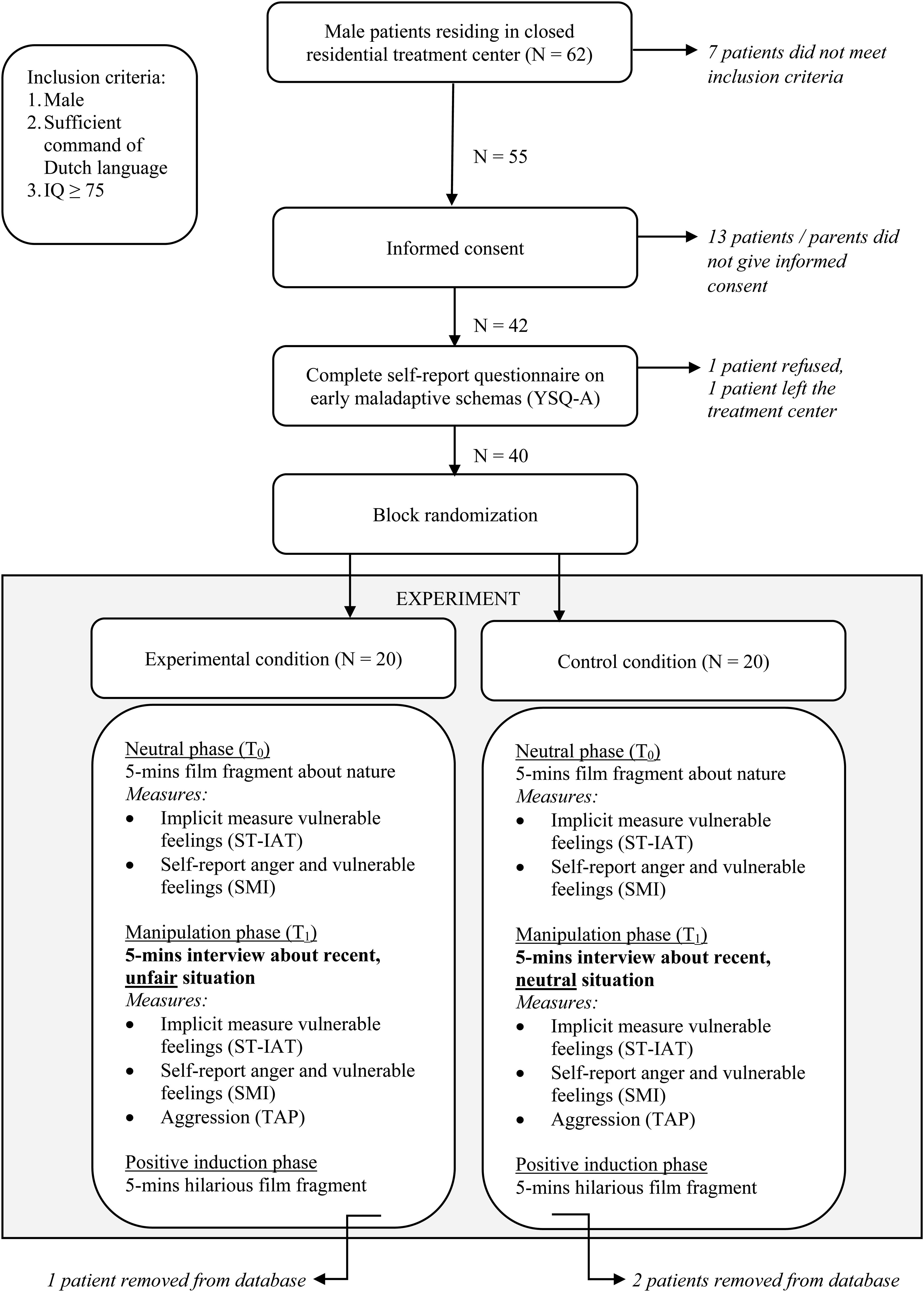
This study was performed in 2016 in a secure residential treatment center, to which adolescents with severe behavior problems are involuntarily admitted under Dutch civil law. At the time of this study, 62 male patients were residing in this treatment center. Seven of them were excluded because of insufficient command of the Dutch language (four patients) or because of an IQ lower than 75 (three patients). All other patients (N = 55) and their parents were asked informed consent to participate in this study. Thirteen patients or their parents refused to sign informed consent. The other 42 patients and their parents gave informed consent to participate in this study, of which one patient was arrested and transferred to a youth prison before we conducted the experiment. The experiment was thus conducted with 41 boys, of which four were removed from the final database: one because he refused to complete a questionnaire measuring maladaptive schemas prior to the experiment; another patient because he recollected a negative situation in the interview phase whilst being in the control condition, which repeatedly returned in his story, possibly biasing his results; and two others because their trials of the implicit measure of abandoned/abuse contained more than 10% of latencies lower than 300 ms (see scoring algorithm for this measure in Measurement section), which could indicate random responses. The final sample for statistical analyses therefore consisted of N = 37 participants (participation rate 67%), of which 19 were in the experimental condition and 18 in the control condition.
The age of the participants ranged from 13 to 18 years old (M = 16.0, SD = 1.2). The majority was Dutch (81%), and other participants were Moroccan (11%), African (3%), or of other origin (5%). Total IQ scores (derived from the charts) ranged from 87 to 133 (M = 92.7, SD = 12.9). Most prevalent DSM-IV (American Psychiatric Association, 2000) chart diagnoses were Disruptive Behavior Disorders (70%; 38% oppositional defiant disorder and 32% conduct disorder), Substance Abuse Disorders (51%), and ADHD (46%). Personality pathology or emerging personality disorders were specified in 35% of the charts. Other chart diagnoses included Autism Spectrum Disorders (32%), Post-Traumatic Stress Disorder (24%), Reactive Attachment Disorder (16%), and Mood Disorders (16%).
Procedure
After receiving informed consent of both patient and parent(s), we randomly allocated the patient to either one of the conditions. Because the random allocation threatened to cause unequal sample sizes between the conditions, we decided to start using block randomization and partly had to apply this retroactively. The first block consisted of 8 allocations (5 control, 3 experimental), the second block of 20 allocations (10 control, 10 experimental), the third block of 4 allocations (2 control, 2 experimental), and the final block of 9 allocations (4 control, 5 experimental). Especially in our relatively small sample size, unequal sample sizes would decrease the statistical power to detect significant differences between the conditions.
The study design is presented in Figure 2. The research assistant met with each participant individually to conduct the experiment. Two weeks prior to this meeting, participants completed a questionnaire about their schemas (Young Schema Questionnaire, see Measures) by pen and paper. The duration of the meeting with the research assistant was approximately 45 minutes. A web application was created to conduct the experiment, and all tasks from the experiment were completed using a laptop. After a short introduction of the experiment, the participant was asked to fill out some personal details that were used for the implicit measure of abandonment/abuse feelings (seeMeasures). The web application automatically directed these personal details to the task measuring implicit abandonment/abuse; they were not saved and could not be retrieved from the web application. Next, the participant practiced how to complete the trials of the Taylor Aggression Paradigm (TAP; see Measures). We reasoned that practicing this task before any manipulation was done would save practice time when the actual task was administered, preventing attention to be driven away from induced experience of unfairness.
Study design.
The actual experiment was divided into three phases (similar to the experiment conducted by Lobbestael & Arntz, 2010). First, in the neutral phase, participants watched a 5-minute fragment of a film about nature (used as a baseline). We subsequently administered a task to measure implicit vulnerable feelings related to abandonment and abuse, followed by a short self-report questionnaire measuring explicit anger and vulnerable feelings related to abandonment and abuse. The second phase was the manipulation phase, in which 5-minute interviews were held with the participants. The participants were asked about a recent situation in which they were treated unfairly (experimental condition), or about a recent situation in which they felt neutral (control condition). The research assistant was trained to help the participants recollect the situation as vividly as possible. She asked the participants to describe the situation as if it were a film clip, and helped them focus on the details by asking questions (e.g., Where were you?; What did you see when you looked around?; Who were with you?; What did you hear?; What went through your mind?). She asked the participant to focus on his feelings (e.g., What made you feel treated unfairly?; How did that make you feel?; What made you feel most [emotion reported by participant]?), and on any bodily sensations (e.g., Where did you feel these feelings in your body?; Can you feel the same feeling in your body now we’re talking about it?; What does that feel like?). Such an interview has been demonstrated to be one of the most effective anger induction methods (Lobbestael et al., 2008). After the interview, the participants repeated the tasks measuring implicit abandonment/abuse feelings and explicit anger and abandonment/abuse feelings, and subsequently completed the task measuring aggression. The last phase was the positive induction phase, in which participants watched a 5-minute fragment of a Dutch comedy TV show. This phase was included to minimize lasting impact of any negative feelings induced by the experiment, and was not included in any of the analyses. After completion of the experiment, participants received a gift voucher worth €7.50 to thank them for their participation. After all participants had completed the experiment, the particiants and their parents were debriefed.
Measures
Early maladaptive schemas
We used the Young Schema Questionnaire for Adolescents (YSQ-A; Van Vlierberghe et al., 2004) to measure maladaptive schemas two weeks prior to the experiment. The YSQ-A is a self-report measure, consisting of 75 items, based on the short-form Young Schema Questionnaire (YSQ-sf; Young, 1998), which has demonstrated adequate psychometric properties (Baranoff et al., 2006; Bates et al., 2002; Welburn et al., 2002). For the Dutch YSQ-A, corresponding items of the YSQ-sf were extracted from the Dutch long-form YSQ (Sterk & Rijkeboer, 1997), which has also shown adequate psychometric properties (Rijkeboer & van den Bergh, 2006; Rijkeboer, et al., 2005). Van Vlierberghe et al. (2004) adapted the items to make them more comprehensible for adolescents, and these adaptations were approved by the original author (Young). Factor analysis (Van Vlierberghe et al., 2010) has shown that the YSQ-A measures the 15 early maladaptive schemas originally proposed by Young (1994). Schema scores represent the mean of five items that had to be rated on a 6-point Likert scale (from 1 = not at all true to 6 = totally true). Research has shown that the YSQ-A distinguishes between clinical and non-clinical adolescent samples, and that the YSQ-A scales (i.e., schemas) are related to adolescent psychopathology (Muris, 2006; Van Vlierberghe et al., 2010). The current sample showed adequate internal consistencies for the schemas used in this study: Cronbach’s alphas were 0.91 for Abandonment, 0.80 for Mistrust, 0.76 for Entitlement, and 0.72 for Insufficient self-control.
Explicit measure of state anger and abandonment/abuse feelings
We administered 10 items from the self-report Schema Mode Inventory (SMI; Young et al., 2007) to explicitly measure anger (5 items) and feelings related to abandonment and abuse (5 items). Schema modes are transient states comprising emotions, cognitions, and coping behaviors, and for this study we were mainly interested in emotions. To measure state anger, we selected items that reflect the affective component of the Angry Child and Enraged Child modes (e.g., “I feel furious at someone”). To measure state feelings related to abandonment and abuse, we selected items that reflect the affective component of the Abandoned and Abused Child mode (e.g., “I feel helpless”). We asked the participants to rate to what extent (on a 6-point measurement scale; from 1 = not at all, to 6 = very much so) they experienced these emotions at that moment. Studies have shown adequate psychometric properties of the SMI in both adults and adolescents (Roelofs et al., 2016; van Wijk-Herbrink, Roelofs, et al., 2018; Young et al., 2007). In the current sample, internal consistencies for anger and feelings related to abandonment and abuse were good: Cronbach’s alphas for anger were 0.82 at T0 and 0.91 at T1, and Cronbach’s alphas for feelings related to abandonment and abuse were 0.93 at T0 and 0.94 at T1.
Measure of aggression
We used the Competitive Reaction Time Task (CRTT, see e.g., Bushman & Baumeister, 1998; Warburton & Bushman, 2019), a widely implemented variant of the Taylor Aggression Paradigm (TAP; Taylor, 1967) to measure aggression. This task constitutes of 30 trials in which participants had to click on a button on the screen as soon as possible after it turned red. Usually, participants completing this task are being told that they are playing against an opponent, and a lot of effort is put in strengthening this cover story. Because we were dealing with a vulnerable population of boys that are thought to be triggered highly by injustice and deception, we did not want to do anything to mislead them. We therefore decided to tell them that they were not playing against an actual opponent. Instead, we asked them to imagine that they were playing against a self-picked person they did not like. When questioned after the experiment, the majority of our participants (82%) said that they managed to keep this person in mind during the task. Thus, playing against this imagined, unliked person, the participant was told that he could win a trial by clicking on the red button as soon as possible. When winning a trial, he could administer a loud noise to this imagined opponent. When losing a trial, he would hear the noise the imagined opponent administered to him through his headphones. Before each trial, the participant was asked to choose the volume and duration of the noise his imagined opponent would hear by moving two sliders between 0 and 10. For volume, 0 represented no noise at all, and 10 represented a noise of 97 dB (equal to the sound of a jackhammer). For duration, 0 stood for zero seconds, and 10 for five seconds. Volume and duration were used as two separate measures of aggression, as recommended by Elson and colleagues (Elson et al., 2014). We used the same settings for the TAP as in a study by Brugman and colleagues (2015), except for some small adaptations to ensure that the ‘opponent’ would react more aggressively after losing a trial (“payback time”). These adaptations only concerned a switch of volume and duration between a few trials. During the first six trials, the ‘opponent’ did not administer any sound blasts to the participant (i.e., both volume and duration sliders were set at 0). From the seventh trial on, the ‘opponent’ was preprogrammed to administer sound blasts of different volume and duration. Factor analyses have shown that the trials before the first sound administered by the opponent may be used as a measure of unprovoked aggression, whereas the subsequent trials may be used as a measure of provoked aggression (Brugman et al., 2015). Thus, we used four measures of aggression in the current sample: unprovoked aggression measured by volume (Cronbach’s alpha = 0.93), unprovoked aggression measured by duration (Cronbach’s alpha = 0.96), provoked aggression measured by volume (Cronbach’s alpha = 0.97), and provoked aggression measured by duration (Cronbach’s alpha = 0.97).
Statistical analyses
All analyses were conducted with SPSS version 24. In order to minimize the number of statistical tests to be performed, we used several steps before testing the final moderated mediation models. First, we checked whether our manipulation led to a higher increase in anger and vulnerable feelings in the experimental condition compared to the control condition (interaction effects of condition by time). To test these interaction effects, we computed difference scores (T1 −T0) on anger and vulnerable feelings to include as dependent variables in independent samples t-tests (with condition as independent variable). Although we could also have used Repeated Measures ANOVAs with condition and time as independent variables (which would have generated the same results), we preferred t-tests on difference scores because we were interested only in the interaction effects (not in the main effects of condition and time), and, moreover, because t-tests can generate one-tailed p-values. We wanted to report one-tailed p-values because our hypotheses were specific about the direction of the deviations in means: We expected larger increases in anger and abandonment/abuse feelings in the experimental than in the control condition. When interaction effects were significant, we used paired samples t-tests to further inspect changes in anger and abandonment/abuse feelings in each condition separately. We expected no significant changes in the control condition (two-tailed testing), and expected increases (one-tailed testing) in these feelings in the experimental condition. A power analysis with G*Power (version 3.1.9.2; Faul et al., 2009) for a paired samples t-tests using a significance level of 0.05 (two-tailed) revealed that our sample size is sufficient: 34 participants are required to achieve 80% power to detect a medium (d = 0.50) effect size.
Moderation analyses
When we found significant changes in anger and/or vulnerable emotions (states) between the experimental and control conditions, we used moderation models to investigate whether such change was conditional on specific schemas (traits). Thus, the independent variable was condition, the moderator was one of the EMS (Abandonment, Mistrust, Entitlement, and Insufficient self-control), and the dependent variable was the change in anger or abandonment/abuse feelings. We used the PROCESS macros (Hayes, 2013) for SPSS to test these moderation models. The PROCESS macro is based on OLS regression analysis, and offers quantification and inference of (conditional) direct and indirect effects. We examined the statistical significance of the interaction effect, and we also examined the significance regions of the effect of condition on induction of feelings as defined by values of the moderator (i.e., the schemas). We used the Johnson-Neyman technique (Hayes, 2013; Johnson & Neyman, 1936) to identify the moderator values that demarcate the regions of significance (set at 0.05). General assumptions (e.g., linearity, homoscedasticity) for these analyses were sufficiently met. With simple regression analyses, we further inspected the relationship between schemas and change in anger or vulnerable emotions in each condition. When the moderation models resulted in significant interaction effects at the 0.05 significance level, we included the associated schemas and feelings in the conditional process models of moderated mediation (see Figure 1). A sensitivity analysis with G*Power (version 3.1.9.2; Faul et al., 2009) showed that we have 80% power to detect (medium to large) effect sizes (f2 ) of 0.22 and higher.
Moderated mediation
In the third and final step, we tested these conditional process models to investigate whether the effect of condition (independent variable) on various forms of aggression (dependent variable) was mediated by change in anger or vulnerable emotions (state; mediator), and whether these indirect effects were moderated by specific schemas (trait; moderator). Again, we used the PROCESS macros (Hayes, 2013) for SPSS to test these moderated mediation models. We used a large number (50,000) of bootstrap samples to calculate 95% bias-corrected confidence intervals (BCI) of conditional indirect effects ((a1 + a3 W)*b) and indexes of moderated mediation (a3*b). Such a large number of bootstrap samples will minimize the errors in estimation of the confidence intervals (Koehle et al., 2009). BCIs for conditional indirect effects were calculated given values of the moderator (W) at the 10th (very low), 25th (low), 50th (moderate), 75th (high), and 90th (very high) percentile. PROCESS can perform a formal test of moderated mediation to test for the differences between these conditional indirect effects. When the BCI for the index of moderated mediation does not straddle zero, then any two conditional indirect effects are significantly different from each other (Hayes, 2013).
Power analyses for moderated mediation analyses are not available yet, but simulation studies show that with small sample sizes only fairly large effect sizes are detectable with a power of 80% (Preacher et al., 2007). We are aware that this may be a limitation of our study, but we also know from the aforementioned sensitivity analysis for the moderation analyses in this study that we have 80% power to detect interaction effects with effect sizes (f2 ) of 0.22 and higher. Although we conducted multiple tests, we did not apply any correction to the significance levels because we conducted planned comparisons that were theory driven. By not adjusting the significance level, the analyses retained more power to detect weak, but possibly important, effects.
We reported interaction, direct, and indirect effects in unstandardized form for all analyses in order to facilitate comparison with future studies using the same instruments. For the moderation models, we reported changes in the proportion of explained variance (ΔR2) as a measure of the effect size of the moderated effect. For the moderated mediation models, no effect sizes are available yet given the complexity of the models (Hayes, 2013).
Results
Table 1 displays the means and standard deviations of all variables. We conducted independent samples t-tests to ensure that baseline scores did not differ significantly between the experimental and control condition. Indeed, there were no significant differences between the conditions on any of the maladaptive schemas, i.e. Abandonment, t(35) = −0.83, p = 0.41; Mistrust, t(35) = 0.28, p = .78; Entitlement, t(35) = 1.30, p = 0.20; and Insufficient self-control, t(35) = 0.68, p = 0.50. Neither were there differences in baseline scores of anger, t(35) = −1.11, p = 0.27; explicit vulnerable feelings related to abandonment and abuse, t(35) = −1.16, p = 0.26; or implicit vulnerable feelings (self-abuse associations), t(35) = −1.50, p = 0.14.
Results of t-tests comparing means of maladaptive schemas, negative affect, and aggression between conditions and within conditions (if applicable).
p < 0.05;
** p < 0.01
(One-tailed p-values for comparison of difference scores T1−T0 between conditions, and for comparison of T0 an T1 scores within the experimental condition because of hypotheses of specific direction. For other comparisons we looked at two-tailed p-values).
Independent samples t-test to compare mean scores between the control and experimental condition.
Paired samples t-test to compare T0 and T1 scores in each condition seperately.
A negative score means that the participants were more likely to associate self with “love” than with “abuse”. The more negative the score is, the less association of self with abuse.
Degrees of freedom were adjusted from 35 to 20 because of unequal variances.
To investigate the effects of our manipulation on anger and vulnerable feelings (interaction effects of condition by time), we conducted independent samples t-tests with condition as independent variable and difference scores (T1 − T0) on anger and vulnerable feelings as dependent variables. Results are displayed in Table 1. Increases in state anger and explicit abandonment/abuse were larger in the experimental condition than in the control condition. For increase in explicit abandonment/abuse, Levene’s test indicated unequal variances (F = 26.68, p < 0.001), so degrees of freedom were adjusted from 35 to 20. There were no significant differences between the experimental and control condition in increase in implicit self-abuse associations. To investigate changes in anger and vulnerable feelings in each condition separately, we conducted paired samples (T0 and T1 scores) t-tests in each condition (see Table 1 for results). In line with our hypothesis, there was a significant increase in anger in the experimental condition. Interestingly, we also found a significant change in anger in the control condition: Participants reported less anger after they were interviewed about a recent, neutral situation they experienced. Changes in explicit abandonment/abuse feelings over time were not significant in the control condition, and the increase in such feelings just failed to reach significance in the experimental condition. Thus, although we found an overall interaction effect of condition by time on abandonment/abuse feelings, changes in such feelings were not significant in each condition separately. We should note, however, that the increase in explicit abandonment/abuse feelings in the experimental condition was very close to significance (one-tailed p = 0.051). Changes in implicit self-abuse associations were not significant in either condition.
Moderation analyses
Next, we investigated whether changes in state anger and vulnerable feelings were dependent on trait maladaptive schemas (moderation). As can be seen in Table 2, the effect of condition on anger change (state) was moderated by the (trait) schemas Abandonment and Entitlement, not by Mistrust and Insufficient self-control. The effect of condition on change in explicit abandonment/abuse (state) was moderated by the (trait) schema Abandonment, but not Mistrust. Neither Abandonment nor Mistrust (trait) moderated the effect of condition on change in implicit self-abuse associations (state). Thus, including these schemas as a moderator did not add to the finding of the previous t-tests: our experimental manipulation did not result in larger increases in self-abuse associations in the experimental condition than in the control condition. In Figure 3, we plotted the significant interaction effects of condition by schema on anger and explicit abandonment/abuse. It shows that with higher scores on the Abandonment and Entitlement schemas (trait), the difference in change in anger (state) between the two conditions increased. Thus, stronger schemas of Abandonment (scores 1.49 and higher) and Entitlement (scores 1.78 and higher) led to higher increases in anger in the experimental compared to the control condition. The same pattern was shown for the change in explicit vulnerable feelings related to abandonment and abuse: A stronger Abandonment schema (scores 2.15 and higher) led to higher increase in state Abandonment/abuse feelings in the experimental condition compared to the control condition. When zooming in on the effects of these schemas on change in feelings within each condition (see results of regression analyses reported in Figure 3), we found that a higher Abandonment schema led to a significantly larger increase in state anger in the experimental condition, whereas it led to a significantly larger decrease in state anger in the control condition. A higher Abandonment schema also led to a significantly larger increase in state abandonment/abuse feelings in the experimental condition, but it did not affect the change in state abandonment/abuse feelings in the control condition. A higher Entitlement schema did not lead to significantly larger increases in state anger in the experimental condition, but it did lead to significantly larger decreases in state anger in the control condition.
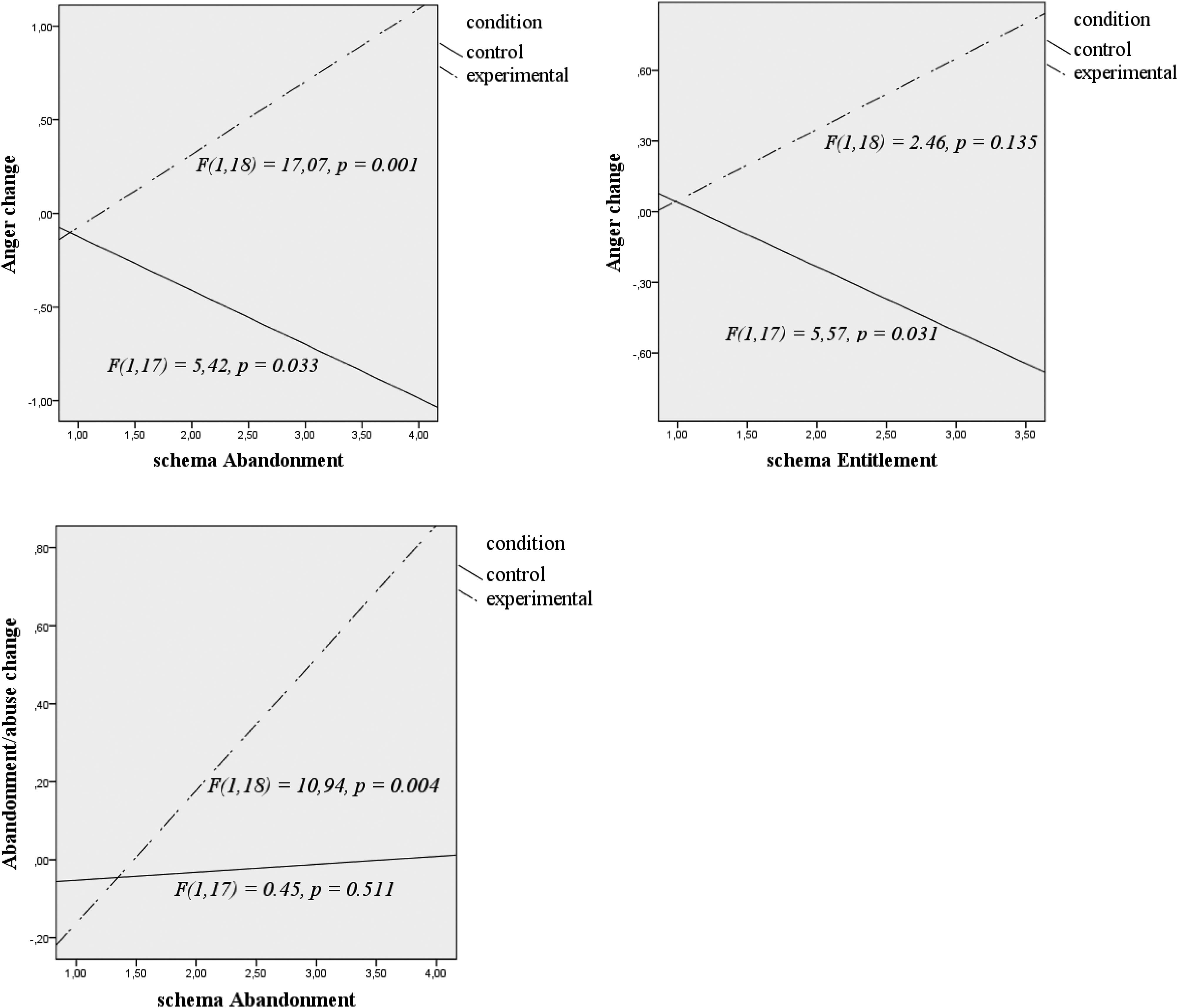
Effects of condition on anger or vulnerable feelings related to abandonment and abuse, moderated by schemas. Scores on both axes are unstandardized. Reported F-values belong to regression analyses per condition with schema as independent variable and anger, or vulnerable feelings related to abandonment and abuse, as dependent variable.
Moderated mediation analyses
Finally, we tested the conditional process models investigating moderated mediation of the effects of condition on various measures of aggression. Direct effects and indexes of moderated mediation for these models are displayed in Table 3. For inference of the direct effects and moderated indirect effects, we calculated 95% bias-corrected confidence intervals (BCI) based on 50,000 bootstrap samples. We found that the effect of condition on unprovoked aggression was mediated by change in anger (state), and that this indirect effect was moderated by schemas of Abandonment and Entitlement (trait). This was true for both measures of unprovoked aggression, whereas no direct or indirect effects were found on provoked aggression. Furthermore, these indirect effects on unprovoked aggression were found only through change in state anger, not through change in state abandonment/abuse. Thus, although feelings of explicit abandonment/abuse conditionally (i.e., dependent on Abandonment schema) increased after the recollection of injustice, they did not subsequently lead to aggression. Coefficients for the conditional process models that had a significant moderated mediation index are displayed in Figure 4.
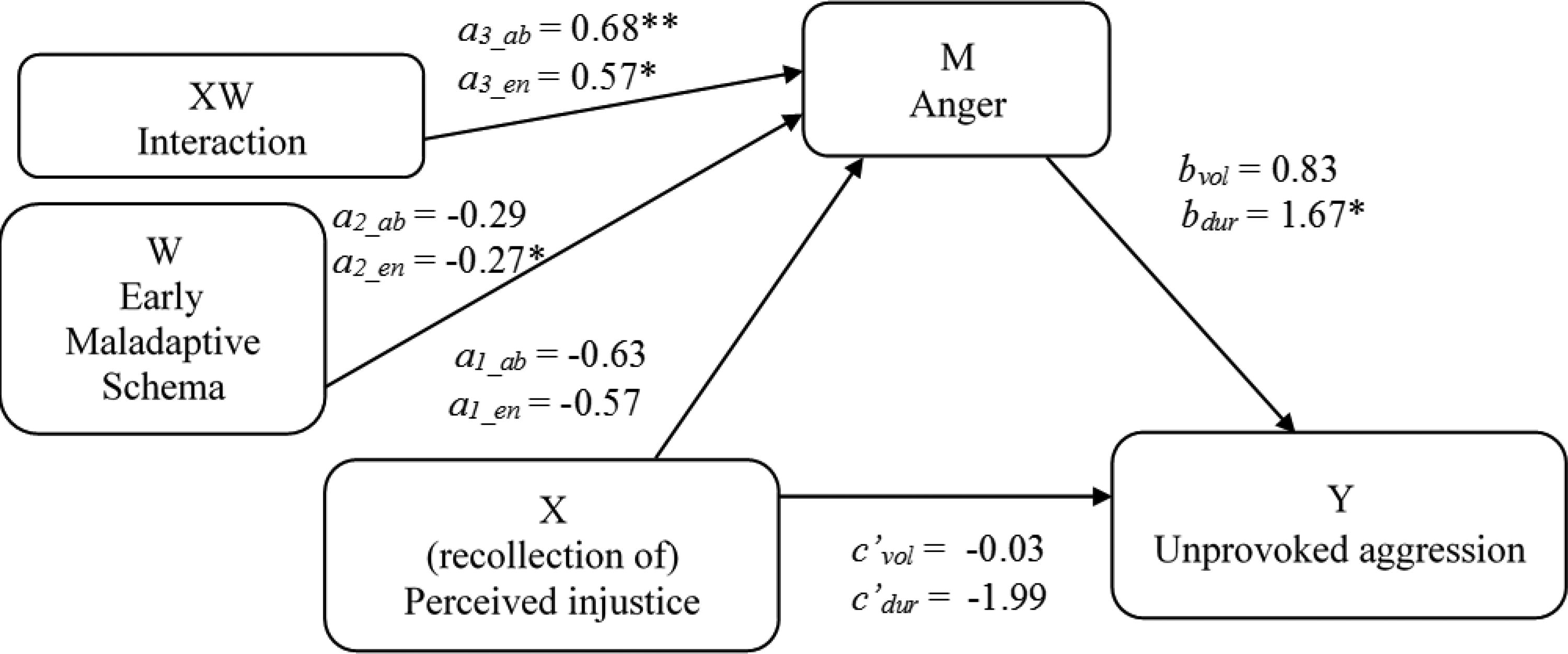
Coefficients of mediated moderation models that had a significant mediated moderation index. ab = Abandonment schema; en = Entitlement schema; vol = volume; dur = duration. *p < 0.05; **p < 0.001.
Results of moderation analyses: Interaction effects, standard errors, and increases in explained variance due to interaction.
p < .05;
p < .001.
R2 increase due to interaction.
Direct effects and indexes of moderation mediation of conditional process models.
significant at the 0.05 level: 95% bias-corrected confidence intervals did not straddle zero.
Zooming in on these statistically significant moderated mediation models, we generally found indirect effects on unprovoked aggression through change in state anger only for participants who scored moderate (50th percentile), high (75th percentile), or very high (90th percentile) on the Abandonment and Entitlement schemas. One exception was that the indirect effect on unprovoked aggression as measured by volume just failed to reach significance for those scoring high (75th percentile) on Entitlement (BCI = >−0.01 − 2.03). No indirect effects were found for participants scoring low (25th percentile) or very low (10th percentile) on the Abandonment and Entitlement schemas. Direct effects in all models were not statistically significant. Thus, in the models for which significant indirect effects were found, anger increase (conditional on the extent to which Abandonment and Entitlement schemas were present) fully explained the relationship between recollection of injustice and unprovoked aggression.
Discussion
We investigated whether early maladaptive schemas influence the causal links between perceived injustice, negative affect (anger or vulnerable feelings related to abandonment and abuse), and aggression in adolescent boys with severe behavior problems. In line with our hypotheses, the main results can be summarized as follows. First, specific schemas were found to moderate the relation between unfairness (manipulation) and feelings of state anger and vulnerability. That is, higher scores on the Abandonment and Entitlement schemas led to higher increases in state anger, whereas only higher scores on the Abandonment schema was found to lead to increases in state feelings of abandonment/abuse. Second, only the increase in state anger was found to lead to unprovoked aggression for particpants who had high scores on the Abandonment and Entitlement schemas, supporting a moderated mediation model with state anger as a mediator and Abandonment and Entitlement schemas as moderators.
Consistent with Berkowitz’ theory (1990, 2012), our findings suggest that specific schemas play a critical role in the occurrence of anger and aggression when encountering perceived injustice. Specifically, participants with higher levels of Abandonment and Entitlement were likely to display more anger and aggression than participants with lower levels of such schemas. The effect was most profound for the schema Abandonment, a schema that is usually associated with internalizing emotions such as loss and sadness. Nevertheless, our finding that the Abandonment schema underlies anger and aggression is consistent with previous research demonstrating that externalizing behaviors may just as well be a manifestation of vulnerable schemas related to disconnection and rejection experiences (e.g., Abandonment) as internalizing behaviors (van Wijk-Herbrink, Bernstein, et al., 2017).
A noteworthy result of our study was that the schemas Abandonment and Entitlement not only led to higher increases in state anger in the experimental condition, but that they also affected state anger in the control condition. Specifically, participants with higher levels of Abandonment and Entitlement schemas reported larger decreases in state anger after they were interviewed about a neutral situation, whereas we expected no changes to occur. This could be considered in the context of mindfulness and diversion of attention. Angry rumination has been shown to mediate the relation between mindfulness and anger (Borders et al., 2010). Explicit reflection on a recent unfair situation, like the participants did in the experimental condition, may prime further negative thinking about this situation and, subsequently, may increase state anger, whereas discussing a neutral experience may distract focus from escalating thoughts, and subsequently reduce state anger 1 .
In contrast to feelings of anger, state abandonment and abuse-related feelings did not decrease after the neutral interview, regardless of the level of the schema Abandonment. Whereas anger can easily be appeased by strangers, abandonment presupposes a relationship with a degree of closeness or intimacy. Reduction of such feelings is unlikely in a 5 minute interview with someone who was met for the first time.
The effects of perceived injustice – in combination with high levels of Abandonment and Entitlement – on anger and subsequent aggression disappeared after all participants were provoked with sound blasts. Thus, the sound blasts provocation eliminated the effects of our experimental manipulation. Provoking all participants with sound blasts thwarted their personal well-being, which may have elicited anger on its’ own (Batson et al., 2007), superseding the initial effects of perceived injustice on anger and subsequent aggression.
Although in situations of perceived injustice, higher levels of specific schemas led to higher increases of both anger and vulnerable feelings, subsequent aggression occurred only through state anger and not through state abandonment and abuse-related feelings. Although it is commonly assumed that emotions directly influence behavior, research has also suggested that behavior is guided by the anticipation of emotion (DeWall et al., 2016). Anticipation of emotion is likely biased by dysfunctional beliefs or maladaptive schemas (e.g., if I don’t aggress now, I will be a victim, and I will feel miserable afterwards). In this light, it could be that aggression rather is a means of preventing vulnerable feelings of abandonment and abuse, than that it occurs as a result of such emotions. On the other hand, it could also be that vulnerable feelings do in fact mediate the effect of perceived injustice on aggression, but not on a conscious level. Unconscious, affective emotional responses are thought to have a different, more direct effect on behavior (Baumeister et al., 2007).
In our study, we attempted to assess such unconscious emotions by measuring implicit self-abuse associations. Nonetheless, we did not include this measure in our predictive models of aggression, because our experimental manipulation did not increase the association of self with abandonment and abuse, regardless of the level of specific schemas. Despite the implicit nature of the measurement, participants’ responses may have been obscured because our ST-IAT explicitly contained the word ‘abuse’ (whereas the explicit measure did not). Relating the self to abuse requires that the adolescent is capable of conceptualizing maltreatment experiences as belonging to the category of abuse, as well as recognizing that their experiences deviate from social standards (Wekerle et al., 2001). This may not have been the case, particularly given the frame of reference of our participants who are highly likely to stem from unstable and hazardous families and environments (Van Dam et al., 2010). It could also be that our intervention was too short to change the implicit associations of the self with abandonment and abuse, as the ST-IAT has been suspected to also measure traits, as well as states (Egloff et al., 2005). However, other studies have shown that a 5 minute intervention can indeed change implicit self-concepts (Bushman, Baumeister, & Phillips 2010). Future research could investigate whether longer interventions may be able to change our implicit measure.
The current study provides a number of other implications for future research. More research is needed to disentangle the influence of current emotions versus anticipated emotions on aggression in case of perceived injustice, for example by using a mood-freezing procedure (see Manucia et al., 1984). This procedure was designed to persuade participants that their emotional states are frozen and temporarily cannot be changed. Bushman, Baumeister, & Phillips (2001) used mood-freezing to demonstrate that people engage in aggression in order to improve their emotional states: People who had been induced to believe that aggression would make them feel better responded more aggressively to criticism, but this aggression was eliminated when they had been given a (bogus) pill to temporarily freeze their mood. Furthermore, future research should incorporate valid implicit instruments measuring unconscious, automatic affective responses to perceived injustice in order to investigate whether they can cause aggression. Of course, replication studies are needed to validate our findings. For example, we have no reasonable explanation for the unexpected finding that the Mistrust and Insufficient Self-control schemas did not affect the occurrence of specific emotions in situations perceived as unfair.
The present findings have potentially important implications for the clinical management of anger and aggression. For example, studies show that antecedent-focused emotion regulation strategies are the most effective means of reducing anger and aggression, following provocations (Gross, 2001). Reappraising situations in more benign terms (e.g., “He didn’t mean to harm me”) can reduce anger before it escalates and triggers aggressive coping behavior. Our findings suggest that early maladaptive schemas, which involve extreme and inflexible interpretations of the other people’s intentions, may interfere with reappraisals of provocative situations. Moreover, early maladaptive schemas (e.g., Abandonment, Entitlement) may increase rumination – dwelling on perceived injustices – that reduces self-control and increases the risk of aggressive behavior (Denson et al., 2011). Thus, early maladaptive schemas may be an important link explaining why stimuli like perceived injustice lead to anger, triggering a cascade of rumination, loss of self-control, and aggression. In clinical practice, schematic activation is easily overlooked. Interventions for aggression, such as Aggression Regulation Therapy, usually only target (coping) behaviors and cognitions that are ususally associated with externalizing behaviors, not schemas that are usually associated with internalizing behaviors (e.g., Abandonment). The findings of this study emphasize the need for interventions targeting early maladaptive schemas, such as Schema Therapy (Young, Klosko, & Weishaar), when treating aggression in adolescent boys with severe behavior problems. Schema Therapy is an integrative psychotherapy that has been shown effective for adult patients with personality disorders (Bamelis, Evers, Spinhoven, & Arntz, 2014; Farrell, Shaw, & Webber, 2009; Giesen-Bloo et al., 2006; Nadort et al., 2009), including forensic patients with severe antisocial behaviors (Bernstein 2016). The literature on Schema Therapy in adolescents is still scarce, but the present study is in line with the preliminary finding that Schema Therapy may ameliorate behavior problems in adolescents with disruptive behavior disorders (Van Wijk-Herbrink, Broers, et al., 2017).
One of the strengths of this study is its experimental design, allowing us to draw conclusions about causality of effects. Furthermore, we used a behavioral measure of aggression instead of self-report. Although we consider this a strength, of course we should bear in mind that laboratory aggression may differ from aggression occurring in natural settings. Nonetheless, research has strongly supported the external validity of laboratory studies using this measure of aggression (Anderson & Bushman, 1997). A limitation of this study is that in natural settings, other variables (e.g, drug and alcohol use, peer pressure) may play a moderating role in the effect of perceived injustice on anger and aggression. Furthermore, because we conducted this experiment in a closed treatment setting in which aggressive behavior is usually followed by negative consequences (e.g., less privileges), participants may have felt restrained in displaying aggressive behavior during the experiment. Another limitation of our study is the relatively small sample size. For the analyses we conducted with bootstrapping procedures, only fairly large effects can be detected with an acceptable level of power (0.80) with small sample sizes (Preacher et al., 2007). However, the significant and meaningful effects we found in our study were large enough to uncover a number of important effects, but it could well be that some other, non-significant effects were too small to be detectable with the current sample size. Another limitation may be that we did not use a more stringent level of significance to correct for multiple analyses. Although applying a correction would have the positive effect of reducing type-I errors, on the negative side it would also increase the chance of type-II errors. Replication is needed to confirm our findings, and, if a larger sample is used, to see if other, smaller effects may be revealed. A final limitation is that we conducted this study in adolescent boys only, so we do not know whether the results are generalizable to adolescent girls or to adults.
Despite these limitations, this study contributed to our understanding of aggression in response to perceived injustice in adolescent boys with severe behavior problems. We found that certain maladaptive schemas predict aggression in these patients, but only in situations perceived as unfair and when anger is triggered. Importantly, even a vulnerable schema such as Abandonment, which is usually associated with internalizing problems, was shown to underlie anger and aggression. Interventions targeting maladaptive schemas may aid the prevention and treatment of aggression in this population.
Ethical approval
All procedures performed in studies involving human participants were in accordance with the ethical standards of the institutional and/or national research committee and with the 1964 Helsinki declaration and its later amendments or comparable ethical standards.”
Informed consent
Informed consent was obtained from all individual participants included in the study.
Footnotes
Acknowledgements
We would like to thank the treatment facility Ottho Gerhard Heldringstichting in Zetten, part of VIGO Group, the Netherlands, where the experiment was conducted. Special thanks go out to Anke van Duren for her assistance with the data collection.
Conflict of interest
The authors declare that they have no conflict of interest, although authors DB, JR, and MvWH declare that there may be an indirect conflict, because they give trainings in Schema Therapy.
1
The authors would like to acknowledge one of the reviewers for suggesting this explanation.
