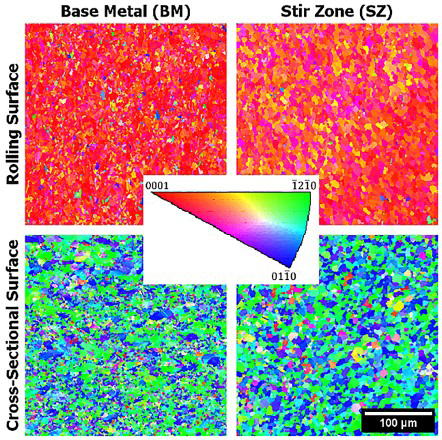
Localised corrosion at the weld periphery of AZ31B friction stir spot welds has been associated with microstructural evolution during the welding process. Several attempts have been made to correlate these changes to the corrosion resistance of a joint; however, the influence of grain reorientation arising from the welding process has been overlooked. Here, the role of grain reorientation during FSSW was investigated using a combination of microcapillary polarisation and analytical microscopy. The influence of changes in grain orientation was shown to have a direct effect on the magnitude of the galvanic couple formed between the stir zone and the base metal.
FriedrichHSchumannS.Research for a “new age of magnesium” in the automotive industry. J Mater Process Technol. 2001; 117: 276–281. doi: 10.1016/S0924-0136(01)00780-4
2.
AbbottTB. Magnesium: industrial and research developments over the last 15 years. Corrosion. 2015; 71 (2): 120–127. doi: 10.5006/1474
3.
SongGXuZ. Effect of microstructure evolution on corrosion of different crystal surfaces of AZ31 Mg alloy in a chloride containing solution. Corros Sci. 2012; 54: 97–105. doi: 10.1016/j.corsci.2011.09.005
4.
GusievaKDaviesCHJScullyJr. Corrosion of magnesium alloys: the role of alloying. Int Mater Rev. 2015; 60 (3): 169–194. doi: 10.1179/1743280414Y.0000000046
5.
CanoZPDanaieMKishJr. Physical characterization of cathodically-activated corrosion filaments on magnesium alloy AZ31B. Corrosion. 2015; 71 (2): 146–159. doi: 10.5006/1384
6.
AungNN.ZhouW.Effect of grain size and twins on corrosion behaviour of AZ31B magnesium alloy. Corros Sci. 2010; 52: 589–594. doi: 10.1016/j.corsci.2009.10.018
7.
XinRLiBLiL. Influence of texture on corrosion rate of AZ31 Mg alloy in 3.5 wt.% NaCl. Mater Des. 2011; 32: 4548–4552. doi: 10.1016/j.matdes.2011.04.031
8.
AghionE.JanL.MeshiL.. Increased corrosion resistance of the AZ80 magnesium alloy by rapid solidification. J Biomed Mater Res B. 2015; 103: 1541–1548. doi: 10.1002/jbm.b.33335
9.
PardoAMerinoaMCCoyaAE. Influence of microstructure and composition on the corrosion behaviour of Mg/Al alloys in chloride media. Electrochim Acta. 2008; 53: 7890–7902. doi: 10.1016/j.electacta.2008.06.001
10.
SudholzADKirklandNTBuchheitRG. Electrochemical properties of intermetallic phases and common impurity elements in magnesium alloys. Electrochem Solid State Lett. 2011; 14 (2): C5–C7. doi: 10.1149/1.3523229
11.
SongGLAtrensA. Corrosion mechanisms of magnesium alloys. Adv Eng Mater. 1999; 1 (1): 11–33. doi: 10.1002/(SICI)1527-2648(199909)1:1<11::AID-ADEM11>3.0.CO;2-N
12.
MakarGLKrugerJ.Corrosion of magnesium. Int Mater Rev. 1993; 38 (3): 138–153. doi: 10.1179/imr.1993.38.3.138
13.
SongGLAtrensAWuXL. Corrosion behaviour of AZ21, AZ501 and AZ91 in sodium chloride. Corros Sci. 1998; 40 (10): 1769–1791. doi: 10.1016/S0010-938X(98)00078-X
14.
WangLShinoharaTZhangBP. Corrosion behavior of Mg, AZ31, and AZ91 alloys in dilute NaCl solutions. J Solid State Electrochem. 2010; 14: 1897–1907. doi: 10.1007/s10008-010-1020-1
15.
LunderOLeinJEAuneTKR. The role of Mg17Al12 phase in the corrosion of Mg alloy AZ91. Corrosion. 1989; 45 (9): 741–748. doi: 10.5006/1.3585029
16.
MathieuSRapinCSteinmetzJ. A corrosion study of the main constituent phases of AZ91 magnesium alloys. Corros Sci. 2003; 45 (12): 2741–2755. doi: 10.1016/S0010-938X(03)00109-4
17.
YuSChenXHuangZ. Microstructure and mechanical properties of friction stir welding of AZ31B magnesium alloy added with cerium. J Rare Earths. 2010; 28 (2): 316–320. doi: 10.1016/S1002-0721(09)60104-6
18.
YinYHSunNNorthTH. Hook formation and mechanical properties in AZ31 friction stir spot welds. J Mater Process Technol. 2010; 210: 2062–2070. doi: 10.1016/j.jmatprotec.2010.07.029
19.
XinRLLiBLiuQ. Microstructure and texture evolution during friction stir processing of AZ31 Mg alloy. Mater Sci Forum.2010; 654-656: 1195–1200. doi: 10.4028/www.scientific.net/MSF.654-656.1195
20.
WooWChooHPrimeMB. Microstructure, texture and residual stress in a friction-stir-processed AZ31B magnesium alloy. Acta Mater. 2008; 58: 1701–1711. doi: 10.1016/j.actamat.2007.12.020
21.
MaZYXiaoBLYangJ. Friction stir processing: a novel approach for microstructure refinement of magnesium alloys. Mater Sci Forum.2010; 638-642: 1191–1196. doi: 10.4028/www.scientific.net/MSF.638-642.1191
22.
PareekMPolarARumicheF. Metallurgical evaluation of AZ31B-H24 magnesium alloy friction stir welds. J Mater Eng Perform. 2007; 16: 655–662. doi: 10.1007/s11665-007-9084-5
23.
Bobby KannanMDietzelWZettlerR. In vitro degradation behaviour of a friction stir processed magnesium alloy. J Mater Sci Mater Med. 2011; 22: 2397–2401. doi: 10.1007/s10856-011-4429-x
24.
SavguiraYNorthTHThorpeSJ. Microcapillary polarization measurements of friction stir spot welds made in AZ31B magnesium alloy. Mater Corros. 2014; 65: 1055–1061. doi: 10.1002/maco.201307410
25.
ChenTXueWLiY. Corrosion behavior of friction stir welded AZ31B magnesium alloy with plasma electrolytic oxidation coating formed in silicate electrolyte. Mater Chem Phys. 2014; 144: 462–469. doi: 10.1016/j.matchemphys.2014.01.020
SavguiraYNorthTHThorpeSJ. Effect of grain size and residual stress on the corrosion resistance of friction stir spot welded AZ31B joints. Mater Corros. 2016; 67: 1068–1074. doi: 10.1002/maco.201608925
28.
KishJrWilliamsGMcDermidJr. Effect of grain size on the corrosion resistance of friction stir welded Mg alloy AZ31B joints. J Electrochem Soc. 2014; 161: C405–C411. doi: 10.1149/2.0901409jes
29.
SavguiraYNorthTHThorpeSJ. Effect of welding flash on the corrosion of friction stir spot welded AZ31B. Mater Corros. 2016. doi: 10.1002/maco.201609182
30.
SongGMishraRXuZ. Crystallographic orientation and electrochemical activity of AZ31 Mg alloy. Electrochem Commun. 2010; 12: 1009–1012. doi: 10.1016/j.elecom.2010.05.011
31.
YuanWMishraRSCarlsonB. Material flow and microstructural evolution during friction stir spot welding of AZ31 magnesium alloy. Mater Sci Eng A. 2012; 543: 200–209. doi: 10.1016/j.msea.2012.02.075