



Abstract
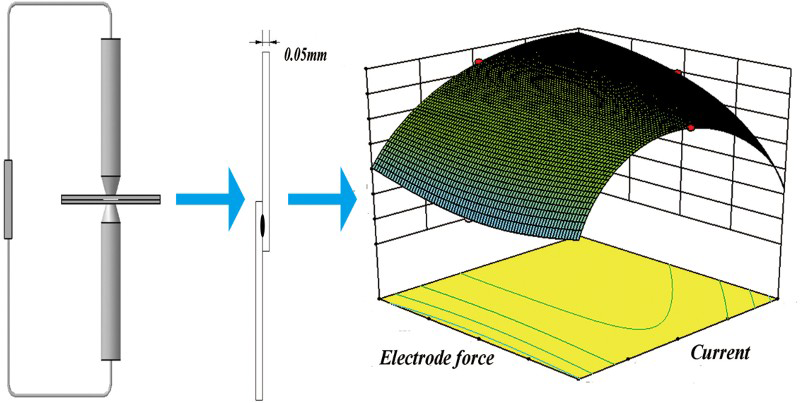
In this study, Ti–1Al–1Mn thin foils with thickness of 0.05 mm were welded by small-scale resistance spot welding. Welding current, electrode force and welding time have been changed while other welding parameters remained constant. The welded joints were subjected to tensile shear tests for determining the values of shear force and absorption energy. A quadratic model of response surface methodology based on Box–Behnken design was employed in establishing regression equations between input variables (current, electrode force and time) and output variables (shear force, absorption energy, variance of shear force and variance of absorption energy). The models were satisfied in optimising the welding parameters. Besides, the microstructure analysis on the typical spot welds was also conducted.
GRAPHICAL ABSTRACT
Keywords
Get full access to this article
View all access options for this article.