



Abstract
Nature has developed unique strategies to refine and optimise structural performance. Using surfaces designed at multiple length scales, from micro to nano levels, combined with complex chemistries, different natural organisms can exhibit similar wetting but different adhesion to liquids under specific environments. These biological surfaces have inspired researchers to develop new approaches to control surface wetting and liquid behaviour via surface adhesion. Here we review natural strategies to control the interaction of liquids with solid surfaces and the efforts to implement these strategies in synthetic materials designed to work in either atmospheric or underwater environment. Particular attention is paid to droplet behaviour on the special-adhesion surfaces in nature and artificial smart surfaces. We highlight recent progress, identify the common threads, and discuss the fundamental differences in a way that can help formulate rational approaches towards surface engineering, and identify current challenges as well as future directions for the field.
Introduction
Wetting plays a vital role in many biological surfaces and industrial processes [1,2]. The research on wetting involves contributions from international scientists in diverse and interdisciplinary fields. It can be traced back to more than 200 years ago and is still developing rapidly today (Figure 1). Thomas Young, a British physicist, was a pioneer in wetting research; he first proposed the use of the liquid contact angle (CA) to define wettability in 1805 [3]. In 1936, Robert Wenzel, a chemist from an American institute, explained the relationship between solid surface roughness and CA, and how roughness enhanced hydrophobicity [4]. Then, Cassie and Baxter, further extended this theory to porous and rough surfaces in 1944 and proposed a composite wetting model theory (see details in Section “Wetting Theory”), which considered that the surface could trap air between water and solid [5–7]. Development of surface wetting research: from wettability (blue and green marked) to wettability & adhesion (purple marked), from natural high/low/anisotropic adhesion surface (green and purple marked) to switchable surface or others enabling special liquid dynamics (black brackets), including both atmospheric (red marked) and underwater (orange marked) studies, in view of surface chemical compositions and micro/nano-structures.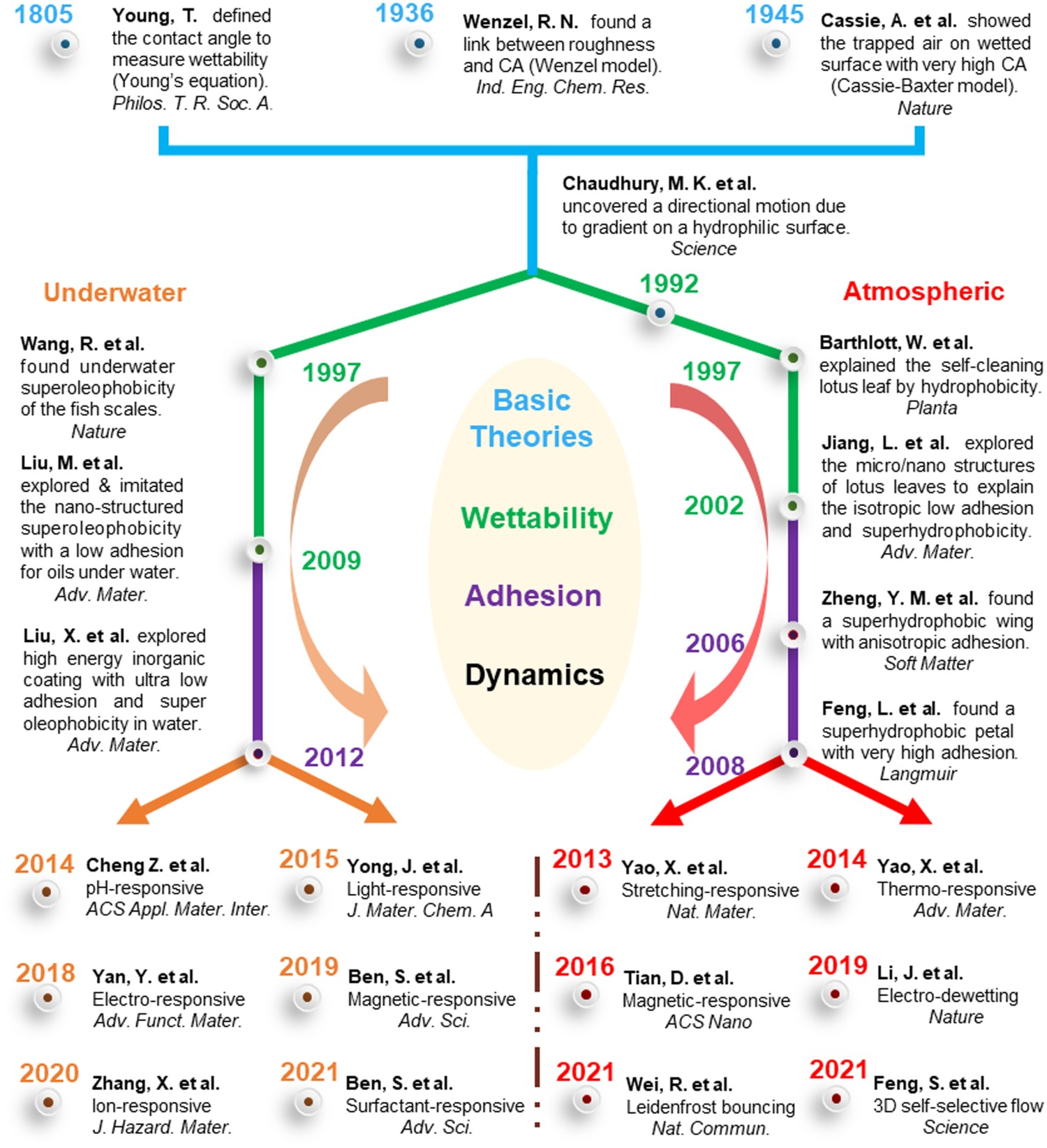
The description of natural superhydrophobic surfaces first appeared in a Chinese Song Dynasty poem, ‘the lotus leaves from silt without dyeing’. However, the scientific mechanism behind it, i.e. the microstructure of the lotus upper surface, was not investigated until 1997 [8]. In 2002, Jiang et al. further revealed that the micro/nano-level structure was an important reason for the high apparent water contact agile (WCA) and isotropic low adhesion on the upper surface of a lotus leaf [9]. This work identified for the first time that the multi-scale structure plays a crucial role in surface superhydrophobicity. In the same year, Richard et al. first uncovered the mechanism of a droplet bouncing behaviour when the droplet was thrown onto a superhydrophobic surface [10]. In 2003, Feng et al. created a superhydrophobic surface using nanostructured polymer materials [11], which attracted many researchers to the field. Since then, through the development of a better understanding of the effect of multi-scale structures on superhydrophobicity, i.e. how recessed structures can enhance the stability of the solid/air composite interface [12,13], researchers have begun to develop superhydrophobic surfaces using diverse materials such as ceramics, carbon, glass, polymers and metals [14–17].
Based on the design of superhydrophobic surfaces in air, researchers began to study the design and fabrication of superoleophobic surfaces in air, which is much more difficult to achieve because of the lower surface tension of organic liquids [12,18–21]. Another special wettability state in air is the superhydrophilicity, where water droplets quickly spread on the surface of materials and form a film to completely wet the surface. A typical biological superhydrophilic surface is the cornea of human eyes, which is able to make tears spread out quickly and eliminate the effect of light scattering [22]. It is noteworthy that wetting on hydrophilic surfaces has been frequently studied in the physical-chemistry domain in the past two centuries, which paves the way for modern studies on bio-inspired superwetting materials. For example, in 1992, Chaudhury et al. first reported a special directional transport phenomena (moving uphill) on a hydrophilic surface with surface-energy gradient [23]. This discovery serves as a theoretical basis for studying directional/asymmetric behaviour on other bio-inspired superwetting surfaces (e.g. superhydrophobic anisotropic surface).
In addition to wetting in air, studies on underwater wetting have increased in recent years. Wang et al. in 1997 first discovered that fish scales exhibited superhydrophilicity in air and superoleophobicity under water [24]. Liu et al. pointed out that this phenomenon was mainly due to the combination of micro/nano-structures and hydrophilic compounds on the surface of fish scales [19,25]. This study extended the wettability research from water/air/solid systems to oil/water/solid three-phase systems for the first time and also proved that the liquid repellency of the surface can be achieved by introducing another immiscible liquid layer into the solid surface structure [26]. On top of constructing micro/nano-structures on the surface, scientists have found that introducing tightly distributed hydrophilic and hydrophobic groups (e.g. hydroxyl and epoxy groups) can also be used to achieve unstructured special wettability [27].
The exploration of wetting on biological systems has triggered studies on bio-inspired surfaces [28,29]. As the wettability theory has been developed, more attention has been paid to how anisotropic structure-induced surface adhesion affects liquid behaviour. In 2006, Zheng et al. found that butterfly wings combined superhydrophobicity with directional adhesion which is different from the isotropic superhydrophobicity of the lotus leaf [30]. In 2008, Feng et al. uncovered the mystery behind the high adhesion of a red rose petal, which had a similar WCA to a lotus leaf but showed different adhesion [31]. Inspired by these natural surfaces with special adhesion, more and more studies have concentrated on controlling droplet behaviour during the past 10 years [32–36]. By optimising the micro/nanostructure and the chemistry of the surface, both wettability and surface adhesion can be manipulated because of the changes in the solid/liquid/gas or solid/oil/water three-phase contact line (TPCL). The liquid behaviour therefore changes spontaneously. For example, in 2017, Li et al. developed a topological liquid diode making use of a precursor film and re-entrant pinning to manipulate retention in two opposite directions, which can enable the unidirectional long-distance transport of diverse liquids [37]. In extreme cases, based on some multiple-layered re-entrant structures, a non-wetting state can be achieved with hydrophilic surfaces [12,13,38,39]. The design of asymmetric structures, Janus wettability, or/and surface-energy gradients can promote complex liquid behaviour, e.g. anti-gravity jumping/bouncing, splitting or deformation overcoming surface tension, and other directional or asymmetric behaviour [37,39–41]. For example, in 2021, inspired by Araucaria leaf, Feng et al. developed a 3D capillary ratchet structured surface on which different liquids exhibit different flow directions [41]. Recently, researchers have also developed intelligent surfaces able to switch surface properties in response to external stimuli [42–54]. In addition, controlling the transport of bubbles in the liquid phase has also been extensively studied [55].
The study of surface wetting for structural or functional applications is generating increasing attention. On the one hand, moisture or droplets may negatively affect the mechanical performance of many structures or materials. For example, in humid environments materials can be more sensitive to fatigue failure [56]. Therefore, researchers would like to evaluate and minimise the effect of humidity on mechanical performance by understanding the roles of wetting and liquid-surface adhesion and by developing materials which repel liquids (e.g. superhydrophobicity). On the other hand, there is a growing interest in the manipulation of the behaviour of liquids on surfaces for a wide range of applications from energy generation to environmental remediation [57].
In this review, we will introduce natural and bio-inspired surfaces exhibiting special adhesion in either atmospheric or underwater environments. The basic theories, the methods to mimic the biological surfaces and the application of the special-adhesion surfaces will also be reviewed. In addition, we summarise the latest developments in switchable surfaces where wettability, adhesion, or/and liquid behaviour respond to external stimuli. Finally, the conclusions will be drawn and recommendations for future research will be proposed.
Wetting theory
The field of surface wetting has developed rapidly over the past few decades. By studying the unique wetting phenomena observed in nature, scientists have constructed a relatively complete theoretical framework to describe surface wettability in air and further extend it to underwater systems. In this section, we will clarify some basic concepts and provide some clues to help understand the special wetting phenomena.
Wettability & CA
Wettability is determined by the chemical composition and microscopic morphology of the surface. Usually, a liquid droplet will wet partially a solid surface reaching a specific CA (i.e. CA). In extreme cases, spread completely (


Typical wetting state of a droplet on the solid substrates in different media (air & water).
where 


For underwater situation, where 


where 

where 

the subscripts can refer to different phases (water & air or oil & water).
Although both Wenzel and Cassie–Baxter equations were originally proposed as semi-empirical formulae, researchers have also derived them from a thermodynamic perspective [63–66]. Their validity has been verified in the study of superhydrophobicity. Furthermore, it was also found that the surfaces described by the Wenzel model usually showed very high droplet adhesion, while the surfaces described by the Cassie model usually showed very low adhesion [67–70]. Actually, the wetting behaviour of droplets on rough surfaces is very complicated. The entire system is often under a metastable situation where the Wenzel and Cassie–Baxter states coexist (Figure 2(d,h)), part of the surface is wetted by liquid, while air pockets remain at the interface [65,68–73]. Typical adhesion state of a droplet on the solid substrates in different media (air & water). (a,e) Young’s model. (b,f) Wenzel’s model. (c,g) Cassie-Baxter’s model. (d,h) Transition model.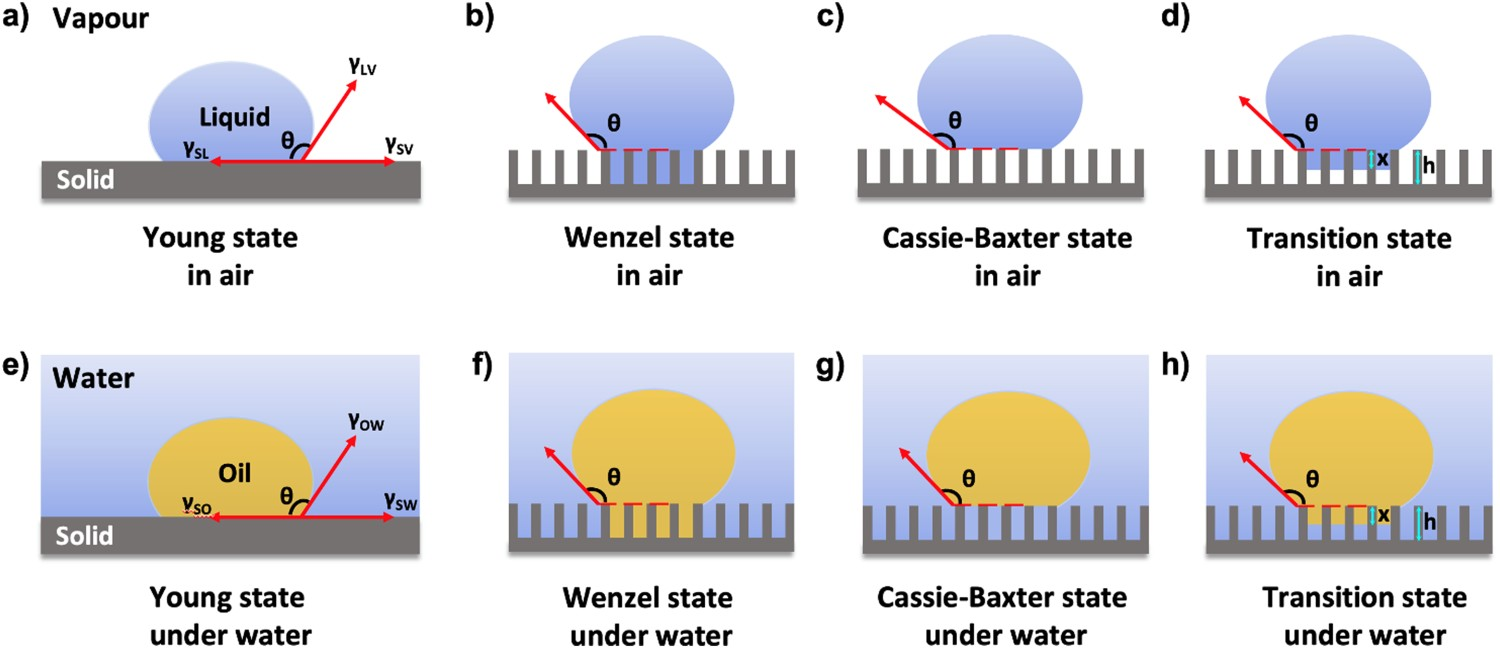




Fabrication methods and their main functions for bio-inspired surface.
Approach here means the main aim of a method: to manipulate the surface chemistry (marked as chemical) or topography
CA hysteresis
The CA predicted in Young’s equation assumes that the solid surface is flat, chemically uniform, and homogeneous [3,58,59]. As a droplet spread on a surface it should reach this static, equilibrium CA defined by the thermodynamic equilibrium state of the solid–liquid–gas three-phase system. The instantaneous CA formed at a moving solid–liquid–gas TPCL is called the dynamic CA and will depend on the speed of the contact line. However, the actual solid surface may be affected by various conditions such as roughness, inhomogeneous chemical composition, and contamination, and as a result the measured static CA may exhibit some hysteresis (CAH). The upper limit is the advancing CA (





The CAH is mainly caused by the adhesion between the droplet and the surface. For super-lyophobic surfaces (CA > 150°), four typical states for the CAH effect have been identified, namely the Wenzel state, the Cassie–Baxter state, the transition between Wenzel and Cassie–Baxter states, and the gecko state [153].
In the Wenzel state, droplets will be pinned to the surface, which will result in a large CA hysteresis and high adhesive force. However, in the Cassie state, there is an air layer between the droplet and the bottom of the surface grooves, droplets roll off easily, and the CA hysteresis is small (the ‘Lotus’ effect is regarded as a special case of the Cassie state). Among these two states, the SA can only reflect the CA hysteresis of the Cassie state, but not that Wenzel state (droplet pinning on the surface). However, even if some surfaces are in the Cassie state, high CA hysteresis (pinning state) will appear in a single micro or nanostructure, and the SA could not reflect the CA hysteresis in these conditions [9,154]. In addition, when a droplet contacts an actual sample, sometimes there will be a transition state between the Wenzel and Cassie states [155]. The special transitional state in which the droplet is in contact with the surface like a droplet on a red rose petal is called the ‘petal’ state [31]. Besides, researchers also found a gecko state, different from Cassie’s state that results in extremely high adhesion [156]. In the Cassie state, there is a connection between the external atmosphere and the gas pocket in the surface grooves (open state). However, for the ‘gecko’ state, there are two types of air pockets trapped in the polystyrene (PS) nanotubes: the completely closed-air pocket inside and the open-air pocket connected to the atmosphere [156]. The trapped air in the open-air pocket resulted in a higher CA, while the negative pressure provided by the sealed air in the closed-air pocket led to extremely high adhesion. To accurately study the adhesion between droplets and the superhydrophobic surfaces for this state, a highly sensitive microelectromechanical balance is needed rather than measuring the 

Adhesion & liquid behaviour
The movement of the droplet on a surface is determined by both the CA and the adhesion force. As mentioned in Section “CA Hysteresis”, a higher adhesion force could prevent liquids from leaving the surface, even if the surface is superhydrophobic. Therefore, understanding the complex adhesion behaviour of droplets on micro–nano structured surfaces aids in the understanding of their dynamic behaviour. We now review some of the adhesion forces caused by typical surface structures. Surface structure induced force to change surface adhesion property. (a) Capillary force for the non-smooth surface. (b) Laplace force for surface with geometry gradient. (c) Surface-energy gradient force for surfaces with hybrid structure. (d–f) concomitant retention force on moving liquid for surface with straight or oblique arrays.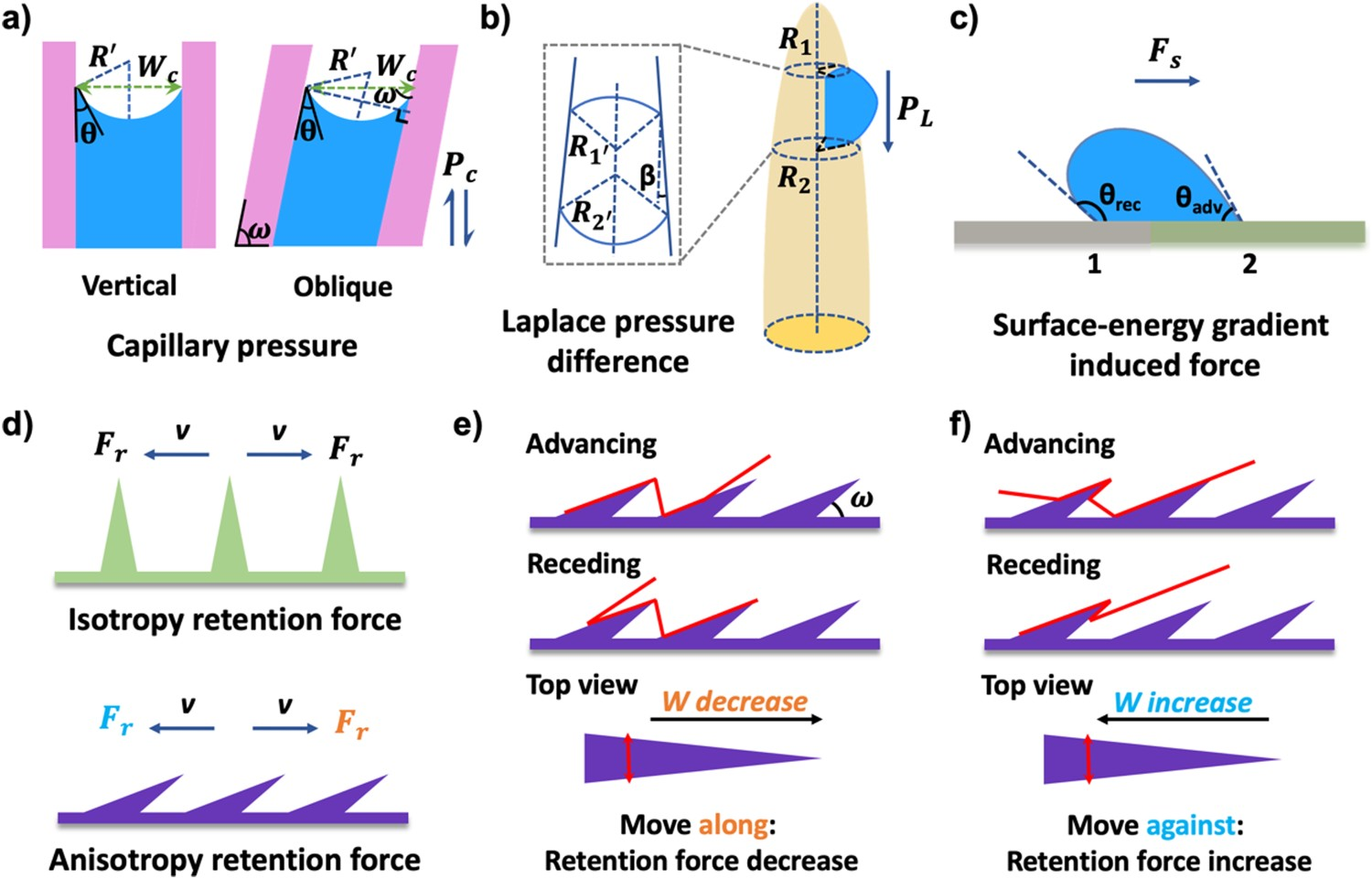
Droplets inside a micro/nano groove are subject to capillary pressure (


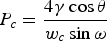


Droplets on a conical, spinous, or needle-like structure are also affected by Laplace pressure differences [87,88,161–163], as shown in Figure 3(b). It can be given by [164]:


Droplets on the surface of a hybrid structure (Figure 3(c)) or on the surface of a structure with varying roughness are affected by a surface-energy gradient [124,165–167]. The corresponding force (
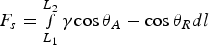


When the special structure and/or chemical composition appear in the parallel direction of the surface, the droplet dynamic on the surface is affected by the corresponding forces according to the same mechanisms. In addition, when a liquid moves on the surface, a concomitant retention force (



Scattered tiny droplets tend to coalesce, achieving higher kinetic energy which helps to overcome surface adhesion [170]. On the micro/nanostructured surface, the kinetic energy of a combined droplet (




Surface wetting properties characterisation
Sessile drop experiment (static CA)
The static CA measurement is used to characterise surface wettability. Generally, droplets with a volume of 2–5 μL are used to measure the CA. When the wettability of different surfaces is compared, the same volume of droplets must be used to make the measurement because the droplet volume and gravity will affect the measured CA.
Dynamic CA
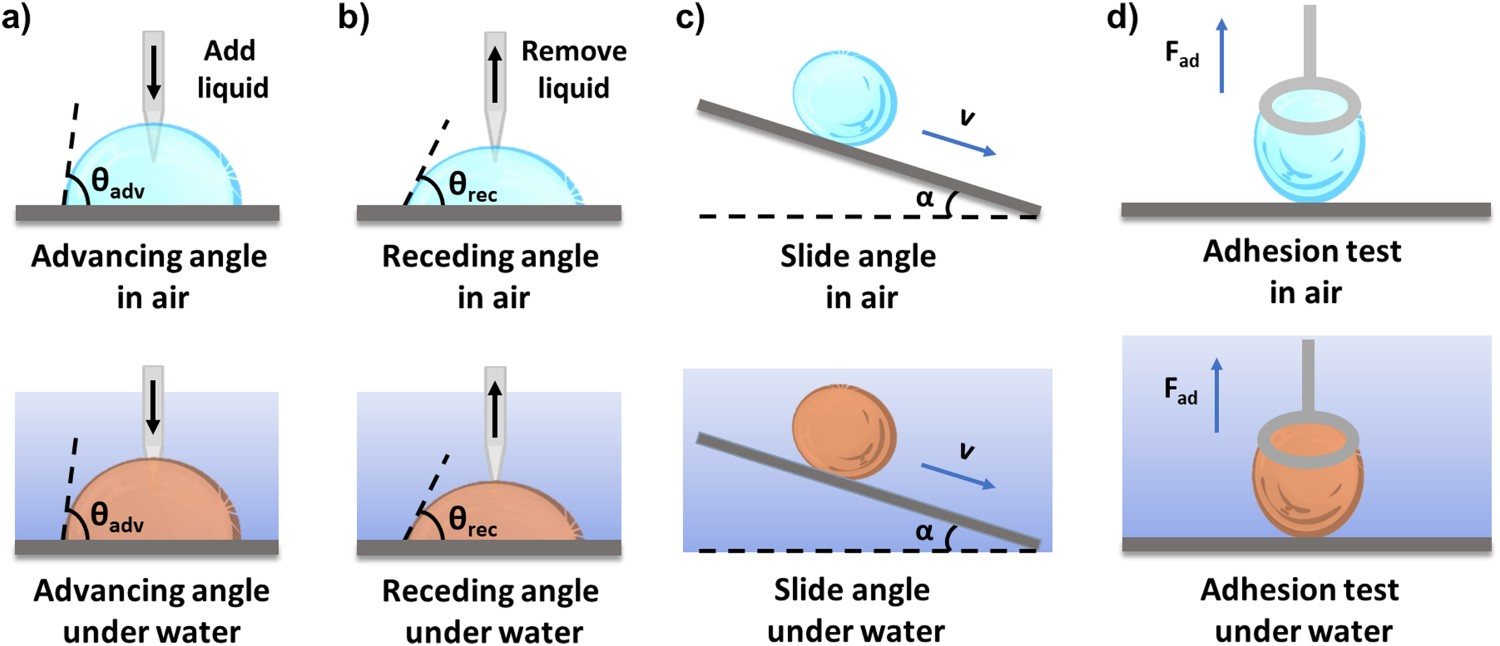
A series of methods have been developed to measure dynamic CA, including advancing & receding angle ( Test schematic diagram of the contact state between the droplet and the surface in different mediums. (a) Advancing angle measurement (in air/under water). (b) Receding angle measurement (in air/under water). (c) SA measurement (in air/under water). (d) Dynamic adhesion test (in air/under water).


Surfactant solutions can also be used as a probe to reflect CAH by measuring the CAs for droplets with/without surfactant, for different CAH surfaces the surfactant would have different effects on CA. McCarthy [174] and Ferrari [172] demonstrated that adding surfactant molecules in water can reduce the CA on some superhydrophobic surfaces which had high hysteresis; but for low CAH superhydrophobic surfaces, both pure water droplet and water droplet containing surfactant, the CAs are similar. McCarthy [173] also reported a method for measuring CAH by lowering the superhydrophobic surface onto the droplet and pressing/releasing multiple times.
Kwoun et al. used high-frequency shear acoustic waves generated by the thickness-shear mode (TSM) of piezoelectric quartz resonators to distinguish between superhydrophobic surfaces with similar CA but different CAH [177]. When the frequency range is 1–100 MHz, the penetration depth of the droplet is about dozens of nanometres to micrometres. As for superhydrophobic surfaces with low CAH, the water layer can only wet the top of the surface, making it difficult to penetrate into the grooves of the rough structure. Compared with the surfaces with large CAH, the harmonic frequency shift of the low CAH surface is much smaller. In terms of the measurement of CAH on non-planar surfaces, it can be achieved by moving the surface to contact water droplets hanging from a needle, such as a gold wire with a larger radius [178]. If there is almost no CAH, the water droplets will only move to one side of the gold wire, with a slight shape deformation. Conversely, if there is a large CAH, the water droplets will adhere to the surface and do not move.
Adhesive force
When a droplet can be completely removed from a surface, its adhesion with a surface can be measured using a high-sensitivity microelectromechanical balance (resolution of μN, Figure 4(d)) [19,35,179]. Usually, a copper cap is connected with a test droplet and attached to the balance, the surface of interest is moved toward the droplet at a constant rate until it makes contact. Subsequently, the substrate is moved downward and away from the droplet. The evolution of the force is recorded to obtain the adhesion between the droplet and the surface [180]. Jamali et al. also developed a method to test adhesion and relate it to CA hysteresis when the droplet could not leave the surface totally using magnets [181].
Natural examples
After millions of years of evolution, organisms have developed specific surface structures and chemistries that can adapt depending upon the environment (Figure 5). Based on the theory summarised in Sections “CA Hysteresis” and “Adhesion & Liquid Behaviour” and using the characterisation introduced in Section “Surface Wetting Properties Characterization”, researchers found that the surface adhesion properties of some organisms as well as the liquid behaviour on these surfaces are unique and diverse. For example, Sections “Superhydrophobic Low Adhesion (in Air)” and “Superhydrophobic High Adhesion (in Air)” summarise natural superhydrophobic surfaces with low or high adhesion, respectively. Section “Anisotropic Adhesion (in Air)” summarises different surface with anisotropic wettability or/and adhesion properties which realise diverse transport modes of liquids. Section “Superoleophobic Low Adhesion (under Water)” introduces the underwater superoleophobic low adhesion surfaces. Photographs and surface microstructures of natural examples of special-adhesion surface: (a–b) Low adhesion superhydrophobic surfaces: (a) Upper side of the lotus leaf. Reproduced with permission [182]. Copyright 2008, The Royal Society. Reproduced with permission [183]. Copyright 2016, Elsevier Ltd. (b) Nepenthes. Reproduced with permission [28]. Copyright 2016, Springer Nature. (c) Superhydrophobic and superoleophobic low adhesion surface: springtail. Reproduced with permission [184]. Copyright 2018, AAAS. (d–e) High adhesion superhydrophobic surfaces: (d) Rose petal. Reproduced with permission [31]. Copyright 2008, American Chemical Society. (e) Salvinia. Reproduced with permission [185]. Copyright 2010, Wiley-VCH. (f–h) Anisotropic adhesion surfaces: (f) Butterfly wing. Reproduced with permission [30]. Copyright 2007, The Royal Society. (g) Ryegrass leaf. Reproduced with permission [186]. Copyright 2012, The Royal Society. (h) Pine needle. Reproduced with permission [187]. Copyright 2019, Elsevier Ltd. (i–l) Underwater superoleophobic low adhesion surfaces: (i) Lower side of the lotus leaf. Reproduced with permission [74]. Copyright 2011, The Royal Society. (j) Clam shell; Reproduced with permission [179,188]. Copyright 2012, 2016, Wiley-VCH. (k) Seaweed. Reproduced with permission [189]. Copyright 2015, Wiley-VCH. (l) Filefish. Reproduced with permission [190]. Copyright 2014, Wiley-VCH.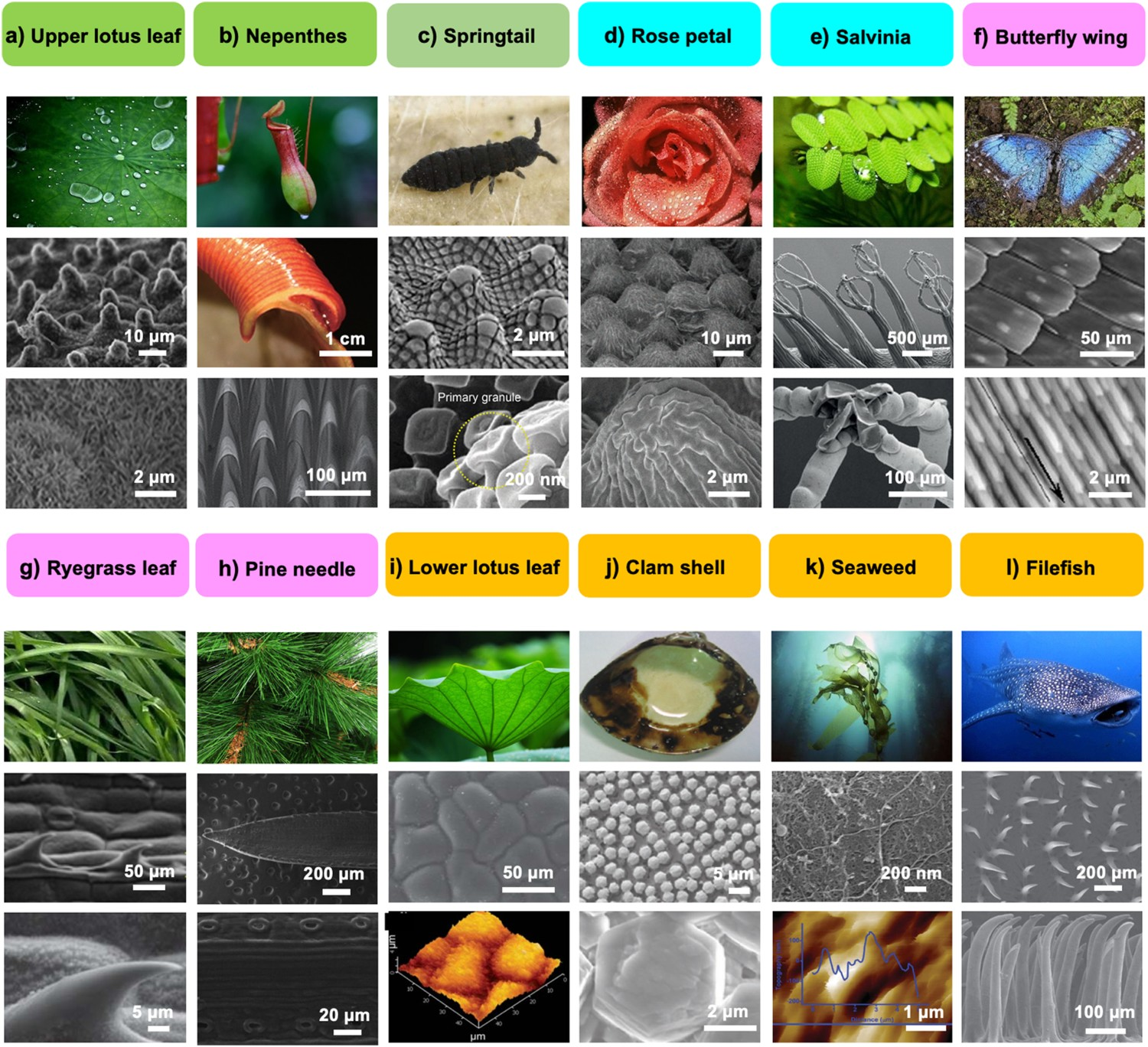
Superhydrophobic low adhesion (in air)
Superhydrophobicity results from the surface micro/nanostructure and is usually accompanied by low droplet adhesion. For example, researchers reported that the WCA on lotus leaves is around 160°, and the water sliding angle (WSA) is around 5°; the adhesive force is much lower than on other biological surfaces [9,182,183]. Hydrophobic epicuticular waxes were first proposed as the cause of the low water adhesion and superhydrophobic properties of lotus leaves [191]. However, it was suggested that the combination of roughness at multiple length scales from the micro to the nano levels is the reason behind this performance as many other waxed surfaces without a similar rough structure do not have this ability [182,192]. As shown in Figure 5(a), the surface is densely covered with micro papillae arrays formed by nanowires. It was concluded that these arrays contribute to the superhydrophobicity of the lotus leaves, and the nanowire structure causes super-low adhesion [183,193].
Apart from the micro/nanostructure, the chemical composition also affects surface hydrophobicity. Researchers found that Nepenthes have low adhesion surfaces, different from the lotus leaves [194–197]. As shown in Figure 5(b), Nepenthes have a lubricant-induced slippery surface of their peristomes at which striped micro-grooves with arch-shaped edges are densely distributed [28]. The surface is fully infused with a self-contained lubricating liquid, which is the main reason for the low adhesion [26,34,194]. It was also reported that the unique complex structure of peristomes may well cause superhydrophobicity while preventing the scape of preys or droplet backflow, and avoiding draining of lubricant to maintain the slippery, low adhesion surface [28,198,199].
In addition, some natural surfaces were found to be super-amphiphobic (i.e. not only superhydrophobic but also superoleophobic) or so-called super-omniphobic (i.e. repellent to all liquids) in air. For example, springtails, living in a humid and humid environment, show a strong ability to avoid being wetted by either water or some liquids with low surface tension (e.g. surfactant or oil) [200,201]. As shown in Figure 5(c), the cuticle of springtail has a re-entrant micro/nanostructure composed of densely distributed hexagon or rhombus nano arrays [184]. This structure can maintain an air layer to prevent wetting by either aqueous or oil-based liquids, which is the main reason for its repellency [184,202].
Superhydrophobic high adhesion (in air)
The micro/nano-structures could not only promote hydrophobicity, but their shapes play an important role in surface adhesion. For example, it was reported that WCA on the red rose petal is around 152°, but water droplets adhered to the petal surface even when it is turned upside down [31]. This combination of superhydrophobic with high adhesion is called the (rose) petal effect [203–206]. The dense micro papillae arrays are deemed as the reason for the superhydrophobicity, and the nano creases where air pockets can be retained give rise to the high adhesion (Figure 5(d)) [31,207]. Peanut leaves were found to have a similar structure leading to a combination of superhydrophobicity with high adhesion [208,209].
In contrast to the previous examples, Salvinia Molesta has a superhydrophobic sticky surface due to the discrete chemical composition of the microstructure. As shown in Figure 5(e), the surface contains unique pillar arrays. The pillars are 2 mm high with hairs on top (Figure 5(e)), resembling an eggbeater [185,210]. The pillars are covered with hydrophobic wax crystals while the hairs are wax-free. The micro array structure together with the hydrophobicity of each pillar contributes to the superhydrophobicity of the entire leaf. The hydrophilic hairs on the top promote adhesion [211,212]. Tiny water droplets on Salvinia leaves exhibit spherical shapes and are pinned on the surface. The phenomenon of a functional entity based on a wettability gradient is now known as the Salvinia paradox [185,213–215].
Anisotropic adhesion (in air)
The anisotropy of the micro and nanopatterns plays another important role in surface adhesion. For example, butterfly wings have a direction-dependent hierarchical arrangement of micro-scales, nano-stripes, and nano-tips, as shown in Figure 5(f). These hierarchical structures generate superhydrophobicity (WCA = 150°–154°) [30,216]. Furthermore, the direction-dependent arrangement contributes to an anisotropic adhesion [170,217]. The measured outwards WSA was 10°, but the droplet was pinned on the wing when the inwards SA was tested [30]. It was suggested that such an anisotropic adhesion might be caused by the difference between the discontinuous TPCL of droplets moving outwards and the quasi-continuous TPCL of droplets moving inwards [30,170,218–220]. Similar oriented striped microstructures (micro-grooves) were also found on rice and other plant leaves [28,221–223]. Oriented nano-stripes with nano-tips are also present on goose feathers and other animal feathers [224–226]. All of them exhibit anisotropic adhesion that enables the movement of droplets in prescribed directions.
Another type of superhydrophobic anisotropic surface, common in some plants, contains oblique arrays [227–229]. For example, oblique micro thorn arrays were found in the ryegrass leaves (Figure 5(g)), and the thorns are at an angle of ∼25° to the surface. The WSA towards the end of the ryegrass leaf (towards the oblique direction of thorn) is around 12° while towards the opposite direction is around 26° [186]. Water droplets moving against the oblique direction will be pinned while droplets moving along will be accelerated [186,227,230]. This resulting anisotropic adhesion promotes directional droplet movement.
The combination of a groove structure with conical shape could realise another mode of liquid transport. For example, the entire geometry of pine needles (Figure 5(h)) or some cactus plants is conical, with some directional micro-groove structure [161,187]. Liquid could move unidirectionally along the microchannel formed by the grooves, driven by Laplace pressure and surface-energy gradients as analysed in Section “Surface Wetting Properties Characterisation”.
Superoleophobic low adhesion (under water)
Through an in-depth study of the underwater superoleophobic surface in nature, scientists have concluded that hydrophilic chemical composition and the designing of the micro–nano composite rough surface structure are the key factors to construct an underwater superoleophobic surface. The lotus leaves from silt without dyeing not only because of the superhydrophobicity and self-cleaning effect on its upper surface, but also for its underwater superoleophobicity (OCA = 155.0 ± 1.5°, 1,2-dichloroethane), and the ability to resist oil adhesion (OSA = 12.1 ± 2.4°, 1,2-dichloroethane) [74]. The lower surface of the lotus leaf is mainly composed of flat protrusions with a length of 30–50 μm, a width of 10–30 μm, and a height of 4 μm. The micro protrusion is further covered with nano grooves with a size of 200–500 nm. Their combination forms a hierarchical surface structure with micro/nano roughness (Figure 5(i)). In addition, there is no crystalline wax layer coating on the lower surface of lotus leaf, and it is replaced by a layer of hydrophilic material, so that water can be embedded inside the rough structure, thereby preventing oil droplets from infiltrating the surface, and ultimately achieving superoleophobic, low oil adhesion [74,231]. Similar structures and chemistries can also be found on clam shells (Figure 5(j)) [179,188], fish scales [25,232], shrimp shells [233,234] and seaweed (Figure 5(k)) [235,236]. These organisms also exhibit superoleophobicity and ultra-low oil adhesion under water.
The morphology of the surface microstructure could also determine the rolling direction of the oil droplets. When the Navodon Septentrionalis filefish swims in oil-contaminated waters, the oil droplets slide across its skin without sticking to it [190,237]. This is mainly because its skin not only contains a lot of high surface-energy organic substances such as collagen but it is covered with a layer of hook-shaped spines with the hooks aligned in specific directions (Figure 5(l)). This layer of closely aligned directional spines increases the surface roughness of the skin, thus making the skin superoleophobic and with low adhesion to oil [190]. Furthermore, the unidirectional movement of the oil droplets directed by the hook-shaped spines results in a directional self-cleaning ability in oil sewage to prevent the oil from accumulating on the head of the fish [32,238].
Fabrication of bio-inspired surfaces
The above sections have highlighted the link between droplet-surface adhesion and the micro/nanostructure or chemical composition of the surface. This section summarises typical methods to fabricate bio-inspired surfaces with special-adhesion properties, including both chemical and physical methods and their combination, which mimic the structural features or performance of the biological surface. As shown in Table 2, these methods can modify the chemical properties of the surface, can alter the surface roughness, can grow/deposit micro/nano-structures on the surface of the substrate, and/or can directly mimic the entire structure of the biological surface.
Many of the techniques listed in Table 2 have been the subject of surface pre-treatment reviews and will not be discussed further here. However, the new and rapidly evolving manufacturing technology of 3D printing has opened up many exciting possibilities in this field, and as the resolution of this manufacturing technique improves, so will its ability to mimic complex and intricate natural surfaces.
Bio-inspired switchable-adhesion surfaces
Inspired by the special biological surfaces introduced in Section “Natural Examples” and using the methods mentioned in Section “Fabrication of Bio-inspired Surfaces”, researchers have developed a large number of ‘smart’ surfaces which could switch their surface chemistry or micro/nanostructure in response to different external stimuli (Figure 6), e.g. mechanical stretching, magnetic fields, temperature, light, electric potential and pH. This switching can induce the switching of surface adhesion, leading to switchable liquid behaviour on surface. The various external stimuli of bio-inspired controllable adhesive surfaces.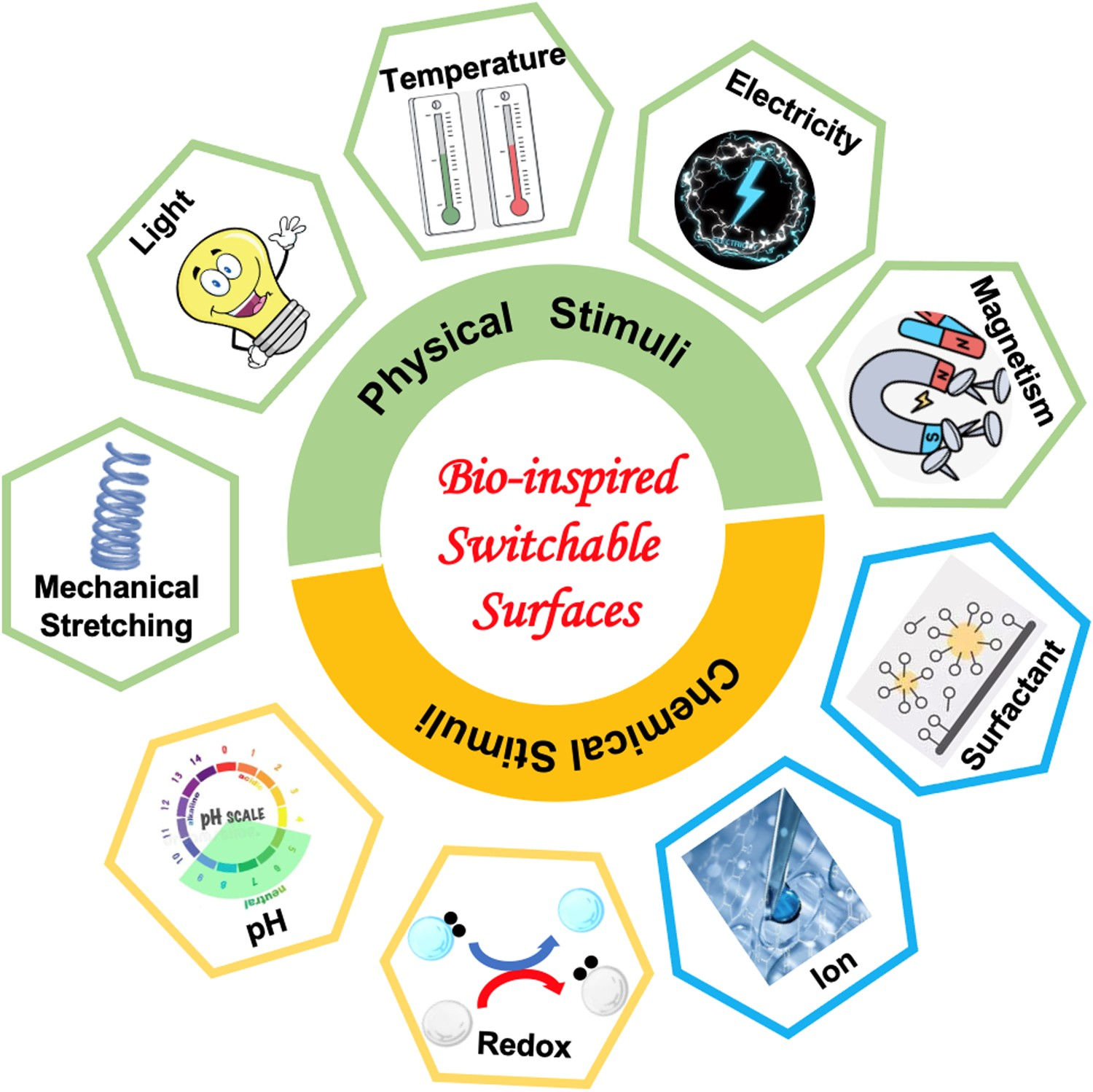
Bio-inspired and artificial strategies to control surface wetting.
Use stimuli to manipulate the liquid behaviour by controlling the interaction between the liquid and the environmental phase.
Applications
The special surfaces introduced in this review, including atmospheric or underwater super-lyophobic low/high adhesion surfaces, anisotropic surfaces, and artificial switchable-adhesion surfaces, have diverse applications. The advantages and challenges for each functional surface are summarised in Table 5. Typical applications involve droplet manipulation, oil/water separation, self-cleaning, anti-bioadhesion, anti-corrosion, drag reduction, anti-icing, anti-oil coating (Figure 7). Various applications of bio-inspired controllable adhesive surfaces, such as oil/water separation, self-cleaning, anti-bioadhesion, anti-corrosion, drag reduction, anti-icing, anti-oil coating, and energy conversion. Usage of special-adhesion surfaces.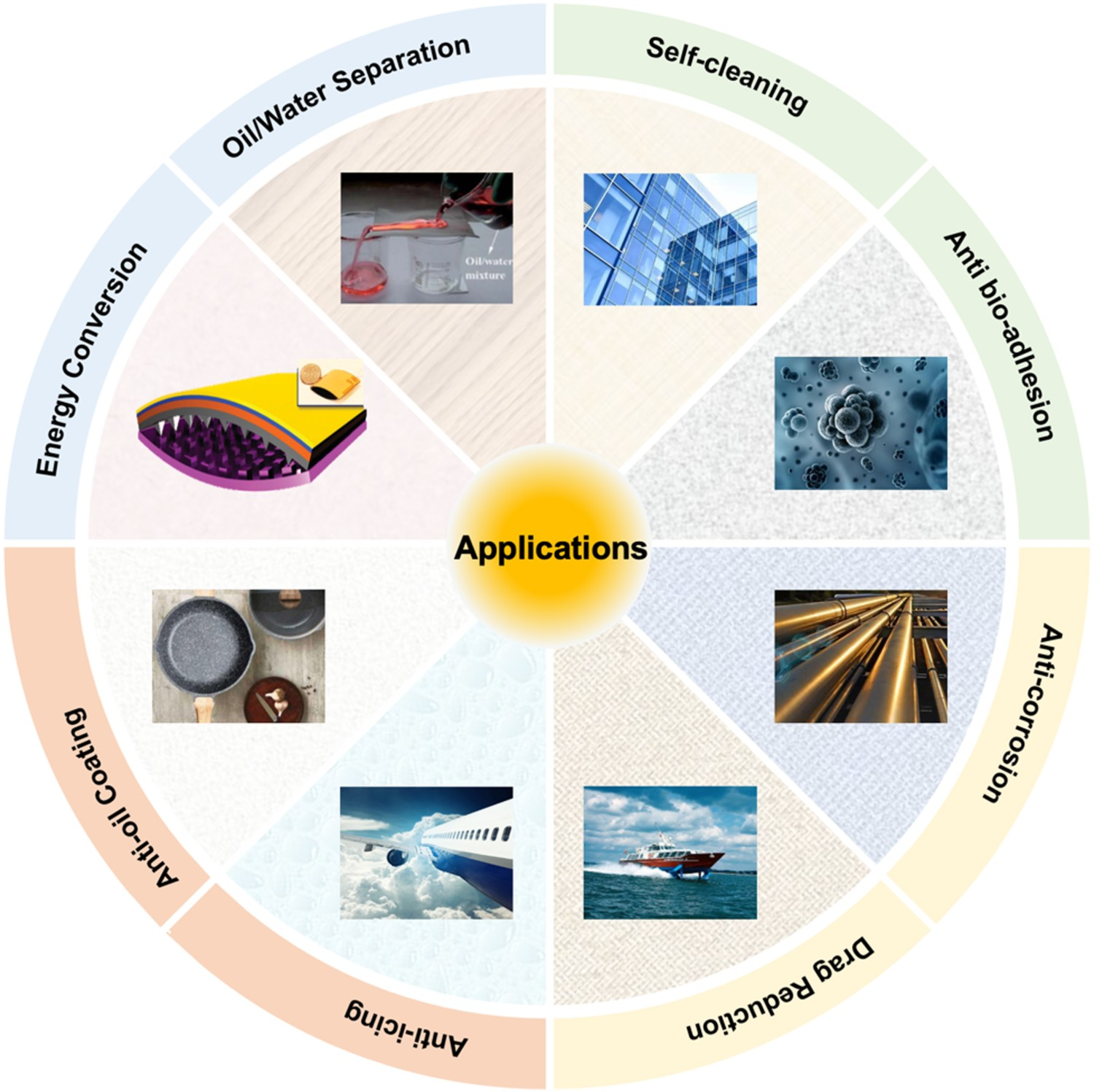
Conclusions and perspectives
This review has systematically evaluated the research progress in the field of liquid behaviour on special-adhesion surfaces: from biological surfaces exhibiting different liquid adhesion to artificial surfaces with switchable adhesion, and from the basic principles to the latest developments and practical applications. During the past decades, researchers have mimicked nature to construct surfaces on which the liquid behaviour can be regulated, and have successfully demonstrated various applications in the fields of, for example, biomedicine, aerospace and marine engineering.
However, surface wetting is a complex issue involving many variables. Existing traditional theories and concepts are not sufficient to explain some emerging surface wetting phenomena, especially the wetting and adhesion at the molecular or even atomic level. Although the existing composite wetting model for rough surfaces can explain the static wetting behaviour of droplets on the surface, it is still difficult to quantify the dynamic behaviour of droplets. For example, we can qualitatively know that the surfaces described using the Cassie wetting model usually exhibit smaller CA hysteresis when compared to the ones described by the Wenzel model. However, none of the existing theories or concepts can quantify the relationship between different composite wetting models and CA hysteresis. Therefore, further exploration is required to develop new theories and concepts to explain the dynamic wetting phenomenon of complex surfaces and extend it into the field of dynamic droplet fluidity on multi-scale structured surfaces.
To promote the practical application of special-adhesion surfaces in real life, more fundamental research is needed. So far, most of the research on surface wetting has been carried out at room temperature and atmospheric pressure, while the research on special wetting systems under extreme conditions is still far from comprehensive. However, special wetting systems under extreme conditions often show unexpected phenomena. For example, the water droplets would bounce off the superhydrophobic surface if the environmental pressure decreases [337]. Therefore, the study of the dynamic wetting behaviour of droplets on the surface under extreme conditions will become the focus of interface science and nanotechnology, including the study of dynamic wettability under ultra-low (ultra-high) temperatures and pressures. And we also need to expand the droplets in the composite wetting system from water to liquid nitrogen, liquid metals, ionic liquids and non-Newtonian liquids. In addition, in-depth research on wettability of the composite systems in different atmospheres such as hydrogen, methane, oxygen or carbon dioxide is needed to overcome the challenges faced in the fields of catalysis and fuel cells. Of particular interest are the emerging applications of special wetting surfaces in the field of energy generation that have been proposed in the last three years. Superhydrophobic or superhydrophilic surfaces are found to be useful in the development of devices to convert liquids with high mechanical, thermal, or chemical energy into a source of usable energy. On a personal note, well-designed anisotropic or switchable surfaces may contribute to improved performance in these emerging applications, and no doubt these will be extensively studied in the future.
Researchers also need to solve the challenges faced in industrial applications. As summarised in Table 5, the progress and challenges of diverse functional surfaces differ. Generally, large-scale manufacturing methods to build functional special-adhesion surfaces should be improved. Most of the existing preparation methods are limited to laboratory scale or face great challenges in their translation to the industrial environment. Researchers urgently need to develop some simple, efficient, and low-cost fabrication methods. The time and energy consumption as well as the environmental pollution should also be considered. Besides, the mechanical properties, chemical durability and stability of artificial materials should be studied and further improved to expand their practical application [338].
Learning from nature remains a principle for designing and manufacturing unique surfaces. In contrast to artificial materials, organisms can spontaneously rebuild their surfaces to regain their original structure and wetting performance when damaged. Thus, building artificial surfaces with self-healing functions is another important area of research, since solving these problems will pave the way for the practical application of special-adhesion surfaces. On the other hand, how to effectively use special wetting surfaces to overcome a series of challenges faced in important industrial applications also requires further research, e.g. reducing the deposition of liquids on superhydrophobic surfaces, realising the separation of miscible organic liquids, promoting the separation of droplets on the surface, anti-icing engineering, realising green and efficient catalytic reactions, and improving the efficiency of pesticide spraying [339]. We also expect to see the development of new concepts and new ideas related to special wetting systems. There are many unique wetting phenomena in nature, and researchers can develop novel materials by understanding the main mechanisms behind these interesting wetting phenomena.
Footnotes
Ming Li and Chang Li conceived, designed, and executed this project, they contribute equally to this work. Professor Eduardo Saiz and Professor Bamber R.K. Blackman helped revise the content of the article and provide many useful ideas. We thank Professor Lei Jiang, and Dr. Xiqi Zhang (Technical Institute of Physics and Chemistry, Chinese Academy of Sciences) for their professional comments and selfless dedication for this work.
Disclosure statement
No potential conflict of interest was reported by the author(s).
