




Abstract
A limb amputation is a traumatic experience for the amputee but it is also a challenge for the recipient to get used to a new situation and reach her/his greatest level of independence. Two patients are presented who had undergone a total calcanectomy. In the first case, a woman with spina bifida aperta L4-L5, calcanectomy was performed to excise a non-healing ulcer and osteomyelitis of the right heel. In the second case, a woman of 72 years of age, calcanectomy was the treatment of the isolated central chondrosarcoma. Both patients were somewhat disabled prior to calcanectomy, one because of spina bifida aperta and the other because of her age. After calcanectomy both patients were able to remain independent for several years. Calcanectomy is an uncommon amputation that may provide better quality of life than other more proximal amputations such as Syme or transtibial amputation. Furthermore more proximal levels of amputation are associated with increased mortality and morbidity. When indicated, calcanectomy should be considered as an alternative type of amputation which provides an effective chance to maintain the patient's independency.
Keywords
Introduction
In industrial countries transtibial amputations represent 47% and foot amputations (Syme to transmetatarsal level) represent 6% of all lower limb amputations.1 The reason for amputation is vascular diseases in 94% of the cases. Trauma and oncology each represent 3% of the reasons to amputate.1
A transtibial amputation has disadvantages compared to a (partial) foot amputation, such as the loss of length or the higher level of energy consumption. In some cases a calcanectomy should be considered. Calcanectomy was first described in 1931 to treat osteomyelitis of the calcaneus.2 The indications for a calcanectomy are osteomyelitis of the calcaneus, intractable ulceration of the heel, deformity of the calcaneus after a severe intra-articular fracture and primary tumours of the calcaneus.3 Data concerning epidemiology of calcanectomy is lacking.
Total resection of the calcaneus is a relatively unknown procedure with a good functional outcome.3-6 Sometimes an allograft replacement after total calcanectomy is performed in order to improve the functional outcome.7
Benefits of calcanectomy include maintenance of ambulatory status and quality of life, additionally calcanectomy does not alter the next step in the treatment algorithm, which is Syme amputation or transtibial amputation.3,7
The purpose of this report is to present the surgical and functional result of two total calcanectomy procedures as alternatives to transtibial amputation for a non-healing fistula and a chondrosarcoma, both heel sited. Both patients gave written informed consent. The local ethics committee does not require ethical approval for case studies.
Case report
Case 1
A 54-year-old woman born with spina bifida aperta (L4-L5) which was closed a few days after birth presented an ulcer of her right heel. Despite her spina bifida she could walk with a rollator, wearing orthopaedic shoes, for more than 30 min. In 1996 the ulcer was excised from her right heel, after which a fistula existed for more than six years which was not treatable with antibiotics and several plastic surgical reconstructions. Osteomyelitis of the calcaneus developed and transtibial amputation was initially proposed by the orthopaedic surgeon. From 1996 to 2002 the patient was mainly wheelchair-bound. The Spina Bifida multidisciplinary working group, University Medical Center Groningen (UMCG) discussed the suggestion of a transtibial amputation. The possibility of walking was much reduced by paresis of several lower limb muscles. A calcanectomy was suggested, agreed upon and performed in 2002. The recovery period was several months due to wound complications. Since the calcanectomy there were no ulcer recurrences. Currently she is walking again, in and around the house, using a rollator and orthopaedic shoes with an insole for periods of 15 min. She is very satisfied with her current ability to walk which probably would have been lost after a transtibial amputation.
Case 2
A 72-year-old woman came to the hospital in 2001 with a lateral swelling of her right heel. Radiographs showed a lytic lesion with a diameter of 4 cm in the calcaneus with cortical erosion. Computerized tomography suggested soft tissue invasion. Bone scintigraphy revealed a solitary hot spot in the right calcaneus. Chest X-rays were normal. A bone biopsy was performed confirming the suspicion of a chondrosarcoma, histological grade I-II. The first surgical option of the surgeon was transtibial amputation but the orthopaedic surgeon at UMCG who saw the patient for a second opinion proposed a calcanectomy. This procedure was agreed upon by the regional Bone Tumour Board. The calcanectomy was performed and recovery was uneventful. The patient was able to walk using a custom-made orthopaedic shoe and no walking support was needed. During the first two years after the operation she was able to walk for one hour. Three years after calcanectomy bone scintigraphy and X-rays showed no signs of a local recurrence or metastases (Figure 1). Maximal walking time had gradually reduced to 30 min. She experienced some pain due to progressive degeneration of the talonavicular joint of the involved foot.
Currently, six years after the calcanectomy the walking time is about 20 min due to comorbidity. She continues to be very satisfied and wears orthopaedic shoes with a special adapted insole to compensate the leg length difference due to calcanectomy. She walks with a crutch in and around the house and uses a rollator if she walks for more than 15 min. She can walk short distances barefoot in home. The outcome in terms walking ability would have been worse than it is currently if the surgeon had chosen transtibial amputation.
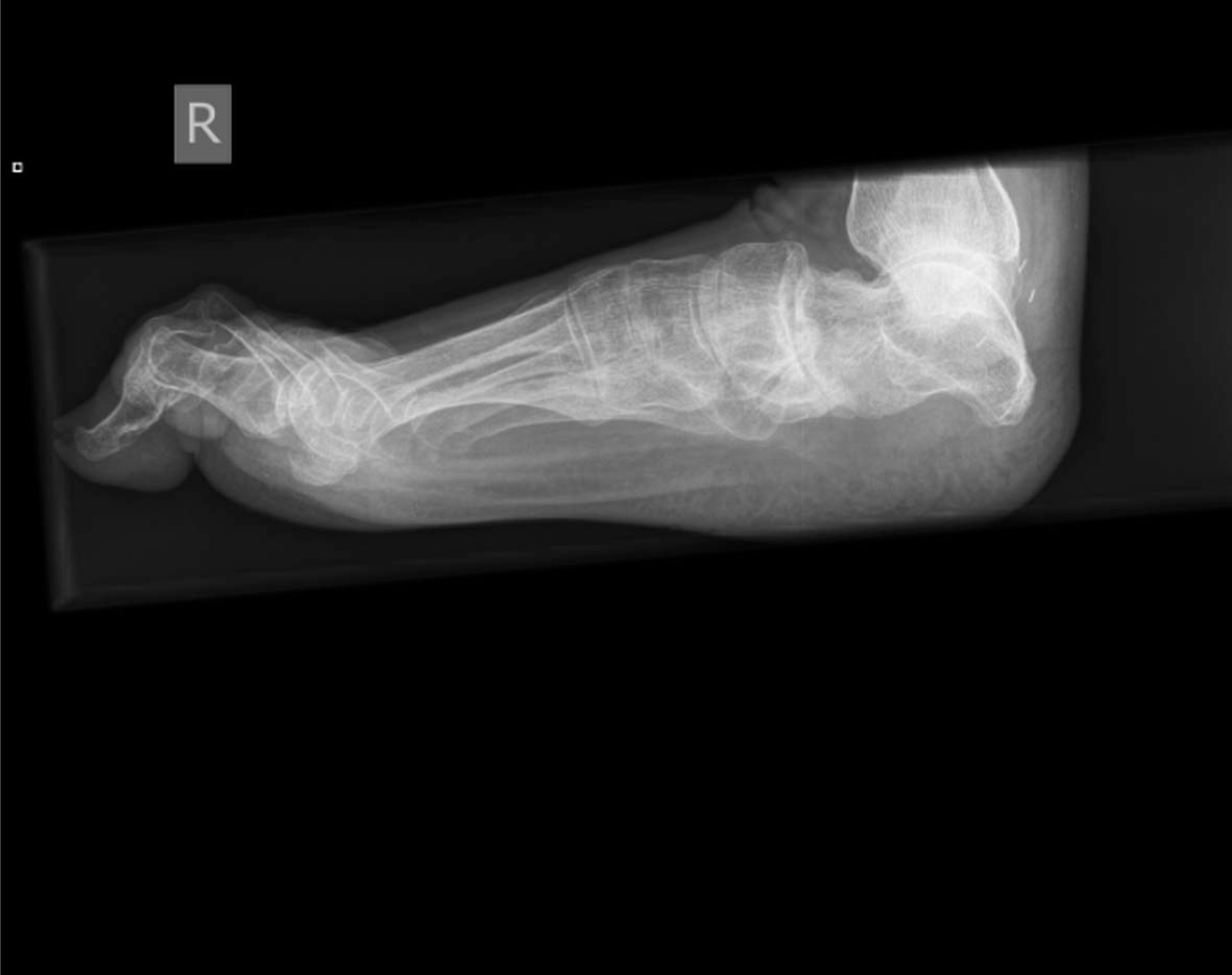
Status after total calcanectomy in Case 2.
Discussion
Calcanectomy is presented as a limb salvage procedure that may provide a better quality of life than transtibial amputation. The few reports concerning calcanectomy are mainly about diabetic or dysvascular patients with untreatable wounds of the feet.
The foot is a rare site for primary and secondary bone neoplasm (<1% of all tumours of the locomotor system).8 If the tumour is solely located in the calcaneus a calcanectomy is an option to be considered.
The more proximal levels of amputation than calcanectomy are associated with increased mortality, morbidity and increased energy demands.3,9 The survival rate after lower limb amputation is poorer with increasing age.9
In some cases a partial calcanectomy can be performed instead of a total calcanectomy to preserve some of the connecting ligaments resulting in a more stable and functional foot.3 Calcanectomy ensures walking ability (barefoot walking; toileting in the night) by preserving most of the leg length. An insole in the (customized) shoe may be needed to keep same leg length and provide independent function.3,6,10 The total contact inlay must be built up with proper lifting of the heel region to compensate the leg discrepancy, a sufficient buffer heel and with support of the talus. The orthopaedic shoe must have sufficient depth and height to enclose this insole.
After calcanectomy normal weight-bearing is possible with or without an orthopaedic shoe for small distance walking but for long distances orthopaedic shoes (with insoles) are necessary to prevent wounds.6 Although patients present a slight weakness in plantar flexion due to the sub-optimal lever arm after reinsertion of the triceps surae in the dorsal talar region, it is still enough to allow walking barefoot for a short distance.5,6 Most patients have no or mild pain after calcanectomy.6,10 Complications are cosmetic deformity (Figure 2), ulceration of the skin, talonavicular subluxation and other late developing additional deformities.6,7 In the cases presented, the outcome is compromised by neurological deficits in one case and morbidity and age in the other.
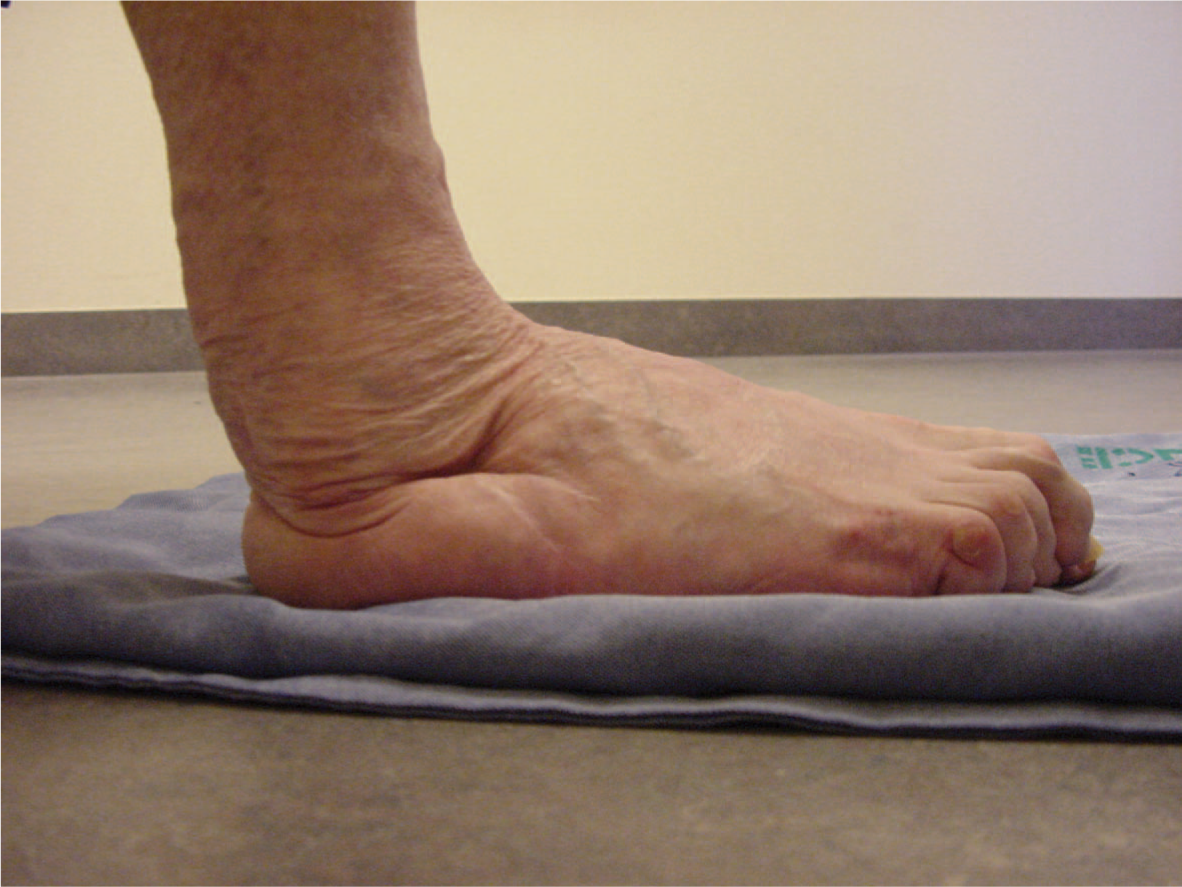
Cosmetic appearance after total calcanectomy in Case 2.
Both cases presented limitations in walking distances, but both have retained their independency without the need for a prosthesis. With the right indication calcanectomy should be considered as an alternative for Syme or transtibial amputations.