




Abstract
Introduction
There are many boundaries in society. There are geological boundaries, cultural boundaries, national boundaries and others. For persons with disabilities, there are other types of boundaries, such as physical, informational and social boundaries. They may be called barriers. In this paper, I define boundaries as barriers which prevent persons with disabilities from accessing and enjoying services, information and activities in the society in which they live.
In December 2006, the United Nations General Assembly adopted the International Convention on the Rights of Persons with Disabilities. This highlights the recent achievement of disability movements which have strived to move social boundaries for persons with disabilities, so that their human rights will be protected.
This paper first reviews the types and the nature of barriers that persons with disabilities face every day, and changing definitions of disability from the perspectives of medicine to social inclusion. The section also discusses the recently adopted International Convention on the Rights of Persons with Disabilities and its implications for future development in the field of disability. Second, the paper discusses an emerging trend to include disability in the field of international cooperation and development. This will particularly ensure moving social boundaries for persons with disabilities in developing countries. The section reviews activities of new players, including multilateral and bi-lateral development banks such as the World Bank, Inter-American Development Bank (IDB), as well as US Agency for International Development (USAID), in their efforts to include disability issues into their activities, as part of achieving the millennium development goals adopted at the World Millennium Summit in 2000.
This paper concludes by pointing out a concern of imposing a simplified rights-based approach being promoted by north-based rights organizations and suggests that the voices of the very poor persons with disabilities in the south and involvement of the community be promoted. This paper also suggests a comprehensive approach rather than a piecemeal approach to disability issues, focusing on rehabilitation, including provision of assistive devices, accessible physical environments and awareness-raising. The approach has been suggested by David Wiener.
What are social boundaries?
As mentioned earlier, social boundaries for persons with disabilities in this paper are defined as social barriers. Generally, four types of barriers are recognized: Physical barriers, Information barriers, Institutional barriers, and Attitudinal barriers.
Physical barriers include inaccessible built environments (steps, toilets, narrow passages, etc.), as well as inaccessible public transportations, including buses, railways, airplanes, etc. Persons with sensory or cognitive disabilities have difficulty in accessing vital information and in communicating with others. Blind persons and deaf persons need special considerations such as translation of printed materials into Braille or an accessible digital format for blind persons, and provision of sign language interpretation for deaf persons. In recent years, Internet accessibility has been an urgent issue particularly for blind persons.
Public laws, rules and regulations often restrict educational and training as well as employment opportunities for persons with disabilities. Some qualification clauses of laws in many countries prevent persons with certain disabilities from obtaining qualifications and licenses because of their disabilities. For example, until recently, a Japanese law did not permit a deaf person to become a pharmacist. Some developing countries still do not permit persons with disabilities to obtain a driving license.
Attitudinal barriers are most common and difficult to redress. In many countries disability is considered as stigma (a curse from ancestors). Persons with disabilities have been perceived as having no ability, and being asexual. Particularly for persons with intellectual disabilities or psychiatric disabilities, prejudice and discrimination are major obstacles for them to fully participate in society. In Japan, about 330,000 persons with psychiatric or psychological disabilities are confined to hospitals. Among them approximately 72,000 have no symptoms, but still stay in hospitals. This phenomenon is commonly called ‘social hospitalization’ in Japan. This means that even though medical symptoms have disappeared, past patients are kept in a hospital, as there is no place for them in the community. It is still common that domestic and international airlines restrict or deny persons with disabilities from boarding airplanes because of their disabilities.
Now, how could these boundaries or barriers for persons with disabilities be moved? I would like to review a brief history of changing perception towards these barriers through changing definitions of disability.
Changing definitions of disability
The effects of social barriers on persons with disabilities have been increasingly recognized, as the definitions of disability have changed over the years. In 1980, the World Health Organization (WHO) issued the international classification of impairment, disability and handicap (ICIDH), which viewed disability from three different dimensions, namely impairment, disability and handicap. This classification for the first time recognized the importance of the relationship between an individual and the environment where she/he lives. However, this classification was still considered medically oriented by persons with disabilities and they insisted on modifications to include environment as an important factor. Meanwhile, two distinctive models to describe disability emerged. They are a medical model and a social model.
They were defined as follows (WHO 2002): The medical model views disability as a feature of the person, directly caused by disease, trauma or other health condition, which requires medical care provided in the form of individual treatment by professionals. Disability, on this model, calls for medical or other treatment or intervention, to ‘correct’ the problem with the individual. The social model of disability sees disability as a socially created problem and not at all an attribute of an individual. On this model, disability demands a political response, since the problem is created by an unaccommodating physical environment brought about by attitudes and other features of the social environment.
As defined above, the medical model is based on the traditional thinking of disability, whereas the social model emerged from the disability consumer movement following the theoretical work of disability researchers in the UK and the independent movement in the USA during the 1970s. The international disability consumer movement established a slogan ‘nothing about us without us’ to claim its leadership in disability-related fields. The movement had reached its height when the disability rights convention was adopted by the United Nations General Assembly in December 2006.
In 2002 WHO came up with the updated version of its ICIDH. It was named the International Classification of Functioning (ICF). ICF is defined as follows: Disability is a complex phenomena that is both a problem at the level of a person's body, and a complex and primarily social phenomena. Disability is always an interaction between features of the person and features of the overall context in which the person lives, but some aspects of disability are almost entirely internal to the person, while other aspects are almost entirely external. (WHO 2002)
ICF is based on the Biopsychosocial model, an integration of medical and social models. ICF provides, by this synthesis, a coherent view of different perspectives of health: Biological, individual and social. ICF is expected to provide a common language for consumers, researchers, and professionals in health, disability and other fields.
We have seen the changing of definitions of disability. The traditional medical model has been challenged by the emerging social model which is advocated by the disability movement. Eventually, the two models have been integrated into the new model which embraces the characteristics of the both models. Under these changes, we need to recognize the increasing presence of the international disability consumer movement since 1980. This movement reached its height when the United Nations General Assembly adopted the Convention on the Rights of Persons with Disability in December 2006. The following section covers a rights-based approach towards disability.
Rights-based approach under the initiative of the United Nations
Until the 1960s, disability issues had been basically a charitable issue, as well as medical or rehabilitation issues. Internationally, disability issues were addressed as technical assistance, prevention of disability and rehabilitation. In the 1970s, disability issues began to shift to a rights-based issue. In 1971, the United Nations General Assembly adopted the declaration on the rights of the mentally retarded. Following this, the declaration on the rights of disabled persons was adopted in 1975 and the rights-based approach towards disability issues was accelerated. In the 1980s, disability issues took an international arena. In pursuance of the implementation of the two declarations, the United Nations declared the year 1981 as the International Year of Disabled Persons. In 1982, the United Nations General Assembly adopted the World Programme of Action concerning Disabled Persons (WPA). The WPA included three basic pillars to address disability issues; the prevention of disability, rehabilitation and equalization of opportunities. With a view to implementing the WPA, the United Nations Decade of Disabled Persons (1983–1992) was declared. Member states were requested to make a long-term plan of action to address disability issues at the national level.
At the evaluation of the United Nations Decade of Disabled Persons, it was recognized that even though the prevention of disability as well as rehabilitation services had been improved to some extent, little had been achieved in the area of equalization of opportunities, including education, employment, and access to the built environment, transportation and information. To respond to the situation, the UN General Assembly adopted the Standard Rules on the Equalization of Opportunities for Persons with Disabilities in 1993. Although not a legally binding instrument, the standard rules represent a strong moral and political commitment of governments to take action to attain equalization of opportunities for persons with disabilities. The rules serve as an instrument for policy-making and as a basis for technical and economic cooperation. The standard rules consist of 22 rules. The rules incorporate the human rights perspective which had developed during the decade (UN). The standard rules were the precursor for the 2006 international convention.
Convention on the rights of persons with disabilities
General Assembly resolution 58/248 adopted in 2001 created the Ad Hoc Committee to elaborate an international convention on the rights of persons with disabilities. After five years of negotiations, countries meeting at United Nations headquarters in New York agreed on a new treaty to protect the rights of persons with disabilities. The Ad Hoc Committee agreed on a draft at its eighth session. The draft convention was formally sent to the General Assembly and it was adopted at its 61st session on 13 December 2006. As of January 2008, 123 countries have signed the convention and 14 governments have ratified it. When 20 member governments have ratified, the convention will become effective.
In the convention, discrimination on the basis of disability is defined as follows: Any distinction, exclusion or restriction on the basis of disability which has the purpose or effect of impairing or nullifying the recognition, enjoyment or exercise, on an equal basis with others, of all human rights and fundamental freedoms in the political, economic, social, cultural, civil or any other field. It includes all forms of discrimination, including denial of reasonable accommodation.
Reasonable accommodation is unique in the definition of discrimination. The concept distinguishes this convention from other human rights conventions. Reasonable accommodation recognizes the importance of environmental factors as well as provision of necessary services to guarantee equal opportunities for persons with disabilities. Reasonable accommodation is defined as follows: Necessary and appropriate modification and adjustments not imposing a disproportionate or undue burden, where needed in a particular case, to ensure to persons with disabilities the enjoyment or exercise on an equal basis with others of all human rights and fundamental freedoms.
Therefore, denial of reasonable accommodation includes inaccessible physical environments and inaccessible public transportation, as well as inaccessible information. Article 9 on Accessibility reads as follows: States Parties shall take appropriate measures to ensure to persons with disabilities access … to the physical environment, to transportation, to information and communications, including information and communications technologies and systems, and to other facilities and services open or provided to the public, both in urban and in rural areas. These measures, which shall include the identification and elimination of obstacles and barriers to accessibility, shall apply to, inter alia: (a) Buildings, roads, transportation and other indoor and outdoor facilities, including schools, housing, medical facilities and workplaces; (b) Information, communications and other services, including electronic services and emergency services.
While access to the physical environment is considered important for independence of persons with disabilities and their full participation in society, the personal mobility of persons with disabilities is considered similarly important. Article 20 on Personal Mobility states: States Parties shall take effective measures to ensure personal mobility with the greatest possible independence for persons with disabilities, including by: (a) Facilitating the personal mobility of persons with disabilities in the manner and at the time of their choice, and at affordable cost; (b) Facilitating access by persons with disabilities to quality mobility aids, devices, assistive technologies … (c) Providing training in mobility skills to persons with disabilities and to specialist staff working with persons with disabilities; (d) Encouraging entities that produce mobility aids, devices and assistive technologies to take into account all aspects of mobility for persons with disabilities.
The Convention thus recognizes the importance of acquisition of quality mobility aids, devices and assistive technologies such as orthoses and prostheses for persons with disabilities.
Another important issue included in the Convention is international cooperation. This issue was controversial between representatives from developed countries and developing countries in the drafting process. However, the article on international cooperation was finally included. Article 32 on International Cooperation reads as follows: States Parties recognize the importance of international cooperation and its promotion, in support of national efforts for the realization of the purpose and objectives of the present Convention … by: (d) Providing, as appropriate, technical and economic assistance, including by facilitating access to and sharing of accessible and assistive technologies, and through the transfer of technologies.
Inclusion of international cooperation is another distinctive characteristic of the disability rights Convention. As the Convention was initiated and fully supported by Mexico and other developing countries, inclusion of international cooperation was an important agendum. For the developing countries, without international cooperation the implementation of policies and programs concerning disability is difficult. Until recently, the international development sector has paid little attention to disability issues. This Convention is thus expected to spur the inclusion of disability concerns into activities of the development sector, including international multilateral and bilateral development banks such as the World Bank and United Nations agencies, including the United Nations Development Programme (UNDP). This section leads to issues on inclusive development in the next section.
An immergence of inclusive development
The World Bank and other international development banks and agencies drew up international development goals. Those goals were strengthened and adopted as millennium development goals (MDGs) by all United Nations member-governments at the world millennium summit in 2000. Among important MDGs targets are poverty reduction by half and universal primary education by 2015. MDGs also include a target to reduce by half the number of people who do not have access to safe drinking water by the same year.
Millennium Development Goals to be achieved by 2015:
Halve extreme poverty and hunger; Achieve universal primary education; Empower women and promote equality between women and men; Reduce under-five mortality by two-thirds; Reduce maternal mortality by three-quarters; Reverse the spread of killer diseases, especially HIV/AIDS and malaria; Ensure environmental sustainability.
According to an estimate by the World Bank, persons with disabilities are the poorest of the poor and constitute about 15–20% of the poor today (Elawan 1999). One third of the total poor population is disabled persons in China, (ILO 2002). Thus, poverty is both a cause and consequence of disability. Poverty and disability reinforce one another, contributing to increased vulnerability and exclusion.
The international development community has come to realization that without addressing disability issues, it would be difficult to reduce poverty in the world. The World Bank took an initiative to include disability into its development activities, and other multilateral and bilateral development banks have joined the initiative.
A recently published report of the Commission for Social Development titled ‘Mainstreaming disability in the development agenda’ (UNESC 2008) confirmed the importance of inclusion of persons with disabilities in all developmental activities. It reads as follows: (c) Halfway to the Millennium Development Goals target date of 2015, persons with disabilities remain conspicuously absent from programming and discourse on achievement of the Goals. Persons with disabilities represent approximately 10 per cent of the world's population. Eighty per cent of persons with disabilities live in developing countries, and the failure to include and integrate them in all development activities will mean failure to achieve the Millennium Development Goals.
Now, let us examine the initiative of the World Bank concerning the inclusion of disability into its development activities, as a good example of the international development banks.
The World Bank
The World Bank began to include disability issues into its own development activities in 2000. The Bank appointed the Advisor on Disability and Development in 2002, and in December in the same year organized the first World Bank Conference on Disability and Development to declare that the Bank would include disability into its development activities. James D. Wolfensohn, former president of the World Bank, stated in his inaugural speech at the Conference: Unless disabled people are brought into the development mainstream, it will be impossible to cut poverty in half by 2015 or to give every girl and boy the chance to achieve a primary education by the same date – goals agreed to by more than 180 world leaders at the United Nations Millennium Summit in September 2000.
The Bank established the disability and development team as well as regional working groups on disability within its regions to pursue this goal.
Global Partnership for Disability and Development
In 2003, with the initiative of the World Bank, the Global Partnership for Disability and Development (GPDD) was established. GPDD is a network of organizations of persons with disabilities, non-governmental organizations in social development, international private funding organizations, United Nations Organizations as well as multilateral and bilateral development banks. Members meet twice a year to discuss inclusive development and disability. GPDD is expected to play a significant role to create a network which bridges between organizations and agencies working in the field of disability and the mainstream development agencies and organizations.
Disability research
The Bank has been active in disability research. It has been partnering with the UN Statistical Commission's Washington Group on Disability Measurement (WG) to develop improved data instruments. The WG is pilot-testing census questions on disability, and is beginning to work on survey instruments. Disability is being incorporated in a growing number of Bank research projects including primary data collection (e.g., Afghanistan, Ecuador, Bolivia, and Kenya). In addition, using poverty mapping techniques, the Bank is developing a methodology for estimating the poverty rates of small vulnerable groups and applied it to several countries in 2005. A qualitative data instrument focusing on how disability affects family dynamics is also in development, as is a study on service delivery to disabled people in Indonesia, a regional study of disability in Europe and Central Asia (ECA), and a study of cash transfer programs in Latin America and the Caribbean (LAC) (World Bank 2005).
Establishment and inclusion of accessibility standards into infrastructure projects
As Infrastructure has a key role to play in terms of supporting the MDGs, poverty reduction, and growth, the World Bank Group has decided to re-engage in infrastructure, (World Bank 2003). The Bank's infrastructure projects include, water and sanitation, modern energy, road and other aspects of transport, and access to modern information communication technology. An important issue concerning disability in infrastructure development is the inclusion of accessibility. The Bank has already drafted guidelines entitled ‘Including Accessibility Features/Universal Design in Infrastructure and Human Development Project’, presented in March 2006 for public comment. The draft guidelines indicate that it would respect existing national accessibility standards supplemented by available international accessibility standards that are acceptable by the Bank.
Inclusion of disability into poverty reduction strategy paper (PRSP)
Developing or strengthening a poverty reduction strategy is on the agenda of about 70 low-income countries, most immediately in the countries receiving debt relief under the enhanced HIPC (Highly Indebted Poor Countries) Initiative. The resulting Poverty Reduction Strategy Paper (PRSP) will be broadly endorsed by the World Bank and IMF boards as the basis of concessional assistance from the two institutions.
An ILO paper (ILO 2002) indicated that despite the fact that persons with disabilities in developing countries belong to the poorest of the poor and the PRSP process might seem to be their unique chance to be integrated in socio-economic development and poverty reduction initiatives, this has not proven to be the case. Except for a few cases, disability has not been addressed in any specificity in the interim PRSPs completed so far. A category like ‘vulnerable groups’, though useful at certain levels of analysis, becomes an obstacle when it hides essential differences in poverty determinants of various vulnerable sub-groups and in strategies to apply. This issue should concern all the people involved in disability issues.
Research on assistive technology
This theme has a strong potential in the Bank's research activity. Metts, as one of his recommendations to the World Bank, suggested that as one of the largest knowledge bases and providers of education and training, the World Bank had the opportunity to cost-effectively foster the development of assistive technology through collaboration with United Nations agencies, research centers and other international organizations in support of research on assistive technology and international cooperation on the global dissemination of information about assistive technology, (Metts 2000). In a report commissioned by the East Asia and the Pacific Region of the World Bank in 2003, I made a recommendation, inter alia, on studies on cost-effectiveness of assistive devices which would examine the production and dissemination of low-cost but high quality assistive devices that meet the needs of persons with disabilities in the region. The studies could identify innovative designs, affordable materials, and expertise available in the region, and suggest ways to promote exchange within the region (Takamine 2004). Thus, there is a strong possibility that the World Bank would initiate studies on assistive technology including orthoses and prostheses.
Other multilateral and bilateral development banks and agencies
Inter-American Development Bank (IDB) and the United States Agency for International Development (USAID) have shown leadership in the area of inclusive development. IDB created the Disability Section and established the Operational Guidelines on Accessibility in Urban Development Projects in 2005. The Operational Guidelines are binding and enforced for all the IDB's infrastructure projects. There are many good examples in accessible public transport systems in the Latin American and Caribbean region, including in Curitiba, (Brazil), and Bogota, (Colombia). IDB also focused its efforts to improve disability statistics in its region. The Organization of America States launched the Decade of the Americas for the Rights and Dignity of Persons with Disabilities (2006–2016). IDB is thus expected to play an important role to support the latest regional decade of persons with disabilities.
The United States Agency for International Development (USAID) is the most advanced in terms of inclusion of disability concerns into its policy and operation. USAID issued its ‘USAID Disability Policy Paper’ in 1997, which was the first of its kind formulated by multilateral and bilateral development banks and agencies. It says that USAID policy on disability is ‘To avoid discrimination against people with disabilities in programs which USAID funds and to stimulate an engagement of host country counterparts, governments, implementing organizations and other donors in promoting a climate of nondiscrimination against and equal opportunity for people with disabilities. The USAID policy on disability is to promote the inclusion of people with disabilities both within USAID programs and in host countries where USAID has programs’.
In 2004, USAID formulated ‘USAID Policy on Standards for Accessibility for the Disabled in USAID-financed Construction’. This guidance provides standards for any new or renovation construction project funded by USAID to allow access by people with disabilities and the use of these standards is required in all USAID acquisition and assistance for construction and alteration. The accessibility standards in this policy are also the first binding standards that have been issued by international development banks and agencies.
As shown above, the major multilateral and bilateral development banks have already taken action to include disability concerns into their development works. In particular, inclusion of accessibility requirements into infrastructure development projects has been considered as the most urgent and rational action to be taken. With the improvement of the physical environment, it is also imperative that persons with disabilities have access to appropriate assistive technology including orthoses and prostheses for their personal mobility and functioning in daily life.
Conclusion
We have seen new developments in the field of disability as well as in the international development field. We discussed the shift from the medical model to the social model which emphasizes on moving social boundaries for persons with disabilities (barriers in the physical environment and in transportation, as well as informational, institutional and attitudinal barriers in society). The adoption of the disability rights convention represents the clear direction of moving social boundaries at the international level. At the same time, disability issues have been expanded into the much wider development field represented by the millennium development goals.
Therefore, we need to see disability in the context of overall development rather than within the small disability-related field. In the development context, disability could be promoted through a twin track approach. The twin-track approach consists of: (i) Mainstreaming of disability concerns into all development programs, and (ii) empowerment of persons with disabilities. The mainstreaming focuses on addressing inequalities between disabled and non-disabled people in all strategic areas of development works. Empowerment of disabled people will be realized through providing specific programs targeted at them, which include the provision of rehabilitation services and assistive technology, vocational training, and strengthening of self-help groups.
As indicated above, there is a major shift happening in terms of disability and development policy and strategy. But there is a great concern during this shift of over-simplifying and of encouraging a pendulum swing that rejects core perspectives and approaches that are necessary for inclusive development. This shift may occur because of limited concept of the rights of persons with disabilities. There could be a tendency to focus on civil and political rights only in the north (disability rights groups in the industrialized countries). Rights for poor disabled persons in the south need to focus on the basic rights to life, development, food, clean water and sanitation, etc. These are economic and social rights. Imposition of north-based disability rights agenda therefore creates a concern that the voices of the very poor persons with disabilities in the south will not be heard. We need to keep in mind that the south-based rights agenda would take account of community rather than just the individual, and of basic poverty and development issues, this issue is discussed in Disability Knowledge and Research (http://www.disabilitykar.net/index.html).
Thus, moving social barriers alone, on which the disability movement of the industrialized countries has been focusing, could not achieve the full participation and equality of persons with disabilities in the communities of the developing countries.
Explicit inclusion of disability in all development agenda is imperative. Disability has so far included general terms such as ‘disadvantaged group’ or ‘vulnerable group’. A category like ‘vulnerable groups’ becomes an obstacle when it hides essential differences in needs of various vulnerable sub-groups and differences in strategies to apply. Therefore, disability should be clearly mentioned as a target group in MDGs and PRSP. Since the adoption of the disability rights convention in 2006, there has been a strong indication that disability has begun to be explicitly mentioned in important United Nations development frameworks, such as Common Country Assessment/United Nations Development Assistance Framework (CCA/UNDAF) to be formulated for each UN assisted country.
When we consider an approach to disability and development, an integrated approach should receive more attention. This has been suggested by David Werner, a well-known advocate for a community-based approach. The integrated approach and a non-integrated (piece-meal) approach have been shown in the following pictures. Major barriers (lack of rehabilitation and equipment, physical barriers and attitudinal barriers) (See Figure 1). Partial solutions (various solutions are provided without coordination) (See Figure 2). Each group involved in disability issues tends to focus on one solution without coordination with other solutions, thus, creates an ineffective result. Integrated solution (See Figure 3).
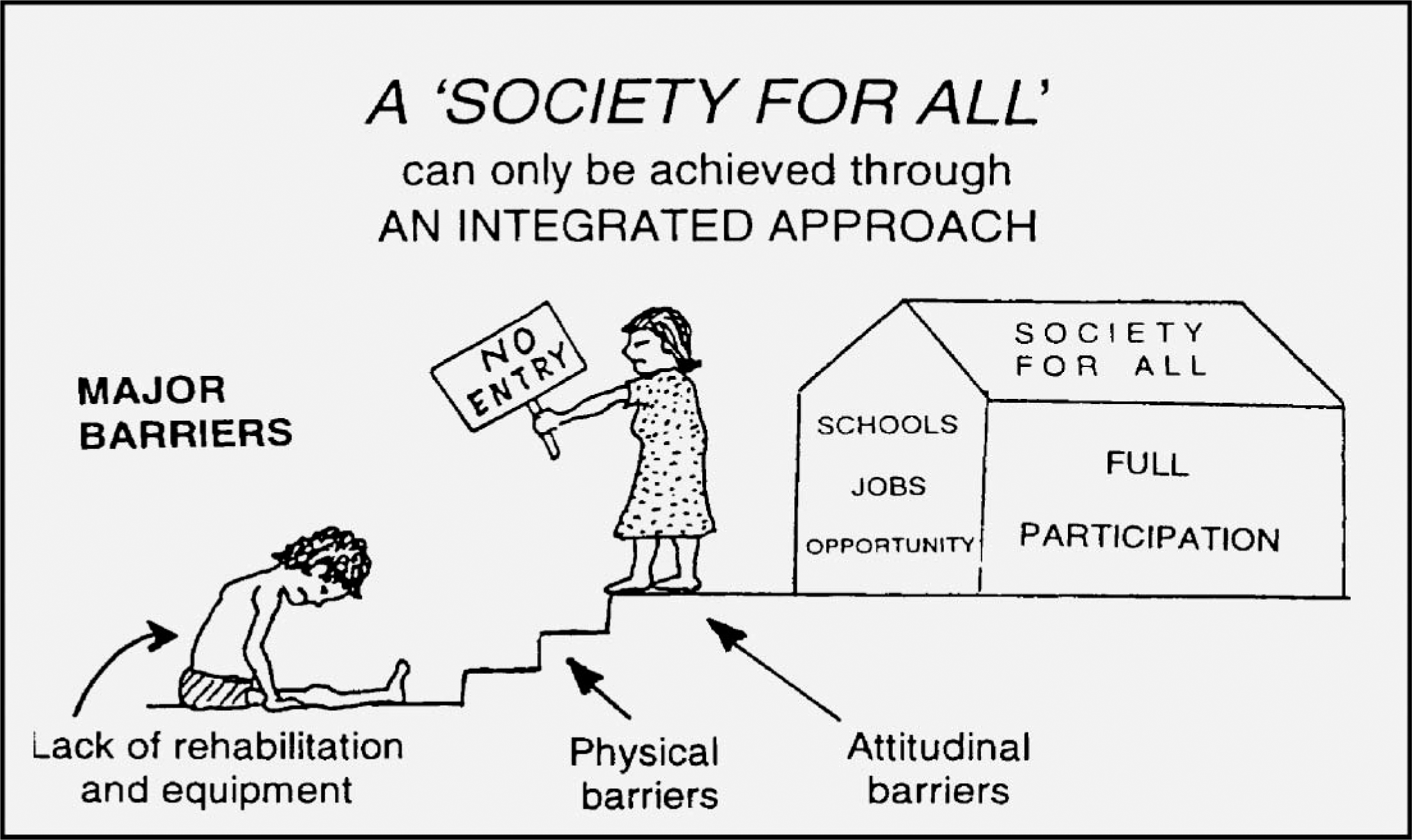
Major barriers. Source: David Werner.
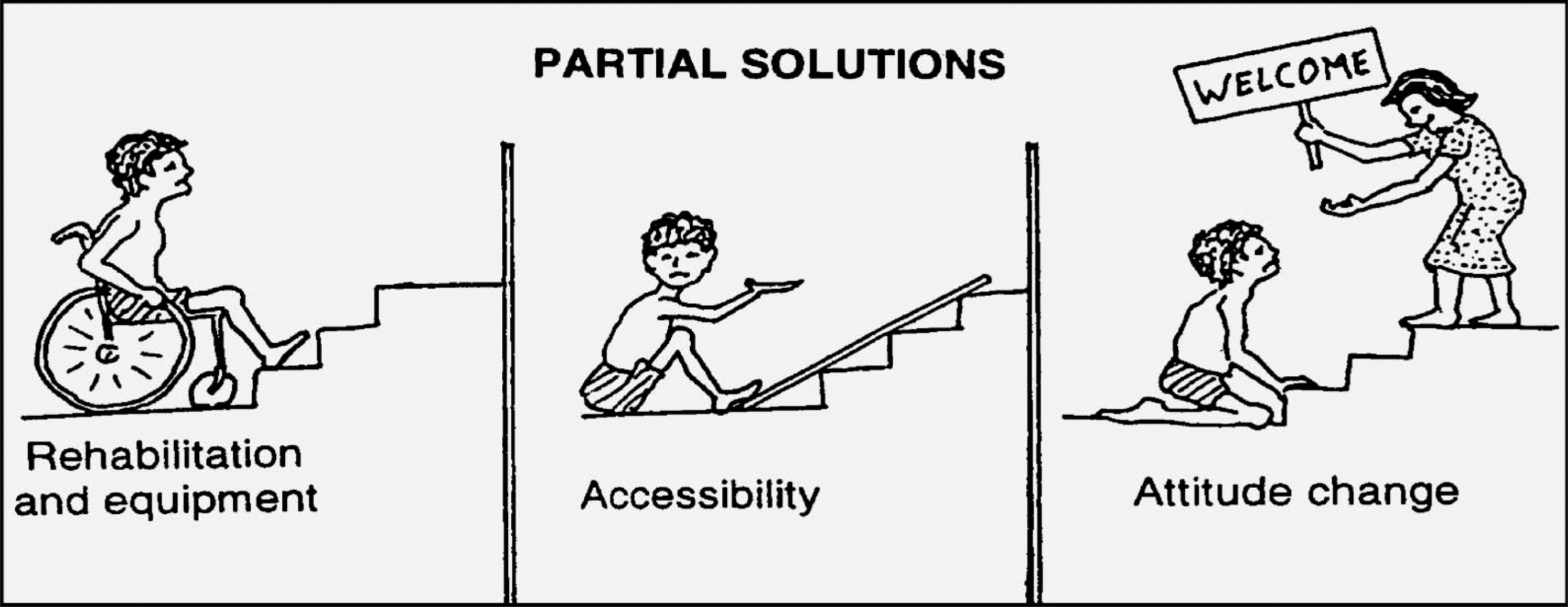
Partial solutions. Source: David Werner.
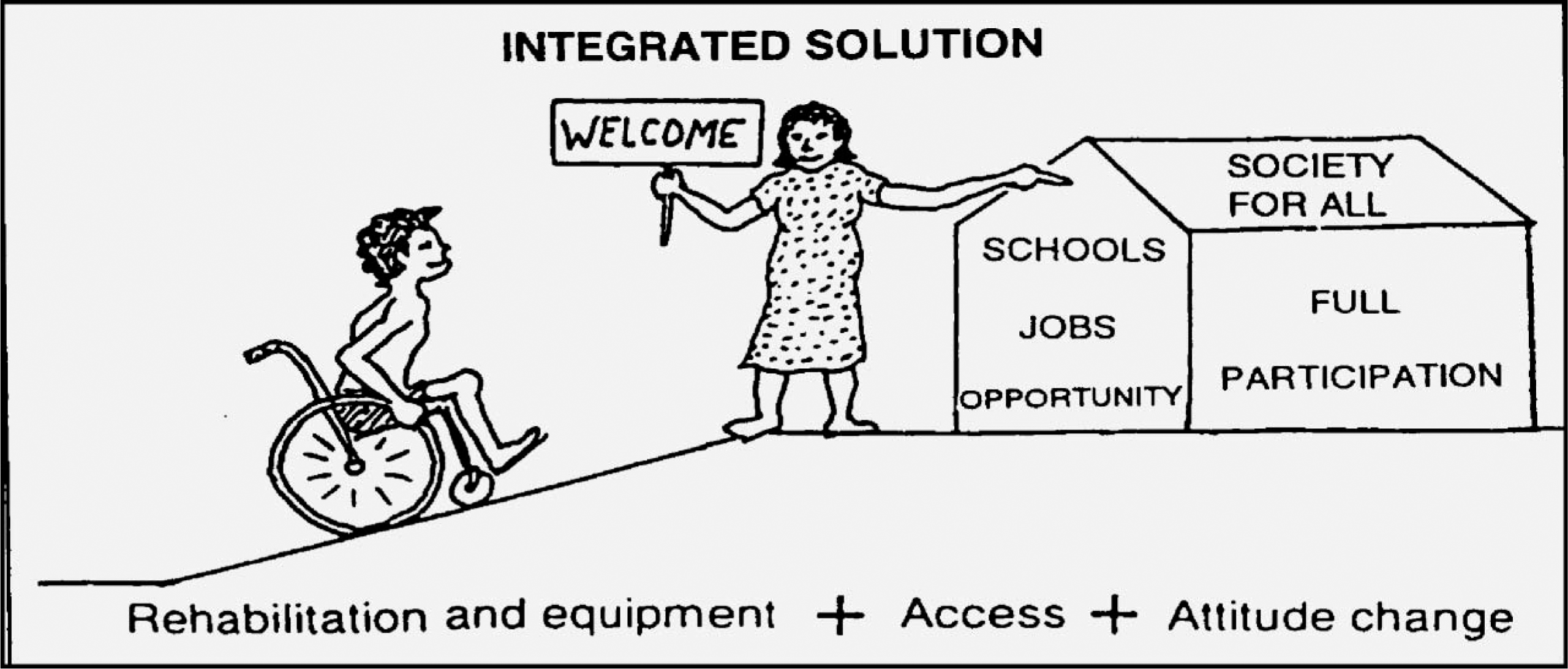
Integrated solution. Source: David Werner.
All interventions (provision of rehabilitation services including assistive technology, accessible physical environments and transportation, and attitudinal change of citizens) are coordinated. As a result, a person with disability is empowered and able to participate in community activities, including school, job, religion, leisure and recreation and others. Rights to access rehabilitation services and assistive technology should be recognized as a right to development.
With a view to moving social boundaries and achieving empowerment of persons with disabilities, we need to create an inclusive society for all that celebrates all types of difference in terms of gender, age and disability.
Footnotes
This paper was presented at the International Society for Prosthetics & Orthotics 12th World Congress.