




Abstract
Critical thinking skill is considered to be one of the important attributes to nurture students to cope with the challenges coming from this ever-changing world. The training of critical thinking skill could be quite different from the conventional education. Thus, special arrangements should be considered in the curriculum design and effective assessment method should be employed to test the subsequent learning outcome. This study was to evaluate prospectively the development of critical thinking disposition of the student prosthetists and orthotists in Hong Kong and a validated instrument, the California Critical Thinking Disposition Inventory (CCTDI) was used. The results showed that there was significant improvement in 5 out of the 7 domains, namely Truthseeking, Open-mindedness, Systematicity, Analyticity, Critical thinking self-confidence, Inquisitiveness and Maturity of judgment in 3 years' time. Further curriculum enhancements were suggested as the sum of all the domains was just slightly above the threshold of positive tendency.
Introduction
In today's rapidly changing information age, information to obtain, trust and apply is a cautious, apprehensive and critical process. People have to make choices, evaluations, and decisions in their work as well as daily activities (Beyth-Marom et al. 1987; Presseisen 1986). Perhaps most importantly in today's world, critical thinking skills are viewed as crucial for educated persons to cope with a rapidly changing world. Many educators believe that specific knowledge will not be as important to tomorrow's workers and citizens as the ability to learn and make sense of new information (Gough 1991).
Critical thinking is postulated to be essential to proficient clinical decision-making and competent professional practice (Girot 2000; Facione et al. 1998; Chenoweth 1998; Miller 1992; Pardue 1987). The definitions of critical thinking have been published widely. Ennis (1987) suggested that it is the process and skill involved in rationally deciding what to do or what to believe. Some program developers and educational researchers (Keating 1988; Costa 1985) have tried to include four elements in writings on critical thinking. They include: (i) content knowledge (knowledge of the discipline), (ii) procedural knowledge (knowledge of thinking skills), (iii) ability to monitor, use and control thinking skills (metacognition), and (iv) an attitude to use thinking skills and knowledge.
Although critical thinking skills are considered important, they may differ among various disciplines. Winocut's list of skill (Costa 1985) has three categories: (i) enabling skills, (ii) processes, and (iii) operations. Enabling skills include observing, comparing/contrasting, grouping/labelling, categorizing/classifying, ordering, patterning, and prioritizing. Processes include skills related to analysing questions, facts/opinion, relevancy of information, and reliability of information. Processes also include skills necessary for inferring, understanding meanings, cause/effect, making predictions, analysing assumptions, and identifying points of view. Operations include logical reasoning, creative thinking, and problem-solving skills. Another commonly used model is the California State Department of Education model (Costa 1985), which includes most of the same skills organized into three categories: (i) Defining and clarifying the problem; (ii) Judging information related to the problem, and (iii) Solving problems/drawing conclusions.
In reviewing the work of Tiwari et al. (2003) who did a cross-sectional comparison study of the critical thinking dispositions between Hong Kong Chinese and Australian student nurses using the California Critical Thinking Disposition Inventory (CCTDI), significant differences (p < 0.05) in critical thinking disposition between the two groups of students were detected. The Hong Kong Chinese student nurses (CCTDI total mean score 268) failed to show a positive disposition toward critical thinking while the Australian students (CCTDI total mean score 288) did. Their findings contribute to knowledge of critical thinking by demonstrating difference and similarities between Hong Kong Chinese and Australian nursing students. This study raises questions about the effects of institutional, educational, professional and cultural factors on the disposition to think critically.
A longitudinal study was conducted by Stewart and Dempsey (2005) to examine student nurses' disposition toward critical thinking as they progressed from the Sophomore II to Senior II semester in a baccalaureate nursing program in the mid-western United States. The CCTDI was distributed during week 10 in the Sophomore II, Junior I, Junior II, Senior I, and Senior II semesters. Significantly higher CCTDI scores were achieved in the Junior I and Junior II semesters, but no significant differences were found when comparing the Sophomore II and Senior II semesters. This study brings up the importance of critical thinking development sequence.
In the past, the curriculum design of tertiary education would focus more on specific knowledge education and training but less on the development of all-roundness qualities. In fact, to cope with the need and pace of this complex and ever-changing world, an increasing emphasis on higher-order learning skills, including critical thinking skills, should be sought. In Hong Kong, nurturing students' specific knowledge as well as all-roundedness becomes equally important in most tertiary institutes. The objective of this study was to assess prospectively the development of students' critical thinking skills throughout a three-year education and training program in prosthetics and orthotics. The results would be used for curriculum review and enhancements.
Material and method
The critical thinking dispositions of the undergraduate students were measured using CCTDI, which were developed by Facione et al. (1994a). This instrument was chosen as its framework was based on the Delphi Report (American Philosophical Association 1990). It has obtained cross-consensus on the conceptualization of critical thinking and conceptual clarity (Facione et al. 1994a), and its design can measure different aspects of critical thinking disposition (Facione et al. 1995). The decision to measure students' critical thinking disposition was made on the basis that a complete approach to develop critical thinkers includes nurturing critical thinking disposition and teaching critical thinking skills.
The CCTDI was designed for community college students, college and university undergraduate students, graduate and professional school students, adults, and working professionals. It has been used nationally and internationally for program evaluation, professional development, training, student assessment, and an element in application, admissions, and personnel evaluation processes (Facione et al. 1994a).
The CCTDI measures the seven constituent domains of critical thinking, namely Truthseeking, Open-mindedness, Analyticity, Systematicity, Inquisitiveness, Confidence in reasoning, and Cognitive maturity. Their definitions are as follows (Facione et al. 1994a):
Truthseeking. The courageous desire for the best knowledge in any situation, even if such knowledge fails to support or undermines one's preconceptions, beliefs or self interests; the intellectual integrity to follow reasons and evidence wherever they lead.
Open-mindedness. Tolerance of divergent views, self-monitoring for possible bias. Respectful of the possibility that others might reasonably hold differing opinions in certain circumstances.
Analyticity. Demanding the application of reason and evidence, alert to problematic situations, inclined to anticipate consequences.
Systematicity. Valuing organization, focus and diligence, and persistence in approaching problems of all levels of complexity.
Critical thinking self-confidence. Trusting of one's own reasoning skills and seeing oneself as a good thinker.
Inquisitiveness. Curious and eager to acquire knowledge and learn explanations even when the applications of the knowledge are not immediately apparent.
Maturity of judgment. Prudence in making, suspending, or revising judgment; an awareness that multiple solutions can be acceptable; an appreciation of the need to reach closure in certain circumstances even in the absence of complete knowledge.
The format of CCTDI is with 75 “Agree-Disagree” items in 6-likert scale and its administration time is 20 min. The reliability (internal consistency, based on the typical sample) is 0.90 (Cronbach's Alpha) for overall and ranges 0.72 – 0.80 (Cronbach's Alpha) on the seven domains (Facione et al. 1994a).
For each domain, there is a scale of score ranging from 10 – 60. Scores from 50 – 60 denote a strong positive disposition. Scores from 40 – 49 indicate a positive tendency. The mid-range scores of 31 – 39 signify ambivalence. Scores at 30 or below present a negative disposition, while those in the 10 – 20 range suggest a strong negative tendency. The CCTDI total is the sum of scores of the seven domains. It can range from 70 – 420, with a total score above 280 indicating a positive tendency toward critical thinking. A total score of 210 or lower indicates a negative disposition.
As the CCTDI originated from the United States, there was a concern about its suitability to assess the Hong Kong Chinese students. A Hong Kong Chinese version was translated and tested by Tiwari et al. (2003). In their evaluation test for internal consistency, 110 students were recruited. An overall alpha of 0.70 and subscale alphas ranging from 0.46 – 0.74 were obtained. The results were similar to those of the English CCTDI (Facione et al. 1994b) and the Taiwan Chinese CCTDI (Yeh 2002). Therefore, this Hong Kong Chinese version was adopted in the current study.
A group of 12 student prosthetists and orthotists (n = 12) were recruited from the BSc (Hons) program in Health Technology of the Hong Kong Polytechnic University. The study was started in September 2001 and ended in August 2004. Four prospective surveys were conducted right before the commencement of university education and at the end of each academic year. Approval to conduct this study was obtained from the Human Subject Ethics Committee of the Hong Kong Polytechnic University. The students were well informed of the nature and purpose of the study and their participation was fully voluntary. The subject anonymity and personal data confidentiality of the study were emphasized.
The collected data were first categorized according to the CCTDI scores for assessing the positive tendency of critical thinking. The software, GraphPad Prism for Windows (version 4.03), San Diego, California, USA was used for statistical analyses. One-way repeated measures ANOVA was applied to compare the CCTDI scores in the seven domains of the critical thinking dispositions over a period of three years, and post-hoc Tukey's Multiple Comparison Test was used to study differences among years.
Results
The CCTDI score of this group of students from Year 0 (freshmen) to Year 3 (final year) and the relevant statistic analyses were discussed below.
Year 0 CCTDI score
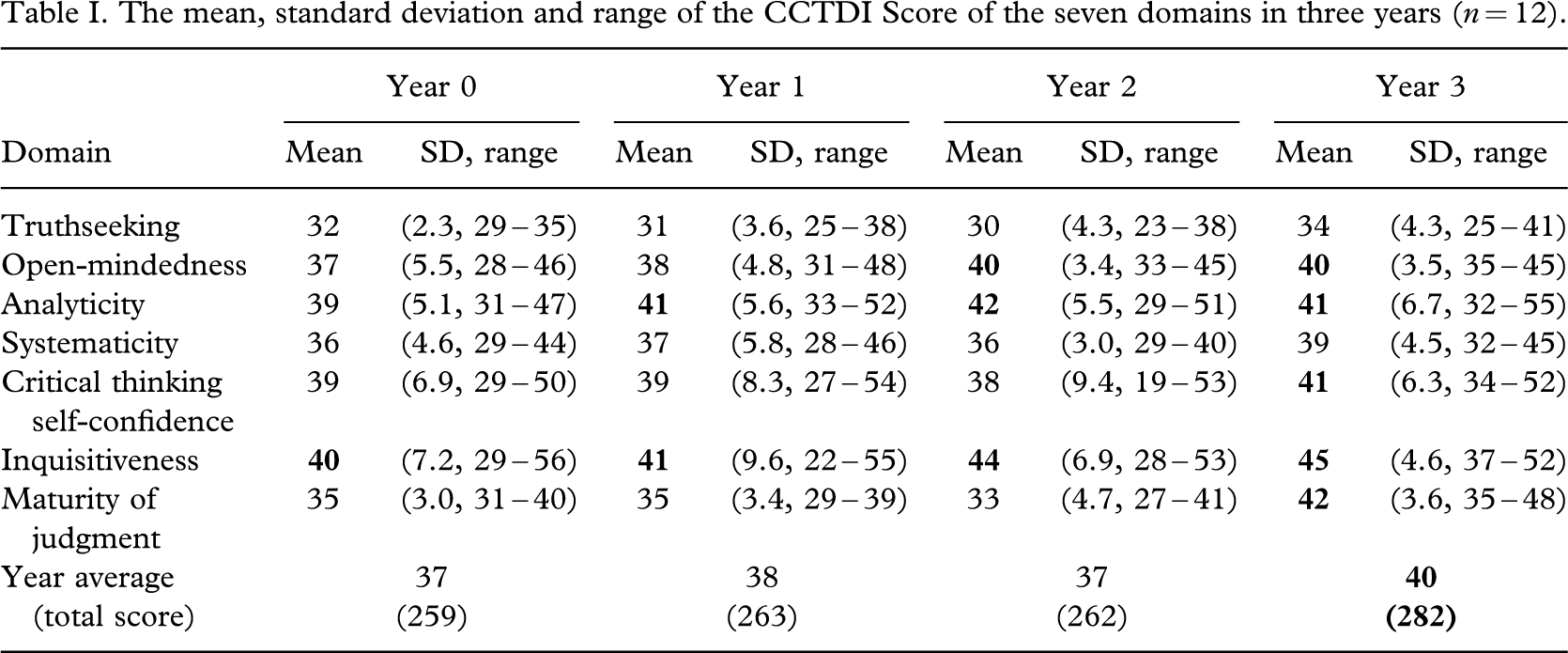
The results are shown in Table I and Figure 1. In Year 0, the findings showed that the students' mean scores towards the six domains (Truthseeking, Inquisitiveness, Open-mindedness, Systematicity, Critical thinking self-confidence and Maturity of judgment) were in the range of 31 – 39. The remaining one (Inquisitiveness) of the seven domains had scored at 40, and the total CCTDI mean score was 259. The most common profile in the sample of 12 students was ambivalent disposition towards all the domains except Inquisitiveness, which indicated a positive disposition. In general, the results showed that only 33% of these students were positive (e.g. ≥ 280) on the CCTDI total scores whereas the rest were ambivalent.
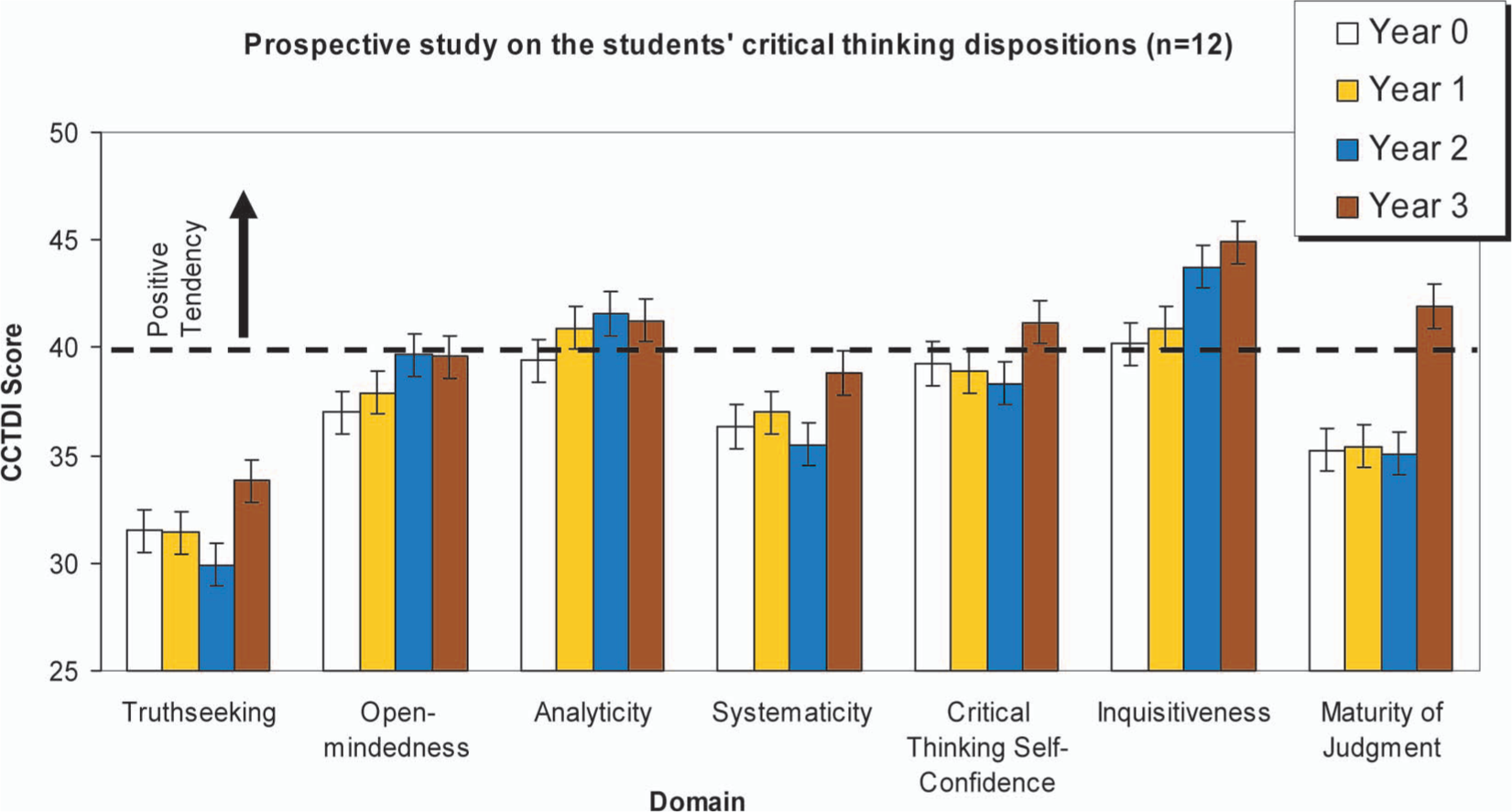
Prospective study on the students' critical thinking dispositions in 3 years.
The mean, standard deviation and range of the CCTDI Score of the seven domains in three years (n = 12).
Year 1 CCTDI score
At the end of Year 1, the findings showed that the mean scores to the five domains (Truthseeking, Open-mindedness, Systematicity, Critical thinking self-confidence and Maturity of judgment) were in the range of 31 – 39. The remaining two (Analyticity and Inquisitiveness) had scored above 40, and the total CCTDI mean score was 263. The most common profile of this student group was ambivalent disposition towards all the domains except Analyticity and Inquisitiveness, which indicated a positive disposition. All in all, the results showed that only 33% of these students were positive (e.g. ≥ 280) on the CCTDI total whereas the rest were ambivalent.
Year 2 CCTDI score
The mean scores towards the four domains (Truthseeking, Systematicity, Critical thinking self-confidence and Maturity of judgment) were in the range of 31 – 39 whereas the mean scores of the other three domains (Open-mindedness, Analyticity and Inquisitiveness) were at or above 40, and the total CCTDI mean score was 262. The most common profile of this student group was ambivalent disposition towards all the domains except Open-mindedness, Analyticity and Inquisitiveness, which indicated a positive disposition. The results showed that only 25% of this group of students had positive tendency on the CCTDI total whereas the rest were ambivalent and negative. Although the student percentage decreased from Year 1 to Year 2, the average score of Year 2 (37) was close to that of Year 1 (38).
Year 3 CCTDI score
The mean scores to the two domains (Truthseeking and Systematicity) were in the range of 31 – 39 while the mean scores of the other five domains (Open-mindedness, Analyticity, Critical thinking self-confidence, Inquisitiveness and Maturity of judgment) were at or above 40 and the total CCTDI mean score was 282. The most common profile of this student group was positive disposition towards all the domains except Truthseeking and Systematicity, which indicated ambivalent disposition. From this data, it could be recognized that this group of students was positive and seeking the application of reason and evidence, alerted to problematic situations, and inclined to anticipate consequences. They were eager to acquire knowledge, learn explanations and trusted their own reasoning skills. They also perceived themselves as a good thinker. In summary, the results showed that 42% of this group of students was positive on the CCTDI total whereas the rest were ambivalent.
Comparison among different years
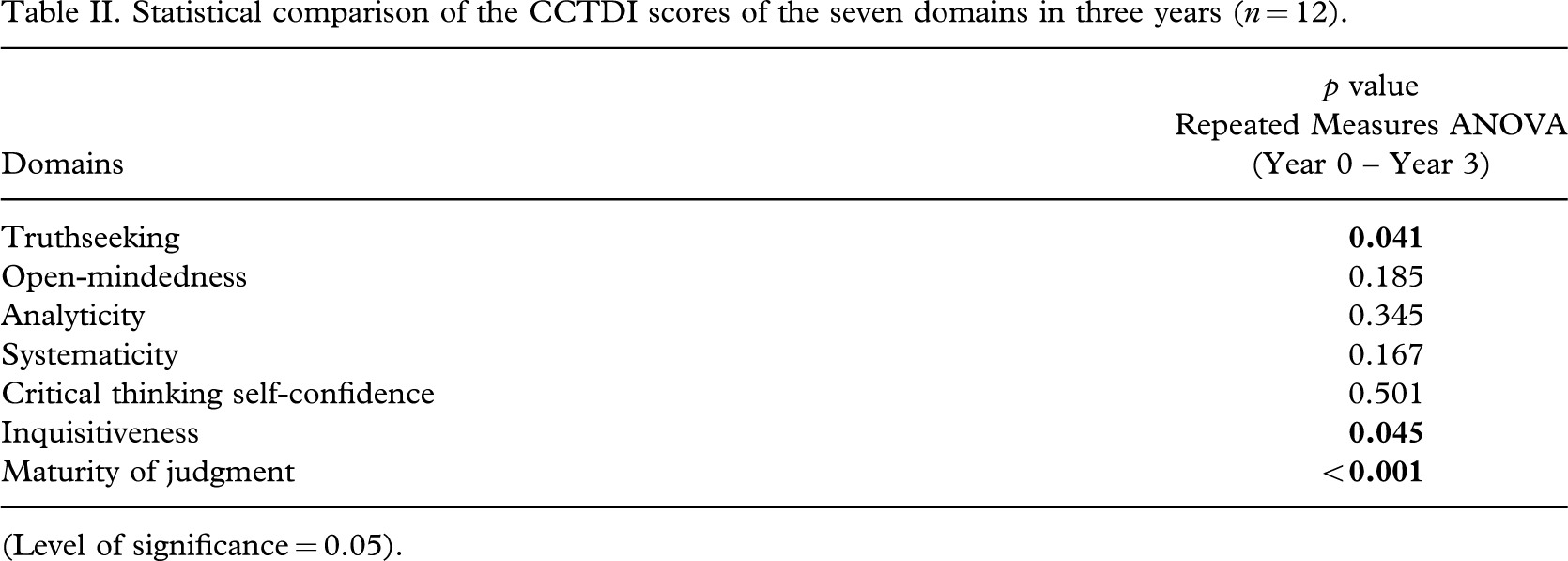
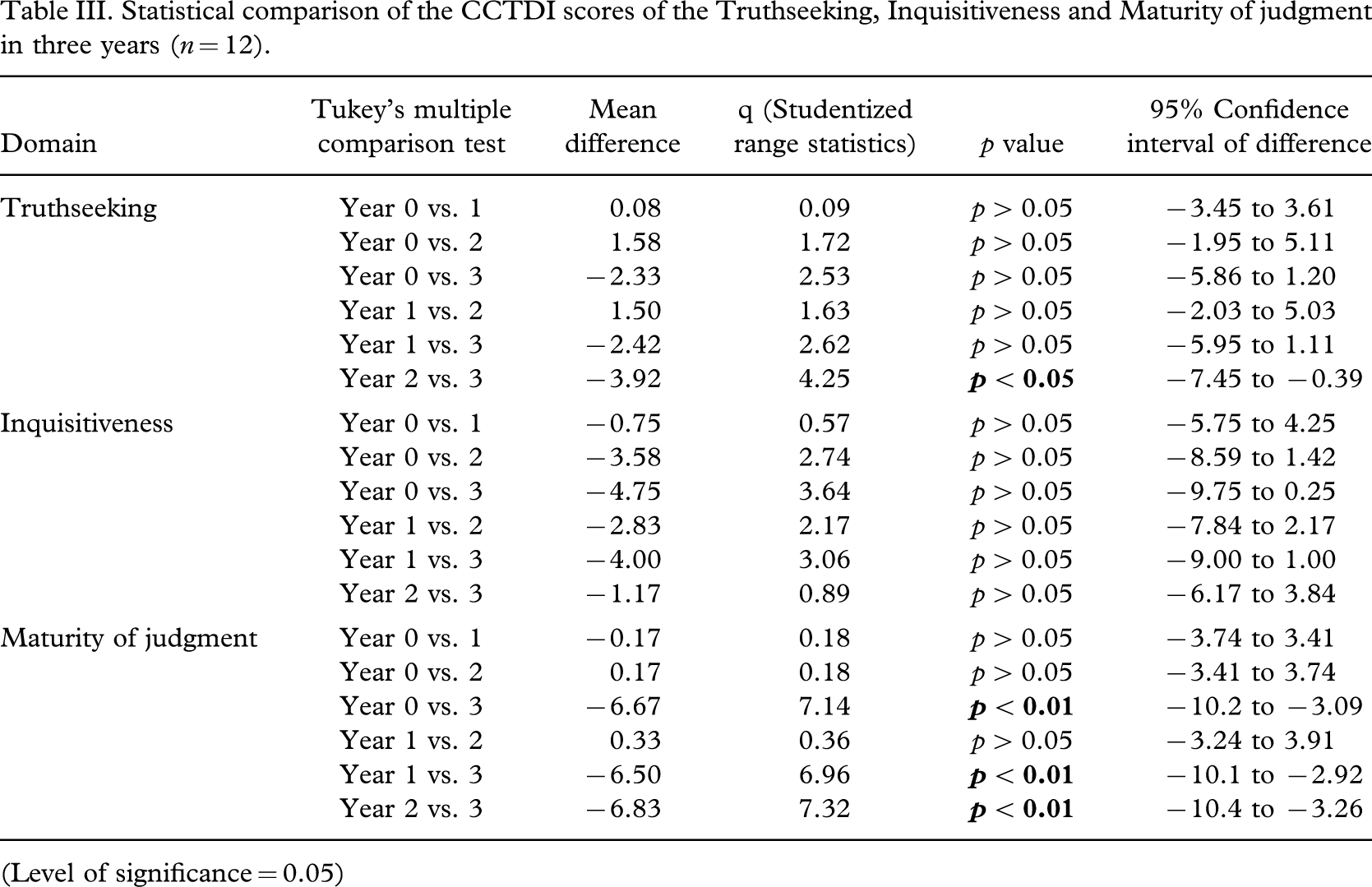
The data were analysed using one-way repeated measures ANOVA and the results are shown in Table II. It was found that there were significant differences in the domains of Truthseeking, Inquisitiveness, Maturity of judgment in the CCTDI scores from Year 0 to Year 3. Further elaborations on the results of the domains with significant differences are shown in Table III.
Statistical comparison of the CCTDI scores of the seven domains in three years (n = 12).
(Level of significance = 0.05).
Statistical comparison of the CCTDI scores of the Truthseeking, Inquisitiveness and Maturity of judgment in three years (n = 12).
(Level of significance = 0.05)
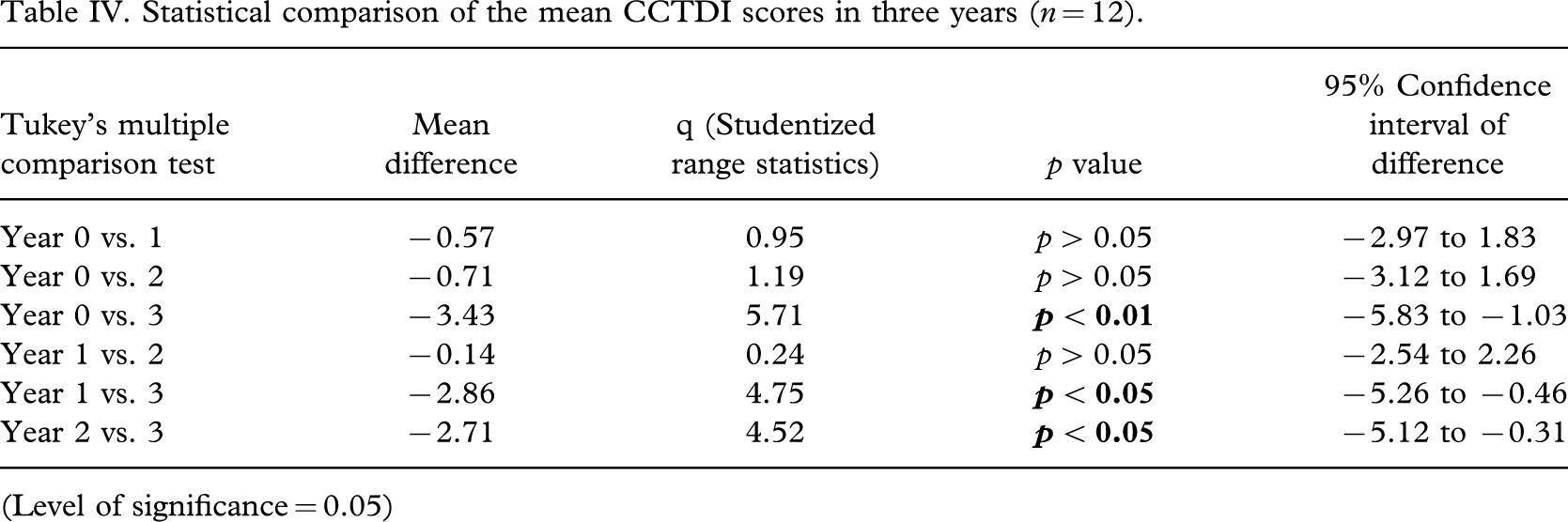
In the Tukey's Multiple Comparison Test, it was found that there was significant increase in mean CCTDI scores from Year 2 to Year 3 in the domain of Truthseeking but no significant difference was shown in the domain of Inquisitiveness across the three years. Significant increases in CCTDI scores of the domain of Maturity of judgment were noted between Year 3 and Years 0 – 2.
In the comparison of mean CCTDI scores across the three years, significant increases were noted between Year 3 and Years 0 – 2 (See Table IV). This implied significant improvements demonstrated in Year 3 as compared with the previous years.
Statistical comparison of the mean CCTDI scores in three years (n = 12).
(Level of significance = 0.05)
Discussion and conclusion
The curriculum of the currently studied program includes professional education and clinical training components in prosthetics and orthotics with special emphasis on nurturing clinical competence and client-interphase skills. This program is to prepare students with a good human science and bioengineering foundation in the first year and then followed with a clinical learning sequence in the second and third years. It aims to facilitate students to proceed in a step-by-step manner from a layman towards a competent clinician in the field of prosthetics and orthotics in three years time. After having the basic clinical theories and principles, students begin with a role-play (including both parties – clinician and patient), and then practise on model patients inside the university. In the summer term of the second year and at the end of the third year, students are arranged to real clinical environment to practise on real patients under the one-to-one mentorship scheme. About half the students' class can be arranged to go overseas for their clinical attachments in order to broaden their clinical exposure and personal horizon. In addition to the vigorous clinical education and training, students are also required to conduct an independent project in their final year in order to enhance their critical thinking and problem-solving skills. This part of the curriculum is for learning amalgamation and the students' learning outcome can be fully reflected from their capability to integrate the learned knowledge to tackle real life problems.
The result of this study showed significant improvement (p < 0.05) of the students' critical thinking disposition in three years' time and the total mean CCTDI score in Year 3 was 282. In comparing the results of Tiwari's group (Tiwari et al. 2003) with the current study, the CCTDI score of the student prosthetists and orthotists was close to that of the Australian student nurses (CCTDI total mean score 288). It could be considered that the finding of Tiwari's group towards the significant difference between the Chinese and Australian student nurses might be due to curriculum variation or other reasons but not merely the cultural factor.
The results of Stewart and Dempsey (2005) were different from the current study. They showed significant improvement in the CCTDI score in the first two years but not the last two years while the current study demonstrated a progressive improvement from Year 1 to Year 3. This might be due to different arrangements of program curriculum and different emphases in pathway of critical thinking development.
This study provides useful information to curriculum review and enhancements especially in the aspect of nurturing students' critical thinking skills. The findings could support a significant improvement in the domains of Open-mindedness, Analyticity, Critical thinking self-confidence, Inquisitiveness and Maturity of judgment in 3 years time. However, the total mean CCTDI score in Year 3 was just slightly above the threshold of positive tendency toward critical thinking. Further improvements in the curriculum should be sought. With reference to the experiences from Biggs (1999), Payne and Bird (1999) and Pandy et al. (2004), case-based learning and real life problems should be considered in an attempt to strengthen the students' critical thinking skill especially in defining and clarifying the problem, judging information related to the problem, solving problems and drawing conclusions. The CCDTI should be used regularly to evaluate the possible improvements and learning impact.
Footnotes
Acknowledgements
This study was fully supported by the learning and teaching grant of the Hong Kong Polytechnic University. Special thanks were given to Dr Agnes Tiwari for her permission of using the Hong Kong Chinese version of CCTDI, and Dr Patrick Lai and Mr Alex Wong for their support in data collections and analyses.