



Abstract
Both Mina Loy's autobiographical poem ‘Anglo-Mongrels and the Rose’ and C. Day Lewis's From Feathers to Iron are cognizant of epic without reproducing the conventions of epic narrative. In part, the epic quality of both comes from their depiction or implication of epic scales as a backdrop for human action. Unfamiliar scales were found in many sciences, with astronomy and cosmology being the most prominent in the early twentieth century. The essay considers Loy's scientific diction and Day Lewis's sources in popular science and astronomy works by A. S. Eddington and James Jeans.
By the second decade of the twentieth century, the identity of epic was fractured and contested. Educated writers would have had no difficulty naming the great classical epics – The Odyssey, The Iliad and The Aeneid – and little trouble naming English vernacular successors such as Paradise Lost and The Prelude, but definitions proved harder to agree on. To define epic merely in terms of generic features – the catalogue of heroes, the descent into the underworld or the presence of the supernatural – was, as far as Lascelles Abercrombie was concerned in 1914, to mistake means for ends, and to fail to grasp the spirit of the epic (Abercrombie 1914, 52). That the epic encompassed ‘wide horizons’ (as a 1900 critic put it) was understood, but as a definition was too vague; that it traditionally had been a narrative form was agreed, but narrative had become the province of the novel and it was clear that epic was more than narrative (Clark 1900, 7). Many epics concerned heroic actions, but the ‘heroic epic’ was only one sub-category of the form (Clark 1900, 7). Some epics – notably The Aeneid – concerned the founding of a nation, and the epic could be seen more broadly as a national poem, but if that idea seemed viable in 1910, by the end of the First World War the confidence in the nation as a unit had been shaken. Some commentators questioned whether the conditions for epic still existed: an early version of this idea comes in Karl Marx's ‘Introduction to a Critique of Political Economy’ (written 1857) (Marx 1974, 150); another in Ezra Pound's letters from around 1910 (Stock 1970, 76). As Marx asked, ‘is Achilles possible when powder and shot have been invented? And is the Iliad possible at all when the printing press and even printing machines exist?’ Epic seems incompatible with modernity. Similar questions might be posed about the presence of the gods. For Abercrombie, the gods were not essential; supernatural machinery was merely a device for enlarging the scope of the action. Nevertheless, for him, the presence of the supernatural signified ‘the poet's determination to show us things that go past the reach of common knowledge’ (Abercrombie 1914, 55).
For the two poems considered in the present article, Mina Loy's ‘Anglo-Mongrels and the Rose’ (written c.1923–1925) and C. Day Lewis's From Feathers to Iron (1931), epic was a cluster of conventions that a poem could employ and allude to, rather than a formula for composition. That science is present in both poems will become obvious, even if it is an aspect neglected by previous commentators, but how it relates to epic is one of this essay's key questions. Both poems are autobiographical and both are concerned with new life: with the family history and early life of the protagonist in Loy's case, and with the birth of his son in Day Lewis's. Neither aims to present an evolutionary history of the universe, but both place individual growth in vast scales of space and time. Although both embrace scientific ideas and terminology, they do not aim for the encyclopaedism that some critics have seen as important to epic; for example, Northrop Frye, who approached the Renaissance epic as ‘the story of all things’, ‘distilling the essence of all the religious, philosophical, political, even scientific learning of its time’ (Frye 1965, 5). Nevertheless, scientific terminologies and expository images frame the human action. This essay asks what purposes scientific diction and concepts fulfil in these poems, and what continuities exist between those purposes and older epics. Like the classical gods, modern scientific ideas appear to go ‘past the reach of common knowledge’, whether because those ideas run counter to common sense, or because they look at the world at temporal and spatial scales alien to the human body. What happens to ordinary human actions – falling in love, conceiving a child – when they are set against an immense backdrop of inexorable processes?
Cosmic mockeries: ‘Anglo-Mongrels and the Rose’
Mina Loy's ‘Anglo-Mongrels and the Rose’ is about 1600 lines long, and is written in an irregular verse form held together with alliteration, assonance and syntactical parallelism (Perloff 1998, 136–7). It is autobiographical, but much of it concerns her parents’ early lives and courtship, treated in a satirical manner. The poem was written in the early 1920s, parts of it appearing in The Little Review and in the anthology The Contact Collection of Contemporary Verse (1925); its parts were first gathered together in Roger Conover's edition The Last Lunar Baedeker (1982). The poem's account of Loy herself does not extend beyond her early childhood; it also gives some coverage to the early childhoods of her two partners. It is not known whether Loy intended to continue the narrative further; its apparent abandonment or curtailment leaves it with some of the characteristics of an epic fragment. It implies a bildungsroman or künstlerroman but ceases long before the conventional end-points of such narratives. Why it ceases is unclear, but it may have been nothing more than diminishing interest on the part of the author: as Marjorie Perloff notes, Loy seems less comfortable talking about herself than about her father and mother (Perloff 1998, 144). Loy's poem does not conspicuously claim the status of an epic for itself. Although Roger Conover has called it a ‘mock-heroic autobiographical “epic”’, it is notable that he keeps ‘epic’ in quotation marks (Conover 1997, 171). ‘Anglo-Mongrels’ is cognizant of epic without being one.
‘Anglo-Mongrels’ adopts a satirical attitude towards its characters, without being recognizably in the tradition of mock-epic or Byronic epic satire. The fictionalized version of Loy's immigrant father, called ‘Exodus’, is consistently characterized with reference to his Jewishness and, in places, to stereotypes of Jewishness; her mother is placed in relation to English imperial ideology, and is called ‘Rose’. Loy herself is ‘Ova’. While for the author the name ‘Ova’ powerfully and poignantly echoed that of her first child, Oda Haweis, who died in infancy, for most readers that private echo was not audible; the name simply reduces the girl to an egg. Part of the satirical attitude is the consistent insinuation that the characters lack autonomy because their selves are shaped by forces beyond their control. Those forces are sometimes religious, sometimes ideological, but as the name ‘Ova’ suggests, they can also be biological and physical.
The scientific terminology that Loy uses throughout the poem is predominantly derived from the life sciences – anatomy, physiology, zoology and botany – but there are also terms from geology and mathematics and others that can't be so easily placed. The terms from the life sciences include some nouns – for example, arteries, cerebellum, epiderm, grey matter, iris, larva and plasm – but they are more often adjectives: anaesthetized, bifurcate, cancellated, cardiac, insensitized, involute, nacreous, osseous, restringent and sub-umbilical. Other terms include things like adamsite, decimal fraction, disequilibrium, energies, ethereal, optic ray and velocities. As that list suggests, the terms from outside the life sciences tend to be less obscure. Some terms have a scientific flavour but were apparently invented by Loy. For examples, ‘ego-axis’ appears in psychology and psychiatry, but not until many years later (e.g. Sadow 1969, 15–24). While the Oxford English Dictionary records ‘sensitized’ as far back as 1851, at the time of writing it has no entry for ‘insensitized’. ‘Anglo-Mongrels’ is also a poem that feels as if it contains more scientific terminology than is in fact the case, because a relatively high-proportion of the diction is Latinate. The characters’ lives are played out against the backdrop of an alien discourse.
The epic scope of the narrative is implied in part by the narrative proportions: the birth of Ova does not occur until one third of the way into the narrative. The narrative structure also implies it: the poem begins with Exodus, and then turns to Rose; as it becomes more concerned with Ova, it also turns to the childhoods of her lovers Esau Penfold and Colossus. Although the poem eschews epic tropes such as the epic simile, the figure of Colossus is presented in hyperbolic terms that also imply epic: when the baby first sits up, ‘it is as if a pillar of iron / erects him / in place of a spine’ (Loy 150). ‘Anglo-Mongrels’ is epic in that it encompasses a large scale, both of space and time. I have already suggested that the poem has a larger than normal temporal scale, more along the lines of family saga than the conventional bildungsroman. In narrative terms its spatial scale is large: though mostly set in London, it begins in Budapest with the birth of Exodus, and the birth of Colossus takes place in an Alpine summer resort.
More importantly, the narrative also implies a cosmic scale for the action and this is something that ‘Anglo-Mongrels’ has in common with From Feathers to Iron. This scale is apparent in the opening lines:
Exodus lay under an oak tree bordering on Buda Pest he had lain him down to overnight under the lofty rain of starlight having leapt from the womb eighteen years ago and grown (Loy 111)
Archaic diction also works to frame the action within a longer literary and philological time scale. The suggestion of spatial scale in the first paragraph of the poem is reinforced in the second by a brief reference back to Exodus's grandfather, the Patriarch who endowed a synagogue, and by a briefly sketched scene of Exodus's father meeting his mother. Old Testament language reinforces the sense of deep ancestry: the unnamed father ‘begat’ Exodus, and not long after fever ‘smote’ him (Loy 111, 112). Similarly, the phrase ‘burning track’ noted earlier gestures towards an older style of poetic diction: ‘burning Phoebus’ is very probably the commoner phrase, but there is a seventeenth-century antecedent for ‘burning track’ (Heywood 1609, 116).
One of the most densely packed passages of scientific diction occurs early in the poem and, coming early, establishes science as a dominant frame of reference. At this point Exodus is still lying underneath the oak tree.
An insect from an herb errs on the man-mountain imparts its infinitesimal tactile stimulus to the epiderm to the spirit of Exodus stirring the anaesthetized load of racial instinct frustrated impulse infantile impacts with unreason on his unconscious (Loy 113) He is undone! How should he know he has a heart? The Danube gives no instruction in anatomy the primary throb of the animate a beating mystery pounds on his ignorance in seeming death dealing (Loy 113)
Although it establishes a cosmic frame around its action, ‘Anglo-Mongrels’ never refers directly to the ‘cosmos’. Loy's use of the word ‘universe’ rewards further study, as it seems intended to diminish its scope. The word first appears when Exodus has reached London, in a passage that, in the absence of punctuation, is difficult to parse grammatically:
The parasite attaches to the English Rose at a guinea a visit he becomes more tangible to himself the exile mechanism he learns is built to the same osseous structure shares identical phenomena with those populating the Island that segregated from his apprehension moves a universe of unceasing energies for the biological explorer's introspection (Loy 119)
Any lingering belief the reader might have that the ‘universe’ refers to infinite spaces beyond our planet is undermined by the three subsequent appearances of the word. When Ova is new-born, ‘The suctional soul / clings to the vari-pinct universe’. Matthew Hart, presumably on the basis of ‘suctional’ and ‘clings’, takes this universe to be her mother's nipple (Hart 2010, 179). The adjective ‘vari-pinct’ does not appear in the Oxford English Dictionary and, to the best of my knowledge, no critic has attempted to gloss it. It may be that Hart takes it to refer to the colour pink and for ‘vari-pinct’ to be a compressed way of designating the various shades of pink of Ova's mother's breast. However, if ‘pinct’ suggests pinking shears, then the phrase points as much at Ova's father, the tailor and ‘prestidigitator cutter’ (174), as it does at her mother. (I would more tentatively suggest that a ‘vari-pinct universe’ is one that has been decoratively sheared in saw-tooth patterns at its edges, with ‘vari-’ suggesting variable sizes of pattern.) Regardless of whether nipples or napped cloth are in question, the satirical intent is the same: Ova's ‘universe’ does not extend beyond those of her parents. This satirical diminishment of the concept is further confirmed by its subsequent appearances: Ova's father gives her what she believes to be a sovereign, a gold coin worth one pound, to buy a ‘circus universe’ (Loy 166); when she discovers it is a farthing – a quarter of a penny, and so only 1/960th of a pound – he has ‘burst a universe’ (Loy 167). Loy's toying with the word ‘universe’ raises questions of how far the cosmic frame around an individual's epic actions might be simply a cultural construct or indeed their own mental projection. If Loy's use of ‘universe’ in the poem includes a tender recognition that a small space can constitute an inexhaustibly fascinating universe for a child, it also includes a satirical awareness that would-be heroes like to pose themselves against impressive backdrops.
In ‘Anglo-Mongrels,’ scientific discourse functions in several different ways. It is presented as a perspective that is known to the narrative discourse but unavailable to the characters. In places it establishes scales that extend far beyond those of the characters. That it establishes a scale larger than them is not so very surprising, and one might assimilate that idea to divine forces or the pressure of destiny in classical epic. In a more distinctly modern move, the discourses of the life sciences and anatomy also establish a microscopic scale, which suggests that human lives might be directed not only by larger forces, but by forces that are too minute to come to their attention.
Interstellar voyages: From Feathers to Iron
C. Day Lewis's From Feathers to Iron (1931) is a sequence of twenty-nine lyric poems followed by a verse ‘Epilogue’ addressed to his contemporary and friend W. H. Auden. The poems are structured by the underlying narrative of a pregnancy, with several allusions suggesting that it is the pregnancy of his first wife Mary, née King (1902–1975), with their son Sean Day Lewis, born 3 August 1931. However, the pregnancy theme is sufficiently open to interpretation that it was read at the time as referring symbolically to the creation of a new state and a suggestion, therefore, of founding a new city (Roberts 1933, 231). There is not a strong narrative element to the sequence and in its gradual and implicit forward movement it has more in common with Tennyson's In Memoriam (1850) than with conventional narrative epics. Like Tennyson's poem, it also embeds its concerns within contemporary science, though, while for Tennyson the concerns were mortality and the sciences were geology and pre-Darwinian evolutionary biology, for Day Lewis the concerns are fertility and the sciences are astronomy and, to a lesser extent, contemporary technology.
While it could not easily be claimed as an epic, From Feathers to Iron is, like ‘Anglo-Mongrels’, certainly cognizant of epic as a form, notably in its suggestions of epic voyages and in its use of epic simile. One may assume that Day Lewis was aware of classical epic at this date; he would later translate Virgil's Aeneid. The voyage is suggested from part 2 onwards, where the speaker calls to his partner to leave their town, and taken up in part 4's reference to ‘trade-routes’ and ‘freight’ (Day Lewis 1992, 108); part 8, a dialogue between ‘He’ and ‘She’, explores at length a metaphor suggestive of Aeneid book I: a ship blown off course and needing to undertake repairs before it can continue on its way to found a new city (Day Lewis 1992, 110–11). Although in parts 17 and 20, as we shall see, the voyage becomes an interstellar journey, even there the metaphor of the voyage, like the voyages in classical epic, implies questions about the balance between the free-will of the heroic individual and the divine or cosmic forces beyond them.
The epic similes first appear in the opening poem of the sequence. The third stanza consists of an extended simile of bird song filling a ‘dark wood’ at dawn, concluding ‘So our joys visit us, and it suffices’ (Day Lewis 1992, 105); the ‘dark wood’ also alludes to the opening of Dante's Inferno. Worthy of more detailed examination are the two epic similes in part 12, a thirty-line poem divided into two paragraphs of equal length; one of the similes is fractured and difficult to parse, while embedded within it, in the second paragraph, is a more straightforward one.
The fractured example begins at the opening of part 12: it is a simile of someone escaping the heat and brightness of a summer day by entering a disused mine, and experiencing a nightmarish sense of disorientation, because ‘nothing intrudes here to tell the time’ (Day Lewis 1992, 113). Initially it looks like a conventional epic simile following the formula or ‘As this … so this’:
As one who wanders into old workings Dazed by the noonday, desiring coolness, Has found retreat barred by fall of rockface. (Day Lewis 1992, 113) Train shall spring from tunnel to terminus, Out on to plain shall the pioneer plunge, Earth reveal what veins fed, what hill covered. Lovely the leap, explosion into light. (Day Lewis 1992, 114)
Embedded within the larger epic simile is a smaller and more conventional one, also concerning tunnels and emergence, but drawing on contemporary transport and electrical technology:
As a train that travels underground track Feels current flashed from far-off dynamos, Our wheels whirling with impetus elsewhere Generated we run, are ruled by rails. (Day Lewis 1992, 114)
The epic similes in part 12 echo and interlock with other similes in From Feathers to Iron: the metaphor of the dark place, for example, picks up a metaphor of the womb as a photographic darkroom in the previous part; the simile of the explorer in the mine being drawn ‘as tide to the moon's nod’ (Day Lewis 1992, 113) by forces beyond his control, anticipates a metaphor of tidal pull in part 17. The epic similes in part 12 are not simply decorative, but are deeply integrated within the poem's conceptual structures; those structures attempt to construct a system of analogies in which Mary's pregnancy stands for ideas and feelings of renewal and anticipation and in which the relation of individual human intentions to larger forces beyond rational control is explored – forces biological, astronomical, social and cultural. In that consideration of the relation between the human scale and larger scale there is also a continuation of the traditional epic concern with the interaction of the human and the divine.
As the examples of photographic darkrooms and underground trains might suggest, From Feathers to Iron draws widely on contemporary technologies for its metaphors; it also draws on contemporary astronomy, including both Einstein's work on spacetime and the work of other astronomers on the formation of the solar system. Day Lewis left little external evidence of his scientific reading at this time, but internal evidence from the poem suggests he was acquainted with the best-selling popular works of the period by A. S. Eddington and James Jeans. These are not only the likeliest sources for Day Lewis's knowledge of science, but the works most readily available to his readers.
The first poem of the sequence announces its scientific modernity with a reference to the Einsteinian concept of the ‘Here-now’. The poem begins with a meditation on mortality and what would be lost by one's premature death in an accident. The answer, soon given, is love. In the topographical metaphors of the first poem, which are part of the larger journey metaphor that runs through the entire sequence, we ‘in the valley / Of the shadow of life have found a causeway’ (Day Lewis 1992, 105). Day Lewis then turns to a more abstract speculation, which is where Einsteinian spacetime comes in:
Some say we walk out of Time altogether This way into a region where the primrose Shows an immortal dew, sun at meridian Stands up for ever and in scent the lime tree. This is a land which later we may tell of. Here-now we know, what death cannot diminish Needs no replenishing; yet certain are, though Dying were well enough, to live is better. (Day Lewis 1992, 105)
When scientists realized that light travelled at a finite speed, it was, as Eddington says, ‘a blow to the whole system of world-wide instants’:
We had been mixing up two distinct events; there was the original event somewhere out in the external world and there was a second event, viz. the seeing by us of the first event. The second event was in our bodies Here-Now; the first event was neither Here nor Now. (Eddington 1928, 43) The Here-Now. The Hour Glass.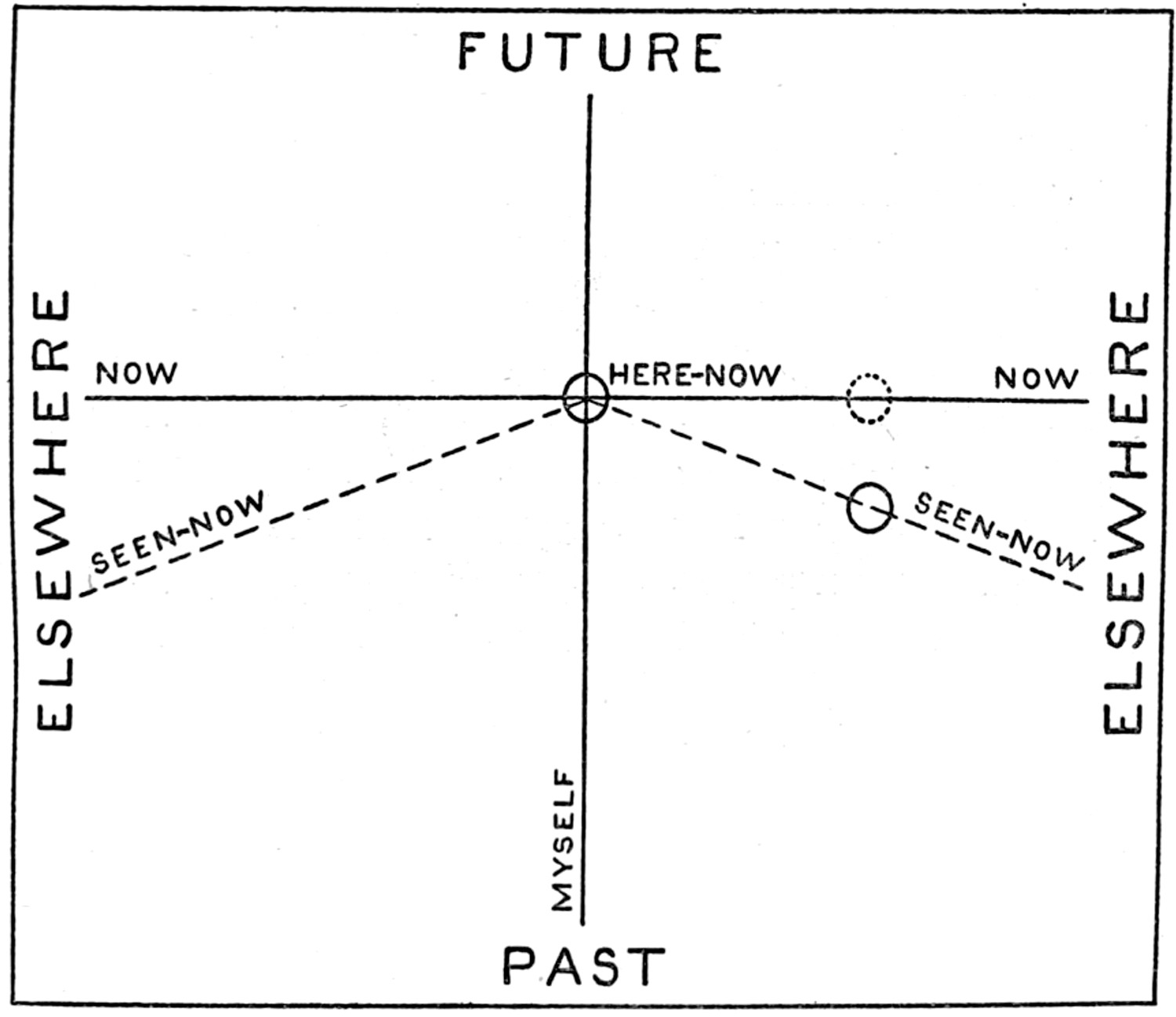
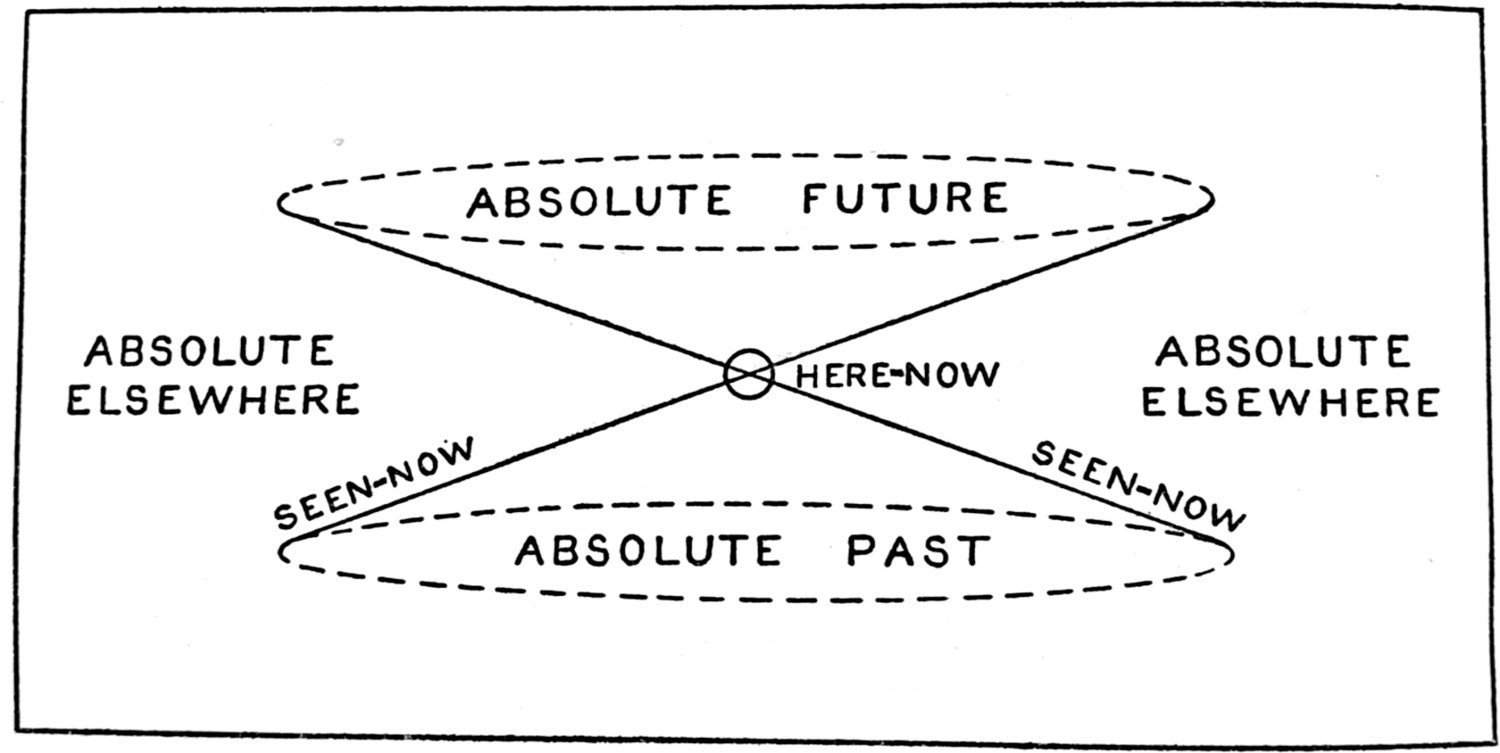
The ‘elsewhereness’ of the region is less absolute than this might seem to imply; from the point of view of the here-now it cannot be known, but from a ‘here-in-the-future’, it might be, and from other here-nows located variously through space-time, it can be. In any case, Day Lewis's description of it as a place ‘which later we may tell of’ returns it to temporal relations. The region cannot be known here-now, but it will be knowable in the future. Day Lewis recruits the idea of the here-now for a form of existentialism that clings to the immediate, but it is one supplemented by a trust – or a faith? – that the here-now will itself be the object of knowledge in the future, and that death will not diminish it.
Larger scales of space and time are periodically alluded to throughout the poem, even when, as in the fourth part, space travel is used to contrast with more local and practical forms of activity. The second extended astronomical metaphor occurs in part 17, where Day Lewis draws on cosmogony. He draws specifically on the ‘tidal theory’ about the formation of the solar system advanced by Jeans in 1916 and popularized by him in The Universe Around Us (1929) and again briefly in The Mysterious Universe (1930); of the popularizations, the latter seems to be Day Lewis's most likely source, on the basis of verbal resemblances (Jeans 1929, 232–6; 1930, 2–3). The theory was that the planets derived from solar material which had been drawn out by the gravitational pull of a passing massive object, most commonly thought to be another star (Jeans 1929, 232). It was a development of an older theory, dating back to G. L. L. Buffon in 1750, which had hypothesized an actual collision between the sun and another body. The language of parentage and reproduction is often deployed in popular accounts of cosmogony: Jeans writes, for example, that a single star cannot ‘give birth to a solar system’ and speaks of the ‘parent sun’ (Jeans 1929, 232; 1930, 2). In other words, Day Lewis's metaphor elaborates on one that is already present in his source materials.
Day Lewis's poem is more self-consciously artificial than many of the others in the sequence:
Down hidden causeways of the universe Through space-time's cold Indifferent airs I strolled, A pointless star: till in my course I happened on the sun And in a spurt of fire to her did run. (Day Lewis 1992, 117)
Part 17 concludes with a versification of Jeans's theory:
Soon from the mother body torn and whirled By tidal pull And left in space to cool That mountain top will be a world Treading its own orbit, And look to her for warmth, to me for wit (Day Lewis 1992, 118)
Part 17 of From Feathers to Iron is modelled on seventeenth-century metaphysical lyrics, perhaps too self-consciously so. It enlarges the conceptual and physical space of the poem, placing an ordinary human pregnancy in vast scales. In doing so it suggests simultaneously a heroic scale for the human actors in the narrative and their insignificance and fragility when placed against the solar system. In this there are analogies not so much with Tennyson as with Thomas Hardy, whose poetry was later to become an important touchstone for Day Lewis. However, the contrived quality of part 17 places the focus as much on the poet's ingenuity in creating the conceit as on the ideas underlying it; the poem both entertains the analogies and mocks them with a sidelong glance. In some respects the mockery might seem to imply a healthy scepticism about the authority of popular science writing, but because the manner of the questioning is so indebted to the seventeenth-century lyric, the scepticism itself seems inauthentic and uncertain of its real target.
Day Lewis himself changed his attitude to the use of science in poetry. By his 1956 lecture The Poet’s Way of Knowledge, he was sceptical about the viability of using scientific material in poems, though he mentioned Edwin Muir, William Empson and Kathleen Raine as poets who had succeeded. The difficulties were both those of specialization in science and of the impossibility of science becoming fully assimilated. For the second argument, William Wordsworth's remarks in the Preface to the Lyrical Ballads were a crucial touchstone. Wordsworth had argued that the ‘remotest discoveries’ of the chemist, botanist or mineralogist would be suitable objects for poetry when they had become ‘familiar’ (Wordsworth 1802, 607). Day Lewis argued that science moved too quickly for its discoveries ever to become familiar: ‘Poetry on the whole requires a stable foundation of ideas from which to make its flights: but today, and particularly in the all-important field of physics, there seems to be a constant modification and readjustment of scientific theory’ (Day Lewis 1957, 29). In what reads like a criticism of his own earlier work, Day Lewis comments that if poets try to use such material in poetry, ‘as poets did in the 1930s’, they are in danger of ‘falling into shallow conceit’ (Day Lewis 1957, 28).
Conclusion
Day Lewis might have looked differently at his work. The unfamiliar quality of scientific terminology and scientific concepts, rather than being a weakness, can create powerful if disconcerting aesthetic effects. Such effects are more immediately apparent in Mina Loy's employment of exotic lexis in ‘Anglo-Mongrels and the Rose’ (1982), but they are present too in From Feathers to Iron: ‘Here-Now’ presents an immediate challenge to the reader. Ideas about microscopic and cosmological scales were sufficiently familiar that both poets could use them to place their protagonists against an immense backdrop, while the language of science was sufficiently unfamiliar that the reader senses the presence of, in Abercrombie's words, ‘things that go past the reach of common knowledge’. Setting ordinary human actions amidst alien scientific discourse and against cosmic scales of space and time can reveal something of what is inhuman within them and can expose respects in which free will is an illusion; but it also has the potential to bestow a significance on those actions and to find traces of the heroic in the everyday.
Footnotes
Disclosure statement
No potential conflict of interest was reported by the author(s).