



Abstract
This paper presents the results of a pilot interview study investigating the leisure reading habits of 20 practising AI researchers based in the United Kingdom. The interview analysis yields six areas in which literature plays a role in the field of AI: research focus, career choice, community formation, science communication, ethical thinking, and modelling of sociotechnical futures. These categories are proposed as the basis of a systematic taxonomy of the role of literature in AI research, evidencing literature's significance in AI laboratory and professional cultures. The paper presents the results of this preliminary investigation in combination with a synthesis of existing evidence in each category of influence. The aim of this hybrid approach is to cohere research and evidence in this relatively new area of study, and to present new findings contextually, in order to provide the foundations for further qualitative and quantitative research.
Introduction
This paper presents the results of a pilot interview study investigating the leisure reading habits of 20 practising AI researchers based in the United Kingdom. Although asked about their reading, interviewees also freely discussed visual media, including film and television. Their understanding of ‘the literary’ was not confined to the printed book; the use of ‘literature’ throughout this paper reflects that expansive understanding. 1 The findings and discussion therefore present material of relevance to the influence of imbibing stories embedded in different forms of media, with the further research section noting that differentiating between the influence of different media, in particular perhaps along generational lines, requires further investigation. 2 The interview analysis yields six areas in which literature plays a role in the field of AI: research focus, career choice, community formation, science communication, ethical thinking, and modelling of sociotechnical futures. These categories are proposed as the basis of a systematic taxonomy of the role of literature in AI research, evidencing literature's significance in AI laboratory and professional cultures. This paper presents the results of this preliminary investigation in combination with a synthesis of existing evidence in each category of influence. The aim of this hybrid approach is to cohere research and evidence in this relatively new area of study, as well as to present new findings contextually, in order to provide the foundations for further research.
Context
This study is situated at the intersection of a number of fields: literature and science studies, science and technology studies (STS), the sociology of literature, ethnographies of reading, and empirical science fiction studies. Studies in literature and science have demonstrated the influence of literature on scientific discourse and practice, primarily, although not exclusively, drawing on textual and historical evidence (Beer 1983; Hayles 1999; Canaday 2000; Kilgore 2003; Amigoni 2007; Dawson 2007; Shuttleworth 2010; Ferro and Swedin 2011; Kirby 2011; Littlefield 2011; McCurdy 2011; Holmes 2012; Buckland 2013; Middleton 2015; Milburn 2015). Two UK projects funded under the AHRC's 2011 Science in Culture Highlight Notice focused not on the historical and textual evidence of literature-science influence but instigated practical examination of that relationship in the present (Battey et al. 2012; Hurwitz 2013). But empirical research remains rare in the literature and science field. 3
STS has firmly established the interdependence of science and society. The mutually constitutive relationship it proposes between the two parallels the mutually constitutive relationship proposed in the sociology of literature between life and literature (Andringa and Schreier 2004). Studies in the history of the book aim to trace the transmission of ideas through print, and literature's influence on human behaviour and thought (Darnton 1982; Kaestle et al. 1991; Long 1993; Chartier 1995; Wiegand 1998; Pawley 2002), with more recent studies exploring the same impact of stories embedded in, for example, television, films, and games (Andringa and Schreier 2004). While empirical work in the sociology of literature has been to some extent displaced by more theoretical approaches (English 2010b), this study aims to help reinvigorate empirical research into ordinary readers in order to understand how literature shapes both individuals and communities. 4 Such an approach understands ‘reading as social practice,’ and asks questions about ‘who reads what, how people read, and how their reading relates to their other activities’ (Griswold, McDonnell, and Wright 2005, 127). It fills the gap Pawley (2002) identifies between case studies of individual readers and the inference of imagined communities, and is aligned with ethnographic studies of contemporary readers informed by qualitative social science techniques (Radway 1984; Long 1992; Boyarin 1993; Ahern 2001; Reed 2011). Ethnographies of reading (Gubrium and Holstein 2008; Rosen 2015) and viewing from empirical reception studies (Radway 1984; Morley and Brunsdon 1999; Griswold 2000) and studies of participatory culture (Jenkins 1992; Jenkins, Ford, and Green 2013) reveal the uses and functions of literature within specific communities or collectives. 5 But as Rosen (2015, 1060) notes, ‘the vast and diffuse realm of reading “as a daily activity and of routine stuff” remains very much open for future ethnographies’.
Ethnographies of literature provide a model for analysis of the functions of reading specifically in scientific communities. Existing work in this sub-field focuses exclusively on science fictional reading, primarily using interview studies to investigate the influence of SF on technoscience (Bainbridge 1982; Helmreich 1998; Murphy, Mogus, and Crotty 1998; Fleischmann and Templeton 2008; Ferro and Swedin 2009; Sigma Xi 2010). Such work might be gathered under the name ‘empirical science fiction studies’. Within the field of computer science in general there is plentiful (auto)biographical evidence of the influence of science fiction (SF) on salient individuals (for example, Marvin Minsky [Geraci 2010, 52]). In fact, it is considered by many a self-evident truth that SF influences computer scientists. Ferro and Swedin (2011, 2) note that ‘the prevalence of science fiction readership among those people who create computers and programs is so well-known that it has become a cliché’, but, they caveat, ‘the cliché has remained largely unexplored by scholars’. ‘What role,’ they ask, ‘has science fiction truly played in the development of real computers? What has it meant for society?’ (Ferro and Swedin 2011, 2). Within empirical science fiction studies, there are to date no interview studies of AI researchers in the collective that start to answer those questions in a rigorous way.
Current study and method
The current study set out to investigate what AI researchers read (WAIRR), and the influence they perceive this to have on their scientific lives, thought, and practice. The WAIRR study was small-scale and qualitative, but it lays groundwork for future research. In 2017–2018, in-depth interviews were carried out with 20 AI researchers, asking them about their reading habits from childhood onwards and the influence, if any, they thought their reading had had upon their research career, thinking, or practice. Some researchers worked in the private sector, others at universities, some worked across sectors. Their specialisms included: cognitive robotics; bio-inspired robotics and embodied AI; computational linguistics; online learning; swarms; artificial emotional intelligence and affective computing; network technology; optimal control and biomechanical simulation; neuro-science inspired approach to understanding machine learning systems; deep learning and computational neuroscience; kernel methods; Gaussian processes, active learning, Bayesian optimization, and Bayesian quadrature; remote sensing, image and signal processing and machine learning for patient benefit; designing intelligent systems; humanizing computer reasoning; AI safety; machine learning for healthcare and bayesian nonparametrics; diagrammatic reasoning; and machine learning through probabilistic models.
The interviewees ranged across the career spectrum, from postdoctoral researchers to established professors; 10 were men and 10 women. The interviewees represented a range of nationalities and although all were currently based in the UK, all had lived and worked at some point elsewhere in the world. Potential interviewees responded to a call for participants circulated via the University of Cambridge's Leverhulme Centre for the Future of Intelligence's mailing list. The twenty interviewed were then selected for gender balance and to ensure a broad career-stage range. All interviewees completed and signed the project's interview consent form.
The guiding research questions were: What literature do AI researchers read/have they read? Does reading literature influence the career decision to become an AI researcher? How does reading literature affect the AI researcher's scientific thought and practice (where ‘practice’ covers all of the relevant processes, from formulating the initial hypothesis to communicating results, and further outreach)? Do AI researchers use literature directly in any of their scientific practice? How do AI researchers view the relationship between literature and science more broadly? The interviewees were informed the project was researching the influence of literature upon AI researchers and their work; ‘literature’ was defined as all non-professional leisure reading.
In their responses, the interviewees discussed both fictional and non-fictional leisure reading, although predominantly the former. Non-fictional reading matter discussed included works of philosophy, biography, popular science, history (in particular, the history of science), business and management, politics, religion, natural history, and car and computing manuals. This paper presents the findings regarding the influence of fictional stories.
WAIRR used a qualitative method, aiming to produce explanations which are ‘generalizable in some way, or which have some demonstrable wider resonance’ (Mason 2002, 8), not to produce explanations which are merely particular to the study's specific empirical parameters. The results presented here are not generalizable (and are not intended to be) as descriptions of the influence that all literature has on all AI researchers. But they are generalizable as descriptions of what influence literature can have on AI researchers. In consequence, the interview analysis is a process of extrapolation in order to create hypotheses about the influence of literature on AI researchers, hypotheses that can then be subject to further testing, including through quantitative methods. Interview analysis was carried out through traditional close reading of the interview transcripts and complementary coding via NVivo.
It is noted that much of the evidence presented here is a result of researchers’ autobiographical (volunteered or solicited) accounts of the role of literature in their research. This is an inevitable consequence of ethnographies of reading which has been noted in the literature (Kaestle et al. 1991, 47; Rosen 2015, 1067), but which has not been deemed to devalue the interview as method. Qualitative investigation is needed in order to adequately account for influence and its collective operations. As Bassett, Steinmueller, and Voss (2013, 12) note, influence,
concerns questions of co-constitution rather than original invention, and might be thought about in terms of emotion (inspiration and desire for instance) and affective force as well as in relation to knowledge (how it is suggestive of possibilities for technical development for instance).
Findings and discussion
Some of the interview responses regarding the role literature plays in the AI researchers’ lives reflect the roles that literature might commonly be understood to play in all readers’ lives: to provide relaxation or escape; to help see the world from different perspectives; and to learn new languages or acclimatize to new cultures. The findings presented here are those patterns of response across the interviews that are specific to the AI researchers’ scientific lives and research. SF was most commonly, although not exclusively, discussed by the interviewees (see Figure 1).
Total mentions of literary works (higher values) and number of interviewees who mentioned each work (lower value).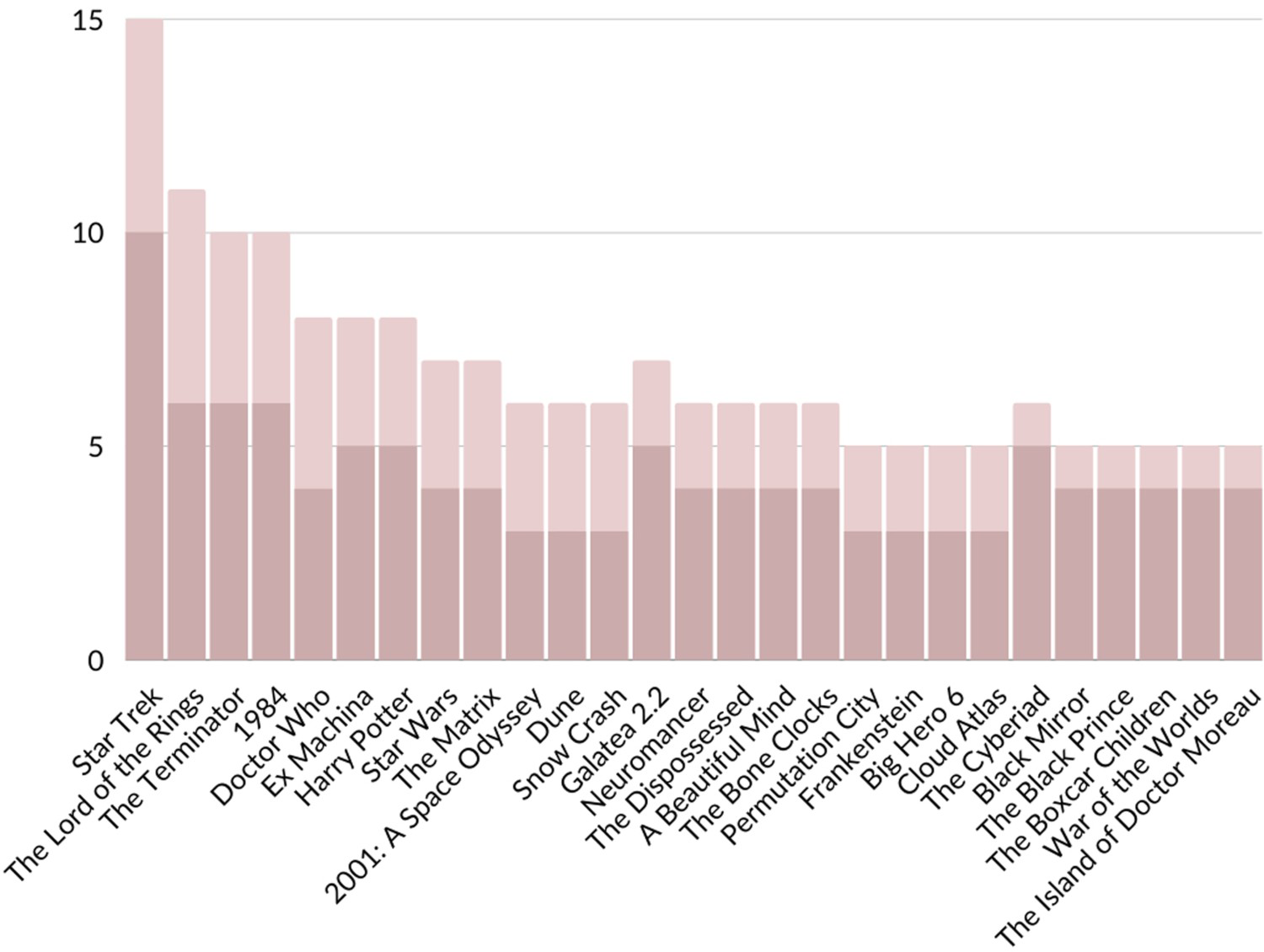
The interview analysis yields six areas in which literature play a role in the field of AI: research focus, career choice, community formation, science communication, ethical thinking, and modelling of sociotechnical futures. The findings in each of these categories are presented and discussed alongside the extent to which they match, dispute, or extend evidence from other studies or sources. The aim of this hybrid approach is to present the results of this study, as well as to start to collect and organize a wealth of further evidence currently distributed across sources. Ferro and Swedin (2009, 87) note that ‘the search for examples is an ongoing effort’ – this study aims to bring existing examples together, as well as provide new evidence. It aims to demonstrate the need for further systematic research, both qualitative and quantitative.
Many general discussions of the influence of fiction on science present a few charismatic examples of direct influence – that is, examples of an idea conjured in a (usually science fictional) story that inspires its real-world development. The most common of such examples is Arthur C. Clarke's ‘invention’ of the global communications satellite. But Clarke came up with the idea not in a fictional story, but in a letter to Wireless World written in 1945 when he was a young officer in the Royal Air Force (Mills 1997, 12–13). A less successful attempt to realize an idea from one of his works of fiction – that of the space elevator – inspired Minsky to spend six unsuccessful months with scientists at the Lawrence Livermore National Laboratory trying to design ‘a pulley that would haul things into space’ (Broussard 2018, 71–72). 6 As Bassett, Steinmueller, and Voss (2013, 3) note, examples of a technology imagined in SF inspiring its material development – what Colin Milburn (2010) calls blueprint modding – are in fact ‘relatively rare’. 7
This study's interviewees disagreed about the extent to which fiction might be considered a direct influence on AI research. I9-M, who works on neuro-science inspired approaches to understanding machine learning, shared the direct influence view –
if you look at all technology that exists today, a lot of it was from sci-fi. That's not an accident, that's because the scientists who developed these technologies read sci-fi. That's one very explicit link that exists between literature and sci-fi.
8
When asked how he thought literature had influenced his research, thinking, and scientific practice, if at all, I7-M suspected that it was examples of blueprint modding that the interviewer was in search of, but he was sceptical that influence functioned in that direction. Instead, he reversed the direction of influence, proposing that the presence of computing technology in literature was a result of the authors in fact being the scientists behind the technology. He pointed to the invented language in Ted Chiang's ‘Story of Your Life’ (1998) – I7-M observed that in this instance, it was Chiang's computer science background that informed the invented language in the story, not the other way around.
Some interviewees were therefore sceptical about the idea that SF, or other forms of literature, might imagine technologies which researchers would then be inspired to create. No interviewees gave examples from within their own careers of this form of inspirational direct influence, but there were examples of literature influencing research focus and direction. I7-M noted that William Gibson's Neuromancer fed into his team's research when it was published. Whilst it did not give them their research ideas, ‘it did make us think a bit about what would be a cooler interface’. I7-M's and his team's relationship to Neuromancer can be understood in the context of wider evidence for the role of cyberpunk in influencing the research focus of those working in virtual reality. A collection of essays by computer scientists published together with Verne Vinge's True Names (1981) (a novella that might be described as proto-cyberpunk) testifies to the influence of that story on their research directions. ‘Did Vinge create virtual reality?’, Pesce asks in that volume, ‘In a practical sense, perhaps not, but something about his novella caused people to revision their work, and refocus themselves towards the ends he described. […] people dedicated their professional careers to realize Vinge's vision. I was one of them’ (quoted in Vinge 2001, 178–179).
I6-F talked about how her reading had influenced her research direction, if not her research output. I6-F works on affective computing and social signal processing and using these for creating emotionally and socially intelligent computing systems. She observed that whilst her reading hasn't ever directly influenced any of her research papers, it has ‘maybe’ given her ‘different ideas to research’. She thinks literature that explores ‘emotions or expressions or personality or even trying to understand humans’ may have informed one aspect of her research, which examines ‘human behaviour analysis or human behaviour understanding’, but with the caveat that this influence was ‘maybe’ at an ‘unconscious level’. The author she cites specifically here is Agatha Christie:
Things like for instance Agatha Christie's books. Everyone has a different personality and to resolve the mystery you need to sort of have these subtle cues as well of what people say, how they act and how they're interrelated to others. You need to have a sense of behaviour, observation of behaviour and understanding. I would say [this] probably indirectly influenced [me] but I wouldn't have used it in my book chapter or paper directly. (I6-F)
Whilst it is sensible therefore to be sceptical about too simple charismatic anecdotes of direct influence, it remains the case that literature does influence AI researchers’ research focus and direction. Other examples beyond the interviews, and in relation to computer science and robotics more generally, include the popular early computer game ‘Spacewar’, which was created at MIT based on E.E. ‘Doc’ Smith's Lensman series (Brand 1987, 224). Pioneering social roboticist Cynthia Breazeal (2002, xi) was captivated by R2-D2 and C-3PO when she was a child, and ‘developed a deep appreciation for the insights that science as well as art have to offer in building “living, breathing” robots’; she says that ‘as a well-seasoned researcher, I began to build a robot in the image of my childhood dream’. Brian Aldiss’ short story ‘Supertoys Last All Summer Long’ (1969) influenced the creation of David Hanson's robot boy Zeno (Slagle 2007). Geraci (2010, 54) notes the influence of Isaac Asimov's work on Western roboticists in particular (see also Hornyak 2006, 79). Ndalianis (2013, n.p.) notes that, ‘as a genre, science fiction has inspired the realization of so-called “entertainment robots” since the 1990s, especially within Japan’, citing as an example Tatsuzo Ishida's proposition that Sony engineer a new type of entertainment robot similar to C-3PO from Start Wars (1977), and the strong influence of the manga and anime robot Tetsuwan Atomu (Mighty Atom, known in the West as Astro Boy), for example on the ‘self-professed fan’ Tomotaka Takahashi (Director and Founder of Kyoto University's Robo-Garage).
Career choice
Literature also plays a role in influencing career choice. Examples of this category of influence are prevalent in the wider literature and were also common in the interviews. Ferro and Swedin (2009, 86) point to the TV documentary How William Shatner Changed the Universe (2006) in which a number of scientists and technologists credit Star Trek as influencing their career choices. Joshua Cuneo (2011) also notes the influence of Star Trek on many researchers going into science and engineering fields. Ferro (Ferro and Swedin 2011, 1) himself, a computer scientist, ascribes his career choice to the ‘defining moment’ of receiving Isaac Asimov's The Rest of the Robots as a fifth-grade Secret Santa-style Christmas present and states that ‘science fiction [has] been an inspiration for those entering scientific and technical fields’ (6). Fleischmann and Templeton (2008, 5) found a salient theme in their interviews was ‘science fiction as a first exposure to science’, arguing that their findings ‘demonstrate the complex and multiple ways that science fiction influences the career decisions of scientists and engineers’. Isaac Asimov's stories and those about Tetsuwan Atomu influence roboticists’ career choice as well as research direction (Hornyak 2006; Geraci 2010; Ndalianis 2013).
Interviewees in our study also identified their SF reading specifically as the gateway to their careers in AI research. I1-M, an expert in cognitive robotics, observes that ‘when I was a kid, I was certainly extremely interested in science fiction and Isaac Asimov's robot stories were very much, for me, the entrée into this whole world of artificial intelligence and robotics’. He continued:
It's [science fiction] influenced me enormously in terms of why I got into this field in the first place. […] my hero, was Susan Calvin in the Asimov stories. I wanted to grow up to be Susan Calvin, the robopsychologist. So that was a sort of literary role model, in a way, that I had as a kid. She was doing exactly what I wanted to do. (I1-M)
I12-M, a machine learning researcher, identified SF as impetus for his career choice and for his research direction, also noting the particular influence of Isaac Asmiov:
I see science fiction as being pretty fundamental in my going into machine learning and perhaps influencing the direction within machine learning that I've chosen. I really loved Asimov in particular, as a child, The Principles of Robots, or whatever he called it. I guess, I took from that the feeling that to design intelligent systems there did need to be fundamental principles that govern their actions. It's still part of my research today. (I12-M)
Further research into the influence of (particularly early) reading on career choice could have an important impact on educational and other initiatives to encourage students into science and engineering careers. Fleischmann and Templeton (2008, 7) come to a similar conclusion, proposing that novel approaches might be developed that use SF ‘as a recruitment tool, especially within the field of information science and technology’ (see also Tambe, Balsamo, and Bowring 2008). Investigation into the role of literature, and SF in particular, might be more regularly and thoroughly considered in policy investigations into what influences participation. For example, it could have usefully been incorporated into the ESRC's targeted Initiative on Science and Mathematics Education's briefing paper, ‘What influences participation in science and mathematics?’ (TISME 2013). Disregarding consideration of literary influences in such contexts risks both omitting identification of a key influence, and failing to take advantage of potentially productive tools of intervention.
Community formation
The first two categories of influence – research focus and career choice – primarily focus on the individual researcher. But work in the sociology of literature has drawn attention to the importance of understanding reading as a collective act, with collective consequences, in particular ones that can shape communities, both who is included in them and who is excluded from them. Long (1992, 110) argues that ‘the ideology of the solitary reader’ has resulted in a lack of attention to the institutional and social dimensions of reading such as what is available to read (and to whom), and what is considered ‘worth reading’ (and by whom). Such questions necessarily involve issues of access and of power. Long (1992, 110–111) argues that the separation of ‘culture’ and ‘society’ – here we might say ‘culture’ and ‘science’ – has led to a lack of scholarship on groups of readers, and a lack of exploration of sources of change other than those of ‘great men of ideas’ or technological determinism. Narrative networks research (Dillon and Craig 2021) and research into ‘textual communities’ (Stock 1983; cited in Long 1992, 111) offers a site for such scholarship, investigating the role of shared storyimbibing in group participation and community formation and cohesion. It can offer a way to explore what Bassett, Steinmueller, and Voss (2013, 36) identify as SF's ‘role in the shared social construction of science’, helping to identify the place of SF in the practice of expert scientific communities. Ferro and Swedin (2009, 84) also recommend that social science approaches to understanding techno-scientific development need to take SF into account when investigating scientific ‘communities of practice’.
Close analysis of the interviewee's language when talking about SF indeed reveals its structuring role in the community formation of AI researchers. Whilst I1-M received his paperback copy of Asimov's stories from his father, who had read them, this was not his first encounter with SF: ‘of course,’, he says, ‘I'd already been, as we all are, exposed to a lot of science fiction in terms of television and cinema, and so on’. The adverbial phrase ‘of course’ is significant here, especially combined with the following phrase, ‘as we all are’. ‘Of course’ emphasizes that a speaker is saying something that they believe to be self-evidently true, but also that they assume will come as no surprise to a listener. Combined with the subsequent subclause, ‘as we all are’, including the second personal plural ‘we’, the language conveys an assumption of shared experience – that ‘we’, some common, unified identity, ‘all’ share the same experience of early childhood exposure to SF, especially via visual culture. This phrase – ‘of course’ – reoccurred, with variations, elsewhere in the interviews. When asked if there was any particular kind of fiction he liked when at university, I2-M, who works on bio-inspired robotics and embodied AI, commented, ‘well of course, the science fiction movies’ which he both liked personally but which were also ‘quite important for my own study and subjects’. Subsequent reinforcement of ‘of course’ occurs, as in I1-M's comments, ‘science fiction, usual things’ [added emphasis]. This can be seen again in computational linguist I3-F's interview, where ‘obviously’ substitutes for ‘of course’: ‘obviously lots of people who are in computer science read science fiction’ [added emphasis]. And again in I5-F: ‘I mean, I read the Asimov's, like everyone in robotics’ [added emphasis].
Not all of the interviewees were SF readers, but those who weren't felt the need to highlight that, revealing an implicit assumption that this would go against the interviewer's expectations, or that it goes against the majority in the field. I15-F, who works on human-like computation, said ‘I'm not a fan of science fiction. So, I don't really read science fiction’ and I18-F, an expert in diagrammatic reasoning, also introduced her disconnect with the genre without interviewer prompt: ‘I am not a big science fiction fan or anything like that. I read a bit, but for some reason the connection was never really there’. I20-M – working on machine learning through probabilistic models – had brought Douglas Adams's Life, the Universe and Everything with him amongst his material prompts, but he noted concern about assuming from that that SF was a dominant influence: ‘I'm wary of going too far in that direction because I wasn't obsessive about science fiction, or solving intelligence, or space in any of those things’. Again though, before the interview he had reflected himself on whether that was the case: ‘I was trying to think if I was at all, and not really at all’. So, amongst interviewees that were SF fans, their language revealed an assumption that this was unsurprising because a universal characteristic of a researcher in the field. Equally, responses from interviewees who did not read SF confirmed this assumption: they made a point of noting what they considered was unusual, explaining why they did not connect with SF.
The interviews provide evidence that reading of, and influence by, SF is assumed to be a shared characteristic of AI research communities. As noted above, though asked about literature, interviewees naturally responded by talking about their storyimbibing across media. In this category context, they referenced not just SF literature, but SF cinema and television as well. I1-M posited that
when it comes to AI researchers and science fiction, there's a much more intimate relationship to cinema, and probably TV as well. So where do you start? As I say, I think you'll find very broad familiarity with just about everything. Everybody's seen everything that you talk to. So everything from 2001 and Star Wars and Forbidden Planet. I imagine that you've already found that people in my field are very well-versed in science fiction. It may be cinema and film as much as anything else, but everybody's familiar with the same stuff. I think it has a huge influence on people's thinking, in a way, in my field.
Interviewees talked explicitly about SF serving a community-formation function and as a means of communication between researchers (the latter is discussed in the following section). In both instances, influence works here in a feedback loop: researchers in the field experience, or see evidence of, the communal effect of shared SF literacy, so imbibe the stories to share in that community, thereby reinforcing the function of SF in that community formation. I20-M, not an avid SF fan, nevertheless read Asimov's Foundation series at the recommendation of a colleague. Their shared knowledge of the books then provided grounds for interaction: ‘once I'd read it, we can talk about it. The ideas in a book become a way of connecting between each other’ (I20-M). I6-F identified evidence of the importance of the genre to researchers in the field such as the fact that at one of the major AI research centres in the UK two communal areas are named after SF writers – Isaac Asimov and Iain M. Banks, and that one of the company founders mentioned an SF text as inspiration. She took this as an indication that it was important also for her to read these works: ‘I think there's some assumption that there's familiarity with these sorts of things, which is probably why I wanted to read it [Banks’ The Player of Games]’. SF therefore serves – as I10-M, an expert in deep learning and computational neuroscience, described it – as ‘a great bonding thing, bonding tool for other people and being able to share ideas’.
The wider literature provides further evidence that SF serves as a form of community formation within AI researcher collectives, and computer science research communities more widely. Vernor Vinge's True Names, already discussed, coalesced around it computer scientists such as Danny Hills, Timothy May, and Marvin Minsky, and was, anecdotally, required reading for graduate students in AI at Carnegie Mellon in the 1980s (Geraci 2010, 51–56; see also Abbate 2011, 189 on the influence of Vinge's work). May (in Vinge 2001, 10) discusses True Names’ influence on the ‘cypherpunk’ community, which recommended it to new members, along with John Brunner's Shockwave Rider, Orson Scott Card's Ender's Game, Neal Stephenson's Snow Crash, and Hakim Bey's TAZ. In his study of MIT's Media Lab, Brand (1987, 224) observes that ‘science fiction is the literature at MIT. The campus bookstore has a collection as large as some science fiction speciality stores. Every computer science student knows and refers to John Brunner's Shockwave Rider, Vernor Vinge's True Names (Afterword by Marvin Minsky), William Gibson's Neuromancer’ (Brand 1987, 224). Powerfully charismatic individual stories have ensured the cohesion of a specific research community despite fragmentation and dispersal across other more established identity categories such as industry and academia. Allucquere Rosanne Stone (1991, 98–99) identifies William Gibson's Neuromancer as one such work.
Whilst this shared SF literacy has distinct advantages in terms of community formation and cohesion, it also poses certain risks. Three were identified in the interviews: (1) the risk of not reading other literature; (2) the risk of being influenced by poor SF; (3) the risk of exclusion. Larger quantitative and qualitative studies are needed to further investigate these potential risks:
Risk of not reading other literature
Some interviewees expressed hesitancy or uncertainty about AI researchers’ shared SF knowledge. One wondered if the focus on SF precluded wider literary reading which might expand AI researchers’ minds in different ways: ‘not everybody is particularly well-versed in other kinds of literature. Maybe that's not such a good thing’ (I1-M). Many researchers noted early and voracious reading, often influenced by their parents and resourced by local libraries. That said, I5-F reflected that the SF focus of the AI researchers around her limited her incentive to search out different types of reading: ‘I probably would enjoy other types of books. I might just be surrounded by a crowd of people who haven't pushed them in front of me, so I probably need to do more of an effort to look into those other types of genres’. The interviews allayed this concern to some extent, since all of the interviewees displayed deep and wide-ranging fictional reading beyond the genre of SF, although less professional influence was attached to such reading.
Risk of being influenced by poor SF
I11-M, who works on kernel methods, was particularly concerned about the compulsion to read SF works because of their contribution to collective thinking, in instances where those works were of poor quality. ‘Sometimes I read books because they're part of the conversation,’ he said, ‘I'll read stuff, even if I think it's sort of facile’. The example he gave was Ernest Cline's Ready Player One (2011) which he described as ‘a really awful stupid book’, but which he read because his team was reading it and he wanted to know what insight it would bring. Given how poor he found the book, he expressed concern if that was the quality of fictional ideas that were informing his team's work.
Risk of exclusion
I14-F looked back on her early voracious reading of SF with concern regarding the influence the portrayal of women and the explicit misogyny of many canonical works of SF had on her perception of herself:
The other really big thing that happened in junior high was that I got assigned to read science fiction which I'd never heard of. The very first science fiction I read was Andre Norton. All of a sudden that was like this huge shift and then I read all the science fiction in the […] library. I think, in some ways, that was really cool and exciting but it was also probably bad for my self-image because I probably internalised all the … because I read all the Isaac Asimov and all that. I think I really internalised a lot of the misogyny that was in a lot of that.
Therefore, even though AI researchers might be engaging in shared consumption of science fictional narratives, different researchers may be taking different things from them. In particular, researchers from minority backgrounds within the population of the field (as a result of race, gender, religion, class, and other categories) may well experience them in radically different ways – for instance identifying issues relating to social justice rather than focusing exclusively on the AI-related content. This different interpretation of a story might alienate such researchers from the AI community despite their participation in its shared SF reading and viewing. Attention, therefore, needs to be paid to which literature dominates in a researcher collective, and there is a need for increased narrative literacy (Dillon and Craig 2021) in those imbibing the stories, so that their multiple meanings and effects can be better understood.
Exclusion can occur through differing hermeneutic acts, but also through the types of literature that are dominating. This risk is hinted at in I10-M's observation that ‘most people here tend to share a common cultural background’. There is a strong case to be made that this uniformity of background is a weakness, not just a perceived strength. Ferro and Swedin (2009, 87) note that ‘if we accept computer development as community, culture, or social process then there are cultural requirements. There are decisions by members of that culture as to who is in and out of that culture, language that informs and creates it, networks of relations woven, organization that is created and evolved’. Literature, in particular SF, plays a key role in these operations of community inclusion and exclusion. Ferro and Swedin's (2011, 2) findings confirm that SF ‘plays a role in defining social relations and helps determine who is inside and outside of the community of the creators of digital culture’. Bassett, Steinmueller, and Voss (2013, 3) found that SF ‘influenced certain groups disproportionately (operating within relevant sub-cultures as entry points/gatekeepers – for instance gendered hacker cultures)’. Further investigation is needed into the way in which the expectation of shared knowledge of certain types of SF might serve as a gateway to the field for some, but as a gatekeeper for others, in particular, if (as the interviews suggest might be the case) the dominant operational stories are primarily works produced by white Anglo-American men (see Figure 2). Such further investigation should be taken into account in the shaping of public initiatives attempting to diversify the types of researchers entering, and remaining in, the AI and computer science fields.
Total mentions of authors (higher values) and number of interviewees who mentioned author (lower value).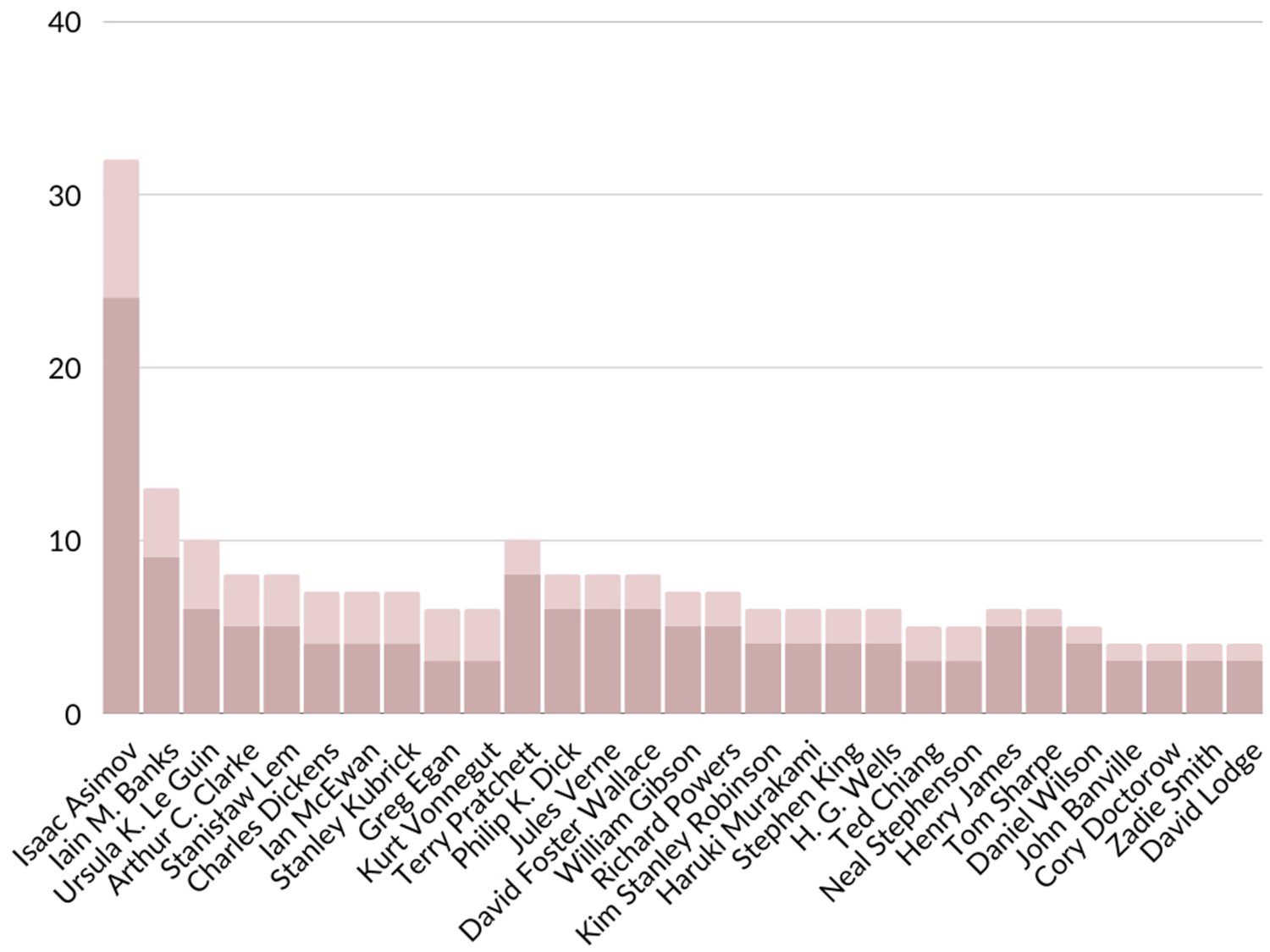
AI researchers’ story imbibing, again in particular of SF works, aids (1) communication of research ideas internally, that is within researcher communities and with students, as well as (2) plays a role in external science communication.
Internal communication
SF provides a communal metonymic shorthand – a databank of shared knowledge, assumptions, characters, plots, and ideas – that enables AI researchers to communicate better with each other and, if they are based in universities, with their students. I10-M observes that:
you want to communicate a concept and or an idea or a piece of technology. And you can just point to the relevant science fiction movie or the relevant character from a book who is a stand-in for an idea. And that is often a very effective mode of communication. we need students to have a prior knowledge of what we're talking about. Otherwise we have to build everything from zero to there. I think it's good that very popular literature or even sci-fi movies, all these stories are a baseline of our communication. So, you know, if we don't have the Star Wars movie I don't think we can talk about research anymore, right? [Laughter] Seriously, ‘Imagine that scene and that robot is this, but how can we do it in the real world?’ Right? So, that's the, kind of, typical communication we have, and that's the contribution of literature, I think. I was teaching an intro course on machine learning for the first time this year, and I finished up by saying, ‘Look, we don't know, we can't really imagine what's going to happen if artificial general intelligence does happen. As scientists we can't really imagine that, but science fiction writers have talked about that.’ So I was telling them obviously Asimov's laws of robotics, I told them about slightly obscure science fiction books, a couple of books called Roderick and Roderick at Random by John Sladek.
External communication
SF also plays a role when it comes to communicating externally, that is, with publics not part of the researcher community. Stories about, or relevant to, AI (both fictional and non-fictional) constitute a body of enduring narratives – often problematic ones – that affect both AI researchers and the public, and have a significant influence on the development, communication, and reception of the scientific research (The Royal Society 2018). Many interviewees talked about the way in which literature explores and transmits these narratives, by which they themselves are sometimes influenced but also with which they must contend or become familiar in order to communicate their research to the public.
I20-M identified an external impetus to familiarize himself with the body of AI stories, not because of his research community, but because of his external work: ‘I talk a lot in public about AI and machine learning, and more recently I've had to make sure I'm up on the literature that has inspired others. It wasn't an inspiration to me’. He read Frankenstein, for instance, as part of ‘a stage of making sure that I read all these interesting classic books’ (I20-M). I18-F started reading popular science and other stories around AI when she began to do public engagement work in relation to her research, ‘just to get an idea of what other people, what normal people think about AI’. But her science communication work was motivated in part by a frustration with the disconnect between the state of the actual research and the public discourses around it. She noted the tendency in the mainstream media towards stories about AI that are driven by and/or drive collective fear, such as The Terminator:
I might start off just googling The Telegraph or something, something that everyone in this country has an opportunity to read, about artificial intelligence or anything. ‘AI robots are taking over’ and that Terminator idea. It's because I think it is something that there is a lot of mistakes around it. The state of the art AI is nowhere near close to what the media portrays it to be, to be honest.
Many other interviewees identified problems and challenges with dominant stories about AI. I1-M talked about ‘the somewhat negative narratives about AI that are out there at the moment, which, I think, are very often really misguided and misinformed’ (I1-M). He shared with many other interviewees a frustration, in fact an infuriation, with contemporary media portrayal of AI which, he says, ‘is really so often completely off the mark and incredibly naïve’.
I20-M observed that whilst he didn't used fiction directly in his academic work, he used it a lot in his science communication where ‘often it's explaining how it's not like that’. In other words, he considers it necessary to correct what he perceives as misrepresentations of AI, perpetuated by dominant stories. Expressing his views on the relationship between literature and science more broadly, I20-M also addressed the disconnect between AI research and AI stories: ‘some of the very seductive narratives are quite dislocated from the technology’. He noted that this has happened before – for instance, the problematic effect that the negative narrative epitomized in H. G. Wells’ The Island of Dr. Moreau (1896) has had on the reception of GMO – and is interested to see how this plays out in relation to AI. 11
Despite the frustration with media AI stories and the dominance of negative narratives in AI fiction (in text and on screen), some researchers also saw that this coverage could serve as motivation to the AI research community in terms of research direction and engagement to shift public perception. In her public engagement work, I4-F, a reinforcement learning researcher, often uses films – ‘a different way of envisioning an idea’ – because their iconicity and visuality facilitate the communication of an idea. For I4-F stories about AI, even negative ones (if treated critically), can aid science communication:
Especially in a research area where I work on something that's not there yet, how do I illustrate, how do I explain what I'm trying to do and how I'm thinking about this? Often people have a pretty clear association with a certain character in a movie. I love R2-D2 from Star Wars, it's one of my favourite examples because people feel a close connection to those characters and that allows them to grasp what you're trying to do. […] I keep getting asked about Terminator and I'm saying, ‘No, we want R2-D2.’ That's my most common example. (I4-F)
I5-F said that whilst she does not consider her personal reading to have had any influence beyond entertainment, she did acknowledge that the most profound influence of literature on her science was in terms of having to contend with the narratives around their field – again, she mentions The Terminator in this respect: ‘the way it's influenced me most is to really try to understand what other people watching it might be thinking and how we, as a result, need to communicate differently about our research’. Literature, she says, has ‘influenced me in how I communicate about the technology so that we can, in a very direct way, address the fact that the general population has a narrative about this technology that might not be driven by technology, and we need to be mindful of that when we communicate about it’. The same interviewee notes that when people ask about her work on swarms they often use a fictional narrative as a point of shared reference, for instance, an episode of Black Mirror, or Michael Crichton's Prey or Big Hero 6 (which contains an evil magnetic swarm). This has confirmed not just her sense that she has to contend with these stories, but also a desire for more positive SF stories, and a sense that perhaps scientists might play a part in – or even, as a recent Nature editorial (Editorial 2018) argues, have a responsibility to contribute to – creating those more positive stories: ‘If you think of the biomedical applications I work on, if you think of the things that we want to do in terms of environmental monitoring – those aren't the scenarios you'd find in science fiction, and actually I'd love for them to be in science fiction’ (I5-F).
I5-F voiced a shared sentiment amongst the interviewees: ‘I'd like for our technology to be perceived in those positive ways’, giving the films Robot and Frank and Wall-E as examples of popular films that break the negative mould. I15-F echoed this:
I would very much prefer the novels to reflect the reality of science, and where it is, and the frontiers of science […] I understand how AI works, and what the possibilities are. I would much prefer to read stuff that reflects that, rather than scaremonger people. (I15-F)
One very interesting example from the wider literature of serious engagement with an AI story in order to explore and communicate the state of the science is Stork's (1997) Hal's Legacy: 2001's Computer as Dream and Reality, in which prominent figures from within AI engage with Kubrick's film adaptation of Arthur C. Clarke's novel (who writes the foreword to the collection) in order to reflect on the past, present and future of a range of aspects of the science. More broadly, Bassett, Steinmueller, and Voss (2013, 3) note that SF influences how science and technology are publicly understood and debated (see also Fleischmann and Templeton 2008). Ferro and Swedin (2009, 88) point to Suominen's (2003) study ‘examining the role of popular culture (including Science Fiction) on preparing the Finnish public for computers even before the first personal computer arrived’. 12
The House of Lords Select Committee on AI's report (Select Committee on Artificial Intelligence 2018, 23) notes that ‘many AI researchers and witnesses connected with AI development told us that the public have an unduly negative view of AI and its implications, which in their view had largely been created by Hollywood depictions and sensationalist, inaccurate media reporting’. The report rightly concludes that ‘it is not for the Government or other public organisations to intervene directly in how AI is reported on, nor to attempt to promote an entirely positive view among the general public of its possible implications or impact’ (Select Committee on Artificial Intelligence 2018, 25). However, storytellers and scientists can play a role in sophisticating AI stories, and scholars of literature can aid in developing greater narrative literacy across publics (including scientists) so that existing and dominant AI stories, their functions and effects, are better understood (Dillon and Craig 2021).
Ethical thinking
The interviews demonstrate that SF, and other forms of fiction (from high canonical literature to popular cinema), serve as productive sites for thinking through the ethical questions raised by AI research. Such narratives encourage and aid ethical reflection on the research being undertaken, decisions that need to be made about research direction, and the potential wider consequences of that research. This role of literature was put succinctly by I13-M, who works on machine learning for patient benefit: ‘I think it helps us take a good path’.
I1-M, a researcher of consciousness who also reads a significant amount of philosophy for his professional work, observed that his SF reading prepared him for when he started reading serious philosophy. SF, he observed, is ‘an extraordinary source of ideas. I see it as pursuing philosophical questions from a particular kind of angle’. As a result of his science fictional literacy, he reflected that, ‘I think I was very well equipped to think in these kinds of big idea terms through reading science fiction’ (I1-M). For example, he pointed to the work of filmmaker Andrei Tarkovsky as providing a site for thinking through the philosophical question of minds, over and above its treatment in more ‘serious philosophical literature’:
Both Solaris and Stalker touch on this really extraordinary theme of what it would be like to encounter something utterly alien. I think that's a really deep question, and relates to this whole kinds of minds issue, and is one of the big sorts of questions that science fiction enables to ask. And in many ways, does it better than serious philosophy does. What would it be like to encounter an utterly alien mind? What might utterly alien minds be like? So I think the treatment of that question in serious philosophical literature is very limited. Science fiction, both written and in the cinema, treats that question in a much more interesting way. He's gone to the sort of crucible, where they're creating all of these Daleks that are going to go on, as he knows, to cause untold harm throughout the universe. He's managed to plant the bomb there that will blow up this whole thing, and make it never happen. He's there, about to press the button, and he's saying, ‘Is it the right thing to do? Should I?’ Because just think of how all of these different races came together. Just think of the extraordinary productivity and creativity that was brought about by the- [creation of the Daleks] But there was so much pain and suffering. He's standing there, holding the button, going through, in his head, should he do that? That's an amazingly powerful question to ask in the context of this, in many senses, slightly naff setting. (I1-M)
When asked about how he thought literature influenced his scientific thought and practice, I7-M also identified ethical thinking through literature as a key role. He noted the importance of challenging the dominant public narrative that AI researchers, and scientists in general, do not reflect upon the consequences of their research, and identified that his ethical consciousness was as a result of his reading. The example he gave of literature that encourages an ethical perspective was Gustav Flaubert's Madame Bovary: ‘you get a view of, “You shouldn't do this, because it will do bad things.” It's kind of very simple, but it's not wrong, so that's kind of the main thing’. I8-M talked about Alfred Bester's The Stars My Destination (1956) in which, amongst all the climaxes and explosions, a character makes a speech to the robot butler: ‘He says things there that resonate with me very much, and inform the ethics of my AI research’. I13-M said that his reading
has probably helped me be more ethically minded, possibly. For example, 1984 you've got the TV screen where it's monitoring you and trying to see how you are and thinking of those kind of dystopic futures makes me think of the potential dystopias we can create scientifically and how we need to be careful not to create those dystopias.
I2-M observed that given that much AI and robotics research is on the edge of fiction, stories quite naturally serve as imaginative thought-experiments about socially beneficial research directions:
How we can push the border, that's our job as a scientist and researcher, but the question is which direction we push. Where to push and which direction we should push, and all these things are probably, one way or the other, influenced by literature.
I1-M talked about how literature provides a history of imaginative thinking about the major tropes that continually feature in discussions around artificial intelligence, both within and outwith the research community, from Faust to Frankenstein, Mary Shelley to Ex Machina:
there's a whole thread of large mythological themes that I think it's good to be acquainted with. Because the reason they're there is to make us think, in the most abstract terms, about the largest kinds of questions. So to my mind, that's a big part of what it provides, literature.
The wider literature provides further evidence in this category. When Brand (1987, 224) asked Marvin Minsky why he was friends with SF writers, and kept up with their work, he replied:
Well, I think of them as thinkers. They try to figure out the consequences and implications of things in as thoughtful a way as possible. A couple of hundred years from now, maybe Isaac Asimov and Frederic Pohl will be considered important philosophers of the twentieth century, and the professional philosophers will almost all be forgotten, because they're just shallow and wrong, and their ideas aren't very powerful.
Literature therefore prompts and aids ethical reflection in AI researchers’ thought and practice. I15-F provided an excellent summary of literature's function, and responsibility, in contributing to ethical thinking around AI:
Literature is a very accessible medium, so it's got huge power. […] there are various ethical dimensions at the moment that are very real, in terms of AI and technology, and literature is a place where this can be explored in very practical, real-world scenarios.
Pedagogy
Tambe, Balsamo, and Bowring (2008) used SF in the teaching of AI in order to give students a broader perspective and prepare them to consider ethical issues relating to their research: ‘science fiction stories provide a narrative context for discussing the social importance and significance of AI theories and research’. More broadly, scholars of literature and science are developing pedagogical models and practices that deploy the ethical thinking of literary texts in scientific and technological contexts (Droge 2017; Hansen 2018). Kathyrn Strong Hansen (2018, 338) has developed the idea of ‘literature for specific purposes’, modelled on ‘language for specific purposes’ teaching models, which ‘provides a beneficial framework for the teaching of many discipline-specific concerns’, including ethical questions in science and technology. The interview findings demonstrate the applicability in the context of AI research of Hansen's (2018) arguments for the ethical value of literary thinking (see also Gregory 2009). Such scholars are keen to emphasize that such practices do not replace, but can usefully complement, the more traditional forms of literary teaching found in English departments or on liberal arts courses.
AI Ethics
These findings also support the need for wider disciplinary perspectives, including those from literary studies, to be incorporated into the rapidly expanding field of ‘AI Ethics’ (Dillon and Craig 2021).
Anticipatory narrative models
SF dominated interviewees’ discussion of the importance of literature for modelling the potential social futures to which their AI research could lead, but other types of literature were referred to as well. I3-F said that ‘in terms of science fiction specifically, I see it as really, really important, as a way of exploring things like what's going to happen with AI and so on’. I9-M observed: ‘What science fiction does is it invites you to think about possible futures. So, good science fiction is full of thought experiments’. He pointed to Kim Stanley Robinson's Mars trilogy as an example of fantastic exploration of ‘possible futures’.
In response to being asked how he thought literature had influenced his research, his thinking, or his scientific practice, I10-M responded ‘in very many ways’ but focused down upon this idea of the narrative modelling of possible futures: ‘[it] sets expectations or goals to say, “Here are kind of natural consequences of if you follow down this line of thinking what might happen”’. In relation to one of the big social questions around AI – its effect on the future of work – I1-M also talked about the importance of narrative modelling, but looked back to English modernism from the early twentieth century for such thinking:
There's a philosophical question: what constitutes a meaningful life, if we don't have to work to live? That's a really deep, difficult question. In a sense, the Bloomsbury Group, who were in the privileged position of not having to work to live, were kind of experimenting with having meaningful lives through art and literature and friendship and relationships, and so on. So in a sense, it's a kind of prototype for what might be an answer to that kind of question, if everybody was educated to be able to do that. now there's a lot of this discussion of is AI going to replace a lot of people in the current workforce? How is this going to go and what kind of society could we move towards? In the literature we can explore that without much risk. We can try to see what resonates with people and what kind of society we could aspire to.
Similar comments on this role of literature in their AI research and thought were found in many of the other interviews. I16-F gave Iain M. Banks’ Culture novels as an example of books
giving me some idea of what kind of society we might eventually want to build, if AI is actually solved in some way. To figure out how to build AI that's aligned with human values and can help us to solve the societal problems and set out better incentives for people. So, in research you can look at from different perspectives. You could say, ‘Well, I want to advance my career, where's the area where I can make the next step? Where I can make progress?’ You can also look at in the longer run, ‘Where should we actually move?’ So, what are the kinds of technologies, what's the kind of development that is the most valuable to society as a whole? That is where I see the biggest impact of literature, and not just in terms of the science fiction, of sketching out those various future roles and what the dangers and risks are, but also understanding human nature, understanding society. Understanding how or when technology could fit in there and what kinds of effects that could have. (I4-F)
Literature, therefore, offers anticipatory narrative models of possible futures, providing virtual worlds in which the nature of a potential reality can be explored in detail. In the wider literature, Geraci (2010, 52) notes a former PhD student in AI at Carnegie Mellon identified ‘the novels of William Gibson and Neal Stephenson as better prognosticators and better illustrations of technological implications than the nonfiction of Negroponte, Gate, or Dertouzos’. Ferro and Swedin (2011, 2) found that SF ‘assists in imagining the implications of computing on society and ourselves, or, vice versa, the needs of a society that promotes computer development’. Our interview findings in this respect align with a developing body of work attending to this important function of stories. Focusing specifically on SF, Milburn (2010, 568) calls this function speculative modding: ‘this modified form of science fiction appears frequently in scientific writing as a way of discussing possible futures and extrapolations of current research’. In their overview of the role of stories in Futures Studies, Dillon and Craig (2021) demonstrate that whilst Futures Studies and practices engage with stories and narrative methods to a certain extent, more serious attention needs to be paid to the speculative and anticipatory potential of the vast body of extant SF.
Avenues for future research
The interview study has revealed a number of areas where further research into the role literature plays in AI research is needed:
Medium differentiation
Many interviewees referred regularly to film without distinguishing cinematic narratives from textual ones in any substantial way. More research on the influence of different narrative media – including literature, film, and video games – is necessary to evidence the role stories embedded in different media might play. Bassett, Steinmueller, and Voss (2013, 7) also identify the question of medium differentiation as an area that needs further investigation.
Demographic differentiation
Investigation into the influence of stories embedded in different media might usefully be correlated with interviewee age, and indeed further research into the role of literature ought to investigate different patterns in general across such categories as age, gender, nationality, and more. There is a question of whether generational differences are linked with changes, for instance, in an expansion of the availability of different types of SF (at least in its US and UK history) after the dominance of the hard SF literature of the mid-twentieth century Golden Age and the insistence of magazine editors of that period (for instance Hugo Gernsback and John W. Campbell) on the scientific veracity of the stories they published. 13
SF and diversity
Further investigation is needed into what extent, if any, the types of SF that play a role in AI researcher communities contribute to inequities and lack of diversity in the field, and in the technologies it produces. Such research might seek to further discover, for instance, what authors researchers have read, including more diverse creators of SF. Ferro and Swedin (2009, 92) also identified that research is needed to answer questions such as: ‘How well does it [SF] conscript/retain and, in contrast, exclude, membership to those communities? How big a part of the language is it in those communities? How much have the creations of those communities been shaped by it?’. Such research could provide a basis for recommendations regarding narrative-based contributions to diversity initiatives and/or play a part in critiques of AI from the perspective of social justice and questions of power.
It is possible that the AI community's valuation of SF as a genre does create barriers to entry, less because of the actual contents of SF than because of the reinforcement of certain sociological correlations based on stereotypes about who should be predisposed to read such texts. Moving from the large scale to the finer scale, detailed individual case studies of literary influence on specific areas of AI research, and on specific high-profile researchers, both contemporary and historical, would provide a useful dataset. These could be combined with a study gathering anecdotal reports of influence (such as those found in blogs, talks, media interviews, etc.) and combining them into a substantial body of further evidence. This paper has attempted to lay the groundwork for such work. Studies could be designed that, given actual audience demographics, might reliably investigate the correlation between a liking of SF in general and, for example, the gender imbalance in AI and computer science research more broadly, as well as other measures of diversity in terms of race, ethnicity, class, nationality, and sexuality. 14
Quantitative research
This study has been small-scale and qualitative. Given the extent to which SF was discussed by the interviewees, a large-scale quantitative survey is required to further study the influence of SF in particular on the AI research field. Fleischmann and Templeton (2008, 7) likewise call for ‘a broad-scale survey to test hypotheses developed as a result of [their] interviews’, so that they can be ‘rigorously tested and evaluated’. As well as testing the categories of influence proposed in this paper, and addressing 5.i-5.iii, such a study might also investigate the role of literature at different stages of the life course. Many interviewees talked about childhood and early adulthood (often teenage and onwards), reading, for instance, as having a significant influence. Fleischmann and Templeton (2008, 5) also note that ‘scientists who self-identify as reading science fiction tend to do so most intensively in childhood and youth’ (see also Hartwell [1984] 2017).
Conclusion
AI researchers’ non-professional leisure reading can inform and develop research already underway, and open up new directions of exploration. Literature can expand and energize AI researchers’ thought and some texts, in particular, resonate with individual researchers as a result of their research specialisms. Literature plays a role in career choice, encouraging entry to the field for some. SF in particular serves a community formation function, and aids communication of research ideas with fellow AI researchers and with students. The historical and contemporary weight of stories about, or relevant to, AI is felt by researchers who respond to it both positively and negatively, in particular when communicating with publics. Literature provides a site of imaginative thinking through which AI researchers can consider the social and ethical consequences of their work, and provides narrative models through which they can explore the social and other implications of different potential futures.
None of the interviewees expressed anxiety about the potential influence of literature on certain aspects of their scientific thought and practice. All expressed positivity about the relationship between literature and science going forward. I14-F talked about the importance of literature, and the humanities more broadly, given our rapidly changing society as a result of scientific and technological developments. For him, whilst science can be descriptive, the humanities are crucial to engaging with the consequences of science, which is also where AI research expands to include an engagement with policy:
science can give you descriptive. It can tell you what the likely consequences of a policy will be but it can't tell you which one you should take. It can't be normative. Science is not normative. I think the humanities are the only source of normative. […] if you're actually talking about how to do policy, to me that's more humanities and the whole planet needs that’. (I14-F)
Footnotes
Acknowledgements
Ethics approval provided by the Research Policy and Support Committee, Faculty of English, University of Cambridge. Credit to Nathaniel Zetter for research assistance in processing and visually representing the data on author and work mentions.
Disclosure statement
No potential conflict of interest was reported by the authors.
1
This expanded conception of ‘the literary’ matches its definition in contemporary literary studies. On their website, The British Association of Contemporary Literary Studies, for instance, notes that ‘We are committed to literary studies in the broadest sense, including written, visual, performative and audible texts’. See also Andringa and Schreier ( , 162).
2
Dillon and Craig (, 163) use ‘imbibing’ and ‘storyimbibing’ to denote ‘the different ways in which people receive stories in different media, as well as acts of story engagement such as embellishment, co-creation or sharing, not denoted under the more limited term “reading”’. Where useful, that terminology is adopted here.
3
See Fleischmann and Templeton (, 3) for further references, who note that ‘science and literature studies examine the relationship between technoscience and science fiction on a conceptual level […] but have not undertaken empirical research to examine the impact of science fiction on the lives of scientists and engineers’.
5
For an introduction to the sociology of literature – which includes ethnographic approaches – see English (2010a), and the contents of the New Literary History special issue (English 2010b) it introduces. A case for the incorporation of ethnographies of reading into anthropology is made by Rosen ().
6
7
Claims of direct influence often in fact turn out to be apocryphal, or at least not quite as clear cut as they seem. Another example shared by Bassett, Steinmueller, and Voss (2013, 3) is that the virtual community Second Life is ‘said to be inspired by Neal Stephenson's Snow Crash’ (Bassett, Steinmueller, and Voss 2013, 3), but see Avi Bar-Zeev () for a more accurate account of this connection.
8
To protect confidentiality but aid comprehension, interviewees are referred to as ‘I’ followed by a number, and designation of gender. Research specialism is flagged on first mention of the interviewee.
9
I5-F works on swarm engineering; I14-F researches the design of intelligent systems.
10
11
The House of Lords (Select Committee on Artificial Intelligence , 23) report on AI in the UK also noted a connection between the fate of AI and of GMO: ‘Such witnesses wanted a more positive take on AI and its benefits to be conveyed to the public, and feared that developments in AI might be threatened with the kind of public hostility directed towards genetically modified (GM) crops in the 1990s and 2000s’.
12
13
See, e.g., Ferro and Swedin (2009, 91) and Bainbridge (1982, 122). There is some evidence that modern space rocketry was inspired by SF texts (Bainbridge ), and there was indeed close interaction between Golden Age SF authors and the scientific community in the mid-twentieth century, but Bainbridge (1976, 198) concludes that by 1976 SF no longer had any ‘direct relationship to astronautics’, for instance.
14
Our thanks to an anonymous peer reviewer for these reflections.