



Abstract
The music of English experimental composer Howard Skempton has been described as strangely simple in acknowledgment of its combination of apparent artlessness and subtlety. Drawing on foundational and more recent psychological research on music and emotion, Cavett explores representative examples from Skempton's approximately 140 piano miniatures, written from his student days in the 1960s until this year. She proposes that Skempton's music creates a sense of expectation and thus desire through the creation of pattern repetition that is disrupted, only to be later re-engaged with, creating gratification and a sense of being ‘in the moment’. Skempton then responds to Cavett's interpretation of his music from his unique perspective as the creator of the repertoire under consideration looking back across the trajectory of his creative career.
Keywords
Introduction: setting the scene
This article explores, through the lenses of music analysis and psychology, how repetition can have an impact on a listener's experience of music unfolding in time, and how a composer can manipulate repetition as part of the creative process. In so doing, it illustrates what two different kinds of musicians do and are interested in when communicating about, and through music.
The music analytical sections of this article use traditional techniques developed for the analysis of Western art music to consider repetition in Howard Skempton's music. I hear some of the most emotionally charged moments in his music as being created through repetition of various kinds and investigate whether recent research in music psychology can help me understand why. Howard then responds to my interpretation of his music from his unique perspective as the creator of the repertoire under consideration looking back along the trajectory of his composing career. Since this is an interdisciplinary journal rather than one written specifically for musicians, some preliminary issues should be addressed next.
First, what do music analysts do? It may be something of an oversimplification to characterize the 1980s as a purely positivistic era when the analyst was supposed to be ‘examining pieces of music in sufficient detail to discover, or decide, how they work’ (Cook 1987/1994); after all, the activity of analysis always involved the commentator offering a (subjective) reading of the score. The systematic nature of analysis was, however, underlined by Cook's and other's definitions from the time (Bent and Drabkin 1987; Dunsby and Whittall 1988), which refer to the application of pre-determined techniques to reveal what exactly the music is made of and how it fits together. The autonomy of musical works was challenged by Goehr (1992) and eroded by the advent of ‘New Musicology’ (Agawu 1997), and music analysis now claims a wider purview, drawing on ethnomusicology, gender studies, hermeneutics, materialism and more. Music analysis is still, nevertheless, preoccupied with understanding the specific, with ‘the music itself’, however, that may be notated (or not), created, perceived or contextualized.
Because Western art music, of which Howard's music is a contemporary example, is almost invariably notated, a second preliminary issue needs to be addressed. Intrinsic to my account of Howard's music are my score-based analyses. Other articles on music in this journal include music examples without comment on their form of presentation (for instance, Ball 2011 and Jan 2012). But the current contribution is written against the backdrop of the Black Lives Matter summer of 2020 when music in academia is urgently re-examining its remit, and music analysis is under scrutiny, not least due to Philip Ewell's article on the whiteness of music theory (2020) and its subsequent stormy reception (Powell 2021). The somewhat uneasy compromise offered here is to write the main text for those who read Western classical music notation and concepts but add explanatory footnotes for readers without that background.
Third, what do music psychologists do (for further detail, see Huron 2006; Pearce (forthcoming))? Some music psychology is ‘field research’ which investigates the perception and performance of real music as it is listened to by real people in real life. Though this kind of research has greater ‘ecological validity’ than other methods, it is nevertheless difficult to create consistent experimental conditions in real-life situations, meaning that it is impossible to know for sure what the real stimulus is for the musical experience under examination. A second kind of psychological research creates experimental conditions by manipulating a musical stimulus; its limitation is that the stimulus is typically so artificial it cannot replicate the richness of a performer's or listener's experience. The stimulus might be a simple rhythmic pattern, for instance, or a very short extract from one piece of music, such as was used for much of the famous ‘Mozart effect’ research (Rauscher, Shaw, and Ky 1993, 1995; Steele, Bass, and Crook 1999; Verrusio et al. 2015). A third approach uses computers to model human musical capacities. One advantage of the computational approach is that it benefits from both ‘ecological validity’ by using real music examples and ‘experimental control’ through quantitative simulations of psychological processing generated by the model. A recent, sophisticated example is IDyOM (Pearce 2018). IDyOM creates its two internal models that together seek to replicate how humans experience listening to music in time, one based on its long-term syntactic ‘knowledge’ of musical styles in general and the other on short-term analysis of the structure of the individual piece it is ‘listening’ to.
The research in the three categories just referred to is quantitative. That is, it involves collecting numerical data in order to subject it to transparent, standardized and systematic methods of analysis to produce objective, measurable and replicable results. Such an approach can seem impenetrable to humanities scholars who have not been trained in evidence-based research methods. Indeed, such research can seem, as David Huron acknowledges in his book, irrelevant to a humanities scholar's experience of music, and indeed what interests them about music, which is its ‘function’, or how it works (Huron 2006, 371). It also seems inadequate for capturing the composer's process of production, which brings the artwork into existence for others to respond to. John Sloboda's chapter on composition in The Musical Mind (1986/2008) attempts to bridge the gap between psychology and musical creation, and remains a useful resource.
Finally, what do composers do? Howard offers the following explanation:
They tend to listen to a lot of music, and to do so critically. They also reflect on musical tradition and the environment in which they operate. At its best, composing brings all these experiences into play. The techniques for doing this are individual, as is the process through which elements are selected and integrated. There is much to learn on the practical side but composing music of character is dependent on reserves of imagination and commitment that are beyond analysis (private communication to the author, 9 April, 2021).
Howard's comments imply that composers work inter-textually and in relation to earlier practices. Their art is always and already a kind of mediated repetition – or sometimes repudiation – of tradition. For example, in his response to my contribution, Howard draws explicitly on this notion in categorizing a group of his pieces as ‘chorales’, that is music of chordal, contemplative character, originally written for unaccompanied choir.
The following commentary draws upon the disciplines and approaches referenced in this Introduction, to show how they can illuminate one another and, more importantly, the music they seek to explain. 1
Continuing the conversation
In the book Howard Skempton: Conversations and reflections on music (Cavett and Head, 2019), referred to here as The Conversations, I wrote about one of Howard's pieces, Recessional, as follows:
What is it about [this piece] which speaks to both the sophisticated and innocent ear? Is it because it is sufficiently short for us to sense the whole? Few have the aural capabilities to comprehend long-term harmonic structure and linear relationships but listening to [this piece] gives me at least a gratifying sense of what such structural hearing might be like. There is sufficient repetition for the overall form to be grasped on first listening, yet expected harmonic sequences are beguilingly diverted, and when a diversion returns, it is transformed back into the material from which it derives. I know and yet I don't know what will come next. I feel I am being played with, but I feel I “understand” the music.
Writing at that time principally from the perspective of music analysis and critical musicology, my questions were rhetorical, but more recently I started to see if psychology could help me understand why Howard's music, probably more than other music I enjoy, gives me such a pleasurable sense of ‘understanding it’ in the ‘moment’, as it were; of feeling I ‘know’ how the music is ‘playing me’. I, therefore, sought a different kind of understanding from that which, to date, has informed the reception of Howard's music (for instance by Hill 1984; Parsons 1980, 1987; Potter 1991; Pace 1997; Whittall 2017, 2018a, 2018b). Much of what has been written by these authors has been specifically about Howard's approximately 140 piano miniatures, and I continue this line of investigation here, rather than looking at his later, longer compositions which offer different interpretational challenges. These miniatures were written from his student days in the 1960s until the present. Howard has called them the ‘central nervous system’ (Skempton 2021) of his repertoire.
Elizabeth Margulis acknowledges in the first line of her book devoted to repetition, Music on Repeat, how Music Plays the Mind (2014), that repetition in music seems ‘at once entirely ordinary and entirely mysterious’: it is ubiquitous and yet so common we hardly notice it. Repetition is found in the music of all cultures, and fundamental to our experience of it. It has societal and cognitive benefits. We are probably hard-wired to enjoy repetition even when not fully aware something is repetitive. Though I do not make a case that we listen to repetition in Howard's music differently than in other repertoires, repetition is a constant compositional preoccupation in his piano miniatures, particularly the ones composed during the period from the 1960s to 1990s, as Howard acknowledges in The Conversations. What is more, from a perceptual perspective, the texture of these short pieces is often consistent throughout and consequently repetition (except in a subcategory of pieces referred to later) is aurally easy to identify. There ‘is sufficient repetition for the overall form to be grasped on first listening’, as I put it in my quotation above. As Margulis puts it far more poetically than I can: ‘repetition enables us to ‘look’ at a whole passage, even while it is progressing moment by moment’ (7), and her book is a conspectus of the evidence to date on how and why this is the case. Howard's piece senza licenza (please listen to Soundfile A and see Example 1) exemplifies this process.
My analysis is not dissimilar to Arnold Whittall's in The Conversations, but Whittall is interested in the balance between innovation and tradition, or what he calls the ‘strange and the familiar’ in Howard's music, rather than the effect of repetition.
In Example 1, each unique ‘event’
2
is numbered as it occurs in the music, from (1) to (21). When one of those events is repeated, it is underlined. This nomenclature highlights what is aurally evident: there is a high degree of exact or almost exact repetition in this piece. The layout of the score reflects the music's longest repeating units. There are four phrases, or ‘units’ as I'll call them to avoid tonal implications, in all. Unit 1 is repeated exactly in unit 3; units 2 and 4 are similar to each other, and to unit 1.
3
Set-theory nomenclature
4
is added under the stave to indicate similar, or identical, pitch and interval-class set content, which is not to imply that the music has no tonal implications – indeed Howard says in The Conversations is that ‘[The piece] starts with a B, C, and E, so it is like a suspended A minor triad. Then it resolves into an A minor triad [as event 2]’ (49).
5
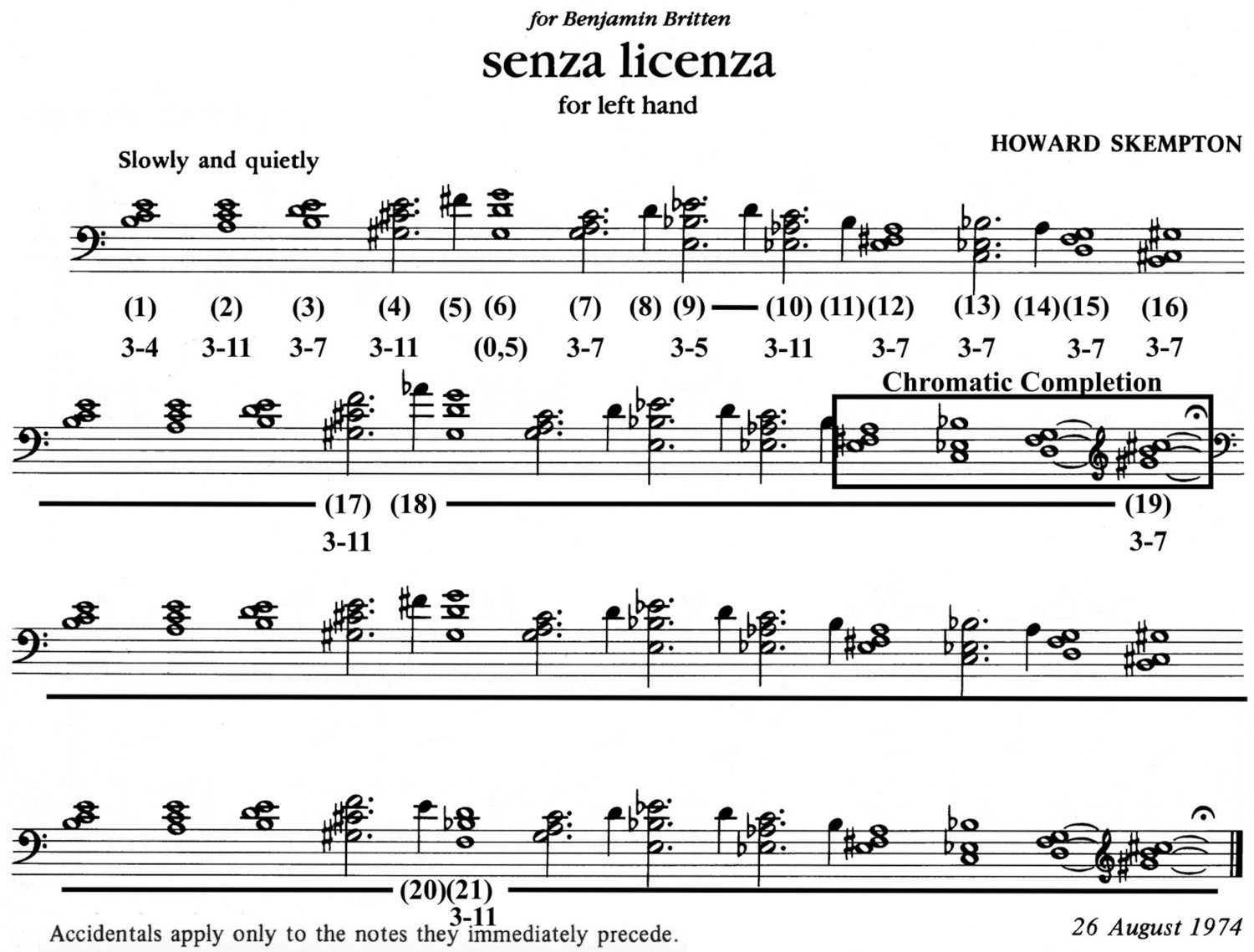
The major/minor set 3–11 even occurs three times in each line. Using traditional tonal terminology for a moment: an A minor chord is the second such event; C-sharp minor/major (in second inversion) the fourth event; and the chord of A flat major (again in second inversion) is used a bit further on (see event (10) in the first line, and then beneath it). In the bottom line, there is an additional B-flat major chord as event 21. The music may be triadic, therefore, but it is not tonal in any conventional sense. Instead, set 3–7, which can sound like a jazz-style seventh chord, forms much of the rest of the material. 6
The four forms of set 3–7 occurring at the end of line 2, and then again at the end of line 4, complete the 12-note chromatic. 7 Howard says, in his response below, that this pitch structure combination was deliberately ‘engineered’. I am not, however, consciously aware of such a resolution through completion, as Webern or Charles Rosen might have called it (Rosen 1976). 8 Rather, to my ear, it is the distinctive, high sonority of the last chord of those lines which is aurally most striking, simply because it is so outside the previously established registral range.
Another aurally striking and much-theorized aspect of tonal Western art music is its ‘goal direction’ (Schenker 1935/1979; Rosen 1971/2005). This phenomenon is exemplified in the overall tonal shaping of a piece of classical music, which starts by establishing a home or ‘tonic’ key, then moving decisively away from it, and concluding with a return to the tonic. A significant part of the drama of tonal music is the ‘artistry’ by which the composer negotiates this tonal homecoming, often playing with our sense of expectation as to exactly how and when it will occur. Bringing out the contrast between this purposeful trajectory and the character of much of Howard's music, an early writer described Howard's musical style as representing ‘the moment turning back on itself’ (Zimmermann, quoted in English translation in Parsons 1987, 16). What this could be taken to mean in the case of senza licenza is that the music does not go anywhere in a conventional sense. Despite its major/minor triads, it does not resolve tonally, it does not have a sense of drive, but more a sense of ‘the moment’ being re-examined; and the shadow of a melodic line seems gently to float up, not down, in contrast to the traditional tonal, driving descent to the tonic at the PAC, 9 the close of the fundamental line. This kind of ghostly, wandering Urlinie 10 – a melodic line which is there but hardly so – is characteristic of many of his piano miniatures.
One of Howard's most devoted and expert performers, the pianist John Tilbury, gave his view of this piece in The Conversations: ‘The first line is repeated in line three, but line two reaches up to A flat [my event 18] which I find unexpected and very expressive. Then in the fourth line, which one would expect to repeat line two (just as line three is a repeat of line one), instead of the “expected” A flat, he takes us through to an E and then a B flat major chord [my events 20 and 21] which is really also a surprise’. These comments show a performer trying to make sense of the score as it unfolds in time. As a performer, one is constantly listening both forwards and backwards, just as happens in the computer programme IDyOM referred to above. This is the case even if one has heard the music before, many times. Tilbury's description indicates that he experiences surprise, as if for the first time, in music he has known for many years and indeed recorded for Sony (Skempton 1996b).
A qualitative diversion/investigation
Margulis reports on an experiment (Margulis 2012) which confirmed the hypotheses that listeners shift their attention from short, repeated units to longer repeated units over the course of successive exposures. In the quotation from The Conversations give above, I confidently proposed that music such as senza licenza could be ‘grasped on first hearing’ due to its repetition but know that in fact I cannot know what relation my score-based analysis of senza licenza bears to my initial hearing of this piece long ago. Memory is a notoriously inaccurate representation of fact (Loftus and Palmer 1974). Accordingly, to test my assumption (I do not call it an hypothesis, because I was not conducting a true experiment in any scientific sense), I interviewed four professional musicians (acculturated in Western art music) to see what they thought of Howard's music on first hearing.
11
Two were composers and two performers who taught in London music conservatoires. In other words, these people were people quite like the authors of this essay and those who originally wrote about Howard's music and informed initial reception of it. I asked my interviewees to listen to senza licenza (which none of them knew before) just once and give me their immediate responses in descriptive rather than technical terms. My orientation was that of Interpretative Phenomenological Analysis used in qualitative psychology (Smith, Larkin, and Flowers 2009), a precursor of which is the phenomenological music psychology research by Gilman and Downey from the 1890s (Juslin and Sloboda 2010/2012). The interviews were semi-structured with open questions. Here are some extracts from the transcriptions:
The repetition is clear, but it wasn't obvious. When the opening three chords came back, that was clearly beginning another cycle but then it seemed that each one carried out its own thing. It is a really strange effect aurally. There are clear repetitions but that don't describe the spirit of the piece. The spirit of the music is unfolding rather than repetition. Repetitions are variations of various things, like the different petals of a flower. I loved that it seems to me that each section starts with three to four chords but then seems to take slightly different tack each time. Repetition enhanced my enjoyment. It gives me something to hold onto, so I can go along each new path.
These extracts show how two of interviewees heard the first three chords of each line as similar, and the rest of each line as unfolding in different ways. All of them sensed material coming back and being slightly different when it did so, which of course is not quite the case since line three is an exact repetition of line one, though positioned in a new temporal context.
These responses and my analytical commentary suggest that Howard's music – for me and probably for others who say they enjoy it – offers patterns of repetition that have sufficient variation to sustain interest and enough familiarity for comfort. Huron (2013) explains this ‘compositional strategy’, as he called it, as organizing patterns of repetition in music so as to ‘maximise processing fluency while circumventing the problems due to habituation’ (2013, 8). Habituation occurs when an individual reacts less and less when repeatedly exposed to the same stimulus (Harris 1943). In seeming contradiction to habituation, processing fluency refers to the situation where people prefer stimuli which they find easier to perceive. Easy mental processing creates positive emotional reactions and aesthetic pleasure which listeners wrongly attribute to the stimulus itself (Reber, Norbert, and Piotr 2004). Whether or not conscious of the different kinds of mental stimuli and responses involved, Howard seems to be taking ‘advantage of the positive hedonic effects of processing fluency while minimizing habituation’ (Huron 2013, 18). Thus his music provides both an optimal degree of challenge (for cognitive processing) and an optimal level of arousal (for affective processing), which might explain why, as I expressed it earlier, his music pleases both the innocent and sophisticated listener.
One for Molly: the ‘implication-realization’ model of music analysis
John Tilbury's ‘surprise’ at certain events in senza licenza, referred to earlier, is a seasoned performer's shorthand for the perception that senza licenza, as with many of Howard's miniatures, create a sense of expectation – and thus desire – through setting up a pattern repetition that is disrupted only to be re-engaged with, creating gratification. Of course, we can expect something we do not desire, and to examine more fully the ramifications of this observation would be to paraphrase much of David Huron's foundational book on the psychology of expectation, Sweet Anticipation (2006), which acknowledges the formative contribution to music theory and music psychology of Leonard Meyer and his implication-realization model of analysis (1956, 1973) and developments since then (including by Margulis 2014; Narmour 1990, 1992; Schellenberg 1997).
Meyer's approach was influenced by the principles of the ‘law of good continuation’, completion, and closure proposed by Gestalt psychology. Applying these principles to the perception of music, he considered that certain patterns in music will set up expectations in a listener for particular outcomes which are either frustrated or confirmed by what follows. In this way, music has an information content which conditions our emotional response to it, very much as was proposed in behaviourist psychology of the time. Meyer's writings were somewhat unsympathetically reviewed from the perspective of music analysis during the decade following publication of his book Explaining Music (1973), not least by the present writer (see Dunsby 1983), but as music psychology was increasingly considered a part of mainstream academic music studies, he was seen as a founding figure (see, for instance, Cuddy (2008)). Rather than further theorizing Meyer, what follows is an analysis of Howard's One for Molly, drawing on Meyer's model. It is performed by me online. See the link below Example 2.
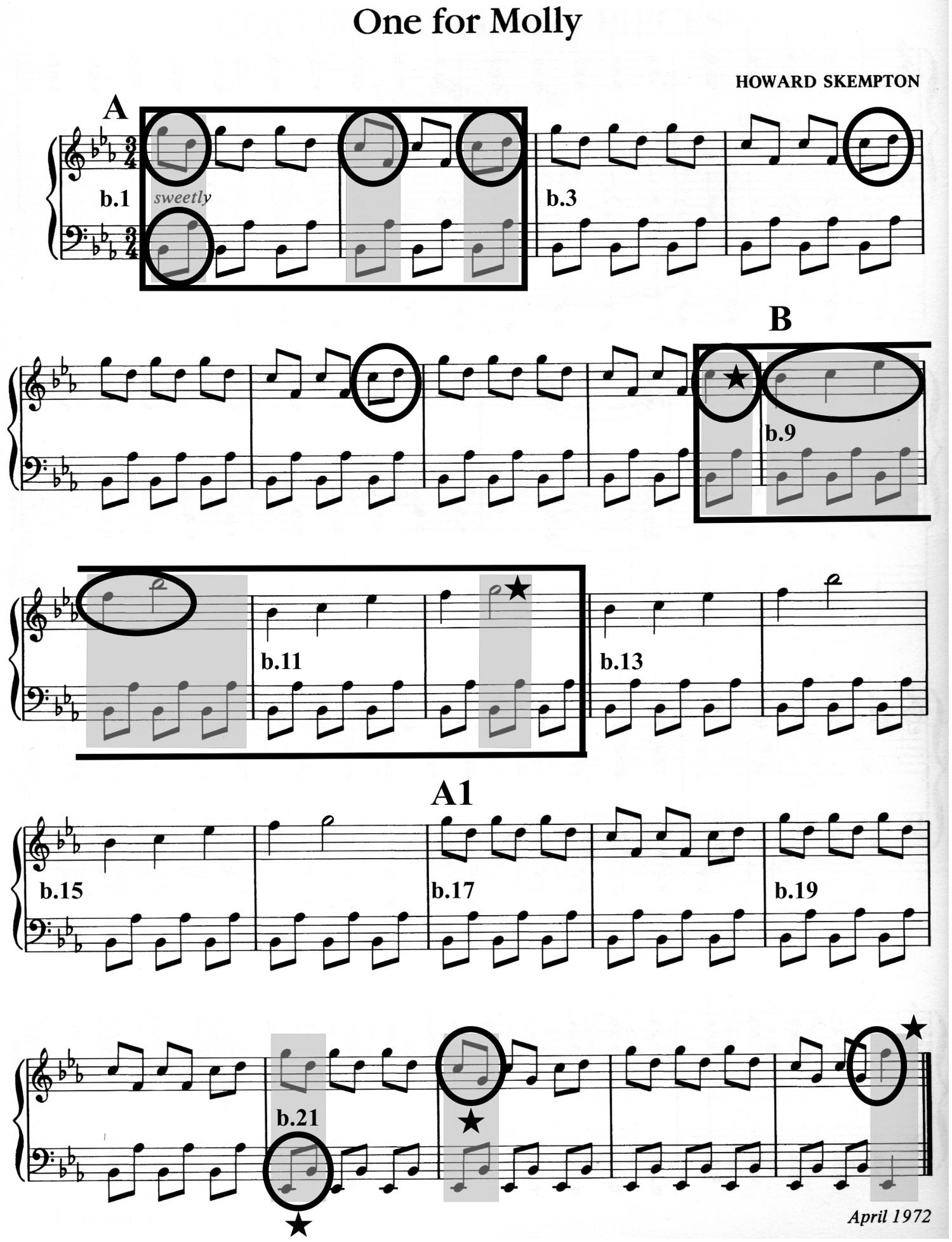
Readers can listen first without the score, recreating the quasi-experimental conditions of my interviewees, or listen simultaneously with reading Example 2, an annotated score of the music
The annotations show (and listeners will have heard) that the piece is in ternary form with the inner section (marked ‘B’) distinguished from the outer parts (marked ‘A’ and ‘A1’) by a predominantly crotchet, rather than quaver motion in the right hand. The piece starts with minor 7th quaver oscillations in the left hand, B flat to A flat, which are continuous until the last line where, at bar 21 (circled and marked with a star), the LH drops to an E flat to B flat oscillation which lasts until the end of the piece.
It is clear, therefore, there is a high degree of repetition in this piece, both regarding longer and more immediate units. Looking at the longer units (shown by the oblong box outlines), bars 1–2 are repeated exactly in bars 3–4, 5–6, 17–18 and 19–20; and bars 9–12 are repeated in bars 13–16. Regarding shorter units, the greyed-out boxes on the score indicate the first statement of each short unit which is subsequently repeated. I could lay these two distributions out paradigmatically 12 but I hope my shorthand annotations serve their intended purpose, which is to show that about 4/5ths of the total material in the piece is repeated.
The features just noted were remarked upon to a greater or lesser extent by my interviewees, but none of these seasoned music professionals mentioned what interests me as a performer and thus listener who has been regularly exposed to this piece. What catches my attention are the ‘surprise’, to use Tilbury's expression, deviations from expected repetitions which are marked with little stars (a new analytical nomenclature of my own(!)), to highlight the moments which seem to me almost to audibly glow. These moments are as follows:
The ‘missing’ D at the end of bar 8 (please observe the notes in circles in bars 2, 4 and 6 where C is followed by D, and contrast those with what happens at the end of bar 8). The ‘new’ G at the end of bar 12, which ‘usurps’ the B flat at the end of bar 10. The quasi dominant seventh, the B flat to A flat interval which the left hand plays constantly from bar 1 to bar 20 inclusive, functioning as a reference sonority
13
simply due to incessant repetition, to quasi tonic
14
‘resolution’ in b.21 (the oscillating E flat to B flat in the left hand starting four bars from the end and lasting to the last bar, mentioned earlier). In bar 22, G replaces the ‘expected’ F (please compare bar 2 with bar 22, for instance, as indicated by the circle annotations). In the last bar, the now expected C (from bar 8) is replaced by F, arguably supplying the missing F from three bars before, and also creating the same interval (a minor 7th) as in the left hand, bars 1 and following.
I enjoy the features referred to here as ‘surprise deviations’ even though I've played and thus listened to this piece again and again. It is as if Howard is playing little aural jokes with me and indeed psychology's research into how we understand jokes in terms of failure of expectation is relevant here (Huron 2004). Generally, though, Huron (2006, 351, quoting numerous other psychological studies) observed that structures in music which excite music theorists have been shown to lack perceptual salience. Margulis, again referencing prior experimental evidence, puts it somewhat differently, saying that ‘repeated listenings engage listeners with stimulus at different levels, connecting them [at each listening] with new aspects of the same sound’ (2014, 97). Janet Schmalfeldt, from her music analytical-critical perspective, would agree, claiming that ‘repeated hearings can only enrich the memory of expectations and surprises that first-time hearing may have aroused’ (2011, 9).
Piano Piece 1969: finding a narrative
The above discussion considers examples of repetition within two short pieces which are representative stylistically of much other Howard music, and particularly his miniatures. They are consistent in texture, harmonically somewhat ambiguous, yet with obvious units of repetition defining the overall form. There is, in contrast, no obvious repetition in Piano Piece 1969 (Examples 3 and 4).
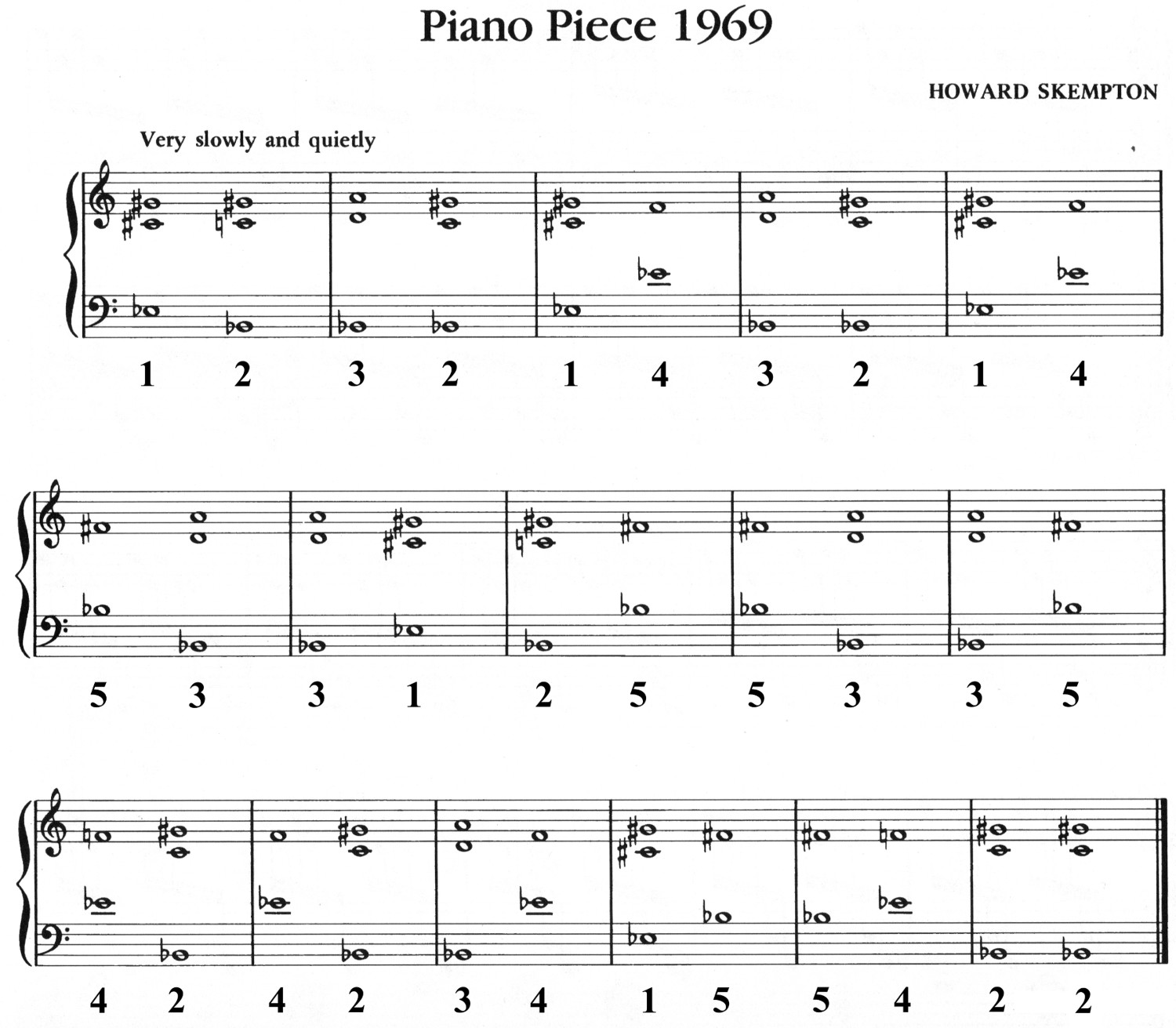
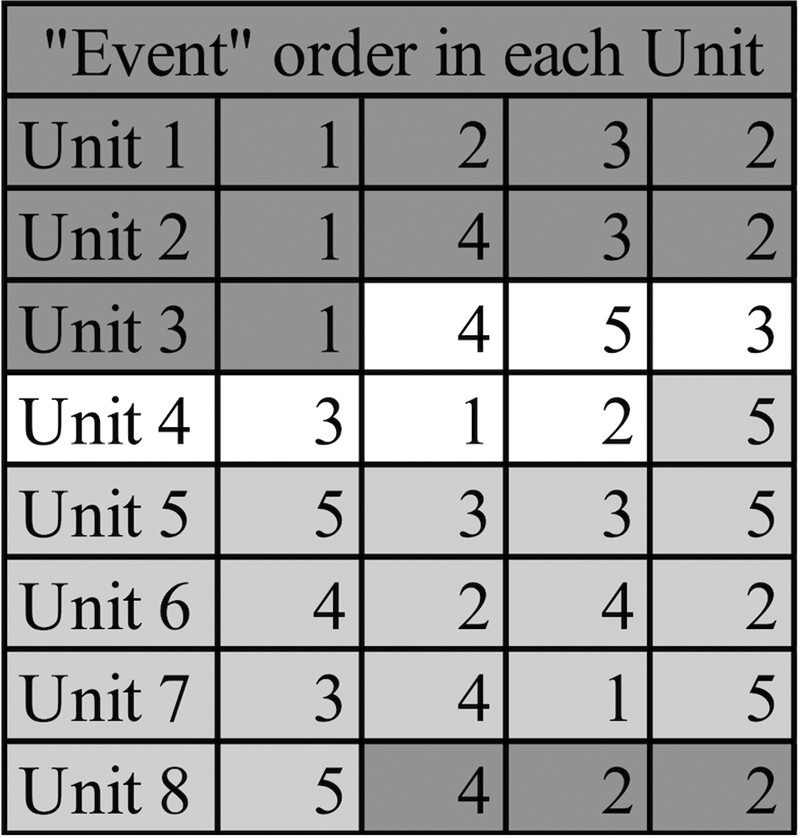
The annotations under the score in Example 3 indicate that the music consists of five ‘events’ in total. As my tentative segmentation in Example 4 shows, I hear the 32 statements of these five events as subdivided into units consisting of four events each. To make my discovery procedure explicit: I am looking for units of repetition and my analysis indicates that I have seen – and heard – that the first and second units begin and end with event 1 and finish with event 2, and unit eight ends with two statements of event 2. Unit three starts with event 1 but wanders off into new territories as unit 5 comes to the fore: event 5 ends units 4, 5 and 7, and begins units 5 and 8. Overall, I hear the piece as making shadowy references to both binary (‘A, B’) and ternary (‘A, B, A1’ forms). Unit 3 and Unit 4 act as a kind of transitional bridge between the A and B sections.
Howard says in The Conversations, as he has said elsewhere (Fallas 2012), and says in his closing response, below, that the ‘events’ were created intuitively, but that the subsequent ordering, to create the piece, was generated by pre-determined chance procedures. Nevertheless, I want as a performer to find ‘how the music goes’ and to convey this interpretation to the listener, as well as – later – in my analysis. Whittall in The Conversations analyses another of these chance procedure pieces – Toccata (from 1987) – by looking for (and finding) a degree of pattern repetition in it. Howard, too, remembers his younger self being fascinated by finding ‘all sorts of little patterns in a small sample’ (The Conversations, 40), whether in music, or in pebbles on a beach. This impulse towards identifying order and shape in unfamiliar things, in order to account for their relationship to one another, is as old as stories themselves, when ancient societies used stories – in lieu of scientific understanding – to make sense of their surroundings. The narrative urge to sense-making is intrinsic to cognitive mental processing, as Dennett (1991), Bruner (2002) and have shown.
The beguilingness of metaphor
Psychologists would call expectations arising during listening to piece for the first time ‘dynamic’; expectations arising from knowledge of what happens in a particular piece having heard it before ‘veridical’; and expectations which arise due to familiarity with a typical practice ‘schematic’ (Huron 2006, 227; Margulis 2014, 92). My preceding analyses have focussed on the first two kinds of expectation. In contrast, Whittall's exploration of the concurrently ‘strange’ and ‘familiar’ in Howard's music, referred to earlier, proceeds against schematic expectation – that of the relationship of Howard's music on the one hand to classical tonality and on the other to post-tonal modernism, and its imperviousness to traditional techniques of music analysis.
Rather than investigating Whittall's ambitiously broad vista further, I became interested, as his interviewer over many months in the summer of 2016, in how Howard creates another kind of schematic expectation through the terminology he uses, which other writers about Howard then adopt, or at least find hard to ignore in their accounts of his music. My investigations were prompted by Howard, in an early interview with Parsons (1987), classifying his music into three categories, which he calls chorales, melodies and landscapes:
Chorales have more melodic shape and a greater sense of harmonic movement than landscapes Melodies seem generally to move back and forward over a very limited range of notes, sometimes within a confined harmonic area Landscapes simply project the material as sound. They are more static. Sequence is not important.
In a private communication (phone call, summer 2018), Howard confirmed to me what I already thought, that senza licenza is an example of a chorale, One for Molly is a melody, and Piano Piece 1969 is a landscape. It seems, therefore, that though with the exception of landscapes these classifications might seem merely to refer to generic musical categories, they are being used metaphorically by Howard, to indicate different types of compositional approach.
Encouraged by Howard's tripartite classification, which I found engaging when he first mentioned it to me a few years back, I innocently and earnestly set out to categorize the whole of his piano repertoire according to these descriptions but found I couldn't. Though some pieces fitted reasonably well with his descriptions, others had very different characteristics, or a mix of characteristics, so I could not be sure how to designate them. Howard's terms simply didn't capture what I felt I heard. In semiological terms, we would say that the poietic did not generate a viable esthesic taxonomy. And perhaps this jargon-laden paraphrase is worth it, in the sense that it underlines that I am not talking of some sort of failure here – by Howard, or by me – but rather of different types of explanation.
When I asked my interviewees if they found Howard's categories helpful in understanding the music – or one might say, esthetically pertinent – they, like me, could fairly confidently classify the pieces they had just listened to according to Howard's metaphorical designations. Asked if these categories had broader application for their understanding of his music, however, having heard a further selection of miniatures I provided to them, they thought not. And, yet when I asked Howard to categorize the pieces in his 1996 OUP collection as we sat in a café a while back, he identified them so quickly our coffees were still warm as he turned the last page of that volume. He said then his classifications are primarily constructs through which he thinks about his own creative process rather than categories for the listener. One of my interviewees thought otherwise:
Interviewee: He's created those three categories after he's written these pieces. It doesn't seem to me he was aware of them when he was composing. My instinctive feeling is he made those categories almost from a different time in his life observing himself as a younger person. I don't think those categories would have helped him compose.
Howard refutes this characterization in his response, below, where he says he identified these categories at the time of composition. His confirmation may be, nevertheless, a past re-imagined. Without a ‘contemporaneous note’, as the lawyers call it in the law of evidence, the truth of the matter is not accessible to us, or even to perhaps him.
Metaphor ‘as’ understanding
Howard's metaphors beguilingly hijacked my thinking about his music even if they may not be neutrally identifiable. They could also have influenced my playing of his pieces, though– being a sample of one – I cannot prove it. Early critical commentary on his music, too, adopted these categories as a kind of shorthand conceptual framework to help new listeners feel they understood it. Often these writers went further, using metaphor liberally to seemingly explain function (pace Huron) within a technical account. For instance, the music is described as ‘of monumental gravity and strength’ (Parsons 1980), ‘extraordinarily tender’ (Hill 1984), ‘essentially non-discursive’ (Parsons 1987) or even ‘transcendent’ (Pace 1997). Howard knew this literature well because it was written by some of his most ardent supporters, so it is interesting to speculate that these views of his music could have influenced Howard's subsequent compositional process, or at least his thinking about it. If so, esthesic response generated by the music will transfer back into subsequent poietic information (as the semiologists referred to earlier would characterize it). Ambitiously, therefore, I propose that metaphor and analogy play their own, independent role (outside that of the kind of music analysis I modelled above) in creating a sense of understanding of Howard's music, even in apparently ‘neutral’ of accounts it. Psychology supports this proposition, showing that we develop understanding by relating new information to previously learnt categories (Johanson and Papafragou 2016). This process also works the other way round: previously learnt categories can (sometimes erroneously) be assumed to apply to new information (Feldman, Griffiths, and Morgan 2009; Roberson et al. 2005; Winawer et al. 2007). In other words, our perception of future facts, objects, events, colours and language is conditioned by our experience and vice versa. Limitations in terminology can affect thinking too (Yuan, Kuiper, and Shaogu 1990). For instance, I found when talking to music lovers who were not professional musicians (another part of my interview study), the very features which attracted professional musicians and early critics caused consternation: it was ‘nice but with no obvious characteristics’, ‘unoffensive, like lobby music’, ‘didn't seem to be going anywhere’. One explanation for their muted response might be that they did not have the language to explain their perceptions, or as one person put it, ‘were I still fluent in the language of talking about music, I might have responded differently’. Another explanation, and this could apply equally to the professionals, was that response is strongly conditioned by personality (two of my non-professional interviewees would score high on extroversion scales), or mood immediately before listening, and other factors I could not control for.
Towards a conclusion
In my contribution to this essay, I have demonstrated some of the challenges and rewards in conjoining two separate systems of meaning making (that of psychology on the one hand and music theory and analysis on the other) in relation to Howard's – or indeed anyone else's – music. This discussion has shown how psychology can add insight to what performers, writers and listeners report as their experience of Howard's music, thus contributing another approach to the reception of Howard's music. I tentatively started exploring the relationship of music and psychology at the same time as a very mature student I started a masters degree in psychology. Four years on, my degree and this piece of writing completed, I appreciate the terrain as far deeper and broader than ever I could have imagined when I penned the paragraph which stimulated the reflections offered here. Howard said, in his words which conclude The Conversations, ‘it seems … music and psychology are natural bedfellows’. My enquiry supports yet complicates this view, revealing fissures between different kinds of interpretation which, under the regime of positivistic structuralism, would be seen as irreconcilable, but can now be characterized as legitimately pluralistic. The experience listening to music pluralistically, yet also ‘in the moment’ has also been addressed. I will be interested to learn next what Howard thinks.
Afterwards: Howard's response to Esther
I was told, when a student, that through studying, we exchange blinkers for binoculars. If so, the first step must be to discard the blinkers. Without a full view, how can we decide what merits our focussed attention? The broader the approach, the better-informed the research.
At the beginning of her contribution, Esther quotes from The Conversations. Regarding my Recessional, she writes, ‘There is sufficient repetition for the overall form to be grasped on first listening’. I certainly understand form to be both the shape of the whole and its essence. It is easier to understand ‘shape’ and ‘essence’ through the work of the sculptor, Constantin Brancusi, for example, than through music, though the composer, Anton Webern, places a similar emphasis on unity and clarity, and paraphrases Hölderlin in a letter (to Willi Reich, February 23rd, 1944): ‘(T)o live means to defend a form’.
Both repetition and diversion play their part in promoting understanding. Esther continues, ‘I feel I am being played with, but I feel I “understand” the music’. Such understanding is ‘feeling’ in every sense, and memory is inevitably in play. As Arnold Whittall observes in The Conversations, the effective use of more familiar elements in my music ‘is only possible through the action of memory, and memory is to do with feeling as well as form’ (92).
Esther writes about ‘feeling I “know” how the music is “playing me”’. I have always thought of my piano pieces as akin to lyric poems. As such, they address the player in confidence and do so with gentle immediacy. The composer confides in the music, and the music confides in the player. It may seem fanciful, but perhaps the reverse is also true. The player might seek out the music, and the composer might seem to ‘receive’ it? Lyric poetry, too, is there when the reader has need of it.
Esther makes the point that the consistent texture of my short piano pieces allows repetition to be ‘aurally easy to identify’. The aim here is to highlight irregularity. Although the expressive potential of the musical material is of primary concern, the ‘design’ is governed by the balance of controlled and uncontrolled elements (or ‘variables’). In a regular world, irregularity gives life.
The analysis of senza licenza is beautifully clear and objective. The four phrases are described as ‘units’ (‘to avoid tonal implications’), prompting thought of a ‘unity’ of all four. Unity and clarity have been heralded above, with reference to Anton Webern, always a powerful influence in my music. Webern, to my mind, is also radically melodic, even if the melody is fragmented, or characterized by changes of instrumental colour. Melody not readily identified as melody could be what Esther perceives as a ‘ghostly, wandering Urlinie – a melodic line which is there but hardly so’.
Webern may be playful in a quintessentially Viennese way, but he is not prone to tease. When teasing is kindly, we should smile on it, and I make no apology for tweaking expectations. Timing is all, and ambiguity is revealed in the moment, as in the telling of a joke. Indeed, following her analysis of my One for Molly, Esther comments, ‘It is as if Howard is playing little aural jokes with me’ and reflects that this chimes with ‘psychology's research into how we understand jokes’.
Jokes can be liberating. Puns, for example, open up the language by playing fast and loose with habitual comprehension. Joseph Haydn was perhaps the greatest master of the musical joke. There is even a so-called Joke Quartet, his String Quartet, Opus 33, No. 2, at the end of which the first-time listener is almost certain to applaud too soon. His Surprise Symphony (No. 94) quietly inflates the bubble of habituation before gleefully bursting it. In this case, it is repetition that serves to lull the audience into a false sense of security until rudely ‘woken’ by a loud chord.
It is a central achievement of artistic endeavour that it can open up, or liberate, in some way. This bid for freedom seems meaningless, however, without a measure of resistance. These are complementary forces. The most fundamental pair of such forces are gravitational and centrifugal. In engineering terms, we might speak of construction and consolidation. In music, there is likely to be an alternation between movement and stillness. In my view, any musical interpretation could do worse than focus on when ‘to push things on’ and when ‘to keep things steady’. Could it be that desire and gratification relate in a similar way, perhaps to a similar extent?
The balance between complementary forces can be represented most purely in vertical and horizontal axes. It was this basic opposition, especially as celebrated in the paintings of Piet Mondrian, that enabled me to present my early piano pieces (like Piano Piece 1969) in so radically distilled a form. Achieving a balance between the number of different types of elements and the total number of elements gave rise to striking symmetrical patterns. The ‘pebbles on a beach’ mentioned by Esther would be found within a small, circumscribed area; more than Blake's ‘grain of sand’, but somehow just as mind-expanding.
Mention of Blake (writer of ‘he who kisses the Joy as it flies’) reminds me that each of the three pieces analysed by Esther was composed at a single sitting. Senza licenza unfolded slowly but intuitively, although I certainly engineered the ‘12-note chromatic’, as she calls it, at the end of lines 2 and 4. One for Molly was shaped naturally and quickly at the keyboard, the ‘surprising’ adjustments being caught on the wing, as it were. The chordal material of Piano Piece 1969 was similarly ‘found’ at the piano. Though the sequence was devised later, it is the sound of this early, experimental piece that determines its character. Esther's analyses illuminate the experience of the music to an extent to which I would not have had access in the moment of composing it. The use of set theory is particularly helpful in analysing senza licenza, but I was not conversant with it in 1974. I became aware of the patterns in Piano Piece 1969 only after the event, having listened to the piece several times and absorbed myself in the score.
Esther is curious about my tripartite classification, the labelling of my short piano pieces as ‘chorales’, ‘landscapes’ or ‘melodies’. Looking back, I am struck by how regularly I devised such ‘schemes’. One of the Improvisation Rites (devised to facilitate improvisation) I wrote at the time of the Scratch Orchestra (in 1969 or thereabouts) consists of a single line of text: ‘Each player divides himself into three equal parts’. It would have been soon after that when I listed the prime human qualities as ‘courage, honesty and kindness’, and the prime musical elements as ‘melody, rhythm and texture’, identified with ‘heart, character and soul’.
The knowledge that Henry Moore had a tripartite classification of his sculptures – reclining figures, mother and child, and figures within figures – encouraged me to frame my work as Landscapes, Chorales and Melodies. The idea of Landscapes came from Morton Feldman and John Cage (the composer of Imaginary Landscapes); the description, Chorales, was dropped into a conversation at a concert in the mid-seventies by a friend, Michael Robinson (an experimental musician and subsequently a distinguished BBC financial journalist); melodies were lines that made their escape in some way.
If music offers manageable freedom, there can be collateral benefits socially, politically and psychologically. The case for allowing social, political and psychological concerns to influence musical thinking seems irresistible.
Viewing Karlheinz Stockhausen's talk recently on his Momente (delivered at the Institute of Contemporary Arts, London, in 1972, and currently available on YouTube), I was struck by his innovative, constructivist explanations, and also by his references to memory and hope, with regard to ‘inserted’ material.
Perhaps it is too simple to imagine post-1945 Modernism as fixated on wiping the slate clean. There was also an excited interest in the sciences, and the related disciplines of psychology, statistics and linguistics. We might not be scientists, but we can pretend.
It is through pretending that we find out who we are and where we belong. We do this as children, once we become self-conscious and begin to socialize. My argument is that we never stop. We are all actors by nature, if not by profession. Even if we are not taking the stage, or being seen on the screen, we are fascinated by those who are. We are all pretending. Even poets pretend, by pretending to be poets and then ‘becoming the mask’ (as Yeats would have it, in his poem A Vision). We pretend by engaging with fiction, as Wagner did. There was a change at the end of World War II, when there was a need to begin again. Perhaps then there was a shift from fiction to psychology? Or the other way round?
Conclusion
This collaborative endeavour draws upon and reveals various kinds of knowledge, learning and experience: different perspectives of commentator and originator on a work of art, and different assumptions made about what ‘research’ is in the humanities rather than the social sciences. The music-analytical account also reveals how musical scholars (not only analysts/theorists) can conceive music materially, as ‘stuff’ to be described in spatial, even architectural terms. Howard partially agrees with this in his response, possessing his formalist imaginings of music, whilst distinguishing these from his process of creation. The discourses of psychology referenced here imperil this musicological ontology, however, suggesting that ‘music’ as it is perceived and remembered has no existence outside the human mind. What is at stake – at this level of abstraction – is how to constitute ‘music’ for the purposes of scholarly knowledge, and thus what disciplinary formations are most productive. I, as author, and Howard, as responding composer, argue for, indeed model, exploration of interdisciplinary territories, even at the risk of feeling discomfort or getting things wrong, just as Howard refers in The Conversations (76) to how composers have to be willing to ‘drop their guard’ and make mistakes. It is precisely these precarious moments that kindle the creative spark.
Footnotes
Disclosure statement
No potential conflict of interest was reported by the author(s).
1
I gratefully acknowledge the insights of the reviewers of this article, though of course take full responsibility for any errors which may remain. Marcus Pearce provided psychological, and Matthew Head and Arnold Whittall musicological and music-analytical comments, all of which helped refine the final formulation. Since Howard speaks of his own experience and understanding, his contribution stands somewhat outside the process of peer-review.
2
I refer to “event” rather than ‘chord’ to avoid terminology strongly associated with tonal music, which is also to acknowledge that music analytical ‘techniques’ are already interpretative in their relation to how we explain what we hear or, rather, find most salient. See further footnote 5.
3
As a music analyst (and indeed performer) I am trying to make sense of the music by discerning its overall ‘shape’ which in turn is determined by units of repetition. Form is a central topic in the theory of Western art music (Huron 2013, 7), and the identification of both short and longer units of repetition can define form (Bonds 2010; Hanninen 2003; Nattiez  ).
).
4
In music theory, set theory designates groups of pitches according to their intervallic content rather than in reference to any tonal centre. This approach was developed for analysis of atonal and serial music (for a discussion of the distinction between tonal and atonal music see Ball (2011); see Forte () for a codification of set theory in music).
5
Thus Howard's account draws upon conventional tonal terminology, even though his music is not conventionally tonal in orientation.
6
The terminology in this explanation reflects Whittall's characterisation of this piece where he flips between language associated with tonal music (‘chord’, ‘phrase’) and more neutral terminology (‘event’, ‘unit’).
7
Meaning that all notes of the chromatic scale available within the diatonic system which underlies classical tonality but also Western atonal and serial music, have been sounded by this point.
8
Anton Webern once famously said ‘I had the feeling … that when the twelve notes had been played the piece was over’ (quoted in English translation in Rosen 1976, 71). He wrote this in 1912, when he and other members of the ‘Second Viennese School’ (Auner ) were breaking away from tonality whilst claiming their compositions were rooted in the classical style of their Viennese predecessors Haydn, Mozart, and Beethoven.
9
The acronym PAC is used in technical analytical writing to refer to a Perfect Authentic Cadence, which is the most final form of harmonic and melodic closure of a tonal piece of music (Hepokoski and Darcy , xxv). It occurs when the top line of the music descends to the tonic (that is, the first note of the main key of the piece) and is supported by a tonic chord in root position. The reference to the ‘fundamental line’ is to Schenkerian theory (1935/1979). In that theory, too, the upper line of the music is seen to descend inexorably to the tonic during the course of a piece of tonal music. So, what is being said here is that Skempton's music does not share that defining characteristic of tonal music, at least in this instance.
10
Schenker's terminology for the fundamental line, but this time in his native German language.
11
Ethical clearance for my interview study was granted by King's College, London, under the reference MRA-18/19-11134.
12
Semiotics, with its origins in linguistics, was taken into music-analytical discourse during the 1970s. Jean-Jacques Nattiez, a foremost exponent at that time, proposed a model of music analysis (Nattiez 1987/1990), consisting of three levels, the poietic, dealing with the process of production of a piece of music, for example an extra-musical stimulus for the composer, the esthesic, that is the process of reception, and the neutral level. The neutral level is supposed to be the autonomous structure of a piece of music that is amenable to pre-determined, neutral discovery procedures, such as identification of units of repetition. Typically, in a semiotic analysis, the units identified are segmented and laid out in columns, so that reading across produces the order of the original music (a syntagmatic reading) and reading down each column shows similarities between repeated units (a “paradigmatic” reading). For further detail, see Dunsby and Goldman (2017) and Agawu (1991/)).
13
By reference sonority I mean a collection of notes which are repeated sufficiently often that they sound more stable than other collections of notes around them.
14
By referring the quasi dominant and tonic, I invoke but do not commit to terminology used in the analysis of tonal music to denote chords which underpin the PAC referred to earlier.