



Abstract
For decades, scholars have been concerned with the role of public policy in stimulating entrepreneurial activity. Aside from pro-entrepreneurship policy, governments can also erect barriers to startup activity. Researchers have concluded that the degree of corruption in a country can become a significant deterrent to entrepreneurship, while research on the relationship between bureaucracy and startup rates has been inconclusive. In this study, we apply the theory of planned behaviour – in particular, the perceived behavioural control construct – to clarify the role of corruption and ineffective bureaucracy both independently and jointly in their relationships with entrepreneurship participation rates. Data on individuals from 53 nations for the 2006–2015 period were utilized to test the hypotheses. This research confirms that both are negatively associated with rates of startup activity and that in the context of highly corrupt countries, the two constructs interact to further reduce startup activity.
Keywords
Introduction
Entrepreneurship policy seeks to influence the level of entrepreneurial activity in a particular region (Lundstrom and Stevenson 2005) since increased levels of entrepreneurship have been found to support job growth (Birch 1979) and country competitiveness (Audretsch and Peña-Legazkue 2012). Researchers continue to pursue the question of what factors, and which entrepreneurship policies, if any, are actually successful in stimulating rates of entrepreneurship and country competitiveness (Lecuna and Chávez 2018; Acs and Amorós 2008).
However, results have been mixed at best regarding what role governments play in supporting more productive entrepreneurship in their territories (Capelleras et al. 2008; Ribeiro-Soriano and Galindo-Martín 2012). Baumol (1990) suggested that policy may, perhaps, not be able to produce more entrepreneurs but could possibly direct, or ‘allocate,’ entrepreneurs to more desirable pursuits. Shane (2009) went further by suggesting that most entrepreneurship policy is unlikely to have any measurable impact on local economies, because most entrepreneurial activity, with or without government support, fails to generate employment anyway.
The lack of consensus regarding the potential for government policy to positively impact the rate, or quality, of startups in a region has led some scholars to turn their attention to the other side of the equation regarding government barriers. For example, Acs et al. (2009) provided empirical support to the notion that a range of barriers to entrepreneurial activity, including legal restrictions and taxes, are negatively correlated with startup activity, while Murdock (2012) showed that business regulation has a negative impact on entrepreneurial activity.
Leveraging institutional theory while investigating eighteen Latin American economies during the 2002–2014 period, Lecuna and Chávez (2018) found weak evidence for an association between strengthening of the institutional framework and the number of newly registered firms as a percentage of an economy's working-age population. To further expand our knowledge concerning the barriers erected against entrepreneurial activity, this study uses a global sample instead of a region-specific sample, multilevel data instead of country-level data alone, and most importantly, given that multilevel analysis focuses on the individual, the theory of planned behaviour (TPB) – and the perceived behaviour control construct (PBC) – instead of institutional theory as the relevant conceptual framing for understanding the study's entrepreneurial-related data.
The TPB, first developed by Ajzen (1991), suggests that three types of beliefs, behavioural, normative, and control, influence an individual's intentions to act. Ajzen's work has been leveraged in the following decades by entrepreneurship scholars to identify factors that influence entrepreneurial intentions (Boyd and Vozikis 1994) and to predict rates of nascent entrepreneurship (Serida and Morales 2011). Recently, TPB was utilized to understand what factors influence the growth intentions of entrepreneurs in developing countries (Lecuna, Cohen, and Chávez 2017). Within Ajzen's (1991) TPB is the construct of control beliefs. An individual's self-efficacy – that is, their belief in their own capability to be successful in a specific pursuit – has been shown to be highly related to entrepreneurial intentions and actions (Zhao, Seibert, and Hills 2005).
However, even in the context where an entrepreneur may have internal self-efficacy, their beliefs regarding control over the success of their venture could be influenced by exogenously erected barriers, which are out of the entrepreneur's control. Specifically for this research, we are interested in two of the most commonly researched governmental barriers to entrepreneurship: corruption and ineffective bureaucracy (captured mainly by the degree of government corruption and the amount of procedural bureaucracy).
The study of corruption has been a source of debate. From one perspective, according to Leff (1964), corrupt public employees should be more efficient if they were to charge directly for their remunerations, because by independently charging their supposed salary, the incentives to work should increase. Huntington (1968) obtained similar results by arguing that corruption should reduce the governmental interference that adversely effects those economic decisions that would be favourable for growth. Lui (1985) extended this idea by proposing that corruption should accelerate slow and rigid bureaucratic processes. However, the more classical view regarding corruption will argue that corrupt activities should not be considered a solution to government inflexibility, because government inflexibility was deliberately instituted in the first place to generate opportunities to commit acts of corruption, such as extortions and bribes. Moreover, corruption should never be considered an element of efficiency, because the acceleration of bureaucratic process by corrupting public management decisions will eventually decelerate average times, since corrupt public employees and elected politicians will benefit from this deceleration.
Based on the World Bank's Worldwide Governance Indicators (WGIs), corruption is defined as the perception of the extent to which public power is exercised for private gain, including both petty and grand forms of corruption, as well as capture of the state by elites and private interests. This definition is similar to that of Bayley (1996), who suggested that corruption is the abuse of a public management position for personal or third parties’ benefits against those interests of society and its institutions. Other authors, such as Harch (1993), developed a more practical definition based on specific corrupt actions, such as extortion, payoffs, bribery, collection of charge fees, illegal gifts, illicit contributions, tax evasion or fraud, open public robbery, nepotism, unlawful appropriation of public funds or state property, and the abuse of public authority. The definition of Harch (1993) also includes traffic of influences, acceptance of compensations and gifts, use of privileged information, and any other activity that influences the political system with the objective of obtaining benefits, either personal or for groups of interests.
This study defines corruption using the theoretical lenses of political science and economics. In contrast, procedural bureaucracy is measured from the perspective of public administration (i.e. the number of procedures required to start a business), while entrepreneurial activity is defined based on the management and business literatures. According to Shane and Venkataraman (2000, 218), entrepreneurship is the process and the set of enterprising individuals who discover (or create), evaluate, exploit, and respond to situational cues and existing sources of opportunity. Essentially, entrepreneurship is the nexus of two phenomena: the work of entrepreneurs and the presence of lucrative opportunities (Shane and Venkataraman 2000, 218). Using the Global Entrepreneurial Monitor dataset, this study measures entrepreneurial activity from two dimensions: total early-stage entrepreneurial activity (TEA) and high-growth expectation (i.e. high-aspiration) entrepreneurial activity (HAE). HAE is a percentage of TEA ventures that have better opportunities to grow as measured by the number of employees. Consistent with how Shane (2009) implores policymakers to shift their attention and resources towards high-potential and high-growth ventures, the focus of the study is on high-growth entrepreneurs, instead of on the opportunity-driven versus necessity-driven entrepreneurship dichotomy.
There are many reasons an individual may choose to become an entrepreneur. In the past several decades, entrepreneurship researchers have chosen to differentiate necessity-driven entrepreneurs from opportunity-driven entrepreneurs (Williams 2009). Necessity-driven entrepreneurship emerges when individuals have no job prospects; consequently, they start a business as the only alternative to unemployment. In contrast, opportunity-driven entrepreneurship occurs when individuals identify a new and profitable business opportunity (Lecuna, Cohen, and Chávez 2017, 143–144). According to Shane (2009), however, the significant attention invested in differentiating between opportunity- and necessity-driven entrepreneurship is misguided, which is principally justified by the assertion that the distinction between opportunity- and necessity-driven entrepreneurship does not exist, since entrepreneurs can build high-growth, job-creating, wealth-generating ventures even if their motivation for starting a business is out of sheer necessity (Shane 2009). Moreover, most opportunity-driven entrepreneurs have founded businesses that have more in common with self-employment than with the creation of high-growth companies (Lecuna and Chávez 2018, 33–34) and ‘are not interested in growing their businesses, and fewer still manage to do so’ (Shane 2009, 142), whereas necessity-driven entrepreneurs have strong growth potential based on the necessity to survive as a motivation for successful entrepreneurship (Lecuna 2019, 13).
In the next section, we provide an overview of the TPB from an applied psychological lens and its application to entrepreneurship research. We then review the evolving literatures on both corruption (political science) and procedural bureaucracy (public administration) in independently affecting entrepreneurship (management science) in regions around the globe. This is followed by the formal development of three hypotheses. We then detail our data sources and present our methodology for testing the hypotheses. We conclude with a discussion of the results and the implications of our findings on TPB and potential avenues for future research.
Literature review
TPB in entrepreneurship research
The TPB was developed as an extension to Ajzen and Fishbein's (1980) prior theory development known as the Theory of Reasoned Action. TPB has been applied to a range of social science disciplines and has generally been found to have strong predictive capabilities. In a meta-study of the accumulated results of the application of the TPB across 185 studies published through 1997, Armitage and Conner (2001) found that TPB accounted for 39% of the variation in intentions and 27% of the variation in behaviour.
In entrepreneurship research, TPB has often been leveraged to predict entrepreneurial intentions (Politis et al. 2016) as opposed to behaviour (Kautonen, Gelderen, and Fink 2013). Such use has occurred despite TPBs having been developed to predict intentions and behaviour, and TPB has been used for both purposes in numerous social science disciplines (Ajzen 1991; Armitage and Conner 2001). Entrepreneurship scholars have also found consistent results in predicting entrepreneurial intentions from TPB's belief constructs, with approximately 35% of the variation in intentions explained in TPB models (Aloulou 2016). Kautonen, Gelderen, and Fink (2013) published one of the first complete tests of TPB in entrepreneurship research by leveraging a longitudinal approach to explore the relationships between beliefs, intentions, and actions. With a sample of nearly 1000 individuals in Austria and Finland between 2011 and 2012, Kautonen, Gelderen, and Fink (2013) found that 59% of the variation in intention and 31% of the variation in action to form a venture were predicted by the TPB model. Interestingly, PBC, measured through survey questions associated with the capability to form a venture and perceived control of the outcome, was a significant factor in predicting both intention and behaviour.
Early entrepreneurship traits research sought to confirm that individuals with an internal locus of control were more apt to launch new ventures. Entrepreneurship scholars have long abandoned trying to identify universal personality traits that predict entrepreneurial action and success. Nevertheless, the PBC construct from TPB has continued to show predictive capability in many disciplines, including entrepreneurship. However, entrepreneurship scholars have yet to fully determine the full range of factors that influence PBC in its relationship with entrepreneurial action. For this study, we are particularly interested in the relationship between two governmental barriers, corruption and ineffective bureaucracy, which are measured for testing purposes as the perception of the degree of corruption and procedural bureaucracy. Below, we will provide a brief literature review of the extant research pertaining to corruption, procedural bureaucracy, and entrepreneurship.
Corruption and entrepreneurship
Exogenous variables can influence an individual's attitudes and moderate the relationship between entrepreneurial intentions and behaviour (Krueger, Reilly, and Carsrud 2000). Government corruption and procedural bureaucracy are two ways in which governments can inhibit entrepreneurial action.
A growing body of research has argued that decreasing the level of corruption encourages entrepreneurial activity (Anokhin and Schulze 2008; Aidis, Estrin, and Mickiewicz 2012; Lecuna and Chávez 2018). In the absence of strong rule enforcement – which is a common trait of highly corrupt governments – it becomes risky to rely on legal contracts and/or the goodwill of service providers (Alchian and Woodward 1988). Alternatives to trust as foundations of entrepreneurship, such as affect, kinship, and/or ethnic identity, are economically inferior because they necessarily limit the size of the provider pool and expose promising entrepreneurs to a greater risk of adverse selection. Corruption also creates disincentives for investment in innovation and other economic activities, with payoffs that are difficult or costly to monitor because they are uncertain and/or temporally distant (Teece 1981).
In particular, we support the specific argument that corruption may encourage unproductive and destructive forms of entrepreneurship and breed negative societal attitudes towards entrepreneurs (Baumol 1990). This is mainly because corruption increases agency costs (Alchian and Woodward 1988), transaction costs (Luhmann 1988), and institutional risks for prospective entrepreneurs, forcing them to rely on one-sided trust (Anokhin and Schulze 2008). Thus, there are examples, such as the so-called ‘China Conundrum,’ whereby entrepreneurs among a country's elite can actually benefit from a corrupt system (Bhoothalingam 2012); we would consider this unproductive entrepreneurship and not always representative of productive or market-based entrepreneurial activity. In contrast, better control over corruption should increase cash flow reliability and allow entrepreneurs across political and economic spectra to capture a greater share of revenue (Anokhin and Schulze 2008).
Ineffective bureaucracy and entrepreneurship
Government bureaucracy that can inhibit startup activity is associated with extensive government procedures for new firm formation and burdens associated with growing a new venture, such as labour policy, credit restrictions, tax policy and firm closure (van Stel, Storey, and Thurik 2007). For this research, we are particularly interested in the extant literature pertaining to the relationship between the number of government procedures imposed on startups and the rate of startups in a country.
The number of procedures and lengths of time required to start a firm in countries around the globe varies widely.
To meet government requirements for starting to operate a business in Mozambique, an entrepreneur must complete 19 procedures taking at least 149 business days and pay US$256 in fees. To do the same, an entrepreneur in Italy needs to follow 16 different procedures, pay US$3946 in fees, and wait at least 62 business days to acquire the necessary permits. In contrast, an entrepreneur in Canada can finish the process in two days by paying US$280 in fees and completing only two procedures. (Djankov et al. 2002, 1)
Hypotheses
We have developed three hypotheses in order to determine if two different forms of government barriers serve independently or collectively to hinder new firm formation. Below we develop the hypotheses, present our data and methodology, interpret the results, and discuss implications for TPB and entrepreneurship policy research. While Krueger, Reilly, and Carsrud (2000) posited that exogenous variables would be weak predictors of entrepreneurial activity, our hypotheses predict that the perceived loss of behaviour control associated with increasing corruption and ineffective bureaucracy will be significantly associated with decreased rates of entrepreneurship.
Hypothesis 1: Corruption and rates of nascent entrepreneurship
As discussed previously, corruption rates in a country have been found to be negatively associated with entrepreneurship behaviour. Prior results are consistent with what would be expected utilizing TPB and, in particular, the PBC construct. TPB scholars have found that individuals with high degrees of self-efficacy may be deterred from acting on their intentions towards a new behaviour if they perceive that exogenous factors limit their volitional control (Ajzen 2002).
A corrupt environment distorts entrepreneurial opportunities and returns: it facilitates the development of entrepreneurs willing and able to engage in corrupt practices while acting as a barrier that hinders the entry or growth of businesses by entrepreneurs who are unwilling to engage in corrupt practices. (Aidis, Estrin, and Mickiewicz 2012, 122) Hypothesis 1: Increasing corruption will decrease the probability that individuals engage in early-stage entrepreneurial activities.
Hypothesis 2: Ineffective bureaucracy and rates of nascent entrepreneurship
As discussed previously, governments may also ‘get in the way’ of entrepreneurial action by having high barriers to startup through bureaucratic procedures for firm formation. In a highly cited study of procedural bureaucracy in 85 countries, Djankov et al. (2002) found that procedural bureaucracy led to several negative outcomes for aspiring entrepreneurs and the economy. van Stel, Storey, and Thurik (2007) suggested that aspiring nascent-stage entrepreneurs would be more likely to be deterred by governmental barriers to entry more than by barriers. van Stel, Storey, and Thurik (2007) identified several potential government deterrents of new firm formation, including minimum capital requirements, labour market regulations, and procedural bureaucracy.
Contrary to van Stel, Storey, and Thurik's (2007) findings, and consistent with Djankov et al. (2002), we posit that the number of procedures required for firm formation, which we have referred to as procedural bureaucracy, will in fact deter new firm formation. Because procedural bureaucracy is an exogenous factor outside the control of the entrepreneur, the PBC associated with this aspect of firm formation is low and can result in impeding the relationship between an entrepreneur's intentions and their behaviour, as represented by the formalization of their new firm.
Hypothesis 2: Ineffective bureaucracy, captured by higher rates of procedural bureaucracy, will decrease the probability that individuals engage in early-stage entrepreneurial activities.
Hypothesis 3: Combined effects of increasing corruption and ineffective bureaucracy on new firm formation
The two constructs tied to our first two hypotheses, corruption and procedural bureaucracy, have been linked to each other in the extant policy literature. Djankov et al. (2002) introduced the tollbooth hypothesis, which suggested that higher procedural bureaucracy leads directly to increased corruption as government officials offer to ‘grease the wheels’ in return for financial compensation.
A direct implication of the tollbooth hypothesis is that corruption levels and the intensity of entry regulation are positively correlated. In fact, since in many countries in our sample politicians run businesses, the regulation of entry produces the double benefit of corruption revenues and reduced competition for the incumbent businesses already affiliated with the politicians. (Djankov et al. 2002, 26) Hypothesis 3: Corruption rates and levels of procedural bureaucracy combine to further lower rates of entrepreneurial activity
Methodology
Because our data feature a hierarchical structure – namely, individual and country-year levels – we apply a multilevel approach to test our hypotheses. Our source for individual-level data derives from the global entrepreneurship monitor (GEM) adult population survey (APS), which covers a representative sample of the population in each participant country (Autio, Pathak, and Wennberg 2013). We use data from the 10-year period 2006–2015. Our analysis includes 53 countries 1 and covers responses from 725,153 individuals.
Data for country-year variables were gathered from the WGI and the World Economic Forum's Global Competitiveness Index (GCI). While other studies employ data from the Heritage Foundation/Wall Street Journal to measure institutional factors (see Aidis, Estrin, and Mickiewicz 2012; McMullen, Bagby, and Palich 2008), including ‘freedom from corruption,’ as key variables of interest, the dataset presented here uses the World Bank's measurement for government institutions based on the WGI, as suggested by Djankov et al. (2002). As in many other studies, including Acs and Amorós (2008), we use the GCI to measure the competitiveness factors, whereas the macroeconomic control variables were drawn from the IMF World Economic Outlook (WEO) database.
Measures
Individual-level dependent variables
We use two dependent variables to test our hypothesis: the first is the early-stage entrepreneur (TEA), and the second is a subset of the early-stage entrepreneurs who are involved in a high-growth-expectation venture (HAE). TEA is based on the life cycle of the entrepreneurial process, which covers nascent entrepreneurs who have taken some action to create a new business in the past year but have not paid any salaries or wages in the last three months, or the owners/managers of businesses that have paid wages and salaries for more than three months but less than 42 months. TEA is composed of both opportunity-driven entrepreneurship as well as necessity-based entrepreneurship. While some scholars have sought to distinguish these metrics in studying rates of entrepreneurship, others have argued that the distinction is largely irrelevant because ‘people can build high-growth, job-creating, wealth-generating companies even if their motivation for starting a business was necessity’ (Shane 2009, 142). HAE considers the high-aspiration ventures that are part of the TEA. HAE is thus defined by entrepreneurs who expect to employ at least 5 employees 5 years from now. HAE is negatively correlated with TEA. In our results section, we further interpret the relationship between our hypotheses and the two different dependent variables identified in this section.
Country-level predictors
Corruption. The corruption indicator (CORR) is the inverse value of ‘control of corruption,’ which is drawn from the WGI. We transformed this variable so that the sign would be harmonized; moreover, for ease of interpretation, we centred the variable on zero. CORR reflects the perception of the extent to which public power is exercised for private gain, including both petty and grand forms of corruption, as well as capture of the state by elites and private interests. The expected direction of the corruption coefficient in the regression models is negative, which implies that higher levels of corruption negatively affects entrepreneurial activity. Following Lecuna (2012, 144), we tested the ‘control of corruption’ variable as a valid country-level predictor against four potential endogenous factors from the 2008–2009 GCI: property rights, strength of auditing and reporting standards, judicial independence, and reliability of police services. The correlation coefficients between the five measures, including the ‘control of corruption’ indicator, ranged anywhere from .76 to .96, which was expected due to all simply being variants of a lack of corruption.
Procedural bureaucracy. The information for the second independent variable of interest, the number of procedures required to start a business, or procedural bureaucracy, is measured using the GCI. The World Economic Forum's Global Competitiveness report remains the most comprehensive worldwide assessment of national competitiveness, providing a platform for dialogue between government, business, and civil society about the actions required to improve economic prosperity. In line with the ‘H2’ hypothesis, procedural bureaucracy is expected to enter the regression model with a strongly negative sign, indicating that fewer bureaucratic procedures lead to increased entrepreneurial activity.
Individual-level control variables
Descriptive statistics.
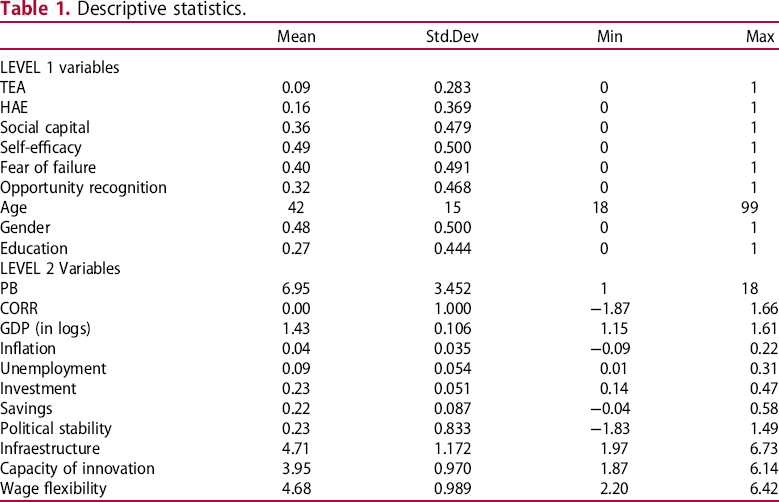
Descriptive statistics.
Drawing from prior studies of rates of entrepreneurship, we employ a series of macroeconomic indicators as control variables for testing our hypotheses. The first macroeconomic explanatory variable is the Gross Domestic Product per capita (GDP), as expressed in current U.S. dollars per person. Log GDP per capita values are used to better interpret the GDP per capita explanatory variable in the regression models and to avoid excessive weighting of extremely high and low observations. The rates of unemployment (number of unemployed persons as a percentage of the labour force), inflation (percentage change in average consumer prices), investment (total investment as a percentage of GDP), and savings (gross national savings as a percentage of GDP) are included to reflect the soundness of a country's monetary policy. All the macroeconomic variables are measured using the WEO database. The WEO database contains selected macroeconomic data series from the statistical appendix of the WEO report. To capture the influences of additional institutional factors, we use variables drawing from the WGI and GCI. The WGI measurements report on broad characteristics of government institutions, including political stability, infrastructure, capacity of innovation, and wage flexibility.
Estimation technique

 represents the dependent variables (TEA or HAE);
 represents the country predictors;
 represents the individual controls; and
 represents the country control variables. (Table 2 presents the correlations among the controls, predictors, and dependent variables). The combination of
 comprises the random part of the equation, where
 represents the country-level residuals, and
 represents the individual-level residuals.
Correlation matrix.
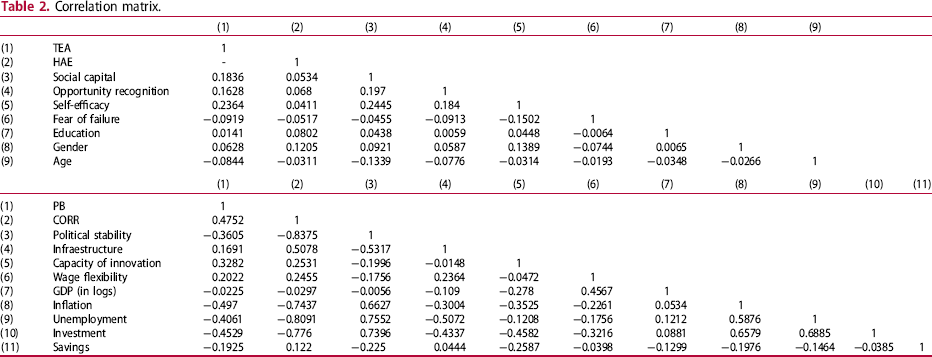
Correlation matrix.
Estimation results.
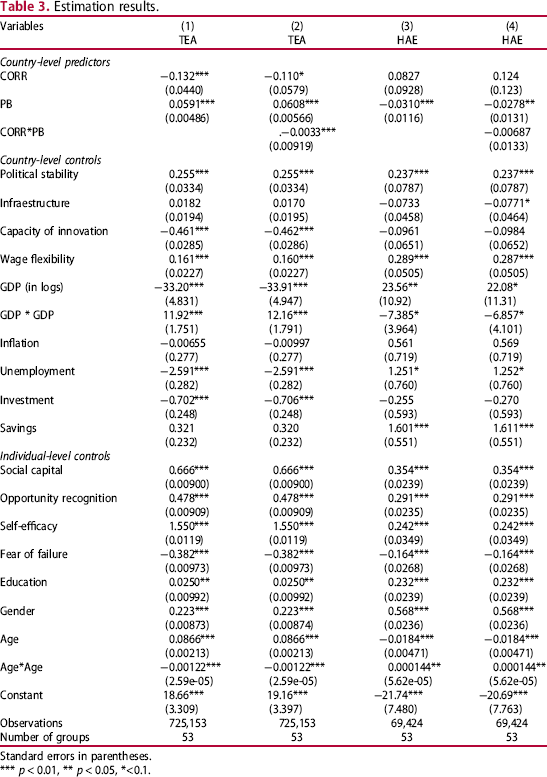
Estimation results.
Standard errors in parentheses.
*** p < 0.01, ** p < 0.05, *<0.1.
As reported in Column 1 of Table 3, corruption enters the TEA model with a strongly negative coefficient that is reinforced with significant a highly significant p-value
 . Statistically speaking, corruption provides reasonably good explanatory power for entrepreneurial activity when judged by the usual t-test of significance. This finding provides support for the ‘H1’ hypothesis, which specifically tests whether higher levels of corruption in a country have a negative and significant impact on total entrepreneurial activity. However, in the case of HAE in Column 3, we do not find a significant coefficient.
Hypothesis 2: Relationship between procedural bureaucracy and entrepreneurial activity
In the case of procedural bureaucracy, the impact of more bureaucracy in entrepreneurial activity is significant in all the specifications, but the direction of the effect is different when comparing the different definitions of entrepreneurial activity. HAE is negatively associated with more bureaucracy
 , whereas TEA is positively related
 . An additional procedure to start a business reduces the HAE by approximately 3%. Conversely, as TEA likely also includes large numbers of informal ventures, the increase in levels of bureaucracy could eventually become an additional exogenous barrier leading aspiring entrepreneurs to avoid formality. Therefore, in the case of TEA, more procedural bureaucracy increases the percentage of informal entrepreneurs.
Hypothesis 3: Interaction effects between corruption and procedural bureaucracy
The interaction term between corruption and procedural bureaucracy is reported in Table 3 (Columns 2 and 4) for all the definitions of entrepreneurial activity. We find this interaction effect to be significant only for the TEA definition of entrepreneurial activity
 , which implies that the combination of high corruption and relatively greater procedures required to start a business provides an additional boost to total entrepreneurial activity over and above the direct effects.
Limitations, discussion, and future research
This research draws on panel data from 53 economies to empirically test three hypotheses derived from TPB. Specifically, we set out to determine the relationships among corruption, procedural bureaucracy, and two measures of entrepreneurial activity (TEA and HAE) in 53 countries around the globe. We were particularly interested in the application of PBC from TPB, which suggests that entrepreneurs who may otherwise be inclined (entrepreneurial intention) to start a new firm and who believe they are capable of doing so may choose not to act on those intentions because there are important factors out of their control that may negatively affect their ability to actually incorporate a new firm.
All three of our hypotheses were confirmed to some degree: corruption is associated with lower rates of total entrepreneurial activity (H1); ineffective bureaucracy, as measured by the number of procedures required of a startup, is associated with lower rates of high-aspiration entrepreneurial activity (H2); and procedural bureaucracy moderates the relationship between corruption and total entrepreneurial activity (H3). These conclusions are consistent with prior conceptual work by Djankov et al. (2002) and later empirical work exploring the tollbooth hypothesis as it pertains to the relationship between corruption and procedural bureaucracy (Guriev 2004; Ahlin and Bose 2007).
However, we cannot fully support our three hypotheses, because corruption was not significant in the HAE specification; moreover, procedural bureaucracy enters the TEA specification with a highly significant negative sign, indicating that as procedural bureaucracy increases, it becomes likely that more formal entrepreneurs will consider informal startups, which is likely captured by the TEA measurements from the GEM (Valdez and Richardson 2013). Similarly, though we were able to confirm that corruption and procedural bureaucracy jointly have a greater detrimental impact on TEA, we were not able to fully extend prior research by finding a significant interaction effect between high levels of corruption and procedural bureaucracy as they pertain to HAE.
While the link between corruption and entrepreneurial activity has been confirmed consistently in the extant literature (Aidis, Estrin, and Mickiewicz 2012), the role of ineffective bureaucracy, independently or jointly with corruption, had yet to be clearly confirmed in prior research. Given the largely inconclusive or inconsistent results found in numerous studies of pro-entrepreneurship policy and the rates or quality of entrepreneurial activity, we believe our results contribute to the conversation about the different positive and negative roles governments may play in affecting the entrepreneurial phenomenon in their country or region.
These results suggest new lines of research related to governmental barriers to entrepreneurship in the context of TPB. Longitudinal studies, similar to that of Kautonen, Gelderen, and Fink (2013), using the same or expanded government barrier indicators could allow for deeper insights into the relationship between intentions and behaviour. Due to our reliance on secondary data, we were unable to test a full TPB model that could capture data from aspiring entrepreneurs at the concept stage and explore which aspects of TPB and PBC affected the relationship between initial intention and eventual action or inaction.
Measuring corruption also presents a significant challenge. Because corruption is a criminal activity, methodologies measuring it must be sustained on the subjective perceptions reflected in questionnaires and surveys, which distorts any possibility of achieving precise measurements. Moreover, the intrinsic problem with relying on the perception of corruption is that corruption itself has different meanings to different people. As such, corruption varies greatly depending on the nationality of the corrupt individual. For example, it is common for foreign entrepreneurs to pay sums of money far in excess of the nominal building permit fee compared to the fees paid by local entrepreneurs. In addition to the relevant limitation presented by the measurement of corrupt activities, quantifying the real impact of corruption on society based mainly on the sum of individual cases is also very misleading. For example, which is more corrupt: to pay a restaurant waiter an extra tip for a beachfront window table in Rio de Janeiro, to resell tickets for a baseball game in Santo Domingo, to collect bribes by a low-paid traffic officer in La Paz, or to award multi-billion-dollar military contracts for the U.S. Department of Defense? Based solely on the amount of money involved, there should be no doubt as to which is more corrupt.
Furthermore, by using the perception of corruption and procedural bureaucracy, we omitted other government barriers that may also influence an aspiring entrepreneur's PBC. Other government barriers worth exploring include taxation policy, competition policy, and transparency, among many others. Which of the aforementioned barriers, independently or in combination, also deter entrepreneurial activity? Naturally, an extension to this research relates to normative policy guidance for governments seeking to get out of the way. While the jury is still out on the efficacy of pro-entrepreneurship policy, the evidence is mounting that governments can clearly impede entrepreneurial activity through a range of barriers erected intentionally or unintentionally.
Controlling corruption is an extremely difficult endeavour. Although strengthening governmental institutions is insufficient, it is a strong first step in the right direction. In reference to the ‘cures’ of corruption, Tanzi (1998, 587) argued the following:
The greatest mistake that can be made is to rely on a strategy that depends excessively on actions in a single area, such as increasing the salaries of the public sector employees, or increasing penalties, or creating an anticorruption office, and then to expect quick results.
However, decreasing the number of procedures required to start a business is a relatively straightforward public policy measure. Therefore, this research has important policy implications, because the theory and evidence presented here indicate that stimulating entrepreneurial activity in an economy is more effective when policy reforms aimed at better control over corruption are implemented in combination with decreasing bureaucratic procedures.
Finally, one of the contributions of this research is its use of two different measures of entrepreneurial activity. As highlighted in the Results section, we found unique and sometimes conflicting results regarding the relationship between corruption and procedural bureaucracy on startup activity, depending on which of the two measures was utilized (TEA versus HAE). As Valdez and Richardson (2013) suggested, further research is needed to understand the unique role informal entrepreneurship plays in studies of entrepreneurship activity. We found that TEA was associated with significantly different behaviour with respect to procedural bureaucracy. Perhaps one reason for entrepreneurship scholars’ inability to obtain consistent results in studies of entrepreneurship activity is the lack of consistency in the dependent variable chosen.
Conclusion
There is growing consensus that corruption is an impediment to entrepreneurship (Anokhin and Schulze 2008; Aidis, Estrin, and Mickiewicz 2012; Acs, Desai, and Flapper 2008). With regard to ineffective bureaucracy and new firm formation, however, results have been mixed (van Stel, Storey, and Thurik 2007). Furthermore, despite the logical connections between corruption and bureaucracy, these constructs have rarely been related in empirical studies of government impediments to entrepreneurship (Estrin, Korosteleva, and Mickiewicz 2013).
The focus of this research was to clarify the roles of corruption and ineffective bureaucracy as they pertain to government barriers to entrepreneurship, thereby extending our understanding of control beliefs within the TPB. In this research, we developed three hypotheses. The first two sought to clarify the roles of corruption and procedural bureaucracy as independent constructs affecting entrepreneurial activity in an economy. The third hypothesis sought to relate the two constructs to each other in order to determine if there is an interaction effect between corruption and procedural bureaucracy as a combined factor affecting entrepreneurship activity in a region. We obtained data from several sources in support of this research (GEM, WGI, and GCI).
The evidence is mounting that government barriers can affect the relationship between an aspiring entrepreneur's intention to start a firm and their eventual behaviour. This study contributes to the ongoing conversation about demonstrating a linkage between corruption, procedural bureaucracy, and entrepreneurial activity. In all, our findings suggest direct policy implications: reducing ineffective bureaucracy influences individuals’ engagement in high-quality entrepreneurship. Policymakers could implement simple regulatory changes that can facilitate business development, such as cutting bureaucratic red tape or eliminating unnecessary procedures for firm creation. Alleviating corruption is a more difficult endeavour, but initiatives that increase the states’ modernization, transparency, and accountability have been implemented successfully, for example, in some Latin American countries with the support of the Inter-American Development Bank (IADB).
It is quite possible that Baumol (1990) and Shane (2009) are correct in arguing that pro-entrepreneurial policy may not increase the number or quality of entrepreneurs but instead that bad government may impede otherwise promising startups from ever getting off the ground. We believe this to be a fertile area for future research.
Footnotes
Disclosure statement
No potential conflict of interest was reported by the author(s).
1
Sample: Argentina, Australia, Austria, Belgium, Canada, Chile, Croatia, Czech Rep., Denmark, Finland, France, Germany, Greece, Hong Kong, Hungary, Iceland, Ireland, Israel, Italy, Japan, Rep. of Korea, Latvia, the Netherlands, New Zealand, Norway, Poland, Portugal, Singapore, Slovenia, Spain, Sweden, the United Kingdom, Algeria, Bosnia and Herzegovina, Brazil, Colombia, Jamaica, Kazakhstan, Malaysia, Mexico, Panama, Peru, Romania, the Russian Federation, Serbia, Turkey, Uruguay, Egypt, Indonesia, Jordan, Morocco, the Philippines, and Thailand.