



Abstract
This review addresses how women and men are represented in regulatory tests conducted to assess adult occupant safety in vehicles. Injury statistics show that protection in the event of a crash is lower for females than males. Still, vehicle crash safety assessment for adult occupants is only using the average sized male to represent the entire adult population, while the average sized female is not represented. In order to enable car manufacturers and road safety regulators to safeguard that females benefit equally from crash safety measures as males, it is necessary to develop new dedicated occupant models. These new models must represent the female part of the population, i.e. crash test dummies and human body models representing the average female. New female models would, together with their male equivalents, make it possible to identify the vehicle occupant safety systems which provide the best safety features for both females and males.
Introduction
Every year approximately 1.35 million people are killed worldwide in road traffic crashes (WHO 2018). More people die as a result of traffic injuries than HIV/AIDS, tuberculosis and diarrheal diseases (WHO 2018) together. In addition, up to 50 million people sustain injuries in traffic of which some will lead to life-long disabilities. Thus, health loss in the road transport system is a global health concern. Injury statistics are used to identify potential gaps in terms of protective performance as well as to evaluate any improvements of recently introduced injury preventing measures.
Vehicle design and technology plays an important role in achieving traffic safety improvements (European Transport Safety Council, ETSC 2018). A vehicle's ability of preventing occupants and surrounding road users from being injured and killed is assessed in regulatory tests such as the UN Vehicle Regulations (ECER, UNECE 2017) and the US Federal Motor Vehicle Safety Standards (FMVSS 208 2018; FMVSS 214 2018), as well as through consumer information tests in various New Car Assessment Programmes (NCAPs) and by insurance organizations such as the Insurance Institute for Highway Safety.
Regulatory tests are conducted to ensure that vehicle structures are robust and that life-threatening injuries are prevented. Crash testing is performed with crash test dummies representing vehicle occupants. During the last few decades virtual models of the human body, also known as human body models (HBMs), have been developed. Incorporated into the models are details such as the skeleton, organs and muscles of the human body, which in comparison to mechanical crash test dummies allows for more detailed assessment of the loadings human body is subjected to in a crash.
The aims of this study were to review how the adult population is represented in vehicle safety assessment tests, provide an overview of the main differences in average female and male properties of importance in vehicle crashes, compile road traffic injury statistics in terms of female and male injury risk and provide recommendations on how to better represent the whole adult population in vehicle safety assessments.
Method
A review of the models representing the adult population in regulatory and consumer tests as well as the latest developments within this area was carried out. To identify different regulations, enquiries were made to the relevant governmental agency in Sweden, the Swedish Transport Agency as well as the consumer testing organization, Euro NCAP. The obtained regulations were then verified with a selection of vehicle manufacturers’ safety department and certified crash testing laboratories. Finally, summaries were made of the development within virtual occupant models throughout the last few decades and gender differences, of importance in vehicle crashes, as well as any discrepancies in the risk of injury between males and females.
Results
Regulatory and consumer tests
Crash test dummies are used when developing and evaluating the level of crash safety of a vehicle. Vehicle regulatory test procedures predominantly involve two main sets of tests worldwide, the ECE regulations No. 16 (R16) (safety belt), No. 94 (R94) and No. 137 (R137) (frontal collision), and No. 95 (R95) and No 135 (R135) (lateral collision) (UNECE 2017) and tests that only applies in the US, the frontal test FMVSS 208 (2018) and the side impact test FMVSS 214 (2018). The tests are applied worldwide with minor modifications. For vehicles to be type approved within the EU/EES areas in Europe, the technical requirements for vehicles are applied under Directive 2007/46/EC. The basis of Directive 2007/46/EC is the 1958 Agreement and its 135 Addenda WP29 (UNECE 2017). In Europe, there are five regulatory tests assessing adult occupant safety in the event of a crash, ECE regulation (R16, R94, R95, R135, R137). In the US, the FMVSS 208 and FMVSS 214 are applied. Crash test dummies are also used in consumer information tests, such as NCAP tests (Euro NCAP 2017). Both frontal and side impact regulatory tests are performed at impact severities representing a high risk of fatal and severe injuries. Injuries such as whiplash injury occur at a lower crash severity, typically below 25 km/h (Eichberger et al. 1996; Kullgren et al. 2003). The assessment of occupant protection in these types of impacts is currently not part of any regulatory tests.
The mass and height of the 5th and 50th percentile female and 50th and 95th percentile male (Schneider et al. 1983).

The side impact dummy in ECE R95 should have ‘the dimensions and masses of the side impact dummy representing a 50th percentile male, without lower arms’. The footnote on page 48 states: The dummy corresponds to the specifications of the ES-2 dummy (ES-2). The ECE R135 describes that ‘a WorldSID 50th percentile adult male dummy’ should be used (WorldSID). In the FMVSS 208 and FMVSS 214, average male dummies are used in the same manner as in the UNECE tests with the average male scaled down to a 5th percentile female to represent a small occupant. Thus, the female part of the adult population is currently not represented in any crash test dummy models. Hence, an average female dummy model, equivalent to the average male frontal and the side impact dummies, does not exist.
The same dummy tests as in the UNECE regulation tests are used in the EuroNCAP for the frontal and side impact tests. The average male dummy BioRID (Davidsson et al. 1998) can be used to perform an additional optional low severity rear impact test series, but an average female dummy, equivalent to the BioRID, is not yet available.
Injury statistics
Comparing the risk of injury for males and females, Bose, Segui-Gomez, and Crandall (2011) showed that females are exposed to a higher injury risk for a range of crash types. Bose, Segui-Gomez, and Crandall (2011) analysed accident data on fatally or severely injured belted occupants held on the National Automotive Sampling System Crashworthiness Data System (NASS CDS) 1998–2008, managed by the US National Highway Traffic Safety Administration (NHTSA). Injury severity is determined through the Abbreviated Injury Scale (AIS), an anatomically based, global severity scoring system classifying each individual injury by body region according to its relative severity on a 6-point scale (1 = minor and 6 = maximal). The AIS incorporates current medical terminology providing an internationally accepted tool for ranking injury severity (AAAM 2019). MAIS is the Maximum AIS, which is the most severe injury that a person can sustain. The results show that the odds of a belt-restrained female driver sustaining a MAIS 3+ and MAIS 2+ injury were 47% and 71% higher, respectively, than for a belt-restrained male driver, when controlled for the effects of age, mass, Body Mass Index, crash scenario, change of velocity, vehicle body type, number of events and crash direction.
Whiplash injuries
For the injuries studied to date, the most significant difference between male and female injury risk is found for soft tissue neck injuries, generally referred to as ‘whiplash injuries’. In Sweden, such injuries account for ∼70% of all injuries leading to disability due to vehicle crashes (Kullgren et al. 2007). The majority of those experiencing initial whiplash injury symptoms following a car crash recovered within a few weeks or months of the crash (The Whiplash Commission 2005). However, 5–10% of these individuals also experienced permanent disabilities of varying degrees (Nygren 1983; Galasko, Murray, and Pitcher 1996; The Whiplash Commission 2005). Injury statistics from the mid-1960s until today show that on average, females are exposed to double the risk of sustaining whiplash injuries than males, ranging from 1.5 to 3 times higher (among others: Kihlberg 1969; O'Neill et al. 1972; Otremski et al. 1989; Morris and Thomas 1996; Dolinis 1997; Temming and Zobel 1998; Richter et al. 2000; Chapline et al. 2000; Kullgren et al. 2003; Krafft et al. 2003; Jakobsson, Norin, and Svensson 2004; Storvik et al. 2009; Carstensen et al. 2012).
In fact, certain types of whiplash protection systems have proved to be more effective for males than females (Kullgren and Krafft 2010; Kullgren, Stigson, and Krafft 2013). With designs based on what is known as a reactive head restraint, the proportion of permanent medical impairment for men was reduced by 70% while simultaneously increased for females by 13%. These results confirm that the safety performance of different seat designs varies for male and female occupants.
Average male and female characteristics
Females and males have different anthropometry as shown by Schneider et al. (1983) in the examples of mass and height of the 5th and 50th percentile female and 50th and 95th percentile male, as found in Table 1.
The mass distribution of the different body parts was found to vary according to gender (Young et al. 1983; McConville et al. 1980). Furthermore, there are inherent differences between each sex in terms of geometry, such as shape and form of the torso, for example.
Female and male muscle strength
The dynamic response in the event of a crash may also differ due to differences in the muscle strength in males and females. Some examples include: the stabilizing torques of the spinal muscles and the trunk muscles differ between the genders. Jordan et al. (1999) reported that the maximum isometric strength in a seated position was 20–25% greater in males during flexion and extension of the head. A study by Vasavada, Li, and Delp (2001) revealed that maximum neck moments (generated by the strengths of the muscles in the neck) were 40–50% lower in females. Greater flexion strength and stiffness of the upper cervical spine in male human specimens were reported by Nightingale et al. (2007). Brown et al. 2002 reported greater axial stiffness also for the lumbar spine in males. Stemper et al. (2010) reported similar findings for the thoracic spine, and also that the elastic modulus in female specimens was greater than in males. Studies have reported female-to-male neck strength ratios ranging from 0.8 down to 0.4 (Kumar, Narayan, and Amell 2001; Peolsson, Oberg, and Hedlund 2001; Chiu, Lam, and Hedley 2002; Garcés et al. 2002; Vasavada, Li, and Delp 2001).
Female and male dynamic response in a rear impact vehicle crash
It has been reported that the dynamic response of females in rear impact volunteer tests is somewhat different than in males, such as greater head forward acceleration, greater (or similar) T1 forward acceleration, more pronounced rebound and larger angular displacements between adjacent vertebrae in females (Szabo et al. 1994; Siegmund et al. 1997; Hell et al. 1999; Welcher and Szabo 2001; Croft, Haneline, and Freeman 2002; Mordaka and Gentle 2003; Viano 2003; Ono et al. 2006; Linder et al. 2008; Schick et al. 2008; Carlsson et al. 2011; Carlsson et al. 2012; Sato et al. 2014; Sato et al. 2015).
Female and male differences of the neck influencing the response in a rear impact
Looking closer at the differences in the neck of females and males, for example, several systematic morphological differences have been found (Stemper, Pintar, and Rao 2011) between the female and male cervical spines. The morphological, i.e. occupant–related, characteristics that can influence the response of the cervical spine during automotive rear impacts was identified as anatomical differences of the cervical spine, head neck and cervical spine orientation at the time of impact, facet joint orientation and neck muscle size and orientation (Stemper, Pintar, and Rao 2011). Some examples include: a smaller circumference relative to the length of the neck, smaller vertebral body size and 20–32% less muscle strength for size matched subjects (Vasavada, Li, and Delp 2001).
Average female and male size and geometrical differences
The EvaRID, a virtual average female dummy model for low severity rear impact testing, based on the same approach as the design and development of the average male crash test dummy, the BioRID, was recently developed (Linder et al. 2013; Carlsson et al. 2014). The numerical models of the rear impact dummy, the BioRID and the average female equivalent, the EvaRID, visualize the main differences between the average sized male and female, as shown in Figure 1.
The low severity virtual rear impact average sized male dummy BioRID (left) and the average sized female EvaRID (right) (Linder et al. 2013).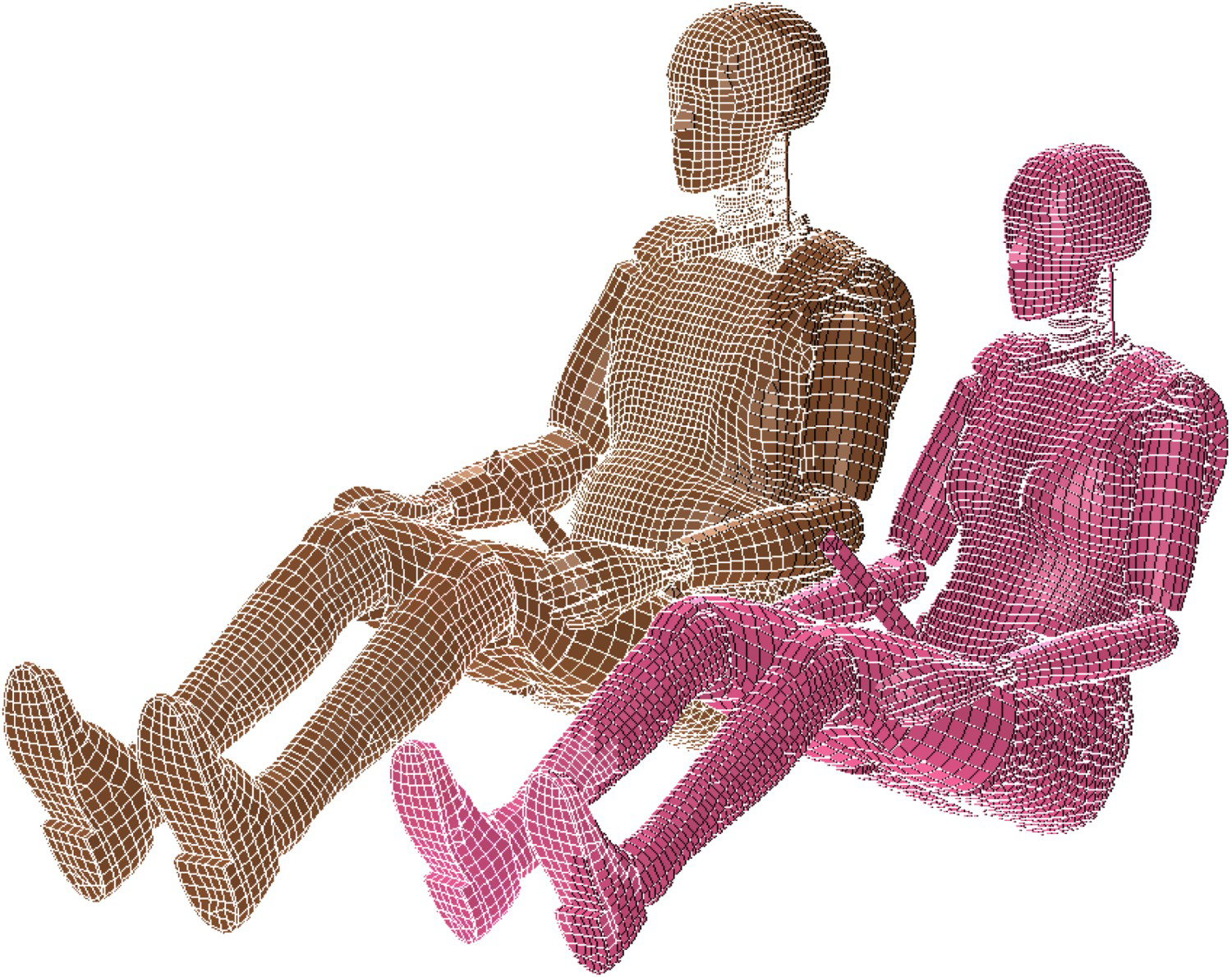
Female and male spinal curvature
A further issue that may be of importance in a dynamic event is the difference in spinal alignment in males and females (Sato et al. 2016), with males displaying a more pronounced curvature of the neck in seated positions. A rear impact simulation study of Sato et al. (2017) showed larger intervertebral angular displacements in the cervical spine in female spinal alignment compared to in male. Hence, thresholds for injury criteria are expected to differ for average male and female models. John et al. (2018) modelled variations in spinal vertebral geometries that mirror the differences between male and female cervical spines. They concluded that straighter spine segments sustained greater posterior facet joint compression, which may offer an explanation for the higher incidence of whiplash-associated disorders among females, who exhibit a straighter cervical spine.
In a simulation study, Yao, Svensson, and Nilsson (2016), reproducing potentially injurious pressure transients in the neck vertebral canal during whiplash trauma, showed a trend toward increased pressure magnitudes with female properties, compared to male properties. Based on a synthesis of literature data, Schmitt et al. (2012) suggested a 20% lower threshold with regard to Neck Injury Criterion for the average female, compared to the male.
Discussion
This study covers a review of injury statistics from road traffic crashes including the risk of injury of male and female occupants in these crashes, an overview of how the adult population is represented in regulatory and consumer tests as well as the main differences between the average male and female in terms of weight, height, geometry and the dynamic properties such as muscle strength. The review of the regulations shows that the adult population is represented by the average sized male, while the average sized female is excluded from the assessment of the protection of adult vehicle occupants. Although the overall structure of male and female bodies is similar, certain inherent differences prevail producing differences between the average of males and females. These differences have the potential to influence the protective performance of a vehicle as has been shown in a range of crash scenarios (among others Bose, Segui-Gomez, and Crandall 2011; Kullgren, Stigson, and Krafft 2013).
Adult occupant crash safety is assessed through high speed frontal and side impact tests (FMVSS 208 2018; UNECE 2017, Euro NCAP 2017) and an optional low severity test in Euro NCAP (2017). All tests exclusively use the 50th percentile male to represent the whole adult population. To study the effect on the smallest and largest parts of the population, the 50th percentile male has been scaled down to represent the height and weight of a 5th percentile female and scaled up to a 95th percentile male. According to growth curves of the Swedish population, the 5th percentile female is equivalent to an average 12–13-year-old girl (PCPAL 2018).
The safety potential of recent developments in the vehicle safety area with regard to preventing crashes from occurring, or largely reducing the energy in any crashes that occur, is significant. However, it will take time before all vehicles become autonomous and crashes are eliminated. Fully autonomous driving (automation level 4 or above) will initially likely only be allowed in less complicated traffic situations, for instance, on motorways as described by Victor et al. (2017). Only later when this technology has reached a more mature level will it become available in more complicated traffic environments, such as inner cities. Swedish injury statistics show that in 2017 only 9% of fatalities and 1% of severe injuries occurred on the highways (SRA 2018), and this indicates that the major safety gains that are expected from road vehicle automation will not materialize in the near future.
In order to identify the best performing occupant safety systems, it would be advantageous to use dummy models representing both parts of the adult population. To initiate such an approach, an average sized female prototype dummy, the BioRID 50F (Schmitt et al. 2012) a scaled down version of the BioRID 50M, was developed. To illustrate some of the geometrical differences between males and females, both models can be seen seated in the same seat, Figure 2.
The low severity rear impact average sized male dummy BioRID 50M (left) and the average sized female prototype BioRID 50F (right) seated in the same vehicle seat (Schmitt et al. 2012).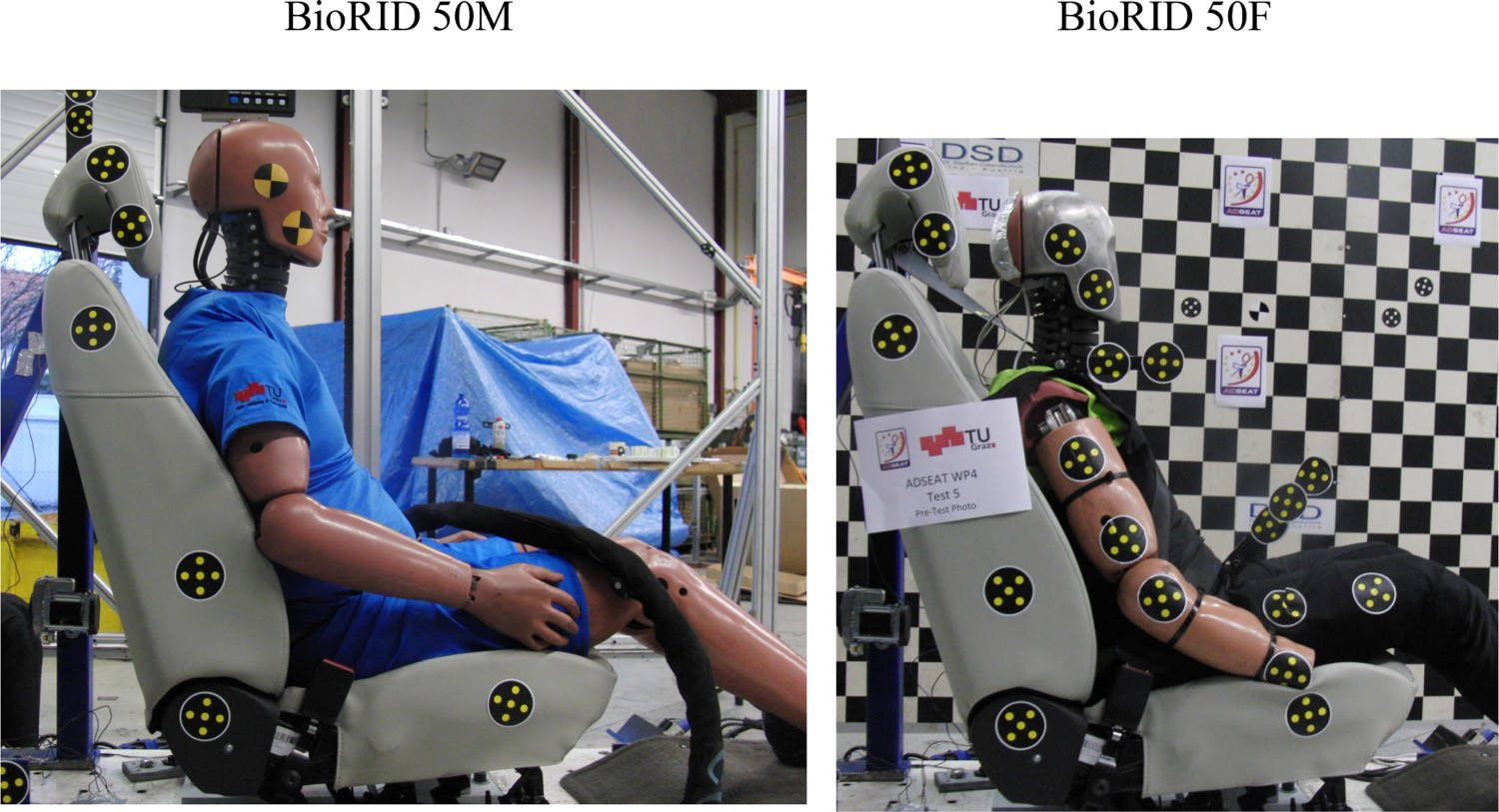
In the last few decades, finite element HBMs have been developed with a detailed representation of the geometries and mechanical properties of the human body structures. These models typically started out as average sized male models, for example: the Total HUman Model for Safety (THUMS) (Iwamoto et al. 2002; Iwamoto and Nakahira 2015) and the Global Human Model Consortium (Gayzik et al. 2011; Vavalle 2012). These models have recently been developed into a small female and a large male version to represent a wider occupant height and weight range. Although these additional sizes are important, they are not sufficient or comparable in representing the female part of the population, to the average male size representing the male part of the population. Thus, developing average female human models in the same manner as the average male models still remains. The first step has been made by developing the open source HBM ViVA model, representing an average female and adapted for low severity rear impact testing (Östh et al. 2017) and the development of THUMS 50F by Sato et al. (2017).
Kullgren, Stigson, and Krafft (2013) not only showed that seats equipped with reactive head restraints can provide different levels of protection for females and males. Kullgren, Stigson, and Krafft (2013) also showed that two different whiplash protection systems, the Whips and the WIL, provide increased protection for both females and males, Figure 3.
The proportion of drivers sustaining permanent medical impairment in three different seat categories: WIL and Whips, seats with reactive head restraint and the standard seat from Kullgren, Stigson, and Krafft (2013).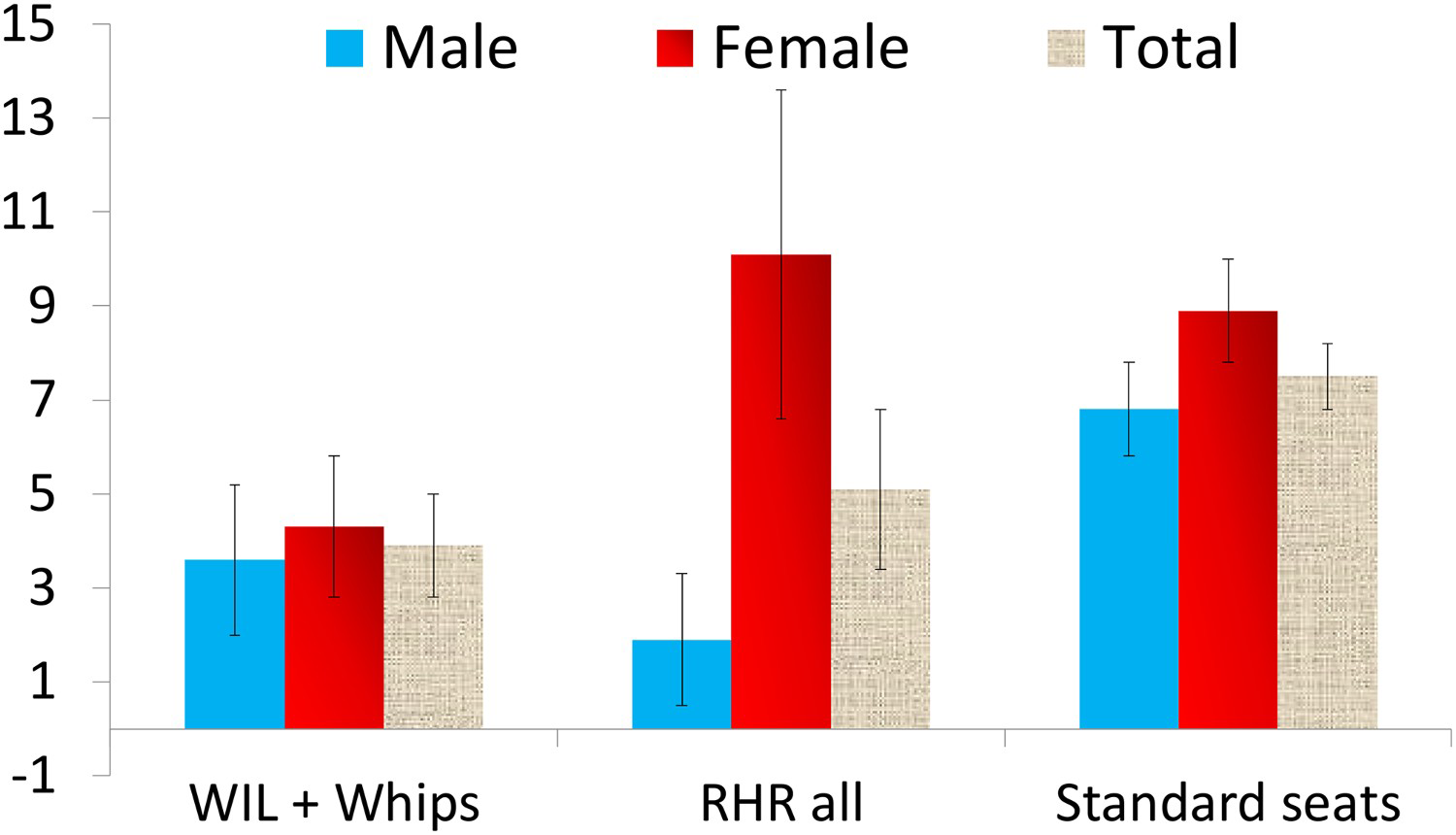
Regulatory tests, as well as consumer evaluation tests, should be able to identify which vehicles provide the best protection for the whole adult population. In order to identify the best performing occupant safety systems (which exists as shown by Kullgren, Stigson, and Krafft 2013), dummy models representing both the female and the male part of the population would be needed. This issue has previously been highlighted by Mordaka and Gentle (2003) who stated that the need to revise car testing programmes and regulations, currently based on the average male, is evident.
Despite the urgent need and ambition for developing a 50th percentile female it has, to date, never been included in the family of available dummy models for crash testing. In their work in the early 1980s, Schneider et al. (1983), who defined anthropometric design specifications for crash test dummies, argued that providing both 50th percentile male and female dummies would be optimal; still, the 50th percentile female was and remains omitted. The knowledge required to address both women and men equally well in the assessment of vehicle safety is already available. However, what is lacking in all new car safety assessment methods is the incorporation of the knowledge obtained into the development of models of the female part of the population, in the same manner as for the male part.
Conclusions
Despite injury statistics showing that protection in the event of a crash is not equal for women and men, the average male represents the adult population in vehicle safety assessments. Development and usage of occupant models representing the female part of the population, i.e. crash test dummies and HBMs representing the average female for use in safety assessment tests together with the male equivalent, would make it possible to assess vehicle occupant safety for both females and males. The knowledge required to develop HBMs, appropriate for assessing vehicle safety equally well for females as males, has already been obtained and is ready for use.
In order to enable car manufacturers and road safety regulators to ensure that females are offered equal benefit from crash safety measures as males, new occupant models must be developed. It is imperative that the female part of the population is represented by these new models, i.e. crash test dummies and HBMs representing the average female. New female models would, together with their male equivalents, make it possible to identify vehicle occupant safety systems providing the best safety features for both females and males.
Using occupant models representing both female and male vehicle occupants would enhance the robustness of current safety assessments and consequently encourage safety innovations that increase the protection for both the female and the male part of the population.
Footnotes
Acknowledgements
Elisabet Agar has supported us by reviewing the language.
Disclosure statement
No potential conflict of interest was reported by the authors.
Adjunct Professor
Full Professor
 ).
).