




Abstract
In contemporary historical culture, digital entertainment games about the Second World War have become a prominent format for cultural expression. By allowing players to actively engage with the history of the Second World War, this body of commercial digital entertainment games can significantly co-configure how this war is understood, especially in light of the blurring distinction between formal and informal historical learning. This article presents an interpretative content analysis of the marketing ‘paratexts’ of a corpus of digital entertainment games about the Second World War that are shared through online game stores and online game community platforms. This is done to provide insight into how digital entertainment games and their online community platforms can function as sites for informal historical learning, both in relation to the history of the Second World War and the central goals of formal history education.
In February 2016, the British game developer Bulkhead Interactive launched a crowdfunding campaign for a new first-person shooter (FPS) game 1 , centred on the events of the Second World War: Battalion 1944. The developer set a goal of £100,000 ($145,000), which was met in merely three days (Chalk, 2016). Four months later, the Swedish game developer Paradox Interactive announced that Hearts of Iron IV, the latest iteration of its grand strategy game series about the Second World War, had ‘sold over 200,000 copies worldwide in less than two weeks after its release’. This made it their fastest-selling historical grand strategy game to date (Paradox Interactive, 2016b). And in April 2017 and May 2018 respectively, two of the biggest game publishers globally, Activision and Electronic Arts, revealed that the next iterations of their best-selling FPS games, Call of Duty WWII and Battlefield V, would mark the return of both series to their original Second World War setting, which in the case of Call of Duty WWII led to great commercial success (Hall, 2017). All of these examples show that there is still a great interest in digital entertainment games about the war, which have been around since the 1970s. It has added up to a large body of games: as of April 2019, the database Mobygames lists a total number of 734 published games about the Second World War since 1976 (Mobygames, 2019). At the same time, several new games are currently in production (e.g., DT Gaming, 2018).
In line with the global growth of the game industry of the past two decades, these digital entertainment games about the Second World War have taken up a prominent position as a format for cultural expression. They offer millions of players, including but not limited to a significant number of school-age young adults (Statista, 2017), a compelling way to engage with the history of the Second World War. As such, the activity of playing these games, and interacting with the broader culture in which they are embedded, can have a significant impact on how these young adults and others learn about and remember the conflict. As stated by historian Kees Ribbens, contemporary understandings of the Second World War are not only formed through exchanges in family contexts, historiographical debates, history curricula in schools and politically contested commemorative practices surrounding monuments and museums on the local, regional and (supra-)national level; at the same time, they are co-configured by an interconnected set of what are often identified as ‘popular’ representations and performative imaginations of the past, through films, adventure novels, comic books and games, which are primarily created for commercial and entertainment purposes and often tailored towards transnational consumers (Ribbens, 2014). As a result, the study of how these formats operate in contemporary historical culture, i.e., the types of narratives and performative configurations they put forward, the mnemonic networks and infrastructures that produce them, the ontological conceptions of history they subvert or reinforce, and ultimately, the ways in which they shape the broader understanding of the past (Grever & Adriaansen, 2017), becomes equally important, also in relation to the history of the Second World War. Concerning the practice of history education, it gives rise to the consideration of how representations of the Second World War through popular formats and platforms, and digital entertainment gaming in particular, relate to how the war is discussed in schools, and what this means for the overall goals of formal history education, such as the advancement of historical thinking skills (Seixas & Morton, 2013). This is particularly important given the increasingly blurred distinction between formal and informal historical learning processes (Grever, 2018).
This article aims to shed light on digital entertainment gaming as an expression of a ‘popular’ historical culture that co-configures the broader understanding of the Second World War and is fundamentally transnational in nature, in contrast to many school history curricula, which are often still structured along, for example, national lines (e.g., Carrier, Fuchs, & Messinger, 2015; Crawford & Foster, 2008; these studies highlight how the discussion of the Second World War in schools is still strongly locally/nationally embedded, although a focus on broader topics such as the Holocaust and the development of historical thinking skills has become more prominent in history curricula in recent years, especially in North America and Europe). To do so, I will not study specific games or player experiences (for such an analysis, see Van den Heede, 2018). Instead, I will focus on the broader ‘paratextuality’ that accompanies these games, in the form of press releases, promotional trailers, ‘making of’ videos and other marketing materials that are created by game companies in conjunction with a game and presented through online stores, official game websites and dedicated pages on social media platforms such as Facebook, YouTube and Twitter. I opt for this analysis because marketing paratexts for games provide a direct insight into how game creators transform and repackage the history of the Second World War in the context of a ludic commodity market. As argued by media scholar Jonathan Gray (2010), marketing paratexts for games are not only meant to generate ‘hype’ for a cultural commodity and encourage people to purchase and engage with it. At the same time, they function as primary ‘gateways’ into a game, which offer players frames through which they can reflect on the content of the games before or while playing them. This infuses the games with additional meanings, albeit often in close connection to the meanings expressed in other media representations and the games themselves. Marketing paratexts for historical games in particular tend to highlight how game creators embed their games in broader networks of mythologies, ideologies, historical imaginations and commemorative expressions. As a result, they shed light on the specific prior understandings of the Second World War that school-aged young adults and other players can acquire through their engagement with the broader media ecology in which digital entertainment games are embedded, as a site for informal historical learning.
In this article, I aim to answer the following central question: what are the dominant historical and commemorative themes and narratives that are expressed by game creators in marketing materials for digital entertainment games about the Second World War, and what do these say about the representation of this war in digital entertainment gaming more broadly, also in light of the central goals of formal history education? As a part of this effort, I will explicitly highlight how marketing paratexts of digital entertainment games about the Second World War tend to offer a transnationally converging representation of this war, in contrast to how the war is discussed in many nationally oriented history curricula in schools and other commemorative discourses on the local, regional and (supra-)national levels (Carrier et al., 2015; Chirot, Shin, & Sneider, 2014; Crawford & Foster, 2008).
In what follows, I will first discuss the nature of ‘paratexts’ and how they direct the reading of digital entertainment games as media ‘texts’, also specifically in relation to how they operate in contemporary historical culture and informal learning. Secondly, to contextualize my paratextual analysis, I will give an overall characterization of the games to which the studied marketing paratexts belong. Finally, I will discuss which dominant historical and commemorative themes and narratives could be identified in the corpus, and what these findings mean for formal history education.
Game paratextuality between transnational branding and informal learning
The concept ‘paratext’ was originally adopted in the field of literary studies. Gérard Genette (1997) used it to describe various elements that ‘surround’ a book as literary artefact, such as its cover, typesetting and other elements inside the book itself (‘peritexts’), and reviews, interviews with the author and other elements external to it (‘epitexts’). Genette identified all of these elements as ‘thresholds of interpretation’, which fundamentally channel the reader’s expectations of a book before or while reading it. The concept was later adopted by media scholars, who equally emphasized that the meanings people assign to a TV show, film or any other media ‘text’ are co-determined by the paratexts they consume in conjunction with the text. Jonathan Gray in particular elaborated on this observation by developing a broader theory of media paratextuality, in which he highlights the following two elements (for the following two paragraphs, see Gray, 2010, pp. 23–30):
Marketing materials, as a particular type of paratext, often do not primarily provide an overview of the features, pleasures and other benefits of a cultural commodity. Instead, they imbue that commodity with additional meanings, to embed it in a broader semiotic universe. This general observation only partly applies to media texts, as their marketing materials usually directly include scenes from the texts themselves. More generally, paratexts of a media text can best be seen as an integral part of a media text as a broader cultural entity in society. This means that the paratexts of media texts can at least partly provide insight into the central text itself. At the same time, however, these paratexts also aim to infuse the original text with additional meanings to appeal to consumers.
By setting up various meanings and interpretational strategies for readers to make sense of a text, paratexts allow for a process of ‘speculative consumption’, in which consumers, when faced with a large number of texts and only a limited amount of resources, will try to form an idea of what pleasures each text will offer, in order to decide which ones they will engage with. As a result, many people will only know a text at the paratextual level, which makes paratextual analyses all the more relevant.
How do these observations relate to game paratexts and their operation in contemporary historical culture and informal learning? For game paratexts in general, game scholars have mostly corroborated the characterizations provided above (Consalvo, 2007). At the same time, they have highlighted how marketing paratextuality for games functions in an explicitly bidirectional manner in comparison to the paratextuality of other media formats. Media scholar Matthew Payne, for example, has studied how marketing materials of military-themed digital entertainment games evoke a sense of ‘ludic war’ among players. He does so by adopting the concept of ‘circuitry of interactivity’ introduced by media scholars Stephen Kline, Nick Dyer-Witheford and Greg de Peuter, which postulates that technological production, marketing and cultural consumption should be seen as the three central subcircuits of contemporary globalized capitalism, and the global game industry as its primary expression (Kline, Dyer-Witheford, & De Peuter, 2003). In his analysis, Payne goes on to describe how in the game industry, production and consumption have come to coexist in a fundamentally dialectical relationship, as game creators constantly seek feedback from players throughout the life cycle of a game to optimize their game product. This tendency has only been reinforced in recent years, due to two closely interconnected developments. On the one hand, an increasing number of game companies have adopted a service-oriented business model, in which they no longer limit themselves to producing games as singular commodities. Instead, they continue to provide updates and content through digital distribution channels long after the initial release of the game (e.g., Kerr, 2017, pp. 64–105). On the other hand, the emergence of social network platforms such as Facebook, YouTube and Twitter, and streaming services such as Twitch, has opened up additional venues for game creators and players to interact with each other. This reinforces the creation of ‘(online) brand communities’ surrounding games and companies (for the concept ‘(online) brand community’, see Martínez-López, Anaya-Sánchez, Aguilar-Illescas, & Molinillo Jiménez, 2016). Taking these developments into account, Payne argues that game paratexts function as the ‘preliminary textual interface’ through which this constant interaction between game creators and players unfolds. At the same time, he still considers marketing paratexts created by game companies to be essential, in that they remain the first expressions of a game that players will usually encounter, and the first ones to establish important meaning-making frames that shape how players experience the game, as argued above (for the entire paragraph, see Payne, 2016, pp. 152–6).
In relation to how marketing paratexts operate in contemporary historical culture as sites for informal learning, then, the following double characterization can be given. On the one hand, from the perspective of potential player-consumers, marketing materials of historical digital games function as sites to assess whether or not a game and the updates that are subsequently released for it will both reconfirm and legitimately and meaningfully expand upon a player’s pre-existing knowledge, commemorative frameworks and experiences in relation to a historical subject, as one component of a broader set of interests and desires players have for a game. A telling example thereof is how in May 2018 players reacted to the announcement trailer for the game Battlefield V, which became the subject of online controversy because it prominently depicted a female frontline soldier with a prosthetic arm, something that was considered to be too unrealistic for a game set during the Second World War by a specific segment of the Battlefield player community (Chalk, 2018a). On the other hand, from a production perspective, i.e., the perspective I focus on in this article, marketing paratexts show how game creators aim to position themselves as ‘developer-historians’ (Chapman, 2016, pp. 30–55) and mnemonic agents when creating historical digital games, in that they, as discussed by historian Esther Wright (2018), use marketing materials to highlight the distinct historical and commemorative themes and broader narratives they wish to express through their games. I identify these narratives as ‘developer narratives’, in line with Chapman’s notion of the ‘developer-historian’. By formulating these themes and developer narratives, game creators partly transform their online community platforms into sites for historical and commemorative expression. This blurs the distinction between a profit-driven brand community on the one hand and a community for informal learning and remembrance on the other, at least in ways that are not meant to interfere with the commercial interests of the involved game companies. It allows players to acquire understandings of the past that operate as a starting point for further historical engagements, for example when entering a formal learning environment.
Method: studying game paratextuality through content analysis
In order to study the marketing paratextuality of digital entertainment games about the Second World War as both an expression of a commodified ‘popular’ historical culture and as a potential site for informal historical learning, I carried out an interpretative content analysis of textual and audiovisual sources. I identified the historical and commemorative themes and ‘developer narratives’ that were highlighted in the press releases, promotional trailers and other marketing materials for the digital games about the Second World War that were published on Steam, a leading global online store for PC games. I also studied the complementary marketing paratexts of these games that could be identified on their dedicated community platforms, in particular their official websites and dedicated YouTube channels. When carrying out the interpretative content analysis, I paid special attention to lists of ‘selling points’ with an explicit historical and/or commemorative dimension that were highlighted in the marketing materials. To inform my analysis of the paratextual ‘developer narratives’, I adopted the open-ended definition of a ‘narrative’ formulated by historians Keith Barton and Linda Levstik. They define narratives as ‘chains of events in cause-effect relationship’ that unfold over time and involve specific actors, actions, goals/intentions, settings and instruments (Barton & Levstik, 2004, pp. 129–132). When studying the paratexts, I used this general definition to identify the ‘developer narratives’ that were expressed in both the textual and audiovisual sources.
I used games about the Second World War that were distributed on Steam as a starting point for this study, for several reasons. Not only is Steam a dominant distribution platform for games globally; it also serves as a focal point for marketing paratexts, and it allowed me to identify a broader corpus of games about the Second World War through its ‘tagging’ system, in that game creators and players can assign keywords to a game on Steam, to help other players search for games in a more targeted way. As such, these tags shed light on what players themselves identified as games about the Second World War. Finally, Steam offered me insight into the popularity of games through SteamSpy. This is a web service that gathers information about games that are owned and played by Steam users worldwide through an analysis of publicly available user statistics (SteamSpy, 2016) 2 . As such, I analysed the marketing materials of the games about the Second World War that were owned by the highest number of players on 18 September 2018.
To carry out my study, I analysed the marketing paratexts that were distributed on Steam and the aforementioned community platforms in the Netherlands, as this is where I accessed the materials. This is noteworthy for this study for several reasons. Firstly, not all the digital entertainment games about the Second World War that are created worldwide are made available through Steam, or are commercially successful in the Netherlands or other parts of the world. For example, as Steam has been less dominant in Asian countries such as China and Japan until recently (Chalk, 2018b), a choice for Steam means that some of the games that were distributed in these countries but not on Steam were not included in the corpus. Secondly, game stores such as Steam have a number of region-specific settings (although they mostly apply to pricing and payment methods), while globally produced games are usually also localized for specific regions and countries (e.g., Carlson & Corliss, 2011). An example thereof is that until August 2018, Nazi symbols such as swastikas were categorically removed from digital games and their marketing materials in Germany specifically, due to a prohibition on the use of these symbols in digital games under the German Criminal Code (Raymond, 2018). Taken together, this means that the current analysis is explicitly regionally embedded. At the same time, the adopted approach does allow for the identification of broader patterns in the marketing paratexts of digital entertainment games about the Second World War that are distributed around the world, especially in North America and both Western and Eastern Europe, including Russia. This is especially the case since games and their marketing materials are usually not translated in Dutch for a Dutch market, and there are no specific Dutch legal prohibitions concerning the content of digital entertainment games about the Second World War similar to the ones in Germany or elsewhere.
Following the approach discussed above, I studied the marketing paratexts of 220 digital entertainment games, belonging to 151 different game series that were identified by game creators and players as ‘World War II’ games on Steam. Most of these games were released on the platform since 2003, with a significant increase in 2014 (Figure 1). To highlight the transnational dimension of these games and their marketing, I identified the countries where the main headquarters of the involved companies were located, based on the information found on Steam and the additional community pages. In doing so, it is important to remember that (1) several of these companies, such as Wargaming Group (World of Tanks), own subsidiary companies in other regions and are part of global multi-industry conglomerates, and that (2) most of these companies consist of teams combining various national backgrounds, who increasingly operate in digitally enabled transnational production networks. However, as game production is nevertheless still strongly embedded in distinct local (e.g., national) contexts (Kerr, 2017, pp. 27–63), it remains important to identify these locations. WWII games: number of games/year (n = 220).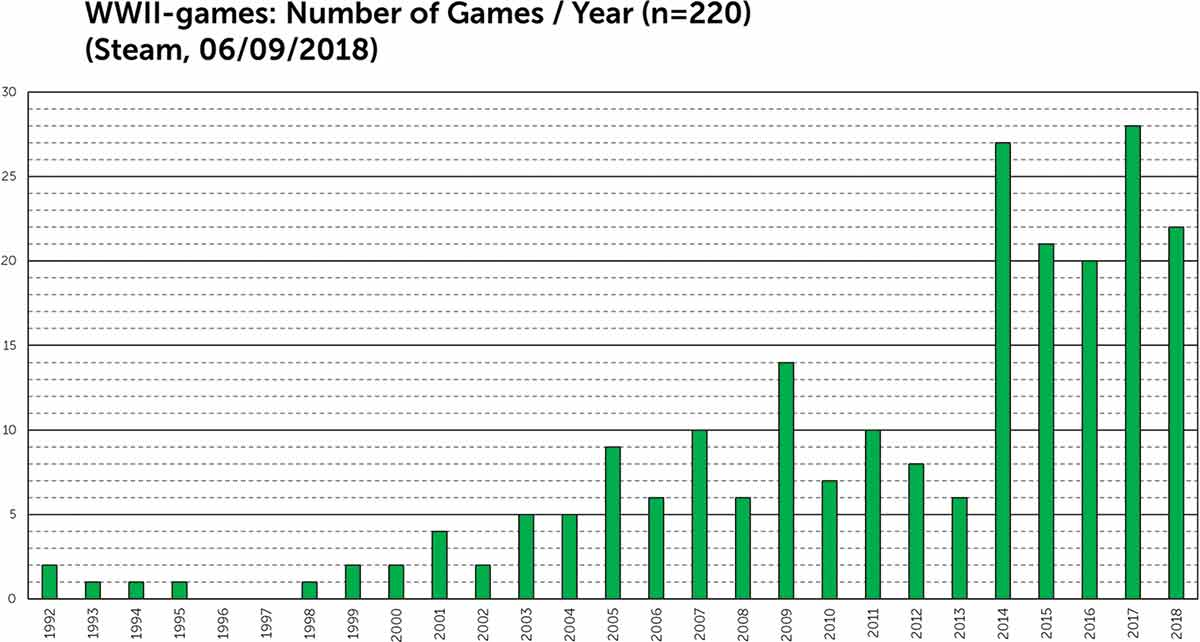
Results
To contextualize my paratextual analysis, I will first provide an overall characterization of the studied game series in terms of genre and country of origin. Concerning genre, a striking consistency could be identified in the corpus: when ranking the games based on sales figures or how often they were downloaded, almost all of them could be identified as either first- or third-person shooters (FPS/TPS) (32 series), flight and other simulation games (26 series), real-time, turn-based or grand strategy games (RTS/TBS/GS) (65 series) or hybrid games combining several of these genres. As illustrated by the data provided by the market research company Quantic Foundry, these genres are predominantly, but not exclusively, played by male players (Yee, 2017). This means that, also from the perspective of history education, a clear gender divide can manifest itself: the digital entertainment games about the Second World War that are currently available primarily appeal to male players. This means that history educators have a higher chance of encountering male school-age young adults that have engaged with these digital games and their paratextuality as a platform for informal learning. The corpus included online games that can be accessed for free (F2P MMO, or free to play massive multiplayer online games) such as World of Tanks, big budget games that are released on PC and home gaming consoles such as Call of Duty: WWII, and mobile games, such as Battle Islands. In line with game scholar Aphra Kerr’s observation that today’s global game industry is dominated by a small number of major cross-industry conglomerates such as Microsoft, Sony and the Chinese technology firm Tencent, while at the same time there has been an explosion in the number of small game companies over the past decade (Kerr, 2017, p. 27–63), the corpus included 13 game series that were developed by major companies and owned by millions of players, such as Heroes & Generals, War Thunder, Company of Heroes and Sniper Elite (Appendix 1), while it also included dozens of small games that had only been downloaded by a few thousand players.
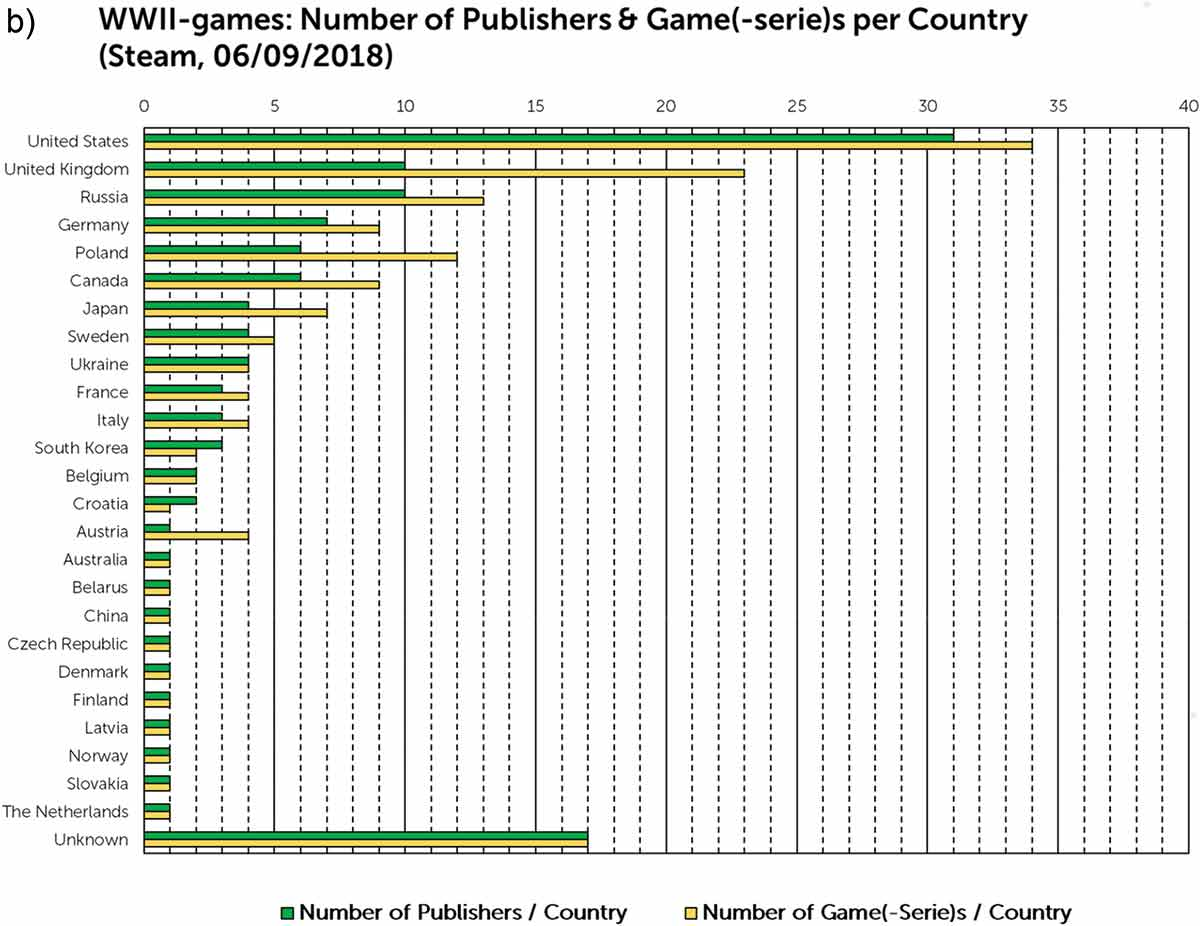
In terms of country of origin, a majority of the total number of involved game companies, that is, 156 developers and 121 publishers, had their main headquarters in the United States (33 developers, 31 publishers), Russia (17 and 10) and the United Kingdom (13, 10) (Figure 2a, b). Overall, approximately 50% of the games were (co-)created by companies that are US American, Russian or British in origin. Most other companies had their main headquarters in Canada or European countries such as Germany, Poland, Ukraine, Sweden and France. In all, only eight developers and nine publishers could be located outside North America and Europe/Russia, i.e., in Japan, South Korea, China and Australia. This included Japanese companies such as Sega, who also publish games such as Company of Heroes, made by the Canadian developer Relic Entertainment for primarily a North American and European market (Grubb, 2017). When ranked according to the number of owners of a game, it became visible that the most popular games, with more than a million owners, were (co-)created by companies located in Denmark (Heroes & Generals), Russia (War Thunder), the US (Red Orchestra, Call of Duty), Canada (Company of Heroes), the UK (Sniper Elite), Sweden (Hearts of Iron), Belarus (World of Tanks) and Spain (Commandos), respectively (Appendix 1). (a) WWII games: number of developers & games (/series) per country (Steam, 6 September 2018). (b) WWII games: number of publishers & games (/series) per country (Steam, 6 September 2018). (Continued).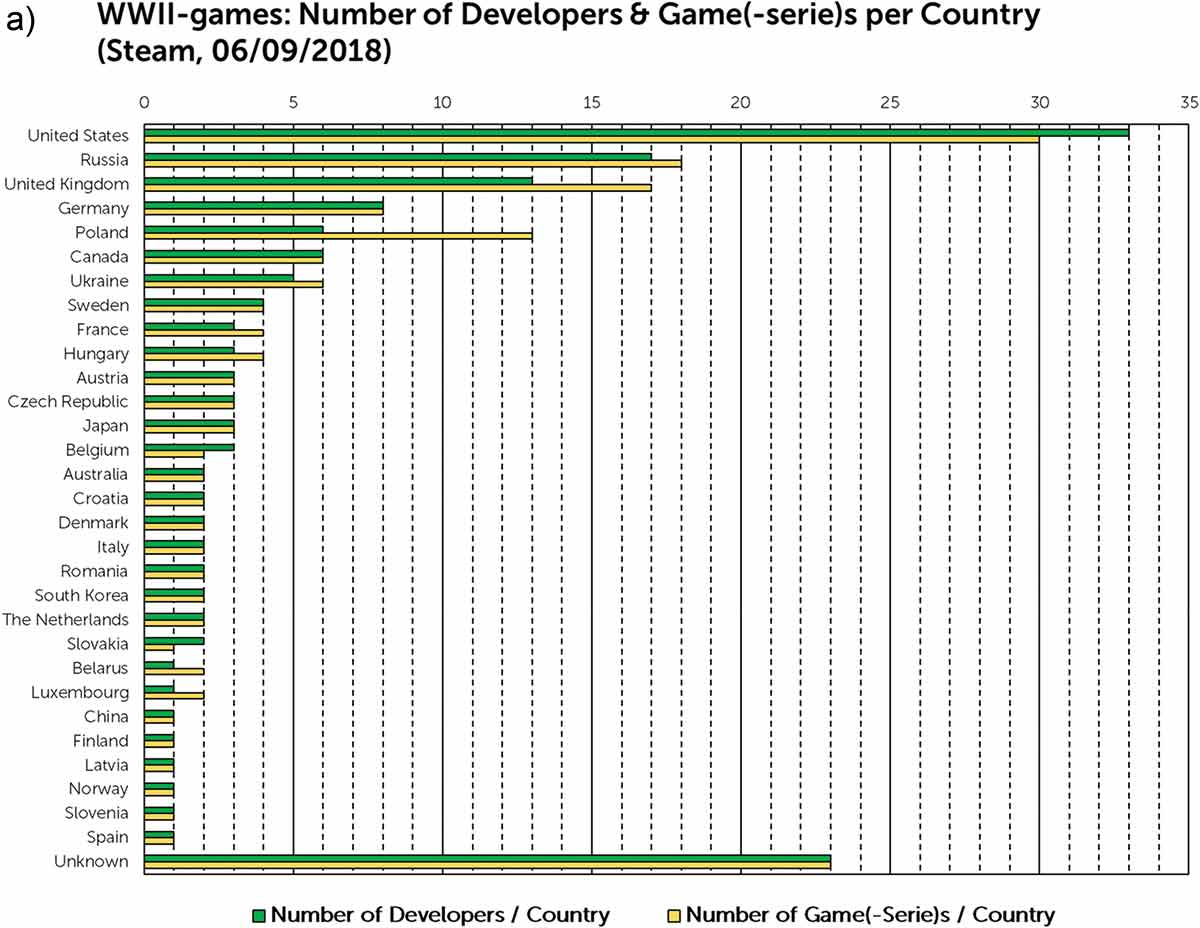
Throughout my paratextual analysis, I identified several distinct but interconnected historical and commemorative themes and ‘developer narratives’, reiterated upon repeatedly in transnational game creation circles. These themes and developer narratives revolved around the depiction of ‘militaria’ that were deployed by primarily male empowered military and political figures in distinct battle environments, as described in traditional battle histories, against either capable regular Axis armed forces or unidimensionally ‘evil’ Nazi opponents. In addition, these themes and developer narratives were presented to players through the use of distinct aesthetic strategies. In what follows, I will explore each of these recurring themes, narratives and aesthetics, and reflect on the broader implications of these findings for history education.
‘Militaria fetishism’ and battle narratives of empowered male heroism and ingenuity
Based on my paratextual analysis, I first identified a near exclusive focus of the studied marketing materials on armed combat and military and politically centred history. In the context thereof, I identified several subclusters of historical and commemorative themes and developer narratives, which I will discuss more extensively below.
Firstly, a majority of the marketing paratexts, of games belonging to all of the genres and produced by companies located in all of the identified countries, included a wide range of explicit references to either firearms, vehicles or other types of military equipment, or the ability for players to deploy a range of meticulously recreated military units. This is shown in the quote below, taken from the press releases in the selected corpus:
Use over 60 weapons including everything from Thompson sub machine guns to PIAT bomb launchers to FG42 auto rifles and flamethrowers. […] Progress through the ranks and unlock 33 different playable units of the US Army, British Commonwealth and German Wehrmacht factions like the 101st Airborne Division, No. 2 Commando, and 1. Fallschirmjäger Division. (Steam, 2017c) (Game: Day of Infamy, 2016)
This is a clear example of how creators of digital entertainment games about the Second World War aim to capture the historical fascination of players by focusing on what media scholars Salvati and Bullinger (2013) have called ‘technological fetishism’, i.e., the detailed depiction of the weapons used during the war, or more broadly, a sense of ‘militaria fetishism’. Given that this theme was mentioned in the paratexts of games produced in all of the involved countries, including China and South Korea, this can be seen as the primary transnational theme in the marketing of globally produced digital entertainment games about the Second World War. It is further illustrated by the historical and commemorative developer narratives that were shared on the online community platforms of, for example, the simulation games World of Tanks, World of Warplanes and IL-2 Sturmovik, and the FPS Rising Storm. On the YouTube channels of these games, a significant number of what I identify as ‘narratives of technological operation’ could be found, in which military consultants, game designers and celebrities talk about the design and functionality of tanks, planes and firearms, and the fate of specific pieces of military equipment that were used during the war and later recovered from the battlefield. Examples include: a series of videos on the dedicated European YouTube channel for Wargaming Group, the Belarussian company behind World of Tanks, World of Warships and World of Warplanes, in which Bruce Dickinson, the lead singer of the British metal band Iron Maiden, talks about the design of planes such as the Messerschmitt BF 109 (Wargaming Europe, 2018) (Figure 3); a series of videos on the same channel in which Richard Cutland, a British Gulf War veteran and one of Wargaming’s in-house tank specialists, investigates what happened to a German Tiger I tank that was captured by the British armed forces in North Africa in 1943 and is currently exhibited in the British tank museum in Bovington (Wargaming Europe, 2013); two videos on the YouTube channel of the Russian game developer 1C Game Studios, in which the director of a Russian aviation institute talks about a test flight he carried out with a recently restored Soviet Ilyushin IL-2 Sturmovik aircraft (1C Game Studios, 2013); and two videos in which the president of Tripwire Interactive, the creator of Rising Storm, showcases the firearms that were included in the game (Tripwire Interactive, 2013). ‘Narratives of technological operation’ in the marketing paratexts of popular games about the Second World War (Game: World of Warplanes).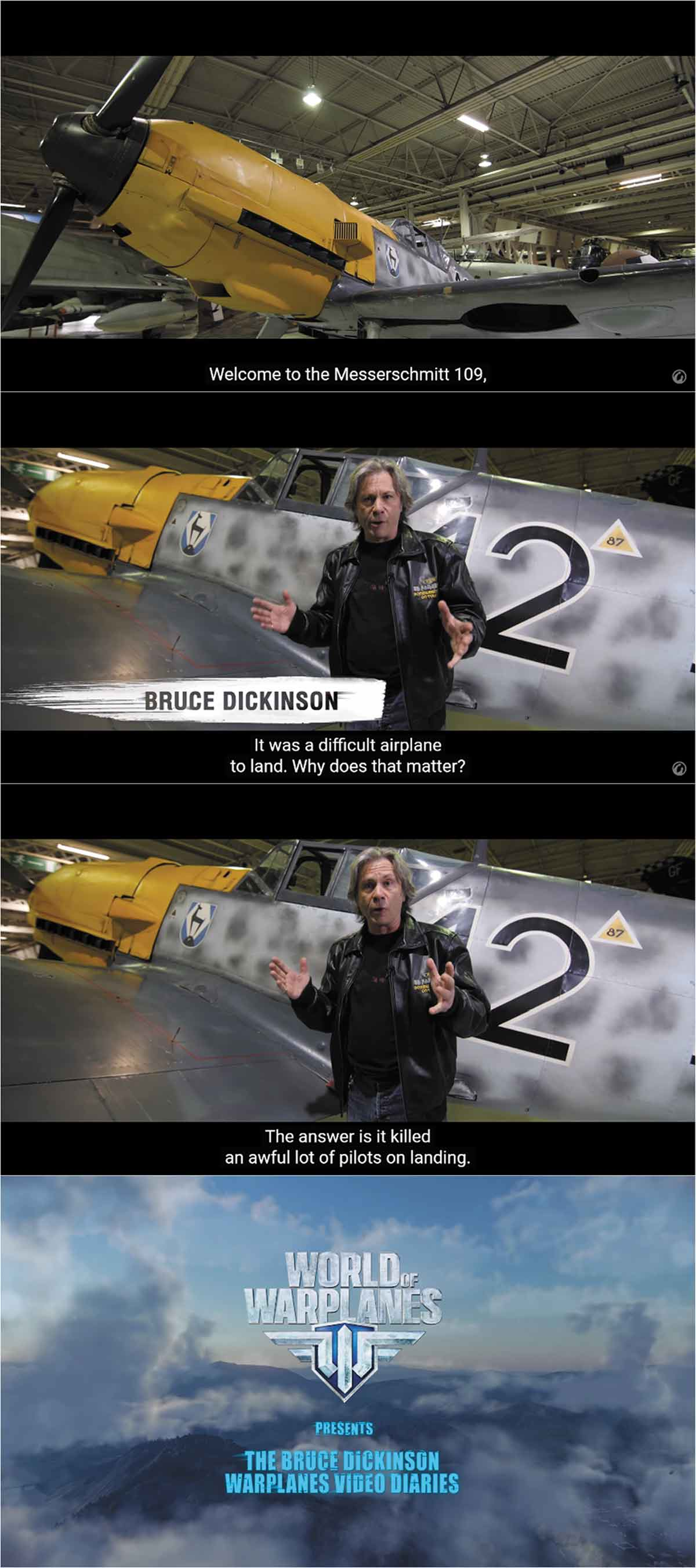
Each of these narratives presents a detailed level of knowledge to players about the military technology that was used during the war, a topic that is usually not discussed in school history curricula (e.g., Carrier et al., 2015; Crawford & Foster, 2008). From the perspective of historical thinking skills, as defined by historian Peter Seixas, this detailed rendition of military technology can provide a starting point for history educators to let school-age young adults further reflect on aspects of historical significance (Seixas & Morton, 2013): to what extent is it historically meaningful to discuss military technology? Are there specific military technologies that were developed during the Second World War that have resulted in significant transformations over time? What certainly is important for educators to take into account in this context is that many of these technocentric paratextual historical representations are more technological than violent: they express a fascination for military technology that usually ignores or only briefly touches upon the material destruction and loss of human life these technologies brought about. This should be rendered explicit in history classes.
Secondly, and in close connection with this focus on ‘militaria fetishism’, I identified a strong emphasis on ‘battle-centred’ developer narratives in the studied marketing paratexts, especially in relation to direct military confrontations between the major wartime powers in the European, and to a significantly lesser extent Asia-Pacific, theatre of the war. Some of the most explicit examples thereof could be found on the websites of strategy games such as Graviteam Tactics: Operation Star, Steel Division: Normandy 1944 and Company of Heroes, where I encountered a significant number of blog posts detailing the events of, for example, the third battle of Kharkov (February–March 1943) (Graviteam, 2011), the D-Day landings in Normandy and Operation Overlord (June–August 1944) (Eugen Systems, 2017) and the Battle of the Bulge in the Belgian Ardennes region (December 1944 to January 1945) (Company of Heroes, 2014). It results in a rich set of battle accounts similar to the ones found in traditional military historiography, which offers players the possibility to gain insight into the overall military course of the Second World War. At the same time, many of these battle narratives were relatively ‘bloodless’, in that they revolve around rather abstract descriptions of strategic decision-making in which the brutality of violence is discursively rendered invisible, as is often the case in school history textbooks as well (Bermudez, 2019). However, given that these military events are often only discussed in general terms in history school curricula (for the Netherlands, see for example the following report of the national centre of expertise for curriculum development SLO: Bron & Visser, 2018), this also offers history educators an opportunity to reflect on aspects of historical significance. In addition, it can allow educators to establish meaningful connections with other aspects of the curriculum. Knowledge about the military course of the war serves as an important context to understand how, for example, the genocidal violence of the Nazi regime further escalated between 1939 and 1945.
Furthermore, when analysing the human perspectives that were highlighted in the ‘battle-centred’ developer narratives and the studied marketing paratexts more generally, it became clear that a majority portrayed the war from the perspective of a series of mostly white and male militarized operatives and political leaders: infantry soldiers and junior officers at the frontlines, secret agents, fighter pilots and commanders of combat vessels, senior officers leading broader military operations, heads of state who take control of a country’s armed forces and its diplomatic and industrial apparatus, and resistance fighters. This can be explained based on the prevalence of FPS/TPS, simulation and strategy games in the studied corpus, since these genres are centred on the depiction of these military and political perspectives. At the same time, although the paratexts of several games in the corpus do refer to women and people of colour in military roles, it does highlight their continued underrepresentation and marginalization.
Following this observation, I identified several historical and commemorative developer narratives that explicitly highlighted the ‘noble heroism’ and ‘strategic ingenuity’ of the involved operatives and leaders, as well as a call to commemorate their actions. In some cases, these narratives were closely linked to recruitment efforts on behalf of, for example, the US military (McMahon, 2018). This is illustrated in the marketing paratexts of games belonging to all genres, including: an interview for the RTS Company of Heroes 2: Ardennes Assault, in which a developer and military historian Peter Caddick-Adams discuss the Battle of the Bulge and the role played by junior officers therein (Company of Heroes, 2015); a livestream video for the MMO FPS Heroes & Generals, in which two developers talk about the actions of heroic soldiers and resistance fighters whose names start with the letter B (Heroes & Generals, 2016); a series of videos uploaded to the YouTube channel of the FPS Call of Duty in which US veterans of the Second World War talk about their wartime experiences (Call of Duty, 2017); and a series of instruction videos for the RTS Sudden Strike 4, in which a game producer discusses the military ‘doctrines’ that players can adopt in the game, as a reference to strategic innovations and military successes that were implemented and achieved during the Second World War by generals such as Guderian, Zhukov, Patton and Montgomery (Kalypso Media, 2018).
All of these narratives are subsequently projected onto the player, who in the marketing paratexts is challenged to take on the role of these figures and change the outcome of the war or history itself, in reference to player ‘agency’ and an exaggerated sense of ‘heroic empowerment’, as described by game scholar Jonas Linderoth (2013). This is shown in the quotes below, taken from the press releases in the selected corpus: Eisenhower, Rommel, Zhukov; Assume your rightful place among the great generals commanding the Allies, Germans or Soviets as they advance through the decisive battles of WWII. (Steam, 2017a) (Game: Blitzkrieg Anthology, 2003) You hold the power to tip the very balance of WWII. It is time to show your ability as the greatest military leader in the world. Will you relive or change history? (Steam, 2017e) (Game: Hearts of Iron IV, 2016)
In contrast, hardly any of the studied paratexts mentioned the ability for players to experience the Second World War from the perspective of a non-combatant civilian, as is the case in a fictional game such as This War of Mine (11Bit Studios), or to explore the broader impact of the war on civil society. An exception to this are the paratexts for the game Attentat 1942, a point-and-click adventure game created by researchers at the Charles University of Prague, which highlight that players will be able to discover what happened to their grandparents during the occupation of Czechoslovakia by Nazi Germany during the war, by talking to fictionalized eye-witness accounts (Pötzsch & Šisler, 2019). In all, however, no other paratexts that referred to a similar focus on eye witnesses, or a broader sense of disempowerment during wartime, could be identified. When compared to how ‘war narratives’ as a broader cultural form in general have evolved over time, this means that the developer narratives expressed in the marketing paratexts of the selected games about the Second World War, and in close connection, the games themselves, tend to focus on top-down leadership perspectives and grassroots heroic soldier perspectives, in reference to the top-down general narratives that were prevalent until the late nineteenth century and the ‘democratized’ soldier narratives that became more dominant during the First World War. In contrast, however, the game paratexts hardly contained any of the types of war narratives that have become prevalent during the second half of the twentieth century in North America and Europe but also elsewhere, centred on accounts of civilians and victims of mass violence, in particular of the Holocaust (Adler, Ensel, & Wintle, 2019, pp. 204–217; Winter, 2006).
What are the implications of these observations for the development of historical thinking skills in formal history education? Given that most of the studied marketing materials put a strong emphasis on heroic empowerment and player ‘agency’, these paratextual narratives offer history educators a good starting point to let school-age young adults reflect on the underlying causality that is highlighted in these paratexts and the games themselves. This can help to advance the ability of school-age young adults to assess aspects of historical causality, one of the central historical thinking concepts identified by Peter Seixas (Seixas & Morton, 2013). To what extent did individual political and military leaders shape the outcome of the Second World War? To what extent was this outcome already determined by economic and other structural forces? A complementary set of historical and commemorative themes and developer narratives that I want to highlight in that respect could be identified in the marketing paratexts of GS games such as Hearts of Iron and Supreme Ruler, in which players take on the role of a head of state. Here, I encountered several marketing paratexts that highlighted various aspects of political, military and diplomatic history, as well as several causal factors that were seen as crucial to understanding this history. This is, for example, shown in the development diaries of the game Hearts of Iron, in which the developers talk about how the game is focused on resource management, the creation of industrial capacity and constant technological innovation, as a reference to the crucial role played by these factors in determining the outcome of the Second World War (Paradox Interactive, 2016a). This again shows how the studied marketing paratexts, and the games themselves, can offer rich sites to further reflect on the nature of historical causality.
Finally, I also want to highlight a significant transnational dimension in relation to the developer narratives of militarized male empowerment identified above. In line with the finding that approximately 50% of the games in the selected corpus were (co-)created by US, Russian and British companies, it could be established that the national, state- and military-centred perspectives of these countries in particular were dominant in the paratexts. References to other, more localized historical and commemorative narratives about the Second World War, on the other hand, were usually absent or only of secondary importance (for example, when embedded in optional additional downloadable content for the studied games), also in the paratexts of games produced by companies located elsewhere. This is illustrated in the following quotes, taken from games created by companies located in the US, Russia and Sweden, respectively: Join Matt Baker, Joe Hartsock and the rest of the 101st Airborne Division in Operation Market Garden as they fight to open the infamous Hell’s Highway in a daring bid for a quick end to the war. (Steam, 2017b) (Game: Brothers in Arms Hell’s Highway, 2008)
Men of War: Condemned Heroes tells the story of one of the infamous Soviet penal battalions during the WWII. […] These battalions’ images are surrounded by many myths, and this game tells the truth about these regiments based on real evidence from their former members. (Steam, 2017f) (Game: Men of War Condemned Heroes, 2012)
FLYING TIGERS: SHADOWS OVER CHINA is an air-combat action game based on the true events of America’s secret volunteer squadrons that defended China against Japan in the China-Burma-India theatre of World War 2. (Steam, 2017d) (Game: Flying Tigers Shadows Over China, 2015)
What therefore emerges as a second dominant set of transnational themes and developer narratives is an emphasis on the ability for players to ‘step into the shoes’ of empowered military and political heroes of the wartime powers, and determine the course of the war. These function as the commercially most viable themes and narratives for digital entertainment games about the Second World War, as they are assumed to be recognizable for the highest number of players, especially in North America, Europe and Russia. This does not mean that counterexamples were absent. The game Attentat 1942 was already discussed earlier. Furthermore, I noticed throughout my analysis that the marketing paratexts of several games developed by companies located in Poland tended to highlight more specific national themes, for example related to the Warsaw Uprising in 1944. In these paratexts, the Soviet Union was sometimes explicitly identified as an enemy state, in reference to the inherently contentious nature of how the Soviet Union’s involvement in the Second World War is remembered in Poland. It confirms the observations made by game scholar Piotr Sterczewski (2016), who discusses how Polish game creators have actively strived to include more explicit references to their national commemorative frameworks in their games in recent years. In all, however, such examples were rare, and most of these games only sold a limited number of copies, as shown by the data provided by SteamSpy. In addition, the involved game creators also sometimes made additional strategic choices to increase the game’s visibility. In the Polish FPS Enemy Front, for example, partly set during the Warsaw Uprising, players do not play as a Polish resistance fighter but as an American journalist who fights alongside them, as shown in the promotional trailers. This choice was made because of commercial imperatives, to appeal to a wider community of players.
‘Nazisploitation’: eccentric fascination, horrified bewilderment and carnivalesque ridicule and revenge
A second major cluster of themes and developer narratives that could be identified in the marketing paratexts was related to the depiction of the Nazi regime, or Nazism more generally. Here, I found that the concerned paratexts primarily referred to game settings that were centred on what literary scholars Magilow, Vander Lugt, and Bridges (2012) have described as ‘Nazisploitation’ themes (in reference to a subgenre of low-brow cinema that emerged during the 1970s), in which players have to confront mad Nazi ‘scientists’, evil SS commanders, robotic super-soldiers, zombies and dinosaurs, in games such as Wolfenstein, Zombie Army Trilogy, ÜberSoldier and Dino D-Day. In relation to these games, I identified several interviews (e.g., Gamereactor, 2013) in which the involved game creators stated that they had drawn inspiration from what they identified as eccentric characteristics of the Nazi regime (some of which are only of minor importance historically or are closely connected to conspiracy theories about the Nazis), such as the involvement of prominent Nazi leaders in occult societies and the search of the Nazi leadership for ‘wonder weapons’, and some of the war crimes committed by the Nazi regime, such as the gruesome experiments carried out by notorious SS doctor Josef Mengele at the Auschwitz concentration camp and extermination centre. The involved creators stated that they used these elements as a starting point to create over-the-top game scenarios for players to overcome through excessive and subversive virtual violence. Other marketing paratexts elaborated on this exaggerated premise, such as the promotional trailers for the game Wolfenstein: The Old Blood, which urge players to ‘infiltrate the Nazi paranormal division’ in a fictional German town and virtually ‘kill as many Nazis as you can’ (e.g., Bethesda Softworks, 2015). These marketing materials did not present elaborate historical or commemorative developer narratives that were meant to be informative, as was the case for the narratives identified in the previous section. Instead, they mostly highlighted what I define as themes of ‘eccentric fascination, horrified bewilderment and carnivalesque ridicule and revenge’, in that they were meant to invite players to either have fun while killing larger-than-life Nazis or to symbolically subvert and cathartically overcome a regime that is seen as ‘evil’ in Manichaeistic terms, in a more directly ideologically driven manner. In that respect, a transnational dimension could also be identified, in that game creators located in the US and the UK in particular, but also in Russia and elsewhere, equally tended to replicate these themes. An example thereof can be found in a number of videos published on the official website of the FPS game RAID: World War II, made by the Zagreb-based developer Lion Game Lion, in which members of the development team talk about how their game was inspired by eccentric stories about Nazi art and gold theft (Lion Game Lion, 2017).
The following general observations can be made about these paratextual themes, also in relation to the development of historical thinking skills in formal history education. Firstly, although the aforementioned depictions of Nazism explicitly rely on exaggeration and revolve around symbolic ridicule and subversion, they do reinforce the same binary dichotomies between ‘good’ and ‘evil’ that are omnipresent in other popular historical representations. These dichotomies are equally present in the marketing paratexts of single-player games centred on military combat between Allied and German soldiers in particular, such as Call of Duty WWII. Secondly, this critique on strict binaries also applies to the following observation: marketing paratexts of primarily multiplayer games that mentioned the Wehrmacht, or the regular German armed forces during the war, and the ability for players to play from both an Allied and a German perspective, mostly omitted direct references to Nazism, regardless of by whom the games were created. This means that, also specifically through marketing, North American, European and Russian game creators continue to make a clear distinction between the Nazi regime and the German armed forces. This transnationally perpetuates the ‘Wehrmacht myth’, i.e., the misconception that the Wehrmacht was an apolitical organization that was not actively involved in the genocidal violence and other war crimes committed by Nazi Germany on the Eastern Front in particular (Chapman & Linderoth, 2015; Stone, 2004, pp. 206–7). All of these distinctions make it important for history educators to explicitly counter dichotomies, by discussing how extreme war violence is brought about by complex social and other processes that do not lend themselves to static binary distinctions between ‘heroes’ and ‘villains’. Here, a connection can be made with two historical thinking concepts: historical perspective taking and ethical reflection. The distinction between ‘heroes’ and ‘villains’ often found in games can offer a good starting point for school-age young adults to learn both how to understand the socio-cultural structures and intellectual and emotional settings that have shaped people’s lives in the past, and to make proper ethical judgements about past actions and events (Seixas & Morton, 2013).
Aspects of audiovisual design
Finally, it is useful to analyse the aesthetic design of the studied audiovisual marketing paratexts, as it equally is a crucial way for game creators to repackage the history of the Second World War and offers players an important entryway to assess whether or not a game will meaningfully connect to their pre-existing knowledge, commemorative frameworks and experiences. Here, one can immediately see that the marketing paratexts of a majority of the studied digital entertainment games included explicit references to either (stereotypical assumptions about) media used during the war itself, such as black-and-white newsreel footage and visual propaganda from the 1940s, or references to the cinematic conventions of more recent and especially military-themed media texts, such as the such as the films Saving Private Ryan (Steven Spielberg, 1998; US), Fury (David Ayer, 2014; US), Dunkirk (Christopher Nolan, 2017; UK) and Stalingrad (Fedor Bondarchuk, 2013; RU). This confirms the observations made by several authors (Kingsepp, 2006; Salvati & Bullinger, 2013), i.e., that the use of cinematic and other audiovisual conventions makes up a central aesthetic strategy in the marketing of digital entertainment games about the Second World War, especially the ones that are published in North America and Europe, including Russia. These intermedial points of reference are actively used to play into a sense of recognition and perceived authenticity among players when they engage in speculative consumption of commodified historical representations. It perpetuates these audiovisual conventions as a naturalized point of reference, although they primarily refer to distinct media properties rather than an outside reality. As such, meaningful connections can be established with the ‘hyperreal’ and ‘simulacra’ as defined by the French philosopher Jean Baudrillard (1994). It makes it important for history educators to identify these media constructs and analyse them accordingly. This also applies to the aesthetics that are used in the marketing paratexts of games that explicitly depict Nazism and ‘Nazisploitation’ themes, which rely heavily on the symbolic language used by the Nazi regime. This happens in a strongly subversive manner in the studied paratexts, as discussed above. At the same time, the aesthetics of the paratexts continue to replicate some aspects of the propagandistic self-image and ‘brand’ that the Nazis themselves wanted to perpetuate (e.g., O’Shaughnessy, 2018). This can be illustrated by referring to the repeated use of images showing huge crowds of uniformed SS soldiers in the marketing paratexts of games such as Wolfenstein, which in the original Nazi propaganda were explicitly staged and meant to express a sense of strength, unity and determination. In the paratexts, this notion is explicitly ridiculed and exaggerated, but at the same time, these images are still used to highlight a sense of overwhelming power that needs to be challenged, at least partly in line with what the Nazi leadership originally wanted to express. This continued replication of the symbolic language of the Nazi regime as a semiotic index for the regime itself needs to be explicitly addressed by history educators.
Discussion: findings and implications for formal history education
In this article, I carried out an interpretative content analysis of the marketing paratextuality of the digital entertainment games about the Second World War that were distributed in North America and Europe (including Russia) in particular, through online game stores such as Steam and the additional official community platforms of these games. I carried out this analysis to contribute to a deeper understanding of digital entertainment gaming more broadly as a central expression of a contemporary transnational ‘popular’ historical culture that has the potential to generate and reinforce specific understandings of the past, and the Second World War in particular, in accordance with, as a supplement to or in opposition to the ones expressed in other contexts, such as formal history education. The choice to study the marketing paratextuality of these games was made because marketing paratexts provide a direct insight into how game creators repackage the history of the Second World War into entertainment-oriented cultural commodities for mass consumption. In addition, they show how digital entertainment games and their online community sites have become platforms for continued historical engagement, where the distinction between brand promotion, informal learning and remembrance has become fundamentally blurred.
Based on my analysis, I established that the marketing paratexts of the games in my corpus, which were mostly developed by North American, European and Russian game companies, tended to revolve around a limited set of interconnected historical and commemorative themes and ‘developer narratives’, reiterated upon by a majority of the involved game creators: A near-exclusive focus on military and political history, as showcased both by a clear emphasis on ‘militaria fetishism’ and accompanying ‘narratives of technological operation’ on the one hand and ‘battle-centred’ narratives that highlighted the heroism and strategic ingenuity of mostly white and male military and political figures on the other. Other perspectives and narratives were mostly absent. The depiction of ‘Nazisploitation’ themes and a desire to ridicule and subvert Nazism through excessive virtual violence. More generally, two overall binary dichotomies could be identified in the studied paratexts: a first one between Allied ‘heroes’ and Axis ‘villains’, and a second one between unidimensionally ‘evil’ Nazis and apolitical, ‘clean’ Wehrmacht soldiers. The use of aesthetics that draw heavily from the formal properties of other war-related audiovisual representations produced both during the war itself and in later decennia, and the propagandistic iconography used by the Nazi regime, to play into a sense of recognition and perceived authenticity among potential players.
This consistency presents both challenges and opportunities to history educators, in that these themes, narratives and aesthetics need to be actively questioned and deconstructed, while they can also be actively addressed to play into the prior knowledge of school-aged young adults who play these games, as a starting point to both expand on the aspects of the Second World War that are currently discussed in history school curricula and to advance the development of historical thinking skills.
To explain the prevalence of the aforementioned themes and developer narratives, several factors can be mentioned. On the one hand, the creation of digital entertainment games about the Second World War is structurally embedded in a strongly militarized mnemonic infrastructure. This is illustrated by the observation that a significant number of the studied games were at least partly made in cooperation with military advisors and national militaries, in what is often identified as a ‘military-entertainment complex’ (Lenoir & Caldwell, 2018). On the other hand, a number of game design and marketing considerations play an important role. Not only does the perceived clarity of the Second World War in both moral and military terms (i.e., Nazi Germany as the evil enemy and an emphasis on combat between clearly distinguishable state armies) lend itself well for game design; at the same time, a ‘presumed burden of interactivity’ (Van den Heede, Ribbens, & Jansz, 2018) can be observed in transnational game creation circles, that is, the assumption that game design centred on armed combat and existing genre conventions in particular is usually seen as commercially ‘safe’, which leads game companies to not explore other design principles and therefore ignore non-combat-oriented narratives. Finally, most game creators also focus on what is the least contentious and most recognizable for players globally to be commercially successful, which leads them to avoid sensitive and lesser known topics.
What are the implications of these findings for formal history education? The current analysis has shown how digital entertainment games and their paratexts, as shared through the online community platforms of these games, offer primarily male players a wide range of historical and commemorative narratives about the Second World War, which can serve as a significant basis of prior understanding of the war before these players enter a formal instruction setting. By engaging with the historical knowledge and commemorative discourses that circulate on the community platforms of these games, players will encounter historical representations that are overtly technocentric in nature and sidestep the violent consequences and broader societal impact of the Second World War, while also consistently adopting distinct aesthetic strategies that need to be actively deconstructed. At the same time, these paratextual representations offer players the opportunity to gain knowledge about the military course of the war, and in the case of more complex strategy games, some of the political decision-making and the role played by factors such as a country’s industrial capacity in determining the outcome of the war. These are forms of historical knowledge that are more commonly found in military historiography. In doing so, marketing paratexts of digital entertainment games about the Second World War highlight aspects of the conflict that are often not extensively discussed in history classrooms and other formal learning environments.
Furthermore, as a platform for informal learning, the studied marketing paratextuality can, under the right circumstances, certainly be used as a source for formal history education. Throughout my analysis, I have especially tried to demonstrate how the marketing materials, and the historical and commemorative themes and narratives that are expressed therein, can be used to advance historical thinking. Here, several opportunities present themselves: the elaborate depictions of military equipment and battle narratives in the paratexts offer history educators the possibility to reflect on the nature of historical significance, whereas the emphasis put on player ‘agency’ and empowerment in the paratexts and the games themselves can be used as a starting point to further discuss the nature of historical causality. In relation to the two central dichotomies that could be identified in the paratexts, between Allied ‘heroes’ and Axis ‘villains’ on the one hand and ‘evil Nazis’ and honourable, ‘clean’ Wehrmacht soldiers on the other, I argued that these static and mythic binaries should be actively deconstructed by history educators, which offers a good opportunity to reflect on historical perspective-taking and the ability to engage in historically meaningful ethical reflection. These are but a number of the meaningful ways in which the discussed paratextual content can be used to advance historical thinking skills.
‘¡Experimenta la Segunda Guerra Mundial como nunca antes!’ La paratextualidad de los videojuegos entre el branding transnacional y el aprendizaje informal
En febrero 2016, el desarrollador británico de juegos Bulkhead Interactive lanzó una campaña de microfinanciación colectiva para un nuevo videojuego ‘first-person shooter’ (FPS, videojuegos de disparos en primera persona), 1 centrado en los sucesos de la Segunda Guerra Mundial: Battalion 1944. El desarrollador fijó un objetivo de 100,000 £ (145,000 $), que se consiguió en apenas tres días (Chalk, 2016). Cuatro meses después, el desarrollador sueco de juegos Paradox Interactive anunció que Hearts of Iron IV, la iteración más reciente de su gran serie de juegos de estrategia sobre la Segunda Guerra Mundial había ‘vendido más de 200,000 copias en todo el mundo en menos de dos semanas tras su lanzamiento’. Esto lo convirtió en su gran juego de estrategia histórico que más vendido se ha vendido hasta la fecha (Paradox Interactive, 2016b). En abril 2017 y mayo 2018, respectivamente, dos de los editores de videojuegos más grandes del mundo, Activision y Electronic Arts, revelaron que las siguientes iteraciones de sus juegos FPS más vendidos, Call of Duty WWII y Battlefield V, marcarían el regreso de ambas series a su entorno original de la Segunda Guerra Mundial, que en el caso de Call of Duty WWII resultó en éxito comercial (Hall, 2017). Todos estos ejemplos muestran que todavía hay un gran interés en juegos de entretenimiento digital sobre la guerra, desde su lanzamiento en la década de los setenta del siglo pasado. Han sumado conjuntamente una gran masa de juegos: a fecha de abril 2019, la base de datos Mobygames incluye una lista de 734 juegos sobre la Segunda Guerra Mundial editados desde 1976 (Mobygames, 2019). A su vez, hay varios juegos nuevos actualmente en producción (e.g., DT Gaming, 2018).
De conformidad con el crecimiento global de la industria de los videojuegos durante las últimas dos décadas, estos juegos de entretenimiento digital sobre la Segunda Guerra Mundial han ocupado un puesto destacado como formato de expresión cultural. Ofrecen a millones de jugadores, incluido un número significativo de jóvenes adultos en edad escolar (Statista, 2017), una forma atractiva de ser partícipes en la historia de la Segunda Guerra Mundial. Por tanto, el hecho de jugar estos juegos e interactuar con el contexto cultural en el cual se integran, puede tener un impacto significativo en cómo estos jóvenes adultos, entre otros, aprenden acerca del conflicto y cómo lo recuerdan. Como dijo el historiador Kees Ribbens, la interpretación contemporánea de la Segunda Guerra Mundial no se forma solo a través de los intercambios en los contextos familiares, los debates historiográficos, los planes de estudio sobre la historia en el ámbito académico y las prácticas conmemorativas políticamente disputadas en torno a los monumentos y los museos a nivel local, regional y (supra)nacional. A su vez, se coconfigura mediante una serie interconectada de lo que suele identificarse como representaciones e imaginaciones ‘populares’ de las artes escénicas del pasado, a través de películas, novelas de aventuras, cómics y juegos, principalmente creados con fines comerciales y de entretenimiento y con frecuencia adaptados para consumidores transnacionales (Ribbens, 2014). Como resultado, analizar cómo estos formatos operan en la cultura de la historia contemporánea, i.e., los tipos de narrativas y configuraciones relacionadas con las artes escénicas que aportan, las redes e infraestructuras mnemotécnicas que los producen, las concepciones ontológicas de la historia que subvierten o refuerzan y, por último, las maneras en las cuales moldean el entendimiento más amplio del pasado (Grever & Adriaansen, 2017), ganan la misma importancia, también respecto de la historia de la Segunda Guerra Mundial. En lo referente a la práctica de la enseñanza de la historia, surge la consideración de cómo las representaciones de la Segunda Guerra Mundial a través de formatos y plataformas populares, y los juegos de entretenimiento digital en particular, están relacionadas con cómo se habla sobre la guerra en las escuelas, y lo que esto significa para los objetivos generales de la enseñanza formal de la historia, como el avance de habilidades de razonamiento histórico (Seixas & Morton, 2013). Esto es de especial importancia, dada la distinción cada vez menos clara entre el aprendizaje histórico formal e informal (Grever, 2018).
El objetivo de este artículo es arrojar luz sobre los juegos de entretenimiento digital como expresión de una cultura histórica popular que coconfigura la comprensión más amplia de la Segunda Guerra Mundial y que es de naturaleza fundamentalmente transnacional, a diferencia de muchos planes de estudio sobre la historia, que aún suelen estructurarse según, por ejemplo, líneas nacionales (e.g., Carrier, Fuchs, & Messinger, 2015; Crawford & Foster, 2008). Para este fin, no analizaremos juegos específicos ni las experiencias de los jugadores (para un análisis véase: Van den Heede, 2018). En su lugar, nos centraremos en la ‘paratextualidad’ más amplia que rodea estos juegos, en la forma de notas de prensa, tráileres promocionales, vídeos del making of y otros materiales de marketing creados por las empresas creadoras de juegos en conjunción con los mismos y que son presentados en tiendas en línea, las páginas web oficiales de los juegos y páginas dedicadas en las plataformas de redes sociales, como Facebook, YouTube y Twitter. Elegimos este análisis porque los paratextos de marketing de los juegos ofrecen un conocimiento directo de cómo los creadores de los juegos transforman y reenvasan la historia de la Segunda Guerra Mundial en el contexto de un mercado de productos lúdicos. Según argumenta el experto en medios de comunicación Jonathan Gray (2010), los paratextos de marketing para los juegos no solo pretenden generar interés y animar a los consumidores a comprar y relacionarse con el producto cultural. Simultáneamente, al ofrecer a los jugadores marcos de reflexión sobre su contenido antes o durante el juego, funcionan como las pasarelas principales de acceso a un juego. Esto impregna al juego de significados adicionales, aunque a menudo estrechamente ligados a los significados expresados en otras representaciones mediáticas y en los juegos mismos. Los paratextos de marketing para los juegos históricos, en particular, tienden a destacar cómo los creadores de los juegos integran sus juegos en una red más amplia de mitologías, ideologías, imaginarios históricos y expresiones conmemorativas. Como resultado, ponen el foco sobre las interpretaciones específicas anteriores de la Segunda Guerra Mundial que los jóvenes adultos en edad escolar y otros jugadores pueden adquirir a través de su participación con la ecología mediática más amplia en el cual se integran los juegos de entretenimiento digital, como un sitio para el aprendizaje informal de la historia.
Este artículo pretende responder a la siguiente pregunta central: ¿cuáles son los temas y las narrativas históricos dominantes y conmemorativos expresados por los creadores de los juegos en los materiales de marketing para los juegos de entretenimiento digital sobre la Segunda Guerra Mundial, y qué dice esto sobre la representación de esta guerra en los juegos de entretenimiento digital a nivel más amplio, además a la luz de los objetivos básicos de la enseñanza formal de la historia? Como parte de este esfuerzo, destacaré específicamente cómo los paratextos de marketing de los juegos de entretenimiento digital sobre la Segunda Guerra Mundial tienden a ofrecer una representación convergente de este guerra a nivel transnacional, a diferencia de cómo se habla de la guerra un muchos planes de estudio desde un enfoque nacional y otros discursos conmemorativos a nivel local, regional y (supra)nacional (Carrier et al., 2015; Chirot, Shin, & Sneider, 2014; Crawford & Foster, 2008).
En los siguientes apartados, explicaré la naturaleza de los ‘paratextos’ y cómo guían la lectura de los juegos de entretenimiento digital como ‘textos’ mediáticos, también concretamente en relación a cómo funcionan en la cultura de la historia contemporánea y en el aprendizaje informal. Segundo, para contextualizar mi análisis paratextual, haré una caracterización general de los juegos a los cuales pertenecen los paratextos de marketing analizados. Por último, abordaré los temas y narrativas históricos dominantes y conmemorativas que pueden identificarse en el corpus, y qué significado tienen para la enseñanza formal de la historia.
La paratextualidad de los videojuegos entre el branding transnacional y el aprendizaje informal
Originalmente, el concepto de ‘paratexto’ se adoptó en el campo de los estudios literarios. Gérard Genette (1997) lo usó para describir varios elementos que ‘rodean’ un libro como artefacto literario, como su cubierta, composición tipográfica y otros elementos dentro del libro mismo (‘peritextos’), y críticas, entrevistas con el autor y otros elementos externos al mismo (‘epitextos’). Genette identificó todos estos elementos como ‘umbrales de interpretación’, que básicamente canalizan las expectativas del lector respecto de un libro antes o durante su lectura. Posteriormente, el concepto fue adoptado por los expertos en medios de comunicación, que también destacaron que los significados que las personas otorgan a un programa televisivo, película o cualquier otro ‘texto’ mediático son codeterminados por los paratextos que consumen junto con el texto. Jonathan Gray en particular profundizó sobre esta observación al desarrollar una teoría más amplia de la paratextualidad mediática, donde destaca los siguientes dos elementos (para los siguientes dos párrafos, véase: Gray, 2010, p. 23–30):
Los materiales de marketing, como un tipo particular de paratexto, no suelen ofrecer una visión general de las funcionalidades, los placeres y los demás beneficios de un producto cultural. En cambio, impregnan dicho producto con significados adicionales para integrarlo dentro de un universo semiótico más amplio. Esta observación general es aplicable solo en parte a los textos mediáticos, dado que sus materiales de marketing suelen incluir directamente escenas de los textos mismos. A nivel más general, los paratextos de un texto mediático pueden verse como una parte integral de un texto mediático como una entidad cultural más amplia en la sociedad. Esto significa que los paratextos de los textos mediáticos pueden, al menos en parte, facilitar la comprensión del texto central mismo. A su vez, no obstante, estos paratextos también tienen como objetivo impregnar el texto original con significados adicionales para atraer a los consumidores.
Al establecer varios significados y estrategias de interpretación para que los lectores encuentren sentido en un texto, los paratextos permiten un proceso de ‘consumo especulativo’, donde los consumidores, ante un gran número de textos y solo una cantidad limitada de recursos, intentarán formarse una idea de los placeres que cada texto ofrecerá, con el fin de decidir con cuáles interactuará. Como consecuencia, muchas personas solo conocerán un texto a su nivel paratextual, lo que otorga aún mayor relevancia al análisis paratextual.
¿Qué relación tienen estas observaciones con los paratextos de los juegos y su función en la cultura de la historia contemporánea y en el aprendizaje informal? Respecto de los paratextos de los juegos en general, la mayoría de los expertos en juegos han corroborado las caracterizaciones anteriores (Consalvo, 2007). A su vez, han señalado cómo la paratextualidad de marketing funciona de manera explícitamente bidireccional, en comparación con la paratextualidad de otros formatos mediáticos. El experto en juegos Matthew Payne, por ejemplo, ha estudiado cómo los materiales de marketing de juegos de entretenimiento digital de temática militar evocan la sensación de ‘guerra lúdica’ entre jugadores. Lo hace al adoptar el concepto de ‘circuito de interactividad’ introducido por los expertos en medios de comunicación Stephen Kline, Nick Dyer-Witheford y Greg de Peuter, que postula que la producción tecnológica, el marketing y el consumo cultural deberían verse como los tres subcircuitos centrales del capitalismo contemporáneo globalizado, y la industria global de los juegos como su principal expresión (Kline, Dyer-Witheford, & De Peuter, 2003). En su análisis, Payne describe cómo en la industria del juego, la producción y el consumo han llegado a coexistir en una relación básicamente dialéctica, dado que los creadores de los juegos buscan constantemente la retroalimentación de los jugadores a lo largo del ciclo de vida de un juego para optimizar su juego/producto. Esta tendencia también se ha consolidado en los últimos años, debido a dos acontecimientos estrechamente interconectados. Por un lado, un creciente número de empresas creadoras de juegos han adoptado un modelo comercial orientado al servicio, en el cual ya no se limitan a producir juegos como productos singulares. En cambio, continúan ofreciendo actualizaciones y contenidos a través de canales de distribución digital mucho tiempo después del lanzamiento inicial del juego (e.g., Kerr, 2017, pp. 64–105). Además, el surgimiento de las plataformas de redes sociales, como Facebook, YouTube, Twitter, y servicios de streaming como Twitch, ha abierto vías adicionales de interacción entre los creadores de juegos y los jugadores. Esto refuerza la creación de ‘comunidades de marca (en línea)’ alrededor de los juegos y las empresas creadoras de los mismos (para el concepto ‘comunidad de marca en línea’, véase: Martínez-López, Anaya-Sánchez, Aguilar-Illescas, & Molinillo Jiménez, 2016). Habida cuenta de estos acontecimientos, Payne argumenta que los paratextos de los juegos funcionan como el ‘interfaz textual inicial’ en el cual ocurre esta interacción constante entre los creadores de juegos y los jugadores. A su vez, sigue considerando esenciales los paratextos de marketing generados por las empresas creadoras de juegos, en que siguen siendo las expresiones iniciales de un juego que los jugadores suelen ver, y los primeros en establecer unos marcos importantes de generación de significados que moldean cómo los jugadores experimentan el juego, como se ha dicho anteriormente (para el párrafo íntegro, véase: Payne, 2016, pp. 152–6).
Entonces, respecto de cómo los paratextos de marketing funcionan en la cultura de la historia contemporánea como sitios para el aprendizaje informal, podemos ofrecer la siguiente caracterización doble. Primero, desde la perspectiva de jugadores/consumidores potenciales, los materiales de marketing de juegos digitales históricos funcionan como sitios donde valorar si el juego y sus actualizaciones posteriores reconfirmarán, además de legitimar y expandir significativamente, o no, los conocimientos preexistentes, los marcos conmemorativos y las experiencias de un jugador en relación a un tema histórico, como un componente dentro de un conjunto más amplio de intereses y deseos que tienen los jugadores en relación a un juego. Un ejemplo ilustrativo de esto es cómo reaccionaron los jugadores en mayo 2018 al tráiler que anunciaba el juego Battlefield V, que fue objeto de controversia en línea porque mostraba visiblemente a una soldado en el frente con un brazo protésico, algo que parte de la comunidad de jugadores de Battlefield consideró demasiado poco realista para un juego ambientado en la Segunda Guerra Mundial (Chalk, 2018a). Segundo, desde la perspectiva de la producción, i.e., la perspectiva del enfoque de este artículo, los paratextos de marketing muestran cómo los creadores de los juegos intentan posicionarse como ‘desarrolladores-historiadores’ (Chapman, 2016, pp. 30–55) y agentes mnemónicos al crear juegos digitales históricos en que, como dice la historiadora Esther Wright (2018), usan materiales de marketing para destacar los temas históricos y conmemorativos distintivos y las narrativas más amplias que intentan expresar a través de sus juegos. Identifico estas narrativas como ‘narrativas de desarrolladores’, en coherencia con la noción de Chapman de ‘desarrollador-historiador’. Al formular estos temas y narrativas de desarrolladores, los creadores de juegos transforman parcialmente sus plataformas comunitarias en línea en sitios de expresión histórica y conmemorativa. Esto desdibuja la distinción entre una comunidad de una marca con ánimo de lucro, por un lado, y una comunidad para el aprendizaje informal y la memoria, por otro lado, al menos en formas que no pretenden interferir con los intereses comerciales de las empresas creadoras de juegos involucradas. Permite a los jugadores adquirir un conocimiento del pasado que funciona como punto de partida para buscar más encuentros con la historia, por ejemplo, al entrar en un entorno de aprendizaje formal.
Método: estudio de la paratextualidad de los juegos a través del análisis de contenidos
Para estudiar la paratextualidad de marketing de los juegos de entretenimiento digital sobre la Segunda Guerra Mundial como expresión de una cultura histórica ‘popular’ convertida en producto y como un sitio potencial para el aprendizaje informal de la historia, realicé un análisis de contenido interpretativo de fuentes textuales y audiovisuales. Identifiqué los temas históricos y conmemorativos y las ‘narrativas de desarrolladores’ que aparecían en las notas de prensa, los tráileres promocionales y otros materiales de marketing para los juegos digitales sobre la Segunda Guerra Mundial publicados en Steam, una tienda en línea líder global para los juegos de PC. También analicé los paratextos de marketing complementarios de estos juegos que podían identificarse en las plataformas dedicadas de sus comunidades, en particular en sus sitios web oficiales y en canales de YouTube dedicados. Durante el análisis de contenido interpretativo, presté especial atención a las listas de ‘argumentos de venta’ con una dimensión explícita histórica y/o conmemorativa señalada en sus materiales de marketing. Para guiar mi análisis de las ‘narrativas de desarrolladores’, adopté la definición abierta de ‘narrativas’ formulada por los historiadores Keith Barton y Linda Levstik: ‘cadenas de sucesos en una relación causa-efecto’ que se despliegan con el tiempo e implican a actores, acciones, objetivos/intenciones, entornos e instrumentos específicos (Barton & Levstik, 2004, pp. 129–132). Al estudiar estos paratextos, usé la definición general para identificar las ‘narrativas de desarrolladores’ expresadas en fuentes textuales y audiovisuales.
Usé juegos sobre la Segunda Guerra Mundial distribuidos en Steam como punto de partida para este estudio por varios motivos. Steam no es solo una plataforma de distribución para juegos dominante a nivel global. También sirve como punto de enfoque para los paratextos de marketing y me permitió identificar un corpus más amplio de juegos sobre la Segunda Guerra Mundial a través de su sistema de ‘etiquetas’, mediante el cual los jugadores y creadores pueden asignar palabras clave a los juegos en Steam para ayudar a otros jugadores a buscar juegos de manera más selectiva. De este modo, estas etiquetas aclaran lo que los jugadores mismos identificaron como juegos sobre la Segunda Guerra Mundial. Por último, Steam me mostró la popularidad de los juegos a través de SteamSpy. Este servicio web recopila información sobre juegos que compran y juegan los usuarios de Steam alrededor del mundo a través del análisis de sus estadísticas públicas (SteamSpy, 2016). 2 De este modo, analicé los materiales de marketing de los juegos sobre la Segunda Guerra Mundial que habían comprado el mayor número de jugadores a fecha de 18 de septiembre de 2018.
Para realizar este estudio, analicé los paratextos de marketing distribuidos en Steam y en las plataformas de comunidades en los Países Bajos anteriormente mencionadas, dado que aquí es donde accedí a los materiales. Esto es reseñable para este estudio por varios motivos. Primero, no todos los juegos de entretenimiento digital sobre la Segunda Guerra Mundial creados a nivel mundial son accesibles a través de Steam, ni tienen éxito comercial en los Países Bajos o en otras partes del mundo. Por ejemplo, dado que Steam ha sido menos dominante en países asiáticos, como China y Japón, hasta hace poco (Chalk, 2018b), el uso de Steam implica que quedaron excluidos del corpus algunos de los juegos distribuidos en estos países, pero no disponibles en Steam. Segundo, las tiendas de juegos como Steam ofrecen varios ajustes específicos regionales (aunque la mayoría se aplican a los precios y métodos de pago), mientras que los juegos producidos a nivel global también suelen localizarse para regiones y países específicos (e.g., Carlson & Corliss, 2011). Un ejemplo de esto es que, hasta agosto de 2018, los símbolos nazis, como la esvástica, fueron categóricamente eliminados de los juegos digitales y sus materiales de marketing en Alemania en concreto, debido a la prohibición del uso de estos símbolos en juegos digitales, según el Código Penal de Alemania (Raymond, 2018). Conjuntamente, esto implica que el análisis actual tiene una integración explícitamente regional. A su vez, el enfoque adoptado permite identificar patrones más amplios en los paratextos de marketing de los juegos de entretenimiento digital sobre la Segunda Guerra Mundial con una distribución global, especialmente en Norteamérica y en Europa occidental y oriental, incluso Rusia. Esto es especialmente el caso dado que los juegos y sus materiales de marketing no suelen estar traducidos al neerlandés para un mercado holandés, y no existen prohibiciones legales específicas en los Países Bajos respecto de los contenidos de los juegos de entretenimiento digital sobre la Segunda Guerra Mundial similares a las de Alemania u otros países.
Desde el enfoque descrito anteriormente, analicé los paratextos de marketing de 220 juegos de entretenimiento digital que pertenecían a 151 series distintas de juegos y que fueron identificados por los creadores y jugadores de los juegos como juegos sobre la Segunda Guerra Mundial en Steam. La mayoría de estos juegos fueron lanzados en la plataforma a partir de 2003, con un aumento significativo en 2014 (Figura 1). Para remarcar la dimensión transnacional de estos juegos y su marketing, identifiqué en qué países se ubicaban las sedes de las compañías involucradas, según la información disponible en Steam y las páginas adicionales de sus comunidades. Al hacerlo, es importante recordar que (1) varias de las compañías, como Wargaming Group (World of Tanks), son propietarias de subsidiarias en otras regiones y pertenecen a conglomerados intersectoriales globales; y que (2) la mayoría de estas empresas están compuestas de equipos que aúnan diversas nacionalidades y que cada vez más trabajan en redes de producción transnacionales de empresas digitales. No obstante, dado que la producción de juegos aún está fuertemente arraigada en contextos locales (e.g., nacionales) independientes (Kerr, 2017, pp. 27–63), es importante identificar estas ubicaciones. Juegos sobre la Segunda Guerra Mundial: número de juegos/año (n = 220) (Steam, 6 de septiembre de 2018).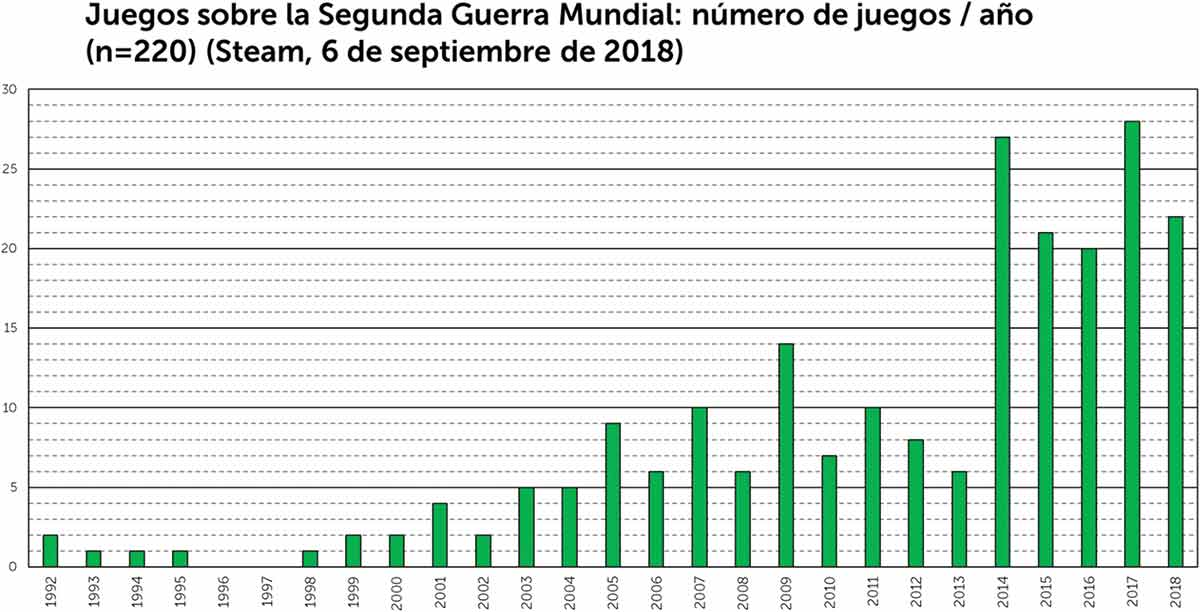
Resultados
Para contextualizar mi análisis paratextual, primero haré una caracterización general de las series de juegos analizadas en términos de género y país de origen. Puede identificarse en el corpus una coherencia llamativa respecto del género: al hacer un ranking de los juegos por cifras de ventas o número de descargas, casi todos pudieron ser identificados como videojuegos de disparos en primera persona o tercera persona (FPS/TPS) (32 series), simulaciones de vuelos y otras simulaciones (26 series), juegos de estrategia en tiempo real, de estrategia por turnos o de gran estrategia (RTS/TBS/GS) (65 series) o juegos híbridos que combinan varios géneros. Como muestran los datos aportados por Quantic Foundry, una empresa de investigación de mercados, los jugadores de estos géneros son predominante ̶aunque no exclusivamente̶ chicos (Yee, 2017). Esto implica que, también desde el punto de vista de la enseñanza de la historia, se manifiesta una división clara entre géneros: los juegos de entretenimiento digital sobre la Segunda Guerra Mundial actualmente disponibles sobre todo atraen a jugadores masculinos. Esto quiere decir que los maestros de historia tienen mayor probabilidad de dar con jóvenes adultos en edad escolar que han jugado a estos juegos digitales y estado expuestos a su paratextualidad como plataforma de aprendizaje informal. El corpus incluyó juegos en línea de acceso gratuito (F2P MMO, o ‘free to play massive multiplayer online games’) como World of Tanks, juegos de alto presupuesto para PC y videoconsolas domésticas como Call of Duty: WWII y juegos móviles como Battle Islands. Conforme a la observación de Aphra Kerr, experta en juegos, que afirma que la industria global actual de juegos está dominada por un pequeño número de conglomerados principales intersectoriales, como Microsoft, Sony y la empresa tecnológica china Tencent, al mismo tiempo que se ha disparado el número de empresas pequeñas de juegos en la última década (Kerr, 2017, p. 27–63), el corpus incluyó 13 series de juegos producidos por empresas importantes y comprados por millones de jugadores, como Heroes & Generals, War Thunder, Company of Heroes y Sniper Elite (Apéndice 1), y también docenas de juegos pequeños que apenas unos pocos miles de jugadores habían descargado.
Respecto del país de origen, la mayoría del total de las empresas de juegos involucradas, es decir, 156 desarrolladores y 121 editores, tenían su sede principal en los EE. UU. (33 desarrolladores, 31 editores), Rusia (17, 10) y Reino Unido (13, 10) (Figura 2a, b). En general, aproximadamente 50% de los juegos fueron (co)creados por empresas de origen estadounidense, ruso o británico. La mayoría de las demás empresas tenían su sede principal en Canadá o países europeos, como Alemania, Polonia, Ucrania, Suecia o Francia. En total, solo ocho desarrolladores y nueve editores se ubicaban fuera de Norteamérica y Europa/Rusia, i.e., en Japón, Corea del Sur, China y Australia. Esto incluyó empresas japonesas como Sega, que también editan juegos como Company of Heroes, creado por el desarrollador canadiense Relic Entertainment para un mercado principalmente norteamericano y europeo (Grubb, 2017). El ranking por número de propietarios mostró que los juegos más populares, con más de un millón de propietarios, fueron (co)creados por empresas ubicadas en Dinamarca (Heroes & Generals), Rusia (War Thunder), EE. UU. (Red Orchestra, Call of Duty), Canadá (Company of Heroes), Reino Unido (Sniper Elite), Suecia (Hearts of Iron), Bielorrusia (World of Tanks) y España (Commandos), respectivamente (Apéndice 1). (a) Juegos sobre la Segunda Guerra Mundial: número de desarrolladores y juegos (o serie) por país (Steam, 6 de septiembre de 2018). (b) Juegos sobre la Segunda Guerra Mundial: número de editores y juegos (o serie) por país (Steam, 6 de septiembre de 2018). (Continuación).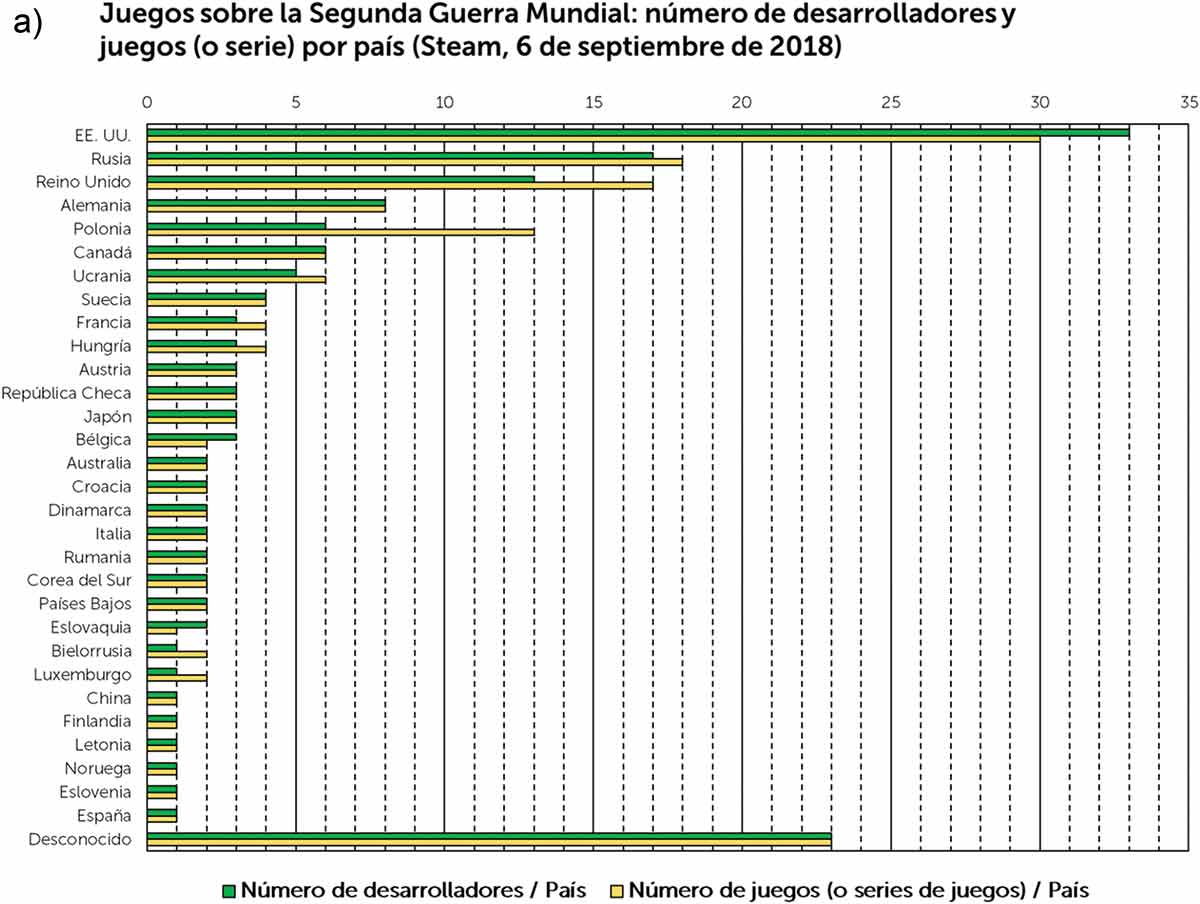
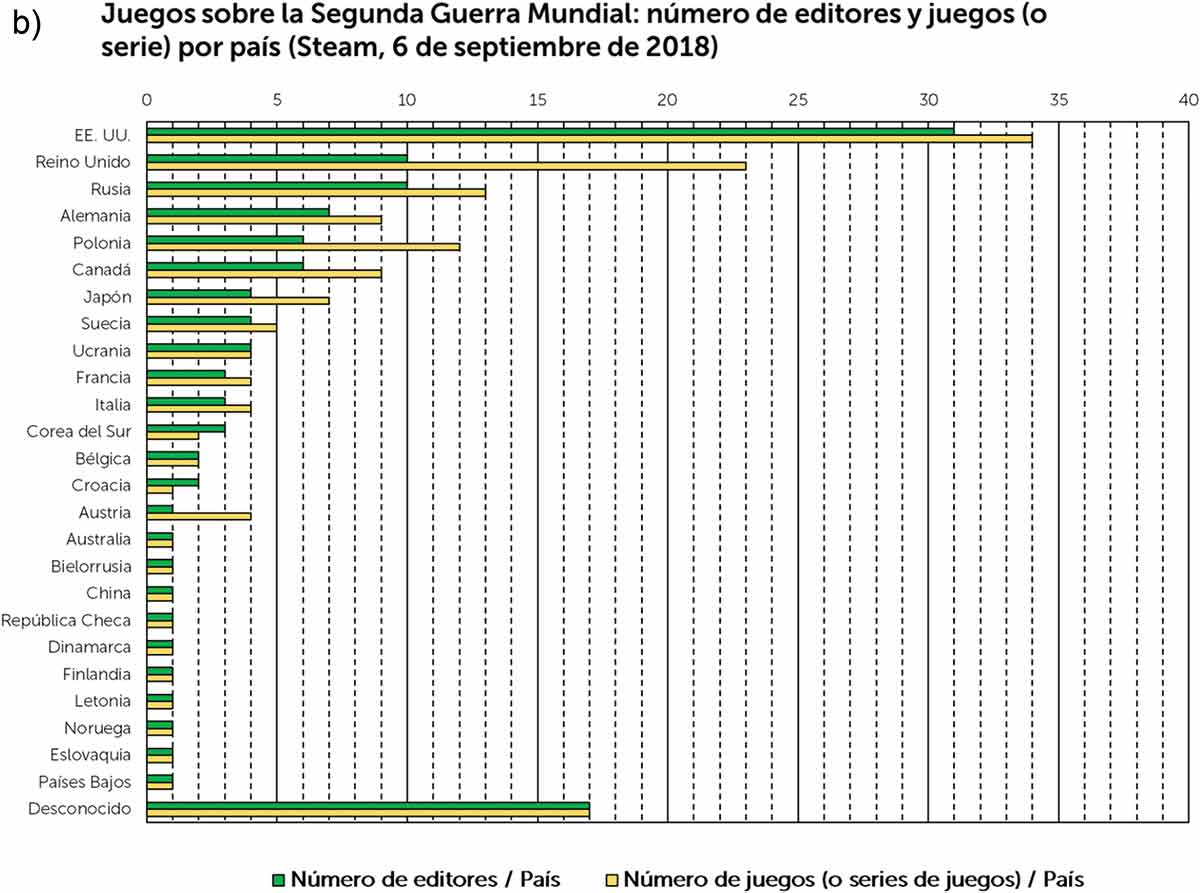
En mi análisis paratextual, identifiqué varios temas históricos y conmemorativos y narrativas de desarrolladores distintivos pero interconectados que se reiteraban repetidamente en los círculos transnacionales de creadores de juegos. Estos temas y narrativas de desarrolladores se centraban en la representación de ‘militaria’ desplegados por militares y políticos empoderados principalmente masculinos en entornos de batalla distintivos, como describieron las historias tradicionales de batallas, en contra de las fuerzas armadas regulares del Eje o los oponentes nazis unidimensionalmente ‘malvados’. Además, estos temas y narrativas de desarrolladores se presentaron a los jugadores a través del uso de estrategias estéticas distintivas. En los siguientes apartados, analizaré cada uno de estos temas, narrativas y estéticas recurrentes, y reflexionaré sobre las implicaciones más amplias de estos hallazgos para la enseñanza sobre la historia.
El ‘fetichismo de militaria’ y las narrativas de batallas de heroísmo empoderado y sagacidad masculinos
Según mi análisis paratextual, primero identifiqué un enfoque casi exclusivo de los materiales de marketing analizados sobre las luchas armadas y la historia desde un enfoque militar y político. En este contexto, identifiqué varios subgrupos de temas históricos y conmemorativos y narrativas de desarrolladores que detallaré en los siguientes apartados.
Primero, una mayoría de los paratextos de marketing de los juegos pertenecientes a todos los géneros y producidos por empresas ubicadas en todos los países identificados incluyeron una amplia variedad de referencias explícitas a armas de fuego, vehículos u otros tipos de equipamientos militares, o la capacidad para que los jugadores pudieran desplegar un rango de unidades militares meticulosamente recreadas. Así lo muestra la siguiente cita, extraída de las notas de prensa de los corpus seleccionados: Usa más de 60 armas, incluyendo todo desde el subfusil Thompson hasta el lanzagranadas antitanque PIAT, el fusil de combate FG42 y lanzallamas. […] Asciende de puesto y desbloquea 33 unidades de juego diferentes de las fuerzas armadas de EE. UU., la Mancomunidad de Naciones y las facciones de la Wehrmacht alemana, como la 101.a División Aerotransportada, Comando N.° 2 y la 1.a División Fallschirmjäger. (Steam, 2017c) (Juego: Day of Infamy, 2016)
Este es un claro ejemplo de cómo los creadores de los juegos de entretenimiento digital sobre la Segunda Guerra Mundial pretenden captar la fascinación de los jugadores con la historia al enfocarse en lo que los expertos en medios de comunicación Salvati y Bullinger (2013) han llamado el ‘fetichismo tecnológico’, i.e., la representación detallada de las armas usadas durante la guerra o, más ampliamente, un ‘fetichismo de militaria’. Dado que este tema fue mencionado en los paratextos de los juegos producidos en todos los países implicados, incluso China y Corea del Sur, esto puede considerarse el tema transnacional principal en el marketing de los juegos de entretenimiento digital sobre la Segunda Guerra Mundial producidos a nivel global. También se vieron otras ilustraciones de esto en las narrativas de desarrolladores históricas y conmemorativas que se compartieron en las plataformas comunitarias en línea de, por ejemplo, los juegos de simulación World of Tanks, World of Warplanes y IL-2 Sturmovik, y el FPS Rising Storm. En los canales de YouTube de estos juegos, se encontró un número significativo de lo que identifico como narrativas de operaciones tecnológicas, en las que los asesores militares, diseñadores de juegos y celebridades hablan sobre el diseño y la funcionalidad de los tanques, los aviones y las armas de fuego, y el destino de las piezas específicas de equipamientos militares usados durante la guerra y posteriormente recuperados de los campos de batalla. Los ejemplos incluyen una serie de vídeos en el canal de YouTube dedicado de Wargaming Group, la empresa bielorrusa detrás de World of Tanks, World of Warships y World of Warplanes, en el cual Bruce Dickinson, cantante principal del grupo británico de ‘heavy metal’ Iron Maiden, habla del diseño de los aviones, como el ‘Messerschmitt BF 109’ (Wargaming Europe, 2018) (Figura 3); una serie de vídeos en el mismo canal en la cual Richard Cutland, veterano británico de la Guerra del Golfo y uno de los especialistas en tanques internos de Wargaming, investiga qué le ocurrió a un tanque alemán ‘Tiger I’ que fue capturado por las fuerzas armadas británicas en el norte de África en 1943 y que actualmente está en exposición en el museo británico de tanques en Bovington (Wargaming Europe, 2013); dos vídeos en el canal de YouTube del desarrollador de juegos ruso 1 C Game Studios, donde el director de un instituto ruso de aviación habla sobre el vuelo de prueba que realizó con una aeronave soviética ‘Ilyushin IL-2 Sturmovik’ recientemente restaurada (1C Game Studios, 2013); y dos vídeos en los cuales el presidente de Tripwire Interactive, empresa creadora de Rising Storm, muestra las armas de fuego incluidas en el juego (Tripwire Interactive, 2013). Narrativas de operaciones tecnológicas en los paratextos de marketing de juegos populares sobre la Segunda Guerra Mundial (Juego: World of Warplanes).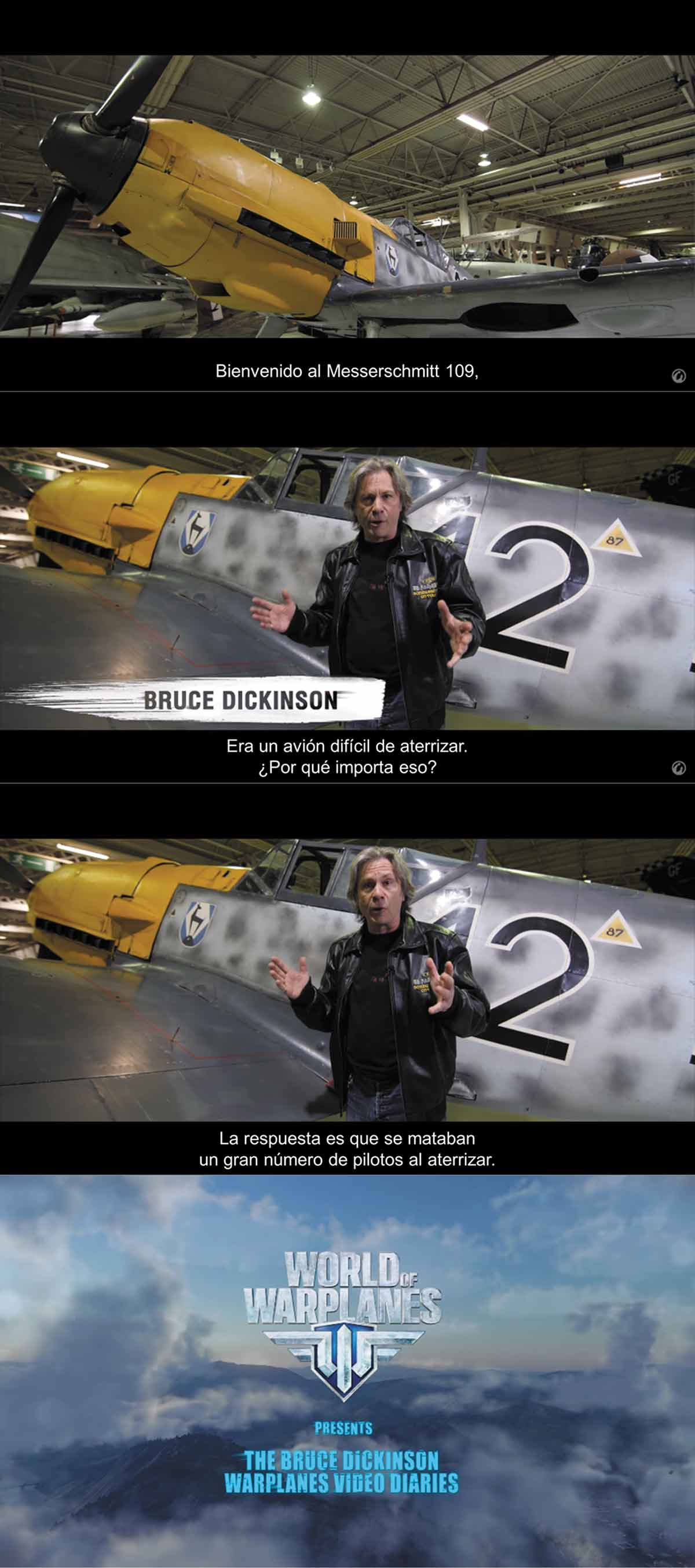
Cada una de estas narrativas aporta a los juegos unos detallados conocimientos sobre la tecnología militar que se usó durante la guerra, un tema que no suele abordarse en los planes de estudio sobre la historia (e.g., Carrier et al., 2015; Crawford & Foster, 2008). Desde la perspectiva de habilidades de razonamiento histórico, según la definición del historiador Peter Seixas, esta reproducción detallada de la tecnología militar puede suponer un punto de partida para que los maestros de historia pueden motivar a los jóvenes adultos en edad escolar a reflexionar más sobre los aspectos de importancia histórica (Seixas & Morton, 2013): ¿hasta qué punto es significativo históricamente hablar de la tecnología militar? ¿Hay algunas tecnologías militares específicas desarrolladas durante la Segunda Guerra Mundial que han resultado en transformaciones significativas con el paso del tiempo? Ciertamente, es importante que los maestros tengan en cuenta en este contexto que muchas de las representaciones históricas paratextuales tecnocéntricas son más tecnológicas que violentas: expresan una fascinación por la tecnología militar que suele ignorar, o apenas hace referencia a, la destrucción material y la pérdida de vidas humanas que estas tecnologías causaron. Esto debería hacerse explícito en las clases de historia.
En segundo lugar, y estrechamente ligado a este enfoque sobre el ‘fetichismo de militaria’, identifiqué en los paratextos de marketing analizados un fuerte énfasis sobre narrativas de desarrolladores centradas en las batallas, especialmente en relación con las confrontaciones militares directas entre las principales potencias durante la guerra en el teatro bélico europeo y, en un grado significativamente menor, de Asia-Pacífico. Algunos de los ejemplos más explícitos de esto pueden encontrarse en los sitios web de los juegos de estrategia como Graviteam Tactics: Operation Star, Steel Division: Normandy 1944 y Company of Heroes, donde encontré un número significativo de entradas de blog que detallaban los sucesos de, por ejemplo, la tercera batalla de Járkov (febrero–marzo 1943) (Graviteam, 2011), los desembarcos del Día D en Normandía y la Operación Overlord (junio–agosto 1944) (Eugen Systems, 2017), y la Batalla de las Ardenas en Bélgica (diciembre 1944–enero 1945) (Company of Heroes, 2014). Resulta en una serie de relatos sobre las batallas similares a los que se encuentran en la historiografía militar tradicional, que ofrecen a los jugadores la posibilidad de obtener conocimientos sobre el curso militar general durante la Segunda Guerra Mundial. A su vez, muchas de estas narrativas bélicas eran relativamente ‘sin sangre’, en tanto que discurren en base a unas descripciones algo abstractas de la toma de decisiones donde la brutalidad de la violencia es invisible en el discurso, como también suele ocurrir en los libros escolares sobre historia (Bermúdez, 2019). No obstante, dado que solo suele hablarse de estos sucesos militares en términos generales en los planes de estudio escolares (para los Países Bajos, véase como ejemplo el siguiente informe del centro nacional de maestría para el desarrollo curricular SLO: Bron & Visser, 2018), esto también ofrece a los maestros una oportunidad para reflexionar sobre aspectos de importancia histórica. Además, puede permitir a los maestros establecer vínculos significativos con otros aspectos del currículo. El conocimiento sobre el curso militar de la guerra sirve como un contexto importante para comprender como, por ejemplo, la violencia genocida del régimen nazi tuvo una escalada más pronunciada entre 1939 y 1945.
Es más, al analizar las perspectivas humanas destacadas en las narrativas de desarrolladores centradas en las batallas y, a nivel más general, en los paratextos de marketing analizados, se demostró claramente que la mayoría mostraban la guerra desde la perspectiva de una serie principalmente de agentes militares y líderes políticos en su mayoría hombres caucásicos: soldados de infantería y suboficiales en el frente, agentes secretos, pilotos de caza y comandantes de buques de combate, altos mandos a cargo de operaciones militares más amplias, jefes de estado que asumen el control de las fuerzas armadas de un país y sus aparatos diplomático e industrial. Esto puede explicarse en base a la prevalencia de juegos de FPS/TPS, de simulación y estrategia en el corpus analizado, dado que estos géneros se centran en la representación de estas perspectivas militares y políticas. A su vez, aunque los paratextos de varios juegos en el corpus hacen referencia a mujeres y personas no caucásicas en roles militares, destaca su continua subrepresentación y marginalización.
Tras esta observación, identifiqué varias narrativas de desarrolladores históricas y conmemorativas que destacan, de forma explícita, el ‘heroísmo noble’ y la ‘sagacidad estratégica’ de los agentes y líderes involucrados, además de una llamada para conmemorar sus acciones. En algunos casos, estas narrativas estaban estrechamente vinculadas a las actividades de reclutamiento de, por ejemplo, las fuerzas armadas de los EE. UU. (McMahon, 2018). Esto queda ilustrado en los paratextos de marketing de juegos de todos los géneros, incluso: una entrevista para el RTS Company of Heroes 2: Ardennes Assault, en la cual un desarrollador y el historiador militar Peter Caddick-Adams hablan de la Batalla de las Ardenas y el papel asumido por los suboficiales en la misma (Company of Heroes, 2015); un video livestream para el MMO FPS Heroes & Generals, en el cual dos desarrolladores hablan sobre las acciones heroicas de los soldados y los luchadores de la resistencia cuyos nombres comienzan por la letra B (Heroes & Generals, 2016); una serie de videos subidos al canal de YouTube del FPS Call of Duty en el cual unos veteranos estadounidenses de la Segunda Guerra Mundial hablan de sus experiencias durante la guerra (Call of Duty, 2017); y una serie de videos de instrucciones del RTS Sudden Strike 4, en el cual un productor de juegos habla de las ‘doctrinas’ militares que pueden adoptar los jugadores en el juego, como referencia a las innovaciones estratégicas ejecutadas y los éxitos militares logrados durante la Segunda Guerra Mundial por generales como Guderian, Zhukov, Patton y Montgomery (Kalypso Media, 2018).
Subsecuentemente, todas estas narrativas son proyectadas sobre el jugador, al que se le reta en los paratextos de marketing a asumir el papel de estas figuras y cambiar el desenlace de la guerra o la historia mismas, en referencia a la ‘agencia’ de los jugadores y el exagerado sentido de ‘empoderamiento heroico’, como describe el experto en juegos Jonas Linderoth (2013). Las siguientes citas así lo muestran, extraídas de las notas de prensa de los corpus seleccionados: Eisenhower, Rommel, Zhukov; asume tu legítimo puesto entre los grandes generales al mando de los Aliados, los alemanes o los soviéticos mientras avanzan por las batallas decisivas de la Segunda Guerra Mundial. (Steam, 2017a) (Juego: Blitzkrieg Anthology, 2003) Tú tienes el poder de inclinar la balanza de la mismísima Segunda Guerra Mundial. Ha llegado el momento de mostrar tu capacidad como el mejor líder militar del mundo. ¿Repetirás o cambiarás la historia? (Steam, 2017e) (Juego: Hearts of Iron IV, 2016)
En cambio, casi ninguno de los paratextos analizados mencionó la capacidad para que los jugadores pudieran experimentar la Segunda Guerra Mundial desde la perspectiva de un civil no combatiente, como es el caso del juego ficticio This War of Mine (11Bit Studios), para explorar el impacto más amplio de la guerra sobre la sociedad civil. Una excepción a esto son los paratextos del juego Attentat 1942, un juego de aventuras de apuntar y hacer clic creado por investigadores de Charles University en Praga, que destaca que los jugadores podrán descubrir qué les pasó a sus abuelos durante la ocupación de Checoslovaquia por la Alemania nazi durante la guerra, al hablar con testigos oculares ficticios (Pötzsch & Šisler, 2019). Conjuntamente, no obstante, no identificamos ningún otro paratexto que tuviera un enfoque similar de testigos oculares, o un sentido más amplio de desempoderamiento durante la guerra. Comparado con cómo las ‘narrativas de guerra’ han evolucionado como una forma cultural más amplia con el paso del tiempo en general, esto significa que las narrativas de desarrolladores expresadas en los paratextos de marketing de los juegos seleccionados sobre la Segunda Guerra Mundial, y en estrecha conexión con los juegos mismos, tienden a tener un enfoque de arriba hacia abajo de las perspectivas de los líderes y un enfoque de abajo hacia arriba heroico de los soldados, en referencia a las narrativas generales de arriba hacia abajo más extendidas a finales del siglo
¿Cuáles son las implicaciones de estas observaciones para el desarrollo de habilidades de razonamiento histórico en la enseñanza formal de la historia? Dado que la mayoría de los materiales de marketing analizados pusieron un fuerte énfasis en el empoderamiento heroico y la ‘agencia’ de los jugadores, estas narrativas paratextuales suponen para los maestros de historia un buen punto de partida para la reflexión por parte de los jóvenes adultos en edad escolar sobre la causalidad subyacente destacada en estos paratextos y en los juegos mismos. Esto puede ayudar a potenciar la capacidad de los jóvenes adultos en edad escolar de reflexionar para analizar los aspectos de la causalidad histórica, uno de los conceptos centrales del razonamiento histórico identificado por Peter Seixas (Seixas & Morton, 2013). ¿Hasta qué punto los líderes individuales políticos y militares moldearon el desenlace de la Segunda Guerra Mundial? ¿Hasta qué punto este desenlace ya estaba determinado por otras fuerzas económicas y estructurales? Referente a esto, otra serie complementaria de temas históricos y conmemorativos y narrativas de desarrolladores que quiero destacar pudieron ser identificados en los paratextos de marketing de juegos de GS como Hearts of Iron y Supreme Ruler, en los cuales los jugadores asumen el papel de jefe de Estado. Aquí hallé varios paratextos de marketing que destacaban diversos aspectos de la historia política, militar y diplomática, además de varios factores causales que se consideraban esenciales para entender esta historia. Esto se expone, por ejemplo, en los diarios de desarrollo del juego Hearts of Iron, en los cuales los desarrolladores hablan de cómo el juego se centra en la gestión de los recursos, la creación de la capacidad industrial y la constante innovación tecnológica, en referencia al papel crítico de estos factores en la determinación del desenlace de la Segunda Guerra Mundial (Paradox Interactive, 2016a). De nuevo, esto muestra cómo los paratextos de marketing analizados y los propios juegos pueden ser la herramienta perfecta para promover más reflexión sobre la naturaleza de la causalidad histórica.
Por último, quiero señalar una dimensión transnacional significativa en relación a las narrativas de desarrolladores del empoderamiento masculino militarizado identificado anteriormente. Conforme a los hallazgos que aproximadamente el 50% de los juegos seleccionados en el corpus fueron (co)creados por empresas estadounidenses, rusas y británicas, se puede establecer que predominaban en los paratextos las perspectivas nacionales, estatales y militares de estos países en concreto. Por otro lado, referencias a otras narrativas más localizadas en términos históricos y conmemorativos sobre la Segunda Guerra Mundial solían estar ausentes o tenían una importancia secundaria (por ejemplo, al estar integradas en contenidos adicionales de descarga opcional para los juegos analizados), también en los paratextos de los juegos producidos por empresas ubicadas en otros países. Las siguientes citas así lo muestran, extraídas de juegos creados por empresas en EE. UU., Rusia y Suecia, respectivamente: Únete a Matt Baker, Joe Hartsock y los demás compañeros de la 101.a División Aerotransportada en la Operación Market Garden mientras luchan para abrir la infame Hell’s Highway en una atrevida apuesta por un final rápido de la guerra. (Steam, 2017b) (Juego: Brothers in Arms Hell’s Highway, 2008)
Men of War: Los héroes condenados relatan la historia de uno de los infames batallones de delincuentes soviéticos durante la Segunda Guerra Mundial. […] Las imágenes existentes de estos batallones están rodeadas de muchos mitos, y este juego cuenta la verdad sobre estos regimientos, a partir de pruebas reales de sus antiguos miembros. (Steam, 2017f) (Juego: Men of War Condemned Heroes, 2012)
FLYING TIGERS: SHADOWS OVER CHINA es un juego de acción de combate aéreo basado en hechos reales de los escuadrones secretos de voluntarios americanos que defendieron a China contra Japón en el teatro China-Myanmar-India de la Segunda Guerra Mundial. (Steam, 2017d) (Juego: Flying Tigers Shadows Over China, 2015)
Por tanto, lo que emerge como una segunda serie dominante de temas y narrativas de desarrolladores transnacionales es el énfasis en la capacidad de los jugadores para ‘ocupar el lugar’ de militares empoderados y héroes políticos de los poderes bélicos y determinar el curso de la guerra. Estos funcionan como los temas y narrativas más viables en términos comerciales para los juegos de entretenimiento digital sobre la Segunda Guerra Mundial, dado que se presupone que son reconocibles para el mayor número de jugadores, en particular en Norteamérica, Europa y Rusia. Esto no implica la ausencia de contraejemplos. Ya se hizo referencia al juego Attentat 1942 anteriormente. Además, observé durante mi análisis que los paratextos de marketing de varios juegos producidos por empresas ubicadas en Polonia tenían tendencia a destacar más temas específicos nacionales, por ejemplo, relacionados con el Alzamiento de Varsovia en 1944. En estos paratextos, la Unión Soviética a veces fue explícitamente identificada como el estado enemigo, en referencia a la naturaleza inherentemente contenciosa de cómo se recuerda la participación de la Unión Soviética en la Segunda Guerra Mundial. Esto confirma las observaciones del experto en juegos Piotr Sterczewski (2016) que habló de cómo en años recientes los creadores de juegos polacos han intentado activamente incluir en sus juegos más referencias explícitas a sus marcos conmemorativos nacionales. En su conjunto, no obstante, dichos ejemplos son infrecuentes, y la mayoría de estos juegos vendieron apenas un número limitado de copias, como muestran los datos de SteamSpy. Además, los creados de juegos involucrados también a veces tomaron decisiones estratégicas para aumentar la visibilidad de un juego. En el FPS Enemy Front polaco, por ejemplo, con el Alzamiento de Varsovia entre sus escenarios, los jugadores no juegan como luchadores de la resistencia polaca, sino como un periodista americano que lucha entre ellos, según muestran los tráileres promocionales. Esta elección se debió a exigencias comerciales para atraer a una comunidad más amplia de jugadores.
‘La nazi-explotación’: la fascinación excéntrica, el desconcierto horrorizado y el ridículo y la venganza carnavalescos
Un segundo grupo de temas y narrativas de desarrolladores identificados en los paratextos de marketing se relacionaba con la representación del régimen nazi, o el Nazismo en general. Aquí encontré que los paratextos correspondientes se referían principalmente a escenarios de juego centrados en lo que los expertos en literatura Magilow, Vander Lugt, y Bridges (2012) han descrito como temas de ‘nazi-explotación’ (en referencia a un subgénero de películas vulgares que emergieron durante la década de los setenta del siglo pasado), en los cuales los jugadores confrontan ‘científicos’ locos nazis, comandantes malvados de las SS, supersoldados robóticos, zombis y dinosaurios, en juegos como Wolfenstein, Zombie Army Trilogy, ÜberSoldier y Dino D-Day. En relación a estos juegos, encontré varias entrevistas (e.g., Gamereactor, 2013) en las cuales los creadores de los juegos involucrados comentaron que habían sido inspirados por lo que identificaron como las características excéntricas del régimen nazi (algunas de las cuales son de una importancia meramente menor en términos históricos o que están estrechamente vinculadas con las teorías conspiratorias sobre los nazis) como la participación de líderes nazis prominentes en sociedades ocultas y la búsqueda por parte de los líderes nazis de ‘armas milagrosas’, y algunos de los crímenes de guerra cometidos por el régimen nazi, como los experimentos horripilantes realizados por el notorio médico de las SS doctor Josef Mengele en el campo de concentración y centro de exterminio de Auschwitz. Los creadores participantes comentaron que usaron estos elementos como punto de partida para crear escenarios de juegos de servicio OTT que los jugadores podían vencer a través de la violencia virtual excesiva y subversiva. Otros paratextos de marketing fueron generados a partir de esta premisa exagerada, como los tráileres promocionales del juego Wolfenstein: The Old Blood, que anima a los jugadores a ‘infiltrarse en la división nazi paranormal’ en una ciudad alemana ficticia y ‘matar todos los nazis que puedas’ en la virtualidad (e.g., Bethesda Softworks, 2015). Estos materiales de marketing carecían de narrativas de desarrolladores históricas y conmemorativas con un fin informativo, como fue el caso de las narrativas identificadas en el apartado anterior. En su lugar, principalmente destacaban lo que defino como temas de ‘fascinación excéntrica, desconcierto horrorizado y ridículo y venganza carnavalescos’, en que pretendían invitar a los jugadores a divertirse al matar a nazis exagerados o simbólicamente subvertir y de forma catártica superar un régimen considerado inequívocamente malvado, motivados más directamente por sus ideologías. En ese sentido, también pude identificar una dimensión transnacional en que los creadores de los juegos ubicados en los EE. UU. y el Reino Unido en particular, además de Rusia y otros países, también tenían una tendencia a replicar estos temas por igual. Un ejemplo de esto puede encontrarse en varios vídeos publicados por el sitio web oficial del juego FPS RAID: World War II, creado por Lion Game Lion, un desarrollador ubicado en Zagreb, en el cual los miembros del equipo de desarrollo hablan de cómo su juego fue inspirado por historias excéntricas sobre robos de arte y oro de los nazis (Lion Game Lion, 2017).
Pueden hacerse las siguientes observaciones generales sobre estos temas paratextuales, también en relación con el desarrollo de habilidades de razonamiento histórico en la enseñanza formal de la historia. Primero, aunque las representaciones del Nazismo mencionadas anteriormente explícitamente dependen de la exageración y giran en torno al ridículo simbólico y la subversión, no refuerzan las mismas dicotomías binarias entre ‘bien’ y ‘mal’ que están omnipresentes en otras representaciones históricas populares. Igualmente, estas dicotomías están presentes en los paratextos de marketing de juegos de un jugador centrados en el combate militar entre soldados aliados y alemanes en particular, como Call of Duty WWII. Segundo, esta crítica de dicotomías estrictas también es aplicable a la siguiente observación: los paratextos de marketing de juegos multijugador que mencionan el Wehrmacht, las fuerzas amadas regulares alemanas durante la guerra, y la capacidad para que los jugadores jueguen desde las perspectivas tanto de los aliados como de los alemanes, y la casi total omisión de referencias directas al Nazismo, independientemente de quién haya creado los juegos. Esto implica que, aunque específicamente a través del marketing, los creadores de juegos norteamericanos, europeos y rusos aún distinguen claramente entre el régimen nazi y las fuerzas armadas alemanas. Esta transnacionalidad perpetúa el ‘mito de Wehrmacht’, i.e., la idea equivocada del Wehrmacht como una organización apolítica que no estuvo activamente involucrada en la violencia genocida y en otros crímenes de guerra cometidos por la Alemania nazi en el frente oriental en particular (Chapman & Linderoth, 2015; Stone, 2004, pp. 206–7). Todas estas distinciones hacen importante que los maestros de historia contrarresten explícitamente las dicotomías, al hablar de cómo la violencia bélica extrema surge de unos procesos sociales y de otra naturaleza que no se prestan a distinciones binarias estáticas entre ‘héroes’ y ‘villanos’. Aquí puede hacerse una conexión entre dos conceptos de razonamiento histórico: la toma de perspectiva histórica y la reflexión ética. La distinción entre ‘héroes’ y ‘villanos’ que suele aparecer en los juegos es un buen punto de partida para los jóvenes adultos en edad escolar para aprender cómo entender las estructuras socioculturales y los entornos intelectuales y emocionales que han moldeado las vidas de las personas en el pasado, y para asumir juicios éticos adecuados respecto de acciones y eventos pasados (Seixas & Morton, 2013).
Aspectos de diseño audiovisual
Por último, es útil analizar el diseño estético de los paratextos audiovisuales de marketing analizados, dado que es también una manera importante que tienen los creadores de los juegos para reenvasar la historia de la Segunda Guerra Mundial, y ofrece a los jugadores una vía de acceso importante para valorar si un juego conectará, o no, de manera significativa con sus conocimientos, experiencias y marcos conmemorativos previos. Aquí, uno puede apreciar inmediatamente que los paratextos de marketing de la mayoría de los juegos de entretenimiento digital analizados incluían referencias explícitas a los medios de comunicación (o las suposiciones estereotipadas de los mismos) usados durante la guerra, como los noticiarios cinematográficos en blanco y negro y la propaganda visual de los años cuarenta del siglo pasado, o referencias a las convenciones cinematográficas de los textos mediáticos más recientes principalmente de temática militar, tal como las películas estadounidense, británica y rusa Saving Private Ryan, Fury, Dunkirk y Stalingrad. Esto confirma las observaciones de varios autores (Kingsepp, 2006; Salvati & Bullinger, 2013), i.e., que el uso de convenciones cinematográficas, entre otros, compone una estrategia central estética en el marketing de juegos de entretenimiento digital sobre la Segunda Guerra Mundial, especialmente los que se editan en Norteamérica y Europa, Rusia incluida. Estos puntos de referencia intermediales se usan activamente para que entren en juego el sentido de reconocimiento y la percepción de autenticidad entre los jugadores cuando participan en el consumo especulativo de representaciones históricas convertidas en producto. Perpetúan estas convenciones audiovisuales como un punto de referencia naturalizado, aunque principalmente hacen referencia a propiedades mediáticas distintivas y no una realidad externa. Así pues, pueden establecerse conexiones significativas con la ‘hiperrealidad’ y el ‘simulacro’, según la definición del filósofo francés Jean Baudrillard (1994). Esto hace importante que los maestros de historia identifiquen y analicen adecuadamente estos constructos mediáticos. Esto también aplica a la estética usada en los paratextos de marketing de juegos que explícitamente representan temas del Nazismo y de la ‘nazi-explotación’, que tienen una fuerte dependencia del lenguaje simbólico usado por el régimen nazi. Esto ocurre de manera fuertemente subversiva en los paratextos estudiados, según se ha dicho anteriormente. A su vez, la estética de los paratextos sigue replicando algunos aspectos de la imagen propia propagandística y la ‘marca’ que los nazis mismos pretendían perpetuar (e.g., O’Shaughnessy, 2018). Esto puede ilustrarse al referirnos al uso repetido de imágenes que muestran grandes multitudes de soldados uniformados de las SS en los paratextos de marketing de juegos como Wolfenstein, que en la propaganda nazi original fueron una puesta en escena explícita con la intención de expresar un sentido de fuerza, unión y determinación. En los paratextos, esta noción es explícitamente ridiculizada y exagerada, pero a su vez, estas imágenes se continúan utilizando para destacar la sensación del poder abrumador al que hay que hacer frente, al menos parcialmente en línea con lo que el liderazgo nazi originalmente deseó expresar. Esta continuada replicación del lenguaje simbólico del régimen nazi como índice semiótico del régimen requiere, de por sí, que los maestros de historia lo aborden explícitamente.
Debate: hallazgos e implicaciones para la enseñanza formal de la historia
En este artículo, realicé un análisis de contenido interpretativo de la paratextualidad de marketing de los juegos de entretenimiento digital sobre la Segunda Guerra Mundial distribuidos en Norteamérica y Europa (Rusia incluida) específicamente a través de tiendas en línea como Steam y las páginas adicionales de sus comunidades. Realicé este análisis para contribuir a una comprensión más profunda de los juegos de entretenimiento digital más ampliamente como expresión central de la cultura de la historia contemporánea transnacional y ‘popular’ que tiene el potencial de generar y reforzar unas interpretaciones específicas del pasado y, en particular, de la Segunda Guerra Mundial, de acuerdo con, o como complemento a, o en oposición a, las expresadas en otros contextos, como en la enseñanza formal de la historia. Elegí analizar la paratextualidad del marketing de estos juegos porque los paratextos de marketing ofrecen un conocimiento directo acerca de cómo los creadores de los juegos transforman y reenvasan la historia de la Segunda Guerra Mundial en productos culturales de entretenimiento para consumo masivo. Además, muestran cómo los juegos de entretenimiento digital y sus sitios web comunitarios en línea se han convertido en plataformas para otros encuentros con la historia, donde la distinción entre la promoción de la marca, el aprendizaje informal y la memoria es cada vez menos clara.
Según mi análisis, concluyo que los paratextos de marketing de los juegos en mi corpus, mayoritariamente creados por empresas de juegos norteamericanas, europeas y rusas, tenían la tendencia de girar en torno a un conjunto limitado de temas históricos y conmemorativos y narrativas de desarrolladores interconectados, reiterados por la mayoría de los creadores de juegos, incluido: un enfoque casi exclusivo sobre la historia militar y política, como muestran el énfasis claro sobre el ‘fetichismo de militaria’ y las ‘narrativas de operaciones tecnológicas’ que lo acompañan, por un lado, y las narrativas ‘centradas en las batallas’ que destacan el heroísmo y la sagacidad estratégica de los militares y políticos mayoritariamente caucásicos y masculinos, por otro. El resto de perspectivas y narrativas solían estar ausentes. la representación de temas de ‘nazi-explotación’ y el deseo de ridiculizar y subvertir el Nazismo a través de la violencia virtual excesiva. En general, identificamos dos dicotomías binarias en los paratextos analizados: la primera entre los ‘héroes’ aliados y los ‘villanos’ del Eje, y la segunda entre la ‘maldad’ unidimensional de los nazis y los soldados del Wehrmacht apolíticos y ‘limpios’. el uso de una estética que se basa en gran medida en las propiedades formales de otras representaciones bélicas audiovisuales producidas tanto durante la propia guerra como en la década posterior, y la iconografía propagandística usada por el régimen nazi para que entren en juego un sentido de reconocimiento y la percepción de autenticidad entre jugadores potenciales.
Esta coherencia presenta para los maestros de historia tanto retos como oportunidades, en que estos temas, narrativas y estéticas necesitan cuestionarse y deconstruirse activamente, mientras que pueden abordarse activamente para tomar contacto con los conocimientos previos de los jóvenes adultos en edad escolar que juegan a estos juegos, como punto de partida tanto para ampliar los aspectos de la Segunda Guerra Mundial que actualmente se presentan en los planes de estudio escolares, como para potenciar el desarrollo de habilidades de razonamiento histórico.
Para explicar la prevalencia de los temas y las narrativas de desarrolladores mencionados anteriormente, podemos citar varios factores. Por un lado, la creación de juegos de entretenimiento digital sobre la Segunda Guerra Mundial está estructuralmente integrada en una infraestructura mnemónica fuertemente militarizada. Esto se ilustra por la observación de que un número significativo de juegos analizados fueron creados, al menos en parte, en cooperación con asesores militares y ejércitos nacionales, a través de lo que se suele identificar como el ‘complejo lúdico-militar’ (Lenoir & Caldwell, 2018). Por otro lado, asumen un papel importante una serie de consideraciones de las empresas de diseño de juegos y de marketing. No solo se presta bien para el diseño de juegos la claridad percibida respecto de la Segunda Guerra Mundial en términos morales y militares (i.e., la Alemania nazi como el enemigo malvado y el énfasis en el combate entre ejércitos estatales claramente distinguibles). A su vez, puede observarse un ‘presunto peso de interactividad’ (Van den Heede, Ribbens, & Jansz, 2018) en los círculos transnacionales de creación de juegos; es decir, el supuesto de que el diseño de juegos centrado en el combate armado y convenciones de género existentes en particular suele considerarse comercialmente ‘seguro’, lo que hace que las empresas de juegos dejen de explorar otros principios de diseño y, por tanto, ignoren narrativas no centradas en el combate. Por último, la mayoría de los creadores de los juegos también se centran en lo menos contencioso y más reconocible para los jugadores a nivel global en búsqueda del éxito comercial, lo que les motiva a evitar temáticas sensibles y menos conocidas.
¿Qué implican estos hallazgos para la enseñanza formal de la historia? Este análisis ha mostrado cómo los juegos de entretenimiento digital y sus paratextos compartidos en las plataformas comunitarias en línea de los juegos ofrecen a los jugadores, en su mayoría hombres, un amplio rango de narrativas históricas y conmemorativas sobre la Segunda Guerra Mundial que pueden servir como una base significativa de conocimiento previo sobre la guerra antes de que entren en un entorno de aprendizaje formal. Al participar en los conocimientos históricos y los discursos conmemorativos que circulan en las plataformas comunitarias en línea de estos juegos, los jugadores verán representaciones históricas de una naturaleza abiertamente tecnocéntrica y que eluden las consecuencias violentas y el impacto social más amplio de la Segunda Guerra Mundial, a la vez que adoptan consistentemente estrategias estéticas distintivas que deben ser deconstruidas activamente. A su vez, estas representaciones paratextuales ofrecen a los jugadores la oportunidad de adquirir conocimientos sobre el curso militar de la guerra y, en el caso de juegos de estrategia más complejos, sobre parte de la toma de decisiones políticas y el papel de algunos factores, como la capacidad industrial de un país, a la hora de determinar el desenlace de la guerra. Estas son formas de conocimiento histórico que se encuentran más frecuentemente en la historiografía militar. Así, los paratextos de marketing de los juegos de entretenimiento digital sobre la Segunda Guerra Mundial destacan los aspectos del conflicto que no suelen abordarse con mucho detalle en las clases de historia en la escuela y en otros entornos de aprendizaje formal.
Es más, como plataforma de aprendizaje informal, la paratextualidad de marketing analizada puede, en las circunstancias adecuadas, usarse sin duda como recurso para la enseñanza formal de la historia. A lo largo de mi análisis, he intentado especialmente demostrar cómo los materiales de marketing y los temas históricos y conmemorativos y las narrativas expresadas en los mismos pueden usarse para potenciar el razonamiento histórico. Aquí surgen varias oportunidades: las representaciones elaboradas del equipamiento militar y las narrativas de las batallas en los paratextos ofrecen a los maestros de historia la posibilidad de reflexionar sobre la naturaleza del significado histórico, mientras que el énfasis en la agencia de los jugadores y el empoderamiento en los paratextos y los propios juegos pueden usarse como punto de partida para seguir debatiendo sobre la naturaleza de la causalidad histórica. Respecto a las dos dicotomías centrales que pueden identificarse en los paratextos, entre los ‘héroes’ aliados y los ‘villanos’ del Eje por un lado y los nazis ‘malvados’ y los soldados del Wehrmacht honourables y ‘limpios’ por el otro, argumenté que estas dicotomías estáticas y míticas deberían ser activamente deconstruidas por los maestros de historia, lo que ofrece una buena oportunidad tanto para reflexionar sobre la toma de perspectiva histórica como para participar en una reflexión ética sobre el significado histórico. Estos son solo algunas de las maneras significativas de usar los contenidos paratextuales antes mencionados para potenciar el desarrollo de habilidades de razonamiento histórico.
Footnotes
1.
A first-person shooter (FPS) is a game in which players can explore a virtual world from a first-person perspective, usually with a firearm depicted on screen.
2.
Due to technical changes made to Steam in April 2018, the information provided by SteamSpy has become less accurate than before. At the same time, SteamSpy is still widely used as a source for user statistics on Steam games. See, for example, Nathan Grayson, ‘Steam Spy is Back, But Not As Accurate As Before’, Kotaku, 27 April 2018,  (accessed 5 July 2019).
Due to technical changes made to Steam in April 2018, the information provided by SteamSpy has become less accurate than before. At the same time, SteamSpy is still widely used as a source for user statistics on Steam games. See, for example, Nathan Grayson, ‘Steam Spy is Back, But Not As Accurate As Before’, Kotaku, 27 April 2018, (accessed 5 July 2019).
1.
Un juego de first-person shooter (FPS) es uno en el cual los jugadores pueden explorar un mundo virtual desde la perspectiva de la primera persona; suele mostrarse un arma en la pantalla.
2.
Debido a modificaciones técnicas implementadas en Steam en abril 2018, los datos aportados por SteamSpy son ahora menos fiables que anteriormente. A la vez, SteamSpy continúa usándose ampliamente como fuente de estadÍsticas sobre usuarios de juegos en Steam. Véase por ejemplo: Nathan Grayson, ‘Steam Spy is Back, But Not As Accurate As Before’, Kotaku, 27 de abril de 2018, (consultado el 5 de julio de 2019).
The research reported here has received funding from the Erasmus University Rotterdam under the Research Excellence Initiative programme ‘War! Popular Culture and European Heritage of Major Armed Conflicts’. I would like to thank Prof. Kees Ribbens, Prof. Jeroen Jansz and Prof. Maria Grever in particular for their active support while carrying out the research. I would also like to thank my other colleagues in the project, Prof. Stijn Reijnders, Prof. Francisca de Jong, Dr. Susan Hogervorst, Dr. Robbert-Jan Adriaansen, Siri Driessen, Laurie Slegtenhorst and Lise Zurné, for their valuable feedback. Finally, I very much would like to thank Lars de Wildt, Emil Hammar, Astrid Erll and Eva Kingsepp for their additional feedback and support. / La investigación aquí reportada recibió financiación de Erasmus University Rotterdam a través del Research Excellence Initiative programme (programa de iniciativa a la excelencia investigadora) titulado ‘War! Popular Culture and European Heritage of Major Armed Conflicts’ (¡Guerra! La cultura popular y el patrimonio europeo de los grandes conflictos armados). Deseo expresar mi agradecimiento al profesor Kees Ribbens, el profesor Jeroen Jansz y la profesora Maria Grever en particular por su apoyo activo durante esta investigación. También deseo agradecer a mis otros compañeros de proyecto, el profesor Stijn Reijnders, la profesora Francisca de Jong, la doctora Susan Hogervorst, el doctor Robbert-Jan Adriaansen, Siri Driessen, Laurie Slegtenhorst y Lise Zurné, por su valiosa retroalimentación. Por último, quiero agradecer a Lars de Wildt, Emil Hammar, Astrid Erll y Eva Kingsepp por su retroalimentación y apoyo adicional.
No potential conflict of interest was reported by the author. / Los autores no han referido ningún potencial conflicto de interés en relación con este artículo.
WWII-games: owners of popular games about the Second World War (Steam,6 September 2018)
Games (/series) with more than 1,000,000 owners (Steam, 6 September 2018)
Game (/series) title
Number of owners
Involved countries (dev/pub)
Involved countries (dev/pub): total
Heroes & Generals
16,103,000
Denmark
United States: 6
War Thunder
14,066,000
Russia
Russia: 2
Day of Defeat
13,876,000
United States
United Kingdom: 2
Company of Heroes
13,001,000
Canada, United States, Japan
Sweden: 2
Sniper Elite
7,495,000
United Kingdom
Belarus: 1
Red Orchestra
4,135,000
United States
Canada: 1
Wolfenstein
3,850,000
United States, Sweden
Denmark: 1
Call of Duty
3,566,000
United States
Japan: 1
World of Tanks
3,320,000
Belarus
Spain: 1
Commandos
2,465,000
Spain, United Kingdom
Men of War
2,108,000
Russia
Hearts of Iron
1,901,000
Sweden
Dino D-Day
1,474,000
United States
Juegos sobre la Segunda Guerra Mundial: propietarios de juegos populares sobre la Segunda Guerra Mundial (Steam,6 de septiembre de 2018)
Juegos (o serie) con más de 1,000,000 de propietarios (Steam, 6 de septiembre de 2018)
Título del juego (o serie)
Número de propietarios
Países participantes (desarrollo/edición)
Países participantes (desarrollo/edición): total
Heroes & Generals
16,103,000
Dinamarca
Estados Unidos: 6
War Thunder
14,066,000
Rusia
Rusia: 2
Day of Defeat
13,876,000
Estados Unidos
Reino Unido: 2
Company of Heroes
13,001,000
Canadá, Estados Unidos, Japón
Suecia: 2
Sniper Elite
7,495,000
Reino Unido
Bielorrusia: 1
Red Orchestra
4,135,000
Estados Unidos
Canadá: 1
Wolfenstein
3,850,000
Estados Unidos, Suecia
Dinamarca: 1
Call of Duty
3,566,000
Estados Unidos
Japón: 1
World of Tanks
3,320,000
Bielorrusia
España: 1
Commandos
2,465,000
España, Reino Unido
Men of War
2,108,000
Rusia
Hearts of Iron
1,901,000
Suecia
Dino D-Day
1,474,000
Estados Unidos