



Abstract

Bipolar affective disorder with Klippel–Trenaunay syndrome
Klippel–Trenaunay syndrome (KTS) is characterized by a combination of capillary and lymphatic malformations, varicose veins and hypertrophy of soft and/ or bony tissues [1]. Although KTS has been associated with congenital abnormalities of other systems [1], there has been no report of any associated psychiatric disorder so far. We report a patient who presented to Department of Psychiatry, National Institute of Mental Health and Neurosciences (NIMHANS), Bangalore with bipolar affective disorder.
The patient was a 19-year-old woman with a 3 year history of episodic mental illness; the first episode of depression occurred at the age of 16. Thereafter she had two more depressive and two manic episodes. Depressive episodes were characterized by low mood, poor concentration, decreased interest, ideas of unworthiness, poor appetite and sleep while the manic episodes were characterized by irritability, increased activity, religiosity and verbosity.
There was a history of recurrent depressive disorder in her mother, late-onset depression in maternal grandmother and mild depression in her brother.
Consistent with a diagnosis of KTS, physical examination indicated unilateral hemi-gigantism of the left side, with local gigantism of the left 2nd–5th toes (Figure 1) and port-wine haemangioma on the left infra-axillary region, reported to be present since birth. She had scar from surgical resection of lymphadenitis of the left pectoral lymph nodes during infancy.
Local gigantism of the left 2nd–5th toes with left-side hypertrophy.
Chromosomal analysis indicated a normal karyotype. Biochemical and haematological blood parameters were also normal. Although magnetic resonance imaging (MRI) of the brain was normal, MRI of her spine showed scoliosis and hemi-hypertrophy on the left side with excessive fat in subcutaneous and intermuscular planes. X-ray showed elongated metatarsal and metacarpal bones with hypertrophy of soft tissues (Figure 2). Her cardiac scan indicated atrial septal defect for which the patient underwent operation with repair of cleft mitral leaflet.
X-ray of feet, showing elongated metatarsal and metacarpal bones with hypertrophy of soft tissues on the left side.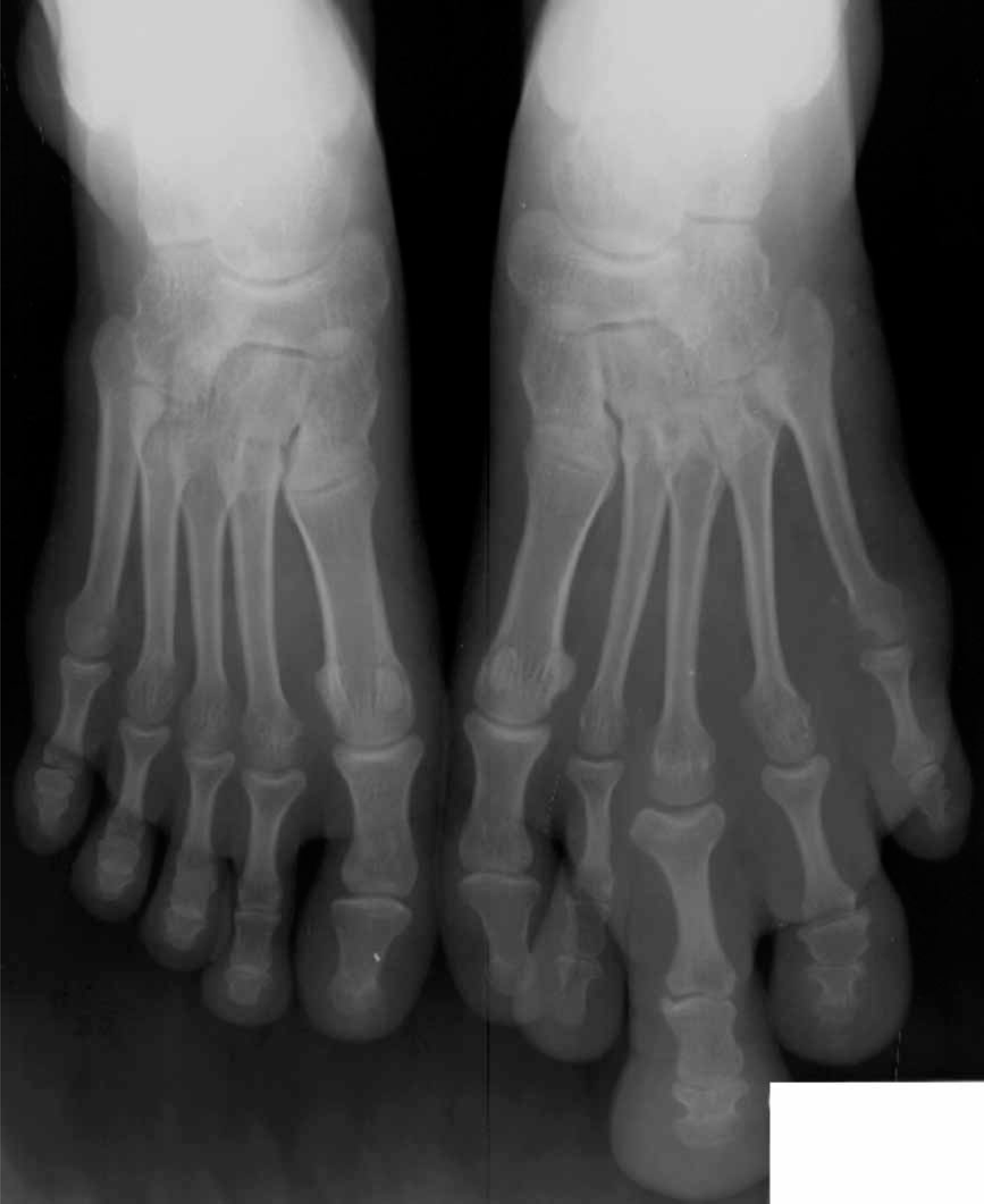
The patient was treated with sodium valproate (600 mg) for her affective symptoms and is currently well.
To our knowledge there has been no previous report of psychiatric morbidity in KTS. The present patient had no family history of physical anomalies. Psychiatric comorbidity in the present case may be coincidental, related to higher familial loading for affective disorders or may be a phenotypic variant of the KTS syndrome per se.
Chromosomal abnormalities have been reported in patients with KTS and it is interesting to note that genetic studies of bipolar disorder have suggested links to loci on chromosomes 5, 8, 11 and 14 [2], similar to those for KT S [3]. This possibility of a genetic link between affective disorder and KTS needs to be further explored.
Sanity masked by insanity: seeing psychiatry through art
I would like to share my experience of visiting the Cunningham Dax art collection in Melbourne, as a medical student learning psychiatry.
The Cunningham Dax art collection houses a series of artworks by people who have been affected by mental illness. The opportunity to visit this gallery arose during my psychiatry rotation. Before I visited the gallery I could not comprehend the value of such a visit. How was an art gallery visit going to help me with my assessment?
What confronted me in the gallery was unexpected. For the first time I was able to see what the patients with mental illness saw, and feel what the patients with mental illness felt. Viewing the artworks by people affected by depression, bipolar disorder and schizophrenia gave me an insight into psychiatry that I never gained through reading textbooks and attending tutorials. I realized how powerless patients affected by mental illness were. Art, for some of them, was their only voice.
Three drawings by a patient affected by schizophrenia moved me. They were pencil portrait sketches. The first drawing showed the ugly face of a man with a confused expression. It was as if the man had lost himself, and was too confused, ashamed and powerless to speak out. Is this how a man affected by schizophrenia sees himself? In the second drawing the face grew uglier and more disorganized. Is this how we see people affected by schizophrenia: ugly monsters who had lost their mind? But underneath this ‘madness’ I saw something humane. There was a person inside like the rest of us not affected by mental illness. He was suffering in silence. And he had no one to turn to. In the third drawing the face became so disorganized it was almost unrecognizable. There was a sense of eeriness and urgency, like a time bomb that was soon to explode. I found out sadly that the patient committed suicide soon after the final drawing. Could we have done anything to help?
I left the gallery with newfound vision: the visit has helped me to see psychiatry. Somehow, I felt embarrassed that, perhaps like many other medical students, I thought before that psychiatry was fluff. Mental illness is not ‘all in the mind’. Patients with mental illness are powerless human beings whose sanity is masked by insanity. They are often isolated by other people's lack of understanding and empathy. A word of advice for health-care students and professionals: next time you meet a person with mental illness, remember there is a helpless person inside. It would be insane not to help any human being. More so if they are a helpless person whose sanity is masked by insanity.
Hip fracture and antipsychotics
Howard et al. recently found an independent, significant association between hip fractures and the use of prolactin-raising antipsychotic medications [1]. Is it time to start worrying?
Prolactin is secreted by specialized cells (lactotrophs) in the anterior pituitary. Its major target organ is the mammary gland, where it stimulates development and milk production. The hypothalamus tonically suppresses prolactin secretion. Dopamine is the major prolactin-inhibiting factor; it is released into the portal circulation and binds to D2 receptors on the lactotrophs. Thus, agents with particular D2 receptor activity cause enhanced secretion of prolactin.
The symptoms of hyperprolactinaemia result from the direct effects of prolactin, or from reduced gonadal hormone levels (suppressed by increased prolactin levels). Symptoms in women include amenorrhoea, galactorrhoea, vaginal dryness and atrophy, infertility, hirsutism and acne, while in men there may be gynaecomastia, rarely galactorrhoea, hypogonadism, impotence and reduced desire. For both genders oestrogen deficiency is an established risk factor for osteoporosis [2, 3].
It has been know for decades that typical antipsychotic medication (and occasionally antidepressant medication) elevates serum prolactin in up to 50% of patients [4]. The atypical antipsychotics can be divided into prolactin-raising (risperidone, amisulpride, ziprasidone) and prolactin-sparing (olanzapine, quetiapine, aripiprazole, clozapine) groups.
Most practising psychiatrists have heard complaints of amenorrhoea and galactorrhoea from patients taking prolactin-raising atypical antipsychotic medications, and this may apply to sexual functioning more broadly [5].
O'Keane and Meaney conducted a cross-sectional bone mineral density (BMD) study of 38 people who had taken prolactin-raising and prolactin-sparing and antipsychotics for approximately 8 years [6]. They found that those taking prolactin-raising antipsychotics had higher rates of bone pathology than those taking prolactin-sparing medication. They then conducted a 1 year prospective study of 38 patients and found an overall gain in lumbar BMD values in a prolactin-sparing subgroup and an overall loss in a prolactin-raising group (p = 0.01) [7].
The work of Howard et al. appears to take the issue of hyperprolactinaemia secondary to antipsychotic treatment beyond nuisance and theory [1]. A search regarding management of hyperprolactinaemia while on antipsychotics yielded very limited suggestions [8]. We think it is timely to consider this issue considering the wide use of antipsychotics [9], length of time antipsychotics are used and our ageing clientele. We need expert advice and hopefully from those who are not overly aligned with drug companies.
Monoamine oxidase is not in synapse
In a previous article in the Journal it was stated that ‘Monoamine oxidase inhibitors relieve depression by increasing the availability of amine neurotransmitters in the synapse by inhibiting the breakdown of these chemicals in the synapse’ [1].
I think that this may not be correct because monoamine oxidase occurs intracellularly on the mitochondrial membrane of the pre-synaptic neuron and not extracellularly in the synapse.
Thus, for example, Himmelhoch states: ‘In most neuronal tissue it is located intraneuronally, more specifically intra-axonally. Only in the liver and the salivary gland is MAO found extraneuronally’ [2].