




Abstract
One of the fundamental debates in the field of psychiatric classification is whether psychiatric disorders are best conceptualized as categories or dimensions. Such debates focus on the latent or underlying structure of psychiatric constructs such as depression and have implications not only for their classification but also for their measurement and treatment. With the revision to both the DSM and the ICD under way and the growing awareness that dimensional representations of psychiatric constructs should be incorporated, where appropriate, into future classification systems [1], there is keen interest in determining the latent structure that best captures the essence of a given psychiatric construct.
The debate surrounding the categorical versus dimensional status of psychiatric disorders, often called the continuity debate, is not new. It has been argued for many years that strictly categorical notions of psychopathological constructs can be counterproductive, both from a clinical [2] as well as a statistical [3] standpoint. Proponents of this view claim that collapsing the heterogeneity of psychopathology down to two categories (present or absent) loses the richness of explanatory information available. However, it has also been argued that classification systems make progress only by identifying stable and justifiable categories into which people can be grouped [4]. Despite convincing arguments on both sides it has become clear that the latent taxonic or dimensional structure of psychiatric disorders needs to be informed by empirical methods that are purpose-built to answer the question. One of the most promising empirical methods specifically developed to inform the continuity debate is a family of statistical procedures originally developed by Meehl et al., collectively called taxometric analysis [5–9]. Taxometric analysis examines the internal statistical relationships among various potential indicators of a given construct and it is the pattern of these statistical relationships that reveals the latent structure of the construct.
Taxometric analysis has been applied to a wide variety of psychiatric constructs [10]. However, the application of taxometric analysis to the psychiatric construct of depression has yielded particularly interesting results. Analysing data from clinical and undergraduate student samples, it has been argued that depression, at least in its endogenous or somatic presentations, is best conceptualized as a distinct taxon [11–13]. However, others have demonstrated that depression is most appropriately viewed as a continuous dimension [14–16]. It has recently been argued that clinical and undergraduate samples are not necessarily representative of the general population and thus may not yield definitive findings with regard to latent structure. To overcome this limitation Slade and Andrews, using data from a representative community-based survey of mental disorders in Australia, demonstrated that depression, as measured by indicators derived from a lay-administered structured diagnostic interview, is best conceptualized as a dimensional construct [17]. Subsequent analyses, also in large community samples, have yielded similar dimensional latent structures [18]. However, recent taxometric analyses of a random and representative sample of community adolescents have demonstrated that clinically-assessed indicators of depression provide evidence of taxonicity [19].
While this short literature review demonstrates that both dimensional and taxonic results have been identified across different types of samples, to date no study has carried out taxometric analyses using exactly the same indicators in both community and clinical sample. It can be argued that any differences in latent structure between these studies could be a result of true differences in latent structure or a result of differences in the content, quality or appropriateness of depression indicators. Consistency of results across both community and clinical samples using exactly the same indicators would offer a strong empirical test of the latent structure of depression and rule out the differential impact of sample type on structural findings. Divergence of findings across both sample types would provide evidence that the latent structure depends on the sample type under investigation. Therefore, the aim of the present study was to examine the latent structure of depression in a clinical sample using exactly the same indicators of depression as those used by Slade and Andrews [17], with the aim of comparing the results to those found in Slade and Andrews [17].
Method
Participants
The sample consisted of a total of 960 patients presenting for assessment and treatment at the Clinical Research Unit for Anxiety and Depression in Sydney, Australia. The unit is a joint hospital and university facility and provides specialist diagnosis and treatment of the major anxiety disorders and depression. Women constituted 53% of the total sample and the average age of the total sample was 34.38 years (SD = 11.01, range = 17–76 years). These demographic findings are consistent with previous studies in the same clinic [20]. All participants completed a standard battery of measures as part of the initial assessment procedure. Due to changes in the assessment procedures part way through the study, overlapping yet different groups of participants completed the two measures used in the current analysis. However, there were no significant demographic differences in sex and age between the group who completed both measures compared to the group who completed only one measure (sex: χ2=0.012, df = 1, p = 0.913; age: F = 2.569, df = 1, p = 0.106).
Measures and construction of indicators
Composite International Diagnostic Interview
The Composite International Diagnostic Interview (CIDI; [21]) is a lay-administered fully structured diagnostic interview to diagnose the common DSM-IV and ICD-10 mental disorders. The present study used the computerized version of the CIDI involving the respondent self-complete mode in which the respondent reads questions off the computer screen and enters the appropriate answers. The CIDI has been shown to possess excellent reliability and good validity [22]. In the CIDI depression module 24 questions are asked, each assessing one of the nine subcriteria in DSM-IV major depressive episode (MDE) criterion A. Each symptom is dichotomous with a score of zero indicating the absence of the symptom and a score of 1 indicating the presence of the symptom. All questions focus on the 12 months prior to the assessment. In order to be asked the questions relating to the symptoms of DSM-IV MDE the patient must answer positively to one of the two initial ‘stem’ questions (‘In the past 12 months, have you had 2 weeks or longer when nearly every day you felt sad empty or depressed?’ and ‘In the past 12 months have you had 2 weeks or longer when you lost interest in most things like work, hobbies or other things you usually enjoyed?’). Given the 12 month timeframe of the CIDI it is possible that the taxometric analysis could be identifying the latent structure of depression-proneness rather than the current state of depression. To safeguard against this individuals were included in the analysis only if they experienced symptoms of depression in the 4 weeks prior to assessment. Thus, while 1239 patients completed the full CIDI assessment, 418 were included in the analysis because they answered positively to one or both stem questions and reported that the most recent time they experienced the symptoms was in the 4 weeks prior to assessment.
Indicators of depression were constructed from the CIDI so as to reflect, identically, the indicators analysed in Slade and Andrews [17]. Four indicators were constructed, reflecting disturbances in sleep (trouble sleeping, waking up too early and sleeping too much) and appetite (increased or decreased appetite and associated weight gain or loss); disruptions in energy (lacking energy and feeling tired) and movement (talking or moving more slowly and talking or moving all the time); feelings of worthlessness, guilt and death (thinking about death, thinking about suicide and attempting suicide); and difficulty in thinking (thoughts coming much slower than usual and inability to make up mind) and concentrating. These indicators had scales with a minimum range of 0–4 and a maximum range of 0–7. The internal consistency of these four indicators, as measured by the Kuder–Richardson 20 coefficient for dichotomous data, ranged from 0.67 to 0.87.
Beck Depression Inventory II
Indicators of depression were also constructed from the Beck Depression Inventory II (BDI-II; [23]) so as to provide an alternative source of data for the current study and as a means of addressing some of the conflicting findings in previous studies. The BDI-II is a clinical measure of depression with excellent psychometric properties [23]. It consists of 21 items each assessing a symptom of clinical depression using a scale ranging from 0 to 3. Respondents were asked to rate the severity/intensity of each symptom according to how they have been feeling in the 2 weeks prior to the assessment. Data were available for 767 people.
Two separate and non-overlapping sets of indicators were constructed from the items in the BDI. These indicator sets were based on BDI items relating either mainly to the somatic symptoms of depression or mainly to the cognitive symptoms of depression in order to examine the continuing debate regarding the latent structure of depression as measured by the BDI. As mentioned in the introduction some previous taxometric analyses have demonstrated that the predominantly somatic forms of depression are best conceptualized as taxonic and the predominantly cognitive forms as dimensional [11, 12], while others have challenged, on methodological grounds, these taxonic findings and instead purport that both forms of depression are best considered as continuous dimensions [14, 24]. Working under the assumption that the chances of identifying a latent taxonic structure, if such a structure exists, are maximized by analysing indicators that have yielded taxonic structure in previous studies, the present study derived sets of indicators that closely mirror those found in these previous studies. Therefore, the first set of indicators was constructed using, for the most part, pairs of somatic-type items of the BDI-II (15 and 20, 16 and 18, 11 and 17, 21) and the second set of indicators was constructed using pairs of cognitive- and affective-type items of the BDI-II (1 and 2, 3 and 7, 4 and 12, 5 and 6).
Data analytic strategy
Overview
Unlike other statistical tests taxometric analysis does not rely on traditional significance testing. Instead, conclusions are drawn based on consistent evidence of either taxonicity or dimensionality across a range of different taxometric procedures, using a variety of different indicators and supported by a selection of different consistency tests. In the present study three sets of indicators were submitted to two taxometric procedures: MAXEIG (maximum eigenvalue) [5] and MAMBAC (MAXEIG (maximum eigenvalue) and MAMBAC (mean above minus mean below a cut)) [9]. These procedures search for particular statistical associations between the indicators of a given latent construct and, when plotted on graphs, these statistical associations produce characteristic curves that are indicative of either a dimensional or categorical latent structure. A short description of each procedure is found here. However, a more detailed description can be found in the referenced literature. The specific implementation rules used for each procedure are described in the results. All taxometric analyses on research and simulated data sets were carried out using program code developed by J. Ruscio [25].
The MAXEIG procedure plots the eigenvalue from a factor analysis of all indicators (often referred to as the ‘output’ indicators) along successive overlapping windows defined by scores on a separate indicator (often referred to as the ‘input’ indicator). The MAMBAC procedure plots the difference in mean scores of any one output indicator above and below a sliding cut-off score on a second input indicator. MAXEIG and MAMBAC curves that are indicative of a categorical latent structure are noticeably peaked and taper off at the extremes. The exact location of the peak provides an estimate of the base rate of the latent taxon in the population. Curves that are indicative of a dimensional structure are characteristically flat when using the MAXEIG procedure and bowl-shaped when using the MAMBAC procedure, although curves for both procedures may be tilted up to the right when indicators are positively skewed, a common situation in psychopathology research with non-clinical samples.
Simulated comparison data
Simulated comparison data were also analysed to strengthen the results of the individual taxometric procedures. Simulated comparison data sets with known taxonic and known dimensional latent structure were generated for each taxometric procedure using each indicator set. These simulated data sets possessed exactly the same distributional properties as the research data (i.e. in terms of sample size, indicator skew, inter-indicator correlations and other properties known to influence the shape of taxometric curves) and differed only in latent structure. Assuming that taxometric analyses of these taxonic and dimensional simulated data sets can identify taxonic and dimensional latent structures, respectively, these analyses provide a useful visual comparator against which to assess the latent structure of the research data [26]. Similarity between the taxometric graphs of the research data and those of the simulated taxonic data provide further evidence of a taxonic latent structure, while similarity between the research data and the dimensional data provide support for a dimensional latent structure. A comparison curve fit index (CCFI) was also calculated to provide a numerical indication of the similarity between the research data and either the simulated taxonic or the simulated dimensional data.
Results
MAXEIG analyses
In the current implementation of the MAXEIG procedure, for each set of indicators, one indicator served as the input indicator and the remaining indicators served as output indicators. This produced four MAXEIG graphs for each of the three indicator sets. Each MAXEIG analysis was carried out in 50 windows with 90% overlap in the windows, which equates to a sample size of 71 in each window for the CIDI indicators and 130 in each window for the two sets of BDI indicators. Ten simulated taxonic and 10 simulated dimensional data sets were also generated, each reflecting the distributional properties of the research data, and all simulated data sets were also analysed with the MAXEIG procedure. Prior to interpretation of the MAXEIG graphs it is imperative that all indicators are shown to be valid indicators of the construct under investigation. Validity is measured by the degree of separation between the putative taxon and complement groups. Ideally, all indicators within an indicator set should separate the groups by at least 1.25 SD [7]. Taxometric analysis also works under the assumption that the indicators within a given set correlate highly (r > 0.3) in the total sample and negligibly (r < 0.3) in both the putative taxon and complement groups (these correlations are referred to as nuisance correlations). As can be seen in Table 1 for the MAXEIG analyses, while some of the individual indicators possessed less than acceptable validity the average validity for each of the three indicator sets is above the accepted threshold of 1.25. With regard to indicator correlations the total sample correlations were always in the acceptable range. Results regarding latent structure were not altered when those indicators with low validity were removed from the analysis. Thus, to ensure comparability with previous studies all chosen indicators were included in all analyses. While the nuisance correlations were occasionally in the unacceptable range, those nuisance correlations >0.3 were accompanied by relatively high total sample correlations.
Summary of indicator properties and analytic results
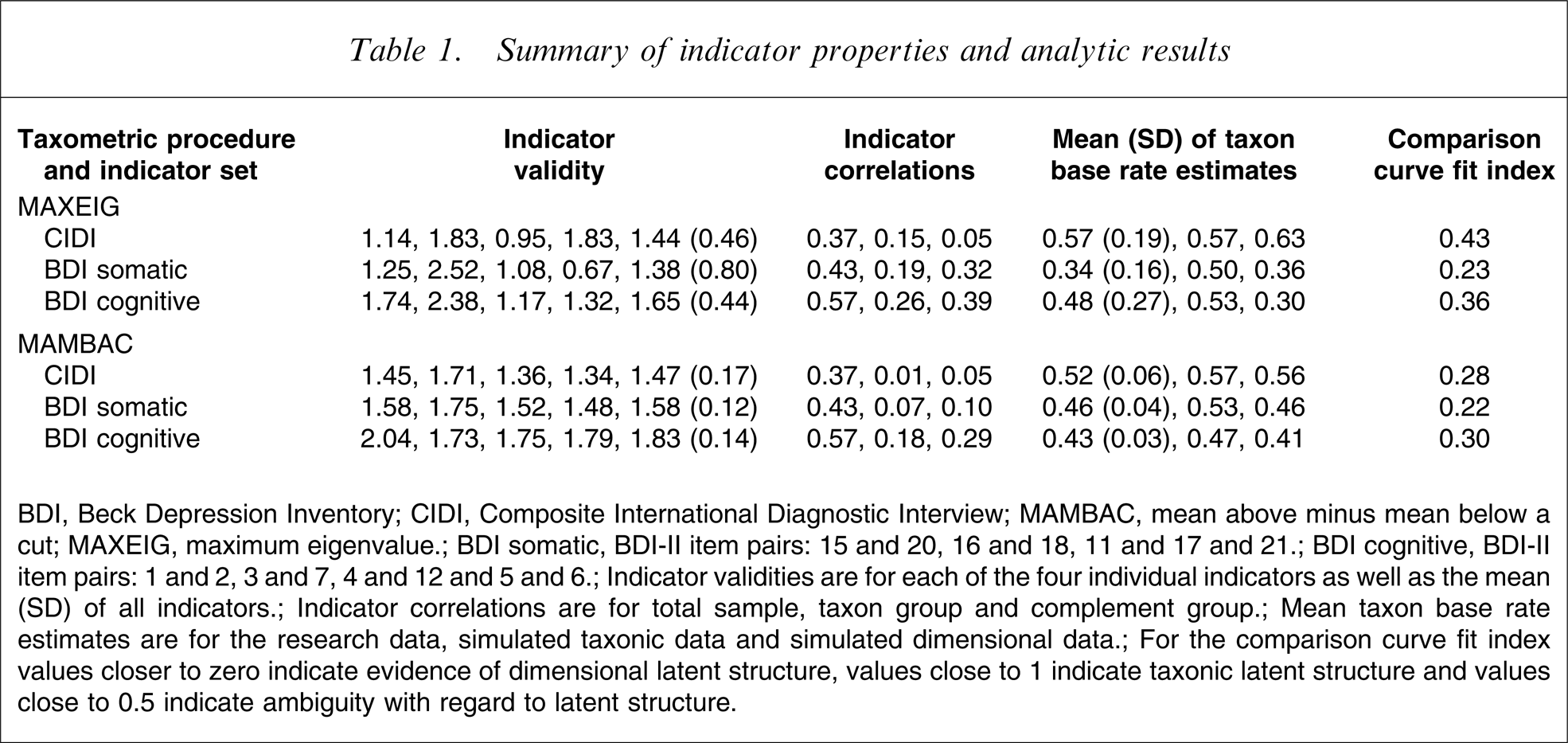
BDI, Beck Depression Inventory; CIDI, Composite International Diagnostic Interview; MAMBAC, mean above minus mean below a cut; MAXEIG, maximum eigenvalue.
BDI somatic, BDI-II item pairs: 15 and 20, 16 and 18, 11 and 17 and 21.
BDI cognitive, BDI-II item pairs: 1 and 2, 3 and 7, 4 and 12 and 5 and 6.
Indicator validities are for each of the four individual indicators as well as the mean (SD) of all indicators.
Indicator correlations are for total sample, taxon group and complement group.
Mean taxon base rate estimates are for the research data, simulated taxonic data and simulated dimensional data.
For the comparison curve fit index values closer to zero indicate evidence of dimensional latent structure, values close to 1 indicate taxonic latent structure and values close to 0.5 indicate ambiguity with regard to latent structure.
The average of the four individual MAXEIG curves generated from the CIDI indicators is presented as the left hand graph (labelled ‘Research Data’) in Figure 1. As can be seen, this average MAXEIG curve is relatively flat, which is suggestive of a dimensional structure. It should be noted that while average curves are presented to save space, determination of latent structure is always achieved through interpretation of all individual curves in a given analysis (individual graphs from all analyses are available from the author). A series of MAXEIG analyses was then carried out using the four somatic indicators derived from the BDI and the average MAXEIG curve generated from this analysis is presented as the left-hand graph in Figure 1(b). This average curve is generally flat with a slight elevation toward the left-hand end. This is indicative of a dimensional latent structure. Finally, a series of MAXEIG analyses was carried out using the four cognitive indicators derived from the BDI and the resultant average MAXEIG curve is presented as the left-hand graph in Figure 1(c).
Average curves from maximum eigenvalue (MAXEIG) analyses. (a) Average MAXEIG curves from analyses of research data, simulated categorical (taxonic) data and simulated dimensional data using indicators derived from the Composite International Diagnostic Interview (CIDI). (b) Average MAXEIG curves from analyses of research data, simulated categorical (taxonic) data and simulated dimensional data using indicators derived from the somatic items of the Beck Depression Inventory (BDI). (c) Average MAXEIG curves from analyses of research data, simulated categorical (taxonic) data and simulated dimensional data using indicators derived from the cognitive items of the BDI.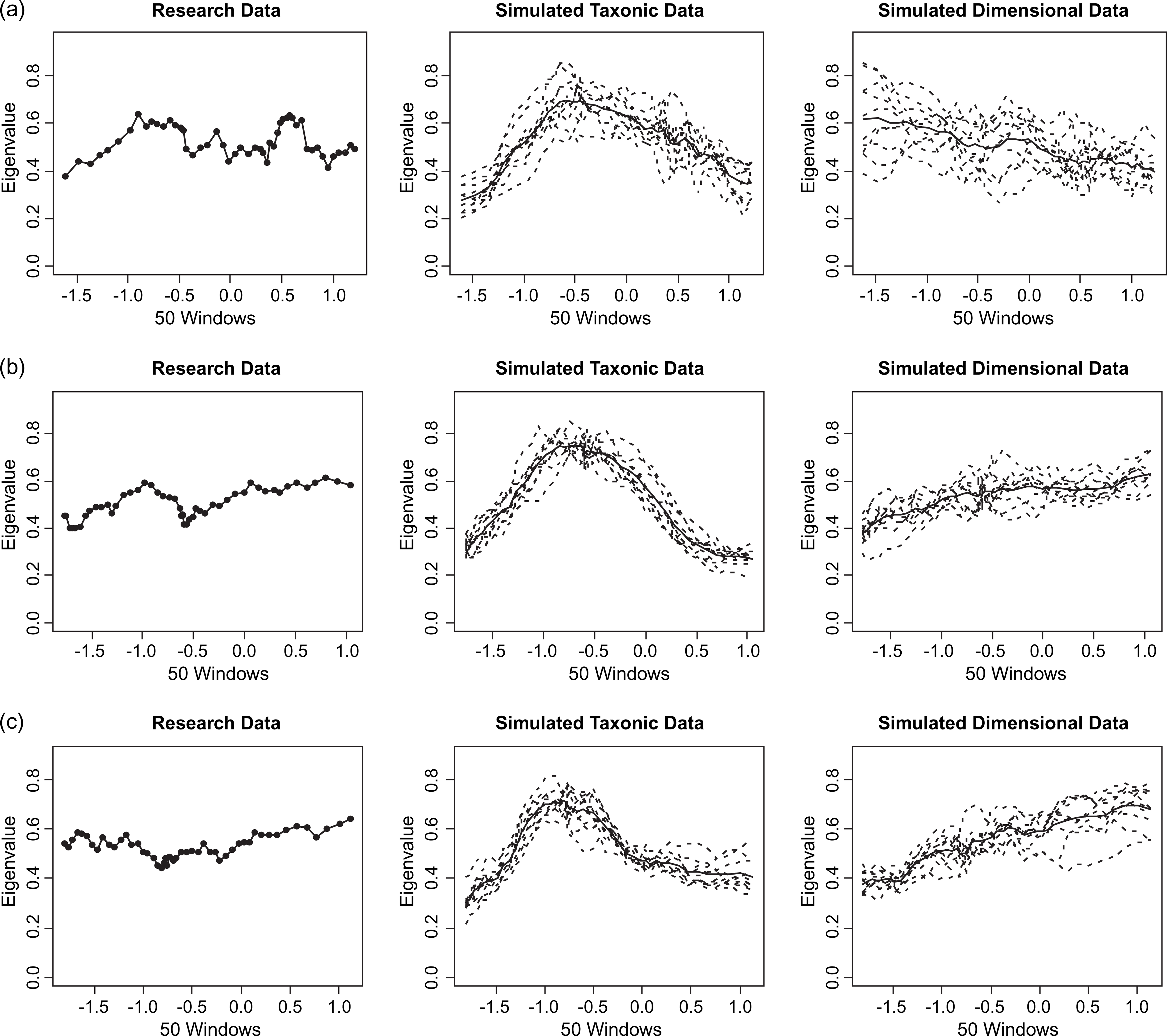
As a consistency test of the structure of the research data MAXEIG analyses were carried out on simulated data sets that matched the properties of the research data, with the difference being that these simulated data sets contained either a known categorical or a known dimensional latent structure. As well as average MAXEIG curves for the research data, Figure 1 also contain average MAXEIG curves for the simulated taxonic and the simulated dimensional data using indicators derived from the CIDI (Figure 1(a)), the somatic items of the BDI (Figure 1(b)) and the cognitive items of the BDI (Figure 1(c)). As can be seen in all three cases the MAXEIG curves generated from the research data almost exactly resemble the curves from the simulated dimensional rather than simulated categorical data. Thus, analysis of simulated comparison data sets provided stronger evidence of a dimensional structure. The CCFI values, which provide an indication of the fit between the research data and the simulated data, for the most part offer support for a dimensional latent structure (Table 1).
MAMBAC analyses
In the current implementation of the MAMBAC procedure, for each set of indicators, one indicator served as the output indicator with the sum of the remaining items serving as the input indicator. Means were calculated among 50 evenly spaced cuts along the input indicator, starting 25 cases from either extreme. This produced four graphs for each of the three sets of indicators. Ten simulated taxonic and 10 simulated dimensional data sets were also generated and all simulated data sets were also analysed with the MAMBAC procedure. Prior to carrying out the MAMBAC analyses the validity of all indicators as well as the existence of negligible nuisance correlations must be determined. As can be seen in Table 1, all individual indicators were above the threshold for validity. Furthermore, total sample correlations and nuisance correlations were well within the acceptable ranges.
The average MAMBAC curve generated from the four CIDI indicators is presented as the left-hand graph (labelled ‘Research Data’) in Figure 2(a). This average curve has a bowl shape with no obvious peaks, characteristic of a dimensional latent structure. As with the MAXEIG analyses latent structure was determined by inspection of all individual MAMBAC graphs. MAMBAC analyses were also carried out using the four somatic indicators derived from the BDI, and the average MAMBAC curve is shown as the left-hand graph in Figure 2(b). This curve is also bowl-shaped, providing further evidence of a dimensional latent structure. Finally, MAMBAC analyses were carried out on the four cognitive indicators derived from the BDI and the average curve is shown as the left-hand graph in Figure 2(c). While the average MAMBAC curve contains a small elevation near the left-hand end, the overall shape of the curve is characteristic of a dimensional latent structure.
Average curves from mean above minus mean below a cut (MAMBAC) analyses. (a) Average MAMBAC curves from analyses of research data, simulated categorical (taxonic) data and simulated dimensional data using indicators derived from the Composite International Diagnostic Interview (CIDI). (b) Average MAMBAC curves from analyses of research data, simulated categorical (taxonic) data and simulated dimensional data using indicators derived from the somatic items of the Beck Depression Inventory (BDI). (c) Average MAMBAC curves from analyses of research data, simulated categorical (taxonic) data and simulated dimensional data using indicators derived from the cognitive items of the BDI.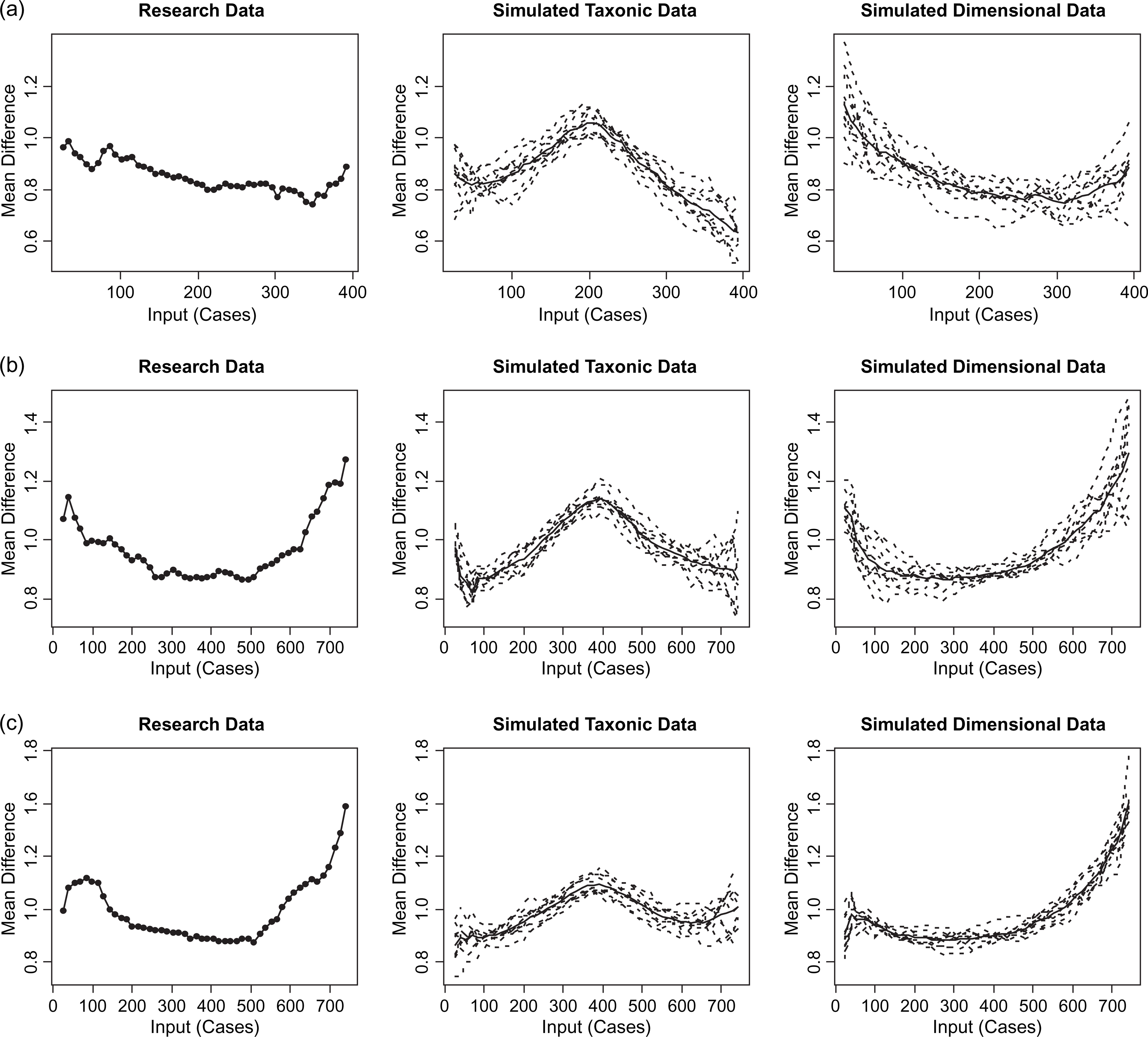
To provide further evidence of consistency in latent structure MAMBAC analyses were then carried out on the simulated data sets. Figure 2 also contains average MAMBAC curves for the simulated categorical data and the simulated dimensional data using indicators derived from the CIDI (Figure 2b), somatic items of the BDI (Figure 2b) and the cognitive items of the BDI (Figure 2c). The average MAMBAC curves generated from the research data more closely resemble the curves from the simulated dimensional rather than simulated categorical data. Once again this provides further evidence of a dimensional latent structure. The CCFI values associated with each indicator set are closer to the value of zero than 1 and therefore also support a dimensional latent structure (Table 1).
Discussion
The results of the current taxometric analysis of depression in a clinical sample replicate those of Slade and Andrews [17] in a community sample and provide further support for a dimensional conceptualization of depression at the latent level. The findings from both the MAXEIG and MAMBAC analyses, on both the research and simulated data sets, together with the results of the consistency tests, provide compelling evidence for dimensionality in the latent structure of depression. The fact that the present study used identical indicators to those used by Slade and Andrews [17] suggests that inconsistent conclusions reached by prior studies analysing clinical versus community samples are likely to be explained by something other than true differences in the latent structure between these two different sample types. The conclusions are further strengthened by the findings of dimensionality using indicators of depression derived from the BDI. As mentioned earlier, prior studies have produced equivocal results with regard to the latent structure of depression measured by the BDI. The results of the present study are in line with those suggesting that depression is dimensional regardless of the content or substance of the symptoms under investigation [14, 24]. In other words, constructing indicators so as to reflect more somatic varieties of depression versus more cognitive varieties of depression does not impact on the resultant latent structure. Both indicator sets yield dimensional conclusions.
If the latent structure is the same irrespective of sample type then what other factors could impact on the latent structure of depression? It has recently been suggested that the latent structure of depression may depend less on the samples under investigation or the content of the indicators and more on the mode in which the indicators are ascertained. Two recent studies have explored the latent structure of depression in large outpatient settings, similar to the one used in the current study, with indicators of depression derived from expert clinical ratings of individual depressive symptoms. In the first of these studies Ruscio et al. analysed interviewer ratings of symptoms of depression derived from two semi-structured clinical interviews (the Structured Clinical Interview for DSM-IV, SCID and the Schedule for Affective Disorders and Schizophrenia, SADS) and found some evidence for a taxonic structure underlying these ratings [27]. In the second of these studies Ruscio et al. analysed a different sample of outpatients using indicators derived from both clinical interview ratings (Anxiety Disorders Interview Schedule for DSM-IV) and self-report questionnaires (unpublished data). They found that analyses of indicators derived from clinical ratings yielded informative taxometric results that were consistent with a taxonic latent structure, while analyses of self-report questionnaire data yielded ambiguous results that could not be interpreted as either taxonic or dimensional. Although some have cautioned against the sole reliance on clinical ratings [28], these results suggest that the latent structure of depression may depend on how one chooses to assess the construct and that self-report questionnaire data ‘may be insufficiently sensitive to the high trait levels on MDD [major depressive disorder] criteria required to adequately represent the construct’. Due to the assessment procedures used in the current clinic the present study was required to rely solely on self-report data and therefore did not include data derived from clinician ratings of the severity or impairment associated with symptoms. It remains to be seen whether a taxonic structure would have been identified in the present study had the appropriate clinician-derived symptom ratings data been available. However, by ruling out differences in latent structure across different sample types the current study provides some indirect evidence that factors other than sample type are leading to discrepant findings across studies.
In conclusion, the results of the present analysis demonstrate that the latent structure of depression is consistently dimensional across both clinical and community samples when using identical indicators in both sample types. While the current study provides preliminary evidence that sample type does not have an impact on the latent structure of depression, further studies are warranted to determine the exact nature of the factors that do have an impact on latent structure.
Footnotes
Acknowledgements
This manuscript was supported in part by a Postdoctoral Fellowship with the School of Psychiatry, University of New South Wales.