




Abstract
The blue and black dress that “melted the Internet” is thought to have done so because its perceived color depended on people using different prior assumptions about discounting the illuminant. However, this is not the first monochromatic object to have confused the public. For a brief period during WWI, RMS Mauretania was dressed in (dazzle) camouflage shades of blue and black/grey, yet she is sometimes depicted by artists, modelers, and historians in a much showier dress of red, blue, yellow, green, and black. I raise the possibility that this originates from a case of public deception deriving from the momentary misperception of a playful artist who neglected to discount the illuminant, propagating the most (perhaps only) successful application of dazzle camouflage known.
Keywords
On 26th February 2015, a picture of a dark blue and black dress went viral on social media. The reason? When forced between two alternatives, about half of the population saw it as blue and black, the other half as white and gold (
The details of all this, including the properties of the fabric and why different people have different priors for the image/illuminant, are being investigated in several vision laboratories across the world, and Journal of Vision is planning a special issue on the subject.
The purpose of this note is to bring to the attention of the scientific vision community a much older (~100 years) misperception of a rather different carrier of a blue and black (or gray) dress, possibly involving processes of the third kind described above. During the First World War, merchant ships and their escorts were painted in so-called dazzle camouflage consisting of crazy patterns of stripes and geometric shapes. Many schemes used black and white, but blues and pastel colors came to be used in some. It seems that the aim of this striking display was to dazzle the U-boat captains, confusing their assessment of the speed and heading of their targets (e.g., Scott-Samuel, Baddeley, Palmer, & Cuthill, 2011; Hall, Cuthill, Baddeley, Shohet, & Scott-Samuel, 2013). Given the large number of vessels involved (over 4,000 merchant ships and 400 military ships from Britain alone, according to Murphy & Bellamy, 2009), the application of dazzle must have impressed the authorities, but whether this strategy was truly effective in practice was never shown; it might well have been done more for morale than for saving allied shipping.
During WW1, the four-funnel liner RMS Mauretania was commandeered as a troop ship, and by 1918 she was dressed in dazzle camouflage. Photographs from this period are in black and white, and this has posed difficulties in assessing the true colors in which dazzle ships were painted, in general. The c1919 painting by Burnett Poole (
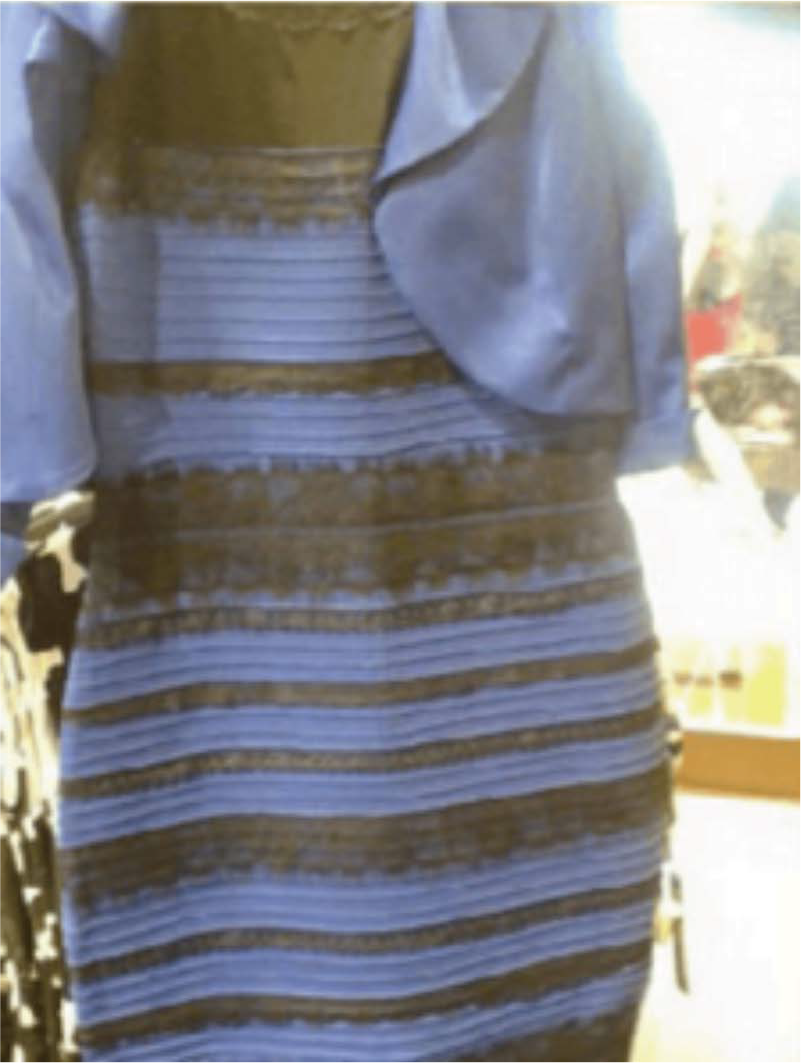
The blue and black dress that introduced the public to the fact that perception of color is not just about “reading” the RGB of each pixel. (This image is assumed to be public domain.)

The blue and black ship? Admiralty diagrams (not shown) indicate that the official scheme was blue, black, and gray. (This image is public domain.)
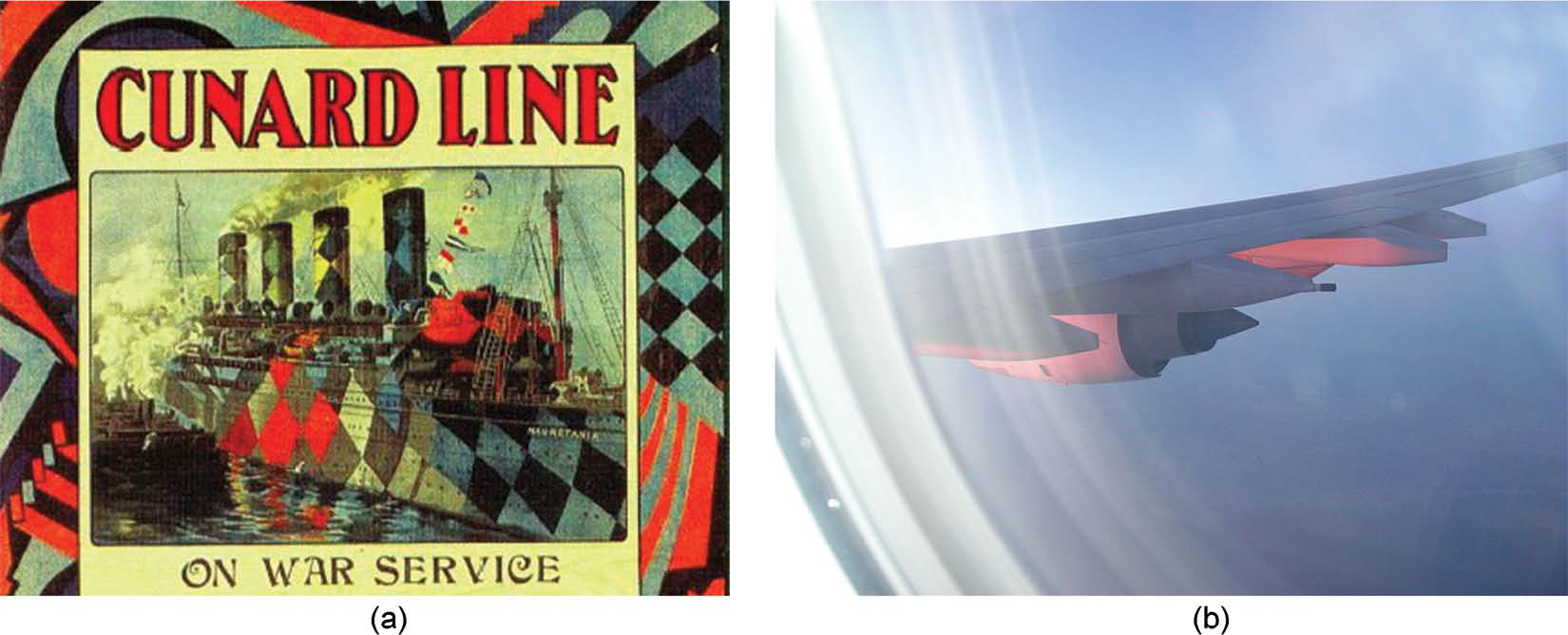
Seeing red. (a) Part of a post-war publicity poster for the Cunard Line. Almost certainly, this image is wrong in depicting RMS Mauritania in red, green, and yellow. This author does not know if the poster's true colors have been accidently/subtly distorted during reproduction, but even so, that could not explain the large splashes of red. Furthermore, the patchwork of gray in the original black and white photograph upon which this image was presumably based (not shown) is inconsistent with a grayscale conversion of this image (not shown). The speculation that the artificial colors were inspired by reflections at sunset is supported by the somewhat iridescent quality of some of the red regions in the image, particularly around the lifeboats. (This image is assumed to be public domain.) (b) Photograph of the wing of an Airbus taken at sundown. A dazzling spectacle, since commercial airlines do not usually paint the underwings of their aircraft red or pink! (In fact, knowledge of this might impede perception of a colored underwing (e.g., Hurlbert & Ling, 2005; Granzier & Gegenfurtner, 2012). (This image is public domain.)
The origin of this (assumed) error is almost certainly a post-war publicity poster by the ship's owners, The Cunard Line, which depicts their liner (
Whatever the underlying reason for this misperception of the blue and black ship, it has proved provocative (e.g., the contemporary artwork in

The door to misperception: Abstract expressionist artwork (
Footnotes
1
It is often thought that the cubist art of the period was the inspiration for the dazzle schemes of WW1. However, the original proposals by Kerr were derived from observations of animal camouflage with the help of Thayer (Murphy & Bellamy, 2009), and it has been claimed that Wilkinson's schemes were derived quite independently of the fashionable art movement of the time, though experiments with cubist ideas were carried out by the French sections de camouflage (Murphy & Bellamy, 2009).