




Abstract
Three recent studies used similar stimulus sequences to investigate mechanisms for brightness perception. Anstis and Greenlee (2014) demonstrated that adaptation to a flickering black and white outline erased the visibility of a subsequent target shape defined by a luminance increment or decrement. Robinson and de Sa (2012, 2013 ) used a flickering disk or annulus to show a similar effect. Here, a neural network model of visual perception (Francis & Kim, 2012), that previously explained properties of scene fading, is shown to also explain most of the erasure effects reported by Anstis and Greenlee and by Robinson and de Sa. The model proposes that in normal viewing conditions a brightness filling-in process is constrained by oriented boundaries, which thereby define separate regions of a visual scene. Contour adaptation can weaken the boundaries and thereby allow brightness signals to merge together, which renders target stimuli indistinguishable from the background. New simulations with the stimuli used by Anstis and Greenlee and Robinson and de Sa produce model output very similar to the perceptual experience of human observers. Finally, the model predicts that adaptation to illusory contours will not produce contour erasure.
1 Introduction
Anstis and Greenlee (2014) demonstrated contour adaptation effects on the perceived brightness of a subsequent target that was defined by small luminance increments or decrements from a gray background. The perceived contrast of the target stimulus was much reduced when a flickering outline contour was presented prior to the target, which they called an “erasure effect.” With a variety of demonstrations, they examined properties of adaptation, brightness filling-in, and the relation between these mechanisms and visual pop-out. For example, they noted that the erasure effect was dependent on the size of the adapting contour and the size of the test stimulus. Erasure occurred for equal-sized stimuli, but if the test stimulus was larger or smaller than the adapting stimulus there was little or no erasure. Anstis and Greenlee argued that their findings support the general idea of brightness filling-in being constrained by boundary contours. As described below, these ideas are part of an existing neural network model (Grossberg & Todorovic, 1988; Francis & Kim, 2012), and new simulations of the model show how they can be quantitatively instantiated.
The findings of Anstis and Greenlee (2014) are similar to earlier studies on flicker adaptation. Robinson and de Sa (2012) adapted observers to flickering disks of varying sizes and measured contrast thresholds for a flickering test disk. Thresholds were substantially increased only when the test and adapting disk had the same size. Similar results were found for a polar checkerboard adaptor, with thresholds increasing when the test disk contours were aligned with interior contours of the checkerboard. In further studies of this type, Robinson and de Sa (2013) adapted observers to a large flickering annulus, which induced perceived flicker of the annulus interior even though it was physically an unchanging gray. Observers then judged the polarity of a subsequent test shape located at the center of the annulus. Similar to Anstis and Greenlee and their earlier study, Robinson and de Sa (2013) found that a test stimulus the same size as the annulus interior was perceived to be of a lower contrast than an unadapted comparison stimulus. Reducing the size of the test stimulus to be smaller than the annulus interior eliminated the adaptation effect. Although the stimuli, experiments, and results are similar to those in Anstis and Greenlee (2014), Robinson and de Sa (2013) argued that these effects were inconsistent with a filling-in model of perception because adaptation caused by induced flicker should have had equivalent effects regardless of the test stimulus' size. As described below, new simulations of the Francis and Kim (2012) model provide an interpretation quite different from Robinson and de Sa (2012, 2013) and suggest that their findings strongly support the filling-in properties of the model.
Stephen Grossberg has long championed the idea that visual perception involves a filling-in process for brightness and color perception. An integral part of his theory is that boundary contours constrain the filling-in process with complementary pathways that trade-off limitations of different types of visual processing (Grossberg & Mingolla, 1985; Grossberg & Todorovic, 1988; Grossberg & Hong, 2006). In the model, anything that affects the strength of boundary contours, such as contour adaptation, also affects the filling-in process. Contour adaptation plays an important role in Grossberg's model. In particular, Francis, Grossberg, and Mingolla (1994) showed that contour adaptation helped control the duration of visual persistence that would otherwise be unacceptably long due to excitatory feedback in neural circuits. The same contour adaptation mechanism was shown to modulate the filling-in of visual afterimages (Francis & Rothmayer, 2003; Francis & Ericson, 2004; Francis & Schoonveld, 2005; Wede & Francis, 2006, 2007 ; Van Horn & Francis, 2007) and filling-in effects described as scene fading (Simons, Lleras, Martinez-Conde, Slichter, Caddigan & Nevearez, 2006; Francis & Kim, 2012). The model suggests that many of these investigations are related to the erasure effects noted by Anstis and Greenlee (2014) and Robinson and de Sa (2012, 2013).
For example, Experiment 1 in Francis and Schoonveld (2005) was designed to test a model prediction that a flickering oriented grating could modify the percept of an afterimage produced by a preceding grid pattern that contained both vertical and horizontal bars on a gray background. As predicted by the model, offset of a flickering vertical grating produced an afterimage percept of horizontal bars. Thus, the vertical bars that would normally be present in the retinal afterimage were rendered invisible by adaptation to the flickering grating. This influence is very similar to the contour erasure effect. Moreover, Francis and Schoonveld (2005) showed that contour adaptation leads not only to erasure (disappearance of the vertical parts of the afterimage) but also to construction of a new perceptual experience (visibility of complete horizontal bars from the incomplete parts of the afterimage). The observations of Anstis and Greenlee (2014) seem similar to the effects identified by Francis and Schoonveld, but differ in that the weak afterimage is replaced with a weak physical stimulus.
Similarly, Francis and Kim (2012) successfully simulated effects of scene fading (Simons et al., 2006). In one version of scene fading, dots are randomly flashed over a blurry photograph. Over time, different regions of the photograph appear to merge together into a faded percept. Similar effects were produced by the offset (but not the onset) of static dots and by an abrupt drop in the photograph's contrast. Francis and Kim (2012) showed that a model based on contour adaptation and filling-in could account for almost all of the reported properties of scene fading. The explanation is nearly the same as for Francis and Schoonveld (2005): the adaptation stimulus weakens boundary contours and thereby allows brightness/color signals to spread via a filling-in process.
This article reports new simulations to show that the model simulation of Francis and Kim (2012) also accounts for most of the observations reported by Anstis and Greenlee (2014) and Robinson and de Sa (2012, 2013). The simulations reported here used the very same model (structure and parameters) as Francis and Kim (2012). Only the stimulus conditions changed for the new simulations. MatLab code to reproduce the simulations described in this article can be found at the Open Science Framework (
2 Model description
This section describes the basic properties of the model that are related to contour erasure. Many characteristics of the model are also involved in other aspects of visual perception, so what is described here is only one perspective of the model, its properties, and the reasons for those properties. The model proposes that the visual system contains two complementary and interacting pathways (Grossberg & Mingolla, 1985). A Boundary Contour System processes oriented contour information that represents edges of stimuli and perceptual groups between elements in a scene (such as illusory contours or texture patterns). The information in the Boundary Contour System also constrains a filling-in process in a Feature Contour System that represents brightness and color information across a surface.
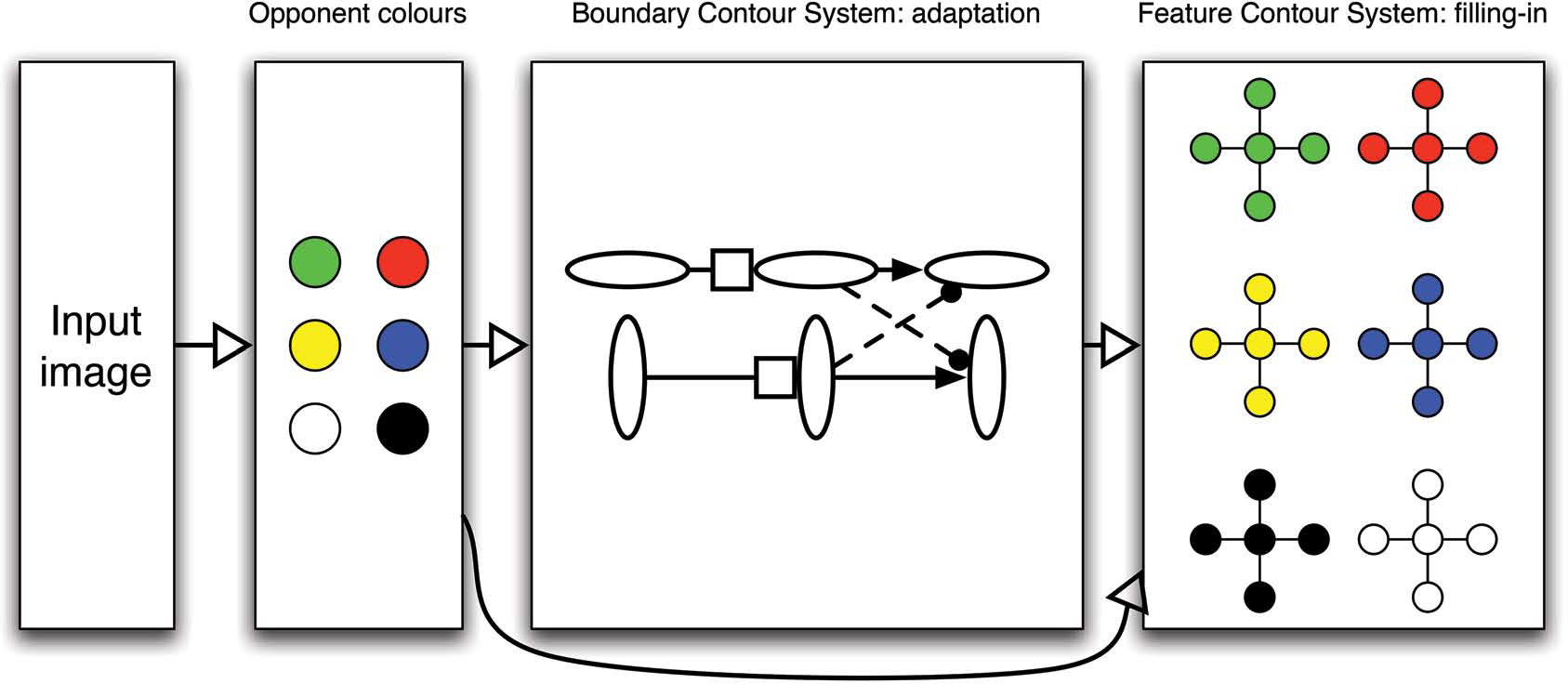
Each box represents processing at a pixel by schematizing the circuits related to contour adaptation and filling-in. Contour adaptation occurs in the Boundary Contour System as part of a gated dipole circuit for cells sensitive to orthogonally oriented boundaries. Oriented boundaries are necessary to constrain brightness/color signals in the Feature Contour System that otherwise spread freely to neighboring pixels. Such constraints can disappear due to contour adaptation, which renders parts of the scene invisible.
In the gated dipole circuit schematized in
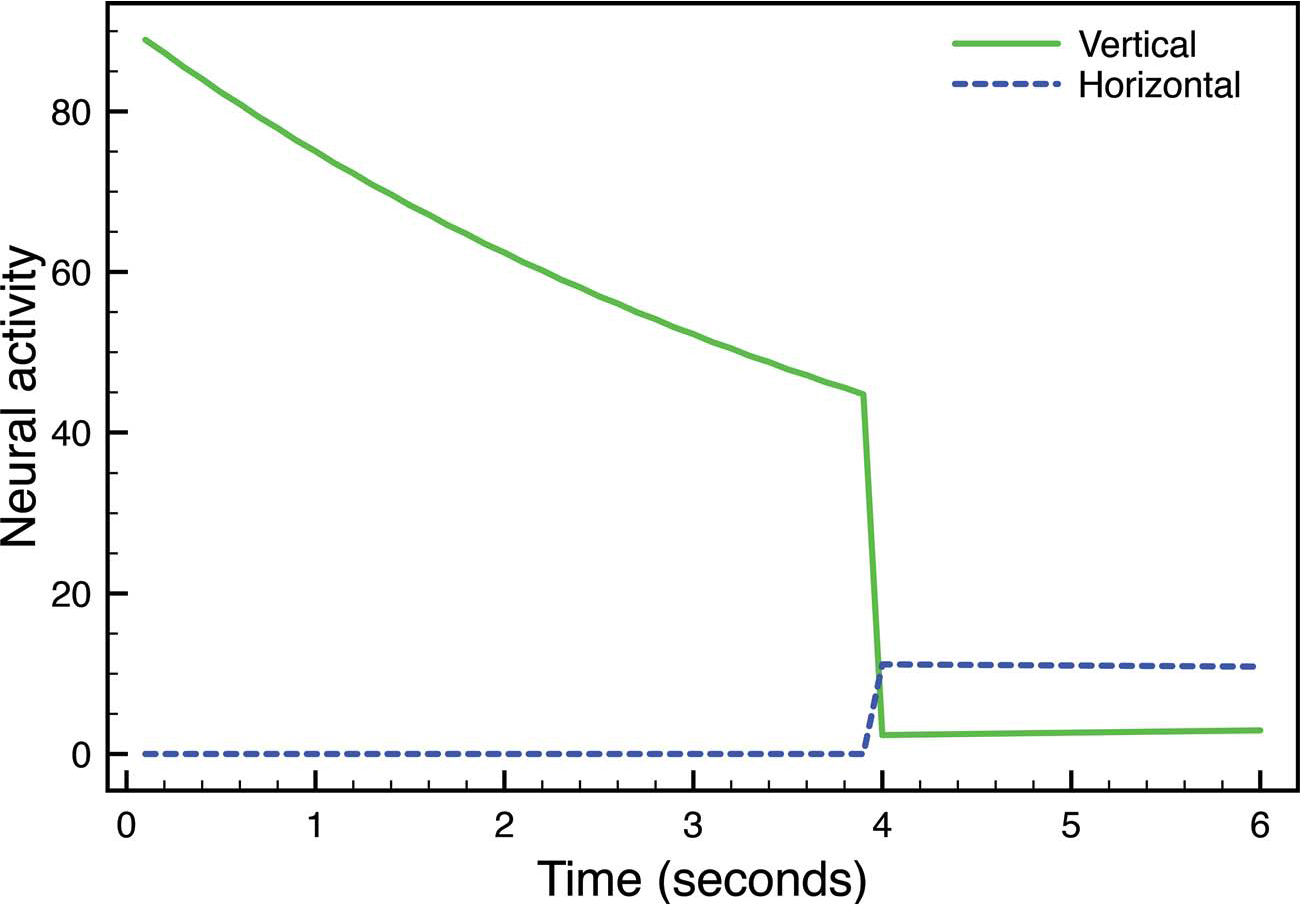
Activity of oriented boundary signals within a gated dipole circuit as a function of time. A vertical edge was presented for 4 s, and the vertically tuned boundary responds strongly and then fades due to adaptation. At time 4, the strong vertical edge is replaced by a weak vertical edge, and the drop in input leads to a rebound of activity in the nonstimulated (horizontally tuned) boundary.
The next section shows that contour adaptation in the model has an effect on the filling-in of a subsequently presented stimulus that closely matches the observations of Anstis and Greenlee (2014).
3 Simulations of the Anstis and Greenlee (2014) observations
Similar model properties explain most of the other stimulus conditions described by Anstis and Greenlee (2014). Movie 2 shows that the model correctly accounts for the observation that adaptation to a flickering surface with a blurred edge does not induce erasure of a subsequently presented test shape, even while adaptation to a flickering outline figure does produce erasure. The blurred edges of the adapting surface do not generate boundaries as strong as the outline figure and thereby produce less adaptation; as a result, the test stimulus generates boundaries that are strong enough to support a percept at the filling-in stage. The simulation results should be compared to Movie 3 in Anstis and Greenlee (2014).

The model reproduces the observations of Anstis and Greenlee (2014) for their Movie 2. Each row corresponds to a fixed time in the simulation. Each column describes the stimulus (left), the response of oriented boundary signals (middle), and the filled-in percept (right). (a) Shows the model's behavior early in the adaptation phase of the flickering outline crosses. (b) Shows that contour adaptation weakens the strength of the boundaries, although they are still strong enough to support visibility of the flickering outline cross. (c) Shows that when the flickering outlines are replaced by cross shapes that are slightly darker or brighter than the gray background, the adapted boundaries are too weak to support filling-in. The faint boundaries at the top and bottom are of orientations opposite what would normally be induced by the surfaces. The test stimuli in (c) may be too faint to be legible on a printed copy of the manuscript; they are more visible in the electronic version of the manuscript and in Movie 1.
Movie 3 shows that the model is sensitive to the relative size of the adapting outline stimulus and the size of the test stimulus. When the outline and test stimuli differ in size, unadapted cells respond to the edges of the test stimulus and thereby support it at the filling-in stage. When the adapting outline and test stimuli are of the same size, the neurons responsible for coding the boundaries of the test stimulus are weakened by the previous adaptation. The simulation results should be compared to Movie 4 in Anstis and Greenlee (2014).
The model does not do well for every stimulus sequence considered by Anstis and Greenlee (2014). Movie 4 shows the model's behavior when the adapting stimulus is a flickering half-square outline followed by a faint filled square. As Movie 5 in Anstis and Greenlee (2014) demonstrates, the perceptual experience of such a sequence is that the unadapted side of the surface appears nearly normal, while the adapted side fades into the gray background. In contrast, the model produces a much stronger erasure effect whereby all but a few brightness signals on the unadapted side disappear into the background. This poor match of the model likely indicates some misspecification of the filling-in process. In the model, a closed set of boundary contours is required to trap brightness signals. A gap on only one side is enough to cause a stimulus to blend into the background. Clearly, this aspect of the model is not correct, and similar problems have been identified in previous work (Francis & Ericson, 2004; Francis & Schoonveld, 2005; Van Horn & Francis, 2007; Kim & Francis, 2011), but a solution remains elusive.
Movie 5 shows that the model is successful in accounting for the properties of Movie 6 in Anstis and Greenlee (2014). Here, a flickering vertical line produces contour adaptation. When a subsequent bipartite surface appears, the vertical edge separating the two sides is too weak to separate the filling-in regions and the two sides appear to have the same brightness.
Movie 6 shows that the model also accounts for the percept of brightness pyramids described in Movie 7 of Anstis and Greenlee (2014). Here, the central square is much brighter/darker than the gray background, but is only modestly different from the surrounding pyramid step. An adapting stimulus defined by flickering contours at the step edges substantially reduces the perceived contrast of all the pyramid steps, even though the central step has a high contrast with the background. Anstis and Greenlee (2014) observed that producing full invisibility of the pyramids required 30 s of adaptation, but the model produces the effect more quickly. This difference may reflect the model simulation having perfect fixation (no simulated eye movements).
Movie 7 shows that the model has partial success for adapting contours on the perception of test annuli. Large or small flickering outline squares matched the inner or outer edges of bright or dark test annuli, as for Movie 8 in Anstis and Greenlee (2014). In agreement with their observations, the small adapting contours weaken the boundary separating the interior of an annulus from the surrounding region, which leads to a percept of a filled shape (without a perceived hole). When the adapting contour matched the outer edge of the annuli, Anstis and Greenlee reported that the outer surface of the annulus disappeared, and the model also produces this erasure. However, Anstis and Greenlee also noted that the hole of the (now erased) annulus appeared different than the gray background, presumably due to brightness contrast. The model simulation does not produce a visible hole. The model limitation is easily identified: the current simulation does not include mechanisms for brightness contrast. This deficit is specific to the current simulation (which was designed to account for scene fading, where brightness contrast effects did not play a role), rather than being a general problem for the model (e.g., see Grossberg & Todorovic, 1988 for a description of how the model accounts for brightness contrast effects). A modified simulation should reproduce the observations of Anstis and Greenlee (2014) for these stimuli.
Anstis and Greenlee (2014) also described two other conditions that explored how the effects of erasure for annuli influenced perceived pop-out of a set of stimuli. The current model simulation does not consider these conditions because the reported percepts seem to require brightness contrast effects.
Finally, Anstis and Greenlee (2014) reported that contour adaptation to rectangle outlines could lead to the erasure of gray horizontal bars on a vertically striped background. This author found that their Movie 11 did not produce the effect described in their text, but this discrepancy may reflect differences in the computer monitor or difficulties across observers for describing percepts of peripheral stimuli. The stimulus sequence was not simulated in the model, but the described effect seems generally consistent with the model's mechanisms.
4 Simulations of the Robinson and de Sa (2012, 2013 ) findings
Robinson and de Sa (2013) measured polarity discrimination of a luminance target after adaptation to induced flicker. Conceptually, the stimuli in Robinson and de Sa are similar to those in Anstis and Greenlee (2014), with the main difference being that the flicker stimulus was not an outline contour but a large annulus. Similar to the report of Anstis and Greenlee's Movie 4 (the present article's Movie 3), Robinson and de Sa found that contrast thresholds for the target stimulus were increased when the inner edge of the annulus abutted the location of the target stimulus, but that the contrast thresholds were low if the target was smaller than the inner edge of the flickering annulus.
A model simulation with stimuli similar to those used by Robinson and de Sa produced the images in
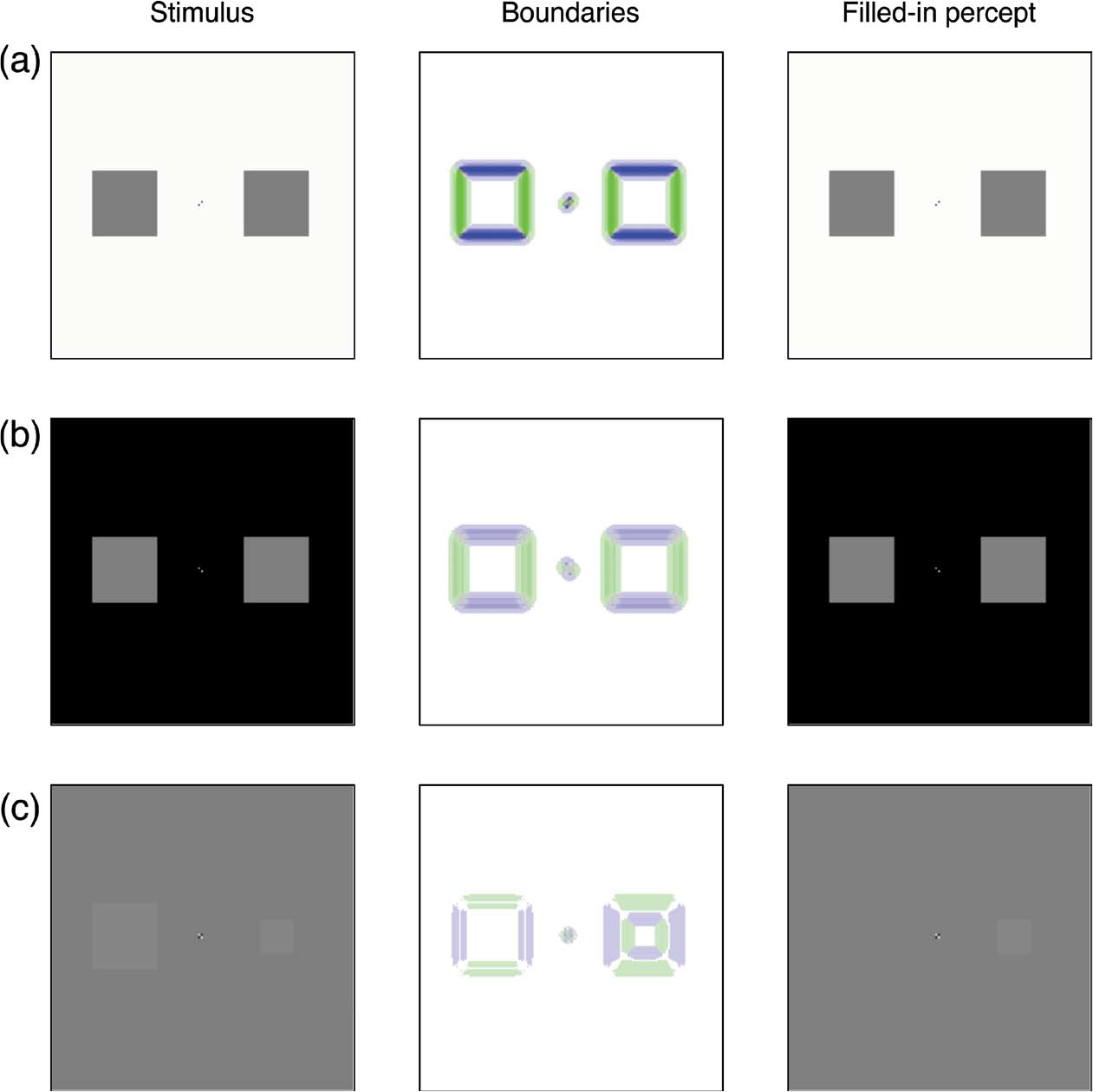
The model reproduces the effects reported by Robinson and de Sa (2013). Each row corresponds to a fixed time in the simulation. Each column describes the stimulus (left), the response of oriented boundary signals (middle), and the filled-in percept (right). (a) Shows the model's behavior early in the adaptation phase of the flickering two-holed annulus. (b) Shows that contour adaptation weakens the strength of the boundaries generated at the edge of the annulus holes, although they are still strong enough to support visibility of different regions of the image. (c) Shows that when the flickering annulus is replaced by faint squares on a gray background, the adapted boundaries are too weak to support filling-in for the larger test square. The faint boundaries around the larger test square are of an orientation opposite what would normally be induced by the square. In contrast, the small test square generates boundaries at unadapted locations, so it is represented at the filling-in stage. The test stimuli in (c) may be too faint to be legible on a printed copy of the manuscript. They are more visible in the electronic version of the manuscript and in Movie 8.
Robinson and de Sa (2013) measured discrimination thresholds for their target stimuli (for judgments of whether the target was brighter or darker than the gray background). The simulation can be treated in a similar way, and
Robinson and de Sa (2013) argued that their findings were inconsistent with filling-in models of brightness perception that hypothesized a point-for-point representation of brightness information. The model of Francis and Kim (2012) is exactly the type of model they were addressing, but the simulations show that their experimental findings are entirely consistent with such a model. In fact, since the model was defined prior to their experiments, the findings can be taken as independent validation of the model properties. Robinson and de Sa (2013) ran additional conditions that are also consistent with the model's explanation. In their Experiment 1, they found very similar thresholds when they varied the size of the nonflickering annulus and the corresponding size of the target. Experiment 2 replicated Experiment 1 with a different measurement method. Experiment 3 found that adaptation had very little effect on a smaller test stimulus if the nonflicker region of the adapting stimulus varied during the adaptation period. These findings are entirely consistent with the model's explanation because an overlap of contours is required for the contour adaptation to have an effect on the filling-in stage. Such overlap only occurs when the adapting annulus interior and the target stimulus have nearly the same size.

Contrast thresholds for the target stimulus after adaptation or not for an equal-sized or a smaller target. The pattern of thresholds for the model simulations (left) is similar to the experimental data (right) from Robinson and de Sa (2013).
A similar argument accounts for the main findings of Robinson and de Sa (2012), which used different stimuli and different measures of test contrast thresholds. In their first experiment, the test stimulus was either a 2 or 10 degrees diameter flickering disk and the adaptor was a 2, 4, 10, 12, or 15 degrees flickering disk. As the data plot in

Contrast thresholds for the target stimulus after adaptation or not for different-sized adapting stimuli. The pattern of thresholds for the model simulations (left) is similar to the experimental data (right) from Experiment 1 of Robinson and de Sa (2012).
Although Robinson and de Sa (2012, 2013) designed their experiments to test adaptation effects of flicker, the model suggests that flicker plays only a minor role in most of their observed effects. Rather, the main effect of the flicker adaptation in their experiments is to weaken the boundaries generated by the flickering adaptation stimulus; that boundary weakening then affects the filling-in process that is needed to support a representation of the test stimulus as being distinct from the background.
5 Predicted absence of contour erasure when adapting to illusory contours
The model includes contour adaptation mechanisms because they generate orientation after-responses that function as “reset signals” to curtail excitatory feedback that would otherwise lead to unacceptably long visual persistence. Francis et al. (1994) used the model to explain the experimental finding that illusory contours have unusually long visual persistence (Meyer & Ming,
If the model's explanation of the persistence of illusory contours is valid, then it predicts that contour erasure should be absent, or much reduced, for an illusory adapting contour at the location of the test stimulus. The current simulation of the model does not include mechanisms for generating illusory contours, but since the prediction is that illusory contours will not produce adaptation, it is legitimate to consider the behavior of the model with stimuli that induce illusory contours.

Contrast thresholds for the target stimulus after adaptation or not for different types of checkerboard adapting stimuli. For both the model and the data (Experiment 2 of Robinson and de Sa, 2012), all adapting stimuli show an increased threshold relative to a nonadapting stimulus.

The model predicts that sparse illusory contour inducing stimuli will not produce contour erasure, even though they produce a vivid illusory contour at the location of the test stimulus. Each row corresponds to a fixed time in the simulation. Each column describes the stimulus (left), the response of oriented boundary signals (middle), and the filled-in percept (right). (a) Shows the model's behavior early in the adaptation phase. This version of the model does not produce illusory contours. (b) Shows that contour adaptation weakens the strength of the boundaries generated by the inducers. (c) Shows that the faint test square on the left (after adaptation to an illusory contour) can generate boundaries that support its representation at the filling-in stage, but the test square on the right (after adaptation to a real contour) cannot. The test stimuli in (c) may be too faint to be legible on a printed copy of the manuscript. They are more visible in the electronic version of the manuscript and in Movie 10.
6 Conclusions
With a few exceptions that are related to already known deficiencies, the model simulated by Francis and Kim (2012) to originally account for scene fading also accounts for the observations of Anstis and Greenlee (2014) on contour adaptation erasure and many of the findings from Robinson and de Sa (2012, 2013). Thus, these new reports validate the main properties of the model, especially the role of boundary contours in constraining a filling-in process. Finally, the model predicts that illusory contours do not produce adaptation that leads to contour erasure. This prediction seems to be validated by Movie 10.
An alternative theoretical approach hypothesizes that filling-in mechanisms are not needed to account for many brightness percepts. Instead, this alternative approach suggests that brightness perception derives from normalized outputs of oriented spatial filters that are summed across multiple scales (Blakeslee & McCourt, 2008). Simulations of such an approach do account for a wide variety of brightness illusions (Blakeslee & McCourt, 1999, Blakeslee, Pasieka, & McCourt, 2005), and it would be valuable to know if they can also account for the contour erasure effects that are so easily accommodated by a filling-in approach to brightness perception.
Footnotes
Acknowledgments
The research leading to these results has received funding from the European Union Seventh Framework Programme (FP7/2007-2013) under grant agreement no. 604102 (HBP).
References
Supplementary Material
Please find the following supplemental material available below.
For Open Access articles published under a Creative Commons License, all supplemental material carries the same license as the article it is associated with.
For non-Open Access articles published, all supplemental material carries a non-exclusive license, and permission requests for re-use of supplemental material or any part of supplemental material shall be sent directly to the copyright owner as specified in the copyright notice associated with the article.


