Abstract
Introduction
To analyze the factors that may influence surgical vs non-surgical treatment for AdIS patients within gray zone (40–55°) main thoracic (MT) curves.
Material and Methods
A retrospective analysis of a multicenter, prospective, consecutive patient series. Inclusion criteria were: AdIS, ≥18 years of age, major curve to be MT, Cobb between 40 and 55°. Ninety-one patients (69 Non-surgical and 22 Surgical) were included. Non-surgery group had 57F and 12M; mean age: 28.3 (18–47), mean Cobb: 46.8° (40- 55). Surgery group had 19 F and 3M; mean age: 31.1 (18–71), mean Cobb: 49.2°(42–55). All patients completed SF-36, SRS-22 and ODI when they were first seen in the clinic. AP and lateral Cobb measurements and sagittal plane parameters were measured. Independent samples t-test was used to compare groups. Variable importance analysis was done using classification and regression tree algorithm to predict factors that influence surgical decision.
Results
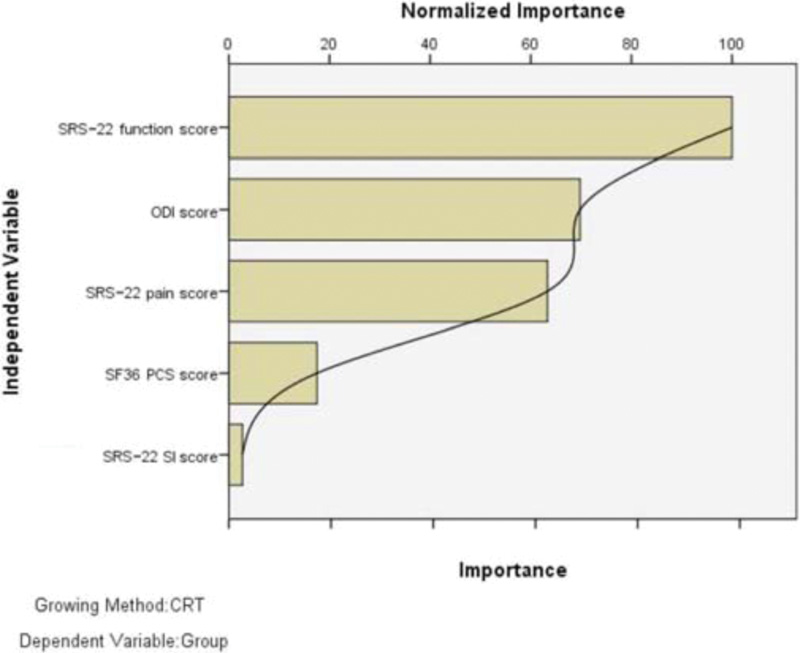
ODI, SF-36 PCS and SRS-22 subtotal, function, pain, self-image scores were significantly different between the groups (p < 0.05). Age, MT curve Cobb, Lumbar curve Cobb, trunk shift, SVA, coronal balance, SF-36 MCS and SRS22 mental health were not statistically different (p > 0.05). Most important variable that created a tendency toward surgery was SRS-22 functional status followed by ODI, SRS-22 pain score, SF-36 PCS and SRS-22 self image score (Fig. 1).
Conclusion
AdIS patients having a curve magnitude in the gray zone (40–55°) with decreased SRS-22 function, pain, self-image and SF-36 PCS and increased ODI scores had a predilection toward surgery. Most important variable was SRS-22 function score.