Abstract
Introduction
Surgical goals and alignment objectives mostly depend on sagittal plane parameters. SVA, C7 tilt and T1 tilt account for spinal balance and PI, PT, SS, PI-LL account for pelvic compensatory mechanism, which are all affected by patient positioning. GT is the angle between the line drawn from the center of C7 to the center of the sacral endplate and a line drawn from the center of the sacral endplate to the center of the femoral head. GT is a single parameter that takes both balance and pelvic compensation into account as a single parameter. GT has been shown to be less affected by patient positioning compared with SVA and PT. Aim was to analyze the correlation of GT with HRQoL parameters and compare with other sagittal plane parameters.
Material and Methods
A retrospective analysis of a multicenter, prospective, consecutive patient series. 337 patients (285F,52M) with adult spinal deformity were included, (mean age: 58.2± 15.7). Pelvic parameters (PT, PI, SS), sagittal balance parameters (SVA, T1 tilt), GT and lordosis gap(LGap) were measured by using Surgimap. HRQoL instruments included: Oswestry Disability Index(ODI), Short Form-36, SRS-22. Correlation analysis between radiographic pelvic and sagittal balance parameters, GT and LGap was pursued. Kruskal-Wallis test was used to compare GT, SVA and PT for ODI < 20, 20–40 and > 40 disability groups.
Results
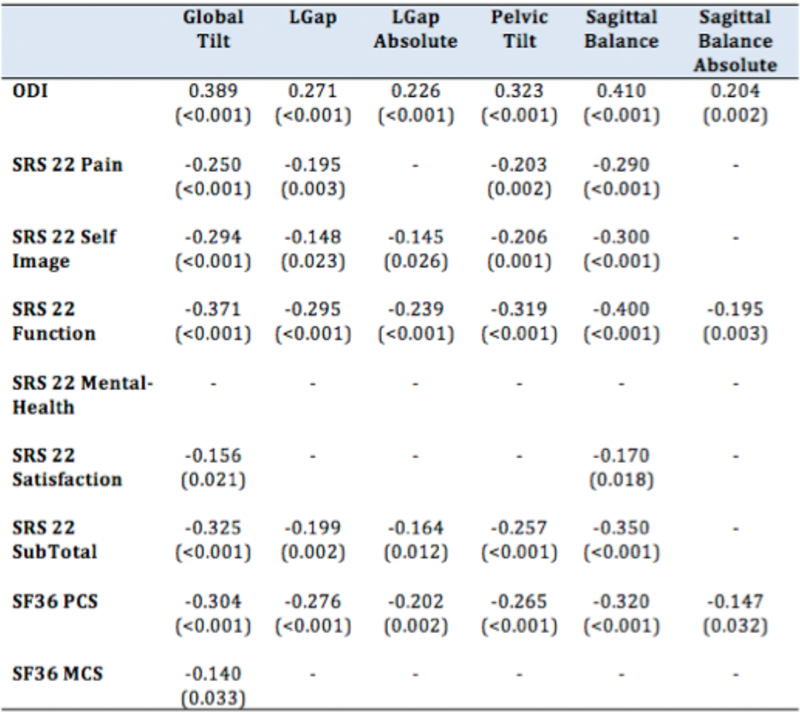
Global tilt significantly correlated with ODI, SRS-22 pain, function, self image, and subtotal scores and SF-36 PCS (p < 0.01) similar to SVA, PT and LGap. None of the radiographic parameters correlated with SRS-22 mental health or SF-36 MCS (Table 1). GT was more sensitive in detecting ODI disability groups when compared with SVA and PT (p < 0.01)
Conclusion
GT has a similar or better correlation with HRQoL domains compared with PT and SVA. This information adds another important feature of this parameter in addition to being a single parameter taking into account both the spinal balance and pelvic compensation and being less affected by patient positioning.