Abstract
Introduction
There are many factors correlated to the vertebral rotation in AIS patients such as the distance between the apex of rib and vertebra (rib-vertebral distance: RVD) on lateral X-rays, MRI or the Scoliometer measurement. However, no study has shown the relationship between those factors and the apical vertebral rotation.
Methods
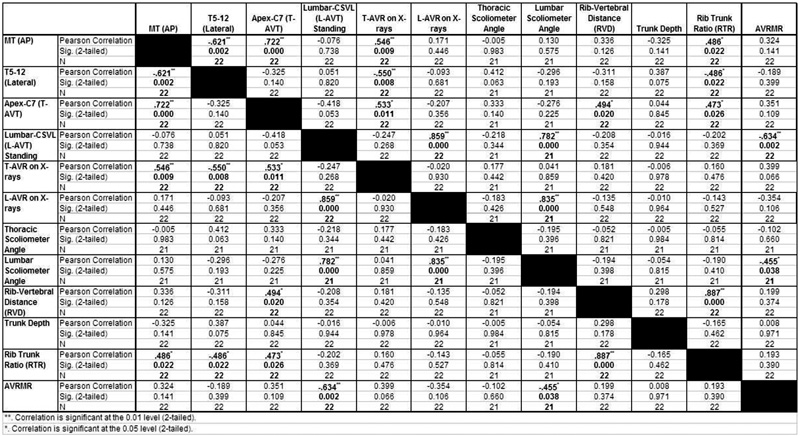
Out of 380 consecutive AIS patients who underwent corrective surgery, 22 patients who had preoperative MRI and complete radiographic images stored in PACS were identified. Various angles and distances including Main Thoracic curve (MT), T5–12 sagittal profile, Apical Vertebral Translation (AVT), Apical Vertebral Rotation (AVR), RVD, trunk depth, and axial rotation of apical vertebra on MRI (AVRMR) were measured. Scoliometer angles (SA) for these patients were found in the charts as well. Rib Trunk ratio (RTR) was calculated by RVD/trunk depth. Each paired value was compared with find any significant correlation.
Results
The radiographic measurement and correlation values are shown in the table. There was no significant correlation between thoracic and lumbar parameters while the larger curves had the greater rotation. RTR was correlated with MT, T5–12 and T-AVT, but not T-AVR. MRI and Scoliometer could not predict the T-AVR as well.
Conclusion
This study shows that we can predict the amount of coronal and saggital deformities from lateral X-rays, but not the axial rotational deformities. Supine MRIs cannot predict AVR and standing MRIs may be helpful. Scoliometer angles predict L-AVR, but not T-AVR probably due to the combination of rib cage deformity and vertebral rotation. During the corrective surgeries in AIS, deformity surgeons may still need to consider the deformity of rib cage itself, even with the direct derotation of vertebral column.