



Abstract
Degenerated intervertebral discs (IVDs) are commonly implicated in low back pain and herniation is a direct cause of pain and disability. There are few minimally invasive treatments to treat and repair painful IVD degeneration including annulus fibrosus (AF) defects. Painful IVD injuries and degeneration are associated with structural disruption, chronic inflammation, and neurovascular ingrowth deep into the IVD and all of these conditions must be addressed to enhance function and inhibit painful conditions. Design goals for functional AF repair involve the restoration IVD height and motion segment biomechanics to intact conditions, sealing of defects in the AF, no (or minimal) risk of herniation under high physiological load conditions, and the ability to promote healing. Evaluation methods for AF repair strategies should progress from rapid screening studies to more advanced and rigorous evaluations in situ and eventually in vivo. Multiple hydrogel repair strategies are described including sealants and cell carriers. Fibrin crosslinked with geniplin (FibGen) shows promise for AF repair with good performance biomechanically and in organ culture.
Disclosures: None
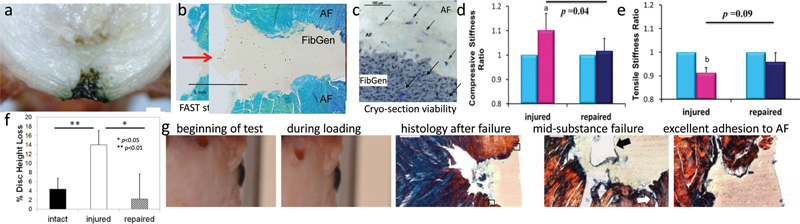
(a) FibGen repaired a large AF scalpel injury. IVD organ culture experiments showed FibGen (b) retained adjacent AF structure, remained well-adhered to AF tissue, and (c) allowed cell infiltration while maintaining local cell viability (black arrows) after 14,000 compression loading cycles. Biomechanical testing showed FibGen (d) completely restored compressive stiffness, (e) partially restored tensile stiffness, and (f) completely restored IVD height to intact levels. (g) Failure bending tests showed no herniation and excellent adhesion but some midsubstance failure (black arrow).