




Abstract
Introduction
Intervertebral disk (IVD) degeneration is a common cause of back pain, which has a negative impact on the quality of life of the patient and is costly to the health care system. It is crucial to understand the interplay between mechanobiology, disk composition, and metabolism to understand the underlying cause of disk degeneration and to be able to study ways to regenerate the degenerate disk. To address such questions, a bioreactor has been developed that facilitates organ culture of intact human disks in a controlled dynamically loaded environment. The bioreactor is used in combination with an isolation method which maintains the integrity of the intervertebral disks by preserving the noncalcified part of the cartilage endplate. In this study, stress profilometry was used to evaluate optimal loading platen design for the bioreactor.
Materials and Methods
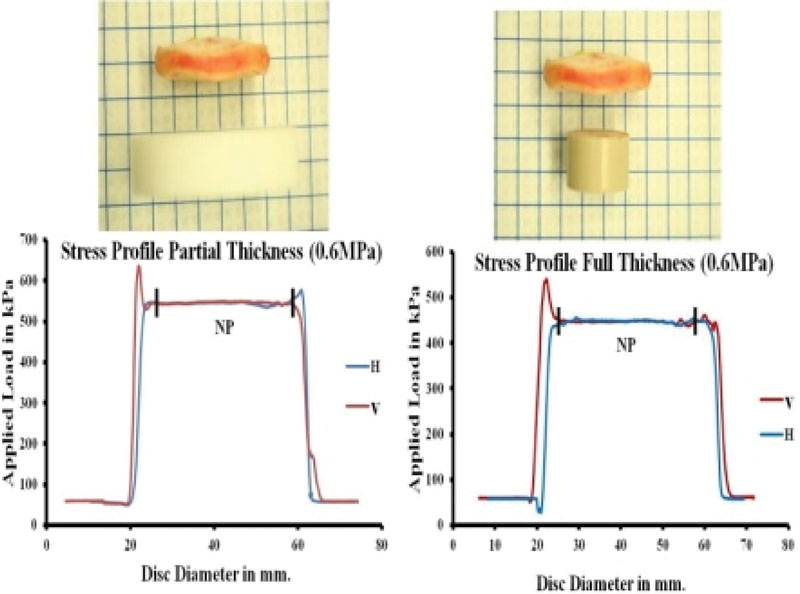
Human lumbar IVDs were obtained through organ donations via Transplant Quebec. The spines were assessed by X-ray to evaluate the degree of degeneration. Intact disks were prepared by parallel cuts through the adjacent vertebral bodies close to the end plates, and the remaining bone and the calcified part of the cartilage endplates were removed using a high-speed bone burr. Pictures of the disk were taken after processing and surface area was calculated with ImageJ software to calculate the load to be applied to generate pressures of 0.3 MPa and 0.6 MPa. Two platen sets were tested, full coverage of the whole disk and partial coverage of only the nucleus pulposus (NP) region. The disks were mounted between two platens and stress profiles were recorded at 0.3 MPa and 0.6 MPa static load. Vertical (V) and horizontal (H) stress profiles were generated for anterior-posterior (AP) and lateral diameters of the disk.
Results
In young and healthy isolated disks, stress profiles for full coverage and partial covering platens were very similar (Fig. 1) to the stress profiles generated from the same disk with intact vertebral bone. The stress profiles showed uniform distribution of load over the entire diameter of the disk, even when only the central part was loaded. As expected, degenerate specimens showed an uneven load profile with regions of perturbation, when loaded with full coverage platens. Loading the degenerate disks with partially covering platens resulted in very uneven load profiles and in failure of the cartilaginous endplates at the higher load.
Conclusion
A critical step in the development of a disk organ culture system that can be subjected to load is the validation of the various components of the bioreactor. We found that the choice of platens did not affect the load distribution in young and healthy but seemed to be critical when loading degenerate disks. The uneven load profiles obtained in degenerate disks using full coverage platens resembles the in vivo profiles published by McNally et al The similarities indicate that we are able to mimic an in vivo environment in degenerate samples using full coverage platens. Our findings indicate that the choice of load platen is critical to provide in vivo load conditions when studying degenerate disks in organ culture. The bioreactor provides an experimental platform useful to evaluate the potential for biologic repair over a range of loading conditions. It also provides a system where the effect of load magnitude and frequency on the onset of degeneration can be evaluated in healthy disks. Such knowledge is important for patient advice on lifestyle in general and for following a biological repair procedure. This bioreactor system provides a very useful tool to study the mechanisms of both degeneration and regeneration of human intervertebral disks.
Yes
None declared