



Abstract
Introduction
Low back pain is associated with degeneration of the intervertebral disk and affects the quality of life in our society1. Cell therapy of the IVD is limited by the lack of appropriate cell sources2, thus appropriate strategies for the differentiation of stem cells towards a nucleus pulposus (NP) cells-like phenotype have to be found. In the native IVD, NP cells are found sparsely in spherical microenvironments of type II collagen (coll II) and proteoglycans that are known to influence the differentiation of stem cells. It is hypothesized that spherical niche-like structures composed of coll II - hyaluronan (HA) will mimic the NP microenvironment and promote the differentiation of adipose derived stem cells (ADSCs) towards a NP cell-like phenotype. The specific objective of the study is to create the optimal microenvironment to promote the differentiation of ADSCs by varying coll II/HA concentration, cell density, and amount of cross-linking.
Materials and Methods
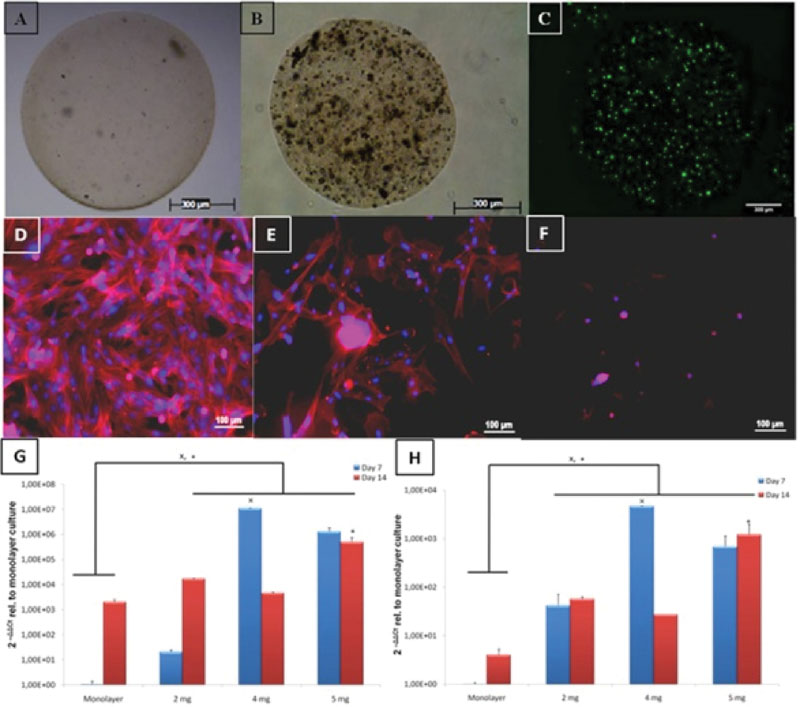
Microgels were created by mixing coll II at different concentrations (2, 4, and 5 mg/mL) with HA at a ratio of 9:1, respectively. ADSC were encapsulated within the hydrogels varying their density (105 to 107/mL). Different concentrations of a poly-(ethylene glycol)-based cross-linker were mixed to the solution with coll II/cross-linker ratios (1:1, 1:2, 1:4). The forming gel solution was then deposited on a hydrophobic surface to create a spherical shape and incubated for 1 hour at 37°C3. The hydrogels were maintained in culture for 14 days before assessing cell viability, cell morphology, and gene expression.
Results
The viability of ADSCs in vitro was not affected by the coll II concentration, the cross-linker concentration, or by cell density. Thus, over 80% of cell viability was maintained after 14 days of culture for each condition. The characterization of embedded ADSCs revealed a change in cell morphology related to the concentration of the coll II used to form the hydrogel. Cells embedded in high collagen concentration were round, while cells embedded in low collagen concentration were more spread. Moreover, the analysis of the gene expression of ADSCs embedded in coll II microgels revealed a higher and earlier expression of coll II and aggrecan compared with cells seeded in monolayer.
Conclusion
Microgels composed of coll II and HA showed great promise as a cell delivery system for the treatment of degenerated disks. In fact, they do not only show absence of toxicity but moreover seem to influence the ADSCs behavior. Among the variables that were examined in the coll II concentration showed the greatest impact on cells phenotype. Indeed, spherical morphology, similar to NP cells morphology, was observed when the cells were embedded in high coll II concentration. The cells also expressed significantly more coll II and aggrecan compared to monolayer cells. A microgel system that mimics the composition of the NP was developed and this system can aid the differentiation of ADSCs towards a NP-like phenotype.
Yes
None declared
O'Halloran DM, Pandit AS. Tissue-engineering approach to regenerating the intervertebral disc. Tissue Engineering 2007;13:1927–1954
Kandel R, Roberts S, Urban J. Tissue engineering and the intervertebral disc: the challenges. European Spine Journal 2008;17: 480–491
Collin EC, Grad S, Zeugolis D, et al. An injectable vehicle for nucleus pulposus cell-based therapy. Biomaterials 2011;32:2862–2870