






Abstract
Cluster headache is usually considered to affect young men. We hereby report on new-onset cluster headache in middle-aged and elderly women. We performed a retrospective chart review of female patients diagnosed with cluster headache (IHS criteria), and studied the charts of women in whom the headache started after the age of 50 years. Out of 168 patients (26 women, 15%) diagnosed with cluster headache, the headache started after the age of 50 years in seven women, of whom three reported past tension-type or migraine headaches. The mean age at the beginning of the headache was 61 ± 8 years (range 52–72 years). In all cases, the pain was severe, strictly unilateral, and accompanied by at least one autonomic symptom. The average duration of the pain was 70 min (range 20 min−3 h), recurring daily for an average period of 7 weeks (range 1–16 weeks). Five patients had 1–2 pain attacks each day, while the other two experienced up to eight episodes of pain in 1 day. In two patients the periodicity of the pain was currently undetermined. In the remainder, the headache periods recurred every 1–4 years. Cluster headache is commonly considered to be a young-male disorder, but middle-aged and elderly women may also be affected. The characteristics of the pain and its manner of occurrence were similar in our cases to those reported in the young-male population.
Keywords
Introduction
The epidemiology of cluster headache (CH) is not entirely known. The few large-scale population studies that estimated the prevalence of CH have shown that this is an uncommon disorder, ranging between 0.09 and 0.4% in males (1–3), and 0.009 and 0.08% in females (2, 3). Cluster headache is commonly considered as a disorder of young men (1–5); however, its prevalence among other age groups is not entirely known.
The aim of this study is to report on the occurrence of new-onset cluster headache in middle-aged and elderly women.
Methods
We performed a retrospective chart review of female patients diagnosed with cluster headache (IHS criteria) (6) at the three largest headache clinics in Israel. We studied the charts of women in whom the headache started after the age of 50 years.
Results
Out of 168 patients (26 women, 15%) diagnosed with cluster headache, we identified seven women in whom the headache started after the age of 50 years (Table 1).
The characteristics of the cluster headache in the seven women.
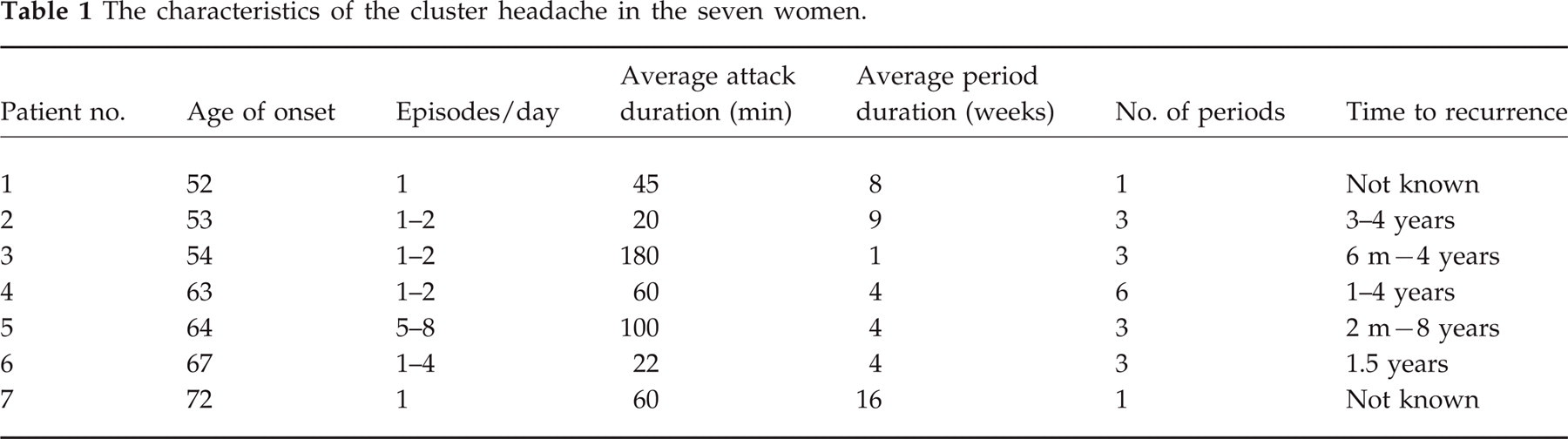
Two patients had past tension-type headache (patients no. 2 and 3) and one had migraine without aura (patient no. 1). The neurological examination disclosed a left eyelid ptosis in patient no. 2 (at the side of the pain), essential tremor in patient no. 5, and signs of an old paralysis of the facial nerve in patient no. 7 (at the side of the pain). The neurological examination was unrevealing in the other patients. Imaging studies of the brain (by computerized tomography or magnetic resonance imaging) were interpreted as normal in all the patients, except for mild brain atrophy in patient no. 4.
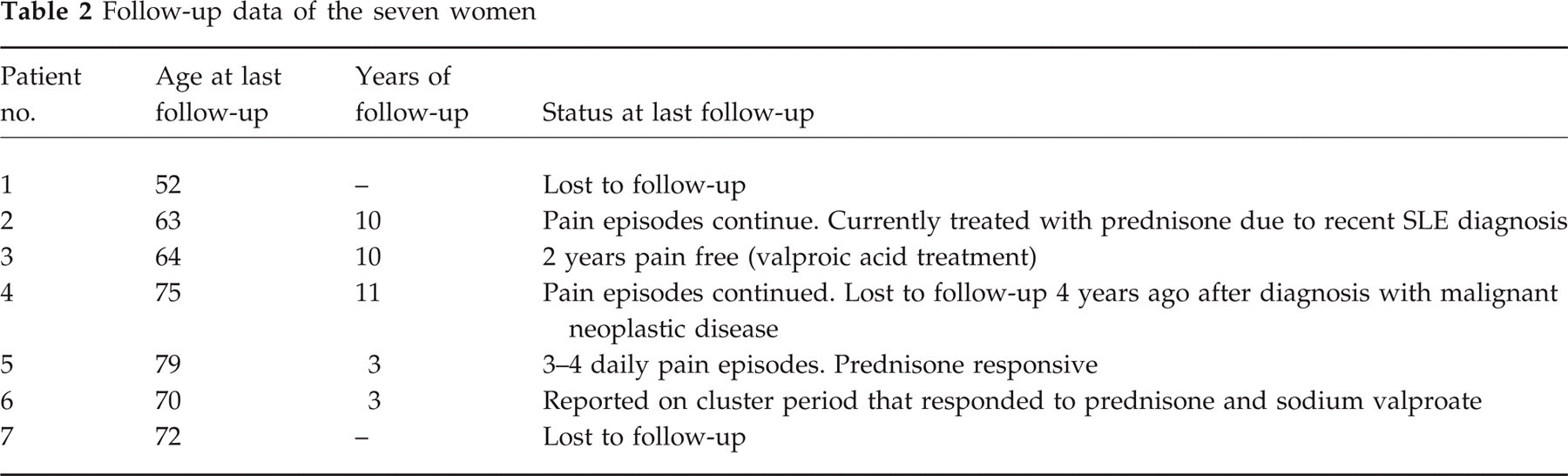
The mean age at onset of the cluster headache in the seven women was 61 ± 8 yr (range 52–72 yr). In the rest of the women the mean age of onset of the cluster headache was 30 ± 11 yr (range 14–48 yr). The characteristics of the CH in the seven patients are presented in the Table 1 and follow-up results are presented in Table 2. In all of the patients the pain was severe, strictly unilateral and accompanied by at least one autonomic symptom. Five patients had 1–2 pain attacks in a day, while the other two experienced up to eight episodes of pain in 1 day. The average duration of the pain was 70 min (range 20 min−3 h), repeating daily for an average period of 7 weeks (range 1–16 weeks). In two patients the periodicity of the pain was currently undetermined, representing probable cases of cluster headache. In the remainder, the headache periods recurred every 1–4 years. Oxygen inhalation reduced the pain in two of four patients. Three patients (nos. 1, 5 and 7) were unsuccessfully treated with indomethacin (up to 150 mg daily). Preventive treatments with lithium carbonate, calcium channel blockers, prednisone and valproic acid gave inconsistent results during the years.
Follow-up data of the seven women
Discussion
The prevalence of CH among different age groups is not entirely known. The reported average age of onset of CH, for both men and women, peaks towards the third decade, but it may begin at any age (2, 4). In fact, Kudrow (2) has noted, based on his own extensive data (425 CH patients, 70 females) and unpublished data of Ekbom, that, ‘peculiar to the female distribution, an increased frequency occurred between the ages of 50 and 60 years’. This unique observation was not found in men and was not further reported, although a small but higher incidence of CH was noted in women older than 50 years (7). Other studies of CH populations lacked specific age descriptions, but women with late age of onset of CH were described (4, 8). A bimodal distribution of the age of onset of the cluster headache, noted by others (9), was not observed in our female participants. This, however, might be due to the low number of women in our study.
Our cases demonstrate that CH, although commonly considered to be a young-male headache disorder, may also start in middle-aged and elderly women. The characteristics of the pain in our cases and its manner of occurrence were similar to those reported in the young-male population. The late onset of CH in our subjects resembles new-onset migraine in menopausal women. Although the role of female sex hormones is not known in the pathophysiology of CH, we speculate that these hormones could play a role in the generation of CH in our cases too.