





Abstract
The rate of attempted and completed suicide in Australia, particularly in rural and regional settings, is of concern [1]. Whereas researchers have documented higher suicide rates in rural youth in New South Wales [2], Queensland [3], and Victoria [4], such differences have not been observed in Queensland [5, 6]. Other research has suggested regional differences, with those in Northern Queensland evidencing a higher suicide rate than those in the more developed and populated areas in the south [6]. Comparison of trends in rural-urban suicides has shown that suicide rates in rural areas have increased significantly, while urban suicide rates have remained stable [1, 2].
Several factors have been postulated to explain the increased suicide rate in rural areas. The downturn of the rural economy and associated factors such as restriction of overseas markets, consolidation of properties, and the collapse of small business have been highlighted [7–9]. These factors, in turn, relate to rural unemployment [10, 11] and poverty [12–14]. Lack of government and private services, including medical, psychological and educational, is also evident in rural communities [14–18]. Higher incidences of alcohol use [19] and greater access to firearms [2, 20] have been implicated.
One factor that has not been investigated is reasons for staying alive. Examination of reasons why people choose not to commit suicide is seen as adaptive [21]. Research has shown that reasons for living relate to suicidal ideation [22–27] and intent [28]. People with more reasons to live are at an advantage during a crisis [21].
Linehan and colleagues [21] have identified six reasons for living. Three (fear of suicide, fear of social disapproval and moral objection) are negative, associated with the act of suicide itself. The remaining three (survival and coping beliefs, responsibility to family and child-related concerns) are positive reasons for choosing not to suicide. The absence of strong positive reasons for living is indicative of suicidal behaviour [21], with research showing that survival beliefs and coping ability related most strongly to suicidal behaviour [21, 29].
Aim
Given the increase in Australian rural suicides, we investigated whether rural-urban differences exist in reasons for living. Consistent with suicide rates, we expected that rural Australians would report fewer reasons for living compared to urban Australians.
Method
The study used a community sample from the State of Victoria, Australia. Selection followed a stratified random sampling procedure, as validated by Shaughnessy and Zechmeister [30]. In line with Dwyer, Barton and Vogel [31], the population was divided into four strata: urban (capital city), regional cities (centres with populations between 50 000 and 200 000), regional towns (with populations of between 7500 and 50 000), and rural (farm and non-farm settings of fewer than 2500 people).
A sample of 3000 Victorian residents (750 from each of the strata) was selected from the electoral roll. A questionnaire was posted to each participant, including a reply paid envelope. To overcome difficulties associated with residents having moved envelopes were addressed to ‘The resident’. This also ensured that residents not enrolled to vote had the chance to receive a questionnaire.
Upon opening the questionnaire, residents read a cover letter, explaining who the researchers were, the study that was being conducted, and what participation involved. At this point, residents had the choice to discard or read the questionnaire before deciding to participate. The letter also detailed support options for anyone experiencing distress, including the telephone numbers of the researchers and Lifeline, a free telephone counselling service.
The Reasons for Living Inventory [21] was employed to assess why participants would choose to stay alive. Participants were presented with 48 items assessing positive and negative reasons for living, and asked to rate ‘how important each item would be as a reason for living if you were contemplating suicide’. The six subscales, with examples, are: Survival and coping beliefs (‘I believe I can find other solutions to my problems’, ‘I believe I can find a purpose in life, a reason to live’); Responsibility to family (‘It would hurt my family too much and I would not want them to suffer’); Child-related concerns (‘The effect on my children could be harmful’); Fear of suicide (‘I am afraid of the actual “act” of killing myself (the pain, blood, violence)’); Fear of social disapproval (‘Other people would think I am weak and selfish’); and Moral objections (‘I consider it morally wrong’). Each reason was rated on a six point scale (1 = strongly disagree; 6 = strongly agree), with higher scores indicating more reason to live.
A total of 655 residents returned the questionnaire (urban = 146, regional city = 164, regional town = 174, rural = 171), representing a return rate of 22%. The mean age of the sample was 42.71 years (SD = 13.42). Both males (42%) and females (58%) were equally represented, and most of the sample was married (72%) and had completed at least secondary schooling (60%).
Results
Overall Reasons for Living scores were calculated and averages obtained as a function of strata (see Fig. 1). Examination of results shows a trend where as population decreases, reasons for living increase. That is, rural residents reported more reasons to live (m = 232.15, SD = 29.21, range = 153–288) than their counterparts in regional towns (m = 229.66, SD = 31.01, range = 110–285), regional cities (m = 222.39, SD = 36.05, range = 99–285), and urban (m = 218.45, SD = 34.02, range = 97–288) locales. ANOVA confirmed that scores were different across the four strata (F3,651 = 6.05, p < 0.001) with rural residents reporting significantly more reasons to live than both regional city (p < 0.05) and urban (p < 0.01) residents.
Total Reasons for Living score as a function of place of residence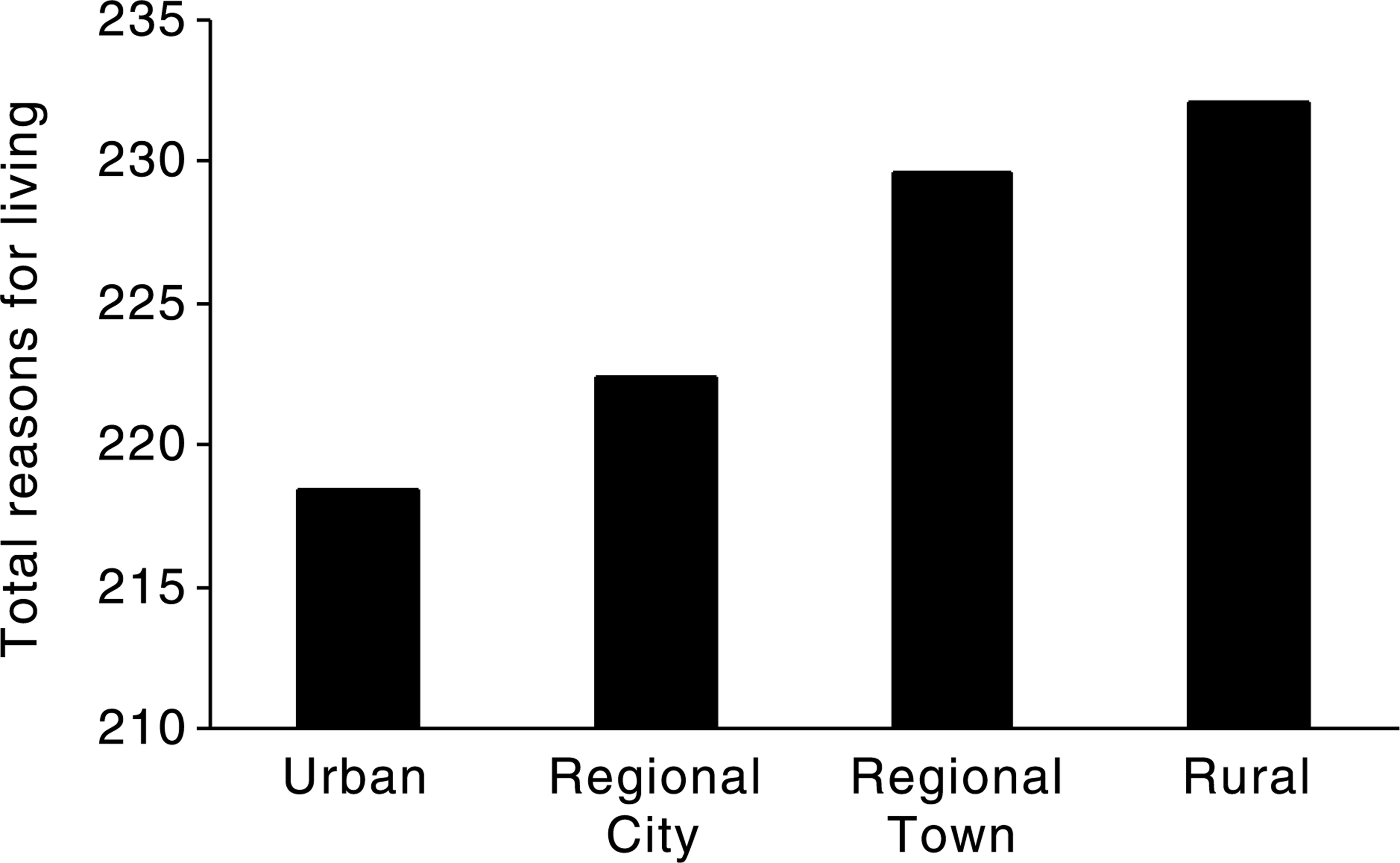
Statistical analyses were then used to assess differences in the six Reasons for Living subscales as a function of location. In order to guard against Type I error resulting from multiple individual tests [32], mean scores for the six Reasons for Living subscales (see Table 1) were entered into a one-way MANOVA. Significant differences were found among the four strata on the Reasons for Living subscales, (Wilks' Λ = 0.95, F18, 1828 = 1.89, p < 0.05). Given the significant overall MANOVA result, the six subscales were examined through univariate testing.
Reasons for living and place of residence
The four strata differed significantly in their belief in their survival and coping skills in a suicidal crisis, (F3, 651 = 3.15, p < 0.05). Further analyses indicated a trend for urban (p = 0.06) and regional city (p = 0.06) to report lesser survival and coping beliefs than rural residents.
The strata answered differently when assessing whether responsibility to family was a reason to live, (F3, 651 = 2.86, p < 0.05). Again, a trend appeared for urban to report a lesser sense of responsibility to family than rural residents (p = 0.11).
The four strata reported different levels of child-related concerns as a reason to live, (F3, 651 = 2.72, p < 0.05). Post-hoc analyses showed that urban residents reported fewer child-related concerns than those living in regional towns (p < 0.05).
Analysis of mean responses across the four strata showed no significant differences when rating whether fear of the actual act of suicide was reason enough to stay alive (F3, 651 = 1.96, p > 0.05).
The four strata differed in the fear of social disapproval they believed might result from suicide (F3, 651 = 4.03, p < 0.01). Post-hoc analysis showed that urban residents had less fear of social disapproval than residents in regional towns (p < 0.05) and rural (p < 0.05) locations.
Univariate results showed that the four strata reported different levels of moral objections against suicide, (F3, 651 = 6.36, p < 0.001). Residents in urban locations had fewer objections than those living in regional towns (p < 0.01) and rural locations (p < 0.01). The same pattern appeared for those living in regional cities; these reported fewer objections than those living in regional towns (p < 0.05) and rural locations (p = 0.07).
Discussion
Residents living in regional cities and urban areas reported fewer reasons to stay alive than those in regional towns and rural areas. Specifically, those in urban-like environments reported fewer survival and coping beliefs in the face of a suicidal crisis, less responsibility and concern for their family and children, less concern over possible social disapproval if they committed suicide, and fewer moral objections to the act of suicide itself. That those in more rural environs reported more reasons to live is contrary to predictions and is contrary to the increase in suicide in rural areas [1–4].
It has been reported that having reasons to live, particularly positive reasons such as survival and coping beliefs, and family and child-related concerns, is related to suicidal behaviour [21, 29]. It is therefore a beneficial finding that people living in less populated rural areas and regional towns are reporting having more reasons to stay alive, and suggests that these residents are at a advantage during a suicidal crisis [21].
The most significant difference between urban and regional town/rural residents was on the Moral Objections subscale. Residents in less populated areas reported that they would not commit suicide due to religious beliefs to a greater extent than those in more populated areas. The utilization of the church and religion has been seen to serve support functions [33–35]. Significantly more rural people reported going to church at least one day a week [36], although other research has demonstrated that urban people rely more on God than rural people [37]. It has been concluded that there probably is no longer a significant difference between rural and urban residents' attendance at church [38]. It would appear, though, that moral and religious objections are important reasons for rural people not to suicide, and that such reasons may exist independent of church attendance.
The results raise an important issue. People living in rural areas reported significantly more reasons to live, however, suicide rates suggest that those in rural areas suicide at a higher rate than their urban counterparts [1–4].
The low return rate of questionnaires raises questions concerning representativeness. Although the educational level of participants seems to be a representative of that in the Australian population [39], there appears to be a disproportionately small number of separated/divorced (9.2%) and widowed (2.6%) people. These people represent groups for whom suicide appears to be an issue [40, 41].
Another sample-related issue to consider when discussing the inconsistency between actual suicide rates and reasons for living in rural/urban residents is age of the participants and suicidees. The highest rates of suicide in rural areas have been in 15–24 year olds [40, 42]. The average age of our sample was 42. Thus, whereas rural residents reported more reasons to live, they were on average much older than those rural males in at risk age groups. Research investigating reasons for living in youth as a function of place of residence is needed.
We did not assess the length of time participants had resided in their current location. Migration related to suicide has received limited attention. For example, youth who suicide are more likely to have migrated from urban to rural areas, rather than from rural to urban areas [11]. Unemployed urban youth may migrate to rural areas due to low cost of living [11]. It is yet to be determined the extent to which long-term rural residents are committing suicide compared to people who have moved from urban to rural environs prior to suicide.
Measurement issues may also be implicated in our results. The first concerns the extent to which the Reasons for Living Inventory adequately assesses concerns of rural residents. For example, financial concerns due to the economic downturn in rural areas and unemployment have been implicated in rural suicides, yet the Reasons for Living Inventory does not tap standards of living. However, other research utilizing this sample failed to find differences between the four groups based on financial concerns and similar life events [43]. One inventory cannot assess all the possibilities as to why people do not commit suicide. There is room to supplement the quantitative with qualitative information.
A second measurement issue concerns instructions to participants. Residents were instructed to complete the Reasons for Living Inventory as if they were contemplating suicide. The reliability of the responses may be questioned, given the conflicting evidence on the relationship between expressed attitudes and actual behaviours [44]. This is difficult to circumvent if the interest is in why the community choose to live or suicide. Of significance, however, is that the relationship between attitudes and actual behaviour is enhanced when the level of specificity at which attitudes and behaviour are measured is increased [45]. Since we examined specific reasons for living, the relationship between the attitudinal response and what might occur in actual suicidal situations is probably more accurate.
The final issue is the method of suicide. Firearms are more available in rural areas [2, 20], and are the preferred means for suicide among those in less populated regional and rural areas [2, 6]. Firearms are an impulsive means of committing suicide, as they do not allow time for consideration of reasons one has to stay alive. But use of firearms in rural suicide has decreased [46]. A substitute method, hanging, has been evidenced [46, 47]. Both firearms and hanging are similar in terms of lethality, violence and immediacy of effect [46]. Further, people who suicide by hanging do so in private and at times and in places when there is little opportunity for them to be found [47].
Rural suicides are achieved through the use of high lethality acts, they may also be impulsive. The choice of high lethality methods often means that highly impulsive acts succeed [48]. If rural residents stop to consider reasons for living, they report having a great deal to live for, a buffer against suicide. Hence, we should explore competing issues of impulsivity versus consideration of reasons for living. Likewise, suicide prevention in rural areas should aim to promote individuals' consideration of reasons for living.
Residents living in urban areas showed a trend to report less to live for, this is by way of contrast to research, theory and practice focusing on rural suicide. If reasons for living are related to suicidal ideation [22–27] and suicidal intent [28], then workers in urban and regional city locations may expect increases in suicide in these areas. Empirical assessment of factors that may contribute to the decrease in urban residents' reasons for living and possible increase in suicide will be invaluable [49].
Footnotes
Acknowledgements
This research was funded by the School of Behavioural and Social Sciences and Humanities, University of Ballarat.