




Abstract

Iginia Mancinelli, Simone Lazanio, Lorella Ceciarelli, Anna Comparelli and Roberto Tatarelli, Department of Psychiatric Sciences and Psychological Medicine, ‘La Sapienza’ University, Rome, Italy:
The armed forces (army, air force, navy) in most countries appear to have a lower suicide risk than the general population of the same age bracket and gender [1, 2].
In Italy in 1998 the suicide rate in the military population was 1.1 per 100 000 and 0.92 per 100 000 among officers and non-commissioned officers respectively; in the general male population of 20–24 years of age suicide rate was 9.8 per 100 000 in 1994.
In the Italian army from 1986 to 1998 there were 76 suicides and 84 attempted suicides (AS).
The age of subjects ranges from 18 to 31; the most frequent age bracket for suicides and attempted suicides was 19–21 with percentages of total suicides of 36% in 19-year-olds, 25.3% in 20-year-olds and 13.3% in 21-year-olds. The AS percentages of total suicides were 42.9%, 21.4% and 16.6%, respectively in these ages (χ2 = 9.87, p < 0.5).
The most frequently involved ranks were ordinary soldiers who constituted 88.2% of suicides and 95.2% of AS, followed by non-commissioned officers and officers (χ2 = 2.75, p < 0.5).
With reference to the enlistment data, the period of highest suicide risk was during the first and sixth months after enlistment when the percentage respectively (at the first and sixth months) of 14.1% is concentrated; as for AS the highest risk period was the first month with a percentage of 40.7% of all AS (χ2 = 103.07, p < 0.5) (Fig. 1.).
Time between enlistment date and suicide (––) and attempted suicide (– – –).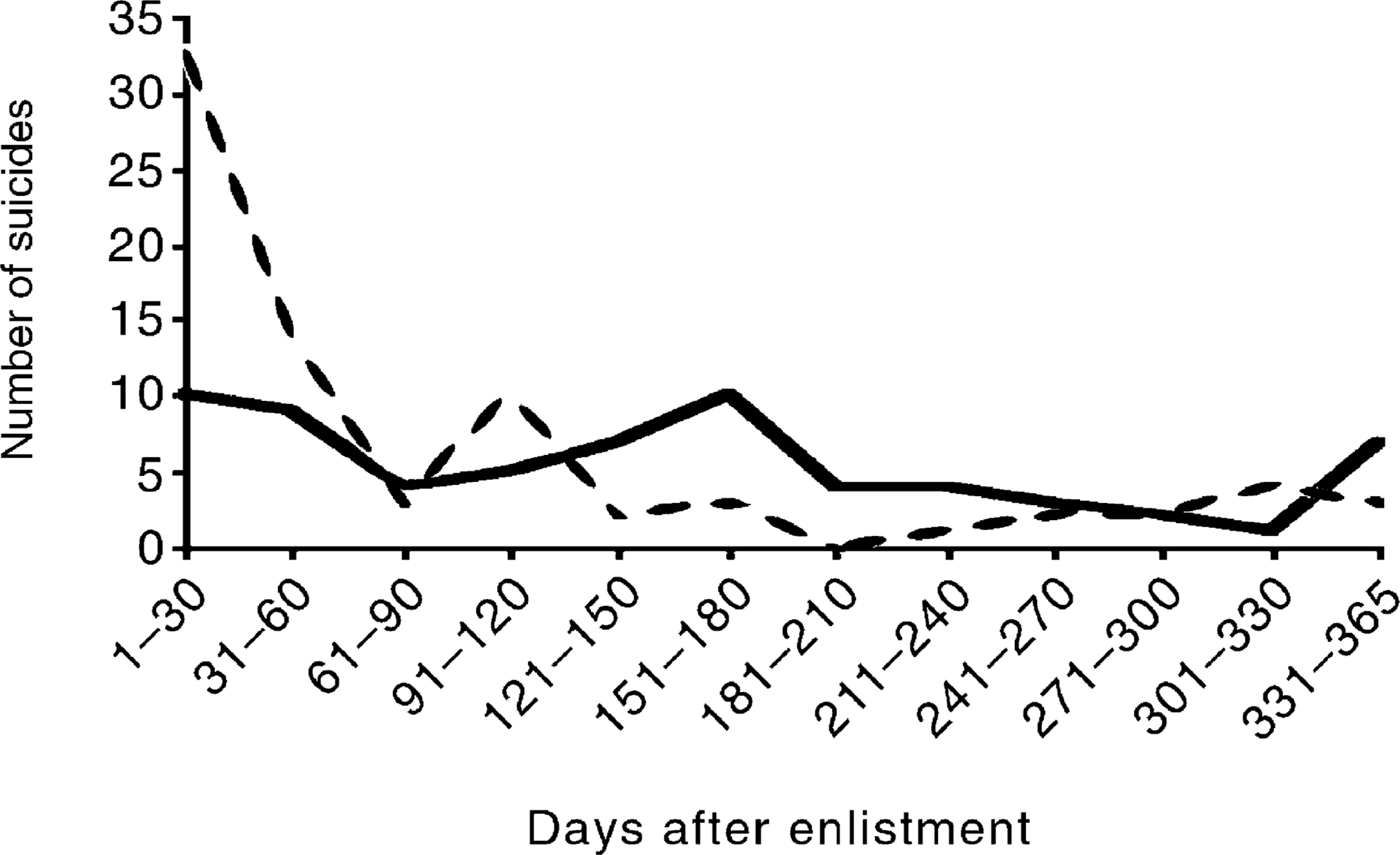
Of the men who committed suicide, their behaviour on military duty was rated good in 47.4%, average in 27.6%, excellent in 18.4%, poor in 3.9%, bad in 2.6%. For the AS group it was: average in 69%, good in 14.3%, poor in 9.5%, bad in 5.9%, excellent in 1.2% (χ2 = 43.86, p < 0.5).
The most frequent methods of suicide used were firearms (51.3%) and hanging-strangulation-suffocation (26.3%); for AS they were self-poisoning (42.9%) and cutting or point-stabbing wrists and arms (36.9%) (χ2 = 104.42, p < 0.5).
We think that the lower prevalence of suicide in the military population as compared to the civilian one is mainly due to two factors: (i) screening procedures of military personnel which are aimed in particular at excluding mentally disturbed conscripts; and (ii) a possible ‘holding role’ carried out by military environment.
We would like to acknowledge that our data were obtained from the clinical documentation received by the Italian Epidemiological Observatory with reference to suicides. Statistics were generated using Statistical Package for Social Sciences (SPSS, Chicago, IL, USA). The research was performed in cooperation with the Directorate General of Medical Corps with the authorization of the Italian Ministry of Defence.