




Abstract
Implications for Impact Statement
Caregiver factors can facilitate treatment for their children with an eating disorder. We demonstrate that caregivers of cisgender boys with eating disorders report less accommodation behaviors at baseline, yet do not have the same increases in self-efficacy over time in treatment as caregivers of cisgender girls. It is helpful for clinicians to routinely assess caregiver accommodation and self-efficacy, which can inform potential adaptations of care for caregivers of cisgender boys with eating disorders.
In the early stages of their child’s eating disorder treatment, caregivers tend to report distress, self-blame, and anger, which are associated with lower self-efficacy and behaviors that perpetuate eating disorder symptoms (Stillar et al., 2016). Parents share that these negative emotions tend to subside during treatment (Coelho, Suen, Marshall, Burns, Lam, & Geller, 2021). Family-based treatments are focused on mobilizing caregivers of youths with eating disorders to support recovery (Loeb & Le Grange, 2009). They aim to improve caregiver self-efficacy (belief in the ability to take charge of their child’s eating), and decrease accommodation behaviors (e.g., giving in to eating disorder behavior to reduce conflict). Increased caregiver self-efficacy (Byrne et al., 2015) and decreased accommodation (Wagner et al., 2020) in the context of family-based treatments, predict youth weight gain and improvements in eating pathology. The role of caregiver self-efficacy in youth outcomes holds across eating disorder diagnoses, including anorexia nervosa (AN; Byrne et al., 2015), transdiagnostic eating disorders (Robinson et al., 2013), and avoidant/restrictive food intake disorder (Lock et al., 2019). In fact, in some research caregiver self-efficacy is a better predictor of treatment outcome than youth self-efficacy (Byrne et al., 2015).
One of the current gaps in the literature on caregiver factors is the focus on caregivers of girls with eating disorders, representing the majority (e.g., 90%) of participants in study samples (e.g., Byrne et al., 2015). This disproportionate focus on girls is problematic, given that there are no sex differences in the lifetime prevalence of some eating disorders, including AN (Swanson et al., 2011). The marginalization of male and transgender youths in eating disorder research has implications for the assessment of eating disorder symptoms, given that the psychometric properties of questionnaires have typically been established with samples of girls and women (Murray et al., 2017). The focus on studying caregivers of girls contributes to gaps in our knowledge of the impact of eating disorders on caregivers of youth across genders, and potential gender-based adaptations that may be helpful in treatment. Furthermore, parents of boys with eating disorders report delays in identifying eating disorder symptoms in their children (Coelho, Suen, Marshall, Burns, Lam, & Geller, 2021). This may in turn drive differences in caregiver behaviors, such as self-efficacy, if parents feel that they missed eating disorder signs.
We set out to examine group differences in caregiver behavior and self-efficacy across child gender and explore group differences in caregiver outcomes. We had an exploratory aim to examine differences in accommodation and self-efficacy in caregivers of cisgender boys and girls, and trans youths (including transgender, non-binary, and gender diverse individuals), 1 at baseline and discharge. Our team previously demonstrated that trans youths reported higher scores on a measure of eating disorder symptoms in comparison to cisgender boys and girls, whereas no significant differences emerged between cisgender boys and girls (Coelho, Suen, Marshall, Burns, Geller, & Lam, 2021). The current study examined whether patterns of caregiver accommodation and self-efficacy were in line with patterns of eating disorder symptoms reported by youth.
Method
Participants
Caregiver and Youth Demographic Information
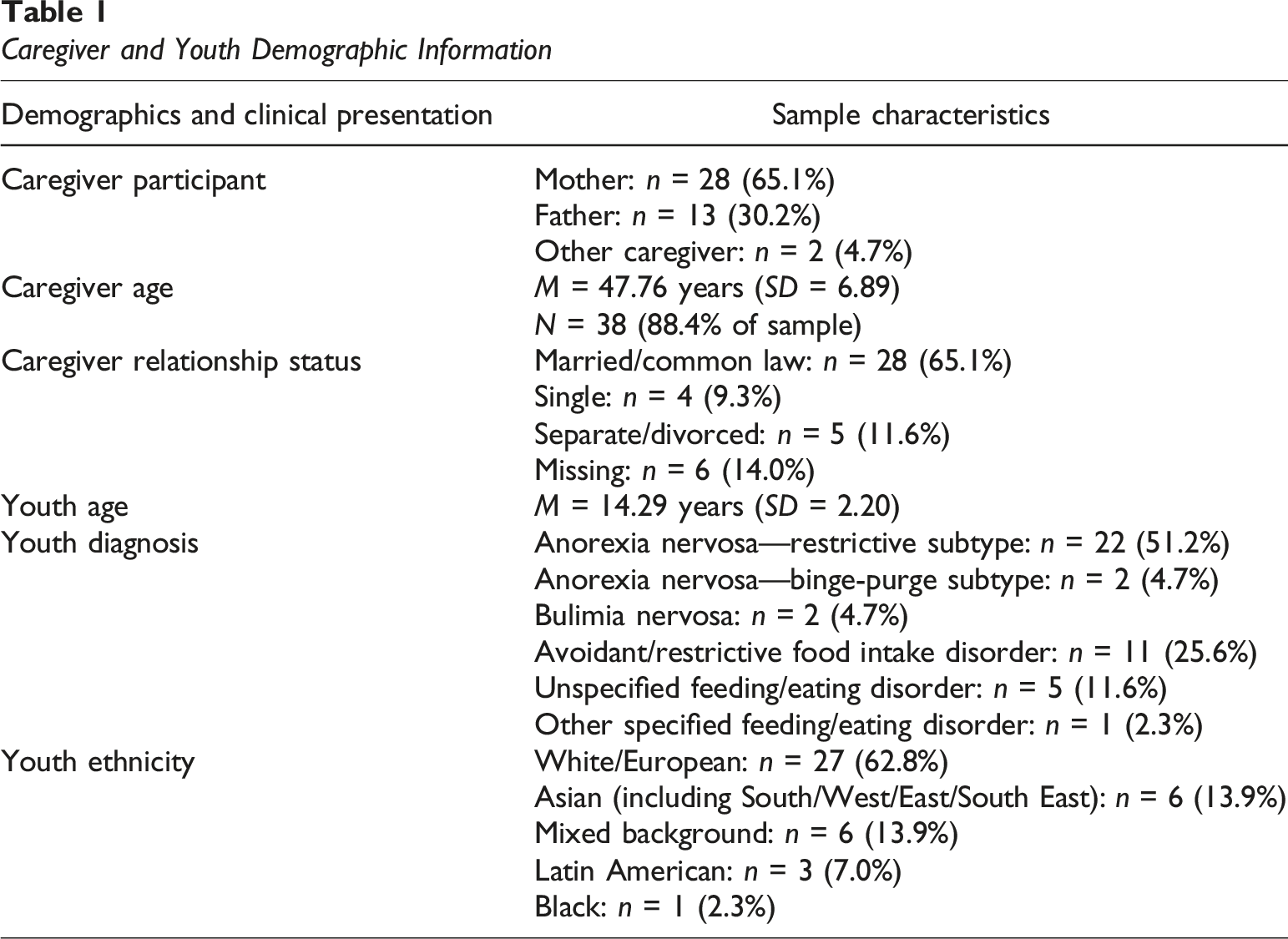
The treatment streams that youth and their families were engaged in program start included outpatient treatment (44.2%; n = 19), inpatient treatment (37.2%; n = 16), and day treatment (18.6%; n = 8). There were no associations between youth gender and their treatment stream, χ2(2, 39) = 1.56, p = .46, or primary diagnosis, χ2(5, 39) = 4.66, p = .46. There were 20 caregivers of cisgender girls, 18 of cisgender boys, and five of trans youths (three transgender males, one transgender female, and one youth identifying as genderqueer). A total of 32 families (74% of sample) completed measures at both admission and discharge.
Procedure
Caregivers provided written consent, while youths under the age of 19 years provided written assent. Caregivers were invited to complete measures at their child’s start of treatment in the program and at discharge. All participants received treatment in a specialized, hospital-based eating disorders program. Details about the services provided in our program are previously published (Coelho et al., 2018). As a provincial program, the goals of treatment are to reduce eating disorder symptoms and improve physical well-being. The majority of youth who participate in the program continue with community-based services for eating disorders at discharge. Measures were provided on paper, or through Research Electronic Data Capture (Harris et al., 2009) housed at the British Columbia Children’s Hospital Research Institute. Each family was provided with a $10 gift card for each time point completed. The study was reviewed and approved by the University of British Columbia/Children’s and Women’s Health Centre of British Columbia Research Ethics Board (H15-01742).
Measures
Accommodation and Enabling Scale for Eating Disorders (AESED; Sepulveda et al., 2009)
The AESED is a 33-item self-report scale that is used to assess caregiver accommodation and enabling of child eating disorder symptoms (e.g., modifying routines). Total scores range from 0 to 132, with higher scores indicating more accommodation behaviors. In this study, the AESED showed excellent internal consistency (α = .93).
Parent Versus Anorexia (PvA; Rhodes et al., 2005)
The PvA scale is a seven-item scale used to measure caregiver self-efficacy regarding their child’s eating disorder treatment (e.g., ability to take charge). Scores range from 7 to 35, with higher scores indicating higher self-efficacy. The questionnaire was modified to replace the term “anorexia” with “eating disorder.” The scale had adequate internal consistency in this study (α = .65).
Data Analysis
AESED and PvA scores were normally distributed. Scores were calculated if <10% of items were missing, with missing data accounted for by averaging available values. We conducted non-parametric tests (Kruskal–Wallis) to identify differences in AESED and PvA scores between caregivers at baseline, assessing differences between three caregiver groups based on their child’s gender (caregivers of cisgender boys, cisgender girls, and trans youth). Non-parametric tests were used given the very small sample size of caregivers of trans youth and unequal sample sizes across groups. Sample sizes differed between the two scales due to missing baseline AESED data for a caregiver of a boy (n = 42 for AESED and n = 43 for PvA scales).
A secondary goal of the study was to examine treatment-related changes. We conducted a repeated measures analysis of variance (ANOVA) with no between-subject factors, including data from all caregivers to examine changes in caregiver accommodation and self-efficacy over the course of treatment. We also examined group differences across caregivers. However, due to a very small sample of caregivers of trans youths (follow-up data was available for three caregivers), only data from caregivers of cisgender boys and girls were included in analysis of group-specific outcomes. Given the approximately equal sample size across the two groups, and the normal distribution of data, our data met the assumptions for repeated measures ANOVA.
Results
Baseline Assessment
Group differences emerged for AESED scores, H(2) = 6.41, p = .041. Caregivers of cisgender girls reported more accommodation and enabling of eating disorder symptoms (M = 57.40, SD = 22.18) than did caregivers of cisgender boys (M = 40.21, SD = 23.14; U = 98, p = .027, r = .36). Scores of caregivers of trans youths (M = 37.53, SD = 7.10) did not meet the threshold for significant differences between either cisgender girl (U = 19, p = .053, r = .40) or boy (U = 46, p = .92, r = .02) caregiver groups. No differences emerged for caregiver scores on the PvA scale based on youth gender, H(2) = 1.49, p = .48 (caregivers of girls: M = 15.61, SD = 3.43; boys: M = 16.35, SD = 4.18; trans youths: M = 14.00, SD = 4.53).
Treatment-Related Changes
Repeated measures ANOVA demonstrated a significant decrease in AESED scores of caregivers, F(1, 30) = 10.35, p = .003, η2p = .26. When examining group differences between caregivers of cisgender boys (n = 14) and girls (n = 15), there was a significant effect of time for this subgroup, F(1, 26) = 12.91, p < .001, η2p = .33), but the interaction between time and gender was not significant, F(1, 26) = 0.75, p = .39, η2p = .03.
PvA scores for the full sample increased over treatment, F(1, 31) = 5.53, p = .025, η2p = .15. When examining the subgroup of caregivers of cisgender boys (n = 14) and girls (n = 15), there were significant increases in PvA scores over treatment, F(1, 27) = 10.28, p = .003, η2p = .28, and a significant interaction between time and youth gender, F(1, 27) = 5.32, p = .029, η2p = .17. Paired t tests demonstrated that caregivers of cisgender girls reported increased self-efficacy from treatment start to discharge, t(14) = 4.91, p < .001, d = 1.27, whereas there was no significant change for caregivers of cisgender boys, t(13) = 0.54, p = .60, d = 0.14. Figures depicting treatment-related changes are in the online supplemental materials.
Discussion
At baseline, caregivers of cisgender girls reported more accommodation behaviors of eating disorder symptoms than did caregivers of cisgender boys. No group differences emerged for baseline caregiver self-efficacy. In the full sample of caregivers, a decrease in accommodation of eating disorder symptoms, and an increase in self-efficacy was observed. These results are consistent with past research demonstrating increased self-efficacy (Byrne et al., 2015) and decreased accommodating behaviors of parents of primarily female youths posttreatment (Wagner et al., 2020).
However, our preliminary results suggest a differential treatment response in caregivers of cisgender girls and boys. Caregivers of cisgender girls reported increased self-efficacy over treatment, whereas self-efficacy did not change significantly for caregivers of cisgender boys. This finding suggests that interventions for pediatric eating disorders may favor the development of self-efficacy in caregivers of girls more than in boys. It is not clear what is driving this difference, but suggests the utility of employing measurement-based care to assess changes in self-efficacy, given the importance of this factor in youth treatment outcomes (e.g., Robinson et al., 2013). To further explore these preliminary differences, a robust measure of caregiver self-efficacy is needed, given concerns about the psychometric properties and appropriateness of the Parent versus Anorexia scale as a measure of caregiver self-efficacy (Jones et al., 2023).
The differential accommodation of eating disorder symptoms of cisgender boys and girls is unlikely to be driven by youth symptom differences, as cisgender youths recruited as part of the current prospective study did not demonstrate differences in baseline eating disorder symptoms (Coelho, Suen, Marshall, Burns, Geller, & Lam, 2021). The difference in accommodation based on child gender has not been demonstrated with other mental health concerns—for example, no significant differences in accommodations based on child gender are reported with measures of family accommodation of obsessive-compulsive disorder (Flessner et al., 2011). The differences in accommodation based on child gender may be driven by challenges with items on the scale that are not gender neutral—including questions about reassurance seeking about getting or looking fat (Sepulveda et al., 2009). Further exploration of the psychometric properties of the AESED across genders is necessary, to guide whether adaptations are needed to be gender-neutral. This may include prompts that highlight drive for muscularity, which is not captured in many of the established measures of eating disorder symptoms (Murray et al., 2017). Additionally, it would be helpful to explore potential gender differences in maintaining mechanisms for eating disorders across youth gender that may account for differences in parental accommodation behaviors.
One of the key strengths of this study was the purposeful recruitment of caregivers of cisgender boys and trans youths. However, a small sample size, limited numbers of matched child–parent participants, and attrition in participation from baseline to discharge measurement precluded the ability to examine the directionality of parent factors and youth eating pathology. A further limitation is the small sample of caregivers of trans youth. Future research examining interdependence between caregiver and youth factors across youth genders would inform the impact of changes in caregiver cognitions and behavior on youth recovery. Interventions for caregivers lead to symptom improvement in individuals with eating disorders (Hannah et al., 2021). Further understanding of the mechanisms by which improvements in caregiver factors improve child outcomes, and whether these improvements are consistent across transdiagnostic eating disorder diagnoses, will inform treatment development.
Given the preliminary indications of differential baseline accommodation behaviors across caregivers of cisgender youths, and a lack of increase in self-efficacy of caregivers of boys, clinicians may need to consider adaptations to caregiver interventions to include gender-specific considerations. Parents of boys have shared that gender contributed to delays in identifying their child’s eating disorder (Coelho, Suen, Marshall, Burns, Lam, & Geller, 2021), suggesting the potential need to address guilt arising in caregivers of boys. Given the small sample size of caregivers of trans youths, there are limitations in developing the clinical implications for caregivers of this group. Although no significant differences between caregivers of trans and cisgender youth emerged, the high levels of eating disorder symptoms reported in trans youth (Coelho, Suen, Marshall, Burns, Geller, & Lam, 2021) suggest the importance of appropriate supports for this population that is at particular risk. Gender-affirming clinical care for trans youth with eating disorders is recommended, in which youth have access to concurrent treatment of gender distress and eating disorders, and caregivers are offered options to access care around how to support their child’s gender experience (Geilhufe et al., 2021).
Supplemental Material
Supplemental Material - Self-Efficacy and Accommodation Behaviors in Caregivers of Youths With Eating Disorders
Supplemental Material for Self-Efficacy and Accommodation Behaviors in Caregivers of Youths With Eating Disorders by Lara K. Radovic, Janet Suen, Sheila K. Marshall, Pei-Yoong Lam, Josie Geller, and Jennifer S. Coelho in Clinical Practice in Pediatric Psychology
Footnotes
Acknowledgments
This study was supported by a grant from the Swiss Anorexia Nervosa Foundation (Grant 40-14). Lara K. Radovic received support from the Glenda MacQueen Summer Studentship Award from the BC Children’s Hospital Foundation and Research Institute. Jennifer S. Coelho was also supported by a Health Professional-Investigator Award from the Michael Smith Foundation for Health Research (Award HPI-2020-0710). The funding agencies had no role in the design of the study, collection, analysis, or interpretation and publication of data. We thank Alex Burns, Avarna Fernandes, Priscilla Karnabi, and MacKenzie Robertson for their assistance with data collection, and Tanya Pardiwala for assistance with data processing. The authors have no conflicts of interest to declare.

Supplemental Material
Supplemental material for this article is available online.
Note
References
Supplementary Material
Please find the following supplemental material available below.
For Open Access articles published under a Creative Commons License, all supplemental material carries the same license as the article it is associated with.
For non-Open Access articles published, all supplemental material carries a non-exclusive license, and permission requests for re-use of supplemental material or any part of supplemental material shall be sent directly to the copyright owner as specified in the copyright notice associated with the article.
