




Abstract
In 2023, the incoming editors of the Journal of Pediatric Psychology (JPP) and Clinical Practice in Pediatric Psychology (CPPP), Avani C. Modi and Christina L. Duncan, respectively, both identified enhancing reporting practices for diversity, equity, and inclusion (DEI) in pediatric psychology as a top priority (Duncan, 2023; Modi, 2023). These efforts build upon a 2021 JPP editorial led by Tonya Palermo and a team of associate/assistant editors declaring a public commitment to being an antiracist journal and providing guidance for reporting on race and ethnicity in JPP articles (Palermo et al., 2021). The rationale for these efforts stems from the likelihood that (a) terminology used in previous articles published in our journals resulted in harm to people with marginalized identities; (b) past research lacks generalizability of results because study samples lacked representativeness; and (c) past articles published in our journals likely perpetuated white supremacy culture by using white culture as the norm and comparing other cultures/identities to the white norm. Moreover, our current efforts strive to address a broader set of diversity dimensions, using the ADDRESSING Framework (Hays, 2016) as guidance, with the goal of enhancing the rigor and inclusiveness of pediatric psychology science. Thus, the editors convened a working group of current and past JPP and CPPP associate editors and editorial board members, as well as DEI content experts. The aims were to generate consistent reporting guidelines for diversity dimensions across the journals and to inform best practices for future research in pediatric psychology. The working group found many detailed, existing checklists and guidelines on inclusive language and transparent reporting relating to DEI (American Psychological Association, 2023b; Buchanan et al., 2021; Letzen et al., 2022; Matsui et al., 2020; Miller et al., 2019; Williford, Sweenie, et al., 2023). However, no comprehensive guidelines were available that captured the specific context of pediatric psychology (e.g., developmental/family considerations), while also being broadly applicable across the field (e.g., not focused on a specific condition or symptom).
Diversity Dimensions Checklist
Note. MENA = Middle East and Northern Africa; NIH = National Institutes of Health; MENA = Middle East and Northern Africa; SES = socioeconomic status; LGBT = Lesbian, Gay, Bisexual, & Transgender; LGBTQ = Lesbian, Gay, Bisexual, Transgender, & Queer; LGBTQ+ = Lesbian, Gay, Bisexual, Transgender, Queer, & all the sexual orientations and gender identities that letters and words cannot fully capture; LGBTQIA = Lesbian, Gay, Bisexual, Transgender, Queer, Intersex, & Asexual; TSLGBTQIA+ & 2SLGBTQIA+ = Two-spirit, Lesbian, Gay, Bisexual, Transgender, Queer, Intersex, Asexual & all the sexual orientations and gender identities that letters and words cannot fully capture. See the online article for the color version of this table.
Application of Diversity Dimensions Checklist in Study Design and Manuscript Preparation
Note. We have organized these considerations by article type to minimize repetition and maximize readability. As many of these considerations are applicable across multiple article types, we encourage readers to consider how each may be applied most broadly when designing studies and preparing manuscripts. REAL = race, ethnicity, and language; DEI = diversity, equity, and inclusion; QALY = quality-adjusted life years; JPP = Journal of Pediatric Psychology.
a This article type is not published in the JPP; however, please note, these research topic areas are encouraged in JPP via other article types.
For authors, we recognize that assessing and reporting across a range of diversity dimensions is an evolving process, and existing data will be in different places on the continuum of optimal practices. Thus, these guidelines may be applied differently based on current phases of research and practice and are based on the researcher’s available sources of data. For authors working with existing datasets or medical record systems, we ask for transparent descriptions of data collection methods, even if those methods do not adhere to these guidelines. The authors should discuss the implications of those methods and make specific suggestions for future work that align with these guidelines. For those planning future work, we encourage consulting these guidelines during planning, implementation, analysis, interpretation, and dissemination stages. Nevertheless, we acknowledge that researchers may not develop their methodology in response to a specific journal’s guidelines and may need to follow the guidelines of a funding agency, for example. Finally, we acknowledge that DEI encompasses a broad range of constructs and that these guidelines are neither exhaustive nor applicable to all situations. We encourage authors to thoughtfully reflect on aspects of the guidelines that are pertinent to their own work, include additional relevant constructs, and exclude those that do not apply, as appropriate.
Authors’ Positionality Statement
At the time of this article submission, the authors provided self-reported information regarding their personal diversity dimensions to inform this positionality statement. We are individuals representing Generation X and the Millennial Generations. Ninety percent of us are able-bodied. We represent various religious and spiritual orientations, including Agnostic, Atheist, Christian, Jewish, and Secular (i.e., nothing in particular). Our racial/ethnic identities include Asian (Far East and South), Black (African American, African, and Afro-Caribbean), White-Non-Hispanic, and White-Acadian. Our backgrounds include coming from the United States, India, Nigeria, and European countries (e.g., England, France, Germany, Greece, Ireland, Italy, Lithuania, Russia, and Scotland). Approximately one-fourth of us speak more than one language. During childhood, our socioeconomic backgrounds varied from lower to middle-upper class while it currently represents middle to upper class (subjectively rated). Approximately 16% of us are first-generation college students. Our sexual orientations include bisexual, heterosexual, and pansexual, with some of us preferring not to answer. Most of us identify as women (90%) and 10% identify as men.
As pediatric and developmental psychologists, we work at the intersection of multiple fields and are expected to keep abreast of standards in psychology and medical disciplines. With our expertise and respective roles, it is our responsibility to promote the highest standards of inclusive language and transparent reporting in our multidisciplinary teams and publications, even beyond JPP and CPPP. It is equally incumbent on us to humbly acknowledge the limitations of our knowledge, be transparent about our frame of reference, and recognize the expertise of people and communities with lived experience of the conditions and disparities we aim to understand and address in our research.
Process in Developing the Diversity Dimensions Checklist
A subset of coauthors created this checklist to guide pediatric psychology science and writing. The ADDRESSING framework is a model that recognizes the complexities of individual identity (Hays, 2016). This framework guided the concepts and areas of foci for the checklist (i.e., age and generation, developmental disability/acquired disability, religion, ethnicity/race, socioeconomic status, sexual orientation, indigenous group, national origin/language, and gender; see Figure 1). Two individuals conducted literature searches and contacted experts in the field to identify best practices for assessment and reporting on each aspect of the ADDRESSING framework. The JPP/CPPP editorial teams provided further feedback and modifications on the initial checklist. The modified checklist was then shared on the American Psychological Association (APA) Society of Pediatric Psychology (Division 54) listserv for open feedback from members. Membership feedback included questions about how the exhaustive checklist would be used by the journals, the need to incorporate international perspectives, the need to consider checklist items when developing science and not solely during the dissemination phase and the need for additional categories beyond the ADDRESSING framework in the future. We incorporated feedback from membership and sent the revised diversity dimensions checklist to an international SPP member (i.e., European–Spain) for further feedback with a lens toward ensuring the checklist was not U.S.-centric. From this additional feedback, the diversity dimensions checklist was finalized for this editorial (Table 1). Note. Adapted from Addressing Cultural Complexities in Practice: Assessment Diagnosis, and Therapy (3rd ed.) by P. Hays, 2016, American Psychological Association (https://dx.doi.org/10.1037/14801-001). Copyright 2016 by the American Psychological Association.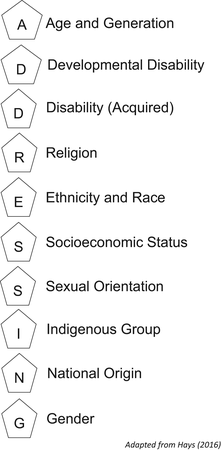
Suggestions for How the Diversity Dimensions Checklist Can Inform Research Best Practices
The Diversity Dimensions Checklist is applicable along the continuum or stages of research—for example, research planning, data collection (in research, routine clinical practice, and electronic medical records), analysis and interpretation, dissemination, and critiquing or peer review, as well as for training and mentorship practices. In terms of planning or preparing for research, the checklist could encourage new directions that incorporate one or more DEI elements described in the checklist and thereby influence the selection of populations to enroll. For example, an author whose field has historically focused on families with high incomes may commit to making active efforts to recruit children and families from a wide range of socioeconomic levels and consider ways to reduce the impact of socioeconomic disparities, such as access to medical care, on recruitment and, ultimately, generalizability of findings (i.e., external validity). By increasing the diversity of the study sample, the research will better represent a broader range of experiences that a particular (health) population may have. In addition, participatory action research (Baum et al., 2006) is a framework of enquiry that improves science through the structured collaboration between researchers and those having lived experience with the physical and/or mental health condition(s) of interest. Finally, being more inclusive in our participants for devising or adapting interventions and testing their feasibility, acceptability, and efficacy should ultimately improve our clinical practice. Overall, these efforts may enhance our field’s ability to avoid missing or obscuring certain experiences due to homogenous, biased samples.
We intend for the Diversity Dimensions Checklist to prompt authors to use or create measures that capture important DEI-related characteristics of their population. Researchers can work in partnership with community members to develop demographic surveys, ensuring that the questions use appropriate, understandable language and terminology. Accordingly, the checklist could also inform data collection for research, such as decisions about how and when to administer certain measures and/or create new ones. For instance, if data are collected in the context of clinical care where these DEI variables are not usually obtained, a demographic survey could be incorporated into her routine measures administered for clinical purposes, such as an intake form or ongoing symptom assessment.
When collecting data on DEI-related dimensions, it is important to assess intersectionality to facilitate nuanced insights into the complexity of participants’ lived experiences. We also want to acknowledge that such a comprehensive goal is one that can be tackled as a team via research partnerships—for example, through a participatory action research approach, as described above. However, constraints may exist—such as resources, time, or geographical restrictions (e.g., a graduate student collecting dissertation data may have limited resources to be able to pursue in-person recruitment; insufficient funding may prevent a researcher recruiting from multiple geographic areas that could have enhanced the diversity of the sample). Despite these constraints, the Diversity Dimensions Checklist can facilitate a team’s awareness as to what DEI data they have represented in their sample and why certain DEI-related dimensions are critical to best understand the population of interest. For example, authors should be attuned to the characteristics of samples on which questionnaires were developed and validated, which may not represent the participants being recruited (American Psychological Association, 2023b). Although constraints can occur, our aspiration should be to overcome them to engage in the best practices possible.
In terms of analysis and interpretation, authors can use the Diversity Dimensions Checklist as a resource in their process of defining and describing groups included in their research (e.g., on different diversity dimensions, as suggested by APA Journal Article Reporting Standards [JARS]), move beyond group comparison analyses, and when possible, take an intersectional approach. With respect to group comparisons, for example, authors should use a DEI-informed perspective to choose which comparisons to make based on the representation of individuals enrolled, rather than grouping different participants together simply to attain adequate cell sizes or frame one group as “normative” (e.g., t test comparing White participants to Black participants, instead of a single comparison of White participants to all participants of color). Of note, this may result in some individuals (e.g., due to small sample size) being excluded from some analyses; detailed reporting of sample size for each analysis will therefore be necessary. When collapsing across groups, researchers should provide a clear rationale, describe specifically what was done, and address the limitations and implications of the decision for interpreting results. Similarly, the potential impact of the research setting, measures or variables targeted, and other factors should be carefully considered in the context of sample characteristics when interpreting study results. Interpretation should also take into consideration the historical and systemic context of diversity dimensions and explicitly name sources of oppression and harm when describing existing disparities in a population; that is, the use of systems-centered language (O’Reilly, 2020) is strongly recommended.
The Diversity Dimensions Checklist has relevance for the dissemination and critique of research (e.g., conference presentations, manuscript reviews, and grant reviews). Rather than simply noting sample homogeneity as a study limitation, it is critical that authors discuss the potential impact on study results when the sample lacks diversity. Likewise, when gathering retrospective data in a clinical setting, authors are encouraged to consider what changes could be made to the protocol to obtain key demographic characteristics to appropriately describe their sample. If unable to find a feasible solution, the authors should acknowledge why the data could not be collected and why it is important to fully describe the population in subsequent work. When discussing DEI-related future directions in research, authors can avoid more general statements such as “future research should…” and instead state specific, improved practices that their team commits to making as it pertains to measuring diversity of identities and addressing diversity dimensions. Another important aspect of dissemination is sharing research findings with the community that contributed to the design and/or participated in the research. This community-first approach expresses appreciation to the community, demonstrates the impact of their involvement, helps empower community members to understand their needs and address them, and builds relationships that may encourage future research collaborations (Crosby et al., 2023; Hines et al., 2011; Williford, McTate, et al., 2023). Further, the Diversity Dimensions Checklist can serve as a guide for evaluating diversity dimensions when engaging in peer review of journal articles, grant proposals, and other scholarly products.
Finally, the Diversity Dimensions Checklist has utility in training and mentoring undergraduate and graduate students, postbaccalaureate trainees, doctoral interns, and postdoctoral fellows in the field of pediatric psychology. Course instructors can use the checklist to discuss articles used in formal classroom and less formal guest lectures or presentations. Research labs can review and discuss this checklist regularly to identify action steps to improve DEI-related practices, as described above. Such practices can create a culture within the classroom and lab environment that prioritizes ongoing cultural humility and DEI in the research context, models transparency and rigor in reporting, and improves research and clinical practices. Such steps are critical to fostering a broader culture shift in the field of pediatric psychology.
Future Directions
Using the Diversity Dimensions Checklist is a necessary step for the field of pediatric psychology to work toward a more inclusive and representative science and increase awareness of the ways in which our field has contributed to the harms against diverse, minoritized, and marginalized groups (American Psychological Association, 2021a). Using this evolving Diversity Dimensions Checklist to embed DEI principles may help cement them as a sustained part of the research culture and facilitate equity and inclusion in data collection, analysis, interpretation, and dissemination. However, language constantly adapts and changes; some words take on different meanings and new words are introduced. Collective terminology or group labels are often context-dependent, and formerly neutral or favored terms can become derogatory or offensive. Therefore, we conceptualize the Diversity Dimensions Checklist as a “living document” that will need to be edited and updated. We commit to revisiting and updating the Diversity Dimensions Checklist yearly and solicit feedback from the larger community of youth, caregivers, students, psychologists, and communities we serve.
The creation of a Diversity Dimensions Checklist is only one part of the larger transformation needed in our science and practice. However, several DEI characteristics remain infrequently reported, indicating the critical need for such resources in our research community. For example, most recent research published in high-impact medical journals do not report ethnicity or socioeconomic status, and authors rarely discuss this omission as a limitation (Buttery et al., 2022). Further, there is evidence that grant funder reporting requirements (e.g., for ethnicity or sex assigned at birth) can make real-world improvements to the representativeness and reporting of clinical trials. For instance, since the publication of the National Institutes of Health (NIH) mandated reporting standards for specific demographic characteristics, ethnic-minoritized groups have been overrepresented in pediatric clinical trials compared to the general U.S. population, demonstrating that enhanced guidelines can contribute to improved demographic representation (Lee et al., 2023).
Although we do not view this proposed Diversity Dimensions Checklist as a mandate for how research is planned, implemented, and reported, we hope it is a resource that helps shift how this field conducts and reports research in relation to DEI and drives change toward equitable healthcare delivery. Taking systematic action to improve consideration of DEI in our research, via employing strategies like the Diversity Dimensions Checklist, is necessary to push equity from aspirational to standard research practice. It is also possible that by using the Diversity Dimensions Checklist and transparent reporting on these issues, the pediatric psychology research community can inform new mandates for grant funders by demonstrating utility. The Society for Pediatric Psychology might assist in these goals through our special interest groups highlighting the distinct needs of their pediatric populations, or the JPP student journal club might discuss articles that demonstrate best practices. Our journals also welcome submissions relevant to using the Diversity Dimensions Checklist to keep the conversation going, share experiences and advice, and advance equitable change.