






Abstract
This study investigated age differences in false memory for visual scenes and the effect of immediate recall on subsequent recognition. Eighty children (7–9 years), 74 adolescents (14–16 years), 92 young adults (19–26 years) and 82 older adults (50–80 years) studied four visual scenes and then took a recognition test after either a free-recall task or a filler task. Results showed an age-related decline in false recognition for visual scenes, but this trend was eliminated when participants were asked to free-recall before recognition. Prior recall decreased false recognition in children, but increased false recognition in older adults. Across the lifespan, adolescents had the loosest criterion, children had the lowest false recall, and prior recall increased true recognition in older adults.
False memory refers to the phenomenon that people recall or recognize things that did not actually happen (Brainerd & Reyna, 2005). There is suggestive false memory (due to exogenous misinformation) and spontaneous false memory (due to endogenous memory distortion; Brainerd & Poole, 1997). The misinformation paradigm creates suggestive false memory by altering the memory of a witnessed event after exposure to certain post-event misinformation narrations (Loftus, 2005). Misinformation/suggestive false memory decreases from early childhood to late childhood (Ceci & Bruck, 1993), and from adolescence to young adulthood (McGuire, London, & Wright, 2015), but it increases from young adulthood to older adulthood (Roediger & Geraci, 2007). In addition, prior cued-recall of the witnessed event has been shown to increase susceptibility to misinformation in both young adults and older adults (Chan, Thomas, & Bulevich, 2009).
Several paradigms have been used to study spontaneous false memory. The Deese-Roediger-McDermott (DRM) paradigm creates spontaneous false memory by asking participants to study lists of related words, which would lead to false memory of unstudied but semantically related lures (Roediger & McDermott, 1995). In addition to the DRM paradigm, Miller and Gazzaniga (1998) developed a paradigm for measuring spontaneous false memory for visual scenes. In this paradigm, research participants are shown several pictures with thematic scenes (e.g., a beach scene) that include many thematically related items (e.g., a swim ring) but also purposely exclude a few thematically related lures (e.g., beach balls; Miller & Gazzaniga, 1998). These lures are used to assess the extent of false recognition for visual scenes. For example, even though no beach ball is presented in the beach scene, participants are likely to have false recognition of a beach ball because it fits the beach theme. This paradigm has been adapted by Moritz and his collaborators to measure false recognition for visual scenes in various samples, including children and patients with schizophrenia, borderline or post-traumatic stress disorder (Jelinek, Hottenrott, Randjbar, Peters, & Moritz, 2009; Moritz, Woodward, & Rodriguez-Raecke, 2006; Otgaar, Howe, Peters, Smeets, & Moritz, 2014; Schilling, Wingenfeld, Spitzer, Nagel, & Moritz, 2013). The current study used the visual scenes paradigm to examine age differences in spontaneous false memory and the effect of prior recall on false recognition.
Age differences in spontaneous false memory
Using the DRM paradigm, researchers have found that false memory for words increases from childhood to adolescence and young adulthood (Balota et al., 1999; Brainerd, Reyna, & Zember, 2011; Howe, 2005) and then remains stable from young adulthood to older adulthood (Gallo, 2006). Thus far, only one study has used the visual scenes paradigm to study age differences in false recognition. Otgaar et al. (2014) found that 7- to 8-year-old children and 11- to 12-year-old children had higher rates of false recognition for visual scenes than did young adults, which was opposite to the pattern based on the DRM paradigm.
Moreover, when DRM stimuli were embedded in story contexts, developmental differences were attenuated, although 6- or 7-year-old children still had lower false recognition than 10- or 11-year-old children (Howe & Wilkinson, 2011; Swannell & Dewhurst, 2013). In contrast, Dewhurst, Pursglove, and Lewis (2007) reported earlier that 5-year-olds actually had higher false recognition than older children when the DRM stimuli were embedded in stories, although the former had lower false recognition than the latter in the standard DRM test. Finally, using detailed colored pictures of objects as stimuli (e.g., boats), Koutstaal and Schacter (1997) found that older adults had higher false recognition for unstudied lures from previously studied categories than did young adults.
The discrepancies in these results can be explained by fuzzy-trace theory (FTT). First, according to FTT, verbatim memory (i.e., memory about specific details) and gist memory (i.e., memory about the underlying meaning) both improve between childhood and young adulthood, but after that and into old adulthood, verbatim memory declines whereas gist memory stays about the same (Brainerd & Reyna, 2015; McGuire et al., 2015). Second, verbatim traces support true memory and suppress false memory, whereas gist traces support both true and false memories (Brainerd et al., 2011). Third, age-related changes in false recognition depend on the type of false memory tasks used, because different tasks rely on verbatim and gist memory to different extents (Holliday, Brainerd, & Reyna, 2011). False memory increases with age if a specific task focuses more on gist than on verbatim memory, but false memory decreases with age if a specific task focuses more on verbatim than on gist memory. For example, the standard DRM false recognition task leads participants to focus more on gist memory, but children are less likely to extract the gist representation than adults; thus, children are less susceptible to false memories that result in DRM false recognition increases from childhood to young adulthood (Otgaar et al., 2014), while it remains stable from young adulthood to old adulthood (Gallo, 2006). Compared with the standard DRM task, when the DRM stimuli are embedded in stories, the theme representation was more likely to be activated for younger children than older children, and it may attenuate age differences in false recognition (Howe & Wilkinson, 2011). However, the visual scenes false recognition task may lead participants to focus more on verbatim memory, so false recognition for visual scenes may decrease from children to young adults. Both young and older adults have the ability to use the verbatim trace to suppress false recognition, especially when there is no prior recall before recognitions in DRM task (Schacter, Israel, & Racine, 1999; Thomas & Sommers, 2005). Moreover, as suggested by the study of Schacter et al. (1999), increased focus on distinctive properties of items during the study would be especially helpful to older adults, which reasoned that there were no significant age differences in false recognition in picture encoding condition. Consistently, Gallo et al. (2007) also found that young and older adults had similar levels of false recognitions using pictures as study materials. Thus, false recognition for visual scenes may remain stable from young adults to older adults.
To examine the lifespan development of false recognition of visual scenes, this study included four age groups: children, adolescents, young adults and older adults. We hypothesized that the false recognition of visual scenes declines from children to young adults, while it remains stable from young adults to older adults (Hypothesis 1).
Age differences in the effect of prior recall on subsequent false recognition
Not only is age an important factor in false memory for visual scenes, it may also be an important factor in the potential influence of a prior recall attempt on subsequent recognition. Although no study has examined age differences in the effect of immediate recall on subsequent false recognition for visual scenes, some previous studies have examined this question using the DRM paradigm. Roediger and McDermott (1995) first reported that prior recall increased DRM false recognition in young adults, relative to a no-recall condition (i.e., a filler task after studying each word list). Several subsequent studies confirmed this finding in both young and older adults (Brainerd, Yang, Reyna, Howe, & Mills, 2008; Gallo, McDermott, Percer, & Roediger, 2001; Intons-Peterson, Rocchi, West, McLellan, & Hackney, 1999; Payne, Elie, Blackwell, & Neuschatz, 1996), although a few other studies reported that prior recall had no effect on DRM false recognition (Gallo, 2006; Norman & Schacter, 1997; Roediger, McDermott, Pisoni, & Gallo, 2004). This effect of prior recall has been replicated for 5- and 6-year-old children, but the results have been inconsistent for 8- and 11-year-olds. Specifically, Brainerd, Reyna, and Forrest (2002) found that prior recall increased DRM false recognition in 5-year-olds, which was replicated in 6-year-olds (Brainerd, Forrest, Karibian, & Reyna, 2006; Howe, Cicchetti, Toth, & Cerrito, 2004). For 8-year-olds, Howe et al. (2004) found that prior recall decreased DRM false recognition. For 11-year-olds, Brainerd et al. (2002) found that prior recall decreased DRM false recognition, but Howe et al. (2004) found the opposite (i.e., prior recall increased DRM recognition), and Brainerd et al. (2006) found no significant effect.
These seemingly inconsistent results from the DRM studies can be explained when a few factors are considered. The first factor is whether the prior recall was true or false. Prior true recall may enhance verbatim memory and hence reduce false recognition, but prior false recall of lures may enhance gist memory and hence increase false recognition. Consequently, the total effect of prior recall on false recognition depends on the balance between true and false recalls. Second, true recall increases from childhood to young adulthood (Brainerd & Reyna, 2001; Brainerd, Reyna, Ceci, & Holliday, 2008), and then decreases from young adulthood to older adulthood (Butler, McDaniel, Dornburg, Price, & Roediger, 2004; Dewhurst & Robinson, 2004), whereas false recall of lures increases from childhood to adulthood (Anastasi & Rhodes, 2008; Dewhurst & Robinson, 2004), and false recall of other intrusions decreases from childhood to adulthood (Brainerd et al., 2002). Finally, most previous studies only reported the false recall of lures, not the total false recall. Potential differences in total false recall across studies might have contributed to the inconsistent results regarding the effect of prior recall on false recognition (Gallo, 2006).
The current study is the first to examine developmental differences in the role of prior recall in false recognition of visual scenes. According to FTT, children are more likely to rely on verbatim memory (Brainerd et al., 2002; Metzger et al., 2008), whereas older adults (i.e., over 50 years old) are more likely to rely on gist memory (Brainerd & Reyna, 2001; Koutstaal & Schacter, 1997; Tun, Wingfield, Rosen, & Blanchard, 1998). Prior recall of the visual scenes would enhance children’s verbatim memory and older adults’ gist memory, which would lead to decreased false recognition in children but increased false recognition in older adults (Hypothesis 2).
Methods
Participants
Participants included 80 children (7- to 9-year-old first graders, M = 7.60, SD = 0.52), 74 adolescents (14- to 16-year-old high school freshmen, M = 15.38, SD = 0.61), 92 young adults (19- to 26-year-old undergraduate and graduate students, M = 21.53, SD = 2.24), and 82 older adults (50- to 80-year-olds from the community, M = 59.01, SD = 8.48, who had 12 years of education on average). All participants were recruited in China, and the study was conducted in Mandarin Chinese. Participants in each age group were randomly assigned to one of two conditions (i.e., immediate free recall prior to recognition or a filler task prior to recognition; see Figure 1). The education level was measured by self-report. There was no age or education difference between the two conditions for each age group, and gender distribution did not differ by age group or condition (p > .05, see Table 1). All participants had normal or corrected-to-normal vision, and were without neurological or psychiatric diseases (based on caregivers’ report for children and adolescents, self-report for young adults, and doctors’ assessment for older adults). Informed consent was obtained from all participants before the study, with caregivers providing consent for the children and adolescents. The study was performed in accordance with the Declaration of Helsinki, and approved by the ethics committee of the authors’ university.
Two experimental conditions (recognition after a free recall or a filler task).
Participants in two experimental conditions

Visual Scenes False Recognition Task
Materials
Materials were adapted from previous studies (Moritz et al., 2006; Otgaar et al., 2014). Study materials were four hand-drawn, black-and-white pictures of the following scenes: beach, funeral, surveillance and classroom. For example, the beach scene included dozens of items, such as the sun, a beach umbrella and a swim ring. The surveillance scene depicts three police officers listening to and recording conversations among suspects next door. For each visual scene (e.g., the beach scene), 12 old items (e.g., “sun”), 8 unpresented but thematically related lures (e.g., “towel”), and 4 unpresented and unrelated foils (e.g., “elephant”) were shown in the recognition test.
Procedure and design
This study was a between-subjects design with age group (children, adolescents, young adults, and older adults) and experimental condition (recognition after a free recall vs. recognition after a filler task) as two independent variables, and performance on the recognition test as a dependent variable. Half of the participants in each age group were assigned to the condition of “recognition after a free recall”, the other half to the “recognition after a filler task” condition (see Figure 1). For both conditions, participants were asked to remember all items that were presented in the four visual scenes. Each scene was presented for 40 seconds with a 1-second interval between two scenes. The corresponding contextual cue (beach, funeral, surveillance and classroom) was presented on the top of each visual scene. During the encoding phase, the presentation order for these four scenes was the same for all participants, that is, beach, funeral, surveillance and classroom. For the “recognition after a free recall” condition, immediately after the presentation of all four visual scenes, participants were asked to recall as many items from each visual scene as possible within 5 minutes. For this free recall test, the corresponding thematic word (e.g., “beach”) was printed on the top of each answer sheet as a cue. For example, an instruction in the recall test is “Please recall what you saw in the beach scene”. Participants did not see any visual objects during the free recall phase. For the “recognition after a filler task” condition, participants took a 5-minute filler task that involved simple arithmetic. Finally, in the recognition test (administered verbally), participants in both conditions were presented with a scene cue (e.g., “beach”) and asked whether they saw a particular item (e.g., “sun”) in the scene. For example, an instruction in the recognition test was “Did you see the sun in the beach scene?” For each scene, the 24 items (12 old items, 8 lures and 4 foils) were presented randomly. Before the recognition test, the experimenter asked the participants to first judge whether they had seen the named item in the original visual scene (i.e., old/new judgment), and then to decide whether they were confident about their judgement (i.e., confidence judgment). For each item, participants chose one of four options, including “old and confident”, “old and not confident”, “new and confident”, and “new and not confident”. No feedback was provided during the experiment. Participants were tested individually in a quiet room at their school, university, and community. Finally, all participants were debriefed afterwards about the purpose of this study.
Indices of memory performance
The recognition test yielded three raw recognition indices: True recognition = number of studied items judged as “old” items (i.e., “old and confident” and “old and not confident”) divided by the total number of items; False recognition = number of lures judged as “old” items divided by the total; Foil recognition = number of foil items judged as “old” divided by the total. Cronbach’s alphas for these three indices were .83, .87 and .75 respectively. In addition, indices based on high-confidence judgment only (i.e., the proportions of “old and confident” responses) were analyzed and the results were similar and hence not reported in this paper but they are available from authors upon request.
In addition, based on signal detection theory, four indices of discrimination abilities (d′) and decision criterion (C) were derived from the raw recognition indices: d′(false recognition) = Z (probability of “old” judgments to lures) – Z (probability of “old” judgments to foils); C(false recognition) = −[Z (probability of “old” judgments to lures) + Z (probability of “old” judgments to foils)]/2; d′(true recognition) = Z (probability of “old” judgments to studied items) – Z (probability of “old” judgments to foils); and C(true recognition) = −[Z (probability of “old” judgments to studied items) + Z (probability of “old” judgments to foils)]/2. Higher d′ scores indicate higher discrimination abilities. Higher C scores indicate stricter decision criterion. Cronbach’s alphas for these four indices ranged from .79 to .89.
Finally, although tangential to this study, we also calculated three indices for the immediate recall test: True recall = the number of recalled true items; False recall = the number of recalled lures; Foil recall = the number of recalled foils. Each answer on the recall test was judged by two independent raters. The interrater reliability (kappa) was 0.95. These p values in post-hoc tests were adjusted using Bonferroni correction.
Results
Recognition
Table 2 shows the means and standard deviations of the indices from the recognition test. Because the foil recognition rates were different between the four age groups, subsequent analyses focused on the results of the d prime statistics.
The means and standard deviations of true and false recognition (the raw data, discrimination abilities [d′], and decision criterion [C]) by age group and experimental condition.

Note: The probabilities of responding “old” to studied items, lures, and foils are referred to the raw data of true, false and foil recognition respectively. d′(false recognition): the ability of discriminating lures from foils. d′(true recognition): the ability of discriminating studied items from foils. Higher d′ score indicates higher discrimination abilities. C(false recognition): the strictness of criteria to judge lures and foils as old. C(true recognition): the strictness of criteria to judge studied items and foils as old. Higher C score indicates stricter decision criterion.
d′(false recognition)
Two-way (age group × condition) analysis of variance (ANOVA) revealed a significant interaction between age group and experimental condition for d′(false recognition), F(3, 320) = 8.89, p < .001, ŋ2 partial = 0.08, 90% CI [0.03, 0.12]. The main effect of age group was also significant, F(3, 320) = 4.45, p < .01, ŋ2 partial = 0.04, 90% CI [0.01, 0.07], but the main effect of condition was not, F(1, 320) = 3.66, p > .05, ŋ2 partial = 0.01, 90% CI [0.00, 0.04]. In the filler task condition (see dashed lines in Fig 2A), post hoc tests showed that children had higher d′(false recognition) than adolescents, young adults, and older adults (ps < .01, Cohen’s d = 1.07, 0.72, and 1.14, 95% CI [0.59, 1.55], 95% CI [0.28, 1.15] and 95% CI [0.66, 1.61], respectively); but there were no differences among adolescents, young adults and older adults (ps > .05). There was no age group difference in the free recall condition (ps > .05).
In terms of the effect of prior recall for each group (see vertical distances between dashed and solid lines in Figure 2A), post hoc tests showed that compared with the filler task condition, prior recall of visual scenes reduced d′(false recognition) in children (p < .001, Cohen’s d = −1.14, 95% CI [−1.61, −0.67]), but increased it in older adults (p < .05, Cohen’s d = 0.44, 95% CI [0.00, 0.88]), and had no effect in adolescents and young adults (ps > .05).
The discrimination ability (d′) of true and false recognition by age group and experimental condition. (A) d′(false recognition): the ability of discriminating lures from foils. (B) d′(true recognition): the ability of discriminating studied items from foils. Indices for false recognition (A) are shown in red, and true recognition (B) are shown in blue. Error bars indicate standard errors.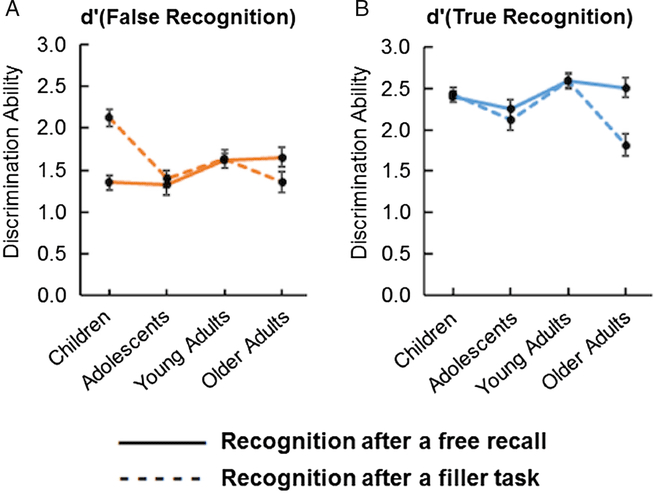
d′(true recognition)
As shown in Figure 2B, there was a significant interaction between age group and experimental condition for d′(true recognition), F(3, 320) = 5.22, p < .01, ŋ2 partial = 0.05, 90% CI [0.01, 0.08]. The main effect of age group was significant, F(3, 320) = 7.74, p < .001, ŋ2 partial = 0.07, 90% CI [0.02, 0.11]. The main effect of experimental condition was also significant, F(1, 320) = 7.28, p < .01, ŋ2 partial = 0.02, 90% CI [0.00, 0.06]. In the filler task condition (see dashed lines in Figure 2B), post hoc tests showed that children and young adults had higher d′(true recognition) than older adults, and young adults had higher d′(true recognition) than adolescents (ps < .01, Cohen’s d = 0.91, 1.15, and 0.69, 95% CI [0.45, 1.37], 95% CI [0.70, 1.60] and 95% CI [0.25, 1.13], respectively), but there was no difference between children and adolescents, between children and young adults, or between adolescents and older adults (ps > .05). There was no age group difference in the free recall condition (ps > .05).
In terms of the effect of prior recall for each age group (see vertical distances between dashed and solid lines in Figure 2B), post hoc tests showed that, compared with the filler task condition, prior recall of visual scenes increased d′(true recognition) in older adult (p < .001, Cohen’s d = 1.04, 95% CI [0.57, 1.50]), but had no effect in children, adolescents, and young adults (ps > .05).
Decision criterion
In terms of decision criterion – that is, C(false recognition) and C(true recognition) – the main effects of age group and condition were both significant (for age group: F(3, 320) = 37.30 and 62.41, ps < .001, ŋ2 partial = 0.26 and 0.37, 90% CI [0.19, 0.32] and 90% CI [0.30, 0.43]; for condition: F(1, 320) = 27.28 and 6.10, ps < .05, ŋ2 partial = 0.08 and 0.02, 90% CI [0.04, 0.13] and 90% CI [0.00, 0.05] respectively, but their interactions were not (ps > = .05). In both conditions, adolescents had the loosest criterion in the prior recall condition for C(false recognition) and C(true recognition): t(75) = −7.65 and −8.36, ps < .001, Cohen’s d = −1.74 and −1.91, 95% CI [−2.27, −1.22] and 95% CI [−2.44, −1.36], t(78) = −3.05 and −3.20, ps < .01, Cohen’s d = −0.68 and −0.72, 95% CI [−1.13, −0.26] and 95% CI [−1.16, −0.29], t(77) = −3.07 and −3.99, ps < .01, Cohen’s d = −0.69 and −0.90, 95% CI [−1.14, −0.26] and 95% CI [−1.36, −0.45] respectively; in the filler task condition for C(false recognition) and C(true recognition): t(75) = −8.54 and −10.74, ps < .001, Cohen’s d = −1.95 and −2.45, 95% CI [−2.49, −1.40] and 95% CI [−3.04, −1.85], t(84) = −4.79 and −4.18, ps < .001, Cohen’s d = −1.04 and −0.91, 95% CI [−1.49, −0.59] and 95% CI [−1.35, −0.47], t(75) = −4.58 and −6.34, ps < .001, Cohen’s d = −1.04 and −1.45, 95% CI [−1.52, −0.58] and 95% CI [−1.94, −0.94] respectively; while children had the strictest criterion; in the prior recall condition for C(false recognition) and C(true recognition): t(75) = 7.65 and 8.36, ps < .001, Cohen’s d = 1.74 and 1.91, 95% CI [1.22, 2.27] and 95% CI [1.36, 2.44], t(81) = 4.90 and 5.72, ps < .001, Cohen’s d = 1.08 and 1.26, 95% CI [0.61, 1.53] and 95% CI [0.78,1.73], t(80) = 4.27 and 4.61, ps < .001, Cohen’s d = 0.94 and 1.02, 95% CI [0.48, 1.40] and 95% CI [0.56,1.48] respectively; in the filler task condition for C(false recognition) and C(true recognition): t(75) = 8.54 and 10.74, ps < .001, Cohen’s d = 1.95 and 2.45, 95% CI [1.40, 2.49] and 95% CI [1.85, 3.04], t(87) = 3.31 and 7.61, ps < .01, Cohen’s d = 0.71 and 1.62, 95% CI [0.27, 1.13] and 95% CI [1.14, 2.10], t(78) = 2.98 and 3.94, ps < .01, Cohen’s d = 0.67 and 0.88, 95% CI [0.21, 1.11] and 95% CI [0.42, 1.34] respectively; but there was no difference between young adults and older adults (ps > 0.05). Compared with the filler task condition, prior recall of visual scenes increased judgement criterion for both true and false recognition, t(326) = 2.07 and 4.48, ps < .05, Cohen’s d = 0.23 and 0.49, 95% CI [0.01, 0.45] and 95% CI [0.27, 0.71] respectively.
Recall
Table 3 shows the means and standard deviations of the three indices of free recall. A univariate ANOVA revealed significant age group differences in true, false and foil recall, F(3,158) = 17.63, 6.04, and 3.84, ps < .05, ŋ2 = 0.25, 0.10, and 0.07, 90% CI [0.15, 0.33], 90% CI [0.03, 0.17] and 90% CI [0.01, 0.13] respectively. Post hoc tests showed that among the four age groups, children had the lowest true recall (20 true items on average), while young adults had the highest true recall (32 true items on average). Children almost had no false recall (0 false item on average), which was significantly lower than the false recall rates for adolescents, young adults, and older adults (about 1 false item on average). Children almost had no foil recall (0 foil item on average), which was significantly lower than the false recall rates for older adults (about 1 foil item on average). Moreover, the prior true recall had a positive correlation with d′(true recognition) in older adults (r (42) = .53, p = .001), but not in other subjects groups (ps > .05). However, there was no significant correlation between true recall and false recognition for subjects in any age group (ps > .05).
The means and standard deviations of three indices in the immediate recall test for participants from four age groups.
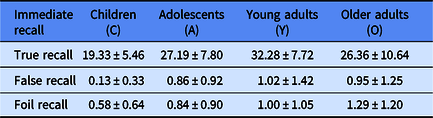
Note: The unit is the number of items recalled.
Discussion
Several main findings of interest emerged from this study. Consistent with our Hypothesis 1, false recognition for visual scenes declined from children to young adults while it remained stable from young adults to older adults. Prior recall, however, eliminated age differences in false recognition because prior recall reduced false recognition in children but it increased false recognition in older adults, in accordance with our Hypothesis 2. Three secondary findings were that across the lifespan, adolescents had the loosest criterion, children had the lowest false recall, and prior recall increased true recognition in older adults. We will discuss these findings in turn.
First, our study replicated and extended the study of Otgaar et al. (2014), who used the same visual scenes as study materials. Both studies found that age (with two age groups in Otgaar et al., 2014, and four age groups in this study) was negatively associated with false recognition (in the filler condition). This finding is in clear contrast with the age-related increase in DRM false recognition (Brainerd et al., 2006). This difference between two paradigms is perhaps due to the fact that children benefit from the usage of easily identified visual scenes with explicit themes (Howe & Wilkinson, 2011; Otgaar, Howe, Peters, Sauerland, & Raymaekers, 2013; Otgaar et al., 2014). In our recognition test, as the previous study of Otgaar et al. (2014) suggested, the explicit themes (e.g., “beach”) probably improved gist memory in children but not in adults, and thus led children to make theme-related errors. Alternatively, this difference may also be due to the fact that different tasks rely on verbatim and gist memory to different extents (Holliday et al., 2011). The current task contained visual scenes that were expected to promote more verbatim encoding than the standard DRM task using words as stimuli. As mentioned earlier, verbatim encoding reduces false memory (Brainerd et al., 2011), so as verbatim memory develops with age (Holliday et al., 2011), false recognition for visual scenes would decrease from children to young adults. After verbatim memory matures at young adulthood, both young and older adults would have the ability to rely on the verbatim encoding to suppress false recognition (Schacter et al., 1999; Thomas & Sommers, 2005), which would explain the finding that false recognition for visual scenes remained stable from young adults to older adults.
Second, when participants were first asked to recall the scenes before recognition (in the free recall condition), age differences in false recognition disappeared. This result was driven by the differential effect of immediate recall in children and older adults. Immediate prior recall reduced children’s false recognition for visual scenes, perhaps because prior recall enhanced children’s reliance on verbatim memory and inhibited their gist memory. In other words, they rejected the related lures because they could directly retrieve specific memory traces as a result of free recall (Odegard, Koen, & Gama, 2008). In contrast, older adults were found to rely more on gist memory than verbatim memory, and immediate recall further enhanced their reliance on gist memory and hence increased their false recognition.
The above, our results are consistent with fuzzy-trace theory (Holliday et al., 2011), which emphasizes developmental differences in verbatim and gist memory. Specifically, young children’s verbatim memory is still developing and hence they are more vulnerable to false recognition; whereas older adults show a greater reliance on gist memory, which can lead to more false recognition after free recall because free recall tends to facilitate meaningful connections between events for older adults.
In addition to the above main findings, three other results are worth discussing. First, across the lifespan, adolescents had the loosest response criterion for both conditions, which may reflect the high impulsivity of 14- to 16-year-old adolescents. Adolescents are prone to risky, impulsive decisions and behaviors (Pechmann, Levine, Loughlin, & Leslie, 2005; Wulfert, Block, Ana, Rodriguez, & Colsman, 2002). For example, adolescents’ low capacity to control response was typically represented by impulsivity (Colder & Stice, 1998). Specifically, the heightened impulsivity observed in adolescence has been partly attributed to the slow development of the brain regions like the prefrontal cortex (PFC) necessary for cognitive control, including response selection, top-down control and inhibitory processes (Blakemore & Robbins, 2012; Pechmann et al., 2005), which may account for their higher impulsive response for foil recognition. Indeed, after controlling for their impulsive response for foil recognition, the d′(false recognition) for adolescents was similar to that of young adults.
Second, unlike false recognition, children had the lowest false recall across the lifespan. There are at least two plausible explanations for this finding. The first explanation is that false recall for visual scenes is likely to rely more on gist memory to generate theme-related lures, but children’s gist memory is poorer than the other age groups. A second related explanation is that young children’s language is still developing so it is harder for them to recall than recognize a thematically related lure (Brainerd & Reyna, 2015).
Third, immediate prior recall increased true recognition in older adults, and the prior true recall was positively correlated to true recognition for older adults; perhaps because prior recall enhanced older adults’ reliance on gist memory. Consistent with previous studies, older adults had lower true recognition than young adults in the filler task condition (Schacter et al., 1999), but they had similar true recognition after recall as young adults (Balota et al., 1999; Kensinger & Schacter, 1999). Previous studies using the standard DRM task using words as encoding and test stimuli found the testing effect (i.e., immediate prior recall increase true recognition) in young adults (Gallo et al., 2001; Roediger & McDermott, 1995), while we only found it in older adults but not in young adults. It might be due to the different modality between study (i.e., pictorial items) and test (i.e., words) used in the current task.
Conclusions and Future Directions
As the first attempt to provide a lifespan pattern of false memory with the same experimental procedure (i.e., visual scenes with easily identified themes), the current study found age-related decline in false recognition, but this trend was eliminated when participants were first asked to free-recall the visual scenes before recognition. These results can be explained by fuzzy-trace theory (Holliday et al., 2011), which emphasizes developmental differences in verbatim and gist memory. In addition to our study’s theoretical contributions, our results should also have significant practical implications for ways to elicit more reliable eyewitness testimony from different age groups (e.g., free recall first for children, but no free recall first for older adults). Our finding that adolescents had the loosest criterion should also help us develop ways to reduce their response bias in eyewitness testimony.
Several limitations of this study need to be addressed in future studies. First, compared to the real-life eyewitness testimony, the delay in our memory test was relatively short and we did not examine the effect of repeated tests. Second, we did not examine semantic proximity between unseen items, which has been found to have age-dependent effects on false memory (Ceci, Papierno, & Kulkofsky, 2007). Third, our older adults had a wide age range, which was justified based on the results of a previous study of false recognition between early and late adulthood (McCabe, Roediger, McDaniel, & Balota, 2009), but it nevertheless remains an open question whether there are specific differences in false memory among older adults of different age ranges. Finally, different age groups may have different degrees of familiarity and sensitivity with these four scenes. Future studies could examine this issue using more visual scenes.
Footnotes
Financial support
This study was supported by the National Natural Science Foundation of China (31571132 and 31971000).