






Abstract
Expressive writing can enhance cognitive processing and improve stress regulation. Particularly, the use of cognitive words (i.e., insightful and causal words) in writing may be associated with the process of meaning making and promotion of post-traumatic growth (PTG). The aim of the present study was to determine how expressive writing and the use of causal and insightful cognitive words influenced meaning making and PTG during writing. In total, 52 traumatized university students were recruited and randomly assigned to one of two writing conditions involving either an expressive writing task or a neutral writing task. The results showed that participants who engaged in expressive (vs. neutral) writing showed higher scores on the presence of meaning and PTG in the post-writing, self-report questionnaires. Moreover, writing task (expressive or neutral) and frequency of causal and insightful cognitive words were both significant predictors of meaning, which in turn led to high levels of PTG. In conclusion, the use of causal and insightful words might be a fundamental cognitive process for developing meaning in writing, which is essential for our further understanding of meaning making and PTG.
Expressive Writing and PTG
People often experience adversity and require coping skills to overcome obstacles and live satisfactory lives. Expressive writing is considered an effective method of managing stress or traumatic events, leading to beneficial cognitive change and more adaptive behavior (Lepore, Greenberg, Bruno, & Smyth, 2002). In particular, expressive writing has been thought to construct coherent narratives using the writing process (Klein & Boals, 2010; Pennebaker, 2000), which involves the written disclosure of thoughts and feelings regarding traumatic events, thereby enhancing cognitive processing and improving stress regulation (King & Miner, 2000; Pennebaker, 1997).
Post-traumatic growth (PTG) refers to the positive change after traumatic or adversary events (Tedeschi & Calhoun, 2004). However, the relationship between expressive writing and PTG is inconsistent. Although previous studies have demonstrated that expressive writing helps individuals in alleviating emotional problems and stress and thus report enhanced growth (Gebler & Maercker, 2007; Hussain, 2010; Wagner, Knaevelsrud, & Maercker, 2007), some studies have not found any impact for expressive writing to foster growth and promote PTG (Frisina, Borod, & Lepore, 2004; Roepke, 2015; Slavin-Spenny, Cohen, Oberleitner, & Lumley, 2011).
One of the reasons for this might be that the mechanisms underlying the expressive writing process still remain unclear. Previous research has found that when individuals engage in expressive writing, traumatic experiences are converted into written language via a cognitive process that involves organising traumatic memories and assimilating them into existing schema, or reframing schema to better understand the trauma (Boals, 2012; Harber & Pennebaker, 1992). Specifically, with respect to the integration of traumatic experience into individuals’ schema, those who participate in expressive writing are more likely to engage in a meaning-making process (Park & Blumberg, 2002). Numerous studies have demonstrated the positive impacts of meaning making as a natural coping process against adversary events, thus leading to PTG (Gan, Zheng, Wang, & Li, 2017; Park & Ai, 2006). In order to organize a coherent narrative, individuals tend to reorganize their emotional and contextual experiences into words with a logical structure for the purpose of disclosure – namely, verbalization (Creswell et al., 2007; Hussain, 2010). Verbalization is a cognitive process that includes thinking about memories, changing thoughts about traumatic events, and transforming these thoughts into language. Therefore, individuals who write about traumatic events might use causal and insightful cognitive words to produce a narrative that enables them to better understand the negative events.
Cognitive words in expressive writing
Cognitive words refer to words that are associated with cognitive processing and include insightful (e.g., “realize”) and causal (e.g., “because”) words (Klein & Boals, 2010; Pennebaker & Francis, 1996). These are considered a precursor to a coherent narrative, which refers to the achievement of coherence between individuals’ memories and written or verbal accounts of events. Previous studies have shown that the use of cognitive words facilitates the reorganization and reappraisal of traumatic events, thereby resulting in a coherent narrative (Boals, 2012; Hussain, 2010). Previous research has found that expressive writing tends to facilitate the use of cognitive and insightful words to promote quality of life among Chinese breast cancer survivors (Lu et al., 2016).
Recent studies involving narratives of stressful events have shown that the active use of cognitive words reflects individuals’ ability to find meaning, interpret causal relationships, and develop integrated schemas (Junghaenel, Smyth, & Santner, 2008; Klein & Boals, 2010). In addition, the use of cognitive words has been associated with meaning making (Boals, Banks, Hathaway, & Schuettler, 2011). Therefore, the use of cognitive words in expressive writing could facilitate the process of meaning making, allowing individuals to make sense of stressful events and achieve PTG.
Meaning making in expressive writing
Meaning making refers to the procedure of striving to understand stressful events within the present meaning framework, as well as reframing one’s beliefs to comprehend those events (Park & Folkman, 1997). It reflects the ways in which individuals perceive, comprehend, and make sense of life events, particularly highly stressful life ones such as trauma, death and loss (Park, 2010). In the meaning-making model, meaning in life is regarded as an outcome of meaning making (Park & Folkman, 1997). Steger, Frazier, Oishi, and Kaler (2006) pointed out that meaning has two dimensions – search for meaning and presence of meaning – that are also included in the meaning-making model. The presence of meaning is defined as the existence of a meaningful life or the capture of meaning from life, via which individuals comprehend their world and understand what they endeavour to accomplish in their lives (Steger et al., 2006). Search for meaning is regarded as the strength, activity and intensity of an individual’s effort and motivation to seek a meaningful life (Steger et al., 2006).
Meaning making refers to cognitive processing that facilitates the understanding of events and helps individuals make sense of adversity (Park, 2010). A growing body of literature is considering the growth and positive change as a result of the meaning-making process after traumatic events (Park & Ai, 2006; Park & Fenster, 2004; Tedeschi, Calhoun, & Cann, 2007). Specifically, people who have experienced traumatic events initiate meaning-making efforts by altering their values, shifting their perspectives, and discovering meaning, which all promote recovery and provide an opportunity for positive change (Park, 2010; Schwarzer & Knoll, 2003). Recent empirical studies focusing on this model have found that successful meaning making is associated with positive affect, improvements in adaptive coping and PTG (Miao, Zheng, & Gan, 2017; Wang et al., 2015). Therefore, meaning making is considered an important process in the promotion of PTG and recovery from traumatic events.
The present study
Individuals who engage in an expressive writing session require the use of cognitive words to ensure linguistic cohesion and semantic coherence (Klein & Boals, 2010). The cognitive processing involved in this writing changes individuals’ thoughts and perceptions of emotional experiences and leads to the transformation of traumatic experiences into meaning schemas (Park, 2008). As noted before, cognitive words are considered a precursor to a coherent narrative, which is an indicator of the enhancement of cognitive processing and the integration of beliefs (Hussain, 2010; Klein & Boals, 2010). Therefore, the use of cognitive words in expressive writing could reflect individuals’ cognitive processing regarding meaning making.
Expressive writing has been shown to promote well-being and life quality following life adversities (Lu et al., 2016; Pennebaker, 1997). However, it remains unclear whether expressive writing promotes PTG following life adversities and how certain processes cope with life adversities. The present study aimed to examine the effects of expressive writing and PTG among traumatized people, and to investigate the use of cognitive words on meaning making and PTG. Therefore, we conducted a between-group design to determine whether meaning in life (i.e., the presence of meaning), cognitive words and PTG differed between expressive writing and neutral writing conditions, and whether the use of causal and insightful cognitive words was associated with the presence of meaning and PTG. We hypothesized that engaging in expressive writing would be associated with the use of causal and insightful words, which in turn would facilitate the capture of meaning and PTG.
Methods
Participants
To ensure satisfactory power, we used G*power 3.1.9.2 to calculate the minimum sample size required (Faul, Erdfelder, Lang and Buchner, 2007). Based on an estimated medium effect size of f2 = 0.20, linear regression analysis with two predictors required a minimum sample size of 52.
Participants were recruited from Peking University via the campus bulletin board system. The Adolescent Self-Rating Life Events Checklist (ASLEC) was used to identify potential participants. In total, 52 (17 men and 35 women) Chinese university students (20 undergraduates, 32 graduates; mean age = 22.38 ± 2.01, range: 18–30 years) fulfilled the inclusion criterion (having an experience of trauma) and were willing to participate in the study.
Materials
The ASLEC, which is a commonly used self-report questionnaire developed by Liu and colleagues (2000), and is widely used in the field of traumatic stress, was used to examine negative life events. The ASLEC includes 28 items that measure the frequency of negative life events (e.g., a motor vehicle accident) and the extent of their effects at that moment. Responses are made using a scale ranging from 0 (none) to 4 (severely affected). The ASLEC has demonstrated satisfactory reliability and validity (Liu et al., 2000). Cronbach’s alpha was .84 in the current sample.
The Impact of Events Scale (IES), which is a self-report questionnaire developed by Horowitz, Wilner, and Alvarez (1979) and widely used in the field of traumatic stress, was used to measure the impact of negative events. Creamer, Bell, and Failla (2003) developed a revised version of the IES (IES-R), increasing its sensitivity to traumatic stress in individuals with fewer symptoms. The IES-R consists of 22 items (e.g., “I avoid letting myself get upset”) divided into three subscales: intrusion, avoidance and hyperarousal. Responses are made using a scale ranging from 1 (not at all) to 5 (extremely). The scale demonstrated adequate reliability and validity (Creamer et al., 2003). Cronbach’s alpha was .89 in the current sample.
The Meaning in Life Questionnaire (MLQ) developed by Steger et al. (2006) was used to measure the presence of and search for meaning. In the present study, only the presence of meaning subscale was used. This five-item subscale assesses the extent to which participants agree with statements related to the presence of meaning (e.g., “I have a good sense of what makes my life meaningful”). Responses are provided using a scale ranging from 1 (strongly disagree) to 7 (strongly agree). Cronbach’s alpha was .87 for presence of meaning.
The Posttraumatic Growth Inventory (PTGI), which is a self-report questionnaire developed by Tedeschi and Calhoun (1996), was used to measure the positive outcomes of experiencing stressful events. The PTGI contains 21 items (e.g., “I know that I can count on people in times of trouble”) divided into five subscales: relating to others, personal strength, appreciation of life, spiritual change and new possibilities. Responses are made using a scale ranging from 1 (absolutely untrue) to 6 (absolutely true). Cronbach’s alpha was .95 in the current sample.
Procedure
Prior to enrolling in the present study, participants were asked to complete the ASLEC online to determine whether they had experienced traumatic events. In the present study, participants who reported more than three of the traumatic events were regarded as traumatized people. Trained graduate students then invited students who had experienced traumatic stress to participate in the study. The study was approved by the institutional review board of the corresponding author’s university. Participants were informed of the experimental procedure, their right to withdraw from the study, and the protection of their privacy prior to their participation. All participants signed an informed consent form. Participants were then randomly assigned to the expressive writing condition (n = 26) or the control condition (n = 26), which involved completion of a neutral writing task. All participants were instructed to complete the IES-R (pre-test), followed by either the expressive or neutral writing task for 20 minutes, and then the MLQ and PTGI (post-writing). Upon completion of the study, participants received financial compensation (30 yuan RMB).
Based on a study conducted by King and Miner (2000), the expressive writing condition received the following instructions: We would like you to recall and write about a traumatic event that you have experienced in your life in as much detail as you can. Really get into it and freely express any and all emotions or thoughts that you have about the experience. As you write, do not worry about punctuation or grammar, just really let go and write as much as you can about the experience.
The control writing condition received the following revised version of the experimental condition’s instructions: We would like you to recall and write about an ordinary day that you have experienced in your life in as much detail as you can. Avoid including any emotional content or describing feelings that you experienced that day. As you write, do not worry about punctuation or grammar, just really let go and write as much as you can about the experience.
Linguistic inquiry and word count coding analysis
The current study employed the Simplified Chinese Dictionary Ver.2015 to code writing text in the environment of the Linguistic Inquiry and Word Count Ver.2015 program (LIWC; Huang et al., 2012; Pennebaker, Booth, & Francis, 2007). The LIWC counts words, including those pertaining to positive or negative emotions, causal and insightful words, and 70 other language dimensions. The use of causal and insightful cognitive words reflects the degree of coherent narrative achieved by the participants (Pennebaker & Francis, 1996). The inclusion of a higher percentage of causal (e.g., “reason” and “because”) and insightful (e.g., “realise”) cognitive words in expressive writing indicates a greater likelihood of achieving a coherent narrative (Klein & Boals, 2010). The LIWC Chinese version was used in a previous expressive study among Chinese (Lu et al., 2017). We therefore employed the LIWC simple Chinese dictionary to analyze the percentage of causal and insightful words for each writing sample.
Results
Preliminary analysis
The results of the t test indicated that the impact of negative events did not differ significantly between the expressive (48.65 ± 14.65) and neutral writing conditions (51.44 ± 13.13), t(50) = 0.71, 95% CI [−5.05, 10.63], d = 0.20. See Table 1.
The means and standard deviations of the major variables in each condition (N = 52)

Note: CICW = percentage of causal-insightful cognitive words in text; PM = presence of meaning; PTG = post-trauma growth.
†p < .10, *p < .05, **p < .01.
Post-writing analysis
The results of a multivariate analysis of variance (MANOVA) showed that presence of meaning and PTGI scores differed significantly between the expressive writing and neutral writing conditions, Pillai’s trace = 0.23, F(2, 48) = 4.71, p = .006, 


LIWC coding analysis: Path analysis of PTG and writing tasks
To explore the relationship between the use of cognitive words and meaning making in a small sample size, we conducted a path analysis using the partial least squares approach and tested the mediation effect using the Monte Carlo approach with 20,000 simulations (Chin & Newsted, 1999) in the R environment. The results showed that the use of cognitive words (B = 0.27, SE = 0.12, 95% CI [0.03, 0.51], t = 2.06, p = .045), and the writing task (B = 0.31, SE = 0.12, 95% CI [0.06, 0.52], t = 2.44, p = .018), were significant predictors of the presence of meaning. Moreover, the presence of meaning (B = 0.36, SE = 0.09, 95% CI [0.16, 0.53], t = 2.71, p = .009) was a significant predictor of PTG. However, there was no significant interaction between the writing task and use of cognitive words in relation to the presence of meaning (B = 0.057, SE = 0.19, 95% CI [−0.31, 0.43], t = 0.31, p = .76). The main effects of the model indicated that participants who engaged in expressive writing were more likely to capture meaning and had a higher PTG level compared to those who engaged in neutral writing (ES = 0.11, SE = 0.05, 95% CI [0.02, 0.23]. In addition, participants who used more cognitive words tended to develop higher levels of PTG through capturing meaning from life events, compared to those who used fewer cognitive words (ES = 0.09, SE = 0.05, 95% CI [0.01, 0.21]; Figure 1).
Path analysis of LIWC-coding variables, writing types and PTG.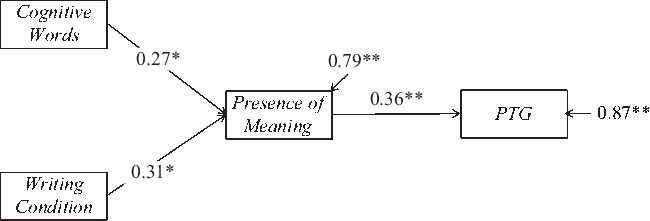
Discussion
The current results replicated and extended those of previous studies on expressive writing. Individuals who reported a high score of PTG were more likely to capture meaning in their writing session relative to those who engaged in neutral writing. Previous research has consistently demonstrated that writing about traumatic or stressful events led to recovery from those events and improvement in physical and psychological health (Baikie & Wilhelm, 2005; Boals et al., 2011; Hussain, 2010). Expressive writing helps reveal life experiences, including the characters, situations and emotions involved, and thereby leads to psychological recovery and PTG. A meta-analysis of expressive writing studies reported that writing about negative events provided significant benefits for both physical and psychological health (Frattaroli, 2006; Frisina et al., 2004). Additionally, Smyth (1998) reported that the effects of expressive writing were of a similar magnitude to those of other psychological interventions. These findings indicate that when individuals engage in expressive writing, they tend to use cognitive words (i.e., insightful and causal words) and benefit from doing so. However, there is an insignificant difference in the use of cognitive words between the expressive writing condition and the control condition among traumatised university students.
Expressive writing has also been found to exert a positive effect on traumatized individuals by reducing the impact of the negative events (Park, Cohen and Murch, 1996). A certain type of cognitive processing engages in this writing process (Creswell et al., 2007), which verbalizes the conversion of emotional and contextual experiences into logical language (Hussain, 2010). Verbalization is a cognitive process that includes thinking about memories, changing thoughts about traumatic events, and transforming these thoughts into language. Therefore, individuals who engage in writing events might use causal and insightful cognitive words to produce a coherent narrative.
In addition, the writing process also induces meaning making, or the resilience-enhancing effect of thinking about early stressors. Previous research has found that meaning making is an important approach for promoting coping capacity and increasing resilience (Miao et al., 2017; Wang et al., 2015). In the present study, recalling and processing early life adversities appeared to have triggered the development of adaptive functioning, including meaning in life and PTG. This is consistent with a recent study showing that individuals reported fewer negative outcomes after writing about previous adversities, which suggests that the process of thinking about past adversities and finding meaning in them promotes resilience and buffers individuals against future stress (Creswell et al., 2007).
The results also found that the use of causal and insightful cognitive words was positively related with the enhanced meaning-making process for both writing conditions. Individuals who used more cognitive words tended to capture meaning in their writing compared to those who used fewer such words. Although the mechanisms underlying the association between cognitive processing and use of cognitive words remain unclear, using cognitive words appears to promote adaptive outcomes and improve health (Ullrich & Lutgendorf, 2002). Moreover, use of causal and insight words is analogous to reconstructing thoughts, perhaps through the use of certain words to organize and combine traumatic events, thus resulting in better outcomes (Ayduk & Kross, 2008; Tausczik & Pennebaker, 2010). Park (2010) also suggested that the use of cognitive words reflects an active state of meaning making. In line with this, Creswell et al. (2007) posited that expressive writing benefits patients through the cognitive process and discovery of meaning. In addition, the cognitive processing in writing about stressful events has been found to associate with meaning making (Boals et al., 2011). Other studies have confirmed these results: Boals et al. (2011) found that cognitive words were strongly associated with meaning making. Similarly, Steger et al. (2006) reported that the use of cognitive words reflected individuals’ efforts to develop a coherent narrative and live meaningful lives. Therefore, stressful events could shatter individuals’ views of the world; however, the need for meaning in life as a fundamental human motivation promotes the meaning-making process (Baumeister, 1991; Boals, 2012) through cognitive processing (Ayduk & Kross, 2008), and results in growth.
The positive association between meaning making and the use of causal and insightful cognitive words is noteworthy. Expressive writing has been shown to promote PTG in previous studies (Tedeschi & Calhoun, 1996; Wang et al., 2015). Therefore, the current study provided further evidence that individuals who are more likely to use cognitive words in the writing process tend to capture meaning, which leads to higher levels of PTG. Previous research has shown that expressive writing allows individuals to shift their attention from the past to the present and future (Boals et al., 2011) and promoted meaning making (Park & Blumberg, 2002), thereby facilitating PTG and helping them thrive (Hussain, 2010). Boals et al. (2011) demonstrated that PTG is the result of a meaning-making process and was positively correlated with narrative coherence, which was reflected in individuals’ use of cognitive words. In addition, Ullrich and Lutgendorf (2002) reported that cognitive words mediated the effects of expressive writing on positive growth. Moreover, Creswell et al. (2007) posited that cognitive processing was a basic psychological self-change process and was related to the discovery of meaning in the process of adjustment. Therefore, meaning making needs cognitive processing to assimilate stressful events into an existing schema or to reframe schemas to understand stressful events in the construction of narratives.
However, the hypothesized interaction effect between expressive writing and the use of cognitive words was not confirmed. Instead, the use of cognitive words led to the process of meaning making in both writing conditions. A previous study found that people who engaged in expressive writing were more likely to use cognitive words in comparison to individuals who were asked to write about a simple event (Boals et al., 2011), which is inconsistent with the results of comparison of the use of cognitive words between the two conditions. In the present research, we recruited traumatised students who might have difficulty in writing about the event in a coherent manner and thus have relatively less use of cognitive words, which might be the reason that the use of causal and insight words in the present study was markedly lower than in other studies.
Furthermore, the use of cognitive words might be a cognitive process that merely occurs in the expressive writing process. Cognitive words are not only used in the expressive writing process, but also in other forms of writing (e.g., song lyrics). Regardless of the form of writing, the use of causal and insightful cognitive words reflects the degree to which the writer reached a coherent status (Pennebaker & Francis, 1996; Steger et al., 2006). During this process, individuals recall and construct life events and make those events meaningful. The use of cognitive words is found to be related to meaning making (Boals et al., 2011). Therefore, the use of cognitive words might be a fundamental cognitive process that occurs in the writing process and reflects individuals’ efforts to capture meaning. The unexpected result of the lack of interaction between expressive writing and the use of cognitive words might be explained by the cognitive nature of writing, in which use of causal and insightful cognitive words not only occurs in expressive writing to facilitate meaning making, but is also present in the search for meaning from daily experiences in neutral writing.
This study has some clinical implications. For individuals who have undergone trauma, expressive writing can be an effective way to encourage the meaning-making process (Park, 2010). Furthermore, deliberate instructions regarding the use of causal and insightful words in expressive writing might increase the intervention effects by promoting meaning making and PTG. Additionally, assessing the content of expressive writing might help clinicians identify the stages of meaning making and how successful individuals are at actually making meaning.
The study has several limitations. First, the sample size of traumatized college students was small, which might be one of the reasons an insignificant difference was obtained in the use of causal and insightful words between the two conditions. Although the power was calculated and found to be adequate, caution should be exercised when generalizing the results to other populations until the study is replicated using large samples with different characteristics. Second, the study did not conduct a pre-test to identify a baseline level of MLQ or PTG, and did not employ longitudinal follow-up assessments. This might have reduced the persuasiveness of the causal effects by priming expressive writing. Nevertheless, PTG after expressive writing has been found to show a genuine positive change (Smyth, Hockemeyer and Tulloch, 2008). Future research should confirm this result by conducting a more elaborate experimental study. Third, the present study selected traumatized participants based on an arbitrary threshold and a self-reported measure, in which different types of trauma may have various effects on the outcomes. The ASLEC was commonly used in previous research to assess adolescents’ psychological problems in China (Chen, Jia, & Liu, 2016). However, a clinical method such as a screening interview should be conducted in future research to select participants with a certain type of trauma.
To summarize, we found both expressive writing and the use of causal and insightful words facilitated meaning making in the writing process, which predicted high levels of PTG. Importantly, use of causal and insightful words might be a fundamental cognitive process to develop meaning in writing, which is substantially needed to further understand the processing.
Footnotes
Acknowledgments
This research was funded by a research grant 31271094 and 31571154 from National Natural Science Foundation of China.
Financial Support
None.