






Abstract
Taiwanese migrants who have settled in Brisbane, Australia (N = 271) completed a questionnaire battery available in both Mandarin and English. A series of multiple and hierarchical regression analyses were used to investigate the factors associated with these migrants’ acculturation and indicators of psychological wellbeing. Results indicated that various personal factors (age, English language proficiency, and duration of stay) were associated with acculturation and indicators of psychological wellbeing. Acculturation was not associated with wellbeing. Social support was associated with the indicators of the participants’ wellbeing. The outcome indicated that although associated with similar personal and environmental factors, acculturation and psychological wellbeing occurred separately. The study highlights the significance of certain personal resources and social support.
Keywords
Over the years, international migration has made Australia a culturally diverse society. Approximately 28% of Australians are culturally and linguistically diverse and have migrated from some other part of the world (Phillips & Simon-Davies, 2014). After taking into account Indigenous Australians, people from 200 language groups and 275 ancestries are settled here (Australian Bureau of Statistics [ABS], 2010). Taiwan, which is geographically close to Australia, is one source of migrants. There is substantial evidence that migration can be stressful and an overwhelming process (Bhugra, 2007), and it can be more severe for migrants whose cultural and linguistic backgrounds differ from those of the host society (Berry, 2005). In general, they encounter migration-related difficulties and stressors. However, in spite of the challenges, migrants generally acculturate and adapt to the host society's culture and demands. Even though the bulk of past research has emphasised migrants’ acculturative stress, there is evidence that they typically resettle effectively and report subjective and psychological wellbeing (Bhugra, 2007; Mirsky, 2009). A number of personal and psychosocial factors appear to be associated with acculturation and the psychological wellbeing of migrants. Considering that Taiwanese form an important community group in Australia, it is important to explore factors that are associated with their acculturation and wellbeing.
Taiwanese Migrants in Australia
Australia, like other Western countries, is now moving toward super diversity (Spoonley & Butcher, 2009), with large, culturally diverse metropolitan cities. The cultural diversity is marked by the presence of different communities, languages, food outlets, and cultural events. Those who reside in Australia are exposed to a multilayered, multilingual and multicultural experience in large cities and even some towns (Vertovec, 2007). The Taiwanese community is very prominent in Sydney and Brisbane. They started to migrate to Australia after the Australian government launched the Business Migration Program (BMP) in 1981 and targeted Taiwan as a country for business migration. Subsequently, a high number of Taiwanese migrated via the BMP. The architects of the migration policy assumed that Taiwanese business migrants with successful business records in their own country would be able to create successful enterprises in Australia. Most of them had privileged social and economic backgrounds and were looking for a better lifestyle for their families, and educational and occupational opportunities for their children. As educated professionals migrating to Australia, some had prearranged jobs (Chiang, 2004), while others became entrepreneurs with small- or medium-sized enterprises. Being self-employed assists the adaptation in the super-diversity context (Ram et al., 2012). A large number (39.1%) have settled in Queensland, with 34% residing in Brisbane (ABS, 2006). By the late 1990s, Brisbane had the largest number of Taiwanese people settled in Australia (Sykes, 2012). Over the years, this close-knit community has flourished, with their population concentrated on the south side of the city where there are a number of Taiwanese restaurants, shops, businesses, churches, temples, and other cultural connections. The question remains, however, whether acculturation to the traditional culture in the host nation is necessary when economic and social needs can be met by other acculturative choices, which are becoming more feasible as cities become more diverse.
Previous research on Taiwanese migrant populations in Australia found that language difficulties, separation from family members, and employment difficulties were the major challenges faced by these migrants, which had an impact on their psychological wellbeing (Chiang & Hsu, 2004; Chiang & Kuo, 2000; Chun, 2010). The process of migration often involves a range of psychosocial adjustments and challenges that may lead to stressful experiences (Ramos, 2005; Sawrikar & Hunt, 2005). Migrants undergo an acculturation process that enables them to adapt to their new settings, although in the context of a diverse society, a range of acculturative choices may be required.
Acculturation and Wellbeing
Acculturation is a complex process that results when individuals from different cultural backgrounds interact and reciprocally influence each other (Berry, 2005). In the case of migration, the dominant culture frequently influences the newly arrived (Berry, 2010). Such acculturation can be a stressful experience as it involves an adjustment to the new host culture by adopting new beliefs, values and behaviours, and renegotiating one's original role, identity and traditions (Mirsky, 2009). Although acculturation was initially considered a unidimensional process (Gordon, 1964), indicating the migrant's degree of adaptation towards the host culture, theoretical refinements highlight the phenomena to be complex and bidimensional. The two independent dimensions of this process are migrants’ attempts to maintain their native culture, and their adaptation to the new host culture. This conceptualisation can be represented by the four outcome strategies: assimilation, integration, separation, and marginalisation (Berry, 2010). Assimilation occurs when an individual rejects his/her native culture to fully absorb the new host culture. Integration is a balance between the host and the original culture. Separation occurs when an individual chooses to maintain his/her original culture and rejects the host culture, while marginalisation occurs when an individual rejects both the native as well as the host culture and chooses to disassociate from them (Berry, 2010).
Acculturation varies and is influenced by a number of personal characteristics. Age is important, as those who migrate at an older age have a higher degree of acculturation to the most dominant culture (Park, Paik, Skinner, & Spindler, 2003). Additionally, longer duration of stay during which migrants interact with the new host culture predicts higher degrees of acculturation (Sodowsky & Lai, 1997). Males, compared to females, typically demonstrate a higher degree of acculturation towards the existing dominant culture and are more likely to engage with the new host culture (Sam, Vedder, Ward, & Horenczyk, 2006). Female migrants, because of gender discrimination and traditional roles, find such acculturation choices more challenging and difficult (Kelly, 2005). Proficiency with the mainstream language is a significant factor associated with a migrant's acculturation to the dominant culture and can also facilitate migrants’ contact with resources in the new host country (Choi & Thomas, 2009; Lu, Samaratunge, & Hartel, 2011; Perez, 2011). Similarly, education and skills not only increase a migrant's chances of employment, but also promote intergroup contact, which opens up the options of mastering the environment and building links with the new country (Schittenhelm & Schmidtke, 2010).
Acculturation is also enhanced by social and emotional support (Wang & Sangalang, 2005). In relocating to a new country, migrants often break their links with the interpersonal networks and support services of their country of origin. The terminated networks cause isolation and emotional distress (Stuchbery, Matthey, & Barnett, 1998). Relocation to a new country involves building new links and relationships (Jibeen & Khalid, 2010). Establishment of social support networks is a significant way for the newly arrived migrants to obtain information about the adopted country's norms and services (Mähönen, Leinonen, & Jasinskaja-Lahti, 2013; Noh & Kasper, 2003). This process enhances the acculturation process (Wen & Wang, 2009). Similarly, social and emotional support alleviates isolation and stress caused by the migration experience (Noh & Kaspar, 2003). All these successful acculturative experiences appear to be associated with wellbeing of the migrants.
A review of the literature indicates that researchers have been interested in the wellbeing of migrants living in the West (LaPlaca & Knight, 2014). In general, psychological wellbeing is reflected by a subjective feeling that life is going well and is measured by life satisfaction. It is also defined as a state that is marked by an absence of psychological and emotional distress and the presence of positive affect (Cummins, 2010; Lincoln, Taylor, Chae, & Chatters, 2010). There is evidence that migrants typically are able to address their challenges, settle in the new country, and maintain wellbeing (Bhugra, 2007; LaPlaca & Knight, 2014; Mirsky, 2009). Psychological distress and life satisfaction of migrants can also be simultaneously influenced by personal factors. Length of residency in a new host country is negatively correlated with psychological distress (Semyonov, Epstein, & Davidov, 2003) and positively correlated with life satisfaction (Sam et al., 2006). The longer the person stays in a new country, the more settled they become. There are mixed outcomes for the relationship between the age of the migrant and wellbeing (Alati, Najman, Shuttlewood, Williams, & Bor, 2003; Phinney, Horenczyk, Liebkind, & Vedder, 2001). A longitudinal study of migrants in Australia indicates that migration at a younger age could contribute to better mental health because of the early exposure to the language and culture of the new host country (Alati et al., 2003; Perez, 2011). In contrast, Phinney et al. (2001) showed that younger migrants had poorer mental health due to parental and educational views conflicting with peer influence in the new host country.
The process of migration can be difficult, particularly for older migrants (Wong, 2001). Some research reported that elderly migrants have feelings of isolation and lower life satisfaction due to limited social life and social support (Berdes & Zych, 2000). Aroian (2001) reported that 83% of the reviewed studies found greater distress in female migrants when compared to male migrants. Female Chinese migrants, compared to male migrants, experienced more social isolation due to the language barrier and higher levels of distress (Ip & Lui, 1999). Lack of English skills tends to increase migrants’ emotional stress (Khawaja, 2007). English language competence decreases migration-related stress and facilitates life satisfaction for migrants (Bhugra, 2007). Similarly, education and professional skills (Rao, 2010) increase the migrants’ chances of adjusting to the new environment and finding employment. Studies indicate that lack of employment is linked with psychological distress (Chiang & Kuo, 2000), while successful and stable employment has emerged as the strongest variable for life satisfaction among migrants as it leads to economic security (Colic-Peisker, 2009).
Researchers (Jibeen & Khalid, 2010; Tiliouine, 2012) have identified social interaction and support as an important determinant of wellbeing. It is important to note that for many migrants from collectivistic societies, their first point of contact for social ties is their own community (Chen, 2011; Wen & Wang, 2009). Due to cultural and language similarities, the newly arrived tend to bond more socially with their own ethnic groups (Ryan, 2008). This interdependence results in living close by or working together (Hernández-Plaza, 2006). Subsequently, support in the form of social interaction and emotional comfort can come from numerous sources, including family, friends, workplaces, and ethnic communities (Wang & Sangalang, 2005). Such support acts as a protective factor and strengthens the self-esteem of the migrants (Fu & Wong, 2010). Colic-Peisker (2009) found social support as a strong predictor of life satisfaction. Social networks in the new settings help migrants to meet their needs and goals (McGregor, 2007). Thus, there is evidence that personal and social factors are contributing to the wellbeing of migrants.
Considering the importance of acculturation and wellbeing in migrants’ resettlement process, researchers have been investigating the relationship between these two experiences. Some researchers have suggested that acculturation subsequently has an impact on the wellbeing of migrants (Koneru, Weisman de Mamani, Flynn, & Betancourt, 2007; Sam et al., 2006). Similarly, other researchers (Berry & Sabatier, 2011; Cilliers, 2005; Griffin, 2013) have reinforced the idea that a successful adaptation to the new settings strengthens the wellbeing of migrants. Some investigations are indicating that the relationship between acculturation and wellbeing is mediated through social connectedness. Migrants who adapt develop a sense of belongingness, which promotes their wellbeing (Yoon, Lee, & Goh, 2008). Nevertheless, some emerging findings indicate that immersion in the new culture is not always a positive experience as it can hinder wellbeing by creating stress (Yoon, Lee, & Goh, 2008; Wright, 2011). It seems that as migrants acculturate they internalise the norms and culture of the host society. In this process, they also become aware of the discrimination and biases toward the minority, which can consequently impede their subjective state of wellbeing (Jasinskaia-Lahti & Liebkind, 2007). However, the link between acculturation and wellbeing requires more investigation, especially with reference to the large communities like the Taiwanese who have settled in Brisbane.
Gaps in the LiteSrature
Migrants’ settlement patterns in Australia show an emergence of super diversity through clustering of ethnic groups in various parts of the cosmopolitan cities. Taiwanese migrants’ concentration in Australia is most evident in Brisbane. Migrants’ acculturation appears to be related with their age, gender, years of residency, English language proficiency, employment stability, and social support (Lu et al., 2011; Park et al., 2003; Sam et al., 2006). Similarly, these personal and social factors have an impact on the wellbeing of newly arrived migrants (Alati et al., 2003; Aroian, 2001; Colic-Peisker, 2009).
Even though acculturation processes have been investigated previously, the link with wellbeing warrants further investigation. The outcome of the recent studies is mixed. Some studies highlight a relationship between acculturation and wellbeing (Berry & Sabatier, 2011; Mahonen & Jasinskaja-Lahiti, 2013), while other studies indicate that acculturation in the form of adopting the host society's culture and norms can trigger distress (Jasinskaia-Lahti & Liebkind, 2007; Wright, 2011). The role that personal and social support factors play in the acculturation and wellbeing of migrants have not been fully explored.
Rationale of the Study
Even though Taiwanese are settled in Australia, very little is known about their acculturation and psychological wellbeing. Moreover, the role that personal characteristics and social suport play in their acculturation and wellbeing is unclear. It is not known if the acculturation of Taiwanese migrants is related to their wellbeing. The goal of the study was to address these gaps in the knowledge by focusing on the Taiwanese community settled in Brisbane. It was hypothesised that in the case of Taiwanese migrants in Brisbane: (1) personal characteristics and social support would be associated with their acculturation; (2) acculturation would be associated with the indicators of their wellbeing; and lastly, (3) personal and social factors would be associated with the indicators of wellbeing.
Method
Participants
Taiwanese migrants (N = 271) who have settled in Brisbane, Australia participated in the study. Their mean age was 33.7 years (range 18–71 years; SD = 12.86). There were 102 men (37.6%) and 169 women (62.4%). Four participants were born in Australia as second-generation migrants. The other 267 participants arrived in Australia at various ages, ranging from 1 to 61 years. The mean duration of stay was 12.3 years (range = 1–25 years; SD = 5.90). Mean years of education were 14 (SD = 2.5). Nearly half of the participants were employed (53.9%), followed by 23.6% unemployed, and 22.5% being students.
Measures
Demographic form
A demographic form was developed to collect personal information such as age, gender, marital status, age at migration, number of years of residency, education, employment, and English language proficiency.
The Suinn-Lew Asian Self-Identity Acculturation Scale (SL-ASIA)
The SL-ASIA (Suinn, Ahuna, & Khoo, 1992) is a 26-item scale that measures different domains of acculturation, including language choice, identity, friendship choice, acculturative behaviours, generation/geographic background, and attitudes. The overall total score indicates the degree of unidimensional acculturation towards the majority host culture. A low score therefore indicates an Asian orientation, while a higher score indicates a Western orientation. The last five items can be used to categorise participants into one of four acculturation strategy groups: integration, assimilation, separation, and marginalisation. The term ‘North America’ was replaced by ‘Australia’ in the current study. The internal consistency of the first 21 items is .88. (Ponterotto, Baluch, & Carielli, 1998) and concurrent validity is indicated by its correlation with age at migration and duration of stay in the new country (Suinn et al., 1992).
Depression Anxiety Stress Scale-Short Form (DASS)
The DASS (Lovibond & Lovibond, 1995) is a 21-item scale with three subscales. The total score can be used as a measure of negative affect (psychological distress). Participants respond on a 0 (not at all) to 3 (very much or much of the time) Likert scale and the scores range from 0 to 63, indicating mild to extremely severe levels of depression, anxiety or stress. It is internally consistent with satisfactory Cronbach's alpha values for depression (.94), anxiety (.87) and stress (.91) subscales (Anthony, Beiling, Cox, Enns, & Swinson, 1998). The concurrent validity of the DASS-21 is sound, as the Depression subscale correlated with the Beck Depression Inventory (r = .85) and the Anxiety subscale correlated with the Beck Anxiety Inventory (r = .85) (Anthony et al., 1998).
Satisfaction with Life Scale (SWLS)
The SWLS (Diener, Emmons, Larsen, & Griffin, 1985) is a five-item scale that measures an individual's satisfaction with life. Participants responded to a Likert scale ranging from 1 (strongly disagree) to 7 (strongly agree). The total item scores ranged from 5 to 35, with higher scores reflecting more satisfaction with life. A score of 14 and below suggested that they were dissatisfied, 15–19 as slightly dissatisfied, 20 refers to neutral, 21–25 as slightly satisfied, 26 and above as satisfied. The SWLS has high internal consistency with Cronbach's alpha of .87 (Diener et al., 1985).
Social Support Scale (Social Support)
This is a seven-item scale derived from the Support Function Scale (Dunst & Trivette, 1988). The original 20-item scale measured the different types of emotional, social, and practical assistance available to individuals. For the purpose of this study, seven items that measured social support were selected. Participants responded to the items using a 4-point Likert scale ranging from 1 (never) to 4 (quite often). Scores can range from 7 to 28, with higher scores reflecting a higher degree of support for the migrants. The overall scale had high internal consistency with Cronbach's alpha of .87 (Dunst & Trivette, 1988).
Procedure
Ethical clearance was obtained from the university's ethics committee. In order to minimise language barriers and increase the response rates, the survey was made available in both Mandarin and English. The Mandarin version of the SL-ASIA, which was translated and modified for the Australian context by Chan, Parker, and Eisenbruch (2005), was used. The Mandarin version of the DASS was acquired from the DASS website (Chun, 2010). The demographic and social support scales were translated into Mandarin by the second author, who is a native Mandarin speaker. Accuracy was confirmed by back translation carried out by a native Chinese Mandarin speaker also fluent in English.
The questionnaire battery, consisting of the information about the study, measures and debriefing note, was converted into an electronic version using Key Survey software (WorldAPP Key Survey, 2011) and was also available in hard copy. Participants were recruited through the Queensland Taiwanese Centre and Tzu Chi Foundation Australia. Members of these organisations were emailed information about the study and were invited to participate via an online link. The study was also advertised through oral presentations at organisations’ events. Hard copy versions were made available to the participants at these events.
Results
Preliminary Analysis
Missing values were minimal (less than 5%). The total score on DASS was positively skewed, indicating that the majority of participants had low scores, as expected in a non-clinical sample. The Cronbach alphas for SL-ASIA, DASS, SWLS and Social Support were .85, .93, .91, and .90 respectively. Hence, the scales had a satisfactory internal consistency. To gain initial insight into acculturation styles within the sample, participants were allocated to the acculturation group using the method suggested by Suinn et al. (1992). Separation (n = 108) and integration (n = 146) groups were well represented; however, marginalisation (n = 0) and assimilation (n = 17) groups were not. This indicates that most participants chose to retain aspects of their Taiwanese culture, and some additionally adopted aspects of the majority culture in Brisbane.
Descriptive Statistics and Intercorrelations for All Variables

Note: *p < .05; **p < .01; — = dichotomous variable.
Variables Associated With Acculturation and Wellbeing
Acculturation
Variables Associated With Acculturation and Wellbeing
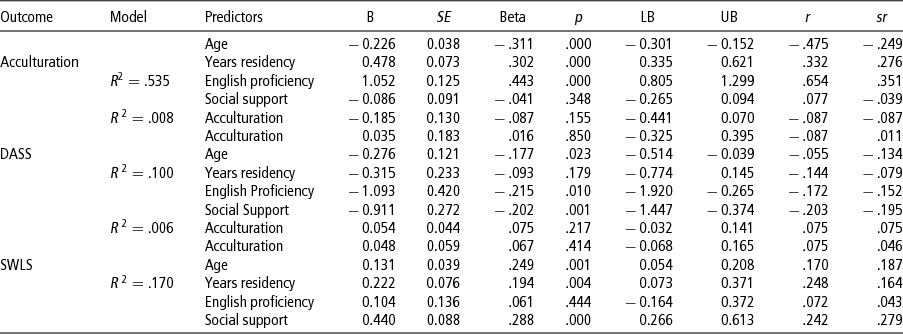
Note: DASS = Depression, Anxiety Stress Scale; SWLS = Satisfaction with Life.
Psychological distress
A hierarchical regression analysis was conducted. Acculturation was entered as the sole independent variable in step 1, with personal factors and social support entered in step 2. As seen in Table 2, acculturation was not associated with psychological distress, R = .087, F(1, 269) = 2.04, p = .155. At the second step, acculturation and personal factors, such as age, years of residence, English language proficiency and social support, emerged as indicators of psychological distress (DASS). The variables account for significance variance, R = .315, Fchange (4, 265) = 6.77, p < .001. As shown in Table 2, age, English language proficiency, and social support were significant variables and negatively associated with psychological distress. Acculturation was not associated with psychological distress.
Life satisfaction
A hierarchical regression analysis was conducted. At step 1, acculturation was entered as the independent variable. Acculturation did not account for significant variance, R = .075, F(1, 269) = 1.53, p = .217. Step 2, however, explained significant variance in SWLS, R = .412, Fchange (4, 265) = 13.09, p < .001. As seen in Table 2, at step 2, acculturation was not associated with subjective wellbeing. However, age, years of residence, and social support were positively associated with the subjective wellbeing (SWLS).
To summarise, although personal factors were significantly associated with both acculturation and wellbeing outcomes, acculturation was not linked with wellbeing. Social support was a significantly related to wellbeing outcomes but not acculturation. As the hierarchical regression analysis did not reveal a relationship between acculturation and wellbeing, we investigated if these outcomes varied between acculturation groups. Two groups, separation and integration, were well represented. Independent samples t tests indicated that these groups did not differ on either psychological distress, t(252) = 0.47, p = .64, d = 0.06, or life satisfaction, t(252) = 0.21, p = .83, d = 0.03.
Discussion
The present study examined the relationship of personal and social factors with acculturation and psychological wellbeing of Taiwanese migrants settled in Brisbane, Australia. The association between acculturation and wellbeing was also explored. The hypotheses were partially supported. Personal factors were associated with acculturation and indicators of wellbeing. However, social support contributed significantly to wellbeing only. Acculturation in this Taiwanese migrant sample was not associated with their wellbeing. This suggests that acculturation to the dominant culture may not be an essential factor contributing to the wellbeing of these Taiwanese migrants. Overall, the study's findings suggest the possibility that in cities with substantial diversity, migrants can stay in their ethnic enclaves, which can contribute to their happiness and subjective wellbeing.
It is interesting to note that contrary to some recent findings (Koneru et al., 2007; Sam et al., 2006), there was no direct relationship between acculturation and wellbeing. The migrants’ subjective state of happiness, positive affect, and emotional wellbeing were not contingent upon acculturation. This outcome suggests that the two phenomena occur independently and are not necessarily contingent on each other. In this Taiwanese migrant group, some were maintaining separation from the majority culture while others chose to adapt to or accept the local norms, culture, and values while maintaining aspects of their original heritage. Similarly, Taiwanese migrants’ satisfaction with life, as indicated by reduced psychological distress and higher level of subjective happiness, was not associated with their assimilation or integration with the Australian society. Nevertheless, the acculturation and wellbeing of the participants appeared to be associated with similar personal factors. One interpretation of these results is that when thriving ethnic communities exist within the broader community fabric, a range of acculturative choices are consistent with psychosocial and instrumental needs being met.
The findings of the study indicate that age, years of residency, and English proficiency assisted with acculturation to the Australian society. This is consistent with previous findings (Choi & Thomas, 2009; Lu et al., 2011; Perez, 2011; Sodowsky & Lai, 1997). A negative association between age and acculturation scores indicated that it is possible that older participants were holding onto their Asian orientation, while the younger participants were open to a Western orientation. It is likely that a longer stay in Australia and English language skills helped the participants adapt by learning about the host culture, traditions, and way of life. These variables also appeared to be associated with the participants’ wellbeing. It is likely that currently being older and having good English language skills contributed to the ability to identify resources in the new environment, hence lowering psychological distress and enhancing wellbeing (Choi & Thomas, 2009; Koneru et al., 2007; Lu et al., 2011). This is contrary to the Wong (2001) study, which found older migrants to be more distressed compared to younger migrants. Moreover, inconsistent with earlier findings (Jabeen & Khalid, 2010; Mahonen et al., 2013; Wang & Sangalong, 2005), social support did not contribute to acculturation of these Taiwanese migrants.
Social support appeared to buffer psychological stress and was associated with life satisfaction. This is consistent with previous findings that highlight the importance of instrumental and social support in the wellbeing of migrants (Chen, 2011; Colic-Peisker, 2009; Wen & Wang, 2009). Taiwanese migrants in Brisbane live in specific suburbs and are geographically close to each other. As a result, they have a strong affinity and links with their own community (Ryan, 2008), which allows them to socialise with people from their own cultural background in their own language. Further, this provides an opportunity to seek guidance and assistance from fellow community members on a range of matters. It is possible that all these options have a direct impact on their satisfaction with life and psychological distress, the indicators of wellbeing (McGregor, 2007).
In contradiction to previous findings (Kelly, 2005; Sam et al., 2006), gender and employment were not associated with either acculturation or wellbeing. One possibility is that Taiwanese women were not restricted by any gender specific role and interacted with the new host society. Another possibility is that gender roles were not deleterious to wellbeing and were not a barrier to the fulfilment of instrumental and psychological needs. It is possible that because Taiwanese migrants are generally financially comfortable, they are not worried about earning an income (Chiang & Kuo, 2000). Further, they migrated to Australia for a better lifestyle and environment rather than for economic benefit (Chiang & Hsu, 2004). Therefore, it is possible that even those participants who were unemployed were financially secure.
It is important to note that Taiwanese migrants tend to concentrate in specific parts of the city and rely on their own ethnic groups for a range of needs, such as employment, cultural and religious activities, and basic needs. Many are self-employed or employ members of their own community (Ram et al., 2012). It is possible that they were not pressed to acculturate and interact with the mainstream population as their needs were met by fellow community members and an environment that provides them with all the essential services and facilities. Therefore, those who have used separation as an acculturation strategy have emerged with similar levels of psychological wellbeing as their counterparts who have integrated into the host society. It could be speculated that being part of a tight-knit community provides them with good social and instrumental support. Even though they are not interacting much with the host society, their social and emotional needs are met. The trend of migrants settling in areas where there are people from their own region or language groups, therefore, may be a protective factor, if this can be accomplished without compromising other needs such as financial security.
Limitations and Future Directions
The study was not free from limitations and the results should be considered with caution. The majority of participants were young adults (20–35 years), limiting the capacity to generalise the findings. Further, as participants were from one geographical area, the sample may not adequately represent the overall Taiwanese migrants settled in Australia. The concept of acculturation is complex and needs further refinement (Ward, 2008); hence, further development of acculturation measures is required. Considering that Australian metropolitan cities are now moving to super diversity, it is important to study acculturation in this new setting with multiple groups living side by side, instead of one minority living with a larger dominant culture. The choice of acculturation measure in the present study was influenced by language requirements; however, previous research employing this measure is sparse. Qualitative and quantitative methodologies could be used to gain more insight into acculturation processes, psychological distress, and the life satisfaction of migrants. Further, comparisons with other ethnic groups on acculturation and psychological wellbeing would be useful.
Conclusion
In spite of the limitations, the study has practical application for Taiwanese migrants, with probable extension to others who live in Australian super diversity. The findings indicate that personal factors like English language, age, and longer duration of stay contribute to acculturation and wellbeing. Further, social support, not acculturation, is linked to the subjective wellbeing of these Taiwanese migrants living in Brisbane. It appears that super diversity may allow migrant communities to thrive on the basis of the support available from both within their own ethnic group and the broader community.