






Abstract
The Virtue Existential Career Model (VEC) is a Chinese career development model based
on the
Keywords
Taiwan has been transforming into a knowledge-based economy (also known as knowledge economy, frequently discussed with issues of informationalism, information revolution, knowledge sharing, knowledge management, intellectual capitalism; Al-Hawamdeh, 2005; Chen & Chiu, 2005; Hu, Lin, & Chang, 2005; Shie & Meer, 2010; So, 2005). The Organization for Economic Cooperation and Development (OECD) defines a knowledge-based economy as ‘economies which are directly based on the production, distribution and use of knowledge and information’ (OECD, 2005). Many national standards for higher education or employability in various countries (Commonwealth of Australia, 2002; Council for the Advancement of Standards in Higher Education, 2009; OECD, 2005; Partnership for 21st Century Skills, 2008) have pointed out the importance of how learning to learn, lifelong learning, using information and communications technology, managing information, acquiring and using knowledge, solving problems, resolving conflicts, and innovating have become common occupational capacities at all levels and in all lines of work. In sum, workers need to acquire, utilise, and innovate upon their knowledge creatively.
Aligned with the international trend of educational reform emerging in the era of knowledge-based economies, Taiwan has gone through educational reform during the past decades (I-ru, 2012; Lin, 2004). In 2014, Taiwan's Ministry of Education (TMOE) implemented its second education reform, the 12-Year Basic Education (十二年國教), following the mandatory education requirement of 9 years, which began in 1968. The new reform is meant to encourage junior high school students to explore their abilities and interests before making their educational and career decisions for the 10th grade. With this agenda, career guidance, a subset of general education in junior high school, becomes a focus. Junior high schools are asked to promote career guidance courses and apprenticeships, and to embed career elements into regular courses so that students can explore their career development and be exposed to sufficient career information.
We observed two problems in TMOE's career guidance practice in junior high schools. The
first problem was the incompleteness of its adaptation of the person-environment (P-E) fit
paradigm (Spokane, Meir, & Catalano, 2000; Tinsley, 2000;
Tracey, Darcy & Kovalski, 2000)
to the current knowledge-based economy. The second results from what Chinese call
To solve these problems, the Chinese Career Research Center of National Changhua University of Education (or NCUE) in Taiwan proposed a VEC curriculum and Career Genesis (CG), both based on the Virtue Existential Career (VEC) model (德性存在生涯模式; Liu, S., Hung, Huang, Wang, & Peng, 2015; Liu, S., & Wang, 2014; Liu, S., Chen, Lu, Lu, & Ching, 2014). This approach echoed Hwang's (2005, 2012) advocacy for culture-inclusive psychology as well as Liu, Ng, Gastardo-Conaco, and Wong's (2008) proposition for social and cross-cultural psychology as a global enterprise. Confucian philosophy is considered to be a world philosophy that is rooted in the universal humanity and appeals to the whole of humanity (Cheng, 2013; Hwang, 2009; Liu, J. 2014). We used it to address ordinary people's practical and existential career concerns.
The purpose of this action research was to complement the TMOE's fit model with the VEC
model. This article presents our application of the VEC model to Taiwan's career guidance
practice in junior high schools. It consists of the following: (1) our problem awareness
concerning Taiwan's career guidance practice in junior high schools; (2) our VEC model and
its application for junior high school students; (3) our research methods in terms of
epistemological concerns, participants, project tasks, and evaluations; (4) our sequential
research action and its action strategies and outcome analyses; and (5) the future vision
of living up to the
Problem Awareness
Can the P-E Fit Paradigm Address the Career Development Requirements of a Knowledge-Based Economy?
The knowledge-based economy trend has added complexity to occupational structures and
an individual's career development (Amundson, Parker, & Arthur, 2002; Borgen, 1999; Kanter, 1999a, 1999b, 2003; Savickas, 2000). Empirical evidence supports
the idea that career development has gradually shifted from a traditional linear
pattern to a boundaryless/protean one (Bussolari & Goodell, 2009; Forrier, Sels, & Stynen,
2009; Harrison, 2006; Stoltz, Wolff, Monroe,
Mazahreh, & Farris, 2013).
Career development has been reframed as a process of choosing an educational or
occupational option for
The 12-Year Basic Education policy holds on to the rational P-E fit paradigm proposed
by Parsons (1909). Its
mandatory practices of career tests, occupation site visits, and the
There may be two challenges when incorporating the Western individual-orientated P-E fit of career paradigm into Taiwanese junior high students’ career development. First, Confucian culture 1 in Taiwan places emphasis on academic achievement and glorifying family through occupation. Parents expect their children to enrol in prestigious schools: ‘the glory of the individual’ implies ‘the glory of the family’ (Hwang, 2012; Qi, 2014). Although such a norm of mutual identification also applies to Western families, studies have illustrated that parental influence in shaping the career decision of their posterity is more powerful in Eastern societies (Iyengar & Lepper, 1999; Tang, 2002). Therefore, in Confucian culture it is an important ability to integrate concerns of family into an individual's career (Liu, J., McMahon, & Watson, 2015; Mau, 2004) and manage family intrusiveness while making one's decisions (Fan, Cheung, Leong, & Cheung, 2014; Liu, J. et al., 2015; Ma & Yeh, 2005; Pekerti, 2008). According to the theory of motivated information management, children in a Confucian culture have to assess the costs and benefits associated with information seeking (outcome assessments) and their ability to enact a particular strategy (efficacy assessments) before they take action to manage career uncertainty and related anxiety (Afifi, Dillow, & Morse, 2004; Chang, 2014). This is because it is normal for parents to expect to have a say in the consequences of such information seeking.
Second, the P-E fit paradigm rests upon the stability and predictability of both a person's traits and the world of work (Holland, 1997; Super, 1957); yet, occupation structures and demands are full of rapid change in the era of knowledge-based economies (Miller, 1995; Trevor-Roberts, 2006). The work environment nowadays is volatile and defies prediction, which is a basis of the P-E fit paradigm (Lynch, 2000; Savickas, 2000).
In sum, the ‘modernist’ approach attempts to use rational strategies to make a choice and execute a corresponding plan to pursue a P-E fit. This may help individuals to handle the stable aspects of career development (Spokane et al., 2000; Tinsley, 2000; Tracey et al., 2000). However, individuals need new career views to cope with change and the uncertainty aspects of career development as well (Delia Rocca & Kostanski, 2001; Herr, 1999; Herr, Cramer, & Niles, 2004). In line with this thought, Gelatt (positive uncertainty; Gelatt, 1989, 1995), Cochran (narrative approach career counseling; Cochran, 1997), Krumboltz (planned happenstance theory; Mitchell et al., 1999; Krumboltz, 1998a, 1998b), Pryor and Bright (career chaos theory; Pryor & Bright, 2003, 2005, 2006, 2007), and Valach & Young (contextual action theory; Valach & Young, 2004) have proposed postmodern approaches to career development. They advocate open-minded and creative strategies to appreciate and adapt to change and uncertainty in the surroundings, so that individuals can extend themselves to try on possible selves and jobs. To combine these two approaches, we have provided an alternative career curriculum based on our VEC model.
How Can Career Guidance Become Professional and Beneficial Instead of Being a Documentation of Career Activities?
To enhance students’ career exploration and decision-making capacities, the TMOE
requires schools to provide career tests and occupational site visits. The schools
are also mandated to facilitate students to document all their career-related
activities in
This phenomenon of superficial documentation resulted from
The VEC Model and its Applications for Junior High School Students
The VEC Model 2
The VEC model (Liu, S., et al., 2015; Liu, S. et al., 2014; Liu, S., & Wang, 2014) was established by the NCUE Chinese Career Research Center. This
model reflects the ancient Chinese wisdom of the
The
Accordingly, career development is constituted of interacting elements, different yet
related, opposing yet complementary to each other. Within such a philosophy, career
development is considered as a process of becoming through a continuous and
discontinuous interplay of preceding and consequent moments in time and human
development. As continuous, it always keeps something from the preceding moment; as
discontinuous, the novel moment has its own originality that cannot be reduced to the
preceding moment. Such a career evolution process is different from the traditional
linear pattern promoted by the rational P-E fit paradigm (Sheldon & Elliot, 1999; Spokane et al., 2000; Tinsley, 2000; Tracey et al., 2000); rather, it is closer to a
A conceptual framework of career views was used to merge the above-mentioned career
propositions based on Chinese wisdom from the
The Characteristics of Two Career Paradigms
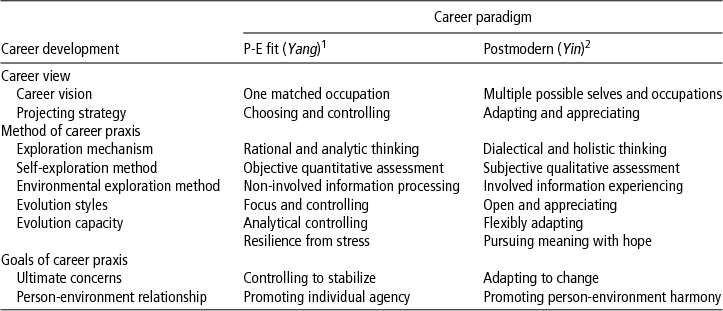
Note: 1This column lists those which are shared by both P-E fit and postmodern career paradigms.
This column lists only those which are unique to a postmodern career paradigm.
Individuals’ career views and praxis differ across cultures. A literature review has indicated that perceived opportunities for choice create the illusion of control, which is a biological imperative for survival; nevertheless, the perception of control, the value of choice, and the preference to exert control can be altered as a result of personal development, personality, learning history, and cultural experiences (Leotti, Iyengar, & Ochsner, 2010). People in a Western culture tend to use rational and analytic thinking while East Asians tend to use dialectical and holistic thinking (Nisbett, Peng, Choi, & Norenzayan, 2001). Specifically, Hong Kong Chinese spend less time on decisions and parse through both important and less important information more efficiently, whereas European Canadians spend more time on decisions and selectively focus on important information (Li, Masuda, & Russell, 2015).
What is the ultimate aim of one's career evolution process? What is the underlying
meaning of life of one's career vision? Confucian interpretations of the
Two perspectives constitute the Confucian ideal of rulership:
Accordingly, an ideal career development is harmonious via wisely utilised
Construction of Career Genesis
Career Genesis (CG;
The theoretical base of CG is our VEC model. It utilises CCN's career measurements to
assess the students’ career characteristics, to assist their competency in
Our VEC Career Curriculum
The VEC model makes up for the lack of emphasis on handling career uncertainty in the
TMOE's 12-Year Basic Education's career guidance policies. To superimpose the VEC
model upon career education, we grappled with the subtlety of its concepts and
translated them into prescriptions for career teaching. It encourages junior high
school students to utilise both
Three Levels of Career Guidance Missions for Junior High School Students

Note: The documentation of the blue brochure is the first (basic) level, the analytical integration of P-E fit curriculum (the second level) is built upon the first level, and the VEC curriculum is the third level which includes the first two levels.
Action Research Method: Reflection-On-Action and Critical-Emancipatory
This is a 3-year VEC career guidance project with a research team of school counsellors, teachers and administration staff from the Tainan Student Counseling Center, NCUE, and Tainan's Department of Education. We have adopted an action research approach, which consists of two parts, reflection-on-action and critical-emancipatory (Schön, 1983; Winter, 1996). The research action to be reflected upon includes problem identification, program selection, team recruitment, implementation, and evaluation. Critical-emancipatory refers to the application of the practice results to liberate the old paradigms and replace them with new approaches. The focus of the first year was to: (1) make connections to promote and establish the VEC project; (2) train VEC instructors, counselling administration staff, and guidance teachers of Tainan junior high schools; (3) facilitate the completion of the administration and interpretations of CCN tests for all junior high school students in Tainan; and (4) hold a career lesson teaching contest. The second year included: (1) the development of CG and VEC teaching materials, (2) volunteer participants in VEC trainings, and (3) the introduction of our CG and VEC model to counties other than Tainan. The application and effectiveness evaluation of VEC started in the third year.
A Core Cooperation Team
The project started with a main team consisting of supervisors from the Tainan 5 Department of Education, the chair and (current and former) career coordinators of Tainan Student Counseling Center, the chair of the Chinese Career Research Center (CCRC), and the principal and guidance teachers from the junior high school designated to administer career guidance in Tainan. The Tainan Student Counseling Center (TSCC) submitted a proposal to the Tainan Department of Education and received funding. The Tainan Student Counseling Center worked with the designated school to implement the project in Tainan. The Chinese Career Research Center provided consultation, data collection and analyses, and CG, an internet career resource.
Research Projects and Participants
In the first year, the CCRC trained 330 guidance teachers and provided test services to 24,250 students in Tainan. The TSCC held a career lesson teaching contest for which 45 guidance teachers submitted 90 lesson reports.
In the second year, the CCRC invited 10 guidance teachers who had won the teaching contest and 18 guidance teachers with information technology (IT) or testing backgrounds to form the VEC curriculum development team and the VEC IT development team respectively. Then, the TSCC held workshops and delivered products developed from these two groups, which resulted in 120 guidance teachers and 2,000 students using CG.
In the third year, a class of 30 junior high school students received three VEC career classes and a female member of VEC curriculum development team was invited to coordinate the effectiveness evaluation of VEC teaching materials.
Measures
Evaluation criteria for action
Effects of this action research were examined using Liu, J. et al.’s (2008) principles of
interconnectedness. While most Western action research uses the term
Assessments for our VEC model
The Confirmative Factor Analysis Results of the Three Career Evolution Measurements

Research Action and Outcome
Tainan's Main Forces and Problems when Implementing TMOE's Career Guidance Requirements Before the VEC Project
Before the VEC project was proposed in Tainan, its Department of Education and
Student Counseling Center followed the guidelines and instructions of the TMOE.
Junior high schools were required to have students complete career measures based on
the P-E fit paradigm, participate in career information gathering tours (such as
occupation site visits), and document all their career exploration activities and
results in
Teachers used two approaches to meet this requirement. One was to just complete the booklet without any reflection or discussion. The other was that teachers used the booklet as a guideline to plan and teach about careers. Though the latter approach was better, it still employed the P-E fit paradigm that we consider to be incomplete in terms of being able to solve the difficulties created by the unavoidable uncertainty of career development.
The Accomplishments and Problems of the First Year of the VEC Project
The Tainan Student Counseling Center has observed the problems in the routine implementation of career guidance policies and the ill fit of the current career curriculum to a knowledge-based economy. The second author, a doctoral graduate of NCUE and a supervisor at the Tainan Student Counseling Center, was a key person. He proposed a longitudinal service and research vision: establish Tainan's CCN test norms and follow up junior high school graduates for 10 years to analyse students’ career development patterns. He talked to managers in various institutes, such as the Tainan Department of Education, Tainan Student Counseling Center, Chinese Career Research Center, and possible designated schools for research.
In order to improve career guidance in Tainan, the Tainan Student Counseling Center worked with the Chinese Career Research Center to promote our VEC model, and successfully proposed this project to the Tainan Department of Education. This was an effort to combine teaching practice, education administration, and academia. In addition to success in gaining sponsorship from the Tainan Department of Education, the accomplishments of the first year included: (1) 24,250 junior high school students’ completion of the three CCN career inventories and receipt interpretation, (2) VEC training of 330 guidance teachers, and (3) a VEC career lesson teaching contest that attracted 90 participants and resulted in 20 winners.
The core cooperation team met every 3 months to discuss the progress on the VEC
project and the feedback and questions from the workshop participants and the
teachers who conducted the CCN tests with their students. Frequent issues raised
were: (1) this project increased teachers’ workload, and (2) it interfered with the
progress of their regular class schedules. The teachers suggested the test result
outputs could be pasted into
It seems that while focusing on promoting the VEC project, we did not pay attention to the problems caused by the dynamics between the TMOE, guidance teachers, and the student counselling centres. We will analyse this problem in the next section.
The Accomplishments and Suggestions of the Second Year of VEC Project
Three adjustments to the VEC project were made after team discussions of first-year
issues. First, the results sheets with CCN measurements were modified to fit
There were a total of 120 participants in the three seminars. Most of them provided positive feedback such as: ‘The instruction and materials from the first-line teachers are practical and meet our clinical teaching needs’; ‘The seminar reminded me to use the blue booklet to construct useful career lessons for my students instead of just completing it for TMOE's evaluation requirements’; ‘After the seminar, I realised that career development is dynamic and is more than planning. This definitely changes the way I instruct my career classes.’ Some of them even suggested that we should give the seminars in all regions of Tainan so they can be available to the teachers of schools in rural areas.
Our Action Strategies to Manage the Phenomenon of ‘Making Policies Versus Circumventing Policies’
To implement this VEC project, it was anticipated there would be conflicts between
the TMOE, guidance teachers’ implementation of the project, and our professional
counselling knowledge. The conflict between us and the TMOE was over the choice of
paradigms. Although the TMOE adopted the P-E fit model, they were open to other
models as long as it helped them to promote career guidance. We were able to present
the VEC model to persuade the TMOE to let us try out this model in their training
workshops for guidance teachers. The conflict that guidance teachers had with us and
the TMOE was the workload. Before their participation in the VEC project, and
although guidance teachers might appreciate the TMOE's good intentions in enhancing
career guidance, they were not comfortable that they were forced to accommodate a
heavy additional workload and were mandated to complete
In the first year of this project, we enthusiastically prepared seminars with the
hope of attracting guidance teachers’ attention to the benefits of the VEC model and
CCN resources. We also took advantage of the TMOE's mandatory request to reinforce
the 12-Year Basic Education policy. We presented and promoted the VEC project at the
mandatory career workshops and seminars for guidance teachers. Such a mandating
strategy turned out to be a mistake. Since teachers were much more interested in
‘learning what to do’, our enthusiasm for theoretical awakening failed to attract
their attention. It should not be surprising that teachers would simply take our
effort as another government mandate and might want to find some way to get around
it. In other words, we, as Confucians, by
Therefore,
In addition to the abovementioned simplifying and attracting strategies, mandating was used as well. With the help of the Tainan Student Counseling Center, the CCRC took advantage of a nationwide mandatory meeting to promote the VEC model and its practical teaching and testing materials. We successfully attracted four other counties to consider the VEC model and CG for their mandatory career guidance by the TMOE. In total, five of the 23 total counties of Taiwan were interested in our VEC model and CG.
Multiple-Win Effect By the Strategies of Mandating, Attracting, and Simplifying
By reflecting on our action process, we found the three useful strategies of mandating, attracting, and simplifying. Furthermore, the project results met the five indexes of interconnectedness (Liu, J. et al., 2008). This project included administrators, researchers, and teachers (building social relations). We required feedback and the core team met every 3 months to make adjustments accordingly. For participants’ reflection (reflexivity), VEC workshops attracted one third of all the guidance teachers in Tainan and increased their appreciation of a virtual existential career view. In terms of empowerment, the participants were encouraged to provide feedback and seek consultation and resources. As a result of their feedback in the first year, a VEC curriculum and CG were established. The strongest evidence of social change is that more than a fourth of counties in Taiwan have subsequently invited our team to share our VEC model, VEC curriculum and CG.
Outcome and Evaluation of our VEC Curriculum
We did have some positive feedback about the effects of our VEC curriculum during the
second year. Nevertheless, as this project took place in the field, it was not
possible for guidance teachers to implement the VEC curriculum in a standardised form
and to undertake pretests and posttests; thus, the positive feedback during the
second year lacked methodological rigor. In the third year, to examine the effect of
our VEC curriculum more precisely, a class of 30 junior high school students was
instructed by a VEC-trained guidance teacher for three class periods, 45 minutes per
period. The classes included instruction of exploration of self and occupation
information, the introduction of the VEC's career evolution concepts, and the
administration and interpretation of the three career evolution tests. The students
were encouraged to collect and analyse objective information ( Example of a student's work in the VEC class.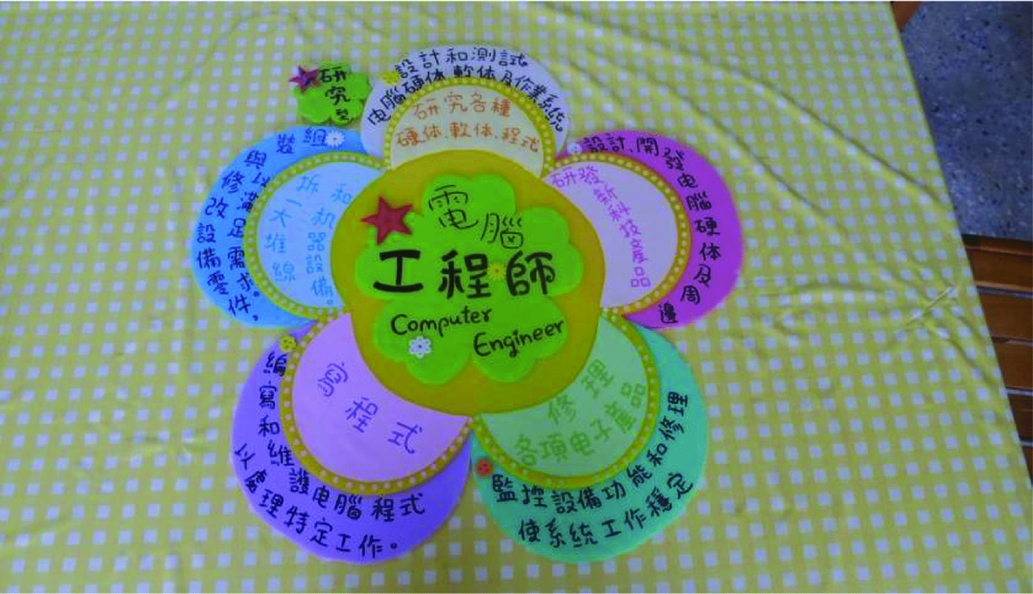
The
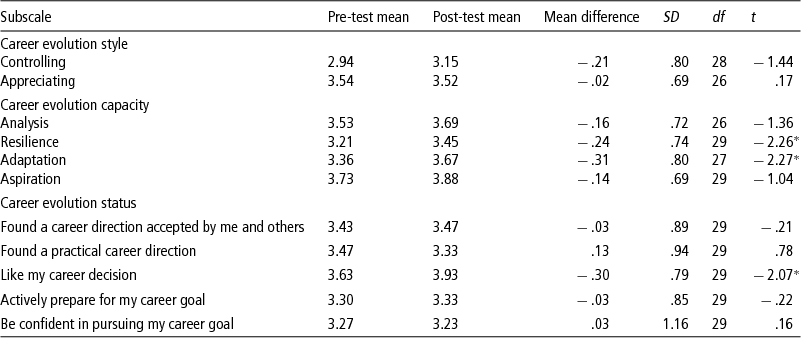
Note: *
Future Vision of Living up to the Tao
This project was designed to promote a new career view based on the
This project fulfilled and went beyond the mandatory requirements of the TMOE's 12-Year Basic Education. Our VEC model improves the traditional career guidance model. The modified VEC career curriculum is simple and easy to administer, so that it attracts school guidance teachers to use it. Guidance teachers also receive professional training. The resources of teaching materials, the CG, and professional consultation have been established and are available to the public. The successful teamwork demonstrates an example of good collaboration among teachers, government agencies, student counselling centres, and academia. Our action results demonstrated effectiveness in terms of the five indexes of interconnectedness (Liu, J. et al., 2008).
The empirical support of the effectiveness of our VEC curriculum shed light on further
elaboration of
Our success with using the combination of mandating, attracting, and simplifying
strategies has a theoretical value for social change. The TMOE has the power and
resources to facilitate a social change. Our professional knowledge has the power to
establish a creative career guidance model based on the
The significant role of simplifying indicates that the key to successfully implementing
an action project is to empower as well as enable the first line executers. The virtue
of simplifying reflects the following statement from the
The effectiveness of the three precepts of mandating, attracting, and simplifying
instead of one or two alone illuminates wisdom of social change. As professional
institutes, the TSCC and CCRC use
With our VEC model, we began with an intention of assisting individuals to handle career
issues as well as to achieve the
Footnotes
Acknowledgments
The first year data has been published in The Archive of Guidance & Counseling in Taiwan. The authors acknowledge financial support from the Tainan Student Counseling Center and professional help from the VEC curriculum development group and the VEC IT group. Special thanks are given to two VEC-trained guidance teachers, Hsing Chun Tsai from the Tainan Municipal Daciao Junior High School and Chi Ya Yu from the Tainai Munlcipal Fusing Junior High School, who gave the VEC lessons in the third year. This article was based on the following projects: (1) one service project sponsored by Tainan Education Bureau, Taiwan (2013.6.1~2014.12.31); and (2) two research projects sponsored by Taiwan Ministry of Science and Technology (NSC 102-2410-H-034-005 for 2013.8.1~2014.7.31 and MOST 103-2410-H-018 -008 for 2014.8.1~2015.9.31).
1
2
The VEC model is renamed from the TSG model, a model of career development touching
the sky yet grounded (Liu, S., & Wang,  ; Liu, S., Wang, C., Deng, Keh, Lu, Y., & Tsai,
2014). The new name is to
highlight the ethico-spiritual aspect of the
; Liu, S., Wang, C., Deng, Keh, Lu, Y., & Tsai,
2014). The new name is to
highlight the ethico-spiritual aspect of the
3
The term
4
According to the ; Petrinic & Urquhart, 2007; Phillips, 2008; Smith, 2005), students in all school
levels, including all higher education institutes, need to practise both
5
Tainan is one of the five municipalities directly under the central government in Taiwan. It is located in the southern part of Taiwan, with about 2,192 sq km and 1,880,000 people.