






Abstract
In this exploratory study, a representative community survey of 319 registered voters was conducted in the island of Guam to analyse the relationships between colonial debt (an internalised acceptance of colonisation), resistance to U.S. military presence, support for an impending U.S. military buildup in the island, and the perceived trustworthiness of information sources supportive of the buildup — that is, U.S. officials and the
The local residents of a number of Pacific Islands share common historical and contemporary psychological experiences with U.S. colonialism, and a growing body of research extends examinations of these colonial and post-colonial experiences to analyses of U.S. militarisation (e.g., Davis, 2011; Rapadas, 2007; Shigematsu & Camacho, 2010). Although there is extant research that informs scholarly understanding about Pacific Island residents’ stances toward the U.S. military (e.g., Simbulan, 2008; Ueunten, 2010), there is a theoretical gap in the psychological literature regarding the relationships between variables relevant to the Pacific — namely, internalised colonialism and resistance to U.S. military presence — and the potential relationships these variables have with attitudes toward, and the perceived trustworthiness of information sources supportive of the U.S. military. The present study attempts to narrow this gap in research by analysing data from a community survey conducted in the Western Pacific Island of Guam. This study explores the relationships between colonial debt (an indicator of internalised colonialism), resistance to U.S. military presence, support for a U.S. military buildup on Guam, and the perceived trustworthiness of information sources supportive of this buildup. While a more thorough definition of colonial debt is provided below, it can be briefly defined as an acceptance of colonisation manifested through a sense of obligation toward colonisers.
From a practical standpoint, this study is important because internalised colonialism is likely a salient component of the identities of colonised groups in the Pacific at an everyday level (David & Okazaki, 2006). Also, recent plans to increase the presence of the U.S. military in the Pacific region (e.g., Fuentes, 2012) make it timely to understand the cultural factors that could be linked with Pacific Island residents’ support for, or resistance to military presence. The U.S. militarisation in Guam, in particular, is poised to continue with plans for the relocation of a large number of U.S. Marine Corps personnel from Okinawa to Guam. This impending military buildup would bring in an estimated 4,500 U.S. Marines to an island spanning less than 33 miles long and 12 miles wide, or about 210 square miles (544 sq km), or 134,314 acres. The additional military personnel would increase Guam's population, which according to the U.S. Census (2010) has seen a growth of about 3% since 2000. The island has a current population of close to 160,000 residents.
Colonial Debt
Postcolonial scholars have documented the ways in which colonised groups internalise their experiences with colonialism (e.g., Fanon, 1965; Freire, 1970). The ideas of these scholars served as the foundation for David's (2011) conceptualisation of colonial mentality (David & Okazaki, 2006). David's research indicated that colonial mentality is experienced by Filipino Americans, and is characterised by a perception of cultural inferiority. One subcomponent of colonial mentality is colonial debt (David, 2011; David & Okazaki, 2006). Colonial debt refers to an internalised acceptance and tolerance of oppression that colonised individuals hold toward their colonisers. The assumption is that colonised groups feel fortunate for having been colonised, and they hold a sense of obligation toward their colonisers (David, 2011).
While David's research focused on colonial debt experienced by Filipino Americans, scholars have also documented this aspect among other groups originating from other places in the Pacific region (e.g., Ueunten, 2010). In Guam, colonial debt among the island's people can be equated to a sense of loyalty to the United States, which was a component of American assimilation (Camacho & Monning, 2011; Underwood, 1984). For instance, during the occupation of Guam by the Japanese, the indigenous population of the island, the Chamorros, remained loyal to the United States and longed for the return of the Americans (Rogers, 1995). Scholars have suggested that the U.S. liberation of Guam cultivated the island's people with a mentality of reciprocity and a sense of obligation to the United States (Dalisay, 2013; Perez, 2002; Rapadas, 2007; Souder, 1991). Thus, based on the literature reviewed, it is expected that higher levels of colonial debt will be positively associated with support for U.S. interests, and particularly, the U.S. military buildup. Therefore, the following hypothesis is proposed:
H1: Colonial debt will be associated with greater support for the U.S military buildup.
Resistance to U.S. Military Presence
Resistance to U.S. militarisation can be considered a rejection of U.S. colonialism. Throughout the Pacific, vigorous anti-colonial/anti-U.S. military resistance movements have been organised in areas where the U.S. military have been present, including Okinawa (Ueunten, 2010), the Philippines (Simbulan, 2009), and Hawaii (Kajihiro, 2008). In Guam, resistance to U.S. military presence has been documented as occurring on the island as early as 1901 (Camacho & Monnig, 2010). From the 1950s through the 1970s, Guam's leaders began proposing strategies toward self-determination (Camacho & Monnig, 2010). This continued through the 1980s and 1990s, when activist groups such as H2: Resistance to U.S. military presence will be inversely associated with support for the buildup. H3: Colonial debt will be inversely associated with resistance to U.S. military presence.
Trustworthiness of Pro-U.S. Military Information Sources
Research suggests that predispositions such as one's ideologies can affect the extent to which one perceives information sources as trustworthy (e.g., Gunther, 1988; Petty & Cacioppo, 1986; Tormala & Clarkson, 2008). In this vein, the present study proposes that colonial debt and resistance to U.S. military presence are two predispositions that are linked with Guam residents’ perceived trustworthiness of information sources that support the U.S. military buildup. Specifically, colonial debt is posited to be positively associated with trust of sources supportive of the military buildup. On the other hand, resistance may result in a form of mistrust of the coloniser. As David (2011) explained, this notion is derived from the concept of cultural mistrust, which is ‘a general distrust of dominant peoples and the institutions they control’ (Terrell & Terrell, 1981, p. 86) stemming from past negative experiences with such peoples. In this case, resistance to U.S. military presence may be linked with less trust of pro-U.S. military sources.
As previously noted, this study focuses on examining evaluations of the perceived trustworthiness of two information sources supportive of the U.S. military buildup: U.S. officials and the H4: Colonial debt will be positively associated with trustworthiness of (a) U.S. officials and (b) the H5: Resistance to U.S. military presence will be inversely associated with trustworthiness of (a) U.S. officials and (b) the
Method
Data Collection
This study used a representative sample of 319 registered voters of Guam, with 56% (
Using strategies from Dillman, Smith, and Christian's (2009) Tailored Design Method for survey research, a self-administered mail survey of a representative sample of registered Guam voters was conducted from June to July 2009. Names and postal addresses of registered voters were obtained from the Guam Election Commission (GEC). Using systematic random sampling, a sampling frame of 1,100 respondents was generated from the list of registered voters. A survey mailer was first sent to respondents during the first week of June 2009. Inside the mailer was a cover letter; the questionnaire; a self-addressed, stamped return envelope; and a $1 token incentive. A week after the survey mailer was sent, respondents were mailed a thank you/reminder postcard. The sampling frame was reduced to 927 because 173 survey packets were not deliverable (i.e., the address did not exist, or the respondent had relocated or no longer received mail in the address). Total response rate was 34.4%, as calculated using the American Association for Public Opinion Research's (2009) response rate 2. Data collection ended on July 3, 2009.
Measures
Means, Standard Deviations, Alpha Scores, and Factor Structure From a Principle Component Analysis for the Items Measuring Colonial Debt and Resistance to the U.S. Military Presence
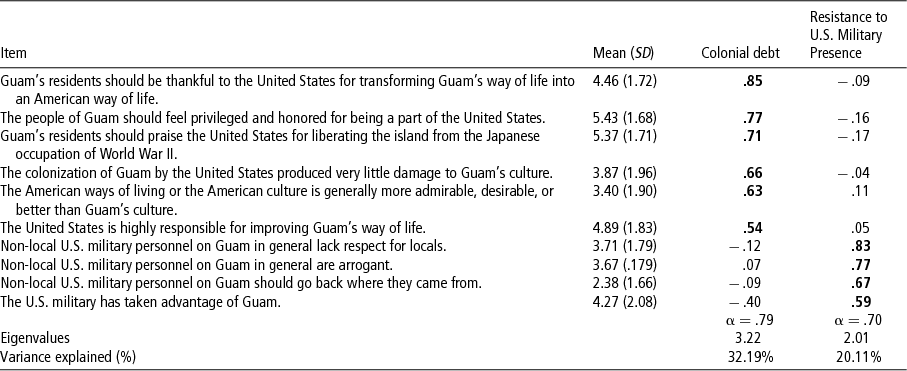
Note: Bolded values indicate the items loading on the two respective factors.
Means, Standard Deviations, Alpha Scores, and Factor Structure From a Principle Component Analysis for the Attitude Items Measuring Economic Benefits and Environmental Risks Regarding the Military Buildup
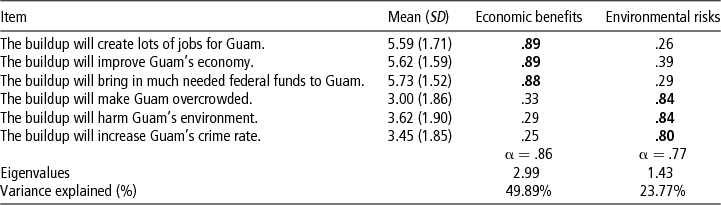
Note: Bolded values indicate the items loading on the two respective factors.
Respondents were asked to rate how trustworthy are (a) U.S. military officials and (b) U.S. mainland politicians as information sources to learn about the buildup. Responses to these two items were measured along a 7-point Likert scale (1 =
Finally, age, gender, income, education level, ethnicity, and level of interest regarding the military buildup (1 =
Results
Correlation Matrix for Zero-Order Correlations Between Key Variables
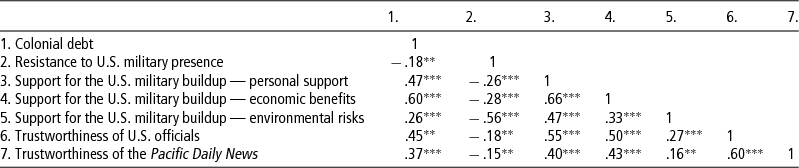
Note: **
Regression Results (Standardised Coefficients) for Colonial Debt as a Predictor of Trustworthiness of U.S. Officials, Trustworthiness of the
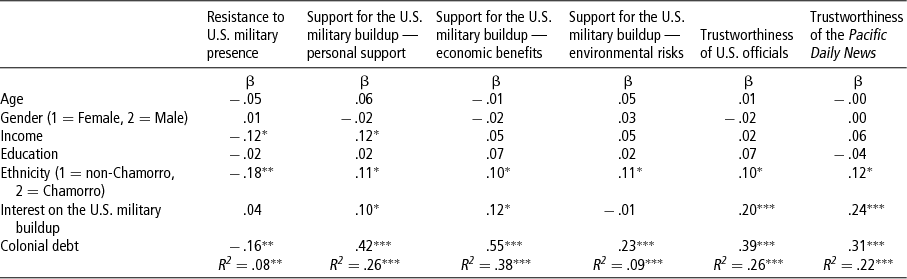
Note: *
Regression Results (Standardised Coefficients) for Resistance to U.S. Military as a Predictor of Trustworthiness of U.S. Officials, Trustworthiness of the
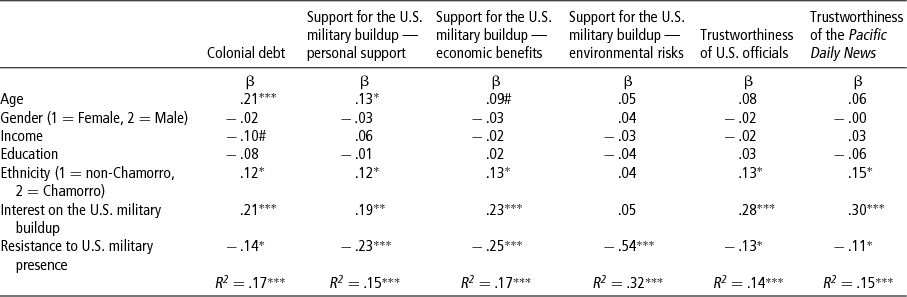
Note: #p < .10, *
Discussion
This study helps contribute to the current understanding of the psychological effects of colonialism and militarisation in Guam and the Pacific in several ways. First, results indicated that colonial debt was associated with greater support for the U.S. military buildup. Specifically, higher levels of colonial debt were associated with greater personal support for the buildup, and greater endorsement for the stances that the buildup will be economically beneficial to Guam and will not pose environmental risks to the island. In addition, this study's findings show that colonial debt was related to less resistance to U.S. military presence. As noted, colonial debt is an acceptance of oppression; it is the tendency among members of colonised groups to feel fortunate for having been colonised (David, 2011). The present study provides evidence that at least in the case of Guam's residents, their sense of debt toward the U.S. as a coloniser could be linked with their willingness to endorse U.S. military interests.
Second, the present study suggests that higher resistance to U.S. military presence was associated with less personal support for the buildup and less endorsement for the stances that the buildup will be economically beneficial to Guam, and will not pose environmental risks to the island. These results were not surprising as resistance to U.S. military presence was expected to be inversely associated with support for the buildup.
Third, it was expected that U.S. officials and the
A few limitations of this study should be noted. First, because causality cannot be established in the use of cross-sectional data such as the approach adopted in the present study, experiments need to be conducted to test the causal claims made above. Second, the sample for this study only included registered voters, lacking adequate coverage and representation of the entire adult population on Guam. This demands that future research analyse data from both registered and non-registered voters. Along similar lines, one may ask whether the findings of this study can apply to other cultures, such as those of other islands (e.g., Puerto Rico, American Samoa) that have also experienced long histories of American colonialism. Thus, researchers could test whether the findings of this study can be generalised across other areas around the world. Finally, one could argue that the present study's focus on colonial debt and resistance to U.S. military presence may be too simplistic, as this focus fails to capture the complex, multi-dimensional, and ambivalent nature of attitudes toward U.S. military presence. In particular, for the four items measuring resistance to U.S. military presence, as these items were couched in negative terms, there is a potential that it may have caused response bias (e.g., respondents skipped the question). Thus, these items could have been couched in both positive and negative terms. Therefore, more research is warranted with a focus on the development of multi-dimensional measures that capture the ambivalent and complex nature of attitudes toward U.S. military presence on Guam.
In spite of these limitations, the present study has some implications. On a theoretical level, the present study's findings imply that both colonial debt and resistance could influence Guam residents’ support of the presence of the U.S. military on their island and their ratings of the trustworthiness of information sources supportive of military presence. More sophisticated theoretical models can be developed that incorporate the influence of these two variables on other types of attitudes and ratings of perceived trustworthiness of other information sources—notably, those that may be less supportive of the buildup. In light of recent plans to increase the presence of the U.S. military in the Pacific region, the knowledge produced by this study may be generalised to other places where similar military buildups might occur in the coming years (e.g., the Commonwealth of Northern Marians Islands [see Eugenio, 2013]) and other islands where the U.S. military has historically been present (e.g., Hawaii). For instance, the knowledge produced by this study may help increase cultural understanding about the social and political impact of colonial debt and resistance for residents affected by these military buildups and U.S militarisation.