






Abstract
The aim of this study was to explore possible synergies between research on motivational interference and time perspectives. A conceptual model relating individual differences in time perspectives to motivational interference during studying and leisure and academic achievement was tested. Filipino college students (N = 385) participated in the study. Results from the path analysis indicated that future time perspective was positively associated with motivational interference during leisure and negatively associated with motivational interference during studying. Moreover, future time perspective also positively predicted academic achievement. Present fatalistic and past negative time perspectives were positively associated with motivational interference during studying. Present hedonistic time perspective negatively predicted motivational interference during leisure. Motivational interference during studying, in turn, was negatively associated with academic achievement. Implications are discussed.
Keywords
‘Should I be studying or would I be better off partying with my friends?’ ‘Should I spend the night working on my homework or should I just slack off and go to my friend's place?’ Studies have shown that students face these types of school–leisure conflicts quite frequently (Fries, Schmid, Dietz, & Hofer, 2005; Randel, Stevenson, & Witruk, 2000). When students have to choose between two alternatives and even when they end up choosing one of the two mutually incompatible goals (e.g., school vs. leisure goals), they may experience motivational interference during the performance of the chosen action.
Motivational interference refers to the ‘cognitive, affective, and behavioural impairment of a chosen activity as a result of the motivational properties of a non-chosen alternative’ (Hofer, Schmid, Fries, Kilian, & Kuhle, 2010; p. 623). It has been found to be related to important outcomes such as academic achievement, persistence, concentration, learning strategies, mood, time invested in studying, and life satisfaction among others (Fries et al., 2005; Hofer, 2007; Hofer, Kuhnle, Kilian, Marta, & Fries, 2011; Kuhnle, Hofer, & Kilian, 2010; Ratelle, Vallerand, Senecal, & Provenchel, 2005).
Given the prevalence and importance of motivational interference, it is surprising that it has received only minimal attention from educational researchers. Moreover, the few studies that did investigate it focused exclusively on the role of values as precursors of motivational interference with other possible antecedents being mostly neglected. The overall aim of this study was to examine a theoretically derived model that elucidates the antecedents and consequences of motivational interference. We proposed a conceptual model that integrates two theoretical frameworks: motivational conflict theory (Hofer, 2007; Hofer et al., 2007) and time perspective theory (Zimbardo & Boyd, 1999, 2008).
The theoretical and empirical literature dealing with motivational interference and that dealing with time perspectives have mostly proceeded in parallel, with little cross-over of ideas. To the best of our knowledge, there is no research at present that has attempted to unify these two lines of inquiry within one study. It is possible that different types of motivational interference derived from motivational conflict theory may align themselves with distinct time perspectives. Examining the potential synergies between these two frameworks may shed important light into the interrelationships and mediating mechanisms among crucial variables and provide substantial theoretical yields to the academic motivation literature. It may also have practical implications for teachers who are interested in encouraging students to choose academic goals and in shielding them from the interference of leisure alternatives.
Motivational Conflict Theory
A central premise of motivational conflict theory is that students pursue a multitude of goals at different times making them susceptible to motivational interference (Hofer, 2007; Hofer et al., 2007). Because resources are limited, the pursuit of one goal necessarily takes energy away from the competing goal. Motivational interference arises when a student has to decide between two highly valued goals, or may occur when a student is already performing an activity and another opportunity comes into play.
Hofer and his colleagues (Hofer, 2007; Hofer et al., 2011; Hofer et al., 2007; Hofer et al., 2010; Hofer, Schmid, Fries, Zivkovic, & Dietzv, 2009) proposed two types of motivational interference which are relevant for students: motivational interference during studying and motivational interference during leisure. Motivational interference during studying is experienced when students choose academic goals over leisure goals. However, as a consequence of this choice, the non-chosen leisure alternative becomes increasingly attractive and may lead students to become distracted and engage in superficial learning. On the other hand, motivational interference during a leisure activity is experienced when students choose leisure over academic priorities. As a consequence, students may feel guilty and distracted because they may perceive that they should be studying instead.
Previous studies have emphasized the role of different values as precursors of motivational interference. For example, researchers have found that students with high achievement values (emphasis on effort and success) were more likely to experience motivational interference when engaged in leisure activities. On the other hand, students with high well-being values (emphasis on free choice, friends, and satisfaction) were more likely to experience motivational interference when studying. They also found that students who had high hedonistic values were more likely to experience interference when studying after having decided to forgo some leisure activities (Hofer, 2007; Hofer et al., 2011; Hofer et al., 2007; Hofer et al., 2010; Hofer et al., 2009).
Time Perspective Theory
Time perspectives represent stable individual differences that represent a cognitive bias toward a particular temporal state (Zimbardo & Boyd, 1999). Zimbardo and Boyd (1999) claimed that time perspectives consist of five factors: past-positive, past-negative, present-fatalistic, present-hedonistic, and future-oriented. Past-positive reflects the extent to which an individual has a positive view of the past, while past-negative reflects a generally negative view of the past. Present-fatalistic reflects a fatalistic attitude and emphasises the present time, while the present-hedonistic reflects the extent to which an individual adopts a ‘hedonistic, risk-taking, “devil may care” attitude toward time and life’ (p. 1275). The future perspective, on the other hand, ‘reflects a general future orientation’ (p. 1275).
Research on time perspectives posits that the continual flow of personal and social experiences are allocated into different temporal loci that help bestow unity, coherence, and meaning to those events. They are used in ‘encoding, storing, and recalling experienced events, as well as in forming expectations, goals, contingencies, and imaginative scenarios’ (Keough, Zimbardo, & Boyd, 1999; p. 150). People differ in terms of which temporal frame they favour, which lead to these time perspectives becoming stable dispositional tendencies.
Educational psychologists have studied how time perspectives relate to educational outcomes (Husman & Lens, 1999; Kauffman & Husman, 2004). For example, Phan (2009a) has shown that having a future time perspective is associated with more adaptive study strategies (see also Phan, 2009b). Horstmanshof and Zimitat (2007) showed that future time perspective is associated with hours spent studying and meaningful approaches to learning. Studies conducted by Barber, Munz, Bagsby, and Grawitch (2009) and by Zimbardo and Boyd (1999) demonstrated that college GPA is positively correlated with future time perspective. In general, these studies show that a future time perspective is beneficial for academic motivation and learning. However, a limitation of these studies is their exclusive focus on the future time perspective dimension and the neglect of the other temporal dimensions. Another limitation is the lack of studies that investigate the psychological mechanisms that elucidate how time perspective is mediated by more proximal academic-related variables through which time perspectives influence outcomes. This study aims to address these gaps by including the five types of time perspectives in Zimbardo and Boyd's (1999) model and by positing motivational interference as a possible mediator of the effects of time perspectives on academic outcomes.
Linking Motivational Conflict Theory and Time Perspective Theory
Zimbardo and Boyd's (1999) distinction between future time perspective and present time perspective (which includes present-fatalistic and present-hedonistic time perspectives) may be especially relevant to the issue of motivational interference. School–leisure conflict is likely to make students aware that they need to weigh actions that serve mutually incompatible ends. Time perspectives can thus help in prioritising and in coping with goal conflicts. For example, students who are future oriented are more likely to prioritise the importance of long-term academic goals while those who are present oriented may be more likely to prioritise non-academic goals that can lead to immediate gratification and enjoyment. It seems plausible to assume that individual differences in time perspectives may serve as antecedents of motivational interference.
Schooling is an inherently future-oriented enterprise (Bembenutty, 1999; Bembenutty & Karabenick, 2004; McInerney, 2004). For one to succeed in school, one needs to learn how to prioritise long-term goals and choose them over more immediate options that would lead to satisfaction in the present (Bembenutty & Chen, 2005; Bembenutty & Karabenick, 1998). Thus, it is quite likely that a future orientation would be related to less motivational interference during studying. A student with a future orientation would be less distracted by leisure alternatives when he/she is engaged in studying.
Choosing academic goals may not necessarily lead to enjoyment in the present moment. For example, choosing to study instead of partying may pay future dividends in the form of good grades (in the near future) and even a good career (in the more distant future), but is not likely to lead to immediate gratification (having fun in the party now) (Bembenutty, 1999). Therefore, it seems plausible to assume that present-oriented individuals may be more distracted when they are engaged in studying.
In the case of motivational interference during a leisure activity, students with a future orientation are more likely to experience conflict when they are engaged in a leisure activity because they are more likely to think that they should be studying instead of having fun. Conversely, students with a present orientation are less likely to experience motivational interference during leisure activities as they are more inclined to prioritise present enjoyment over the consequences of their actions for the future.
There is a dearth of studies investigating the relationship of past time perspectives (past positive and past negative) to academic motivation and learning. However, we still decided to include them in this study given that certain people do endorse past time perspectives. It would be of theoretical interest to see how these time perspectives would relate to motivational interference and academic achievement.
Motivational Interference, Time Perspectives, and Academic Achievement
Both time perspectives and motivational interference have been found to be related to academic achievement. Future time perspective has been found to be related to higher marks while present time perspective has been found to be related to lower academic achievement (Zimbardo & Boyd, 1999, 2008). Motivational interference during studying has been found to be negatively related to academic achievement, while motivational interference during leisure is positively related to academic achievement (Hofer et al., 2011).
In this study, we examined an integrative model that posits time perspectives as antecedents, motivational interference as mediators, and academic achievement as the outcome variable. The designation of time perspectives as antecedents and motivational interference as mediators that influence academic achievement outcomes is in line with most of the studies in the educational psychology literature, which has shown that distal dispositional traits influence more proximal motivational constructs that then impact subsequent academic achievement (see Winne & Nesbit, 2010, for a review).
Hampson's (2011) framework on how individual differences influence outcomes can serve as a useful heuristic for conceptualising the relationships among the variables in this study. She argued that broad dispositional tendencies or personality traits usually exert their influence on outcome measures through more proximal mediating mechanisms. Taking into account possible mediators thereby provides greater theoretical clarity by elucidating how traits become translated into outcomes or how they ‘get out of the skin’ (Hampson, 2011, p. 315). She argued that the elucidation of mediating mechanisms offers a significant advantage over trait-outcome studies that fail to shed light on the process mechanisms.
The Present Study
In the present study, the relations among time perspectives, motivational interference, and academic achievement are analysed. The general assumption is that individuals are differentially susceptible to motivational interference depending on their time perspectives and that different types of motivational interference (during studying vs. during leisure) will lead to subsequent differences in academic achievement.
With regard to the relationship between time perspectives and motivational
interference, we posited that: H1: Future time perspective would be negatively associated with
studying motivational interference and positively associated with
leisure motivational interference. H2: Present-hedonistic time perspective would be positively
associated with studying motivational interference and negatively
associated with leisure motivational interference. H3: Present-fatalistic time perspective would be positively
associated with studying motivational interference and negatively
associated with leisure motivational interference.
Note that we did not specify hypotheses with regard to past-positive and past-negative time perspectives, due to the lack of research on how these past dimensions are related to academic outcomes.
We assumed that the experience of motivational interference during study-leisure
conflict will influence subsequent academic achievement, which led to the
following hypotheses: H4: Studying motivational interference would be negatively associated
with academic achievement. H5: Leisure motivational interference would be positively associated
with academic achievement.
Methods
Participants
A total of 385 university students from a university in Metro Manila, Philippines 1 participated. There were 211 (54.8%) males and 174 (45.2%) females. The average age was 17.66 (SD = .97). The majority of the students were in their first year of undergraduate studies (257), while the rest were evenly distributed among second, third, and fourth year students. Students were also evenly distributed across different colleges/faculties such as Arts, Social Sciences, Business, and Engineering, and Science. Most of the students from this university are in the middle to upper class range in terms of SES.
Instruments
Time perspective
The Zimbardo Time Perspective Inventory (ZTPI; Zimbardo & Boyd, 1999) was used to measure past positive (‘On balance, there is much more good to recall than bad in my past’), past negative (‘I often think of what I should have done differently in my life’), present hedonistic (‘I believe that getting together with one's friend to party is one of life's important pleasures’), present fatalistic (‘Fate determines much in my life’), and future (‘I believe a person's day should be planned ahead each morning’) time perspectives. It is a 56-item scale with each time perspective assessed on a 5-point Likert scale with higher scores indicating a greater degree of endorsement (1 = very untrue of me, 5 = very true of me).
Motivational interference
To assess motivational interference, vignettes depicting concrete school–leisure conflict situations were used. These questionnaires were adapted from Hofer et al.'s (2007; 2010; 2011) studies. In the present study, we contextualised the school–leisure conflict to pertain to the students’ English classes, given that students in this school perceived their English classes to be particularly difficult due to the heavy paper requirements (Gaerlan, 2010; personal communication).
The vignette described a conflict situation contrasting the school-related activity ‘working on papers’ for the English class with the leisure-related activity ‘meeting friends’: ‘Imagine you are sitting at your desk and are about to start working on a paper for English class. The telephone rings and one of your friends is calling to ask, whether you want to join him/her and have some fun. He/she's about to drop by and pick you up.’
After the presentation of the vignette, students were asked to imagine that they had chosen the school-related activity (‘Assume you stay home and worked on your papers and you don't meet your friends. What will happen?’). Then, the students answered 14 items about their assumed mood and behaviour in that hypothetical situation on a 4-point Likert-type response scale ranging from 1 (strongly disagree) to 4 (strongly agree). The items depicted the following mood states and behaviors: (a) distractibility (e.g., ‘While working, I'll be easily distracted’), (b) shallowness of processing (e.g., ‘I'll soon be completely absorbed in working so that I won't think about anything else’; item reverse scored), (c) low persistence (e.g., ‘It'll be very hard for me to keep on until the end’), (d) switching (e.g., ‘I'll switch between working and other activities’), (e) mood (e.g., ‘I'll feel edgy, because there are so many nicer things in life than working on a paper’). The mean score for the whole scale was used to denote motivational interference during studying.
The same procedure was followed with respect to the leisure-related activity. Students were asked to imagine that they had chosen leisure over studying (‘Assume you decide to meet your friends and do not stay home and work on the paper. What will happen?’). Then they answered seven items about their assumed mood and behaviour in that hypothetical situation on a 4-point Likert scale. The items depicted the following mood states and behaviors: (a) mood (e.g., ‘I'll have a guilty conscience’) and distractibility (e.g., ‘Nothing will be able to distract me from my friends’; item reverse scored). The number of items was less than those for the motivational interference during studying because only these two aspects were deemed to be applicable to the leisure choice context.
Academic achievement
Students were asked to report their academic achievement for their English course. Marks were rated on a scale of 1 (lowest) to 4 (highest). While we acknowledge that self-reports of academic achievement are not as optimal as actual academic achievement obtained from school records, researchers have frequently resorted to self-reports when logistical and pragmatic concerns prohibit them from getting the actual achievement scores (e.g., Chan & Lai, 2006; Ruthig, Hanson, & Marino, 2009).
In general, studies have shown self-reports of achievement to be highly correlated with actual achievement, and thus serve as useful proxies of actual achievement. Using meta-analytic techniques, Kuncel, Crede, and Thomas (2005) found that the correlation between self-report measures of GPA and actual achievement among university students was r = .90, p < .001 across a wide range of studies.
Note that we used the English versions of the questionnaires for the current study. While Filipino (or Tagalog) is considered the first language of the majority of the students in our study, all students who participated were highly fluent in English, given that the university where we conducted our study was known for its strict admission requirements with regard to English language proficiency. English is used as the medium of instruction for almost all subjects (except Filipino) from the primary to the tertiary level for most Filipino students. Numerous studies have shown that the Filipino and English versions of psycho-educational instruments function equivalently in the Philippine context (e.g., Bernardo, Lising, & Shulruf, 2012; Ganotice, Bernardo, & King, 2012, 2013). Moreover, many studies conducted in the Philippines have also relied exclusively on English versions of questionnaires and found them to be adequate (e.g., Bernardo, Zhang, & Callueng, 2002; King, McInerney, & Watkins, 2012; King & Watkins, 2011; 2012; Watkins, Hattie, & Astilla, 1986).
Statistical Analysis
The data in the present study were analysed using path analytical procedures with AMOS 5.0 (Arbuckle, 2007). The scores for the individual items for each construct were averaged and used as manifest variables in the path analysis. We used the maximum likelihood method of estimation. Based on the recognition that a variety of fit indices would provide a better picture of model fit, different goodness of fit indices provided by AMOS were reported in the study such as the comparative fit index (CFI), Tucker Lewis index (TLI), root mean square error of approximation (RMSEA), and standardised root mean square residual (SRMR). For the CFI and TLI, values greater than .90 were deemed adequate, while for RMSEA and SRMR, values less than or equal to .08 were deemed adequate (Byrne, 2010).
To ensure greater rigour and to minimise the dangers associated with post-hoc model fitting, a cross-validation approach was adopted whereby the final model derived from the post hoc analyses in the exploratory sample was tested on a second independent sample (Cudeck & Browne, 1983). The cross-validation approach involved randomly dividing our sample into two parts (exploratory sample and cross-validation sample), each containing 50% of the cases. The hypothesised model was tested on the exploratory sample first. Post-hoc modifications were made to refine this model and the refined model was tested again on the exploratory sample. Next, this refined model with the post-hoc modifications was later tested on the cross-validation sample and the total sample.
We randomly divided the sample into two, an exploratory sample (N = 192) and a cross-validation sample (N = 193). We first tested the hypothesised model on the exploratory sample (Model A). The model was refined and tested again on the exploratory sample (Model B). Next, we tested this refined model on the cross-validation sample (Model C) and later the same refined model was tested on the whole sample (Model D). Model D is adopted as the final model for the study.
In this study, we posited motivational interference during leisure and during studying as mediators between time perspectives and academic achievement. These mediation effects were examined through bootstrapping (Preacher & Hayes, 2004).
A multi-group path analysis was also conducted to determine whether the results obtained for the exploratory and cross-validation samples were invariant. Evidence of invariance was needed to justify combining the exploratory and cross-validation samples into a pooled sample. We followed a stepwise procedure of imposing constraints in conducting the invariance test. First, we tested an unconstrained model where all the parameters were allowed to be freely estimated (Model 1). In the second model, we constrained the structural weights to be equal across the exploratory and cross-validation samples (Model 2). In the third model, we constrained the structural weights and structural covariances to be equal across the groups. In the fourth model, we constrained the structural weights, structural covariances, and residuals to be equal across both groups. Chi-square difference tests were used to determine whether the models were invariant. A significant chi-square difference would provide evidence of non-invariance, while a non-significant chi-square difference would provide evidence of invariance.
Results
Preliminary Analysis
Descriptive Statistics, Internal Consistency Reliabilities, and Bivariate Correlations Among the Relevant Scales
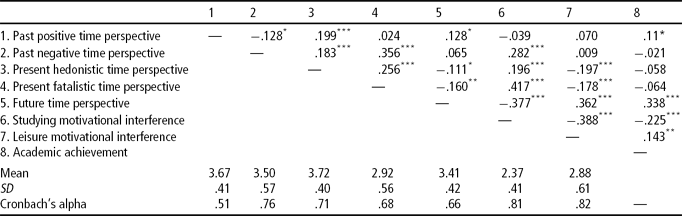
Note: *p < .05; ** p < .01; *** p < .001.
In the current study, skewness for the relevant variables ranged from −.99 to .03 and kurtosis values ranged from .01 to .82, all of which we deemed adequate. No ceiling effects were observed. Most of the scales had adequate internal consistencies except for the past-positive time perspective, which was less than ideal. Despite this, we decided to proceed with the analysis, given that past-positive is not one of the focal variables in this study. Future research would be needed to determine whether the past positive time perspective subscale could be improved for use among Filipino students.
The bivariate correlations indicate that present fatalistic and present hedonistic time perspectives were positively related to motivational interference during studying and negatively related to motivational interference during leisure. The opposite pattern was found for future time perspective. Academic achievement was positively related to motivational interference during leisure but negatively related to motivational interference during studying. Future time perspective was positively associated with academic achievement while present hedonistic was negatively associated with it. The sizes of the correlation coefficients were generally in line with previous research on time perspectives and motivational interference (e.g., Hofer et al., 2007; Zimbardo & Boyd, 1999).
Testing the Theoretical Linkages Among the Variables
In this study, the hypothesised model (Model A) could be summarised as: time perspectives → motivational interference → academic achievement. Future time perspective was posited to positively predict motivational interference during leisure and negatively predict motivational interference during studying (H1). On the other hand, present hedonistic and present fatalistic time perspectives were posited to positively predict motivational interference during studying and negatively predict motivational interference during leisure (H2 and H3 respectively). Studying motivational interference was posited to negatively predict academic achievement (H4), while motivational interference during leisure was posited to positively predict it (H5). We also added a path from present negative time perspective to studying motivational interference given their positive zero-order correlation. The error terms associated with motivational interference during studying and motivational interference during leisure were allowed to be freely correlated given the similarity in the format of the questionnaires used to measure this construct (i.e., vignettes). This model was first tested on the exploratory sample.
Goodness-of-Fit Indices for the Various Models

Note: 1 RMSEA = root mean square error of approximation; SRMR = standardised root mean square residual; TLI = Tucker-Lewis index; CFI = comparative fit index. 2 Model A (see Figure 1) was first tested on the exploratory sample. Post-hoc modifications were made on the model and retested again on the exploratory sample (Model B). This refined model was then tested on the cross-validation sample (Model C) and the total sample (Model D).
Invariance Testing for the Exploratory and Cross-Validation Samples

Note: The refined model (Model B) was found to be invariant across the exploratory and cross-validation samples which justified combining the two samples into one pooled sample.
After combining the data sets, we then tested the model on the whole sample and
we obtained good fit indices (Model D). Figure
1 shows the final model. Mediation effects in the model were tested
through bootstrapping and were all found to be statistically significant. In
this article, we focus only on the results for the total sample, which was
designated as the final model. Final model depicting relationships among time perspectives,
motivational interference, and academic achievement (Model D).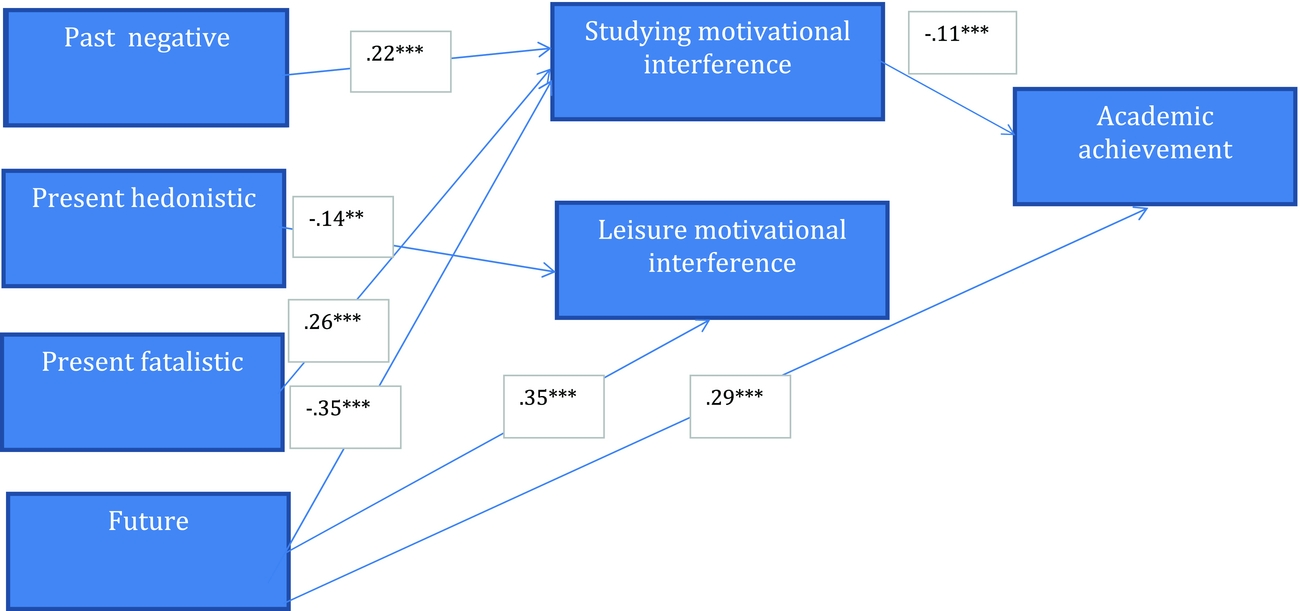
Discussion
Future time perspective was positively associated with motivational interference during leisure and negatively associated with motivational interference during studying, thereby confirming H1. Present hedonistic time perspective negatively predicted motivational interference during leisure, while present fatalistic time perspective positively predicted motivational interference during studying which partially confirmed H2 and H3.
These results indicated that time perspectives are predictors of motivational interference. This broadens the epistemic space explored by motivational conflict theorists who have mostly focused their attention on the impact of values on motivational interference (Hofer, 2007; Hofer et al., 2007). For time perspective scholars, this study highlights a possible pathway through which time perspectives influence academic achievement.
Previous research has found that time perspectives are correlated with academic achievement but has been unclear on the mechanisms responsible for this relationship (e.g., Zimbardo & Boyd, 1999, 2008). The present study shows that motivational interference may serve as a possible mechanism through which time perspectives exert their influence on achievement outcomes.
It seems to be the case that future time perspective is the most beneficial for academic motivation and achievement, while present hedonistic and present fatalistic time perspectives are not. Aside from the indirect effects of future time perspective on academic achievement, which was mediated by motivational interference, future time perspective also had a direct positive effect on academic achievement. This corroborates the extant literature in educational psychology, which has highlighted the importance of a future time perspective for academic outcomes (Bembenutty & Karabenick, 2004; Kauffman & Husman, 2004; McInerney, 2004).
This study also highlights the detrimental impact of present fatalistic and present hedonistic orientations on learning. Present fatalistic students believe they have limited influence on what happens in their lives. Thus, they are more likely to have an external locus of control that previous research has shown to be negatively related to academic engagement and achievement (Findley & Cooper, 1983; Joo, Lim, & Kim, 2013). In order to succeed in the school setting, students need to believe that they are in control of their lives and their academic outcomes. Decades of research conducted by motivational theorists on self-efficacy theory (Bandura, 1997), self-concept theory (Marsh & O'Mara, 2008) expectancy value theory (Wigfield & Eccles, 2000), attribution theory (Weiner, 1986, 2004), and control-value theory (Pekrun, Frenzel, Goetz, & Perry, 2007) proffer similar arguments about the importance of feeling in control for facilitating engagement and achievement.
Present hedonistic students, on the other hand, are more likely to be concerned with having fun and are less likely to be concerned with the impact of their current actions on future outcomes. They exhibit a carpe diem mentality, which explains why they are less likely to feel motivational interference during leisure activities and are more likely to feel motivational interference when studying as shown through the bivariate correlations.
We also found that past-negative time perspective positively predicted motivational interference during studying. It might be possible that students who have a negative view of the past have relatively lower levels of wellbeing, which is detrimental for academic pursuits. Their ability to concentrate may be weakened. Extant research has shown how affect and wellbeing are closely related to school engagement and achievement (Reschly, Huebner, Appleton, & Antaramian, 2008). Students who have a past negative time perspective are more likely to experience negative affect which has been shown to be detrimental to school functioning (Antaramian, Huebner, Hills, & Valois, 2010).
In terms of the relationship between motivational interference and academic achievement, we found that motivational interference during studying was found to be negatively related to academic achievement, thus confirming H4. H5, however, was not confirmed. Motivational interference during leisure was not found to be associated to academic achievement in the path analysis although there was a significant bivariate relationship.
Limitations and Directions for Future Research
This study has several limitations. First, we used a cross-sectional study design. Future studies could use longitudinal designs, which would enable researchers to draw stronger conclusions. Second is the exclusive use of self-reports in this study. Although the use of self-reports is quite common, it has a number of limitations (e.g., Podsakoff, MacKenzie, & Podsakoff, 2012). Future studies might consider employing different types of data such as behavioural observations or teacher and peer-ratings. Moreover, we only used self-reports to assess students'academic achievement. It is recommended that future studies consider use actual achievement outcomes instead. An additional limitation of this study is that all the students were drawn from the Philippines. Future studies could be conducted in other cultural contexts to investigate the generalisability of the results we obtained.
Another interesting avenue for further research would be the investigation of a balanced time perspective and how it relates to motivational interference and achievement. A balanced time perspective pertains to being able to draw on the appropriate time perspective on a given situation. It has been hailed as having a positive impact on wellbeing (Boniwell, Osin, Linley, & Ivanchenko, 2010; Boniwell & Zimbardo, 2003). However, to date, no previous study has investigated the relationship between a balanced time perspective and learning outcomes.
Conclusion
In conclusion, this study provides preliminary evidence of how individual differences in time perspectives, motivational interference, and academic achievement are related to each other. The relationships we found were mostly in line with theoretical suppositions. Results of our study suggest that how people construe time has an important influence on their learning motivation and achievement.
This study has several theoretical and practical implications. In terms of theory, this study enriched the extant literature by showing possible synergies between research on time perspectives and research on motivational interference that have largely proceeded in parallel without much cross-fertilisation. It can broaden the epistemic space explored by motivational interference researchers who have mostly focused their attention on values by showing that time perspectives could also have an important role in school-leisure conflicts. This study also clarifies the process mechanisms whereby individual differences in time perspective influence academic achievement.
In terms of practice, this study indicates that time perspectives may serve as optimal targets in educational interventions. Encouraging a future time perspective and discouraging both a present fatalistic and present hedonistic orientation may be especially beneficial. There has been some research showing how people's time perspectives could be changed (e.g., Ferarri, Nota, & Soresis, 2012) and educators may be able to apply these principles to promote better learning outcomes.
Footnotes
The academic demands placed on students in the Philippines are not as great as
those placed on East Asian societies (e.g., China, Korea, Japan) where
high-stakes examinations are prevalent. In the Philippines, the educational
culture is more relaxed and Filipinos have a wide range of options to choose
from when entering university (Bernardo & Ismail, 2010). A survey of higher education institutions in
the Philippines indicated that most institutions adopt rather minimal admission
requirements and most institutions admit practically all applicants (Science
Education Institute, 2001). Moreover,
Filipino students are known to be collectivist in orientation and place great
emphasis on affiliation and social acceptance in the school context (Church
& Katigbak,  ).
).