




Abstract

Clinical Presentation
An 18-y-old man was found in the tundra approximately 45 km (28 mi) south of Kotzebue, Alaska, following a 4-d search by regional search and rescue. He was wrapped for insulation and transported supine to the local emergency department. On arrival, the patient was able to speak and was maintaining a patent airway. The primary survey was significant for delayed capillary refill and Glasgow Coma Scale score of 14. The patient’s only verbal response was to ask repeatedly for something to drink, and he was unable to initially provide any historical details. His heart rate was 146 beats/min (sinus tachycardia), respiratory rate 22 breaths/min, blood pressure 105/74 mm Hg, and temperature 30.5°C (87°F) rectally. Pulse oximetry reading was not obtainable. He was not shivering. He was fully exposed. The secondary survey was significant for right periorbital ecchymosis, cyanosis of the tip of the nose, and dry mucous membranes. His left hand was dusky, mottled, and with a waxy appearance (Figure 1). The right hand and feet appeared similar to the left hand.
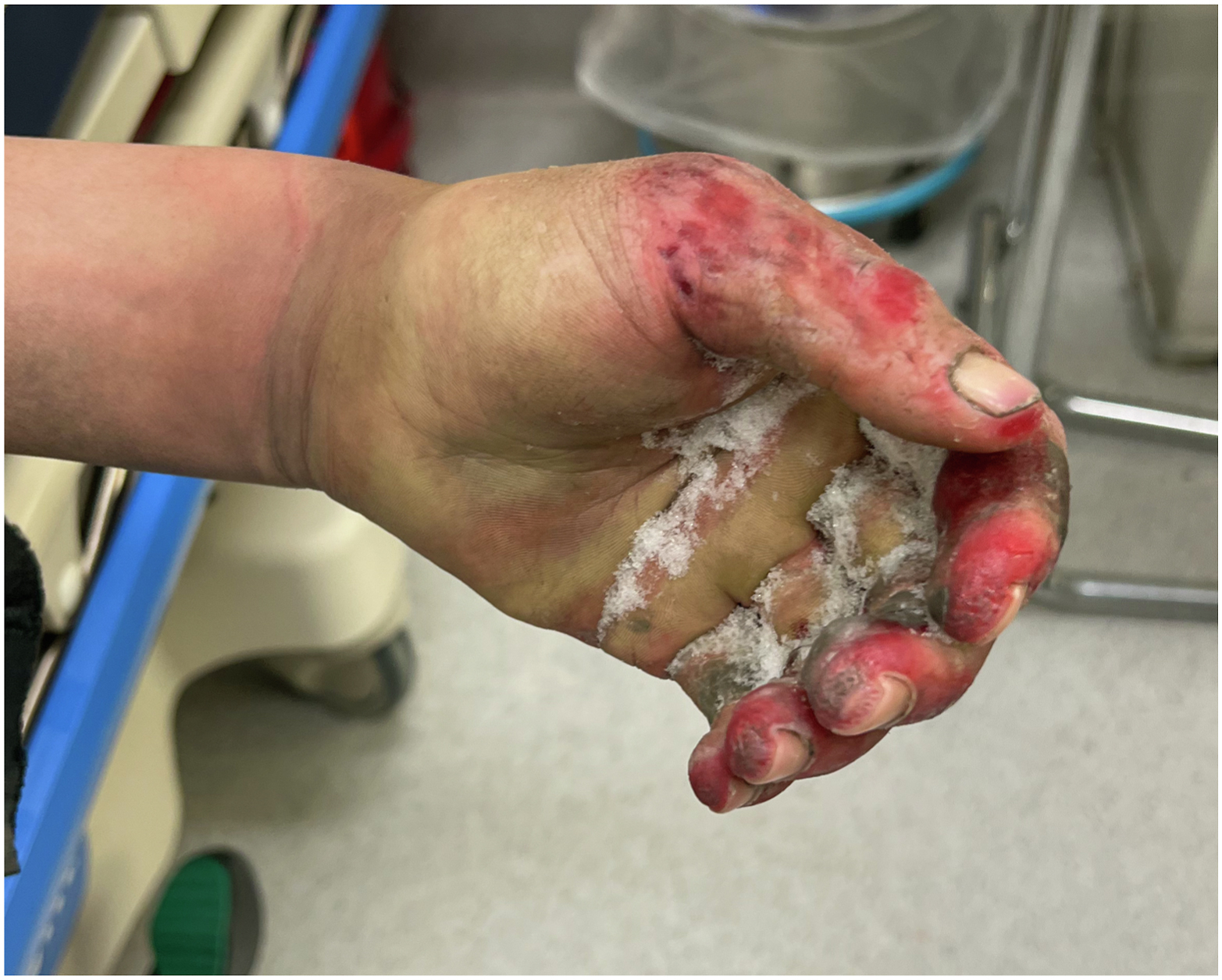
Patient's left hand upon arrival to the emergency department.
What is the diagnosis? How would you treat this patient?
Diagnosis
Deep frostbite involving both hands and both feet.
Hospital Care
This patient was missing for 4 d. He was found several kilometers from his snow machine with altered mental status. During his exposure in the Alaskan Arctic, overnight temperatures reached −46°C (−50°F). He was wearing a 1-piece suit with multiple layers underneath, thick gloves, and snowmobile boots. He arrived hypothermic and significantly dehydrated. As a precaution against hypothermic myocardial irritability, he was handled gently and kept supine throughout the initial care. His boots were frozen to his feet. Both hands were dusky, with contractures of the digits, and frozen solid to the touch.
Two large-bore IVs were established and warmed normal saline infused. His clothing was removed. He was covered with warm blankets and treated with forced air rewarming using a Bair Hugger. A urinary catheter was placed for warm saline irrigation. His hands were placed in plastic basins filled with warm water at approximately 38°C (100°F). Because the patient was supine, rewarming of his feet was deferred. Once his rectal temperature reached 33°C (92°F) and his mental status normalized, he was placed in a seated position to facilitate immersion of his feet and removal of his boots. A noncontrast computed tomography scan of the head was obtained because the patient was confused and appeared to have facial trauma. This scan did not show intracranial hemorrhage. After the extremities were thawed, he received intravenous tissue plasminogen activator (tPA) for treatment of frostbite. He was then transferred to a tertiary care center.
Discussion
This patient with prolonged exposure to extreme cold was handled carefully until he was rewarmed to avoid provoking cardiac arrhythmia or causing vasodilation in the extremities leading to hemodynamic collapse. Ensuring that a hypothermic patient is handled gently and kept supine is critical to prevent rescue collapse. 1 He arrived conscious with a rectal temperature consistent with moderate hypothermia (28–32°C). Because his clothing was not soaked and transport time to the hospital was less than 1 h, he was appropriately “burrito-wrapped” in a vapor barrier by emergency medical services without removing his clothing.
Esophageal and epitympanic regions are the best locations for accurate measurement of core temperature. Esophageal monitoring is usually limited to patients with a secured airway. A “low-reading” rectal thermometer is likely accurate enough for initial core temperature evaluation. The same is true for bladder temperature monitoring. Rectal and bladder temperature measurements lag behind actual core temperature. The mental status of an awake patient should be followed closely during rewarming. 2
Because hypothermia can be life-threatening, treatment of hypothermia should be prioritized over treatment of frostbite. Active external and minimally invasive core rewarming was appropriate given the patient’s mental status. Active external rewarming methods include chemical, electrical, or forced air rewarming. Infusing warm (38–42°C) IV fluid is considered minimally invasive core rewarming. 1 It is not very effective but prevents heat loss to room temperature or cool IV fluids. Normal saline is preferred over Lactated Ringer’s solution because the cold liver cannot metabolize lactate. His initial creatinine level was 3.9 mg/dL, which improved to 1.1 mg/dL after several hours of saline infusion.
Combining warm blankets with forced air rewarming is superior to either approach individually. 3 There is no evidence to suggest that bladder lavage has significant benefit, but it may be considered if it does not detract from other therapies. Use of bladder lavage eliminates the possibility of using bladder temperature monitoring. If the patient is not intubated, heated humidified oxygen via a nasal cannula can be used as an adjunctive therapy. 2
The appearance of the extremities was consistent with deep frostbite. The frostbite injury was managed with warm water immersion. Because the frostbite injuries were severe, he was transferred to a tertiary care center. The extremities were sufficiently thawed when they changed from being hard with a pale white appearance to being pliable and dark-reddish purple. 2 Intravenous tPA was administered according to the Hennepin Protocol prior to transport after telemedicine discussion with the orthopedic consultant at the receiving hospital. 4 In severe frostbite, administration of thrombolytics should be accomplished as soon as possible. 5 Although the data are limited, early administration of systemic tPA at the sending facility is likely to produce the best outcome in severe frostbite. 6
The patient’s frostbite injuries ultimately resulted in a right midforearm amputation, right midfoot amputation, left below-the-knee amputation, and a left radiocarpal amputation. It can be difficult to assess salvageability immediately after thawing. Thrombolysis cannot revitalize tissues that are beyond salvage because of prolonged ischema. 7 The treatment team had to weigh the risks of thrombolysis against the potential benefits of an improved outcome of the profound frostbite injury of all 4 extremities.