






Abstract

I was born and raised in Kunde village in the Khumbu (Mount Everest) region of Nepal and attended school in Kathmandu. Kunde village is situated at 3790 m (12,434 ft), well away from the main trail to Everest Base Camp. It is a tiny village with about 70 Sherpa households and a population of just <400 people. Kunde has been continuously inhabited for about 4 centuries.
My interest in medicine was sparked by my own experience as a child. At the age of 4 years, I was diagnosed with an inguinal hernia and had to be taken to Kathmandu for surgery. When I was 8 years old, I developed severe abdominal pain. I was taken to Kunde Hospital, where I was diagnosed with acute appendicitis. The hospital was remarkably well supplied and self-sufficient but did not have the capability of performing major surgeries. I had to be taken to Kathmandu. There was no possibility of a helicopter evacuation. My parents gathered enough funds for a helicopter, but the helicopter could not fly because of bad weather. The nearest road was 125 km away, a 6-d walk. By the time I was diagnosed, my appendix had already ruptured; so, I was unable to walk. Instead, I was carried down a steep 20-km trail (usually a 10-h walk) to an airstrip in Lukla, strapped to a plastic chair, with a bamboo IV pole tied to the side. 1 I received morphine, phenylephrine, and antibiotics during the 36 h of walking and waiting for the flight to Kathmandu. As soon as I reached Kathmandu, I was taken to the hospital, where I underwent a successful operation.
I have little memory of the event, but I was reminded of my experience by my parents and the doctors who were at Kunde Hospital. At an early age, my answer to what I would want to be when I grow up would be a doctor. I wanted to be of help to other people from my community because only foreign doctors volunteered at the hospital during those times. I kept in touch with the doctors who had helped me. It was because of this incident that my parents decided to send me to a boarding school in Kathmandu. I was a sick child. Besides the appendectomy, I also had herniorrhaphy at the age of 4 years, for which I was carried to Kathmandu. The inaccessibility of a tertiary hospital and the need to be carried down every time I got sick worried my parents about my safety and care. Sending me to a boarding school would keep me away from them, but I would be safer and have easier access to health care. This turned out well because after coming to Kathmandu, I had to be operated twice for a thigh mass (hemangioma).
I did not plan to start my medical career at the top of the world, but that is how it happened. After I completed medical school and internship in Manila, I was recruited to work at the Gorak Shep clinic near Everest Base Camp. Gorak Shep (5180 m [16,000 ft]) is the last village on the way to Everest Base Camp in Nepal. The only way to get there is by helicopter or trekking for at least 8 d. The Gorak Shep clinic was established to help trekkers and mountaineers who visit the Everest region during spring and autumn trekking seasons. The founders of the clinic saw a need to provide medical care at this remote spot, 3 km from Everest Base Camp (Figure 1). Thousands of people dream of completing their bucket lists by seeing Mount Everest and visiting the base camp.
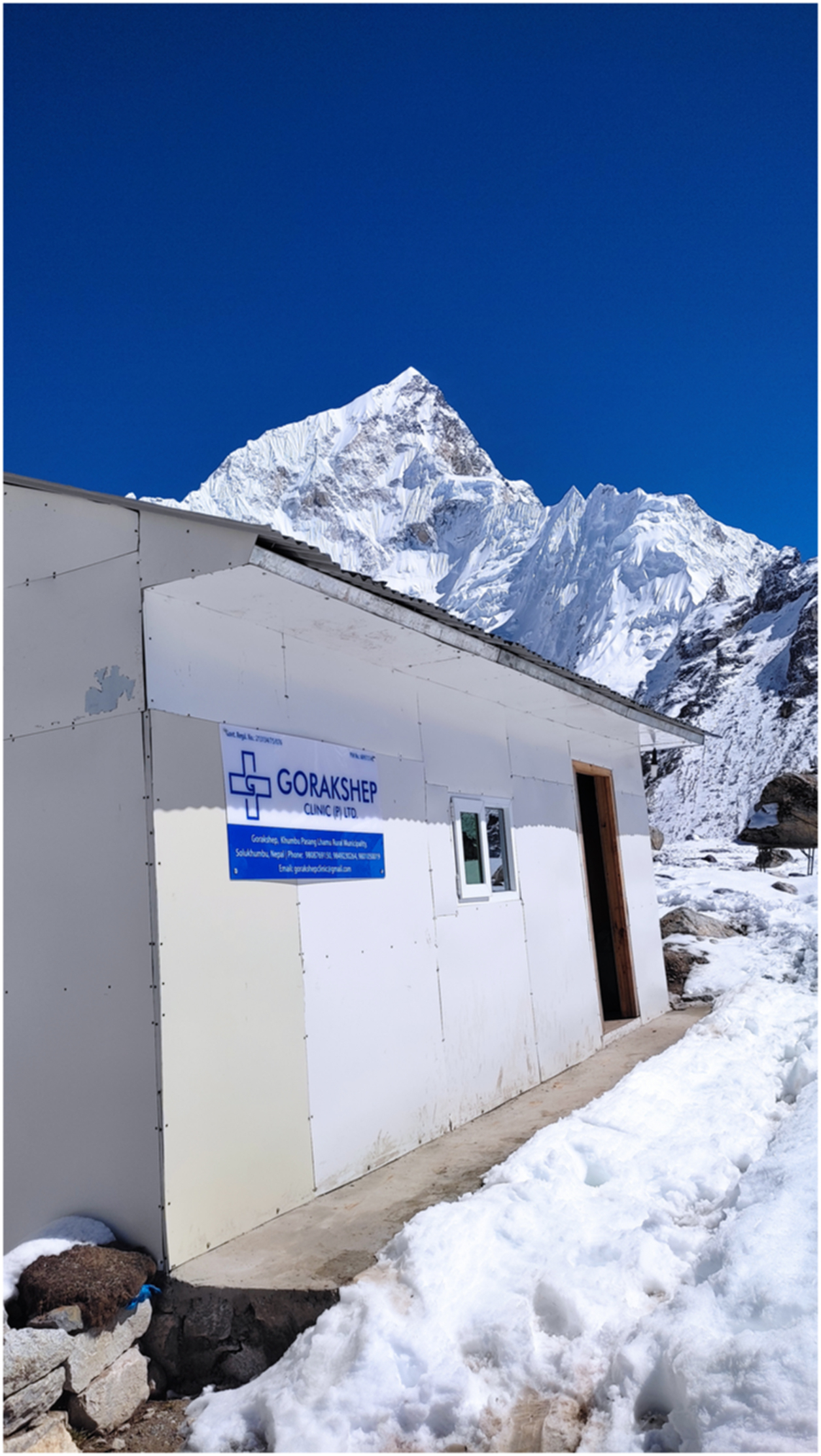
Gorak Shep clinic. Photo courtesy of Nima Ongchuk Sherpa.
In the autumn of 2021, the organizers of the clinic faced many challenges, including complicated logistics and recruiting a doctor and health assistant. All equipment for the clinic was either airlifted or carried by porters to Gorak Shep. The health assistant and I installed everything ourselves. The only source of electricity is a solar panel. The clinic has 2 beds, an electrocardiogram machine, a cardiac monitor, a nebulizer, and an oxygen concentrator that can supply oxygen at up to 6 L/m. The pandemic seemed to be on the verge of stabilizing, and people were getting back to traveling. We expected that many people would need medical attention at Gorak Shep. I was asked to staff the clinic along with the health assistant Suresh Ghale. The clinic operated from October 5 until December 5, 2021. We opened the clinic daily and provided emergency services 24/7 (Figure 2). In the spring of 2022, we brought additional oxygen cylinders that could provide more oxygen than the oxygen concentrator. We also added more drugs in the pharmacy.
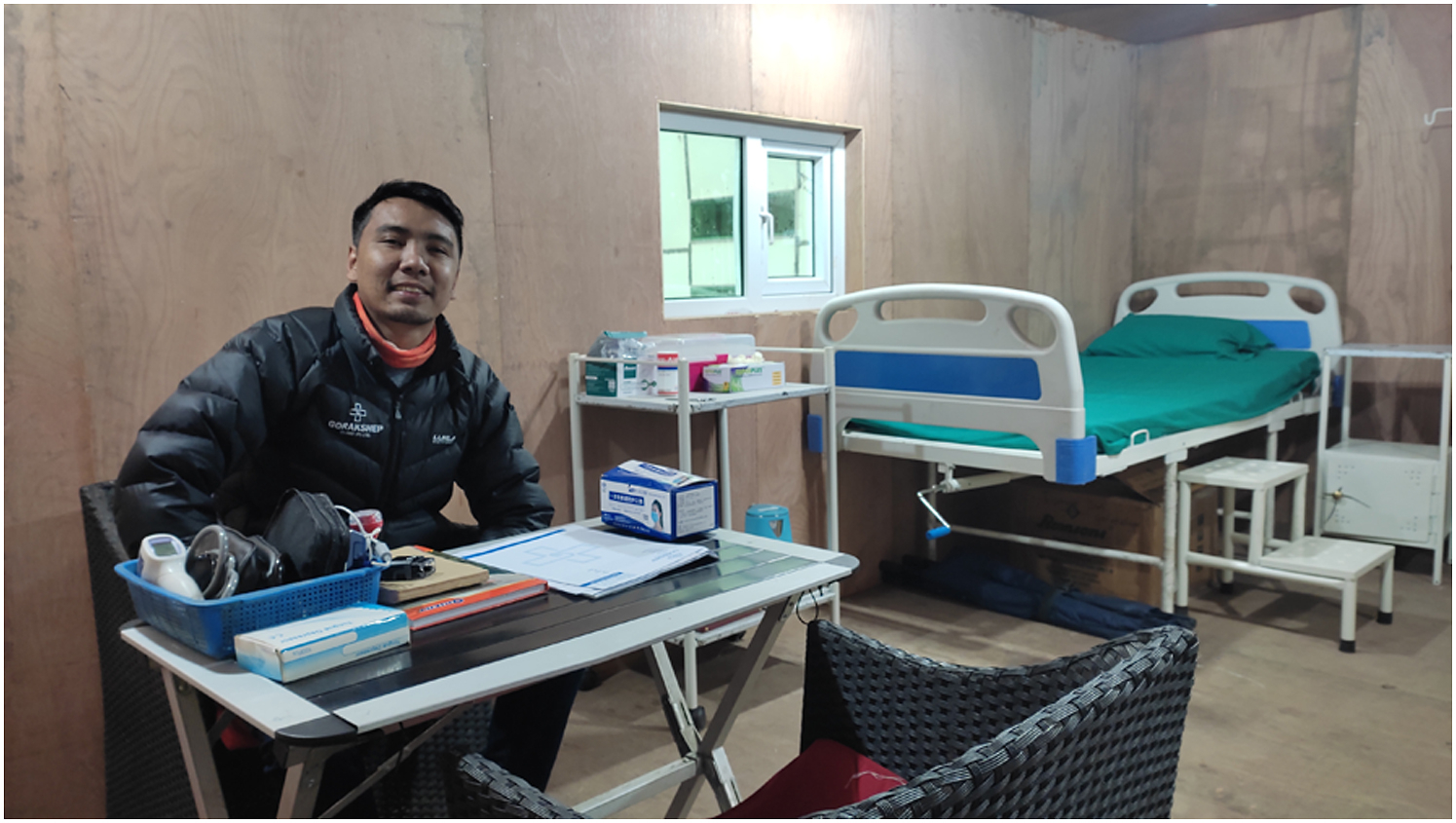
The author at the Gorak Shep clinic. Photo courtesy of Nima Ongchuk Sherpa.
During my medical training in Manila at 5 m above the sea level, cases of acute mountain sickness (AMS), high-altitude cerebral edema (HACE), and high-altitude pulmonary edema (HAPE) were found only in textbooks. Believing that basic science is the foundation for clinical practice, I accepted the challenge of working at an altitude of 5180 m (16,000 ft), where I would be seeing cases that I had not encountered in my clinical rotations or during my internship. I did an observership at Kunde Hospital for 3 wk with Dr Kami Sherpa and Dr Mingma Kanchi Sherpa, who have been working for a long time in the Khumbu region. The hospital was built in 1966 by Sir Edmund Hillary at the request of the Sherpa community. At Kunde Hospital, I was able to see common medical conditions found in the Khumbu region. Suresh, the health assistant, already had experience working at high altitudes for 3 trekking seasons at Gokyo Clinic at 4750 m (15,884 ft).
The most common diagnosis at Gorak Shep was AMS. Among 70 patients seen in the clinic during the 2 mo, we diagnosed 23 patients with AMS. The primary treatment included oxygen and acetazolamide, with symptomatic treatment for headache, nausea, and vomiting. We also advised many patients to descend to lower altitudes.
In the Mount Everest region of Nepal, approximately 50% of trekkers who trek to an altitude of >4000 m (13,124 ft) in ≥5 d develop AMS. 2 Gradual ascent, with adequate time for acclimatization, is the best method for prevention of altitude illness.
In addition to AMS, the medical conditions that we encountered included upper-respiratory infection, acute tonsillitis, acute gastritis, acute gastroenteritis, and hypertension. We treated patients from about 15 different countries. Forty patients were Nepali, including local Sherpas, Nepali trekkers, and porters. We spoke English with the majority of our foreign patients and Nepali with most of the Nepali trekkers. I also spoke Sherpa with local patients. For patients who were unable to speak English, Nepali, or Sherpa, we asked their guide to translate.
Two patients with severe AMS whom we saw at the clinic were evacuated by helicopter to Kathmandu. Coincidentally, they had very similar presentations on different dates. Both presented with severe headaches, poor appetites, nausea, severe fatigue, and light headedness. Their room air oxygen saturations ranged between 50 to 66%. The normal oxygen saturation at Gorak Shep is about 71 to 85%. Both had Lake Louise scores consistent with severe AMS. There were no signs of HACE or HAPE. Both the patients were taking levothyroxine for hypothyroidism. They were taking the medication as prescribed but developed cold intolerance, which seemed to aggravate the symptoms of AMS. Both had been taking 125-mg acetazolamide once daily for the previous 5 d to prevent AMS. The recommended dose to prevent AMS is 125 mg twice daily. At the clinic, both were given oxygen through a nasal canula at 4 L/min, improving their oxygen saturations to 91 to 93%. Both received 250-mg acetazolamide, were kept warm, and were monitored overnight. In the morning, I initially advised both to descend to a lower altitude, but without supplemental oxygen, each of them developed shortness of breath and fatigue, which made it impossible to descend on foot. They had to be flown by helicopter to Kathmandu. They were hospitalized in Kathmandu, where they made full recoveries before returning to their home country, which happened to be the same for both.
Life in the mountains has been exciting, adventurous, and hard. Dealing with cold weather is difficult, but it is a privilege to help people in need and to be of service. Working in isolation, where referring to another service or discussing with a colleague was not possible, I have had to be analytical and innovative to provide effective care.
I worked at the clinic again during the spring season in 2022. The clinic was open for 3 mo, from the second week of March to the end of May. Currently, I am working in the emergency department in a hospital in Kathmandu and preparing for residency training.
Footnotes
Acknowledgment
The author thanks Ken Zafren, MD, Associate Medical Director of the Himalayan Rescue Association, for encouraging them to write this essay.
Financial/Material Support: None.
Disclosures: None.