






Abstract
Systemic symptoms resulting from exposure to members of the Lepidoptera order, such as moths, butterflies, and caterpillars, are known as lepidopterism. Most cases of lepidopterism are mild and result from dermal exposure to urticating hairs; ingestion is less common and generally more medically significant because the hairs may get embedded in the patient’s mouth, hypopharynx, or esophagus, leading to dysphagia, drooling, edema, and possible airway obstruction. In previous cases of symptomatic caterpillar ingestion reported in the literature, extensive efforts, including direct laryngoscopy, esophagoscopy, and bronchoscopy, were undertaken to remove these hairs. We review the case of a 19-mo-old previously healthy male infant who presented to the emergency department with vomiting and inconsolability after ingesting half of a woolly bear caterpillar (Pyrrharctia isabella). His initial examination was notable for embedded hairs in his lips, oral mucosa, and right tonsillar pillar. The patient underwent a bedside flexible laryngoscopy, which revealed a single hair embedded in the epiglottis, without significant edema. He was stable from a respiratory standpoint and, thus, was admitted for observation and IV dexamethasone without any attempt to remove the hairs. He was discharged in good condition after 48 h; at a follow-up visit 1 wk later, no remaining hairs were visible. This case demonstrates that lepidopterism secondary to caterpillar ingestion is amenable to conservative management and does not require routine removal of urticating hairs in patients who do not show signs of airway distress.
Introduction
Lepidopterism describes systemic manifestations of exposure to cocoons, caterpillars, moths, and butterflies. Most cases of lepidopterism are mild and result from dermal exposure to urticating hairs known as setae, which contain venom in some species. Dermal, mucosal, or ocular contact with setae typically produces local symptoms such as pain, erythema, and edema.1,2 Exposure typically occurs in outdoor settings, including both urban and wilderness environments. Although ingestion of caterpillars is rare, comprising <10% of cases in 1 poison center study of exposure to Lophocampa caryae, this exposure may have significant medical implications. 2 Although some patients remain asymptomatic, others present with pain, swelling, and redness at the site of exposure, drooling, refusal to drink, and/or urticarial rash. 1 -4 Airway edema necessitating urgent endotracheal intubation has also been described. 5 Treatment after ingestion often involves removal of setae, antihistamines, topical or systemic steroids, and antibiotics. 1 -4
In previous cases of symptomatic exposure to caterpillars reported in the English-language literature, setae removal was presented as a critical part of management. For example, in their poison center study of exposures to Lophocampa caryae, Kuspis et al 2 described 346 cases of symptomatic exposure; in each case, “initial patient management consisted of removal of hairs or spines,” including in 22 children and 1 adult with oral exposure. Pediatric oral exposures were managed by attempting setae removal with adhesive tape; 2 children were taken to the operating room for direct laryngoscopy and esophagoscopy to facilitate setae removal. The authors concluded that “removal of the defensive guard hairs (setae) or spines is the primary treatment.” Similarly, Lee et al 1 reviewed 8 cases of lepidopterism in children following caterpillar ingestion, and in all 8 cases, significant and invasive efforts—including direct laryngoscopy, bronchoscopy, and esophagoscopy—were undertaken in each case to remove setae. A subset of patients in each of these reports presented with drooling, dysphagia, and/or edema. Presumably, these efforts were undertaken in response to concerns that the patients’ clinical status would deteriorate or they would fail to improve if the setae remained in place; however, little has been published with regard to more conservative approaches. We present the case of a young child who was managed conservatively without any attempt to remove setae after ingestion of a woolly bear caterpillar (Pyrrharctia isabella; Figure 1). The patient’s mother provided informed consent for the publication of this case.
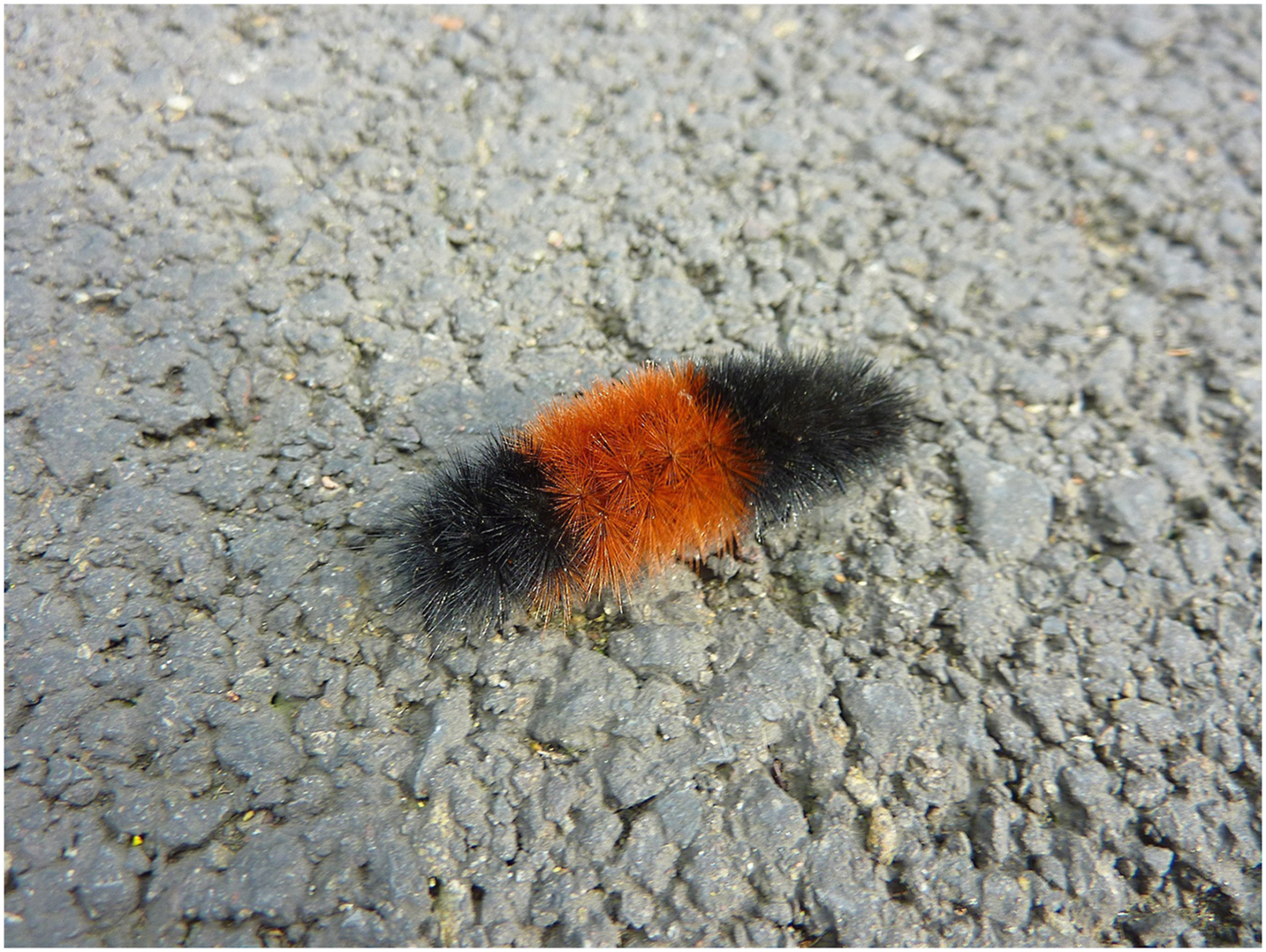
A representative woolly bear caterpillar (Pyrrharctia isabella).
Case Report
A previously healthy 19-mo-old male infant presented to the emergency department (ED) ∼90 min after ingesting half of a deceased woolly bear caterpillar. The caterpillar had been a friend’s pet, and as such, the species was known. Immediately after ingestion, the child began to cry and appeared to be trying to remove something from his mouth, but he had already swallowed the caterpillar. He subsequently vomited; his parents did not see the caterpillar in the vomitus. After remaining inconsolable for over an hour, his parents sought medical care.
The patient’s initial vital signs, obtained while he was crying, were notable for a temperature of 36.4°C, heart rate of 132 beats·min−1, respiratory rate of 32 breaths·min−1, blood pressure of 130/82 mm Hg, and oxygen saturation, determined using a pulse oximeter, of 97% on room air. His physical examination was notable for embedded setae in his lips, buccal mucosa, and right tonsillar pillar, with corresponding areas of erythema but no associated edema. Other than tachypnea in the setting of crying, the patient had normal pulmonary examination results and no evidence of respiratory distress, including no stridor, stertor, or increased work of breathing. After evaluation by the medical toxicology service, an otolaryngology (ear, nose, and throat [ENT]) specialist was consulted in the ED. The patient then underwent a bedside flexible laryngoscopy, performed by an ENT provider without sedation, which revealed an additional seta embedded in the laryngeal surface of the epiglottis, without significant edema.
After discussion among the ENT, medical toxicology, and ED providers, it was thought that the patient was stable from a respiratory standpoint such that he could initially be treated conservatively, with a period of observation. He received 13.5-mg·kg−1 oral acetaminophen for analgesia and a single dose of 0.5-mg·kg−1 oral dexamethasone prior to admission to the general pediatric medicine ward of a large, tertiary-care children’s hospital, with continuous pulse oximetry monitoring. He subsequently received 3 doses of 0.5-mg·kg−1 IV dexamethasone every 8 h and did not require further analgesia. Serial examinations of his buccal mucosa demonstrated no development of edema surrounding the embedded setae over time. As such, performing serial laryngoscopy to monitor for edema surrounding the seta in the epiglottis was not clinically indicated. He was allowed a clear liquid diet overnight and was able to tolerate sufficient intake to maintain hydration.
The following morning, the patient appeared comfortable and was able to tolerate oral intake of solid foods. He was observed for an additional day to ensure that he did not develop significant edema after cessation of steroids and was subsequently discharged in good condition. At a follow-up visit 1 wk later, his examination was notable for mild tonsillar edema, without visible setae; he otherwise appeared well, had normal vital signs for age, and had normal pulmonary examination results, without evidence of respiratory distress. At another visit the following week, his tonsillar edema had resolved, and the remainder of his examination yielded normal results.
Discussion
Members of the order Lepidoptera employ numerous defensive strategies to protect themselves from predators. From the human perspective, the most relevant of these are setae. Setae are sclerotized, cuticular projections composed primarily of chitin; they are typically sharp and often barbed such that once they penetrate human skin or mucosal tissue, they are difficult to remove. Some setae are hollow and contain venom, which is functionally “injected” when the fragile tip of the seta breaks off in the skin. 6
The composition of various caterpillar venoms has not been well studied outside of a few species, such as members of the Lonomia, Euproctis, and Thaumetopoea genera. Lonomia spp venom leads to a syndrome characterized by consumptive coagulopathy and renal failure, which is clinically distinct from lepidopterism. 7 Euproctis spp venom contains a number of enzymes with varying degrees of proteolytic, esterase, and phospholipase A activity, which, when injected into volunteers, clinically led to the development of both immediate and delayed hypersensitivity reactions.8,9 Early studies of Thaumetopoea spp indicated that crude setae extract presumably containing venom directly led to mast cell degranulation in vitro in a nonimmunoglobulin E (IgE)‒dependent manner; later case reports demonstrated that IgE-mediated hypersensitivity reactions also occur, clinically resulting in a spectrum of diseases ranging from urticaria to severe anaphylaxis.6,10
The degree to which the venom itself, as opposed to barbed setae or other anatomic components, is responsible for the clinical manifestations of lepidopterism is challenging to differentiate. Although studies of crude setae extracts and more refined venom extracts injected experimentally into animals and humans have confirmed that these extracts alone produce diseases, mechanical irritation of the lips, tongue, and hypopharynx after oral exposure to setae may lead to swelling of the irritated tissues, mimicking anaphylaxis. As such, the decision to attempt setae removal should not be based on the assumption that, if successful, the effects of venom or mechanical irritation will cease. Theoretically, attempting setae removal may lead to more venom “injection” if intact venom-containing setae tips are subsequently broken and may worsen mechanical irritation because of the difficulty posed by attempting to remove a barbed structure. In the only other case of oral exposure to a woolly bear caterpillar reported in the literature, when the authors attempted to remove setae with forceps and tape from an 8-mo-old female infant’s mouth under ketamine sedation, the patient began developing oropharyngeal edema, prompting transition to the operating room for direct laryngoscopy and intubation as well as ongoing setae removal. 3 The authors noted that “the spines were friable and difficult to remove, and care had to be taken to ensure that they did not break off and remain embedded within the mucosa.” As far as is known, woolly bear caterpillars do not produce any known toxin or venom (M. Deane Bowers, PhD, written communication, November 2020). As such, the worsening edema and eventual need for intubation were presumably due to worsening mechanical irritation precipitated by the attempts to remove the setae.
In contrast, in a Spanish-language case report, Casado Verrier et al 4 described the case of an 11-mo-old male infant who ingested a pine processionary caterpillar (Thaumetopoea pityocampa) and immediately developed lip and tongue swelling, which progressed to generalized facial swelling, drooling, and urticaria, without respiratory compromise. Because of the perceived difficulty of attempting setae removal from mucosal tissues and his lack of respiratory distress, he was managed with IV steroids, dexchlorpheniramine, and intramuscular epinephrine without any attempts to remove setae. He recovered over the following 48 h and was discharged 3 d after the initial ingestion, without incident.
Similarly, in our case, we elected not to attempt setae removal and instead opted for a 24-h course of IV steroids and an additional 24 h of observation; our patient recovered quickly and uneventfully. The mucosal layer harboring the embedded setae in our patient presumably sloughed off within a few days because no setae were visible at his follow-up visits. Ultimately, the decision to attempt or not attempt setae removal in a patient with lepidopterism secondary to ingestion of a member of the order Lepidoptera, regardless of whether or not the species is venomous, should involve a thorough consideration of risks and benefits, specifically with regard to the patient’s respiratory status and ability to tolerate oral intake, with the understanding that attempted removal may precipitate or worsen irritation and edema in anatomically dangerous locations. Flexible laryngoscopy, which is typically performed without sedation, is a low-risk procedure when performed by an experienced operator who can help identify patients who develop upper-airway edema after caterpillar ingestion. Our experience suggests that these cases are amenable to a more conservative approach, which offers clinicians and patients an alternative strategy for consideration.
Footnotes
Acknowledgment
The authors thank Dr M. Deane Bowers, PhD, Professor and Chair of the Department of Ecology and Evolutionary Biology at the University of Colorado, for sharing her expertise on the toxins and venoms produced by various caterpillar species.
Author contributions: drafting and critical revision of the manuscript (LSH, TL); critical revision of the manuscript (SAG, JB); approval of the final manuscript (LSH, TL, SAG, JB).
Financial/Material Support: None.
Disclosures: None.
Presented in poster format at the North American Congress of Clinical Toxicology, virtual format, September 2020.