






Abstract
The use of animals for therapeutic purposes is based on traditional beliefs, family pressure, and watching others appear to be cured. We report an unusual case of a 47-y-old man who choked to death after consuming a live slug. During autopsy, a 9.5-cm slug was found impacted in the tracheobronchial tree. History provided by the family revealed that the deceased consumed slugs in the belief that this would relieve his symptoms of chronic arthritis. We report this rare case to highlight the possible ill effects of such practices.
Introduction
People consuming animals or animal products based on folklore to cure their ailments is a common practice around the world. Although most of these alleged cures are not evidence based, there are reports of earthworms being consumed to increase breast milk 1 ; the use of “Naga oil” derived from cobras for erectile dysfunction 2 ; and leech therapy (bloodletting) as a cure for musculoskeletal, gynecologic, dermatologic, and hematologic diseases. 3 Likewise, the consumption of slugs for curing arthritis has been described. 4 For the treatment of joint pain, animals such as mongooses, earthworms, goats, gray hornbills, crow pheasants, and jackals have been reported to have been consumed by people in indigenous communities. 5 The use of animals for therapeutic purposes is based on traditional beliefs, family pressure, and watching others appear to be cured. 5 The reluctance to use modern medicine may be influenced by high treatment costs, side effects, travel costs, or hesitation to undergo treatment, while traditional healers are well known, are easily accessible, and do not charge prescription fees.4,5 We report a case of a middle-aged man who consumed a slug with the belief that it would cure his musculoskeletal pain but unfortunately caused him to choke to death.
Case Report
One afternoon during monsoon in Nepal, the police delivered the body of a 47-y-old man to our facility for autopsy. This was amid a stringent nationwide COVID-19 lockdown. The police inquest reported that the deceased had consumed a live slug after plucking it from a wall but could not swallow it and died. The autopsy revealed a normally developed male of average build. Rigor mortis was complete; livor mortis (dependent lividity) was posterior, purplish, and fixed; and there were no external signs of decomposition. Externally, no injuries were present, except for an abrasion on the right leg. Internally, the tracheobronchial tree was blocked by a slug facing upward and measuring 9.5 cm in length (Figure 1). All the other organs were intact and unremarkable. The cause of death was found to have been asphyxiation caused by the slug obstructing the airway.
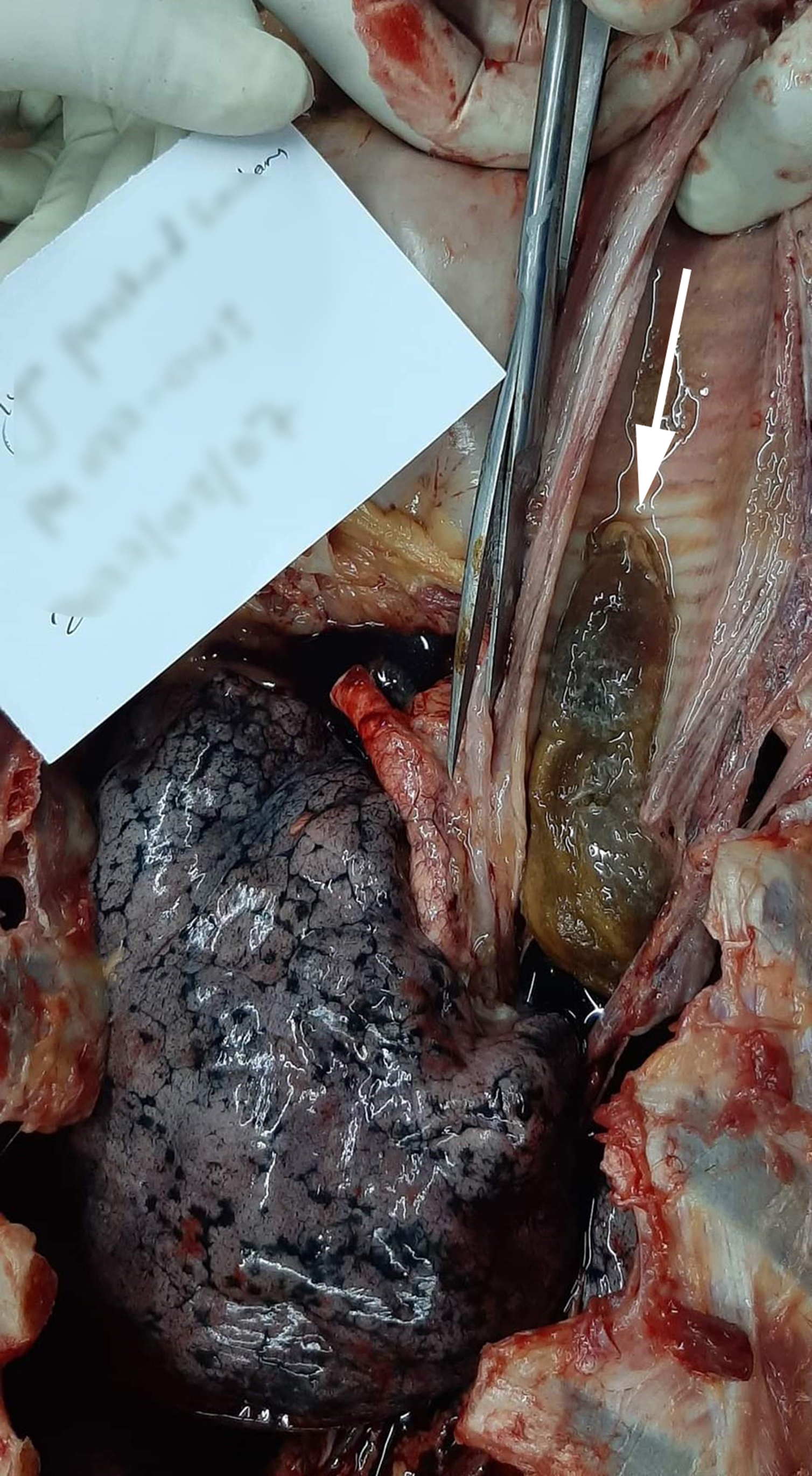
A slug (white arrow) is seen lodged in the trachea.
Discussion
Traditional folk medicine considers food as medicine and medicine as food. In Brazil alone, 354 wild animal species are used in traditional medicine. 6 Although modern medicine has seen some potential in animal-derived substances for a cure, many are still under trial. Traditional practices have contributed to a decline in wildlife populations. The killing of animals such as tigers, rhinos, sharks, sea turtles, and mountain gorillas for use in traditional medicine has increased the threat of extinction of these species.
Humans have been consuming slugs and other mollusks for thousands of years, especially for their nutritional value. 7 During the Roman empire, slugs were consumed because they were believed to have aphrodisiac effects. 7 Ancient Greeks also utilized the mucus slime of slugs for its supposed value in preventing aging. 7 Mucin, present in mollusk slime, is being studied and may have antimicrobial, antitumor, and wound-healing properties. 8 The consumption of snails, slugs, and other mollusks is very popular in countries such as China, Thailand, Vietnam, and Cambodia.9,10
Eating slugs has more deleterious effects than health benefits, however. Snails, slugs, and other mollusks are intermediate hosts for the nematode worm Angiostrongylus cantonensis, which causes human angiostrongyliasis. 10 The nematode affects the brain and spinal cord, causing eosinophilic meningitis, eosinophilic myelomeningoencephalitis, and, in rare cases, ocular angiostrongyliasis and sensorineural hearing loss.9,10 Angiostrongyliasis was also reported as a complication in a young man who consumed 2 slugs in Sydney, Australia, as a dare. 11
Traditional medical practice in Nepal is diverse. In the northern part of the country, folk medicine has influences from Tibetan and Chinese medicine, whereas in the south, there is greater influence from Ayurveda, Unani, and Indian folk medicine. In Nepal, rural geography hinders access to the healthcare system. Many people rely on folk medicine. Traditional healers and spiritual healers treat patients using knowledge passed down from their ancestors. There is little or no scientific basis for most of the treatments. After the treatment process is complete, the patient and their relatives believe that the disease has been cured. Relying on these faith healers can complicate the underlying disease and lead to worse outcomes.
During the COVID-19 lockdown, many people were restricted to their homes. Lacking transportation and fearful of infection, people relied heavily on folk medicine. 12 The victim in the present case might have chosen to ingest the slug to treat his long-standing joint pains. There is no scientific evidence that consuming slugs has any benefit for the treatment of arthritis. However, folklore passed from generation to generation may have played a part in the victim’s choice of therapy. 4 The present case occurred during monsoon in Nepal, when slugs are found in abundance.
Conclusions
The deep-rooted faith of the general public in folklore medicine cannot be easily abolished. However, training of faith healers and integration of complementary and alternative medicine into the modern medical system might benefit patients in the long run. 13 Recruiting more health workers in remote areas, setting up dedicated healthcare facilities with modern equipment, and creating awareness among the public that modern medicine is based on scientific knowledge might decrease the number of people believing in and practicing folk medicine.
Footnotes
Acknowledgements
Written informed consent was obtained from the deceased’s next of kin for the use of images and medical history for educational purposes, including publication.
Author Contributions: autopsy and study concept (SG, DS); literature review, writing, and editing of the manuscript (AA, TK, SK). All authors approved the final manuscript.
Financial/Material Support: None.
Disclosures: None.