






Abstract
Lightning is a natural weather phenomenon that occurs most commonly during the summer months in the afternoon or early evening. Lightning strikes can cause accidental deaths. In developed countries, lightning fatalities occur almost exclusively outdoors. Deaths from lightning may be in remote places with no witnesses. Forensic pathologists may not be able to reach the scene of death because it is too hazardous or inaccessible. Bodies may have neither evidence of skin burns nor torn areas on their clothes. The presumption of accidental death may be difficult to prove. We present 3 cases in which neither the examination of the death scene nor the examination of the bodies by those who attested to the death were performed. The bodies were transported to the morgue for a forensic autopsy because the deaths were considered suspicious. Physicians who attest to death in open spaces during weather that could produce lightning should actively search for Lichtenberg figures, which are considered irrefutable proof of fatal lightning in such settings. They should also photograph them and submit them as evidence. Nevertheless, physicians should keep in mind that Lichtenberg figures are not considered pathognomonic of lightning because some skin manifestations may mimic them.
Introduction
Lightning is one of the leading causes of weather-related deaths, occurring mainly during the summer, in the afternoon or early evening of stormy rainy days. 1 It is a transfer of an electrical charge of very high intensity (10,000–200,000 A) and extremely high voltage (20 million–1 billion V). The duration of a lightning discharge is approximately between 10 to 100 ms, exposing the body to intense heat (as high as 30,000°C) and an overpressure (almost 100 atm) which may cause injuries with a mortality rate of 10 to 30%.2,3
Lightning may leave bodies with neither evidence of skin burns nor barotraumatic injuries. It also may not leave clothes with burn marks or torn areas. There may be no witnesses or evidence (eg, tree damage or dead animals). In such situations, identifying the Lichtenberg figures (LFs) may be the key to death by lightning diagnosis.
The LFs are named for the German physicist Georg Christoph Lichtenberg who observed similar patterns on an electrified insulating plate covered with dust in 1777.4,5 The LFs are superficial red, painless skin signs. They are linear and irregular with fernlike patterns mainly appearing on the torso and the limbs. They appear especially when the skin is clammy from sweating or wet from the rain. They are considered to be a pathognomonic sign of lightning injury.6,7
Herein, we reported 3 cases of a suspicious death in which LFs played a key role in attesting to the cause of death.
CASE 1
The body of a 16-y-old boy was found abandoned in a field on the afternoon of a stormy rainy summer day. The heavy rain prevented investigators from examining the scene of death. The body was removed quickly from the area following a flash flood warning. Because there was no obvious cause of death, a judicial inquiry was opened. External examination of the body revealed the presence of LFs on the anterior chest (Figure 1).
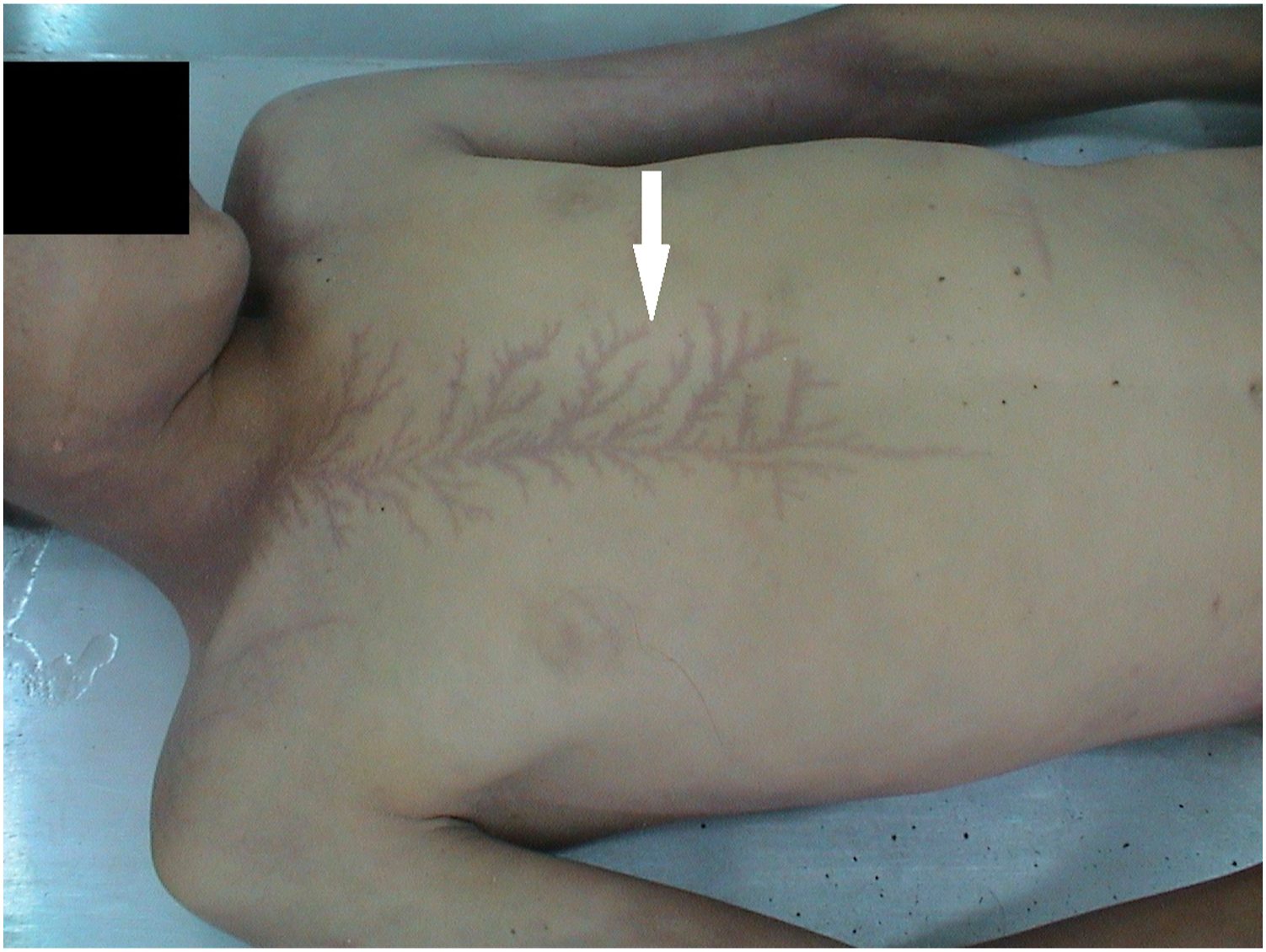
Lichtenberg figures on the anterior chest (Case 1). A superficial erythematous arborization with a fern-like pattern (arrow).
CASE 2
A 28-y-old shepherdess was found lying unconscious in front of her barn by a neighbor on an early summer evening. Because the stormy weather had made the local roads impassable, the medical rescue team was delayed in reaching the patient. Death occurred less than an hour after the patient arrived at the hospital despite cardiopulmonary resuscitation. The doctor, who examined the body without completely undressing it, observed traumatic lesions, including an abrasion on the right side of the face and a bruise posterior to the right ear. He contacted the police because he thought the patient might have been assaulted. A forensic autopsy was performed. External examination revealed abrasions of the face that were not the cause of death. LFs were seen over the left hip, buttocks, and lower back (Figure 2).
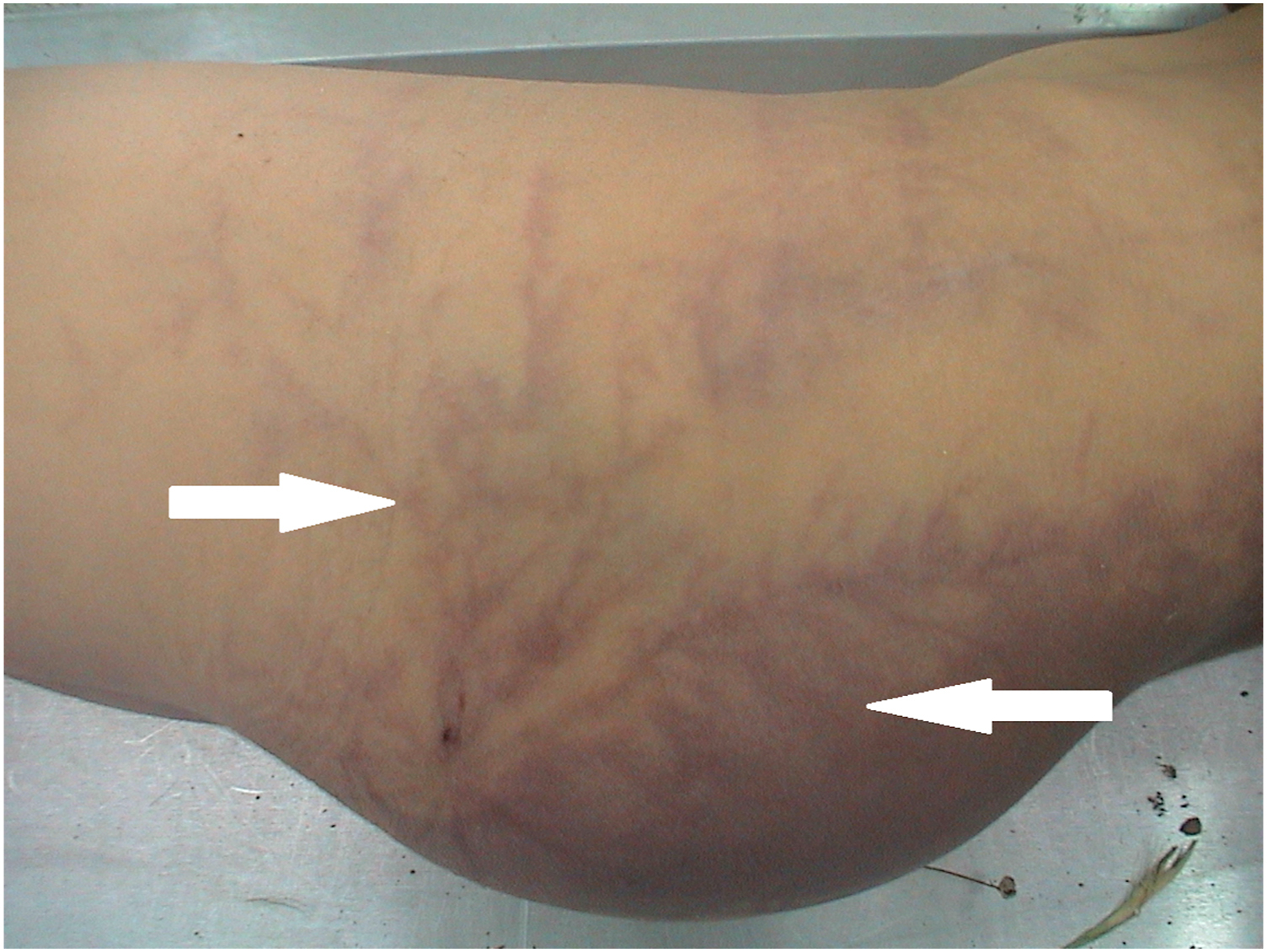
Lichtenberg figures on the left hip extending superiorly (Case 2). A superficial reddish arborization (arrow).
CASE 3
Three friends were found unconscious by a forest ranger on a spring afternoon in a mountainous region. The weather conditions that day were not conducive to outdoor activity because of torrential rains. When the rescue team arrived, 1 of the 3 victims had died while the other 2 were comatose. The ranger suggested the possibility of poisoning by the ingestion of toxic mushrooms. Because it was impossible to question the survivors, a forensic autopsy was requested to establish the cause of death of the third victim. External examination of the body revealed LFs on the anterior thighs (Figure 3).
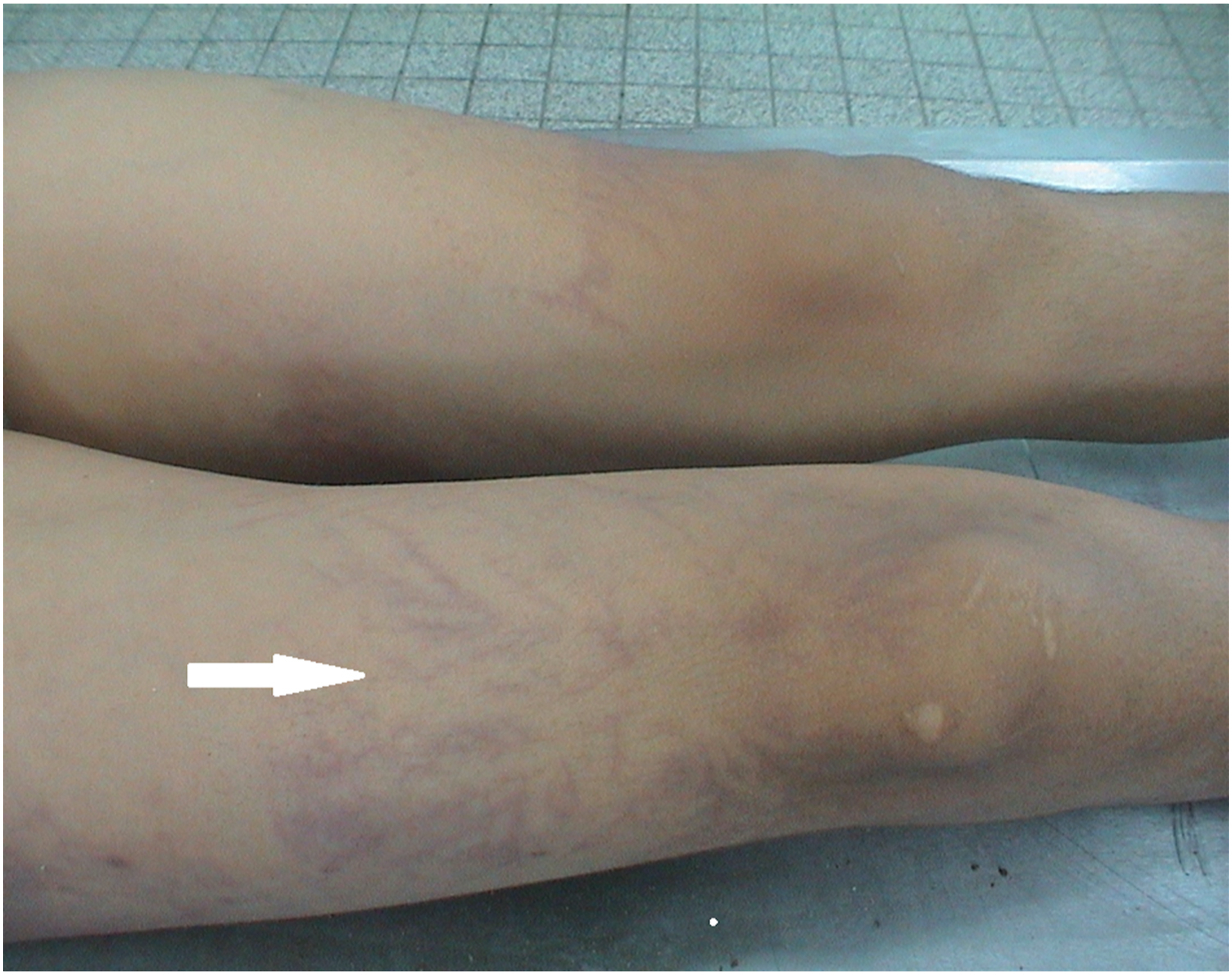
Lichtenberg figures on the anterior thighs (Case 3). A superficial erythematous arborization with a fern-like pattern (arrow).
Discussion
In the 3 cases we describe, internal examination revealed neither traumatic injuries nor pathological findings. The toxicological analyses of the body fluids (blood and urine) were negative for all tested substances (ethanol, opiates, benzodiazepines, barbiturates, and cannabinoids). Based on the presence of LFs on the body of each victim, lightning injury was the cause of death in each case.
A person struck by lightning may have injuries that are apparent, or they may be struck and killed without visible injury. The most common causes of death by lightning are dysrhythmias, such as ventricular tachycardia or ventricular fibrillation,2,8,9 myocardial infarction, 10 –12 and respiratory arrest caused by central nervous system effects. 2 Barotrauma may cause pneumomediastinum, rupture of the tympanic membrane, and injuries to the gastrointestinal tract.13,14 Lightning may also cause blunt force trauma, blast injuries, 14 and gunshot-like injuries. 15
The cutaneous signs of lightning depend on the mechanism of injury. Injuries caused by heat may include linear burns. Histologic skin findings include hemorrhage with coagulation necrosis in the deep and superficial dermis and flattening and congealing of the epidermis with the appearance of spikes on the surface. 15 The burn site may appear scorched with a singed smell. Body hair may also be charred. 14 Electrical injuries may cause spark-like lesions. The LFs are a premortem tissue reaction. The pathogenesis of LFs is a matter of debate. 14 There is a scarcity of histologic evidence.16,17
The LFs generally appear in 1 h then gradually fade and disappear without a trace within 48 h. The LFs may be green, if putrified, 18 or maybe hyperpigmented.15,19 They can sometimes remain visible for several days postmortem. 18 –20 Because LFs are transient, the rescuers and physicians arriving at the scene should look for them and should take photographs for legal purposes.
The LFs can be observed after lightning injury or in high-voltage burns. In open areas without a source of high voltage, LFs are pathognomonic for lightning. 21 There is a reported case of arborescent pressure-induced vasodilation that was said to mimic LFs. The lesion, in this case, was easily distinguishable from LFs because it lacked ferning. 22
The primary concern of a forensic expert is to determine whether a death was accidental or caused by a third party. In the cases we present, the occurrence of death in the afternoon of stormy, rainy summer days and the presence of LFs with no internal traumatic injuries demonstrated that lightning was the cause of death. If the LFs had vanished before the autopsies were performed, it would have been difficult to determine that lightning was the cause of death. The first rescuers to examine the bodies should look for and photograph LFs. A full autopsy should still be performed to not miss the involvement of a third party, such as a person who was poisoned or was a victim of homicidal smothering and then struck by lightning.
Footnotes
Acknowledgments
Author Contributions: Study concept and design (SAM, MS, MA); acquisition of the data (SAM, MG); data analysis (SAM, MG); drafting of the manuscript (MS, MA). All authors read and approved the manuscript.
Financial/Material Support: None.
Disclosures: None.